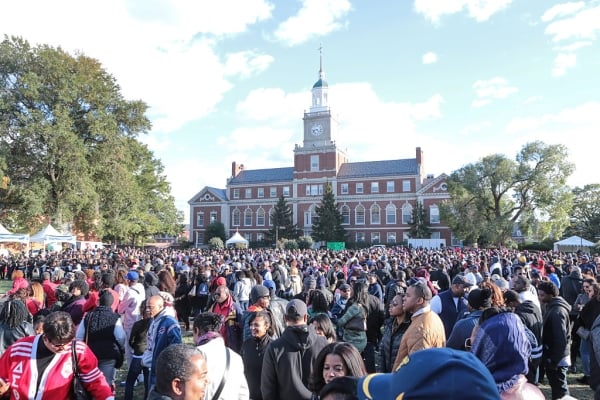
Vinson has led the Washington, D.C., HBCU since 2023.
Cheriss May/NurPhoto via Getty Images
Howard University president Ben Vinson III will step down Aug. 31, two years after assuming the role and two weeks after the start of fall classes, university officials announced Friday. Former Howard president Wayne A. I. Frederick will serve as interim president.
“It has been an honor to serve Howard,” Vinson said in a statement. “At this point, I will be taking some time to be with my family and continue my research activities. I look forward to using my experiences as president to continue to serve higher education in the future.”
University officials declined to comment about why Vinson is leaving only two years after he took up the helm. During his tenure, the Washington, D.C.–based HBCU became an R-1 research institution and brought on several high-profile faculty, including journalist Nikole Hannah-Jones, author Ta-Nehisi Coates and historian Ibram X. Kendi. The university also hosted Kamala Harris’s election night watch party.
But the past year has also brought its share of challenges. In May, the Trump administration proposed cutting Howard’s federal funding by $64 million in fiscal year 2026, bringing it back to its 2021 funding level. Over the summer, the administration took heat from students over surprise bills that appeared on their accounts when the university transitioned to a new student financial platform, and some students turned to crowdfunding to pay those bills.
“On behalf of the Howard University Board of Trustees, we extend our sincere gratitude to Dr. Vinson for his service and leadership as president,” board chair Leslie Hale said in a statement. “We extend our very best wishes to him in his future endeavors.”
Frederick, who served as president of Howard from 2014 to 2023, will remain interim president while the board conducts a nationwide search for a permanent replacement.
When you open the doors to a brand-new school, you’re not just filling classrooms, you’re building a community from the ground up. In August 2023, I opened our Pre-K through 4th grade school in Charlotte, North Carolina, to alleviate overcrowding at several East Charlotte campuses. As the founding principal, I knew that fostering trust and engagement with families was as essential as hiring great teachers or setting academic goals.
Many of our students were transitioning from nearby schools, and their families were navigating uncertainty and change. My top priority was to create a strong home-school connection from the very beginning–one rooted in transparency, inclusivity, and consistent communication, where every parent feels like a valued partner in our new school’s success. Since then, we’ve added 5th grade and continue to grow our enrollment as we shape the identity of our school community.
Up until two years ago, our district was primarily using a legacy platform for our school-to-home communication. It was incredibly limiting, and I didn’t like using it. The district then switched to a new solution, which helped us easily reach out to families (whose children were enrolling at the new elementary school) with real-time alerts and two-way messaging.
The difference between the two systems was immediately obvious and proved to be a natural transition for me. This allowed us to take a direct, systematic, and friendlier approach to our school-home communications as we implemented the new system.
Building strong home-school bonds
Here are the steps we took to ensure a smooth adoption process, and some of the primary ways we use the platform:
Get everyone on board from the start. We used comprehensive outreach with families through flyers, posters, and dedicated communication at open-house events. At the same time, our teachers were easily rostered–a process simplified by a seamless integration with our student information system–and received the necessary training on the platform.
Introduce the new technology as a “familiar tool.” We framed our ParentSquare tool as a “closed social media network” for school-home communication. This eased user adoption and demystified the technology by connecting it to existing social habits. Our staff emphasized that if users could communicate socially online, they could also easily use the platform for school-related interactions.
Promote equity with automatic translation. With a student population that’s about 50 percent Hispanic and with roughly 22 different languages represented across the board, we were very interested in our new platform’s automatic translation capabilities (which currently span more than 190 languages). Having this process automated has vastly reduced the amount of time and number of headaches involved with creating and sharing newsletters and other materials with parents.
Streamline tasks and reduce waste. I encourage staff to create their newsletters in the communications platform versus reverting to PDFs, paper, or other formats for information-sharing. That way, the platform can manage the automatic translation and promote effective engagement with families. This is an equity issue that we have to continue working on both in our school and our district as a whole. It’s about making sure that all parents have access to the same information regardless of their native language.
Centralize proof of delivery. We really like having the communication delivery statistics, which staff can use to confirm message receipt–a crucial feature when parents claim they didn’t receive information. The platform shows when a message was received, providing clear confirmation that traditional paper handouts can’t match. Having one place where all of those communications can be sent, seen, and delivered is extremely helpful.
Manage events and boost engagement. The platform keeps us organized, and we especially like the calendar and post functions (and use both a lot). Being able to sort specific groups is great. We use that feature to plan events like staggered kindergarten entry and separate open houses; it helps us target communications precisely. For a recent fifth-grade promotion ceremony, for example, we managed RSVPs and volunteer sign-ups directly through the communications platform, rather than using an external tool like Sign-Up Genius.
Modernizing school-family outreach
We always want to make it easy for families to receive, consume, and respond to our messages, and our new communications platform helps us achieve that goal. Parents appreciate receiving notifications via email, app, voice, or text–a method we use a lot for sending out reminders.
This direct communication is particularly impactful given our diverse student population, with families speaking many different languages. Teachers no longer need third-party translation sites or manual cut-and-paste methods because the platform handles automatic translation seamlessly. It’s helped us foster deeper family engagement and bridge communication gaps we otherwise couldn’t–it’s really amazing to see.
Megan Cahill-Clark, Grove Park Elementary
Megan Cahill-Clark is principal at Grove Park Elementary in Charlotte, N.C.
Latest posts by eSchool Media Contributors (see all)
I recently attended a student panel on use of AI in college classes. The three panelists shared their perspectives, borne out in an April 2025 Gallup survey: they want to learn to use AI tools in appropriate ways, they’re anxious about the potential negative impact on their critical thinking skills, and they want explicit guidance from their faculty members—which they’re not consistently getting.
Even, or especially, in an AI age, we know our students need to think critically and learn authentically to be productive and engaged citizens and future employees. We recognize we need to update assignments to promote academic integrity in an AI age, yet many of us feel unprepared to do so. The crux of the problem is this: how do we foster critical thinking and authentic learning when it’s so easy for students to outsource their cognitive work?
One promising solution to the triple challenge of fostering critical thinking, meaningful learning, and academic integrity is to double down on transparency. We can provide the guidance students want, embed analysis and evaluation into our assignments to get at that all-important critical thinking, and nudge students toward integrity. How? By embracing transparency.
Let’s detail our expectations for responsible AI use. Let’s emphasize the why: why we want students to use their own cognitive abilities for some tasks, why using AI could be helpful at times, and why we’ve crafted our AI-integrated assignments in the ways we have. Finally, let’s ask students to disclose their use in full transparency (and reflect on their learning, as Marc Watkins argues here).
In short, we can promote integrity when assessments are meaningful, purposeful, and include transparent instruction on appropriate AI use. We can teach students to critically analyze AI-assisted work and promote authentic learning as we do. To help us achieve these aims, here are five steps to update assignments in ways that help students learn the skills they need while fostering a culture of academic honesty.
Step 1: Take a critical look at your current syllabus.
If you’re like me, you have tried-and-true activities and assignments that you’ve relied on for many years. Some of these may be updateable, but others may just need to go. If AI can easily complete a task (try running your instructions through a tool like ChatGPT to find out), maybe it’s no longer a relevant measure of authentic learning. Also, following the remaining steps below will likely mean that you add new instructional practices (like modelling AI use) and new components of the assignments you update (like a reflection on how AI helped or hindered learning). Make time for these important new course elements by getting rid of outdated tasks.
Step 2: Consider whether and how students should use AI on the assignments you keep.
Remember, students want to know exactly what is appropriate for AI use in your class. A helpful tool for this process is the 5-level AI Assessment Scale (AIAS). The levels range from No AI, AI Planning, AI Collaboration, Full AI, and AI Exploration. Each one identifies and sanctions different ways students can use AI in appropriate and meaningful ways to support their learning.
Leon Furze, one of the creators of the AIAS, presents it a tool that helps update our assignments and start conversations with our students. He recommends using this framework to guide your thinking: break down each assignment, project, or discussion board activity into disparate steps, then decide for which parts of the process AI use is appropriate. Providing transparent guidance, guidance that may vary for different parts of the project, is what students need right now.
Step 3: Carve out time to discuss and model your expectations.
Many students are not sure what is acceptable in this current moment. What better way to help them feel confident while developing the AI skills they need than modelling what you’re looking for? Take class time or record a video for your online class to teach your students what you expect them to do with AI for each assignment, what not to do, and what you’ll be looking for in their finished product.
As you approach this aspect of instruction, take heart. I don’t think every instructor needs to be an AI expert, but I do think we’re doing our students a disservice if we’re not teaching them how to be AI Whisperers, a concept I gleaned from Ethan Mollick’s 2024 book, Co-Intelligence. A new kind of expertise is emerging, he argues: the skilled and effective use of AI in every field. As disciplinary experts, you know what kind of AI use will help students learn your material and what will disempower them as learners. Let’s allocate time to help students develop AI literacy while maintaining their agency.
Step 4: Ask students to disclose their AI use, as noted above.
The student panelistsshowed palpable relief when they described instructors who simply had them cite their use of AI. “Encourage your students to be transparent about their AI use,” one student, a finance major, said. As she talked about how simple it was to add a line at the end of the assignment such as, “ChatGPT generated the outline for this essay,” the anxiety that had previously clouded her expression disappeared.
One approach is to use the AI Disclosure (AID) framework to document how students used AI, or add an appendix to each assignment, or add comments or footnotes to make transparent what they wrote and what AI wrote. Get students to declare their AI use and even better, ask them to reflect on whether their use helped or hindered their learning.
Step 5: If you suspect inappropriate use of AI, don’t accuse students of cheating.
Instead, have a conversation with them. Recall that a primary goal of the AIAS is to facilitate discussions about AI use. Imagine that as a class, you agreed that Level 2 (AI Planning) was appropriate for a particular project. If a student submits work that seems to have been completed at Level 4 (Full AI), refer back to the framework to facilitate a conversation about your perception of their work and their process. As AIAS co-creator Leon Furze points out, now you can get away from wondering whether a student cheated with AI and instead ask, “can I make a valid judgement of this student’s capabilities [whether they have used AI or not]?”
And as argued by the authors of a new book titled The Opposite of Cheating: Teaching for Integrity in an Age of AI, this takes moral accusation out of the conversation, reduces the adversarial tone, and enables students to reflect on and hopefully learn from the experience. You can also decide together what actions should take place next, whether the student resubmits the assignment in accordance with your AI-usage guidance, whether they lose the opportunity to earn a grade for that assignment, or whatever else you and your student decide is appropriate in that situation.
Students want to know how to use AI well. “If we don’t teach students how to use AI responsibly, they’re going to be poorly equipped for the workforce,” said the third student panelist, a computer science major. Let’s update our assignments to facilitate meaningful learning of our content, the skills students need in an AI age, and ethical, integrous use of AI to equip them for the workplace they’ll enter. In doing so, we’re helping to develop engaged citizens who think critically about information they encounter. I can’t think of more important work to be engaged in at this moment in time.
Flower Darby is an associate director of the Teaching for Learning Center at the University of Missouri, a co-author of The Norton Guide to Equity-Minded Teaching (2023), and the lead author, with James M. Lang, of Small Teaching Online: Applying Learning Science in Online Classes (2019).
References
Bertram Gallant, Tricia, and David A. Rettinger. 2025. The Opposite of Cheating: Teaching for Integrity in the Age of AI. University of Oklahoma Press.
This audio is auto-generated. Please let us know if you have feedback.
As public complaints continue to pile up at the U.S. Department of Education’s Office for Civil Rights, the agency is dismissing them at a pace that is alarming former OCR employees.
From the time of the agency’s reduction in force on March 11 until June 27, OCR dismissed 3,424 complaints, according to court documents filed by Rachel Oglesby, who has been chief of staff at the Education Department since January. By comparison, the office dismissed 2,527 cases in the three-month period between November 2024 and January 2025 under the Biden administration, according to Catherine Lhamon, who led the agency under the last presidency.
A similar contrast can be seen in the agency’s other benchmarks.
The Trump administration’s OCR opened 309 complaints for investigation in the March-June period, compared to 674 during the Biden administration’s final three months between Nov. 1, 2024, and Jan. 1, 2025. The Trump Education Department recently resolved 290 complaints with voluntary agreements, OCR-mediated settlements and technical assistance, while Lhamon said the previous administration, around the same three-month period, resolved 595 through mediation or voluntary resolution alone.
The contrast “reflects a shocking diminution of work output from the office,” Lhamon said by text message on Monday.
“A dismissal rate this high suggests a fundamental shift in how OCR is triaging and processing complaints,” said Jackie Gharapour Wernz, an education civil rights attorney who worked for the OCR under the Obama and first Trump administrations. “It raises serious concerns about whether civil rights issues are being meaningfully evaluated and whether the agency is adhering to its own case processing manual and relevant law in dismissing cases.”
An Education Department spokesperson, however, strongly defended the agency’s work.
In dismissing complaints, OCR is taking actions according to federal law, regulations and the OCR case processing manual, which outlines the steps the agency must take to process complaints, said Julie Hartman, an Education Department spokesperson, in an email to K-12 Dive late Monday.
“OCR has taken unprecedented steps to streamline its functions according to demand,” said Hartman. “OCR’s daily accomplishments under the Trump Administration disprove the rampant fear-mongering by the media” and makes clear that “OCR is vigorously upholding its responsibilities to protect all Americans’ civil rights.”
The high number of case dismissals comes after the department let go of hundreds of its OCR employees and shut down seven of its 12 regional offices. The moves prompted concerns from civil rights advocates that the agency wouldn’t be able to fulfill its duties to protect students — especially those from traditionally marginalized groups.
Those layoffs came amid historic high OCR caseloads, which had prompted the Biden administration to advocate for increased funding to beef up the office’s investigative staff. Lhamon at the time had said investigators were juggling “untenable” caseloads of upward of 40 cases per person.
Since the mass layoffs, existing investigative staff have been juggling nearly double that workload. And the Trump administration has proposed slashing the office’s funding for fiscal year 2026 by $49 million compared to the $140 million appropriated in 2024.
The concerns led to a lawsuit, Victim Rights Law Center v. U.S. Department of Education, filed by Victim Rights Law Center. In a ruling last month, U.S. District Judge Myong Joun said the mass terminations and closure of multiple OCR offices meant the office had “abdicated its enforcement duties” and ordered that OCR be restored to its status quo.
As part of that lawsuit, the department was required to routinely file updates on its progress in restoring the office. The Education Department has stated that despite being required to reintegrate employees into the office per the court order, it intends to appeal the case.
The department has likewise appealed an order requiring the department be restored to its status quo in State of New York v. McMahon, a separate case challenging the upheaval of the entire department as opposed to just OCR.
Following the layoffs in March, Education Department spokesperson Madi Biedermann indicated changes were being made to OCR’s operations “to better serve American students and families.”
“We are confident that the dedicated staff of OCR will deliver on its statutory responsibilities,” Biedermann said in a March 13 email to K-12 Dive.
As of 2023, more than 464 million people listen to podcasts regularly, and this number is growing each year. And with over 70% of parents listening with their children, podcasts are a communication channel your school can’t afford to overlook.
Why does this matter for education marketing?
Because parents, students, and alumni increasingly expect content that’s on demand, easy to consume, and aligned with how they already engage with other brands. A podcast offers exactly that. It provides a way to humanize your institution, give voice to your values, and build stronger relationships with your audience, all without requiring a massive budget or full production studio.
Is a school podcast worth the effort?
Here’s the reality: Schools that use podcasting strategically are finding new ways to connect with prospective families, boost engagement, and increase brand awareness. Whether you’re trying to showcase your faculty, highlight student achievements, or simply keep your community informed, a podcast gives you a direct line to your audience’s attention.
First things first, what is a podcast in school? A school podcast is an audio series created by educators, students, or staff to share news, stories, or educational content. It can highlight campus life, feature interviews, or support learning, helping schools connect with their communities in an accessible, on-demand format.
This blog post breaks down seven clear steps for launching a school podcast, from planning and production to promotion and measurement.
Struggling with enrollment?
Our Digital Marketing team can help you generate more leads!
Step 1: Define Your Podcast’s Purpose
Before you record a single second of audio, it’s important to answer one key question: Why are we starting this podcast?
A well-defined purpose ensures your content stays focused and impactful. Are you hoping to:
Attract and engage prospective families?
Showcase student life and culture?
Build thought leadership through staff and faculty interviews?
Strengthen alumni connections?
The most successful school podcasts have a clear audience and goal. For example, a private school may want to build trust with prospective families by featuring authentic stories from teachers and students. A language institute might use a podcast to demonstrate teaching methods or highlight student success stories. A university could aim to strengthen alumni ties through interviews and updates.
Whatever the goal, be specific. Broad intentions like “we want to communicate better” are too vague. Instead, anchor your podcast in a focused objective, be it enhancing recruitment, increasing transparency, or offering value-added resources to your community.
Once the purpose is clear, ensure leadership is aligned. Gaining buy-in from school administrators and relevant departments will give your project momentum, credibility, and cross-functional support.
Example: Yale University’s admissions office launched an official podcast called Inside the Yale Admissions Office to pull back the curtain on their application process. Their goal was to demystify college admissions for prospective students by sharing firsthand insights from actual admissions officers. Because the project aligned perfectly with Yale’s outreach goals, it had strong internal buy-in. Admissions staff themselves host the show, with support from the Dean.
Pro tip: Avoid trying to appeal to everyone. Tailor your podcast to a specific listener group and let that clarity shape your voice, content, and messaging.
Step 2: Choose the Right Format
The best podcast format is the one that plays to your strengths and fits your resources. You don’t need to copy what others are doing. What matters most is that your format fits your team and speaks to your audience.
Popular school-friendly formats include:
Interviews with staff, students, or alumni to spotlight personalities and accomplishments
Thematic episodes exploring topics like student life, curriculum innovations, or study tips.
Student-produced episodes that give learners ownership and boost engagement, or other types of user-generated content
Roundtable discussions where multiple voices weigh in on a key theme.
Example: A great illustration of a defined concept is Stanford University’s The Future of Everything podcast, produced by its School of Engineering. The show’s premise is crystal clear – each episode explores how technology, science, and medicine are shaping our lives and future. Hosted by a Stanford bioengineering professor, it follows an interview format where experts discuss innovations in fields from AI to health care. This distinctive theme and structure leverage Stanford’s academic strengths and consistently deliver on what the title promises.
Whatever you choose, aim for consistency in tone and structure. A 20-minute interview series sounds very different from a 10-minute solo voice memo, but either can be powerful if well-executed.
Remember: A podcast is more than a recording; it’s a conversation. Make space for authenticity and spontaneity to shine through.
Step 3: Build a Content Plan and Plan Episodes in Advance
Now that you’ve defined your purpose and format, it’s time to think long-term. One of the biggest mistakes new podcasters make is launching without a content roadmap. Jumping into production without a plan can lead to burnout or disjointed messaging.
Ask yourself:
What themes or topics will we cover across the season?
Which internal experts or guests should we feature?
Are there recurring segments that can anchor each episode?
A solid content calendar will help you avoid scrambling for ideas and ensure your messaging supports broader marketing campaigns (like admissions deadlines, open houses, or graduation season).
Here’s an example of a 6-episode launch plan for a K–12 school podcast:
Welcome from the Head of School
A Day in the Life of a Student
Meet Our Parent Community
Inside the Classroom: A Faculty Roundtable
From Our Alumni: Life After Graduation
How We Support Student Wellbeing
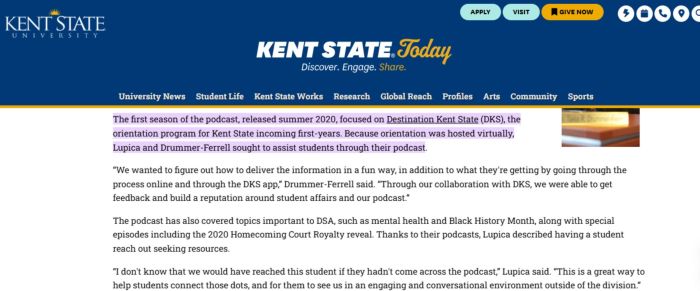
Example: At Kent State University, the Division of Student Affairs took a strategic approach when launching its podcast. They deliberately planned the first season of the podcast to coincide with the university’s virtual orientation program for new students. Because orientation had moved online (due to the pandemic), the podcast team organized a series of episodes addressing topics incoming freshmen needed, essentially turning the podcast into a fun, on-demand extension of orientation. They collaborated with the orientation staff (Destination Kent State) to ensure content was relevant and even gathered feedback from that partnership to improve the show.
Bonus tip: Batch-record your first few episodes in advance so you can launch with momentum and buffer time.
Step 4: Set Up Your Equipment and Software
Worried about needing a full recording studio? Don’t be. Getting started doesn’t require expensive equipment. Here’s a basic setup to launch your podcast with professional quality:
Essentials:
Microphone: A USB mic like the Blue Yeti or Samson Q2U delivers clear, studio-like audio.
Headphones: Avoid audio bleed and ensure consistent sound levels during editing.
Recording Software: Tools like Audacity (free) or Descript (freemium) let you easily record and edit.
Hosting Platform: Services like Buzzsprout, Podbean, or Anchor distribute your podcast to Spotify, Apple Podcasts, and Google Podcasts.
Tip for schools on a budget: Consider using your media or IT lab for recordings. You may already have access to podcast-friendly tools through student programs.
Example: At UC Berkeley, staff in the communications department use a variety of clever do-it-yourself strategies to produce high-quality podcasts on a tight budget, proving that high production value is possible even without a fancy studio or expensive equipment.
Step 5: Record and Edit With Your Audience in Mind
Now it’s time to hit “record.” As you begin, remember that quality matters, not just in audio clarity, but in tone, pacing, and structure.
Keep your episodes:
Concise. Aim for 15 to 30 minutes per episode. That’s long enough to deliver substance, but short enough to fit into a morning commute or lunchtime walk.
Focused. Each episode should revolve around a single topic or theme. If you have more to say, turn it into a two-part series.
Natural. Avoid reading from a script word-for-word. Outline your key points, then speak conversationally.
Editing is where your podcast becomes polished. Using editing software, you can tighten up the conversation, remove umms/uhs, add intro music or segues, and generally polish the recording. Aim to balance the sound levels between speakers and cut any extraneous digressions to keep the episode flowing. The goal is an episode that sounds natural but also stays on topic and within your desired length.
Don’t be discouraged if the first few recordings feel rough. Podcasting has a learning curve for everyone, and you’ll get more comfortable and skilled with each episode. Incorporate feedback from early listeners and continuously improve your technique.
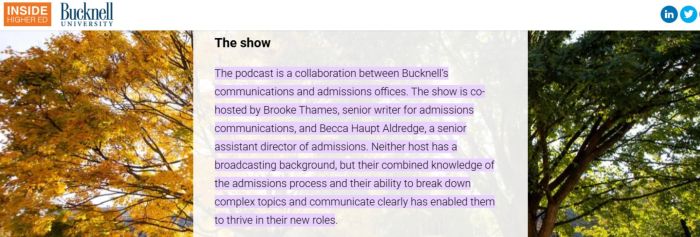
Example: The team behind Bucknell University, which produces the College Admissions Insider podcast, began with two co-hosts from the admissions office and communications staff who had no prior podcasting experience. They weren’t trained radio personalities, but their deep knowledge of the admissions process and ability to communicate enabled them to create engaging episodes from the get-go. In their case, the hosts’ confidence and skill grew quickly as they recorded more sessions. After the first few episodes, they found their rhythm in interviewing guests and editing the content into a polished final product.
Pro tip: If editing feels overwhelming, explore student help or freelance editors. Podcast production is a great opportunity for cross-department collaboration.
Step 6: Publish and Distribute Your Podcast
With a finished episode in hand, it’s time to share it with the world. This step involves uploading your episode to your chosen podcast hosting platform and ensuring it gets distributed to all the major listening apps. The good news: once set up, this process is straightforward.
Start by choosing a podcast hosting service (if you haven’t already). There are many options – from free platforms like Anchor (Spotify for Podcasters) to paid hosts like Libsyn, Podbean, or Buzzsprout. The host is essentially where your audio files live and where your podcast’s RSS feed is generated. When you upload a new episode, your host will update the RSS feed, which in turn notifies podcast directories (like Apple Podcasts) to pull the new content.
Upload your MP3 file to the host and fill in the episode details: title, description, episode number, season (if applicable), etc. Use this metadata to attract listeners – write a clear, engaging description and include relevant keywords (e.g., “STEM education chat with our Science Department” or “Tips for college admissions interviews”). Also, upload your cover art if you haven’t already, as it will display on players.
Next, distribute your podcast. Submit the RSS feed to major platforms such as Apple Podcasts, Spotify, Google Podcasts, and Amazon Music. Many hosts provide one-click distribution or guides to do this. Usually, you only need to do the submission once for each platform; after that, new episodes will appear automatically. Don’t forget any niche or regional platforms popular with your audience. Essentially, you want your school’s podcast to be available wherever listeners might look.
Example: The University of Chicago hosts its award-winning Big Brains podcast on a platform that syndicates it widely – on the official UChicago site, the podcast page prominently offers subscribe buttons for Apple Podcasts, Spotify, and even YouTube. Once UChicago uploaded episodes and submitted their feed, their content became available across all those apps. In practice, this means a parent commuting to work can pull up Apple Podcasts and find the school’s show, while a student on Android might use Spotify to listen – the experience is seamless.
“If you build it, they will come” doesn’t quite apply in podcasting. After creating a podcast for students and other members of your school’s community, you have to actively promote your school podcast so that your community (and beyond) know it exists. Promotion is an ongoing step, not a one-time task.
Here’s how to promote your school podcast effectively:
Website: Create a dedicated podcast page with episode archives and show notes.
Social Media: Share episode clips, quotes, or audiograms on social media platforms like Instagram, Facebook, and LinkedIn.
Email Marketing: Feature new episodes in newsletters or nurture campaigns.
Admissions Materials: Mention your podcast in brochures or application confirmation emails.
Student Portals and Alumni Networks: Make your episodes discoverable for internal and extended communities.
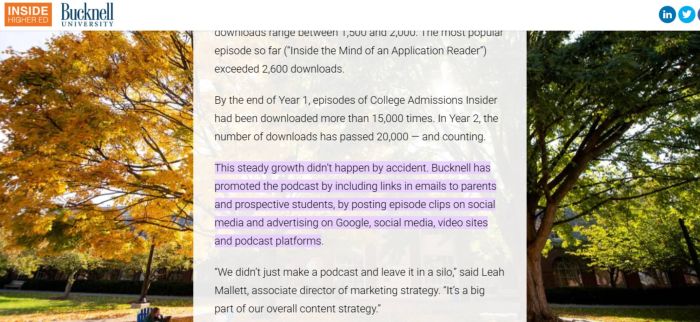
Example: Bucknell didn’t just publish episodes and hope people would find them. The university made the podcast an integral part of its outreach. They promoted it vigorously by including podcast links in emails to prospective students and parents, sharing episode clips on social media, and even running targeted online ads to reach more listeners.
Think beyond downloads: Use the podcast to reinforce messaging in other marketing assets like blog posts, webinars, or virtual tours.
Bonus Tip: Track Performance and Evolve
Like any marketing initiative, measurement is key. Use analytics tools (often provided by your podcast host) to track:
Number of downloads
Listener demographics
Episode drop-off points
Subscription growth
But don’t stop at the numbers. Solicit feedback from listeners. What do they want to hear more of? Which episodes resonated most?
Note: Your podcast will evolve. You might tweak your format, test new topics, or expand your production team. That’s a good thing. Podcasting, like all great content marketing, thrives on iteration.
Partner With HEM to Create an Authentic Podcast That Stands Out
Starting a school podcast isn’t about jumping on a trend. It’s about creating a platform to tell your school’s story in a compelling, authentic way.
Why are podcasts good for school?Podcasts are engaging, cost-effective, and easy to access. They help schools build trust, highlight culture, and communicate more personally with students, parents, and alumni, especially in today’s mobile-first world where audio content fits busy lifestyles.
In today’s crowded education market, families crave meaningful connections. They want to hear directly from your community, not just what you offer, but who you are. A podcast helps you do exactly that.
It’s a platform that humanizes your brand, showcases your values, and builds real relationships with your audience. In short, it allows your community to hear your voice, quite literally.
In a nutshell, the answer to the question “How do I make an academic podcast?” can be summed up in a few crucial steps. Start by defining your goal and audience. Choose a format, plan episodes, and use basic recording equipment or software. Feature faculty or students, keep episodes concise, edit for clarity, and publish on platforms like Spotify or Apple Podcasts. Promote it across your school’s channels.
Ready to bring your school’s story to life through podcasting? Start by defining your audience and recording a pilot episode. With each step, you’ll gain clarity and momentum.
If you’d like support planning your podcast strategy, identifying compelling topics, or aligning the content with your admissions goals, HEM is here to help.
Would you like to learn how to create a podcast for students?
Contact HEM for more information.
Struggling with enrollment?
Our Digital Marketing team can help you generate more leads!
Frequently Asked Questions
Question: What is a podcast in school? Answer: A school podcast is an audio series created by educators, students, or staff to share news, stories, or educational content. It can highlight campus life, feature interviews, or support learning, helping schools connect with their communities in an accessible, on-demand format.
Question: Why are podcasts good for school? Answer: Podcasts are engaging, cost-effective, and easy to access. They help schools build trust, highlight culture, and communicate more personally with students, parents, and alumni, especially in today’s mobile-first world where audio content fits busy lifestyles.
Question: How do I make an academic podcast? Answer: Start by defining your goal and audience. Choose a format, plan episodes, and use basic recording equipment or software. Feature faculty or students, keep episodes concise, edit for clarity, and publish on platforms like Spotify or Apple Podcasts. Promote it across your school’s channels.
We’re rounding up recent stories, from Temple University’s plan to address a $60 million deficit to the Senate’s proposal for a lower endowment tax increase.
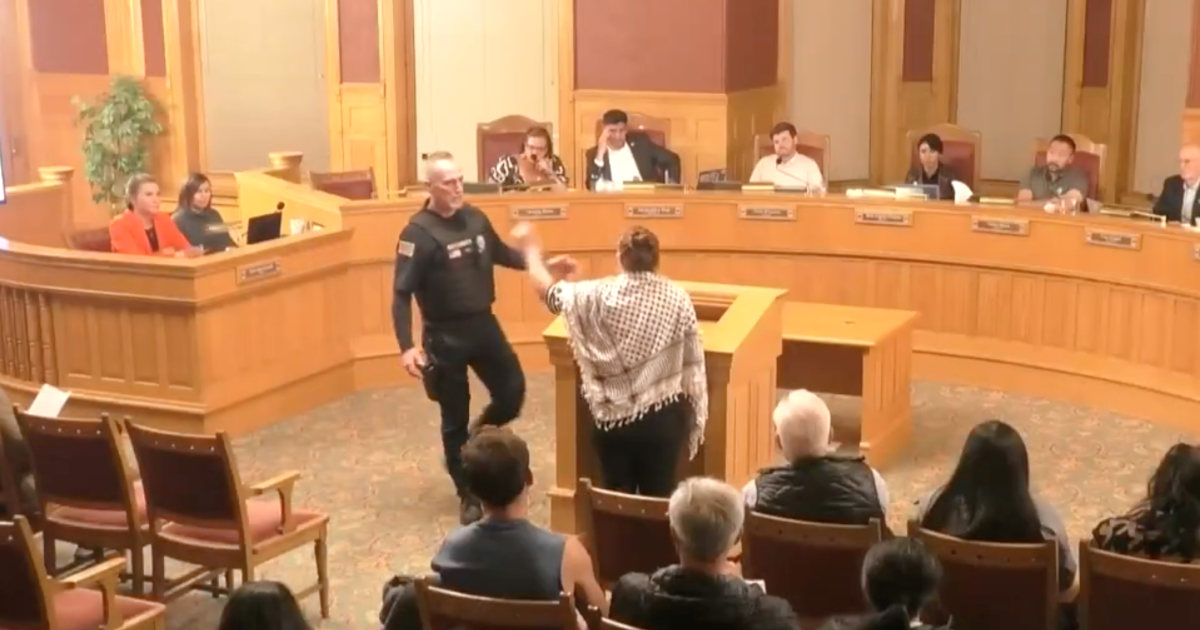
This month marks one year since Salt Lake City clocked possibly the shortest public comment in city council history when police removed activist Jenna Martin after only 20 seconds of speaking that began, “What the hell is wrong with you?”
Martin, who was wearing a keffiyeh pinned in the front like a shawl, then accused Mayor Erin Mendenhall of having police arrest local pro-Palestinian activist Michael Valentine on multiple occasions for “the most bullshit reasons.”
The council promptly ejected Martin, who could hardly be described as causing any type of disturbance given that she only had the floor for 20 seconds and her comments were entirely relevant to matters of public concern. But apparently, the council did not like people cursing in front of the mayor.
On Aug. 14, 2024, FIRE wrote the council, explaining that the First Amendment protects the public’s right to comment on matters related to the city and its leaders, even if the commentary is less than “respectful,” so long as the speaker is not disrupting the meeting. Pointed criticism is not the same as disruption.
Mandating respectful discourse is an example of unconstitutional viewpoint discrimination because the city is sure to enforce the rule only against criticism, not praise. It’s also vague because what qualifies as “respectful” is undefined, constitutes a matter of opinion, and falls to the complete discretion of the same elected officials who are often the subject of that very criticism. The law recognizes that you cannot have the fox guarding the hen house.
Although not pertinent to Martin’s case, FIRE also warned the council that its unqualified ban on “discriminatory” language is unconstitutional for the same reasons. After FIRE sent a second letter on Oct. 7, a city attorney acknowledged the council had no basis to eject Martin, confirmed the policy had been revised to comply with the First Amendment, and noted that the city implemented “First Amendment training after receiving FIRE’s notice and plans to continue to reinforce that training.”
Instead of vague and viewpoint-discriminatory categorical prohibitions on speech, the policy now encourages speakers to “avoid … intimidating or discriminatory language,” “profanity,” “threats,” and “personal attacks.” The policy also now explicitly acknowledges that speakers have free speech rights that the council cannot infringe upon:
The Council respects constitutional rights to free speech. It recognizes that some comments may be legally permissible under the U.S. and Utah Constitutions or other federal and state laws. However, the Council reserves the right to address behavior that creates disruption or safety risk or constitutes unprotected speech (such as true threats).
Salt Lake City’s previous decorum policy highlights a common misconception among elected officials across the country regarding the contours of the First Amendment. While they may encourage the public to be respectful, they absolutely cannot censor or eject a speaker on these grounds. The mere use of profanity does not justify censorship either. FIRE will watch to ensure the city actually enforces the new policy in line with the First Amendment.
Salt Lake City Council meetings are, at minimum, limited public forums. The U.S. Supreme Court has held that in limited public forums, towns can restrict speech only in a reasonable and viewpoint-neutral manner. For instance, Salt Lake City can decide when the public may speak, and may require comments to be relevant to city affairs — but it cannot cut off the public simply for using profanity or accusing the mayor of an abuse of power.
The First Amendment protects not just the content of speech but also the tone and intensity of that speech — an essential part of how people communicate opinions and ideas.
If Martin can’t hold the mayor accountable for a perceived abuse of authority at a city meeting, where can she voice her grievances? City meetings are supposed to encourage civic engagement and inform the public. Yet FIRE has had to repeatedly hold local government officials accountable for censoring public comments beyond constitutional bounds. Fortunately, we’ve recently secured a couple victories on that front.
We commend Salt Lake City for taking corrective action and realizing that salty speech is not a threat to democracy, but a sign of its good health.
FIRE defends the individual rights of all Americans to free speech and free thought — no matter their views. FIRE’s proven approach to advocacy has vindicated the rights of thousands of Americans through targeted media campaigns, correspondence with officials, open records requests, litigation, and other advocacy tactics. If you think your rights have been violated, submit your case to FIRE today.
Preparing the next generation of graduates in a 21st-century, diverse, and international classroom requires a pedagogical shift to recalibrate one’s practice. A faculty vision of inclusive pedagogy informed by equity and social justice transcends bias and makes diversity functional and beneficial to all students. Creating a classroom in the service of social justice (The Metropolitan Center for Urban Education, 2008) requires a profound understanding of the impact of human diversity on teaching and learning (Cushner et al., 2024). Enacting equity pedagogy as an essential component of multicultural education (Banks & Banks, 1995) requires instructors to become change agents. It is important to understand inclusive pedagogies as practices where we discern the nuance between general multicultural education or culturally responsive pedagogy and inclusive practices that specifically address the ability/disability continuum and the health dimension. In this article, we will examine ability/disability as a characteristic of human diversity in education as illustrated by Cushner et al. (2024) in their diversity framework. Approaches to creating an inclusive classroom are presented.
Start here…
Adopt an asset-based approach for all students.
Recognize that disability is often defined by the environment in which an individual exists.
Ensure you are not making ableist statements that reinforce stereotypes (ex: “turn a blind eye,” “fall on deaf ears;” using phobia to mean discrimination, ie “transphobia”).
Avoid negative descriptions of disability (ex: “suffers from a condition,” “confined/bound to a wheelchair”).
Use person-first language rather than deficit-first language (ex: “student with a learning disability,” not “learning disabled student”), unless an individual discloses that they prefer to use identity-first language (for example: some individuals on the autism spectrum may prefer to call themselves “autistic” rather than “a person with autism”; someone may identify as part of the Deafcommunity). Refer to people how they refer to themselves.
Realize that impact matters, regardless of intention.
Assume that students are capable and possess knowledge and skills.
Support colleagues with disabilities.
Tell a colleague that you are committing to the work of becoming a more inclusive educator. When they ask what this means, share these suggestions!
Beginning
Add literature/resources from neurodivergent, disabled, and diverse authors to assigned course readings and class activities.
Replace and/or supplement outdated readings.
Provide electronic files of reading, resources, presentations, and other materials.
Provide multiple sources and access points for assignment requirements and expectations (written descriptions, presentations, instructional videos, examples, rubrics).
Be open and welcome student questions.
Understand that all behavior is a function or indicative of something else; ask if students need support rather than punish them.
Update course syllabi to include statements from the campus disability/accommodations resource office, a statement on academic diversity, religious observant policies, and campus mental health resources.
Create community guidelines for discussions that include intention and impact/anti-bias language.
Immediately address ableist/biased remarks in the classroom through discussion.
Update course syllabi to include a statement of classroom environment that encourages regard for others and respects free speech while not tolerating hate speech.
When presenting a visual/image, also provide a description of the image (alt text).
Provide Closed Captioning on posted videos (lectures, resources, etc.).
Incorporate the impact of and perspectives of groups of diverse abilities in policies of the past and present.
Encourage students (and ourselves as faculty) to analyze research and articles to ensure they represent the perspectives of marginalized groups; follow up with questioning why and providing additional resources to promote self-advocacy.
Revise course syllabi to include Student Learning Objectives, Essential Questions, and Course Descriptions related to self-reflection/advocacy/inclusion/preparing students to be agents of change.
Examine course syllabi to make sure policies (late work, absence, participation grades, etc.) do not indirectly or directly target students with disabilities OR demonstrate bias toward neurotypical students (for example: a “cameras on” video policy in an online course may disproportionately punish students who require accommodations or have diverse learning needs; deductions for late work may punish students who need flexibility due to medical or mental health needs; requiring students to disclose personal details in order to receive extensions or incompletes disrespects students’ privacy of health and disability needs)
Be willing to adjust your expectations through flexibility.
Re-examine assignments and assessments for bias and exclusionary practices.
Consider changing assessments from high-stakes timed tests to projects, homework, open-note/open-book take-home tests.
Ask a colleague to audit your syllabi for readings/topics/policies as listed here.
Collaborate with colleagues in accessibility services to better understand and integrate the services and supports available.
Discuss the need to broaden participation and opportunities for people with disabilities in your department/college.
Examine courses to make sure provided resources are organized and labeled clearly.
Advanced, all the previous steps plus…
Advocate for (or lead!) professional development opportunities on inclusion.
Participate in on- and off-campus events that promote disability acceptance and inclusive practices.
Inform students of community opportunities they can take part in promoting disability acceptance or inclusive practices.
Model examination/reflection on your own privilege (if neurotypical and able-bodied) or experience as a person with(out) a disability.
Consider multimodal access to course participation (for example, HyFlex courses have in-person, video and asynchronous options for all students).
Ask a colleague to informally observe your teaching and provide constructive feedback on your work of being an inclusive teacher.
Invite guest speakers with disabilities to speak with your students about their experiences.
Collaborate with an ADA coordinator to educate students and colleagues about accessibility on your campus.
Collaborate with administrators and faculty who may be working toward DEI or inclusion initiatives on your campus.
Seek input from resources such as the Association of University Centers on Disabilities (AUCD) and Think College for postsecondary education program guidance for individuals with disabilities.
We believe that the responsibility of anti-oppressive work in higher education belongs to all and that making education accessible for individuals with disabilities advances freedom for all groups of people. These universally designed teaching practices, while necessary to increase access for individuals with disabilities, are beneficial for all individuals, regardless of identity status. Thank you for your work towards broadening access to higher education!
Laura N. Sarchet is an autistic self-advocate and Assistant Professor of Special Education at Niagara University who uses her experience as a neurodivergent person to raise awareness about autism and disability through research and practice.
Haoua M. Hamza is an associate professor in the Middle and Adolescence Education Department in the College of Education.
Rachel Bailey Jones, Professor of Education at Nazareth University, focuses their research and teaching on working for educational justice for LGBTQ+ students through an intersectional lens.
Jennifer E. Hartman is an Instructor-ABD in the Special Education Department at Niagara University.
Dennis P. Garland, Ph. D. is Associate Professor and Chair of the Special Education Department at Niagara University.
Maria R. Nader is passionate about providing equitable education for all students and supporting educators to achieve this goal. She serves as a Faculty Fellow in the Special Education Department at Niagara University and has held teaching and administrative roles at the local, state, and university levels in New York, Ohio, and Hawai’i.
References
Banks, J. A., & Banks, C. A. M. (2004). Handbook of research on multicultural education. 2nd ed. Jossey-Bass.
Waitoller, F. R., & King Thorius, K. A. (2016). Cross-pollinating culturally sustaining pedagogy and universal design for learning: Toward an inclusive pedagogy that accounts for dis/ability. Harvard Educational Review, 86(3), 366–389. https://doi.org/10.17763/1943-5045-86.3.366
Preparing the next generation of graduates in a 21st-century, diverse, and international classroom requires a pedagogical shift to recalibrate one’s practice. A faculty vision of inclusive pedagogy informed by equity and social justice transcends bias and makes diversity functional and beneficial to all students. Creating a classroom in the service of social justice (The Metropolitan Center for Urban Education, 2008) requires a profound understanding of the impact of human diversity on teaching and learning (Cushner et al., 2024). Enacting equity pedagogy as an essential component of multicultural education (Banks & Banks, 1995) requires instructors to become change agents. It is important to understand inclusive pedagogies as practices where we discern the nuance between general multicultural education or culturally responsive pedagogy and inclusive practices that specifically address the ability/disability continuum and the health dimension. In this article, we will examine ability/disability as a characteristic of human diversity in education as illustrated by Cushner et al. (2024) in their diversity framework. Approaches to creating an inclusive classroom are presented.
Start here…
Adopt an asset-based approach for all students.
Recognize that disability is often defined by the environment in which an individual exists.
Ensure you are not making ableist statements that reinforce stereotypes (ex: “turn a blind eye,” “fall on deaf ears;” using phobia to mean discrimination, ie “transphobia”).
Avoid negative descriptions of disability (ex: “suffers from a condition,” “confined/bound to a wheelchair”).
Use person-first language rather than deficit-first language (ex: “student with a learning disability,” not “learning disabled student”), unless an individual discloses that they prefer to use identity-first language (for example: some individuals on the autism spectrum may prefer to call themselves “autistic” rather than “a person with autism”; someone may identify as part of the Deafcommunity). Refer to people how they refer to themselves.
Realize that impact matters, regardless of intention.
Assume that students are capable and possess knowledge and skills.
Support colleagues with disabilities.
Tell a colleague that you are committing to the work of becoming a more inclusive educator. When they ask what this means, share these suggestions!
Beginning
Add literature/resources from neurodivergent, disabled, and diverse authors to assigned course readings and class activities.
Replace and/or supplement outdated readings.
Provide electronic files of reading, resources, presentations, and other materials.
Provide multiple sources and access points for assignment requirements and expectations (written descriptions, presentations, instructional videos, examples, rubrics).
Be open and welcome student questions.
Understand that all behavior is a function or indicative of something else; ask if students need support rather than punish them.
Update course syllabi to include statements from the campus disability/accommodations resource office, a statement on academic diversity, religious observant policies, and campus mental health resources.
Create community guidelines for discussions that include intention and impact/anti-bias language.
Immediately address ableist/biased remarks in the classroom through discussion.
Update course syllabi to include a statement of classroom environment that encourages regard for others and respects free speech while not tolerating hate speech.
When presenting a visual/image, also provide a description of the image (alt text).
Provide Closed Captioning on posted videos (lectures, resources, etc.).
Incorporate the impact of and perspectives of groups of diverse abilities in policies of the past and present.
Encourage students (and ourselves as faculty) to analyze research and articles to ensure they represent the perspectives of marginalized groups; follow up with questioning why and providing additional resources to promote self-advocacy.
Revise course syllabi to include Student Learning Objectives, Essential Questions, and Course Descriptions related to self-reflection/advocacy/inclusion/preparing students to be agents of change.
Examine course syllabi to make sure policies (late work, absence, participation grades, etc.) do not indirectly or directly target students with disabilities OR demonstrate bias toward neurotypical students (for example: a “cameras on” video policy in an online course may disproportionately punish students who require accommodations or have diverse learning needs; deductions for late work may punish students who need flexibility due to medical or mental health needs; requiring students to disclose personal details in order to receive extensions or incompletes disrespects students’ privacy of health and disability needs)
Be willing to adjust your expectations through flexibility.
Re-examine assignments and assessments for bias and exclusionary practices.
Consider changing assessments from high-stakes timed tests to projects, homework, open-note/open-book take-home tests.
Ask a colleague to audit your syllabi for readings/topics/policies as listed here.
Collaborate with colleagues in accessibility services to better understand and integrate the services and supports available.
Discuss the need to broaden participation and opportunities for people with disabilities in your department/college.
Examine courses to make sure provided resources are organized and labeled clearly.
Advanced, all the previous steps plus…
Advocate for (or lead!) professional development opportunities on inclusion.
Participate in on- and off-campus events that promote disability acceptance and inclusive practices.
Inform students of community opportunities they can take part in promoting disability acceptance or inclusive practices.
Model examination/reflection on your own privilege (if neurotypical and able-bodied) or experience as a person with(out) a disability.
Consider multimodal access to course participation (for example, HyFlex courses have in-person, video and asynchronous options for all students).
Ask a colleague to informally observe your teaching and provide constructive feedback on your work of being an inclusive teacher.
Invite guest speakers with disabilities to speak with your students about their experiences.
Collaborate with an ADA coordinator to educate students and colleagues about accessibility on your campus.
Collaborate with administrators and faculty who may be working toward DEI or inclusion initiatives on your campus.
Seek input from resources such as the Association of University Centers on Disabilities (AUCD) and Think College for postsecondary education program guidance for individuals with disabilities.
We believe that the responsibility of anti-oppressive work in higher education belongs to all and that making education accessible for individuals with disabilities advances freedom for all groups of people. These universally designed teaching practices, while necessary to increase access for individuals with disabilities, are beneficial for all individuals, regardless of identity status. Thank you for your work towards broadening access to higher education!
Laura N. Sarchet is an autistic self-advocate and Assistant Professor of Special Education at Niagara University who uses her experience as a neurodivergent person to raise awareness about autism and disability through research and practice.
Haoua M. Hamza is an associate professor in the Middle and Adolescence Education Department in the College of Education.
Rachel Bailey Jones, Professor of Education at Nazareth University, focuses their research and teaching on working for educational justice for LGBTQ+ students through an intersectional lens.
Jennifer E. Hartman is an Instructor-ABD in the Special Education Department at Niagara University.
Dennis P. Garland, Ph. D. is Associate Professor and Chair of the Special Education Department at Niagara University.
Maria R. Nader is passionate about providing equitable education for all students and supporting educators to achieve this goal. She serves as a Faculty Fellow in the Special Education Department at Niagara University and has held teaching and administrative roles at the local, state, and university levels in New York, Ohio, and Hawai’i.
References
Banks, J. A., & Banks, C. A. M. (2004). Handbook of research on multicultural education. 2nd ed. Jossey-Bass.
Waitoller, F. R., & King Thorius, K. A. (2016). Cross-pollinating culturally sustaining pedagogy and universal design for learning: Toward an inclusive pedagogy that accounts for dis/ability. Harvard Educational Review, 86(3), 366–389. https://doi.org/10.17763/1943-5045-86.3.366
The OECD’s (Organization for Economic Co-operation and Development) study on teenage career uncertainty underscores a growing concern: 40% of 15-year-olds lack clear career plans, a figure that has risen by over 50% since 2018. This uncertainty is linked to poorer employment outcomes in adulthood, particularly for students with lower academic performance. The study emphasizes career development programs can significantly reduce this uncertainty by helping students explore interests and align education with potential career paths. However, data from PISA 2022 shows that too few students participate in such initiatives, suggesting a need for broader access and promotion of these programs.
The issue that frequently comes to the forefront is the potential disconnect between and among CTE programs, counseling, and academic standards-based classrooms. In conversations, all appear to believe in the interconnectedness of these three areas, yet they are often separate and distinct for a variety of reasons. Helping students prepare for their lives after school and for potential careers needs to be an integral part of all school’s educational vision. This is often demonstrated in graphics and words through a school’s mission, vision, and Portrait of a Graduate.
How can educators bring CTE, counseling, and standards-based classrooms together? Let’s look at six strategies through the lens of a curricular-focused learning environment:
Facilitating Career Exploration, Awareness, & Application
Counselors play a vital role in the success of all students, helping students identify their strengths, interests, and values through a variety of tools including interest assessments and career inventories. They provide one-on-one or group sessions to help students explore specific careers tied to their interests. These activities can guide students toward careers featured in classrooms, courses, and programs.
Interdisciplinary Career Units
Career exploration and application opportunities can be easily woven into all subjects. What students are learning in the classroom and the passions they are discovering can be connected to potential careers they may want to consider. For example, math classes could include performance tasks around topics such as financial literacy or architecture, requiring teamwork and communication to solve problems. Language Arts related careers could include a grant writer, social media marketer, public relations specialist, or a journalist with projects and lessons easily connected with essential content related to reading, writing, speaking, and listening.
Partnerships between CTE programs and general education teachers can help align these activities with broader learning goals and within and across career clusters and pathways.
Project-Based Learning (PBL)
Incorporating an instructional strategy such as PBL is something that is common for CTE teachers. Using this pedagogy and incorporating future-ready skills can involve students working on complex, real-world problems over an extended period, requiring them to think critically, collaborate, and communicate effectively. Defined utilizes career-themed projects that can be integrated across subjects, such as developing a marketing plan in business classes or designing solutions for community issues in science. These experiences make skills relevant to future careers while aligning with academic standards.
Embedded Communication Training
Incorporating oral presentations, team discussions, research, and report writing into assignments across all subjects ensures consistent practice. Weaving active communication strategies into learning activities helps students practice collaboration and interpersonal skills. Projects that require students to do presentations and/or build communication documents that are informative or persuasive promote formative and summative assessments of communication skills.
Assessment & Reflection
Self-reflections and teacher feedback through the lens of reflecting on the real-world connected processes and content applications to careers through their learning can be powerful “a-ha” moments for students. The use of rubrics for evaluating skills such as problem-solving can help teachers guide students as they practice skills throughout their learning experience. Evidence of practice and growth over time can also be part of an evidenced-based portfolio for the student. Bringing these ideas together can help students understand the interconnectedness between careers, content, skills, and projects.
Collaboration with Employers & Community Partners
Schools can establish partnerships with local businesses to provide interactive career days, mentorship programs, and soft skills training. Exposing students to the workplace through job shadowing, internships, or part-time work enables them to understand real-world career dynamics. When possible, incorporating on-site visits through field trips can help introduce students to different work environments and let them see first-hand the connections between school-based learning and future opportunities.
Bringing professionals into classrooms for workshops or mentorship allows students to practice skills in real-world contexts. Additionally, business and industry experts can work collaboratively with a curriculum team to create performance tasks, projects, and virtual internships to help students bridge the world of work, academic standards, and skill development and practice.
To learn more about how you can support and engage your students in career-connected deeper learning, please click here.