
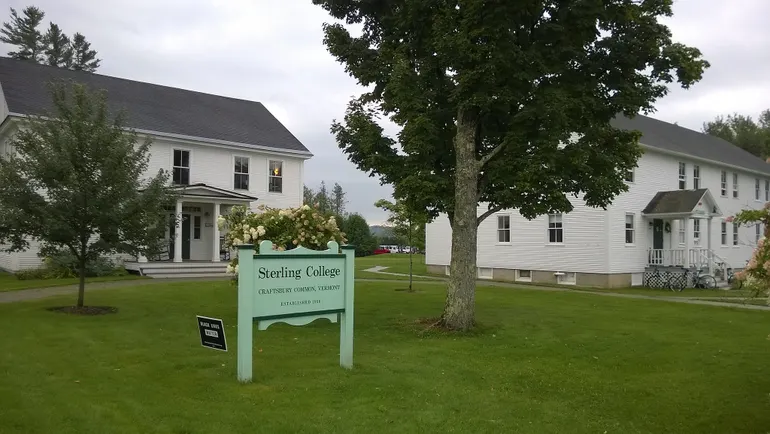
Tag: Sterling

  • Sterling College in Vermont to close

    Sterling College in Vermont to close

    This audio is auto-generated. Please let us know if you have feedback.

    Dive Brief:

    • Sterling College, in Vermont, plans to close after its spring 2026 semester in response to enrollment declines and financial pressure, the private institution announced Wednesday. 
    • The environmental studies-focused college will end its associate and bachelor’s programs following the spring semester, after which it plans to operate its summer internship program, depending on student need.
    • In its announcement, Sterling said that its governing board’s decision to close “reflects the College’s commitment to transparency, responsibility, and care in the face of persistent financial and enrollment challenges.”

    Dive Insight:

    Fewer than 40 students are at Sterling for the current semester, with about 30 faculty and staff members running the college, the institution’s president, Scott Thomas, told a local media outlet this week.

    Closing now “allows us to responsibly support students through their continuing time at Sterling and assist with transitions to partner institutions,” the college said in a FAQ about its closing.

    Sterling is finalizing several teach-out agreements with regional peers College of the Atlantic, Community College of Vermont and Champlain College, all of which will require the approval of its accreditor, the New England Commission of Higher Education. The college will hold its final commencement in May, it said. 

    Just between 2021 and 2023, the small college’s enrollment fell by just over 38% to 78 students, according to federal data. 

    Sterling’s tuition revenue declined with the shrinking student body. Between fiscal years 2021 and 2024, net tuition and fee revenue dipped 10.3% to about $835,700. 

    The college was also heavily dependent on private grants to sustain it. In 2024, for example, it logged $4.9 million in grant revenue, most of it restricted. However, the college’s endowment was relatively paltry. Its total investment assets amounted to $1.2 million in 2024. 

    Founded over 65 years ago, Sterling offers bachelor’s and associate degrees only in environmental studies. Bachelor’s students have the option to pursue self-directed concentrations in topics under the environmental umbrella, such as ecology, natural resource management and social justice. 

    The college touts outdoor learning and its experiential approach. Along with NECHE, it is accredited by the Association for Experiential Education, and it is one of a handful of federally recognized work colleges, which require students have work at least 80 hours per semester as part of their educational program

    Based in Craftsbury, Vermont, Sterling owns forest, wetlands, a farm, a yurt, a climbing wall and 307 acres in nearby Bear Swamp. The college encourages students to camp for short periods on campus property and allows them to hunt, fish and trap during designated seasons outside the campus center. 

    The college’s property was valued at $3.4 million in fiscal 2024. Sterling said the board will later decide “how to steward the College’s remaining resources in a manner consistent with its mission and all applicable legal requirements.”

    Given the possibility of running its internship program through August “if needed,” the college noted that “it is, as yet, unknown if and when College operations will cease entirely.”


    Source link

  • Vermont’s Sterling College to Close

    Vermont’s Sterling College to Close

    Sterling College will close at the end of the spring semester, officials announced Wednesday.

    The small college in Craftsbury Common, Vt., will cease operations in May due to “persistent financial and enrollment challenges,” according to a statement posted on its website

    “We understand that this news is difficult and deeply personal for every member of our community. Sterling College has always been more than a place of learning; it has been a home where curiosity, creativity, and compassion thrived,” officials wrote in the closure announcement.

    Sterling, which offered “transdisciplinary, experiential, competency-assessed educational programs,” according to its website, historically capped enrollment at 125 students. Founded in 1958, Sterling is one of a few U.S. work colleges, a model that allows students to keep tuition down via campus labor. Residential students at Sterling work five hours per week in different roles.

    Federal data shows that Sterling only had a head count of 78 students in fall 2023. 

    While the college managed to eke out modest surpluses in recent years, it had a meager endowment of just over $1.1 million, much of that restricted, according to financial documents.

    Sterling is now the second institution to announce a closure this month, following Trinity Christian College in Illinois, which is shutting down next year due to similar challenges.

    Source link

  • After brazen attack on expressive rights, faculty at Sterling College aren’t in Kansas anymore

    After brazen attack on expressive rights, faculty at Sterling College aren’t in Kansas anymore

    Professor Pete Kosek was a leading voice for the faculty at Sterling College — a small, private Christian college in central Kansas — when negotiating changes to the college’s employee handbook. Ken Troyer, another Sterling professor, spoke out as well, including statements to the media about concerns he had with Sterling administrators’ communication with faculty and about a vote of no confidence in the college’s president.

    For these exercises of basic faculty expressive rights, Sterling has now punished them both for exhibiting “behavior that is fundamentally inconsistent” with Sterling’s mission. But it’s these punishments that are “fundamentally inconsistent” with Sterling’s promises that its faculty enjoy “free expression, on and off campus.”

    FIRE wrote to Sterling on April 3, 2025, articulating our concerns. Its administration ignored us, so today we’re writing to the college again as well as its board of trustees, urging them to reverse the punishments of Kosek and Troyer.

    College clashes with faculty over revisions to the employee handbook

    In 2023, Sterling faculty received a new version of Sterling’s employee handbook. Faculty voiced concerns about whether faculty were obligated to sign the handbook’s acknowledgement, which appeared to require that faculty affirm Sterling’s institutional stance on marriage, life, gender identity, and human sexuality. For example, a provision in the handbook stated: “[m]arriage is designed to be the lifelong uniting of one man and one woman in a single, biblical, covenant union as delineated by Scripture.” 

    Concerned that this may adversely impact faculty who were divorced, Kosek led a group of faculty members in negotiating changes to the handbook. Over the course of a year, he went back and forth with Sterling administrators about making sure the handbook could be modified so that it didn’t single out divorced faculty for adverse action. 

    On Aug. 21, 2024, Kosek emailed a large group of faculty members informing them he believed he and anyone else would be fired if they did not sign the handbook acknowledgement. Kosek also told the administration that while he would abide by the terms of the handbook, he disagreed with how the administration went about communicating with faculty and instituting the new handbook. Two days later, the administration clarified that while faculty were expected to abide by the terms of the handbook, they would not be terminated for not signing it. Kosek subsequently clarified this to the rest of the faculty. The situation seemed resolved, right? Wrong.

    Months later, on Feb. 25 of this year, administrators summoned Kosek to a meeting and gave him a disciplinary warning. They told him that it was because he allegedly misrepresented the college when he told other faculty that he believed he and others would be fired over not signing the handbook’s acknowledgement. Sterling provided Kosek no real opportunity to defend himself from the charge.

    Troyer, meanwhile, received a nearly identical disciplinary warning on the same day as Kosek, purportedly because of his comments to the media criticizing Sterling’s poor communication with faculty. (This poor communication was a major reason why a group of faculty supported a no-confidence vote in Sterling’s leadership.) Troyer had also discussed the inclusion of non-Christian students at the college, and how that inclusion related to Sterling’s Christian mission. 

    Similar to Kosek, Troyer had no real opportunity to defend himself. He was just expected to take the disciplinary warning and keep his mouth shut. 

    If Sterling’s mission required absolute and unquestioning obedience to the administration, this might be understandable. But these punishments cannot be squared with the policies actually laid out in Sterling’s faculty handbook. That handbook does not demand unthinking fealty, but imposes on “students, faculty members, administrators and trustees” the obligation “to foster and defend intellectual honesty, freedom of inquiry and instruction, and free expression on and off campus.” As if anticipating the exact scenario facing both Kosek and Troyer, Sterling adds in the handbook, “administrators should respect the right of faculty members to criticize and seek revision of institutional regulations.” 

    FIRE’s first letter explained why the college could not square its punishment of Kosek with Sterling’s written commitments. Under First Amendment jurisprudence and at most private colleges (like Sterling) faculty members retain the right to comment on matters of public concern — and one of those concerns is how the college is being run. Indeed, faculty members are often among the most important voices regarding how colleges and universities operate since they witness firsthand the impacts of institutional policies. 

    Sterling blew FIRE off. So now we’re taking this up the chain and writing to the Board of Trustees as well as the college. When a private institution like Sterling makes promises in its handbooks to faculty, it must keep those promises. To violate them with impunity is to undermine trust and credibility. 

    Source link