For the last 15 years, I have used my knowledge as a barrister and former university lecturer to advise students on their academic appeals and misconduct cases.
In that time, I have seen the best and worst of student behaviour. I have dealt with students who paid others to write their entire PhDs and who recruited stand-ins to attend clinical placements.
I have encountered countless methods of cheating, from tiny notes hidden in pockets, to phones concealed in toilets, to modified ear protectors.
Only recently, a law student told me she had seen classmates slip earphones beneath their hijab during exams, whispering questions and receiving answers from a distant accomplice.
The ethics of representation
Occasionally, students ask me to act unethically on their behalf. I recall one student who had failed a resit exam and been withdrawn from his course.
In a moment of panic, he told the university that his parents had been killed in a terrible accident shortly before his exam. He begged me to repeat the lie in my formal appeal statement to the university. I refused.
As barristers, we will fight tooth and nail for our clients, whatever they have done, but only within the confines of the truth.
I remember one Russian client who had paid someone to write every single essay and eventually been caught. I explained that the evidence against him was strong, that the prospects of success were slim, and that I could not advise him to lie to the university.
He shook his head in disgust:
What is wrong with this country? In Russia, we pay the professor and everything is okay!
Recently, I had a conversation with a person – a non-lawyer – who had set up a university appeals business abroad. Like me, he had seen the underside of higher education.
He told me that students regularly cheat in the English language proficiency tests required by universities as a condition of entry. These tests ensure that students have sufficient command of English to cope with academic study.
According to him, cheating on these tests is widespread, with some companies approaching him directly with answers to the language tests.
He explained that there were several “university appeal services” in his home country offering forged medical certificates. They also provide fabricated “essay notes” for students wishing to convince their universities they had worked on an assignment.
With a plausible medical note or a set of backdated essay drafts, a dishonest student can present a convincing case for leniency or mitigation.
Despite many years in the business, I was horrified by these revelations. I searched online and quickly found websites that sell fake tests. Thus, Legit Certify states:
We help you legally obtain an official, verifiable TOEFL certificate without taking the test…The certificate is identical to one earned through exams, fully accepted by universities…
…fake/replica sick notes in the United Kingdom and Australia.
Are universities aware of this? Do they know that some of their international students gain admission, or overturn decisions, on the basis of falsified or manipulated documents? What checks do they make to ensure the authenticity of medical and other documentary evidence?
Conflicts of interest
With 40 per cent of English universities in financial deficit, there is also the uncomfortable question of money. The revenue from international students is so significant that many institutions may struggle to survive without it.
This financial dependence creates a conflict of interest. If a university uncovers widespread cheating in English language tests, or if it learns that students gained entry or remained on a course with false credentials, how should it react? If it investigates properly, the findings may threaten the much-needed flow of income.
Handling the growing number of cases of misconduct and appeals is itself resource-intensive and costly. A professor friend of mine, who examines PhDs, told me that he never fails a PhD student because, in his words, “it’s not worth the hassle of an inevitable appeal”.
A university that turns a blind eye may preserve the balance sheet but corrodes academic standards.
Some universities take the issue seriously. They invest in resources to detect cheating, run hundreds of misconduct panel hearings, and occasionally expel students. However, I doubt all institutions appreciate the scale of the problem or the sophistication of the cheating industry.
There is an international trade in dishonesty that exploits the pressure on students to succeed and the reluctance of universities to jeopardise their financial health and reputation.
If universities are not already alive to this reality, they need to wake up. Every forged medical letter that passes unchecked, every essay or thesis written by a ghostwriter, every fraudulent placement report that slips through the net, undermines the credibility of the institution and the degree it awards.
Paying the price
The harm is not limited to universities themselves. Employers, patients, clients and the public at large may pay the price if unqualified or dishonest graduates enter professional roles. Who wants to hire a lawyer or engineer who cheated in their exams, or be treated by a doctor who paid someone to attend clinical placements for them?
The purpose of higher education is not simply to hand out degrees in exchange for fees but to cultivate knowledge and skill, to educate. If universities fail to address the growing industry of deception, they risk betraying that purpose.
The question is not whether students cheat – they plainly do and probably more than ever before with the advent of generative AI – but whether universities have the courage to confront it, even at the cost of short-term financial loss and reputational damage.
This HEPI blog was kindly authored by Dr Steve Briggs, Director of Learning, Teaching and Libraries, University of Bedfordshire
In the context of UK higher education, the terms ‘traditional’ and ‘non-traditional’ are widely used when describing students – as apparent in recent blog posts published by HEPI. In this blog, I consider why the continued use of such terminology may become increasingly problematic and what might be a viable alternative.
Who are ‘traditional’ students?
The Cambridge dictionary defines ‘traditional’ as:
Following or belonging to the customs of ways of behaving that have continued in a group of people of society for a long time without changing.
As such, one can infer that the criterion for traditional students is that they will share established characteristics that have been fixed for a significant period.
The stereotypical traditional student
In the 1970s and 1980s, university students were generally young adults who left home and moved to a new city or town to study. They would routinely live with other students on or near to campus. Many would be able to undertake studies without needing to work and would have significant time available to spend on campus and engage in clubs, societies, sports teams and other social activities. In 2025, many commentators will cite this profile as being synonymous with a traditional student.
The rise of the non-traditional student
In the context of the UK, the term ‘non-traditional student’ has been widely used to differentiate learners who do not adhere to the aforementioned traditional student convention. Examples of characteristics seen to make a student non-traditional include:
Commuting to university, rather than living on campus
Being over the age of 21
Having parental and/or caring responsibilities
Hailing from a lower socio-economic background
Being the first-in-family to study at university
Having had experience of the care system
Such individuals are often time-poor but commitment-rich and in turn have very limited availability to spend on campus outside of scheduled sessions. The use of the non-traditional label has been used increasingly since the advent of widening participation in the 1990s.
Perceptions of traditional are not fixed
The concept of a traditional student is time-bound. For example, pre-1900, there was a small number of ancient universities in the UK and relatively very low numbers of students. Increased numbers of universities opening during the 1900s meant that more individuals were able to study at university, many of whom would be labelled as non-traditional relative to those pre-1900. However, the same group has since then been re-defined as traditional relative to those who studied in the 1990s.
Over the last twenty-five years non-traditional characteristics have become increasingly common amongst the student population. For example, in 2025, HESA reported that over half of students were from IMD quintiles 1 and 2, and the vast majority of students are now over the age of 20. Following previous trends, there will come a point, potentially in the not-too-distant future, whereby the current generation of non-traditional students will become viewed as traditional. The cyclical process will then likely start again with a new conceptualisation of what is non-traditional.
More nuanced classification options
Given the time-bound nature of both traditional and non-traditional characteristics I suggest that higher education commentators should consider the use of more exact terminology when discussing student cohorts. I suggest two options:
By decade: Student groups could be framed in terms of decades, for example the demographic and characteristics of students of the 1990s, 2000s, 2010s and 2020s, etc. Such an approach could work well if there was stability over a decade however, the impact of social or global events (such as a recession, government policy or pandemic) may mean within a decade those studying within higher education could change markedly. For example, the significant impact of governmental immigration policy changes on the recruitment of international students studying in the UK during the mid-2020s.
Create generational names: Since 1950, there have been five main birth generations: Baby Boomers, Generation X, Millennials, Generation Z and Generation Alpha. Each generation has shared characteristics synonymous with being born during that period. Analogously, specific generations could be defined in terms of university students. Each generation would have a distinctive name and characteristics common amongst most members studying at university during that specific window of time. The use of student generational names would offer flexibility to account for periods of stability that lasted longer than ten years and could also accommodate sudden changes to the profile of student cohorts.
I personally favour the use of generational names given the greater flexibility. I see this as necessary given the turbulence and change experienced within the higher education sector over the last decade. For instance, I propose that the pandemic was a catalyst for the emergence of a new generation of students, a defining characteristic of which being greater experience in remote communicating and learning online.
Putting into practice
As a starter for ten, I suggest seven generations of English students over the last 150 years. A caricature for each is provided – these are intended to be illustrative of generational difference rather than exhaustive:
Ancient Generation (pre-1900): A student would study at one of the ancient universities in the UK. Students were mainly from the upper social class, and a fraction of the population attended university. Those attending university would be financially supported by personal networks.
Redbrick Generation (circa 1900-1945): Most students studied at an ancient or redbrick university. Students continued to be mainly from the upper social class, and in turn a small percentage of the population attended university.
Post-World War Two Generation (circa 1946-1989): As the number of universities progressively expanded, students had greater geographic access to higher education. Students could access maintenance grants to cover the cost of living whilst studying. This allowed students to readily engage in activities alongside their studies.
Widening Participation Generation (circa 1990 – 1997): The number of universities significantly increased following the integration of polytechnics. Concentrated efforts were made to expand access to higher education and the percentage of students from previously underrepresented groups increased. In addition to maintenance grants, students were able to access low-cost student loans.
Tuition Fee Generation (circa 1998 – 2014): The widening participation imperative remained but students now paid a tuition fee to study. Choice of where to study remained limited by student number caps. Maintenance grants were abolished and replaced with student loans. As fees progressively increased more students found they needed to undertake work whilst studying.
Free Market Generation (circa 2015 – 2019): Widening participation remained a priority. The student number cap is removed, and many universities actively expand the availability of places. Students have unprecedented choice in terms of where to study at university. Tuition fees and living costs remain a challenge for many students and numbers working whilst studying remains very high.
Pandemic Generation (circa 2020 – current): The pandemic results in a sudden and seismic shift to online education across schools, colleges and universities. This results in students have new experiences and expectations related to online and blended learning. Cost of living increases following the pandemic resulted in more student facing financial hardships in turn resulting in many spending less time on campus. Demand for mental health and well-being support increases.
Analogous to birth generations, I would see that other interpretations of higher education student generation names could emerge through research outputs, thought pieces or social events as opposed to being determined by a single group or professional body. Influential think tanks like HEPI could play a key role in providing platforms for such discussion.
I foresee there potentially being variations in proposed student generational definitions (as is the case with birth generations) but if all are clearly defined, these would all be invaluable for higher education commentators when discussing longitudinal changes in cohorts over time.
The early years are a critical time to teach the foundations of math. That’s when children learn to count, start identifying shapes and gain an early understanding of concepts like size and measurement. These years can also be a time when children are confronted with preconceived notions of their abilities in math, often based on their race, which can negatively affect their math success and contribute to long-standing racial gaps in scores.
These are some of the motivating factors behind the Racial Justice in Early Math project, a collaboration between the Erikson Institute, a private graduate school focused on child development, and the University of Illinois Chicago. The project aims to educate teachers and provide resources including books, teacher tips and classroom activities that help educators combat racial bias in math instruction.
I sat down with Danny Bernard Martin, professor of education and mathematics at the University of Illinois Chicago, project director Priscila Pereira and Jennifer McCray, a research professor at the Erikson Institute, to learn more about their work. This conversation has been edited for length and clarity.
What are some of the key examples of racial injustice that you see in early math education?
Martin: If I say to you, ‘Asians are good at math,’ that’s something that you’ve heard, we know that’s out there. When does that kind of belief start? Well, there’s something called ‘racial-mathematical socialization’ that we take seriously in this project, that we know happens in the home before children come to school. Parents and caregivers are generating messages around math that they transmit to children, and then those messages may get reinforced in schools.
Even at the early math level, there are research projects beginning to construct Black children in particular ways, comparing Black children to white children as the norm. That is a racial justice issue, because that narrative about white children, Black children, Asian American children, Latinx children, then filters out. It becomes part of the accepted truth, and then it impacts what teachers do and what principals and school leaders believe about children.
What does this look like in schools?
McCray: Perhaps the math curriculum doesn’t represent them or their experience. We all know that often schools for children of color are under-resourced. What often happens in under-resourced schools is that the curriculum and the teaching tends to focus on the basics. There might be an overemphasis on drilling or doing timed tests. We also have those situations where people are doing ability grouping in math. And we know what the research says about that, it’s basically ‘good education for you, and poor education for you.’ It’s almost impossible to do any of that without doing harm.
One line of research has been to watch teachers interact with children and videotape or study them. And in diverse classrooms with white teachers … often it is observed that children who are Black or Latina aren’t called on as often, or aren’t listened to as much, or don’t have the same kind of opportunity to be a leader in the classroom.
What should teacher prep programs, administrators and families do to address racial justice issues in early math?
McCray: Maybe the white teacher is reflecting on themselves, on their own biases … trying to connect with families or communities in some way that’s meaningful. We want teachers to have that balance of knowing that sometimes you do want to teach a procedure, but you never want to be shutting down ideas for creative ways to solve a math problem, or culturally distinct ways to solve a math problem that might come from your students.
It might be something like, you’re working on sorting in an early childhood classroom. And what if a child is thinking about a special craft that their parent does that’s like the [papel picado], or papers that get cut in very elaborate designs in Mexico. … If the teacher doesn’t have space to listen, it could be a shutdown moment, instead of a moment of connection, where the child is actually bringing something … that is associated with their own identity.
Pereira: I do feel that sometimes the conversations of racial justice really put the weight on teachers and teachers alone. Teaching is part of a larger structure. Maybe your school will not allow you to do the work that is needed. I’m thinking about [a teacher] who was required to follow a scripted curriculum that did not promote the positive math identity for Black children. It needs to be a whole community effort.
How is your initiative changing this?
Pereira: There are resources in terms of opportunities that we offer to teachers to engage with our content and ideas: webinars, a fellowship and an immersive learning experience in the summer of 2026. These spaces are moments in which educators, researchers and people that are engaged in the education of young learners, can come together … and disrupt mainstream notions of understanding what is racial justice and how one gets that in the classroom.
Right now, research and initiatives zeroing in on race are under scrutiny, especially at the college level. Do you foresee any additional challenges to this work?
Pereira: There was a National Science Foundation grant program focused on racial equity in STEM and we had been planning to apply for funds to do something there. … It’s gone. … The only place we’re welcome is where there’s a governor who is willing to take on Trump. We just have to keep doing the work, because we know what’s right. But it is challenging, for sure.
The Hechinger Report provides in-depth, fact-based, unbiased reporting on education that is free to all readers. But that doesn’t mean it’s free to produce. Our work keeps educators and the public informed about pressing issues at schools and on campuses throughout the country. We tell the whole story, even when the details are inconvenient. Help us keep doing that.
Each summer I make a point of stopping by a first-year orientation session at the University of Virginia, where I have been a professor in the music department for 18 years. The sessions take place in the historic concert hall on the floor below my office. On June 30, members of the Class of 2029 danced their arrival wearing the university’s colors of blue and orange.
Usually, the raw enthusiasm and promise of the students reminds me why, on many days, I love my job. It didn’t work this time. I just couldn’t resolve the dissonance between the fantasy and the reality. The fantasy was of a college education these young people worked so hard to land. In real life, the Department of Justice had just pressured our president, Jim Ryan, into quitting, demanding his resignation to supposedly resolve an investigation into the university’s diversity, equity and inclusion programs.
This is almost old news by now. But it shouldn’t be. There is a direct line between the Jan. 6 insurrection and the 2017 Unite the Right march, when, just days before first-year students started school, a few hundred white nationalists emboldened by the first Trump presidency marched across campus with their torches, chanting, “Jews will not replace us.” The legal historian Farah Peterson, who used to teach here, writes that “an embrace of violence to assert constitutional claims” is baked into our history and that the founders understood violence as a way of making legal arguments.
The charge against UVA by the Department of Justice is being led by two UVA alums. One of them, Harmeet Dhillon, an assistant attorney general who overlapped with Jim Ryan at UVA law school, served as co-chair in 2020 of Lawyers for Trump, which challenged the presidential election results, and represented Trump in a defamation suit involving Stormy Daniels.
The ousting of Jim Ryan was not a surprise. But even after the Trump administration’s relentless siege on universities, it was a gut punch. Those of us who teach here have predicted for months that the Board of Visitors would try to fire Ryan this July, when all of its appointed members would be Gov. Glenn Youngkin’s appointees. We’ve been through that before. In 2012, when the Board of Visitors fired then-president Teresa Sullivan, faculty, students and alumni stood up to resist corporate America infringing on the educational mission of the university, and the board reinstated her.
Youngkin’s newest appointees to UVA’s board include the controversial Ken Cuccinelli, who, when he was the state attorney general, led an assault on academic freedom in the form of a civil investigation targeting five grants held by climate scientist Michael Mann. Youngkin, for his part, has long intended to purge the state’s education system of “divisive concepts”—things like acknowledging the fact that the buildings of Jefferson’s “Academical Village” were built by the enslaved. When the Board of Visitors banned DEI in March of this year, Youngkin gleefully stated, “DEI is done at the University of Virginia. We stand for the universal truth that everyone is created equal, and opportunity is at the heart of Virginians’ and Americans’ future.”
I think we know whom he means by “everyone.”
Beloved by many here, including me, Ryan is perhaps a once-in-a-generation leader. Still, he is so very far from “woke.” As the student satire magazine put it, “Fly high Jim, we’ll never forget the early mornings, late nights, and also the several hundred state troopers you sent to attack students for peacefully protesting.” In May 2024, Ryan did not hesitate to crack down on a very small pro-Palestine encampment. No one at the university cracked down on those tiki torch–bearing white nationalists.
Here is what we are guilty of: believing that our professional duty requires us to openly reflect on our individual and collective responsibilities in a democracy. We do think it’s our job to give our students tools to respond to the world they will inherit. If we were guilty of or capable of “left-wing indoctrination,” I suspect we would have a different governor and maybe different other things, too. Almost 70 percent of our students are from Virginia.
Because we are guilty of believing that history matters, we can’t ignore the wicked irony of a federal and state government killing diversity-related programs and forcing out a president in part by leveraging the equal protection clause of the 14th Amendment, ratified in1868. This amendment, which mandated equal protection for all humans, is now weaponized to protect only white people. The Civil Rights Act of 1964 outlawed discrimination based on race, religion, sex or national origin. It has been similarly weaponized.
Meanwhile, our history also includes these facts: The UVA biology department taught eugenics until 1953. Not only was the institution built by enslaved laborers, but by 1829 it had its very own slave patrol. Indeed, Thomas Jefferson wanted to establish a University of Virginia in part because too many young men went north and learned the evils of abolition. Such thinking amounted to a canker “eating on the vitals of our existence, and if not arrested at once will be beyond remedy.” More recently, the Office for Civil Rights did not approve the commonwealth of Virginia’s plan for desegregating higher education until 1982.
My current and former students have been texting from all over the world since Ryan’s June 27 resignation announcement. Mostly they want to know: Why UVA? Virginia is arguably ground zero for reckoning with the chattel slave system and its intertwining with a flailing fantasy of democracy. “The 1619 Project” made front-page news of it. But you don’t have to go back that far.
Thanks to the summer of 2017, for many Charlottesville now conjures images of burning torches and Nazi slogans. Over the weekend of Aug. 11 and 12, 2017, the sleeping dogs of America’s nasty history rose up from the evidently not dead. Richard Spencer (UVA, Class of 2001) helped orchestrate a torchlit nighttime march across our campus, the marchers barking, “Blood and soil” and “Jews will not replace us.” The university let this happen. In her book about the weekend of Unite the Right and the ideology that inspired it, Deborah Baker writes, “The nature of this awakening appeared to go to the core of who we are and the myths and folklore that have sustained us as a nation.”
Also that weekend of Unite the Right, a young woman was murdered and dozens were injured when a neo-Nazi drove a car into a group of counterprotesters. While the city was still reeling, Trump went on television and claimed there had been “very fine people on both sides.” There was an uproar and a backlash then. And in September 2017, the president had no choice but to sign a congressional joint resolution condemning the violence and domestic terrorist attack in Charlottesville. It is clear that no such condemnation would be forthcoming today.
This administration will not stop with Jim Ryan, and they will not stop with UVA. The miraculous dean who got those first-year students to dance on a hot June day in 2025 will get them dancing at their graduation in May of 2029. But I am very afraid of what this university, and other institutions of higher learning across the country, will look and feel like by then.
Bonnie Gordon is a professor of music at the University of Virginia and vice president of the American Musicological Society.
Is your institution’s marketing truly reaching today’s students, or are you shouting into the void? Higher education marketing is undergoing a seismic shift. With rapid changes in student behavior, the rise of AI and mounting constraints on institutional funding, marketing leaders can no longer rely on yesterday’s strategies to meet today’s challenges. Student expectations have evolved. Budgets are tightening. And yet, many institutions are still using outdated strategies that fail to resonate with the Modern Learner.
To stay competitive, institutions must embrace the new era of higher education marketing—an era defined by personalized engagement, brand-building and data-driven decision-making. In a world where marketing dollars work must work harder than ever, rethinking your strategy is no longer optional. It is essential to long-term success.
Students no longer passively wait for information. They actively seek it across multiple channels, from social platforms to AI-powered search tools. Their behaviors are more self-directed than they were even a decade ago, and the expectations they bring to the table are shaped by instant access, transparency and digital convenience. Modern Learners want institutions that reflect their values and aspirations. As a result, branding plays an even more critical role in decision-making than ever before. Trust, authenticity, and alignment with personal identity all contribute to conversion. Meanwhile AI is accelerating these shifts by analyzing behavior in real time and delivering tailored experiences at scale.
These changes are not on the horizon—they are already here. Institutions that fail to adapt risk being left behind.
This evolution is shaping the standard of higher education marketing, and redefining what it takes to attract and engage Modern Learners. Today’s students are not yesterday’s prospects. They are savvy, value-driven and self-directed. Marketing strategies must evolve to meet them where they are—not where they used to be.
At EducationDynamics, we are not here to maintain the status quo; we are here to challenge it. We rethink, rebuild and drive your institution into a future where growth isn’t just a goal—it’s a guarantee. With solutions designed to empower, we are continually adapting to the evolving needs of our partners to equip them for long-term success.
Evolving Student Behavior: Implications for Higher Education Marketing
The Changing Search Journey
Today’s students are no longer waiting to be guided; they are leading the charge. With a strong sense of autonomy and purpose, Modern Learners navigate the enrollment journey on their own terms. Their decisions are shaped by what EducationDynamics identifies as the Three C’s: cost, convenience, and career outcomes. These components are central to a student’s decision to apply or enroll. The challenge for institutions is not just to deliver value, but to demonstrate that value clearly and quickly in the digital environments that students operate in.
The student search journey has undergone a fundamental shift. No longer do students begin with degree or program keywords. Instead, 58 percent of Modern Learners now initiate their search with specific school names, according to EducationDynamics’ 2025 Engaging the Modern Learner Report. If an institution is not top-of-mind, it is already at a disadvantage.
Compounding this shift, nearly 60 percent of education-related searches result in no clicks. Students are making faster decisions, often based on AI-generated overviews that appear directly within search results. Currently, 65 percent of education searches trigger these overviews. This marks the rise of zero-click search and the emergence of Generative Engine Optimization (GEO) as a critical strategy.
The message is clear: if your institution is not immediately visible and delivering value within the search experience, it risks being excluded from the student’s consideration entirely.
Search engines like Google are prioritizing quick, curated answers, reflecting broader shifts in how users engage with content. Education-related searches have become more intricate, with students asking detailed and personalized questions. They are no longer browsing—they are making decisions. A static, cumbersome website is not just outdated; it is actively repelling Modern Learners. Institutions must create digital experiences that are responsive, student-focused and seamlessly accessible across all digital touchpoints. A lack of dynamic, intuitive design is no longer an option; it’s a failure to meet Modern Learners’ expectations.
In today’s search environment, visibility alone is not enough. Institutions must deliver relevance, clarity and authenticity across channels that Modern Learners use. Institutions that want to remain competitive must not only be present at the beginning of the search journey, but also deliver information with the speed, clarity and authenticity that Modern Learners expect. Those that rise to this challenge will earn attention and trust, while those that don’t will fall behind amid competition.
The Demand for Authentic and Engaging Content
If your institution’s content strategy still leads with rankings, tradition or campus accolades, it is missing the mark. Modern Learners are not making enrollment decisions based on institutional prestige alone. They are looking for evidence of belonging, support and authenticity. Colleges and universities must shift from promotional messaging to content that mirrors the lived experiences of their students. Modern Learners want to see real people, real stories and a real sense of community.
Video content, especially in short-form, is now one of the most powerful mediums for delivering the connection that Modern Learners seek. Today’s students are not flipping through text-heavy brochures or watching ten-minute promotional videos. They are forming impressions in literal seconds, with the rise of TikTok, Instagram Reels and YouTube Shorts. These channels are avenues where your institution’s brand can come to life, showcasing content that is concise, compelling and aligned with the pace of student attention. Highlighting faculty, student testimonials, campus culture and day-in-the-life content in thirty seconds or less can drive significantly more engagement than polished but impersonal campaigns.
Authenticity is not a trend—it is a requirement for building trust. User-generated content (UGC) plays a critical role in building credibility. When students and alumni share their own stories, they give prospective students a transparent view of your institution’s impact. An honest glimpse into campus life helps cultivate connections and bolster credibility in ways that other marketing mediums cannot achieve.
At the same time, social media is no longer just a place for amplification. Increasingly, it is becoming an integral steppingstone in the student research journey. Modern Learners actively use platforms like TikTok, Instagram and Facebook to evaluate how your institution aligns with their lives and goals. Marketing strategies must evolve to include social-first storytelling and platform-specific content that makes the institution feel approachable and relevant.
At EducationDynamics, we don’t just help institutions meet the demand; we empower them to exceed it. We deliver Creative Solutions that are not only strategic but deeply human. Our approach centers on compelling storytelling, a student-first mindset and content designed for the channels where prospective students are making key decisions. Whether through video, social campaigns or user-driven narratives, we equip colleges and universities to show up in ways that make real impact and drive measurable results. We help our partners shape the future, rather than follow it.
Key Shifts in Higher Education Digital Marketing
Website Marketing Evolution
In today’s higher education environment, your website is not just an accessory to your digital strategy; it is the central nervous system of your brand, the engine behind your reputation and a key driver of student engagement and revenue. With deep expertise in enrollment marketing, our team of experts transforms websites into high-performing conversion machines. Through data-driven UX, advanced SEO, GEO and conversion strategies, we ensure your website continuously evolves to meet the changing demands of the industry. If your institution’s website isn’t delivering results, it’s not just underperforming—it’s limiting your growth potential.
To remain competitive, website marketing must shift from static, siloed approaches to dynamic, user-centric experiences. As student behavior changes and new digital platforms emerge, institutions must design websites that can withstand these digital disruptions and provide seamless navigation, personalized content and clear pathways to action.
Search engine algorithms are now more sophisticated and volatile, requiring deeper alignment with how students search and engage. Website optimization now requires more than traditional SEO tactics. It demands an integrated approach that combines content marketing, user journey optimization and brand amplification. A seamless student experience is essential, but so is a strategy that ensures your content reaches prospective students across multiple platforms.
The role of an institution’s website as the front door of your brand remains as vital as ever. However, the digital space has evolved beyond simply driving traffic through SEO. Today, success hinges on ensuring your content is discoverable across a wide range of digital channels, and understanding how that content is delivered to students within the search engine results pages (SERPs).
AI has become a pivotal force in content discovery and visibility within SERPS. Visual shifts in the SERPs now prioritize rich media and first-person expertise, meaning your content must not only reflect relevance but also showcase real-world experiences to stay competitive. First-person expertise, such as student stories, faculty insights and user-generated content, is increasingly favored by search engines, underscoring the growing demand for authenticity. Rich media—images, videos and interactive elements—boost engagement and click-through rates. As visual content continues to dominate SERPs, your strategy must adapt to harness these trends effectively.
Looking to 2025 and beyond, SEO will demand a comprehensive, integrated approach that encompasses both on-site and off-site elements. Institutions that focus exclusively on on-page SEO or create content in isolation risk falling short of maximizing their potential. The most successful strategies will seamlessly connect content across multiple digital channels, driving not just visibility but also meaningful engagement.
Modern website optimization will be multi-faceted and multi-channel, anchored by four key components:
SEO: Search Engine Optimization will remain foundational, still being a critical part of driving organic traffic to your website but now must be paired with user-focused content creation. A strategic blend of blog posts, video content, graphics and articles will ensure that your website remains relevant and discoverable in a competitive search environment.
User Journey Optimization: Understanding the student journey is essential for converting traffic into applications. A data-driven approach that identifies usability roadblocks and tests the optimal path to conversion is key. A/B testing and ongoing adjustments will ensure that every touchpoint on your website drives students to take meaningful actions.
Brand Amplification: Strong content deserves to be seen. To achieve this, institutions must invest in amplifying their brand through content promotion, social media engagement, local profile optimization and PR. Engaging in user-driven discussions on forums and social media platforms will strengthen your brand’s visibility and credibility, allowing your message to reach broader audiences.
Content Marketing: The creation of high-quality content is a cornerstone of digital marketing. By producing content that directly speaks to student needs, you reinforce your institution’s position as a trusted authority. Strategic content creation is not just about filling your website but aligning content with student expectations and ongoing digital trends.
With these changes, institutions must take the driver’s seat in shaping their digital presence and optimizing web strategies. Meeting the moment requires a proactive approach to evolving digital trends, ensuring that your institution remains competitive, relevant and positioned for long-term success in an increasingly dynamic online environment.
The Transformation of Paid Media
The transformation of paid media has been just as significant as the evolution in organic search. With AI now playing a central role in optimization, marketers have had to rethink not only where they invest but how they manage campaigns. Gone are the days of manual bids and rigid keyword targeting. In what was once a highly controlled environment, advertisers would apply uniform bids across all matching search queries, rely on static text ads, and build campaigns around exact or phrase match keywords. These strategies offered precision but lacked adaptability and scalability.
Today, optimization is driven by automation, data and real-time decision-making. Smart bidding adjusts bids dynamically based on user behavior, intent and context. Responsive search ads tailor messaging to the user’s query, while improved broad match capabilities allow for more relevant and flexible reach. This shift demands a new approach, one away from managing structure and more on shaping signals for AI-based optimization.
Performance Max (PMax) campaigns exemplify this change. By consolidating efforts into a single campaign that spans Google’s full inventory, advertisers can let AI optimize toward specific outcomes. Institutions are increasingly shifting towards investments in branded PMax campaigns, using them to drive awareness and conversions across the funnel. Unlocking their full potential, however, requires consideration on inputs such as audience insights, quality creative and defined performance goals.
In this environment, marketers must shift their focus. Rather than managing granular campaign structures or keyword-level bids, success depends on a streamlined structure. Over-segmentation is now the enemy of AI—limiting data flow and stalling machine learning algorithms. Instead, consolidation, automation and audience-centric strategies are key to maximizing performance and achieving scale. The more robust your audience signals and creative assets, the more effectively AI can optimize for effective campaigns.
The Central Role of Brand in Modern Higher Education Marketing
Brand as a Differentiator
In a competitive and crowded marketplace, brand is your most powerful differentiator. As enrollment pressures intensify and prospective students become more discerning, a clear and compelling brand narrative is not an accessory to success; it is essential for it. Yet many institutions struggle with perceived value leaving prospective students unsure of what truly sets them apart.
According to Hanover Research’s 2024 Trends in Higher Education report, 66% of Americans believe colleges are “stuck in the past” and no longer meet the needs of today’s students. This perception gap presents a unique opportunity for institutions to not just rebrand but redefine the role and relevance for higher education in the modern world.
Brand marketing plays a transformative role in addressing these challenges. Brand is not merely visual identity or taglines, it is about storytelling that resonates across platforms and inspires connection. With students engaging across an increasingly fragmented digital landscape, institutions must show up consistently across every touchpoint.
The emotional connection is especially important today, as higher education faces intense scrutiny from multiple forces. Amid ongoing conversations about cost, access and accountability, there is a pressing need for institutions to reshape the narrative. By investing in brand marketing, institutions can demonstrate their alignment with the needs of Modern Learners, reinforce their commitment to student outcomes and build trust in a time categorized by uncertainty.
Brand and reputation go hand in hand. One reflects your promise. The other reflects your proof. When balanced well, they shape a perception that drives enrollment, builds revenue and sustains long term success.
Today’s higher education marketers must engage students before they start their search. This requires delivering authentic content across channels that builds trust and awareness over time. The Modern Learner’s journey begins with emotion, not just information. Your brand must be visible, relatable, and memorable.
In an era marked by uncertainty and choice overload, institutions must lead with empathy, clarity, and purpose. Showcase a brand that resonates, builds confidence and drives action.
Balancing Brand and Performance Marketing
In higher education marketing, finding the right balance between brand and performance marketing channels is crucial for long-term success. Historically, higher education institutions have leaned heavily into performance marketing, driven by the immediate need for results like inquiries and applications. However, this strategy is becoming less sustainable in today’s dynamic and competitive landscape. While performance marketing continues to be essential for driving immediate conversions, it cannot be the sole focus.
Brand marketing plays an increasingly important role, especially in the upper funnel, where students are still in the process of exploring and considering their options. This phase of the student journey is more about building awareness, shaping perceptions and creating emotional connections, rather than expecting immediate results. Students are making life-changing decisions that require time, research and deep consideration, so brand-building efforts often take longer to produce tangible outcomes.
To navigate this, higher education marketers must strategically allocate resources across both brand and performance media. A suggested allocation might be 20-35% for brand marketing, including channels like Connected TV (CTV), OTT streaming video and audio, out-of-home (OOH) ads, display ads, and paid social. The remaining 65-80% can be allocated to performance marketing, focusing on paid search, paid social and website marketing. This balance allows for consistent brand presence while still driving immediate performance goals.
However, finding the right mix will depend on your institution’s unique needs and goals. There is no one-size-fits-all approach. It’s important to embrace a testing mentality when allocating your budget, understanding that this is a multi-year investment. Brand marketing’s impact often requires indirect measurement and time to mature, with a holistic cost per enrollment being a long-term goal.
By adopting a balanced approach and a willingness to test and iterate, institutions can achieve the right blend of short-term performance and long-term brand growth.
Adapting to Thrive in the New Era
The higher ed landscape is evolving and so are your students. Marketing strategies that once worked are no longer enough. To succeed, leaders must challenge the status quo, evolve their higher education marketing strategies, and fully embrace the behaviors, tools and technologies that are shaping this new era.
Now is the time to invest in transformation. Whether that means rethinking your website, shifting your media mix or consolidating campaigns to improve performance, the path forward begins with taking action.
The transformation does not have to be navigated alone. A higher education marketing agency can be a vital partner in this evolution. At EducationDynamics, we bring together proprietary research, full-funnel strategy and decades of expertise to help institutions like yours grow with confidence.
Let’s shape the future together. Connect with an EDDY expert to assess your current strategies and identify new opportunities for growth.
The institutions that succeed will be the ones that are bold enough to evolve—strategically, creatively and with purpose. Now is your opportunity to lead that change.
During the Covid pandemic, nations realized they needed to work together to keep their people safe. That’s where the World Health Organization comes in.
Let’s begin with President Donald Trump’s second inaugural address (Jan. 20), if only to contrast it with last week’s condemnation of his lawsuit against J. Ann Selzer, the Des Moines Register, and its parent company Gannett (see also FAN 451, 449 and 436).
Ready? Here it goes:
After years and years of illegal and unconstitutional federal efforts to restrict free expression, I will also sign an executive order to immediately stop all government censorship and bring back free speech to America.
Never again will the immense power of the state be weaponized to persecute political opponents, something I know something about. We will not allow that to happen. It will not happen again. Under my leadership, we will restore fair, equal, and impartial justice under the constitutional rule of law.
Never again! It will not happen again! Stop all government censorship!
And there’s more: When it comes to free speech, all views will be treated with “impartial justice.” Against that promissory note, let us turn to his unprecedented executive order as discussed below.
Executive Order: Jan. 20, 2025
By the authority vested in me as President by the Constitution and the laws of the United States of America, and section 301 of title 3, United States Code, it is hereby ordered as follows:
What follows is a brief description of the Executive Order along with some preliminary comments.
Section 1. Purpose
This section opens with an attack on the Biden administration’s alleged “trampl[ing of] free speech rights” when it comes to “online platforms.” Such abridgments, it is asserted, were done in the name of combating “misinformation,” “disinformation,” and “malinformation” in order to advance the Biden administration’s “preferred narrative.”
Note at the outset that this section is primarily addressed to reversing the Biden administration’s apparent censorship of online expression. Even so, there is a generalized statement: “Government censorship of speech is intolerable in a free society.”
Keep that in mind when it comes to what is set out in Section 4 below.
Section 2. Policy
This section focuses on four commitments: (i) securing free speech rights of all “American[s]”; (ii) mandating that “no [federal] agent engages in or facilitates” abridgments of free speech; (iii) ensuring that no “taxpayer resources” are used to abridge free speech; and (iv) identify and correct any past federal abridgments of free speech.
Unlike Section 1, the explicit focus of this section is not confined to any free speech abridgments committed by the previous administration. The focus is on securing free speech rights of “citizens.” Hence, the policy is directed to an affirmative obligation of the Executive branch to protect free speech rights. The operative action words are “secur[ing],” “ensur[ing],”and“identify[ing].”
Thus, there is a duty to ensure that no federal officers are used or taxpayer dollars expended in violation of the Speech Clause of the First Amendment. Also, unlike Section 1, much of Section 2 applies to all free speech rights and not those confined to social media. There is also a promise to investigate for any and all existing abridgments of free speech committed by “past misconduct by the Federal Government.”
Section 3. Ending Censorship of Protected Speech
Like Section 1, this section focuses on the actions of the past administration (i.e., abridgments committed “over the past four years”). This section, unlike section 2, explicitly applies to federal departments and agencies, though it also applies to federal officers, agents and employees. Such agencies and departments must comply with the requirements of Section 2.
The second portion of this section deals with the investigative powers of the attorney general working “in consultation with the heads of executive departments and agencies.” Again, this investigation is confined to wrongs committed by the past administration. Following such investigations, a “report” shall be submitted to the President suggesting “remedial actions.”
Much of this section seems repetitive of what is set out in Section 2, save for the references to federal departments and agencies and the need for investigation followed by a report to the President. Note that under Section 3, remedial action is suggested, whereas under Section 4, per this Executive Order, remedial action against the United States and its officers is prohibited.
Section 4. General Provisions
In order to appreciate the import of this clause, it is best to quote the final provision (sub-section (c) it in its entirety (with emphasis added):
This order is not intended to, and does not, create any right or benefit, substantive or procedural, enforceable at law or in equity by any party against the United States, its departments, agencies, or entities, its officers, employees, or agents, or any other person.
The opening provisions of this Section refer to authorizations of grants of executive power. The Order is to be implemented consistent with the “applicable law and subject to the availability of appropriations.”
Importantly, While the First Amendment is a prohibition against the federal government and all its officers, this Executive Order:
applies to free speech wrongs committed during “the last 4 years” or “past misconduct by the Federal Government” or abridgments occurring “over the last 4 years,” though there is a passing mention of securing the free speech rights of all “American[s].”
Yet even as against such past alleged free speech wrongs, the sole remedy is by way of corrective action taken by the Executive Branch.
If such corrective action, or any other actions taken by Executive officials in pursuance of this Executive Order, themselves abridge First Amendment rights, there is no independent remedy secured by the Order.
FIRE weighs in with its own free speech recommendations to the President
Below are the four general categories of recommendations made (see link above for specifics):
Support the Respecting the First Amendment on Campus Act
Address the abuse of campus anti-harassment policies
Rein in government jawboning
Protect First Amendment rights when it comes to AI
“As president, Trump inherits the privilege and the obligation to defend the First Amendment rights of all Americans, regardless of their viewpoint — and FIRE stands ready to help in that effort.”
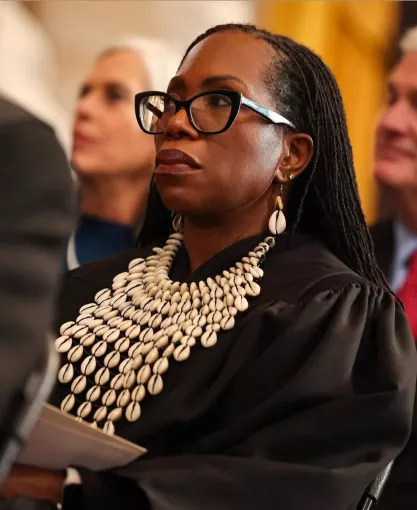
Justice Ketanji Brown Jackson in free expression mode at the Inauguration?
Justice Ketanji Brown Jackson at the inauguration of Donald Trump on Jan. 20, 2024. (Imagn Images)
Excerpts from Virginia Court of Appeals decision in Patel v. CNN, Inc.
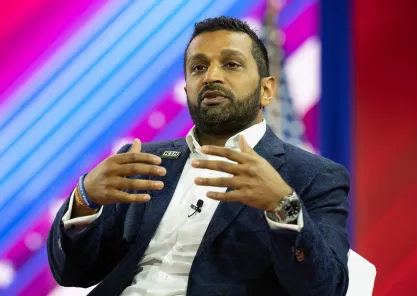
Kash Patel, seen here at the 2023 Conservative Political Action Conference, is President Donald Trump’s nominee to head the FBI. (Consolidated News Photos / Shutterstock.com)
An excerpt from today’s Virginia Court of Appeals decision in Patel v. CNN, Inc., decided by Judge Rosemarie Annunziata, joined by Judge Vernida Chaney (the opinions weigh in at over 12,000 words, so I only excerpt some key passages).
Abortion picketing case lingers on docket
The cert. petition in the abortion picketing case, with Paul Clement as lead counsel, has been on the Court’s docket since July 16 of last year. It has been distributed for conferences seven times, the last being Jan. 21. In his petition, Mr. Clement (joined by Erin Murphy) explicitly called on the Court to “overrule Hill v. Colorado.” (See FAN 433, July 31, 2024))
Paul Clements and Erin Murphy
More in the News
2024-2025 SCOTUS term: Free expression and related cases
Cases decided
Villarreal v. Alaniz(Petition granted. Judgment vacated and case remanded for further consideration in light of Gonzalez v. Trevino, 602 U. S. ___ (2024) (per curiam))
Murphy v. Schmitt (“The petition for a writ of certiorari is granted. The judgment is vacated, and the case is remanded to the United States Court of Appeals for the Eighth Circuit for further consideration in light of Gonzalez v. Trevino, 602 U. S. ___ (2024) (per curiam).”)
TikTok Inc. and ByteDance Ltd v. Garland (The challenged provisions of the Protecting Americans from Foreign Adversary Controlled Applications Act do not violate petitioners’ First Amendment rights.)
This article is part of First Amendment News, an editorially independent publication edited by Ronald K. L. Collins and hosted by FIRE as part of our mission to educate the public about First Amendment issues. The opinions expressed are those of the article’s author(s) and may not reflect the opinions of FIRE or Mr. Collins.
The University of Texas at Dallas has a troubling history of trying to silence students. Now those students are fighting back.
Today, the editors of The Retrograde published their first print edition, marking a triumphant return for journalism on campus in the face of administrative efforts to quash student press.
Headlines above the fold of the first issue of The Retrograde, a new independent student newspaper at UT Dallas.
Why call the newspaper The Retrograde? Because it’s replacing the former student newspaper, The Mercury, which ran into trouble when it covered the pro-Palestinian encampments on campus and shed light on UT Dallas’s use of state troopers (the same force that broke up UT Austin’s encampment just one week prior) and other efforts to quash even peaceful protest. As student journalists reported, their relationship with the administration subsequently deteriorated. University officials demoted the newspaper’s advisor and even removed copies of the paper from newsstands. At the center of this interference were Lydia Lum, director of student media, and Jenni Huffenberger, senior director of marketing and student media, whose titles reflect the university’s resistance to editorial freedom.
The conflict between the paper and the administration came to a head when Lum called for a meeting of the Student Media Oversight Board, a university body which has the power to remove student leaders, accusing The Mercury’s editor-in-chief, Gregorio Olivares Gutierrez, of violating student media bylaws by having another form of employment, exceeding printing costs, and “bypassing advisor involvement.” Yet rather than follow those same bylaws, which offer detailed instructions for removing a student editor, Lum told board members from other student media outlets not to attend the meeting. A short-handed board then voted to oust Gutierrez. Adding insult to injury, Huffenberger unilaterally denied Gutierrez’s appeal, again ignoring the bylaws, which require the full board to consider any termination appeals.
The student journalists of The Retrograde have shown incredible spirit. With your help, we can ensure their efforts — and the rights of all student journalists — are respected.
In response, The Mercury’s staff went on strike, demanding Gutierrez’s reinstatement. To help in that effort, FIRE and the Student Press Law Center joined forces to pen a Nov. 12, 2024 letter calling for UT Dallas to honor the rights of the student journalists. We also asked them to pay the students the money they earned for the time they worked prior to the strike.
UT Dallas refused to listen. Instead of embracing freedom of the press, the administration doubled down on censorship, ignoring both the students’ and our calls for justice.
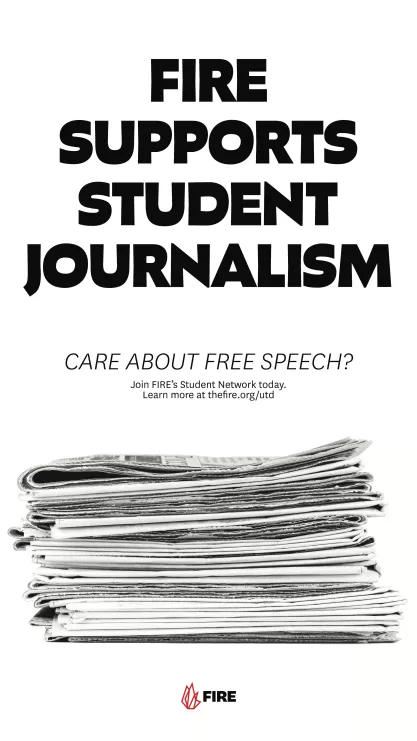
FIRE took out a full page ad in support of The Retrograde at UT Dallas.
In our letter, we argued that the university’s firing of Gutierrez was in retaliation for The Mercury’s unflattering coverage of the way administrators had handled the encampments. This is not even the first time UT Dallas has chosen censorship as the “best solution;” look no further than in late 2023 when they removed the “Spirit Rocks” students used to express themselves. Unfortunately, the university ignored both the students’ exhortations and FIRE’s demands, leaving UT Dallas without its newspaper.
But FIRE’s Student Press Freedom Initiative is here to make sure censorship never gets the last word.
Students established The Retrograde, a fully independent newspaper. Without university resources, they have had to crowdfund and source their own equipment, working spaces, a new website, and everything else necessary to provide quality student-led journalism to the UT Dallas community. They succeeded, and FIRE is proud to support their efforts, placing a full-page ad in this week’s inaugural issue of The Retrograde.
The fight for press freedom at UT Dallas is far from over — but we need your help to make a difference.
Demand accountability from UT Dallas. The student journalists of The Retrograde have shown incredible spirit. With your help, we can ensure their efforts — and the rights of all student journalists — are respected.