Tag: Strategies

  • College Recruitment Strategies and Ideas to Boost Enrollment

    College Recruitment Strategies and Ideas to Boost Enrollment

    Student Recruitment Ideas for Better Enrollment Marketing

    College recruitment strategies have undergone a seismic shift in recent years with the rise of an always-on digital audience and the growing accessibility of online programs. Fewer geographical constraints and heightened competition have fueled this realignment, prompting institutions to craft student recruitment strategies that are as dynamic as the students they aim to enroll. 

    In the modern, digital-first landscape of higher education, recruitment season is no longer confined to the traditional August to December window. Students are applying and enrolling year-round, and your institution must constantly assess which strategies are driving results and which are falling flat. 

    By embracing smarter, data-driven marketing tactics, you can stand out in the crowded landscape of online education, uniting students under the shared mission of your institution. 

    The Importance of Student Recruitment Strategies 

    You’ve been working in higher education for over a decade, but recently, student recruitment seems harder. You’re not alone. Prospective students are going in less traditional directions and finding cheaper, faster ways to become qualified for the workforce through modalities such as online certificates and boot camp programs. Inflation isn’t helping either. 

    But through a realignment of strategy to meet digital native consumers, you can meet students where they are and capitalize on projected enrollment growth

    Don’t get scared into sticking with outdated ways of reaching prospective students. Instead, rise to the challenge, get a better understanding of the landscape you’re working with, and refresh your enrollment marketing strategy. 

    3 Student Recruitment Strategies

    We won’t tell you that all traditional marketing strategies are outdated, but we do want to make it crystal clear that students are online. They’re surfing the web on their smartphones and discovering new universities and programs through (mostly mobile) online journeys. If your enrollment strategy isn’t rooted in this reality, you’re at risk of losing more than half of your potential students. 

    1. Meet Them Where They’re At (On Their Phones!)

    With 91% of the U.S. residents owning a smartphone, it’s no surprise prospective students are surfing the web from their mobile devices. In fact, a recent report by Oberlo tells us that over 60% of all internet traffic comes from mobile devices. 

    Most of the time, however, our web developers, brand managers, and marketing professionals are viewing and building websites on their desktop computers. While working from a computer is convenient, it’s imperative that every single UX/UI change made to your university/program website is tested on both desktop and mobile. 

    Don’t lose out on prospects just because you didn’t consider both desktop and mobile website views in your design process. It may seem obvious, but plenty of colleges and universities aren’t considering this important strategic detail. 

    2. Consider Utilizing Paid Media

    Now that you’ve cleaned up your mobile site, you’re ready to start pushing students from other platforms to your program pages through a key college recruitment strategy: paid media. While paid media isn’t the cheapest option, it’s often one of the most effective. Google Ads, LinkedIn, and Facebook provide fairly straightforward ways to spend for clicks. 

    We recommend starting with PPC (pay per click) campaigns to attract prospective students to your site. These campaigns help the most with bringing in entirely new audience members whom you may not have been able to reach through organic efforts. The internet is vast, and it’s not always easy to track down potential candidates without some extra help. 

    After bringing in new prospects from platforms like Google and LinkedIn, your job is to create a journey where they’ll sign up for your newsletter or respond to a survey so you can effectively follow up and make their click worthwhile. It may seem pricey at first, but once the leads start coming in and you’re able to connect with them well after that first click, you’ll see the return on investment. 

    PPC campaigns can also help speed up the process if you’re finding yourself behind on your goals this quarter.

    3. Tap Into Popular Platforms and Their Users

    If paid media feels a bit too far out of reach, some high-growth organic options can help your student recruitment strategy. 

    Use Instagram to Engage With Students

    Most institutions now have a presence on LinkedIn and Facebook, but university marketers may be missing a huge opportunity with Instagram. A recent article from RivalIQ cited higher ed’s impressive average engagement rate of 2.43% on Instagram, compared with the median across all industries of 0.43%. 

    Instagram should be used in a completely different way than Facebook and LinkedIn, which can be deterring for content teams, but clearly prospective students are interested in engaging there. Be sure to connect with them and provide tailored content.

    Harness the Power of Testimonials

    When you hear the words “influencer marketing,” you may think of famous teenagers with millions of followers dancing their hearts out to a 15-second song. While plenty of those influencers are out there, so are users who share their educational journeys, financial tips and tricks, and personal stories about their lives and experiences. 

    With the number of graduates, administrators, and staff members your school has on social media, you’re sure to find some influential users who are willing to share their satisfaction with your program on their channels. It doesn’t require millions of followers either. 

    Nano influencers (influencers with a following between 1K and 10K) are “everyday people” who come across as more authentic and with much more enthusiasm than the players in the big leagues (micro/macro influencers). According to a recent study from Matter Communications, 69% of consumers depend on recommendations from influencers, family members, and friends over information provided by brands. That means two of every three consumers want to read reviews from online personalities they see as trustworthy sources — an amplified version of word-of-mouth marketing.

    Use Short-Form Video to Reach New Audiences

    Short-form video is an important college recruitment strategy for engaging with students. Though the style of content may seem daunting and the editing may seem like a lot of work, recent studies have indicated that Gen Z users prefer TikTok for search over Google — making it an indispensable part of your strategy. 

    Although prospective student demographics look different across universities, your target students are likely on TikTok. And more importantly, they’re using it as a source of information. The hashtag #LearnOnTikTok had over 360 billion views as of 2024, according to The Leap

    Think of the reasons users visit your website — and the questions they have — and use that insight to inform the kinds of content you can provide to educate prospective students. 

    We Can Help Build Your Online College Recruitment Strategies

    The higher-ed landscape is still undergoing unexpected shifts at a faster rate than most of us are ready for. Some days, you might feel like you’ll be playing catch-up for ages, and evolving marketing tactics might make that race feel even harder. It’s a lot to manage a robust omnichannel college recruitment strategy, but you don’t have to do it all internally. 

    At Archer Education, we partner with colleges and universities to create effective messaging that will illuminate your brand’s strengths and unique values to attract and convert high-quality students. Our experts are always in the know, employing tech-enabled, modern enrollment tactics to attract prospective students’ attention, drive engagement, and facilitate action. Don’t overstretch your team members — let us help. Contact us today for more information.

    Source link

  • The Enrollment Shift: Strategies for Engaging the Modern Learner

    The Enrollment Shift: Strategies for Engaging the Modern Learner

    Meet Maria. A recent high school graduate with her sights set on a career in web development, Maria surprised her family by choosing a six-month accelerated certificate program at a local community college over a traditional four-year computer science degree. Why? Because Maria, like many of today’s learners, prioritizes a fast track to career readiness, affordability and the flexibility to learn at her own pace. She’s not alone. This trend is playing out across the country, forcing institutions to rethink their approach to attracting and retaining students.

    Maria’s story exemplifies the enrollment shift happening in higher education. Greg Clayton, the President of the EMS division of EducationDynamics says: “Higher education isn’t collapsing, it’s shifting. Schools must adapt to meet the evolving needs of today’s students or they will be left behind.” This shift is driven by a confluence of factors, from changing demographics to evolving student priorities and the rise of new technologies.

    Changing How We Think About the Coming Enrollment Cliff

    As we covered earlier this year in our blog post about the Enrollment Cliff, higher education is about to come up against a demographic shift that will impact first-year enrollment, starting with the Fall 2025 class. With this demographic “apocalypse” just on the horizon, all eyes and thoughts have been on what to do about a shrinking pool of 18-year-olds looking to start their first year of college.

    However, as research from the National Student Clearinghouse Research Center (NSCRC) indicates, we may be looking at an Enrollment Shift that is happening concurrently with the Enrollment Cliff. The latest NSC data for 2024 shows that while enrollment rose 3% overall for the Fall 2024 term over the Fall 2023 term, Fall enrollment for incoming freshmen is down across all institutions at an average of 5%. To be clear, we have not hit the Enrollment Cliff yet. The importance of this data cannot be overemphasized. If 18-year-olds are already considering waiting or taking alternate paths to the workforce and obtaining a degree, the demographic shift will hit that much harder, over a longer period of time.

    Digging further into the data reveals even more startling numbers, which show larger shifts in enrollment trends based on economic background. Compared to Fall 2023 enrollment, institutions which have a high percentage of students utilizing Pell grants, the retraction for both publics and private non-profits is over 10%. From the students’ perspective, “middle” income households are also seeing the steepest decline, at 8%.

    So what does this tell us? It is telling us that the background noise over the past 5-7 years regarding the cost of getting a degree, the methodology with which they are achieved and the career/economic outcomes afterward are absolutely being reflected by the decisions people are making who are most impacted by these economic realities. It is telling us that the current model is not working, it is unsustainable – it is untenable for the students and it is untenable for the schools that are supposed to support them. Match this massive regression in the market with the actual Enrollment Cliff and the numbers are more than startling. It is in the millions, compounded by each year of subsequent birth decline.

    And what is making up for this loss in incoming freshmen? As we have stated before, it is being fueled by a surge in “non-traditional” students – adult learners, international students and those returning to college to upskill or reskill. These students bring with them a wealth of experience and a clear sense of purpose, but they also have unique needs and expectations. Institutions must be prepared to cater to this growing population by offering programs and services that align with their goals and lifestyles.

    Furthermore, the “some college, no credential” (SCNC) population, now numbering 36.8 million, represents a significant opportunity for higher education institutions. Re-enrollment among this group increased by 9.1% in the 2022-2023 academic year, demonstrating a growing desire for continued education and career advancement. Reaching out to this population and providing clear pathways for degree completion can be a valuable strategy for boosting enrollment and serving a population eager to advance their careers.

    It’s also important to recognize that age is no longer a predictor of learning modality. Many younger students, like Maria, are opting for part-time enrollment, online programs, or alternative credentials that offer a quicker path to employment. The Modern Learner, regardless of age, demands flexibility and relevance. They are digital natives, accustomed to accessing information and services online and they expect the same level of convenience and personalization from their educational experiences.

    The Rising of the Modern Learner Era

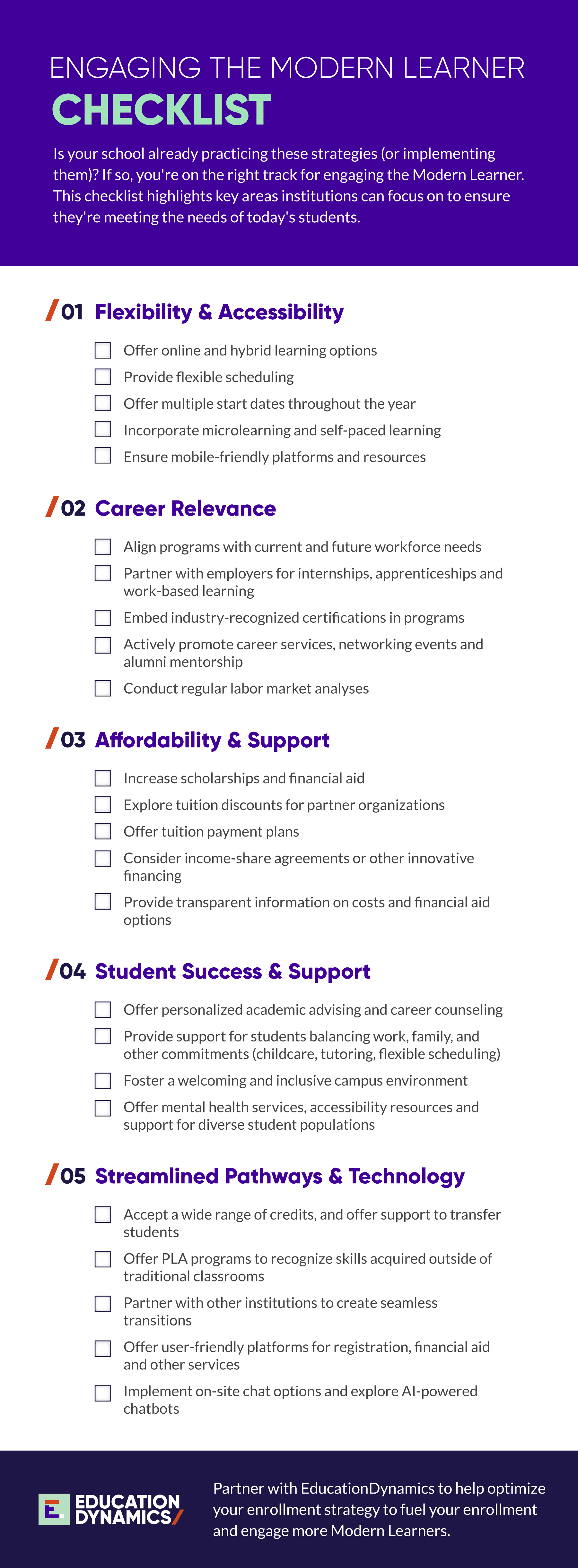
    To thrive in this new era, consider some of these strategies higher education institutions to adapt to the needs of the Modern Learner.

    Offer Flexible Learning Options

    Expand online and hybrid learning modalities to cater to students who need flexibility in their schedules and learning environment. Offer evening, weekend and accelerated programs to accommodate those balancing work and family commitments. Provide multiple start dates throughout the year to allow students to enroll when it’s convenient for them. Consider incorporating modalities like microlearning and self-paced learning to further cater to individual needs. Offer mobile-friendly learning platforms and resources to allow students to learn on the go.

    Focus on Career Relevance

    Develop programs that align with current and future workforce needs. Partner with employers to offer internships, apprenticeships and other work-based learning experiences that provide students with practical skills and industry connections. Embed industry-recognized certifications within degree programs to enhance their value and marketability. Actively promote career services, networking events and alumni mentorship programs to connect students with career opportunities. Conduct regular labor market analyses to ensure programs are aligned with current and emerging industry trends.

    Make Education More Affordable

    Increase the availability of scholarships and financial aid to help students manage the cost of education. Explore tuition discounts for employees of partner organizations to incentivize upskilling and reskilling. Promote tuition payment plans to make education more accessible to those with limited financial resources. Consider offering income-share agreements or other innovative financing models to align the cost of education with future earning potential. Provide clear and transparent information about tuition costs and financial aid options.

    Provide Robust Student Support Services

    Offer personalized academic advising and career counseling to help students navigate their educational journey and achieve their career goals. Provide support for students balancing work, family and other commitments, such as childcare resources, online tutoring and flexible scheduling options. Create a welcoming and inclusive campus environment where all students feel supported and valued. Offer mental health services, accessibility resources and dedicated support for diverse student populations, including first-generation students, veterans and students with disabilities.

    Streamline the Transfer Credit Process

    Implement a clear and transparent transfer credit policy to facilitate the seamless transfer of credits from other institutions. Adopt a generous policy on accepting transfer credits, recognizing the value of prior learning and experience. Provide dedicated support for SCNC students to help them navigate the re-enrollment process and complete their degrees. Consider implementing prior learning assessment (PLA) programs to grant credit for knowledge and skills acquired outside of the traditional classroom. Develop partnerships with community colleges and other institutions to create seamless transfer pathways.

    Leverage Technology to Enhance the Student Experience

    Use data analytics to personalize communication and support, tailoring messages and interventions to individual student needs. Implement user-friendly online platforms for course registration, financial aid and other services, making it easy for students to access information and complete tasks. Offer on-site chat options on school websites to provide immediate assistance and answer questions in real-time. Explore the use of AI-powered chatbots to provide 24/7 support and personalized guidance. Utilize virtual reality and augmented reality technologies to create immersive learning experiences.

    Embracing the Enrollment Shift

    The future of higher education depends on its ability to adapt to the evolving needs of the Modern Learner. Institutions that embrace flexibility, affordability, career relevance and student-centered approaches will be well-positioned for success.

    It’s time to embrace the enrollment shift. By understanding the motivations and priorities of today’s students, higher education can evolve to meet the challenges and opportunities of the 21st century. This requires a shift in mindset, from a focus on traditional models of education to a more agile, responsive and student-centric approach.

    EducationDynamics is your partner in navigating this changing landscape. We provide the expertise and solutions you need to attract, enroll and retain Modern Learners. Contact us today to learn more.

    Source link

  • SEO for Higher Education: Strategies in 2024

    SEO for Higher Education: Strategies in 2024

    Boost Your Enrollment Cycle With These Higher Ed SEO Strategies                                          

    Billions of queries occur daily through global search engines on desktop, mobile, and voice devices. These organic searches are the largest drivers of website traffic, particularly for higher education institutions, making SEO an essential ingredient in the recipe for generating student leads. A student’s journey toward enrollment is a roller coaster of considerations. From looking at financial costs and career opportunities to assessing workloads and faculty projects, students turn to search engines to answer their questions. 

    Optimizing your university’s website involves looking at a variety of SEO factors: webpage speed, page titles and headings, URL structure, link building, content, and more. Here at Archer, our higher education SEO team members have expert insight at every step on the path toward optimizing a university’s website, including technical on-page improvements, off-page link building, and, most importantly, content creation and promotion. 

    Let’s explore how your institution can stay relevant and bring new prospective students in with a sophisticated higher education SEO strategy.

    SEO for Higher Education: What You Need to Know 

    Online content saturation is at an all-time high, and competition in higher ed is intensifying. Meanwhile, the audiences that institutions are marketing to have become less traditional. 

    Capturing the attention of prospective students at a critical point in their college enrollment journey takes a deep understanding of all the nuances of search engine optimization, including search intent, click-through rates, and mobile experience. To create content that will engage online audiences, universities must have strong SEO strategies to ensure brand discovery. 

    7 SEO Strategies to Boost Your College Enrollment Cycle

    Our higher ed SEO experts have pulled together a list of seven strategies to help capture students along their path to college enrollment. Their expertise will help guide you in discerning what’s important in an SEO strategy and where to set focus for the rest of the year. 
    1. Determine Your Student Journey               

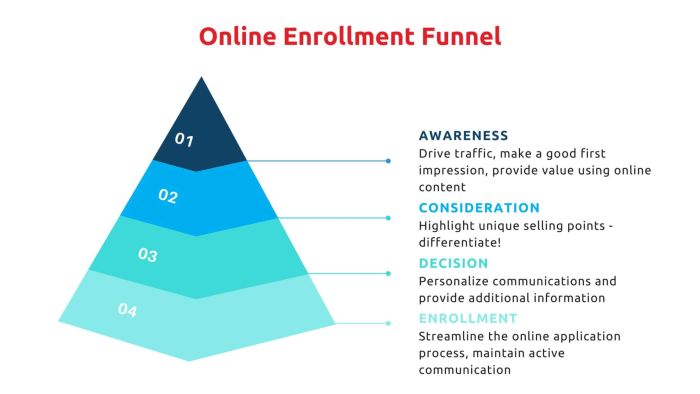
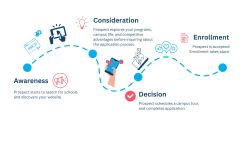
    Student journey maps are going to be key in helping you guide the focus and intent of your content. How are you making students aware of your programs? At what point are they considering your programs? Where in the journey do they make a decision, and what do they need to get there? 

    Students looking to advance their academic and professional careers are at some point in the sales funnel, but they’re also at some stage in their search engine journey. If you’re doing it right, you’ve constructed this journey carefully and provided several different routes for the different kinds of prospective students you interact with. 

    For example, a student might be only tangentially familiar with the construction industry, so you can gain their interest by crafting a piece about construction careers that graduates can enter after receiving a construction management degree. On the other hand, a student might be further along in their journey and might be at the point of more serious consideration of an engineering degree. For this student, you can craft a post about stress management for engineering students. 

    If you want to get students to your website, finding blog topics is only half the game. Using keywords to optimize your content is how you push those posts to the finish line. Google’s latest algorithms emphasize value, so figure out what value you can provide your reader at every stage of inquiry.

    By walking through the student’s college enrollment experience and differentiating content based on the needs of each stage, you can curate specific content to respond to their search intent, keep them engaged with your brand, and guide them down your content map to a post that encourages them to convert.

    2. Satisfy Student Search Intent              

    Since search intent is Google’s ultimate goal, when it comes to SEO for higher education, keyword research and content creation that match the student’s search intent should be a primary focus.

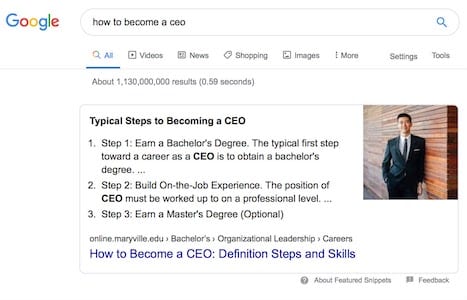
    The “How to Become a CEO” article above is a great example of a university-created piece of content that matches search intent and provides steps that show how the university program can help the searcher accomplish their goal. Content should discuss a range of topics that align with the university’s mission and program’s course curriculum while still keeping the searcher top of mind. With each piece of content, you’ll be able to attract a variety of students who are in different places in the student discovery process.

    Each of these posts should have a strong call to action (CTA) that intrigues prospective students to learn more about the university’s program and how they can become more involved and apply. This CTA can include an aesthetically pleasing “learn more” button that directs readers to a “request more information” form.

    3. Apply Google’s Helpful Content Update Learnings

    In 2023, Google introduced a new helpful content algorithm intended to help searchers find relevant results. This update is intended to weed out nonhelpful search results, defined as content that lacks experience, expertise, authoritativeness, or trustworthiness (E-E-A-T). 

    What does this mean for universities? Crafting high-quality content that meets student search intent is even more important. Instead of focusing solely on SEO keywords, university website pages and blogs need to meet Google’s quality standards in one or more E-E-A-T fields.

    Universities can meet these expectations by providing high-quality information that highlights faculty and student experiences and expertise.

    4. Elevate Your Content Strategy           

    Searchers are no longer satisfied with traditional text-based content or boring images. This is especially true for millennials and Gen Zers, who account for 42% of the U.S. population, according to Statista, and the majority of a university’s target market. 

    To capture the attention of these easily distracted searchers, higher education SEO strategies should branch out beyond traditional articles and infographics to include visually captivating and psychologically intriguing content, such as interactive graphics or videos. This refreshed content strategy should aim to not only catch a searcher’s immediate attention but also leave a lasting brand imprint to intrigue searchers to come back for more.

    Check out the following example of an engaging piece of content from Zippia.com that outlines the different career paths for cost accountants. The piece is interactive, allowing the user to move their mouse along the different career paths to reveal more detailed and relevant information.

    This interactive map is fun and easy to use while still providing the quality and quantity of content the user is looking for. It illustrates the kind of memorable yet useful experience required to capture a student’s attention.

    5. Occupy Google Search Results

    Occupying more real estate on ever-evolving search engine results pages (SERPs) is more crucial than ever. A large number of Google searches do not result in a click. With the advent of more featured snippets, the importance of a technically sound website, structured data, and high-quality content grows.

    While on-page SEO is still crucial for ranking on the SERP, off-page efforts and creating a user experience (UX) that expands past your website are the next wave of occupying internet real estate. Off-page citations, or references to your institution on websites such as U.S. News and Wikipedia, will push hints and signals to Google that validate your brand. Quality higher education SEO strategies should also include a UX that helps your site stand out in today’s saturated marketplace.

    6. Optimize Your Website for Mobile           

    To enhance the college enrollment funnel experience, you need to maintain the health of your website for both desktop and mobile.

    Since a majority of search engine visits come from mobile devices, there’s no question that higher education SEO teams should be focusing on the mobile user experience of their websites. Now that Google has mobile-first indexing best practices, your team has new factors to consider. If your website’s content differs between desktop and mobile, for example, then your site is at risk of having pages not indexed or crawled, which could result in a significant loss of traffic. 

    For starters, ensure that desktop and mobile versions of your website have identical content, as well as identical technical elements, such as structured data and meta tags. Whether you’re developing content or updating your website design, always be sure to consider both platforms in any updates you make.

    7. Understand Your Competition   

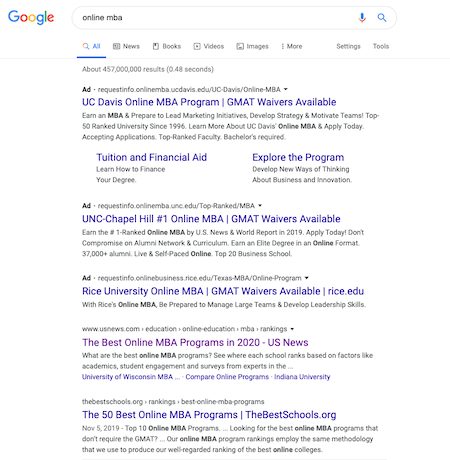
    With Google ads for search terms like “online mba” generating a high cost per click (CPC), higher education is one of the most competitive segments of search engine rankings. Why? Simply put, graduate degree programs are expensive and have large marketing budgets. In addition, affiliate marketing is rampant in the higher education space. What’s affiliate marketing? Affiliate marketers in higher education essentially sell student leads to universities.

    These affiliate sites often have large SEO budgets and benefit from degree ranking and badging tactics. Take a look at the density of non-edu sites in the search results by Googling “online mba.” 

    In addition to competing with a number of affiliate websites, traditional schools have to compete with for-profit institutions and institutions with powerful national and regional brands.

    Despite the competitive market, a long-term higher education SEO strategy, with a nuanced understanding of the market, can yield tremendous results around student enrollments and thought leadership.

    SEO for Higher Education: Boost Your Results with Archer 

    Here at Archer Education, we partner with accredited universities to help higher-ed leaders and marketers accelerate online learning growth and enrollment. We offer a variety of tech-enabled marketing, enrollment, and retention services, and our team of SEO experts is always up to date on strategies to help your program gain visibility in prospective students’ search results. 

    Our SEO tactics can help your university:

    Contact us or visit our SEO tactics page to learn more about how Archer can help you reach your enrollment goals.

    Sources

    Backlinko, Search Intent and SEO: A Complete Guide 

    Forbes, “Understanding Google’s Mobile-First Indexing To Generate More Traffic To Your Website” 

    National Student Clearinghouse Research Center, Current Term Enrollment Estimates

     Statista, U.S. population Share by Generation 2023

    Zippia, How To Become A Cost Accountant: What It Is and Career Path

    Source link

  • 10 Strategies to Attract and Enroll the Modern Learner

    10 Strategies to Attract and Enroll the Modern Learner

    As the higher education landscape continues to shift and evolve, the expectations and priorities of today’s students are shifting as well. To stay relevant, institutions are expanding their focus beyond traditional academic models to better meet the needs of a more discerning audience. Modern Learners are no longer bound by age or conventional learning modalities—today’s students are driven by different priorities, presenting a challenge for institutions relying on outdated methods to engage this demographic.  

    With primary motivators including career advancement and the need for flexibility, Modern Learners demand educational opportunities that offer accessibility, transparency and value. They are more selective, especially as the perceived value of a college degree has been questioned amid economic uncertainty. With rising student debt, these learners are looking for programs that provide a clear return on investment—an education that advances their careers while offering flexible options that meet their financial and personal needs. Success lies in striking a balance between value and cost-effectiveness, ensuring students feel seen, supported and equipped for the future. 

    Explore ten essential strategies for higher education institutions to expand their offerings and better engage Modern Learners. From improving strategies to leveraging resources and fostering deeper connections with students, these strategies aim to engage with Modern Learners based on their preferences and behavior rather than demographics by embracing a Unified Enrollment Strategy that fuels sustainable growth. 

    1. Build a Cohesive Brand

    In a competitive landscape where a strong brand is essential, the increasingly selective nature of Modern Learners calls for an institution’s brand to resonate with prospective students.

    Your institution’s brand identity should authentically reflect its values, mission and unique offerings. A compelling brand narrative not only showcases your unique selling proposition (USP), but also serves as an opportunity to connect on a deeper level with potential students, fostering trust and engagement.

    Building a cohesive brand experience involves aligning visual elements, messaging and tone to create consistency across all touchpoints—from your website to social media, emails and beyond. This alignment strengthens students’ understanding of your value proposition, guiding them throughout their journey and ensuring they feel engaged at every stage.

    At EducationDynamics, our in-house Creative team specializes in data-driven brand positioning and strategy. We take the time to understand your institution’s unique strengths and craft creative solutions that support the student journey, from initial discovery to enrollment. Discover how our creative services can help your institution’s brand thrive and successfully engage Modern Learners.

    2. Adopt a Full-Funnel Marketing Approach 

    As Modern Learners increasingly seek personalized learning experiences that align with their needs, institutions need to elevate their marketing strategies to meet their growing expectations. By embracing a full-funnel approach, schools can more effectively engage with students at every stage of their journey, leading to stronger enrollment outcomes.  

    A holistic full-funnel marketing approach not only boosts engagement, but also augments long-term growth by nurturing students from awareness to decision.  As students continue to research more throughout their journey and prioritize personalized content, institutions must adopt comprehensive approaches to effectively reach them.  

    With EducationDynamics’ multi-channel digital marketing expertise, schools can target students across various platforms, ensuring personalized messaging and an engaging experience across every touchpoint. If you want to learn more about how to build a successful full-funnel marketing approach, check out our Full-Funnel Marketing Guide for Higher Education.  

    3. Utilize Market Research to Identify High-Growth Programs 

    To effectively meet the evolving priorities of Modern Learners, institutions must develop programs that align with market trends and career opportunities. Leveraging market research allows schools to refine their offerings and better address students’ shifting needs and expectations. 

    Resources such as EducationDynamics’ eLearning Index Web App, serve as a powerful resource. The Web App, developed by EducationDynamics’ Market Research team, utilizes current National Center for Education Statistics (NCES) data, to showcase an accurate view of the current labor market and relevant trends regarding degree completions. Administrators can use the app’s interactive features to isolate the data by region, modality and program. By providing insights into the highest opportunity programs available for each educational level and a convenient user interface, the eLearning Index Web App tool empowers schools to optimize their program offerings, ensuring that they are offering degrees that are relevant to Modern Learners. Through aligning programs with high-growth career opportunities, institutions can not only boost retention but also empower students with the skills and support they need to thrive in the current job market.

    4. Nurture Leads and Personalize the Journey  

    Modern Learners often research extensively before finalizing their enrollment decision, seeking personalized and relevant information at every stage. Building relationships early and maintaining engagement over time is essential, whether you’re connecting with prospective students for the first time, re-engaging stopped-out students, or reconnecting with dormant inquiries.  

    Effective lead nurturing helps institutions build these relationships through tailored content that addresses the specific needs and interests of each student. Consistent communication guides students through their decision-making journey, ensuring they feel supported. 

    Marketing automation can help streamline these efforts. Through automation of communication workflows, institutions can deliver timely and personalized messaging that resonates with students. This level of personalization and consideration throughout multiple touchpoints in the student journey improves overall engagement and student experiences.  

    At EducationDynamics, our Nurturing Services offer institutions multi-channel engagement, using best-in-class marketing automation technology.  By delivering personalized communications across various platforms, we help schools strengthen connections with students at every stage of their journey.

    5. Provide 24/7 Support with AI Chatbots 

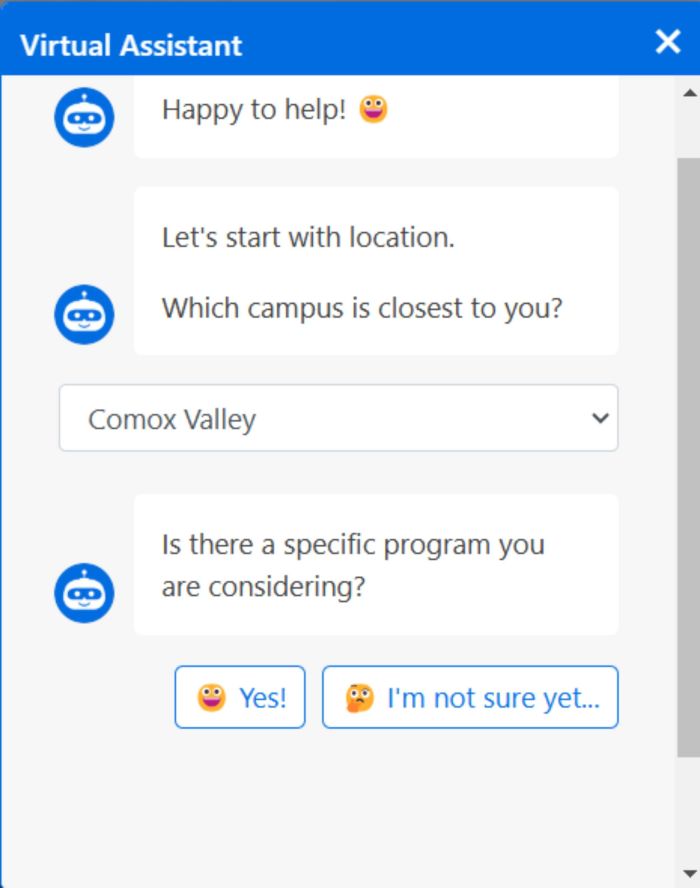
    As institutions seek to attract and enroll the Modern Learner, implementing AI Chatbots serves as a key tool by delivering real-time assistance and tailored responses to common student inquiries. Prospective students frequently encounter obstacles when searching for relevant information during their enrollment journey. With Modern Learners expecting immediate access to information, these challenges can lead to a frustrating experience, potentially impeding their enrollment decision. Employing AI Chatbots can help address this, through instant responses that answer commonly asked questions regarding program details, financial aid and academic support at any time of day. These chatbots not only help manage routine tasks, but they also allow admissions staff to focus on the more complex, high-touch interactions. By incorporating AI Chatbots into your institution’s communication strategy, you enhance student support and ensure that every inquiry receives proper, timely attention.  

    6. Showcase Your Innovative Spirit 

    Standing out amid the competitive higher education landscape is vital for attracting Modern Learners, who seek educational opportunities that align with their evolving needs and aspirations. Today’s students are not merely seeking to fulfill degree requirements; they are looking for an education that resonates with their interests and provides long-term growth opportunities. This is where innovation can play a vital role. By highlighting your university’s unique offerings and distinct culture, you can offer Modern Learners attractive reasons to choose your school, while demonstrating how you are adapting to meet the growing demands of Modern Learners.  

    At EducationDynamics’ Higher Ed Marketing Agency, our team of experts understand the importance of showcasing each institution’s unique selling points and innovative approaches within the higher education space.  Our services are designed to communicate the value of choosing your school, whether it’s through digital campaigns, social media content, or compelling copywriting. We empower you to emphasize your distinct strengths, enabling your institution to foster deeper connections with Modern Learners and guide them towards enrollment.  

    7. Create a Seamless Student Journey 

    The traditional, linear student journey no longer applies to today’s Modern Learners. With various commitments, such as family and work responsibilities, modern students engage with their educational environment in different ways than in years past. As a result, institutions need to adjust how they approach the student journey. By implementing student journey mapping, institutions can better understand the various stages of the student experience and refine it to reduce pain points. 

    EducationDynamics’ student journey mapping process provides institutions with actionable insights to optimize every stage of the student experience, from inquiry to enrollment. The process begins with a comprehensive analysis of your current student recruitment and services, including existing marketing materials, communication technology and student support systems. Using data-driven insights, we then create a visual student journey map that identifies key touch points and opportunities to enhance communication. From there, we develop a communication plan with targeted messaging and content designed to nurture, guide and support students across their enrollment journey. By integrating student journey mapping, institutions can better visualize the Modern Learner’s journey, while meeting their evolving needs.   

    8. Invest in Financial Aid Support 

    Financial aid is among the first pieces of information students seek and often plays a pivotal role in their enrollment decision. Equipping your institution’s advising team with the tools to engage in financial aid conversations early in the student journey is critical to meeting the expectations of Modern Learners and encouraging them to choose your institution over another.  

     EducationDynamics’ Financial Aid Advising services offer personalized support through dedicated coaches who manage student inquiries and provide individualized guidance. This streamlined approach allows your admissions team to focus on key priorities, while ensuring students receive the financial aid support they need. By delivering clear answers and a supportive experience, students are more likely to enroll, resulting in higher enrollment and retention rates. 

    9. Streamline Your CRM and Marketing Data Integration  

    A robust Customer Relationship Management (CRM) system is essential for navigating the Modern Learner’s enrollment journey. By collecting and managing student data, CRMs promote personalized communication that resonates with students. To truly maximize their potential, CRM systems should be optimized through technology integration, data quality assessments and user adoption, ensuring they effectively reach Modern Learners while driving scalable enrollment growth.  

    EducationDynamics recognizes the importance of an integrated CRM system. Our team of integration experts specialize in implementing and maintaining clean, actionable data that supports a cohesive strategy, giving your institution a holistic overview of each student and ensuring your CRM is built for long-term success.   

    10. Optimize Your Enrollment Team  

    As the primary point of contact for prospective students, your enrollment team is one of the most critical investments you can make. The expertise and engagement of your enrollment staff directly influences prospective students’ decisions, making them essential to student success outcomes.   

    At EducationDynamics, we believe in empowering both institutions and students by investing in staff development. Through our The U School platform, institutions can access exclusive 8-week programs designed to equip your team with the skills needed to meet the unique demands of Modern Learners. By strengthening staff training, we help build more effective enrollment pathways, ultimately increasing student engagement, satisfaction and enrollment growth.  

    Empowering Your Institution to Engage Modern Learners

    Attracting and enrolling Modern Learners requires a comprehensive approach that acknowledges their unique needs and preferences. By implementing the ten key strategies outlined in this article, higher education institutions can engage a new demographic of learners while nurturing meaningful connections with students. Embracing innovative solutions like student journey mapping and leveraging available resources allows institutions to transform the student experience. As the higher education environment continues to change and enrollment challenges arise due to shifting economic and demographic factors, institutions who proactively understand and cater to the unique needs of Modern Learners will differentiate themselves from the competition.  As your strategic partner, EDDY is committed to empowering your institution to confidently navigate these challenges while collectively advancing our mission to expand opportunity through education. 

    Source link

  • Role of Dean in Higher Education: 8 Strategies for Engagement

    Role of Dean in Higher Education: 8 Strategies for Engagement

    Tune In To Our Audio Blog


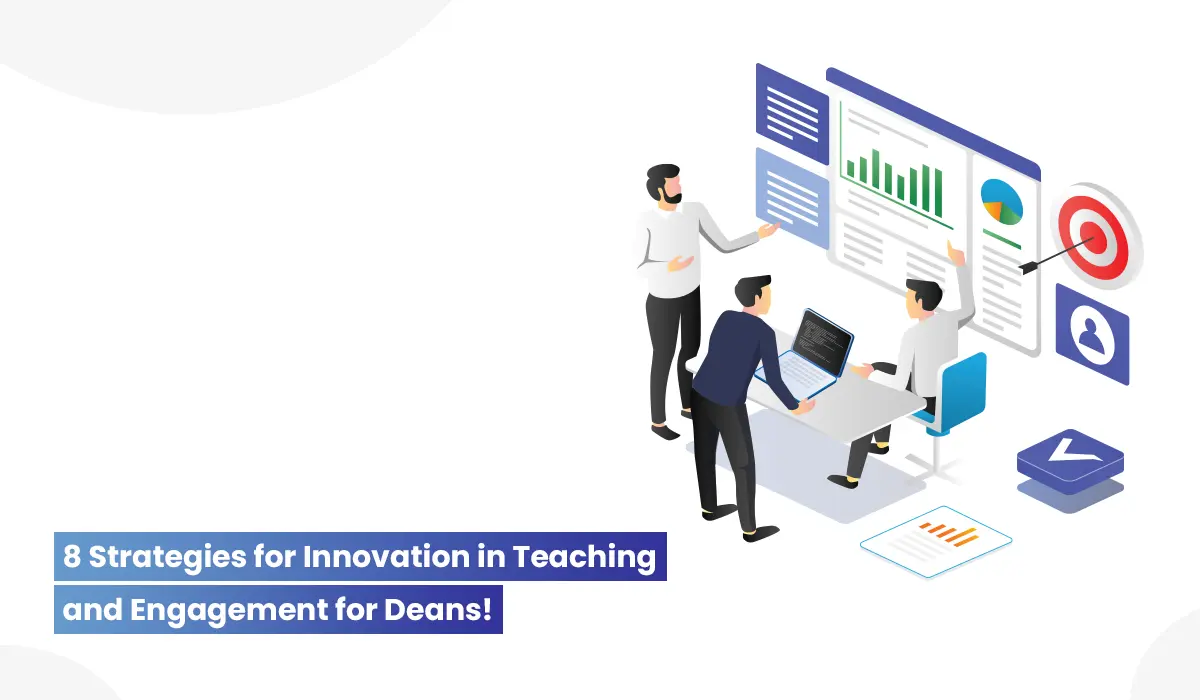
    Hello Deans, you are crucial in determining how education will develop in the future because you are the designers of your higher ed’s academic vision. Building successful learning environments where faculty and students flourish depends on your leadership. We’ll look at the role of dean in higher education and how deans can foster innovation in higher education institutions, and their creative approaches in this blog that can improve instruction and student participation, turning your classrooms into places where learning happens and ideas are generated.

    We’ll also demonstrate how the Creatrix suite can help you at every stage and provide you with the resources you need to have a significant, long-lasting influence. Let’s get started and support your academic community in realizing its greatest potential!


    The Role of Dean in Higher Education – Understanding the Dean’s Influence on a Campus

    With your influence over all facets of your institution’s learning environment, deans are the beating heart of academic leadership. Your influence greatly influences student outcomes, research, and teaching in addition to administrative tasks. Here is the common role of dean in higher education that demonstrates your impact:


    • Decide on the priorities and institutional culture.
    • Take the lead in implementing cutting-edge instructional strategies and technological advancements.
    • Make certain that the courses adhere to the most recent developments in education.
    • Motivate and assist educators in investigating novel teaching strategies.
    • Promote initiatives that increase student involvement and academic performance to increase student engagement.
    • Faculty and students can flourish in a dynamic learning environment when your vision serves as the cornerstone for educational excellence.
    • You take the initiative to implement tactics that raise student retention and success and involvement while fostering engaging learning environments.


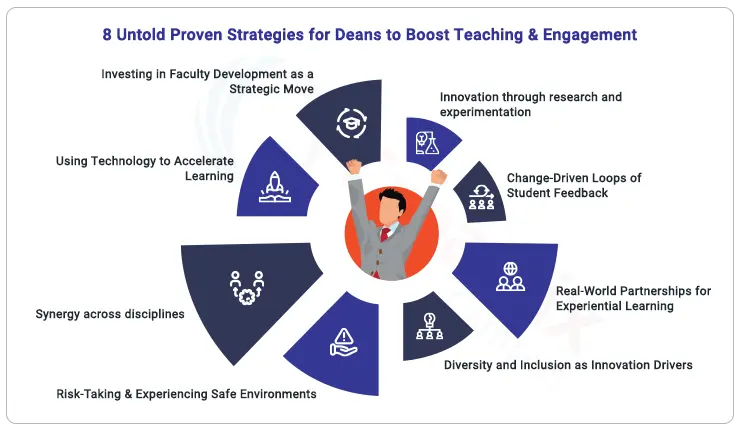
    What’s Working Globally: 8 Proven Strategies for Deans to Elevate Teaching & Engagement

    While researching how deans can foster innovation in higher education institutions we arrived at a stunning analysis; we discovered how effectively leading deans from all around the world are changing education by pushing the envelope and implementing cutting-edge tactics. And we have documented on what’s working with them and the reasons these strategies are spreading throughout institutions worldwide for you to help you better!


    8-untold-proven-strategies-for-deans-to-boost-teaching


    1. Synergy across disciplines

    The most progressive deans of today are bringing students from various disciplines together to work together on real-world issues. Students studying business and engineering at the University of Michigan collaborated to develop ground-breaking solutions that enhanced critical thinking and teamwork, an approach that is quickly becoming recognized as a hallmark of academic innovation.


    2. Using Technology to Accelerate Learning

    Deans from the best universities across the globe are utilizing technology to transform education, from virtual reality to AI-driven tools. We figured out that Virtual reality (VR) and Gamified Learning were implemented at Stanford University recently! The main intention behind these initiatives was to enhance student engagement and understanding in subjects like anatomy and architecture! These technologies indeed allow students to study complex subjects in immersive and interactive ways.


    3. Investing in Faculty Development as a Strategic Move

    Giving professors the freedom to take the lead in innovation is crucial in the rapidly evolving field of education. At UC Berkeley, deans arranged workshops on active learning strategies, equipping teachers with the means to design more engaging, student-focused classrooms and demonstrating how supportive faculty members contribute to student retention and success.


    4. Innovation through research and experimentation

    It is also surprising to witness institutions such as Arizona State University provide faculty with resources to experiment with cutting-edge curricula. This is so welcoming indeed. By funding experiential learning projects, deans and decision-makers enable educators to test new models of teaching, and curriculum mapping, resulting in programs that increase student engagement and academic achievement.


    5. Change-Driven Loops of Student Feedback

    The next best strategy we figured out was that the academic institutions globally are utilizing student feedback to enhance their pedagogical approaches. They throng on 360-degree courses and faculty evaluation tools to listen out students’ opinions for improvement. It has been demonstrated that listening to students can significantly improve the learning experience. Georgia State University’s “Student Engagement Surveys” revealed insightful feedback that resulted in significant improvements in course delivery.


    6. Real-World Partnerships for Experiential Learning

    Another surprising discovery was this – Through partnerships with industry, top universities are witnessing a thirty percent increase in student engagement. More than 85% of participants at the University of South Florida reported feeling more prepared for the workforce as a result of the tech companies’ collaborative efforts with the university.


    7. Diversity and Inclusion as Innovation Drivers.

    We do not want to overlook this particular strategy! Institutions that prioritize diversity benefit from both innovation and engagement. At the University of Toronto, deans launched initiatives to bring diverse perspectives into the classroom, resulting in richer discussions, explorations, and new ideas, demonstrating that inclusive environments lead to more creative outcomes and better attainments!


    8. Risk-Taking & Experiencing Safe Environments

    The last thing we observed was promoting an environment where faculty and students feel comfortable taking chances to learn, adapt, grow, and shine. This strategy will for sure enable the upcoming generation of innovators to push boundaries and fail fearlessly, MIT has established “Innovation Labs,” which provide a creative environment where experimental projects flourish.


    The Role of Creatrix Campus Suite in Supporting Deans

    To all deans and academic leaders, managing a faculty is no small task, but it doesn’t have to be overwhelming. With Creatrix Campus, it’s easy to foster a culture of teamwork and innovation.

    Encourage a Collaborative Culture: Picture professors working together on projects and easily exchanging ideas with one another. Creatrix makes that a reality.

    Way to Miss the Admin Stress: Turn in the paperwork to Creatrix so you can focus on helping students succeed—that’s what really counts.

    Easy Decisions: With Creatrix’s perceptive analytics, you can easily adjust your strategies to achieve better results by identifying exactly what’s working.

    Create an Engaging Learning Experience: The tools aren’t just for management; they’re here to help improve student outcomes. By streamlining how faculty teach and interact, you’ll be building a more engaging and inspiring academic environment.

    Creatrix isn’t just another platform—it’s your partner in transforming the way your institution runs, making your job smoother and your faculty more effective.


    Case Study: University of Otago – Empowering Deans with Creatrix Campus

    But don’t just take our word for it—let’s look at a peculiar student retention and success story from an institution that embraced the Creatrix Suite.

    “Creatrix’s curriculum mind mapping based on learning outcomes, competency standards, and graduate attributes is excellent.” — Stephen Duffull, Dean School of Pharmacy, University of Otago


    Client Overview

    The University of Otago, one of New Zealand’s leading institutions and ranked in the top 1% globally, was looking to innovate its academic management systems to support its pharmacy school. Faced with the complexities of curriculum management, EPA tracking, and faculty workload, they needed a solution that could streamline their academic processes.


    Key Challenges

    Otago’s Pharmacy Department was juggling:

    Complex curriculum mapping: Multiple layers such as LOs, SLOs, EPAs, competency frameworks, and professional standards were difficult to manage manually.

    EPA tracking and rotational planning: Managing placements across five hubs required a detailed, integrated system.

    Timetabling inefficiencies: Manual scheduling for courses, faculty, rooms, and teaching events slowed operations and led to conflicts.

    Faculty workload management: Needed a more transparent and automated way to measure and balance faculty workload.


    How Creatrix Empowered Deans

    Creatrix helped Otago create a connected digital campus, where Deans like Stephen Duffull could:

    Streamline curriculum mapping: A visual mind map that ties in learning outcomes, assessments, and professional competencies, making it easier for Deans to track academic progress.

    Automate EPA planning: A dynamic rotational planner for EPA tracking, reducing manual work and ensuring smooth coordination across hubs.

    Master Timetable Scheduler: Automated scheduling with alerts for conflicts, integrating seamlessly with Google Calendar.

    Faculty Workload Management: Real-time tracking of faculty workloads, helping Deans better allocate teaching, research, and admin duties, with instant visual analysis.


    Business Impact

    With Creatrix, Otago saw immediate gains:

    • 2X faster implementation times
    • Seamless onboarding and reduced admin overhead
    • Greater faculty productivity and balanced workloads
    • Efficient curriculum and EPA management—all under one system

    Deans at Otago now had the tools to lead academic innovation, boost engagement, and drive institutional excellence.


    Conclusion: Empowering Deans to Lead Innovation

    We know that deans are crucial in shaping the future of higher education. Your leadership drives innovation and boosts student engagement. By exploring the Creatrix suite, you’ll discover tools that can simplify operations and enhance your institution’s academic culture. Take the next step—visit the Creatrix Campus suite of solutions and see how deans can foster innovation in higher education institutions. Let’s make a difference together!

    Source link

  • Financial Aid Conversation Strategies for Enrollment Success

    Financial Aid Conversation Strategies for Enrollment Success

    The decision to enroll in college is significant, and students rely on institutional guidance to make informed choices. Financial information, particularly regarding tuition costs and financial aid, is often one of the first things they seek. Unfortunately, many higher education institutions struggle to initiate the conversation early in the enrollment funnel, which can lead to student frustration, decreased enrollment, and potentially higher student debt.

    Engaging in financial aid discussions with prospective students early on in their enrollment journey is a crucial opportunity to alleviate concern and create a smoother experience. We’ve put together actionable strategies to help higher ed professionals initiate these conversations, better manage the student experience, and remove a significant barrier from their decision-making process. Explore strategies for how and when to have these conversations and highlight the key differences between traditional students and online adult learners, providing insights to increase enrollment and student success.

    Gain additional insights into effectively managing financial aid discussions in our latest recorded webinar.

    The Importance of Early Funnel Financial Advising

    As consumers in today’s digital age, Modern Learners are accustomed to having information instantly accessible at the click of a button.  Before committing to a program, students seek transparency about tuition costs and financial aid directly on the university’s website. According to EducationDynamics’ Online College Students Report, 90% of online college students begin their search on a college’s website, with 60% specifically looking for cost and financial information. However, only 36% report being able to easily find this critical information. The report also reveals that 58% of students prefer to learn about costs when they first visit a school’s website, while 26% expect this information after their initial inquiry.  Only 10% are willing to wait until they hear back from the school post-application, and just 6% after acceptance. These findings identify a critical gap in the student experience.

    Addressing this gap is vital for effectively guiding students through their enrollment journey. It’s also important to acknowledge that not all students have the same familiarity with navigating college financial processes. For example, the Online College Students Report found that 36% of online college students are first-generation college students, who may lack experience with navigating the college enrollment process, making conversations centered on financial aid even more critical.

    Additionally, many online students have already incurred student loan debt from prior enrollment, which can impact their ability to finance their education through federal aid alone. This existing debt often influences their decision to re-enroll. Therefore, engaging in financial discussions and understanding the impact of various factors, such as debt and previous financial experiences, is essential.

    Tailoring financial information and support to meet diverse needs is just one part of the broader conversation about enhancing financial literacy for prospective students. Financial literacy is an important component of their overall student journey, and by prioritizing this education and personalizing the approach, institutions can better support their students’ success while also improving enrollment outcomes.

    Building a Comprehensive Financial Aid Conversation Strategy

    When a prospective student inquiries and connects with an advisor, it presents an invaluable opportunity to provide a comprehensive review of tuition, costs, and all available financial options. At this stage, it’s important to ask questions that allow for individualized support, offering personalized answers tailored to each student’s specific financial situation. Remember, many students may already feel frustrated after struggling to find this information on the website. To address this, proactive financial conversations are key.

    Despite the importance of financial clarity, many enrollment interviews with prospective students fail to delve deeply into financial options. Instead, students are often directed to only the FAFSA, which limits the students access to information on other options. Discussing other options, such as scholarships, grants, and payment plans, can help reduce the greater debt load and give students a clearer understanding of how financial decisions impact them each academic year.

    Student Journey Mapping

    Student journey mapping is a strategic process that helps institutions visualize and optimize the student experience from initial inquiry to enrollment. When integrated with financial advising, student journey mapping becomes a powerful tool for identifying gaps in existing financial aid conversations and ensuring students receive the support they need early in their enrollment process.

    To start, assess your current student journey map by identifying all pre-enrollment touchpoints where financial advising is currently provided. Consider where financial discussions are taking place and how they are being conducted.

     Ask questions such as:

    • Where is financial advising currently provided?
    • How is financial information currently provided?
    • What gaps exist in these conversations?

    Once you have reviewed your existing student journey map, create a revised version that reflects a best-case scenario student journey. Consider the following:

    • Has the party responsible for financial advising changed or evolved?
    • Is the current system access still relevant?
    • Are there training or knowledge gaps that need to be addressed?
    • What specific questions should be asked during pre-enrollment advising to better address students’ financial needs?

    By addressing these considerations, institutions can create a more seamless and supportive financial advising experience that meets the unique needs of prospective students.

    For more detailed guidance on student journey mapping, visit our Student Journey Mapping page.

    Training Enrollment Teams

    Effective financial aid conversations are instrumental to student success, and well-trained enrollment teams can make a significant impact. With well-trained enrollment teams, institutions can provide clarity and support while fostering trust in the financial aid process. Here are four strategies for ensuring your team is prepared:

    1. Sell the Vision: Communicate the importance of financial aid discussions in shaping the student experience, motivating your team to approach these conversations with empathy and purpose.
    2. Solicit Feedback: Ask your enrollment team for input on their challenges and needs to ensure that training practices directly address their concerns.
    3. Create or Outsource High-Quality Training Content: Develop or outsource engaging training content that covers financial aid topics. Consider leveraging professional support, such as our Financial Aid Advising services, to ensure your team is thoroughly supported.
    4. Incorporate Relevant Resources or Data: Integrate current data and resources into your training materials, such as insights from the Online College Students Report to help your team understand the specific financial challenges students face and how to address them effectively.

    By implementing these strategies, your team will be better equipped to guide students through complex financial decisions, ensuring they feel supported from the first conversation through to enrollment.

    Beyond FAFSA

    While the FAFSA is a starting point for financial aid, it’s important to explore a range of financial aid options to better address varying student needs.

    Students may benefit from alternative financial aid options such as tuition reimbursement programs, employer-sponsored education benefits, scholarships, grants, and flexible payment plans. These resources can help reduce their reliance on loans and alleviate stress throughout their academic journeys.

    Through presenting a range of financial aid options, institutions can empower students with greater access to financial support, increasing their chances of enrollment success while minimizing financial stress.

    Monitoring and Adapting

    To better understand the effectiveness of your advising strategies, consider tracking key performance indicators (KPIs) related to financial aid conversations. Monitoring these KPIs allows you to identify areas of improvement and make necessary adjustments to ensure students receive the best possible support.

    Relevant KPIs to track include:

    • FAFSA Submission Time: Measure how quickly students are completing their FAFSA applications after engaging in financial aid conversations.
    • Packaging to Direct Cost: Track how effectively financial aid packages cover direct costs, such as tuition and fees.
    • Revised Award Letters/Packages: Monitor the frequency and outcomes of revised award letters or financial aid packages based on ongoing financial aid discussions.
    • Increased Payment Plans: Look for a rise in students adopting flexible payment plans due to better financial aid conversations.
    • Tuition Reimbursement: Track the usage of tuition reimbursement or employer-sponsored education benefits as alternative financial aid options.

    Continuous monitoring and adjusting as needed are key to optimizing the financial advising process. By regularly reviewing KPIs and the quality of financial aid conversations, enrollment teams can ensure that their advising strategies remain effective and aligned to student goals.

    Resources and Next Steps

    Leverage Our Expertise

    At EducationDynamics, we recognize that navigating the financial aid process can be a challenging part of the student journey. Our dedicated financial aid coaches provide your team with personalized support, helping to reduce the workload on your internal teams, allowing them to focus on core responsibilities. By partnering with us, you can streamline the financial aid process, increase efficiency, and improve enrollment outcomes.

    Watch the Recorded Webinar

    For a deeper dive into effective strategies for addressing financial aid conversations with prospective students, don’t miss our recorded webinar. This session offers valuable information on integrating financial guidance into the pre-enrollment experience and enhancing your financial aid conversations. Watch the recording now to access comprehensive approaches that can augment your institution’s financial advising process.


    Source link

  • Template: The Top Metacognitive Strategies for Higher Ed

    Template: The Top Metacognitive Strategies for Higher Ed

    Metacognition plays a critical role in the education process. The concept itself amounts to ‘thinking about thinking.’ When students learn through metacognitive activities before, during and after class, their grades or scores often improve. The reason? Self-awareness, reflection and critical thinking lead to more engagement in the classroom. As such, metacognition is one of the most important strategies that instructors, particularly college-level instructors, can use to help their students succeed.

    Table of contents

    1. Why is metacognition important?
    2. Examples of metacognitive strategies
    3. The value of metacognition in post-secondary courses
    4. 8 metacognitive strategies to use in college classes
    5. Metacognition in the college classroom

    Why is metacognition important?

    Metacognition, put plainly, is thinking about one’s thinking. It refers to the processes used to plan, monitor, analyze and assess one’s understanding and performance. In other words, metacognition in the classroom is the act of considering one’s own learning and thought processes to see if those processes produce results. When educators use metacognitive strategies, learning becomes more visible for students. In turn, students gain a better understanding of why a particular strategy will help them solve a problem. Here’s an example: after an assessment, ask your students to reflect on which of the study strategies they used were most effective to plan more strategically for their next assessment to ensure they meet their learning goals on their next assessment. 

    The word metacognition is an umbrella term: Thinking about and analyzing one’s own thinking and learning processes happen in a number of ways, each contributing to the development of metacognition skills. You could provide students with opportunities for reflection, encourage them to engage critically with course readings or provide real-world case studies to extend learning outside the classroom. Effective educators teach their students how to use a variety of methods to measure and critically reflect on their own learning experiences.

    Examples of metacognitive strategies

    Practicing metacognition can help students develop the essential skill of self-regulation. In turn, students will have a deeper sense of agency over their learning. Metacognitive strategies are usually categorized into four stages: You, Plan, Do and Review.

    • The ‘You’ stage is where students reflect on their prior knowledge on a topic
    • The ‘Plan’ stage is where students develop an action plan for completing a task and determine the metacognitive strategies they’ll use
    • The ‘Do’ stage is where students carry out a task and monitor their progress along the way
    • The ‘Review’ stage is where students reflect on their learning paths and identify areas to improve when taking on completing future activities

    Dr. Linda Nilson, Director Emeritus of Teaching Effectiveness and Innovation at Clemson University and author of Creating Self-Regulated Learners, highly encourages faculty to tap into metacognitive strategies in the classroom. Dr. Nilson suggests asking students the following questions to help them reflect upon their own learning process. Here’s how she recommends breaking things down:

    Planning before a task Monitoring during a task Evaluating after a task
    What do I already know about the topic? What material am I having trouble understanding? Can I see and organize the relationship between topics?
    What additional information, if any, will I need before completing this task? How does what I am learning relate to what I already know? What can I recall and what do I need to review?
    What are my weaknesses and how can I make up for them? How is my thinking on the topic changing? What questions do I need to bring to the next class?

    We’ve rounded up more metacognitive strategies to help students turn into conscious learners. Get access to our free template of self-regulation activities featuring Dr. Nilson’s ideas to deepen learning. Simply sign into Top Hat or create your account today.

    The value of metacognition in post-secondary courses

    Through metacognitive learning strategies, students don’t just consider how they’re learning—they actually learn to identify their own strengths and weaknesses. This allows them to shore up areas where they feel confident and work more effectively on where they may need to focus future learning efforts.

    It is critical for college students to understand how to use metacognitive activities to further their understanding of coursework. Students in higher ed are expected to be able to formulate independent thoughts about the subjects they’re studying. Metacognition is the first step to making this happen. Once students know what they’re thinking about a particular subject, they can make connections between their prior knowledge and the new course concepts they’re learning.

    Metacognition also helps students develop a critical eye. According to Vanderbilt University, students who lack metacognition skills may lack the ability to discern the truth of what they see and hear every day—which is crucial as today’s students have more access to information than ever before. As such, the development of metacognitive skills also contributes to the growth of critical judgment skills. For this reason, it’s essential that college instructors give students plenty of opportunities to work on activities to develop metacognitive thinking. It isn’t an exaggeration to say that, for students, learning how to think is just as if not more important than the subjects they’re learning. That’s because developing metacognitive awareness can be useful for students across disciplines and beyond.

    When students get a grasp on how to use metacognitive processes, they learn how they learn, and that’s a skill that transfers not only to other classes but to life outside of academia. Once students graduate, knowing how to learn is an immensely useful skill to have. This helps students become more effective learners and obtain new skills more easily, which can help meet academic, personal and professional goals.

    Such practices can ultimately help students better master their lives. Students who know how to think about their own thoughts can answer questions like: What does my best life look like? Or what makes me feel good about myself? 

    8 metacognition strategies to use in college classes 

    The following eight examples offer instructors some teaching strategies and tools for employing metacognitive activities in the classroom. Each exercise is designed to allow students to think about their thinking in some way.

    It’s important for instructors to remember that activities designed to promote metacognitive knowledge should be used regularly in the classroom. Sporadic use of these exercises doesn’t promote the intellectual growth that college-level students need in order to succeed in their advanced studies.

    1. Let students know the purpose of in-class questions

    Part of getting students on board with the process of metacognition is to help them identify when they are thinking about their thinking. If an instructor is using questions designed to elicit specific outcomes, then it’s helpful for that instructor to point out when those types of questions are being used as a form of explicit instruction. One obvious place to point out the possible use of such questions is in the syllabus.

    In other words, if questions are designed to encourage students to think about their own thinking and to spark more engaged discussions, then that should be explicitly acknowledged early on.

    2. Consider facilitating a diagnostic assessment

    This recommendation goes hand-in-hand with point one above. At the outset of a college course, it is often a good idea for the instructor to test students on their knowledge of a given topic.

    A set of ten to 20 questions about the subject gives the instructor an at-a-glance look at what students know at the beginning of the semester. The information from these quizzes can later be compared to student answers at the end of the semester. This helps instructors and students measure growth.

    It’s important to let students know that this isn’t graded. Its purpose is to give them and the instructor some information about students’ knowledge of the subject at the beginning of the course. This allows everyone to consider their position and to plan their studies accordingly. For some instructors, this method works so well that they regularly incorporate a version of it into their class instruction, even weekly in some cases.

    These exercises don’t have to be a point of stress for instructors, however. Platforms like Top Hat have exercises and learning tasks, such as quizzes and polls, to help students think about their thinking and keep them engaged in their classwork. These types of exercises also allow students to test their thinking and review their learning strategies in real-time because these platforms can grade student responses immediately.

    3. Get into the habit of thinking out loud

    Many instructors forget that there was a time when they sat in their students’ chairs—when they had their own way of processing the information they were learning.

    One way teachers can invite their students into the metacognitive mindset is by thinking out loud in class. It may sound simplistic, but when people think out loud, they’re processing their thoughts about a topic. Instructors who do this in front of students demonstrate metacognition in action.

    4. Assign a muddiest point essay

    Writing is another example of metacognitive abilities in action. It encourages students to think about what they’re learning and how they’re thinking about it. 

    In this exercise, the instructor asks the students to either write a short essay or come up with a bulleted list of the main points of the lecture. The instructor can assign this at the end of a class period, giving students ten to 15 minutes to write.

    The idea behind this exercise is to help teachers know where students are still having trouble with the material. Once this information is gleaned, these weak points can be addressed in the next class period.

    Even if the instructor doesn’t have them write about the muddiest point, regular writing exercises teach students to think about what they’re thinking.

    5. Leave plenty of time for class discussion

    Speaking and listening activities also give students opportunities to think about their thought processes. As a bonus, students get to learn about the thought processes of others. Classroom discussions promote student engagement. This makes learning more interesting. More interesting learning is a recipe for learning that’s also understood and remembered.

    Additionally, the instructor can go a step further by asking students to lead the instruction. For example, the professor can break the topic down into smaller subjects and assign each smaller topic to a student in the class. Students can then lead the discussion, either in front of the whole class or in smaller groups.

    6. Post-class self-assessments

    There is a reason why so many institutions do end-of-year evaluations. They give educators valuable feedback on student learning.

    The same principle applies to asking students to create a self-assessment at the end of a course. They can talk about what they thought was true about the subject compared to what they know to be true now. If the instructor has assigned them journal work, then this assessment can go in the journal.

    7. Reflective journaling

    Reflective journaling exercises provide students with a forum to monitor their own thinking and their own learning processes. Following a challenging lecture, encourage students to consider which course concepts they are comfortable with and where they could benefit from further review. This can help them plan their future studies or prompt them to reach out to an instructor or TA for extra help.

    Self-reflection exercises can also be used following a summative assessment, like a test or exam. Prompt students to respond to questions like: “What about my exam preparation worked well that I should remember to do next time?” or “What did not work so well that I should not do next time or that I should change?”

    8. Model metacognitive thinking

    To develop a classroom environment rooted in metacognition, consider modeling these practices for your students. By being transparent about how you navigate new developments in your field, tackle complex concepts and relate course content to the world outside your classroom, you show students that metacognition is a lifelong process. 

    Metacognition in the college classroom

    Metacognitive activities seem relatively simple in practice. That’s why it may be easy for instructors and students to overlook how powerful they can be. Activities like quizzes, discussions and real-world case studies all help develop metacognitive skills. Essentially, students can use these activities to examine their thinking processes, including how they learn the materials in class.

    However, despite being straightforward to use in your course, the application of metacognitive activities has far-reaching implications that go beyond the confines of successful learning in the classroom. They enable students to make the best use of their lives and to develop good judgment. Once students graduate from their studies, the activities that they have done to develop their metacognition skills are useful on the job and off.

    Instructors who wish to use metacognitive activities in the classroom have a full toolbox of activities at their disposal. These activities can be as simple as doing frequent quizzes using active learning platforms like Top Hat.

    These activities can also be more involved. They can include lively classroom discussions that are designed to get students engaged in their coursework or even regular journaling activities that students can do throughout the semester.

    Finally, it is important for instructors to demonstrate to their students what this type of critical thinking and problem-solving looks like. When they do, they model the proper behavior for students. In this way, students learn to identify critical thinking in action and to mimic it until they fully grasp what it means to employ metacognition in the classroom and out.

    → Free Template: Get Linda Nilson’s recommended self-regulation activities

    Source link

  • 9 Pedagogical Approaches for Higher Ed Explained [Plus: 40+ Free Strategies to Implement in Your Classroom]

    9 Pedagogical Approaches for Higher Ed Explained [Plus: 40+ Free Strategies to Implement in Your Classroom]

    This article will provide you with an understanding of what ‘pedagogy’ is, why it’s important for every classroom and how pedagogy has been evolving to take 21st-century skills and learning into account.

    You’ll learn about the different aspects of pedagogy, as well as some common pedagogical knowledge and approaches. Examples for each will provide greater insight into how you can apply different pedagogical teaching styles to your own classroom.

    With tips on creating your own pedagogy, including taking into account how digital technology and online and collaborative work are changing teaching, you’ll understand why and how having a clear and concise pedagogy can support your curriculum. 

    There are countless pedagogies that can work for your course. Download our free guide, which highlights and explains 9 different pedagogical approaches and how they can be used to keep your students motivated and engaged.

    Table of Contents

    1.0. What is pedagogy?

    1.1. Why is pedagogy important?

    1.2. How do you say ‘pedagogy’?

    2.0. Different types of pedagogy

    2.1. What is constructivist pedagogy?

    2.2. What is inquiry-based learning?

    2.3. What is the Socratic method?

    2.4. What is problem-based learning

    2.5. What is collaborative learning?

    2.6. What is integrative pedagogy?

    2.7. What is reflective pedagogy?

    2.8. What is critical pedagogy?

    2.9. What is culturally responsive teaching?

    3.0. Creating your own pedagogy

    3.1. How can pedagogy support your curriculum?

    3.2. How does pedagogy impact the learner?

    4.0. How is pedagogy changing?

    4.1. Online learning

    4.2. Personalizing pedagogies

    5.0. Conclusion

    Pedagogy is often confused with curriculum. The definition of pedagogy refers to how we teach—the theory and practice of educating. Curriculum refers to the material being taught. Pedagogy, meaning the relationship between learning techniques and culture, is determined based on an educator’s beliefs about how learning takes place. Pedagogy requires meaningful classroom interactions between educators and learners. The goal is to help students build on prior learning and develop skills and attitudes. For educators, the aim is to present the curriculum in a way that is relevant to student needs.

    Shaped by the educator’s own experiences, pedagogy must take into consideration the context in which learning takes place, and with whom. It isn’t about the materials used, but the process and the strategy adopted to lead to the achievement of meaningful cognitive learning.

    In a literal sense, the word pedagogy stems from the Greek word that effectively means “the art of teaching children.” More specifically, agogos means leader in Greek, and pedagogue refers to the teacher. Paidagogos were slaves tasked with taking boys to school and back, teaching them manners and tutoring them.

    Pedagogy vs. Andragogy

    Pedagogy is the teaching of children or dependent personalities. This means that it is up to the instructor to determine how, what and when course concepts are learned. Andragogy is the facilitation of learning for adults, who are self-directed learners. Adults are primarily driven by intrinsic motivation and can solve complex problems relying on past experiences. This must be taken into account in order to best support them in retaining new ideas, learning new ways of problem-solving, and strengthening independent thinking.

    1.1. Why is pedagogy important?

    Having a well-thought-out pedagogy can improve the quality of your teaching and the way students learn, helping them gain a deeper grasp of fundamental material. Being mindful of the way you teach can help you better understand how to help students achieve deeper learning. And it can, in turn, impact student perception, resulting in cooperative learning environments. The proper pedagogical approach helps students move beyond simple forms of thinking as defined in the Bloom’s taxonomy pyramid, like basic memorization and comprehension, to complex learning processes like analysis, evaluation, and creation. Students can leverage their preferred learning styles with a teaching process that supports them, and the way they like to learn.

    1.2. How do you say ‘pedagogy’?

    Pedagogy is pronounced differently in various countries. The International Phonetic Alphabet pronunciation is ˈpɛdəˌɡoʊdʒi/ /ˈpɛdəˌɡɑdʒi/. In both the U.K. and U.S., it’s often pronounced “ped-a-gaug-gee” (as in “geese”) though some use the “j” sound and pronounce it “paidag-o-jee” (as in the seventh letter of the alphabet, “g”.)

    Others, particularly in the U.K., say “pe-de-gaw-jee,” with more of an “ugh” sound in the middle, and replace the “go” sound with “gaw.” The Merriam-Webster dictionary suggests it should be “pe-de-go-je” (or ga).

    2. Pedagogical strategies

    There are countless pedagogies that can help you engage students. By implementing activities from different pedagogical techniques in your classroom, you’ll ensure students can tackle learning in a way that best meets their needs. Here, we outline nine pedagogical approaches that help students develop higher-order thinking skills and provide a more nuanced understanding of how their learnings fit into the world around them.

    2.1. What is constructivist pedagogy?

    Constructivist teaching strategies help students understand the meaning of their learning materials, instead of just passively ingesting content. Rather than focusing on the subject or lesson being taught, educators are encouraged to focus on how the student learns. 

    An example of a constructivist pedagogical practice:

    KWL(H) Charts are a great way to get an overview of student progress throughout the term. After finishing a unit or series of lessons, have learners fill out a chart with the following fields: What we know, What we want to know, What we have learned, How we know it.

    2.2. What is inquiry-based learning?

    Inquiry-based learning encourages students to ask questions and complete research while learning various concepts. The pedagogy focuses on helping learners acquire the skills necessary to develop their own ideas, as well as question themselves and group members in a constructive way. The four steps of inquiry-based learning are:

    • Developing problem statements that require students to pitch their question using a constructed response, further inquiry and citation.
    • Researching the topic using time in class where the instructor can guide students in their learnings
    • Presenting what they’ve learned to their peers or to a small group
    • Asking students to reflect on what worked about the process and what didn’t. Students focus on how they learned in addition to what they learned, to activate metacognition skills (or thinking about thinking).

    An example of inquiry-based learning: One way to incorporate inquiry-based learning in your classroom is through oral history projects. Ask students to research the personal histories of an individual of their choice, conduct interviews with the person (if possible) and create a presentation that includes artifacts, a feature article, a personal memoir and a photograph.

    2.3. What is the Socratic method?

    The Socratic method is a traditional pedagogy named after Greek philosopher Socrates, who taught students by asking a series of questions. The principle underlying the Socratic method is that students learn through the use of critical thinking, reason and logic. 

    An example of Socratic learning:

    To implement Socratic learning strategies in your classroom, arrange students in inner and outer circles. The inner circle engages in discussion, while the outer circle observes and takes notes. The outer circle then shares their observations and questions the inner circle with guidance from the instructor. The Socratic Method is one of many tools that professors at the University of Chicago Law School use to help theirstudents become lawyers. Elizabeth Garrett writes that “The Socratic Method provides all students greater confidence about talking to large groups, allows them to develop the ability to argue forcefully and persuasively, and teaches them to think critically. “

    2.4. What is problem-based learning?

    In problem-based learning, students acquire knowledge by devising a solution to a real-world problem. As they do, they acquire knowledge, as well as communication and collaboration skills.

    An example of problem-based learning pedagogical practice:

    Concept mapping is an engaging activity that helps students tackle complex course concepts. Divide the class into teams and present them with a course-related problem. One team member writes down a solution and passes the sheets of paper along to the next team member, who builds upon that idea and then passes it along to the rest of the team. In the end, a spokesperson can present their ultimate solution. In a study monitoring the learning of students in an Engineering course, the research found that participants’ learning gains from problem-based learning were two times their gains from a traditional lecture.

    2.5 What is collaborative pedagogy?

    Collaborative pedagogy rejects the notion that students can think, learn and write effectively in isolation. Collaborative pedagogy is a learner-centered strategy that strives to maximize critical thinking, learning and writing skills through peer-to-peer interaction and interpersonal engagement.

    An example of collaborative pedagogical practice:

    Set up stations or posters in a few locations around the classroom and get students to participate in a gallery walk. Divide students into small groups and have them rotate between each station together sorting their observations into categories. Finally, ask them to write down a list of questions about the source material they are viewing.

    2.6. What is integrative pedagogy?

    Integrative learning is the process of making connections between concepts and experiences so that information and skills can be applied to novel and complex issues or challenges.

    An example of integrative pedagogical practice:

    Hands-on learning experiences, like community service, are a great way to bring integrative pedagogy into the classroom. Holding fundraisers, volunteering at local schools or eldercare homes or preparing meals for those experiencing food insecurity are forms of experiential learning that can help students take part in community service activities, like volunteering at food kitchens, tutoring children in local schools, or working in local prisons and detention centers to help with literacy skills, like Queen’s Students for Literacy.

    2.7. What is reflective pedagogy?

    Reflective pedagogy encourages the instructor to reflect upon lessons, projects and assessments, with the goal of improving them for future use. Students are also encouraged to reflect on their performance on assessments and look for areas where they can improve.

    An example of reflective pedagogy:

    Conversation stations are a great way for students to engage with their peers and reflect on their own learnings. Instructors start by sharing a list of discussion questions pertaining to a course reading, video or case study. Students are put into groups and given five-to-ten minutes to discuss, before rotating to another group. The students who have just joined a group have an opportunity to share findings from their last discussion, before answering the second question with their new group. Similarly, reflective pedagogy is useful when used as a complement to placement-based internships. These pedagogical strategies allow students to understand what they have learned and experienced on a deeper level.

    2.8. What is critical pedagogy?

    Critical pedagogy asserts that issues of social justice and democracy are not distinct from acts of teaching and learning. It is a theory and practice that helps students question and challenge prevalent beliefs and practices—and achieve critical consciousness.

    An example of critical pedagogy:

    Flipped classroom strategies aim to increase student engagement and learning by having students complete readings at home and then work on live problem-solving during class time. These strategies allow instructors to orient their teaching to be knowledge-based, focusing on the development of critical thinking skills and understanding what it means to create a just society.

    2.9. What is culturally responsive teaching?

    Culturally responsive teaching is a more modern pedagogy that acknowledges, responds to and celebrates fundamental cultures. It strives to offer equitable access to education for students from all cultures.

    An example of culturally responsive teaching:

    Use learning stations in your classroom to accommodate a variety of student learning styles at the same time. Whether due to culture, socialization, preference or learning needs, students respond differently to a variety of content. You can provide a range of material to each student by setting up learning stations where students can play a game or watch a video.

    3. Creating your own pedagogy

    To create your own pedagogy, start by forming a personal philosophy of teaching statement. This is a crucial step in the profession of teaching. This helps students manage their expectations about your teaching methods and better approach your curriculum. Critically, make sure to support students in finding the best ways to understand the subject matter and encourage engaging discussions in the classroom.

    It’s also important to be mindful of the different educational experiences students have and their preferred methods of participation, as well as their personal experiences and backgrounds. That might include monitoring for cues like wait time between talking in a conversation, eye contact or using written forms of communication, like discussion threads. You can use real-world experiences to demonstrate abstract concepts, and link them back to everyday experiences to which students can relate. Followed by activities that are purpose-built to involve students, this helps learners break down course concepts in their own ways.

    3.1. How can pedagogy support your curriculum?

    Pedagogy can allow students to gain a deeper understanding of subject matter and can help them apply their learnings to their own personal experiences outside the classroom. Teachers can work together with students to come up with the best way for subject matter to be studied.

    Once you’ve created your own pedagogy in higher education, you can then develop course material and activities that are challenging for students. This will assist them in cognitive development, ensuring that they advance their understanding of concepts to higher levels.

    With a clear understanding of your pedagogy, students can follow your instruction and feedback clearly. They know what they need to do and how to do it, and can respond in kind. This encourages engaging dialogue between educators and students, as well as among students themselves—that’s because everyone shares ideas, questions, and knowledge to explore concepts and deepen their knowledge.

    3.2. How does pedagogy impact the learner?

    With a clear and concise understanding of pedagogy, everyone is on the same page. Students can comfortably share ideas and understand how curriculum will be approached and what’s expected of them. 

    Students expand their knowledge base, but also understand how to use their learnings in authentic and relevant real-world contexts. They can draw on their own cultural knowledge as well to come up with unique and personalized thoughts and opinions. Concrete evidence, facts and data, are combined with the exploration of cultural differences of others to further expand knowledge. This allows students to reflect on new concepts and open their minds to different approaches.

    Through your pedagogical strategies, students can also learn what approaches work best for them: Which learning activities and learning styles they tend to gravitate towards—and how to develop concepts and build mental models to further their learning—are all important elements to consider. Overall, active learning makes student engagement rise. Students get to participate in personalized teaching strategies, rather than be mere spectators in the classroom.

    4. How is pedagogy changing?

    Pedagogy has been evolving to better support 21st-century skills and ideas. The traditional classroom lecture is no longer as effective as it once was. Teaching has expanded to include new forms of learning, like interactive and collaborative projects and online and remote curricula, and to accommodate more flexible schedules.

    Real-world scenarios and cultural differences are being taken into account, affording students new ways to acquire, construct and organize their learning. Pedagogy is shifting focus beyond basic memorization and application of simple procedures to aiding students in higher-order learning, including critical thinking skills, effective communication, and greater autonomy.

    4.1. Online learning

    Online learning has become a significant part of higher education. Any modern pedagogy must account for students finding, analyzing and applying knowledge from a growing number of online tools, platforms and sources. Higher-order skills, like critical thinking and the ability to learn more independently, as well as in larger groups, are essential for engaging in online learning in a meaningful way.

    Students must be comfortable using technology to help them learn, and to access, share, and create useful information and gain better fluency in a subject. Educators, in turn, can use technology to enhance course materials and further support their pedagogies through blended learning that combines classrooms with online teaching, flipped classrooms that provide materials students can access after class, like videos, lecture notes, quizzes, and further readings, and overall wider access to sources and experts online.

    They can integrate new forms of technology to teach, like videos, animations, and simulations through sources like YouTube channels, podcasts and clickers. Digital textbooks can incorporate content like video and audio clips, animations, and rich graphics that students can access and annotate. All of this content enhances the experience for students, and particularly benefits students who are struggling. It can also reduce spending since students have plenty of valuable, real-time updated information at their fingertips for free.

    4.2. Personalizing pedagogies

    It’s critical that what you’re teaching students is relevant and meaningful, and personalized to their experiences. The increase in non-formal, self-directed learning methods means that students have more access to information than ever before. It makes it easier for educators to track their learning through digital activities. But it also requires more attention in guiding them to the right sources, adjusting lecture content and adopting approaches purpose-built for engagement and collaboration.

    In many innovative pedagogies, there’s a power shared between educator and student. Students learn more independently, instead of following a set course of lectures and textbooks from an instructor. In many cases, students thrive in self-directed learning methods, while educators can use lecture time more effectively for discussion and collaborative work.

    The educator, then, becomes a critical guide and assessor for students, linking them to accepted sources of information and emphasizing the importance of accreditation. They are no longer the only source of information, delivered in chunks via lectures. And this requires an overhaul of the strategy towards how student learning is achieved, monitored and assessed.

    5. Conclusion

    Pedagogies are constantly evolving. You can develop your own, inspired by common ones and modified for 21st-century learning. A pedagogy must fit your audience, and focus on helping students develop an understanding of the material beyond basic memorization and surface knowledge. Students should be able to relate concepts back to the real world, and even their own lives.

    Every pedagogy is different. A good starting point is to create a philosophy of teaching statement that outlines your communication goals as an instructor, and how you plan to relate the work you do in the classroom to professional development once the student moves on to a career. Then, design classroom experiences around this philosophy, work with students to adapt methods to encourage positive responses and determine how you will evaluate and assess their performance. It’s also worth considering how you will integrate technology into lesson plans and classwork, as well as promote inclusivity.

    Taking all of this into consideration makes for a great recipe for a successful pedagogical approach. The more aware you are of the way you are teaching, the better you’ll understand what works best for your students.

    Download the free guide: 9 Pedagogical Approaches—and How to Use Them in Your Course

    Tagged as:

    Source link

  • 25 Effective Instructional Strategies For Educators

    25 Effective Instructional Strategies For Educators

    Instructional strategies refer to the techniques instructors use to deliver their lessons. Effective instructional strategies—also known as teaching strategies—help students become actively involved in the learning process. When done right, instructional strategies also support students in reaching their learning objectives. 

    By reading the guide below (our downloading this free list of instructional strategies), you’ll gain a solid understanding of the various types of teaching strategies, why they’re important and how they can be applied to the learning process to benefit both professors and students.

    In this guide, you’ll:

    • Learn what instructional strategies are, and the various strategies educators can use to teach more effectively
    • Gain a deeper understanding of how instructional strategies for teachers—including formal and informal assessments, case studies, debates, flipped classrooms and more—play into the overall student learning experience
    • Get equipped to implement instructional strategies that are appropriate for your course in order to become more effective at teaching and engaging students
    • Get access to a free instructional strategies list, packed with 25 easy-to-implement exercises for your next course

    With this collection of teaching strategies, you’ll be ready to guide students towards success in any classroom setting. Plus, putting a few of these techniques into practice will ensure students come to class prepared to engage with the material, with their peers and with you.

    1. What are instructional strategies?

    Instructional strategies encompass any type of learning technique a teacher uses to help students learn or gain a better understanding of the course material. They allow teachers to make the learning experience more fun and practical and can also encourage students to take more of an active role in their education. The objective of using instructional strategies beyond subject comprehension is to create students who are independent, strategic learners. The hope is, with time and practice, students will be able to select the right strategies on their own and use them effectively to complete tasks.

    There are various instructional strategy examples that can be used effectively at all levels and subject areas, with a wide range of learning styles. These learning strategies motivate students by improving their engagement, capturing their attention and encouraging them to focus on not only remembering course material, but truly understanding it.

    Educators who use instructional strategies allow students to make meaningful connections between concepts learned in class and real-life situations. They offer an opportunity for students to demonstrate their knowledge and course correct on their own when needed. Teachers also benefit from using instructional strategies because they’re able to better monitor and assess student performance through different methods of evaluation.

    2. What’s the difference between instructional strategies, teaching strategies, teaching techniques and teaching practices?

    In the dynamic landscape of higher education, understanding the nuances between instructional strategies, teaching strategies, teaching techniques, and teaching practices is crucial for educators aiming to enhance their pedagogical approach. Instructional strategies encompass a broader framework, outlining the overarching plans and methods employed to facilitate learning. These strategies guide the selection of teaching methods and techniques, serving as the foundation for effective educational practices. On the other hand, teaching strategies delve into the specific approaches instructors use to convey information and engage students. These strategies act as the vehicles through which instructional goals are achieved, embracing diverse methodologies such as collaborative learning, active participation, and technology integration.

    Zooming in further, teaching techniques are the tactical tools and methods employed within a specific teaching strategy. These are the hands-on practices educators implement to deliver content, foster understanding, and promote critical thinking. Examples include case studies, role-playing, and interactive discussions. Finally, teaching practices encompass the comprehensive application of instructional, teaching, and technical strategies in the classroom. It reflects the amalgamation of various methods tailored to the unique needs of learners and the subject matter. By dissecting these components, higher education professors can refine their pedagogical repertoire, fostering a rich and dynamic learning environment for their students.

    3. Types of instructional or teaching strategies

    There are far too many types of instructional or teaching strategies to catalog in one place. And there’s no single, specific way to group them together. While the categories below are by no means exhaustive, instructional strategies often fall under general groupings. These include: active learning, assessment-based, group-based, advanced strategies, organizational (or classroom management) and tiered.

    4. Active learning instructional strategies and teaching strategy examples

    4.1. Exit tickets

    Before students leave your learning environment, ask them to answer a question related to a key concept discussed in the lesson that day. They can write it down on a piece of paper or index card. Questions can be simple, like asking students what they found most interesting about the lesson. Or, they can be more complex, such as having them draw a sketch that demonstrates what they learned, or asking them to connect the key concept they learned to a real-life situation. Have students hand the ‘tickets to you as they exit (or have them submit a response to your discussion board), then review the responses.

    The feedback can help educators determine which students need additional teaching in specific areas. Using this approach, teachers gain a quick understanding of how the whole class is grasping and reacting to the material.

    Use the information from the exit tickets to form groups in the class that follows. Place students at similar levels of understanding, or who have similar views on a topic, together. Conversely, group students with opposing views together in order to foster debate and conversation. Learn more about the types of exit tickets you can use in your next course—download an exit ticket template here.

    4.2. Flipped classrooms

    Regardless of where you teach, flipping your classroom is one of the most popular forms of active learning and among the most well-known instructional strategies. Instead of using classroom time for lecturing, educators provide students with a pre-recorded lecture to watch prior to class. They’re often concise, posted to sites like YouTube, or presented in the form of a podcast that students can listen to at home or during their commute. Educators can then use classroom time to engage students in learning activities related to the lecture they’ve already seen or heard.

    Flipped classrooms are an effective teaching technique because they allow students to review and learn concepts on their own time. Students are then free to complete more interactive and collaborative work in class, including discussions and tasks with their peers and teacher. They can also collaborate and discuss material online, via forum discussions with peers and subject matter experts. In class, students can actively apply concepts via peer learning, group work, and presentations.

    Flipped learning helps keep students continuously engaged in class instead of just passively listening. And it makes good use of downtime by allowing students to combine a workout or commute time with further learning, when it’s most convenient for them. Built to enable this strategy, Top Hat makes it simple to adopt a flipped classroom—simply run quizzes prior to your lecture and create interactive discussions for students to collaborate during class time.

    Looking for more? Get 25 additional instructional strategies in this free guide.

    4.3. Journals and learning logs

    This instructional strategy lets students record their thoughts, feelings and reflections on a variety of topics. Journal entries could refer to something discussed in your lecture, or they can allow students to reflect on a relevant newspaper article or piece of media they came across. Journals can also be used for getting students to think critically about the course material and how it can be applied to the real world. This activity lets students make predictions, brainstorm ideas, connect ideas and even identify solutions to problems presented in class.

    You might consider using the following prompts in advance of a journaling assignment to promote higher-level thinking. At the start of a lesson, you might ask, “What questions do you have from yesterday?” During the middle of a lesson, ask, “What do you want to know more about?” At the end of your lesson, ask, “How could you use these findings outside of class?” Encourage students to note any thoughts that come to mind at these three points. At the end of the semester, their journal can form the foundation of a more comprehensive study guide.

    4.4. Minute papers

    Pose a question about the day’s teaching, and give students a moment to reflect before writing down their answer on their own or in pairs. The responses can provide valuable insight into student comprehension of the material.

    Minute papers can be presented in a number of ways, but the easiest is a “ticket out,” whereby educators wrap up class a few minutes early. (We saw this earlier in our instructional strategies list, under ‘exit ticket’). They then ask students to answer what the most important thing they learned today was and what questions they still have. The first question requires students to think quickly, recall class material, decide on the main points, and put it into their own words. For the second, they must think further about what they’ve understood thus far.

    Teachers can use the responses to determine how well students understand the material. Minute papers can also help students understand where their own learning gaps are. Once this is realized, both students and teachers can identify and address weaknesses.

    4.5. Muddiest point

    The ‘muddiest point’ is another active learning instructional strategy. This activity asks students to use index cards (or an app), to anonymously submit what part(s) of the course material they’re having the most difficulty with. Educators can then use the responses to determine where extra instruction is needed and adjust lessons accordingly.

    Alternatively, these topics can be addressed during student review sessions. Ask students to identify topics they feel they need clarification on and consolidate these into a list. Then get each student to select a term from the list they feel they can explain to the rest of the class.

    Cross it off the list, and move on to the next. By the end, it will be easy to see which concepts students are having the most issues with by process of elimination. And if terms haven’t been selected, they are being avoided for a reason. Naturally, students will pick the terms they are most comfortable with.

    Use that information to devise more instructor-led sessions on the concepts that most students are confused about, or that require more clarification, to eventually complete the entire list.

    4.6. Reflection

    Hand out blank index cards or a pre-designed worksheet at the end of a class session and ask students to use them to submit a response to a question about the day’s lesson. Alternatively, ask students to submit a discussion board response. The reflection prompt could be simple, like asking what they learned, or what they found the most interesting. Or, you can make your prompt more application-based, like asking them to connect what they learned to a real-life situation, or telling them to explain why what they learned is important.

    The purpose of reflection is to encourage students to consider what they have learned. Like a number of other instructional strategies in this list, it also gives the teacher an idea of where students stand on a topic or issue so they can use this information to help better prepare for the next lesson. The added benefit is that having students express these thoughts on paper can result in better memory retention.

    To drive this strategy in higher education, Top Hat’s interactive discussions make it easy for students to reflect on what was covered in class. Allow students to discuss concepts with their peers, with the ability to grade discussions as desired.

    4.7. Think-pair-share

    This active learning technique is another of the best-known instructional strategies. After presenting a lesson, pause the lecture for a moment to ask students to pair up with a partner. Have them discuss the material they just learned. Prepare questions, and, once they’ve had some time to discuss with their partner(s), get students to take turns presenting their observations to the rest of the class.

    Make the question challenging, such that it could spark debate between the grouped or paired students. Give them just a few minutes to talk amongst themselves and come to a collective conclusion.

    Think-pair-share can work especially well for the first few lessons of a class, keeping students on their toes and interested in the material that is to come. But it can also help recapture student enthusiasm near the middle of a term, reminding students that they aren’t alone in their learning and that others share their views or concerns, and that there are different perspectives to support an issue that are worth considering beyond their own.

    5. Assessment-based instructional strategies

    5.1. Assessment

    One of the most used instructional strategies, assessments are considered any graded test, quiz, project, or exam. Informal checks of student progress throughout the year, such as discussions or presentations, can be included too. There are many different assessment-based instructional strategies (and a few follow in this group).

    In general, there are various ways to run assessments and different ways to adapt them to class time. These include: asking certain groups of students to only complete specific parts of a test, allowing students to respond orally versus in writing, or asking students to demonstrate what they’ve learned in a more hands-on way, like building something or drawing a diagram.

    The most critical thing to remember with assessments is to try and stay focused on evaluating the concept that’s most important for the student to grasp. This might mean your assessments have to be more practical. Asking a student to put the learning to work and actually do something can be a far better indicator of what they know than simple written or oral answers.

    One tip is to include test or quiz questions that vary in complexity, and focus on different aspects of a concept. You could include one question mandatory for responding, but allow students to choose which ones they want to answer among the remaining ones.

    → Download Now: 25 Free Instructional Strategies

    5.2. Cubing

    “Cubing” is a version of the above. It involves writing a command or question on each of the six sides of a cube, then having students roll the cube like a die and respond to the question or command accordingly.

    The questions can relate to describing, comparing, contrasting, applying, predicting or imagining concepts. Get students even more involved in this cooperative learning activity by having them come up with their own questions that they then exchange with classmates, taking turns to answer.

    Take it to another level by creating multiple cubes with questions of varying levels of complexity. Assign students to work in groups—have each group of students write or dictate their answers to the questions on their cube. Use the data to determine which students should work on which concepts come assignment time.

    5.3. Grade as you go

    This instructional strategy is ideal for subjects that involve repetitive practices and rote memorization, such as mathematics and language. Have students work on assignments either alone or in pairs, checking and marking their work.

    This teaching technique is motivational because students instantly know if they’re on the right track, allowing them to gauge their achievement level. But it also helps students immediately correct something they’re doing wrong. Once they identify the mistakes, they can translate that learning to subsequent questions, instead of completing the entire assignment incorrectly.

    Instructional strategies such as ‘Grade As You Go’ also help educators pinpoint students who have a superior grasp of the material, allowing them to move on to a more challenging assignment.

    By the time the assignment is completed, it’s far more likely that the entire class will be ready to move on to the next concept or skill. And since grades have already been given, it reduces after-class grading time for teachers. Put this strategy into practice this fall by relying on the Top Hat Gradebook. This comprehensive tool lets you view attendance, participation and completion data in one place and makes it easy to retroactively adjust grade weights as needed.

    5.4. Homework practice

    The purpose of homework, as one of the numerous assessment-based instructional strategies, is to extend learning beyond the classroom setting. Homework gives students extra time to master concepts studied in class and further refine their learning. To use this effectively, assign homework based on the student’s skill level, ensuring it aligns with the areas they need more practice in.

    The amount and complexity of homework varies depending on subject and level. Students should be able to complete homework independently, with minimal involvement from tutors or peers. If they can’t, it should serve as a red flag to both the student and educator.

    Built to enable this strategy, Top Hat makes it easy to create, personalize and assign interactive homework assignments. Choose from a variety of question types including fill-in-the-blank or multiple choice and embed discussion questions throughout your assessments.

    5.5. Questions and quizzes

    Question-asking is among the simplest of the instructional strategies, but it can still be strategically complex. The simplest way to gauge student understanding of course material is to ask them questions about it. During group discussions, pose several questions of varying complexity so that everyone has a chance to respond, including both those who are experiencing difficulties with the class, as well as those who are mastering the concepts. Strategically adjust the questions you ask based on who you plan to call upon. This helps build student confidence and ensures the class runs smoothly.

    Timing is important, too. When the class starts, or there’s a pause between concepts or topics, you can administer a quick quiz or poll to get an understanding of how far along students are in their learning. In order to effectively assess comprehension, it’s best to not attach a grade to this activity. Students will inevitably worry if the quiz is going to impact their overall grade for the class. Platforms like Kahoot! can be used to facilitate informal games or trivia sessions at the start of class, setting the stage for what’s to follow in your lecture.

    Use technology like clickers to administer things like multiple choice quizzes that can be tabulated immediately for large classes, with questions that challenge or check an assumption before a lecture begins. Then, administer the same or a similar quiz at the end of class, and compare the results.

    Educators can determine how effective the lesson was and see if they need to revisit the subject matter again, or can confidently move on to the next topic.

    6. Group teaching techniques

    6.1. Case studies

    Case studies, as instructional strategies or teaching techniques, are more spontaneous than structured group projects. But this is a good thing. It helps prepare students for when they enter the workforce, where problem solving on the fly is an essential skill. In a practical work environment, students can’t just do what they’re told and expect to succeed. Case studies can help prepare them for life after college or university.

    To use case studies, put students into groups and task them with finding a way to apply the knowledge they’ve acquired from reading course materials and listening to lectures into real-world scenarios that match your assigned content area(s).

    In a classroom setting, working on case studies encourages students to think critically about what they’ve learned, not just recite points back to the class.

    6.2. Debates

    Instructional strategies like these work as a structured form of argumentation. Debates require students to research concepts and think critically in order to present their positions in a convincing and justifiable way.

    Most fitting for concepts with opposing points of view, debates help students develop listening and presentation skills. Once presented in class, having a debate can also introduce new perspectives on topics, and convince students to conduct further research in order to build stronger arguments, or intelligently counter those of the opposing side.

    6.3. Peer instruction

    With the teacher’s guidance, students can prepare and present course material in class, encouraging interaction with peers. Try to do this without the use of slides as an aid, so students have to communicate more with classmates and discover more creative ways to present the material.

    It’s best to do these kinds of student-led instructional strategies at the beginning of a class, so students can teach one another about what they know, sharing their knowledge and experiences that relate to course material.

    6.4. Role play

    The use of simulations and games in your instructional toolkit can give you a deeper look at the impact of learning, as well as demonstrate how students can invent and experiment with learned concepts. Role playing also offers students a chance to practice their interpersonal skills in an environment in which they are comfortable and familiar.

    Having the opportunity to visualize, model or role play in dynamic situations promotes curiosity, exploration and problem solving. It can aid students in working towards a greater understanding of the material. The more ways that students have of representing the knowledge they’ve acquired beyond writing and oral explanation, the better their comprehension and recall of the information will be.

    In math and science fields, for example, students can experiment with simulated projects that would otherwise be difficult or cost-prohibitive to do in real settings. Examples include: designing a model of a roller coaster to understand slopes, angles and speed; using a hard-boiled egg to demonstrate Newton’s Law of Motion; or building a model volcano to understand what makes them erupt.

    7. Teaching strategies examples for advanced students

    7.1. Curriculum compacting

    These instructional strategies encourage educators to identify students who already have advanced knowledge of a subject, skill or concept so they can spend less time on these areas. Curriculum compacting frees students up to focus more on the areas where they need to develop a greater understanding, versus concepts with which they’re already proficient. It’s ideal when working with individual students or small groups.

    7.2. Independent study project

    If students appear to be ahead of the class, assign them independent study projects. These projects should allow them to focus on a single concept around material discussed in class. They can also work on a separate but related topic for which they’ve expressed an interest or passion, making this an inquiry-based learning exercise.

    Once the project is completed, the student can share what he or she learned with the class, demonstrating their mastery of the concept, and further educating the rest of the class on a specific area or example.

    Independent study projects usually run anywhere from three to four weeks.

    8. Organizational instructional strategies

    8.1. Agendas

    An agenda sets out a comprehensive list of the assignments, activities, projects and tests students are responsible for working on and completing throughout the year, along with a timeline for each. Students can decide how they want to complete the work and in what order. Do they want to focus on one area of learning for an entire week? Do they want to tackle the subject matter they’re most comfortable with first, or start with more difficult concepts? In addition to encouraging students to come up with a structure they can follow, agendas help them practice time management skills.

    To get going, provide each student with a blank calendar to fill in with their own schedule, ensuring they’ve organized work in order to meet assignment and project due dates. If different students are working on the same part of an assignment at the same time, consider allowing them to work together during class. Take on the role of a facilitator here, helping students set reasonable deadlines according to their needs.

    8.2. Anchor activities

    Also referred to as ‘sponge’ activities, anchor activities are assignments that students must work on immediately in order to maximize instruction time. They can complete these activities at the beginning of every class or right after, but the idea is to keep the learning and educational process going.

    Anchor activities might include the student revisiting a question posed in the previous day’s class and composing a response to it, or presenting and discussing an answer out loud to a partner. Another option could be drawing a picture to represent a concept they just learned, or writing down an opinion about a key issue. This instructional strategy for teachers can also be used to provide students with notes as a reference when they’re studying for exams.

    Be mindful of anchor activities that are simply ‘busy work’ to pass the time. Just as a sponge soaks up water, the goal of anchor activities is to help students soak up a better understanding of a concept or skill.

    8.3. Knowledge charts

    Before delving into a new topic or concept, have students submit what they already know, what they want to know and what they’ve learned already. Then, assess their prior knowledge on the subject, and get a feel for how interested they are in a topic.

    Knowledge charts, as instructional tools, can also be used at various times to see how students are progressing, and if their interest in the topic is waning or growing. In filling out these graphic organizers, teachers can get an idea of where students are at academically. Students themselves can gauge their own progress and see where more work is needed.

    8.4. Learning contracts

    Another one of the several instructional strategies aimed at more advanced students is the learning contract. Use it to help students who need to be challenged by providing a specific assignment and list of directives that they must complete within a set period of time. Work with the student to set out the requirements of the contract, and provide a blank calendar they can use to devise a doable timeline, determining what dates and times they need in order to complete different parts of the assignment. 

    This is an effective instructional strategy to help students set their own learning goals and practice time management skills—both of which are useful in the working world. Once the contract and timeline are set, encourage students who are working on the same parts of the assignment at the same time to work together.

    8.5. Portfolio development

    Portfolios allow students to gather, organize and illustrate examples of their learning and academic achievements. Portfolio development is the process of creating, collecting, reflecting on and selecting work samples that best showcase students’ understanding of a given concept. Once students select their top pieces that best represent their learning outcomes, they can then use a binder or scrapbook to organize their work.

    Work samples kept in a portfolio might include notes from an interview, a diagram, storyboards, essays, infographics and more. Portfolio development is a necessary and effective process for most humanities and STEM majors. Art students can use a portfolio to curate their top pieces—whether paintings, drawings or photographs—at the end of the semester. Alternatively, students in architecture or engineering courses can use a portfolio to house mockups and wireframes of a new building or the parts of an engine. No two students’ portfolios will include the same work since these differ based on discipline and course.

    9. Tiered instructional strategies

    9.1. Tiered activities

    Set up three or four activities of varying complexity for students to participate in. Each should have the same common goal of helping students understand a specific element of the subject material. For example, it might be different experiments that all explain the basic concept of physics.

    Start with a mid-level activity that would apply to most students in the class, then include one that’s a step-up in difficulty to challenge students with a better understanding of the material. Alternatively, offer a simplified version for students who are still working to gain a full understanding of the concept.

    Place students in groups based on their perceived level, or give a brief description of each of the assignments and let them choose which level they feel most comfortable working in. Once completed, discuss and compare the results.

    By the end of this collaborative exercise, each group will have a greater understanding of the material. If students are able to choose which group they join, the teacher will also get a feel for the comfort level of each student.

    9.2. Tiered rubrics

    Present a couple of rubrics (scoring guides) to students, based on their current level, so they have the skills needed in order to better focus and be successful in class.

    The rubrics should all contain the same basic categories, but the point value or required elements should be adjusted based on the student’s readiness. For students equipped to take on greater challenges, add more categories or requirements. Conversely, remove some requirements and/or categories for students who need more assistance, or haven’t quite grasped the material just yet.

    10. Conclusion

    In exploring various types of instructional strategies, you’ll find that there’s something to suit every type of student level, subject and lecture format. When applied effectively, instructional strategies for teaching can help students gain a deeper understanding of course material and encourage critical thinking, beyond basic retention and surface understanding. Educators, too, can benefit by using different teaching methods throughout the semester to determine the efficacy of lesson plans, and how every student is progressing through each concept.

    Download our free instructional strategies guide, filled with 25 effective activities and best practices to use in any college course.

    Tagged as:

    Source link

  • 5 Proven Strategies for Debt-Free Success

    5 Proven Strategies for Debt-Free Success


    How to Pay for College: 5 Proven Strategies for Debt-Free Success


    Source link