Tag: Strategy

  • Enrollment Planning: Stop Chasing Student Leads

    Enrollment Planning: Stop Chasing Student Leads

    From Lead-Chasing to Mission-Aligned Enrollment

    I spent 16 years as an enrollment leader and another 10-plus years working with enrollment leaders. As a result, I’ve witnessed firsthand how the standard lead-generation model for building enrollment is failing institutions. 

    The promise is enticing: Your marketing agency delivers a list of thousands of names of prospective students, your enrollment team works the list, and students materialize. But this approach creates a vicious cycle that undermines everything mission-driven institutions stand for. It’s like the effects of taking steroids to enhance your athletic performance — you see short-term gains that appear to be unstoppable, but they ultimately take your money, identity, and health.  

    Here’s what I’ve learned about shifting from a lead-chasing mindset to a long-term perspective focused on building enrollment foundations that actually last.

    Why Lead-Generation Strategies Fail Mission-Driven Institutions

    Finding mission-aligned students requires more than asking your institution’s marketing agency to generate leads. The traditional model — buy bulk leads, work leads, generate students — seems efficient on paper. In practice, however, it produces low conversion rates, disengaged enrollment staff, escalating acquisition costs, and devastating attrition rates.

    The math alone should give you reason to pause. When you generate more leads, you need more enrollment personnel to work them. Now you have two major problems: low-converting prospects and mounting personnel costs. Your enrollment counselors spend their days chasing people who don’t understand your mission, don’t fit your institutional culture, and, if they do enroll, often disappear after a term or two (often because they become a lead for another institution).

    This isn’t just inefficient. It’s likely counterproductive to establishing your institution’s identity. Students recruited through generic lead generation don’t know anything about your institution or what it represents. They can’t articulate why your institution matters, which turns it into a commodity in their eyes. Students can simply ask “How long will it take?” and “How much will it cost?” and not fully realize that the college experience is about so much more than that. 

    Look Inward, Not Outward: The Moneyball Principle for Enrollment

    There’s a powerful scene in the movie “Moneyball” in which Billy Beane, the general manager of the Oakland A’s baseball team, tells his scouts: “If we think like the Yankees in here, we will lose to the Yankees out there.” The same principle applies to your enrollment strategy, particularly for online and adult learners.

    If you think like Grand Canyon University, Western Governors University, or Southern New Hampshire University when designing your enrollment strategies, you likely won’t win the enrollment game, and you’ll waste an extraordinary amount of money and time in the process. 

    Those institutions have built their models based on scale, national reach, and high-volume lead generation. They have the infrastructure, capital, and brand recognition to make that work. Your institution probably doesn’t, and it shouldn’t try to.

    Just as consumers often turn to unique restaurants and up-and-coming artists once the chain establishments and pop stars start to feel too ubiquitous and impersonal, prospective students are increasingly drawn to institutions that offer something distinctive and local. Niche markets can be extraordinarily powerful when you serve them authentically. They generate raving fans. They create word-of-mouth referrals. And they build communities that sustain themselves.

    Your competitive advantage isn’t going to come from outspending the national players. It can only come from your institution being exactly what it is, something that no other institution can be. It’s about attracting students who are attracted to your mission and vision. 

    Understanding the Complete New Student Journey

    Creating a mission-centric marketing strategy begins with understanding every aspect of how prospective students experience your institution: from the design of your logo the first time they see it through the response to their first communication, the cadence of subsequent touches, and the tone of every interaction.

    One of my greatest frustrations in how higher education operates is the request-for-information (RFI) process. We ask students to provide their information and then tell them to wait for someone to contact them. 

    Almost no other industry operates this way anymore. Imagine filling out a form on Amazon and receiving a message that says, “Thank you for your interest. Someone will call you within 48 hours to help you complete your purchase.” It’s absurd. Try it out for yourself. Request information from your institution and see what happens. 

    My advice is to move away from the “Thank you, someone will be in touch” message immediately. Create an instant post-RFI experience that welcomes students and allows them to explore right then and there. Give them immediate access to program information, faculty insights, student stories, and next steps. Let them self-serve while your enrollment team prepares for meaningful, high-value conversations with them.

    When students arrive at those conversations already informed and engaged, conversion rates improve dramatically and the students who enroll actually fit the university’s mission. Let’s also not forget that passionate graduates have historically led to alumni giving down the road. 

    Using Faculty as Your Most Credible Marketers

    Building a mission-centric enrollment strategy requires faculty involvement. In the age of large language models and content generated by artificial intelligence (AI), credible human voices matter more than ever. Prospective students can spot generic marketing copy instantly. What can’t be replicated is the authentic passion of a faculty member explaining why their discipline matters and how your institution approaches it differently.

    Your faculty are your best marketers, especially right now. They bring subject matter expertise, institutional knowledge, and genuine enthusiasm to your messaging. They can articulate your mission in ways that marketing agencies never will. When faculty are engaged in creating content, participating in virtual information sessions, and connecting with prospective students during the exploration phase, the return on investment is extraordinary.

    Embracing Cybernetics: Governance That Learns and Adapts

    If you haven’t read Robert Birnbaum’s “How Colleges Work,” I strongly recommend it. Birnbaum outlines four organizational models in higher education, and I can typically identify which model an institution operates under after just one interaction. I can definitely confirm it if I look at their historical enrollment data.

    For enrollment management specifically, I advocate for what Birnbaum calls the cybernetics model. Cybernetic systems are self-correcting. Teams gather feedback, learn from outcomes, and adjust their strategies accordingly. This stands in stark contrast to the way the political, bureaucratic, and collegial organizational models that often dominate campus decision-making operate.

    A cybernetic approach to enrollment planning means:

    • Creating governance structures in which teams have genuine authority to act
    • Establishing clear feedback loops among marketing, admissions, student success, and academic affairs
    • Using data to inform decisions rather than defend territories
    • Building accountability that’s linked to shared outcomes rather than departmental metrics
    • Adapting strategies based on what actually works, not what teams wish would work

    A cybernetic approach requires institutional leaders, particularly presidents and provosts, to take ownership of the enrollment vision and build governance bodies that align departmental goals with shared institutional goals. Cross-functional committees need decision-making power, not just advisory status. And planning must extend beyond annual cycles to capture multiyear trends and institutional transformation.

    Reallocating Budgets for Mission-Aligned Impact

    Shifting to a mission-driven enrollment strategy requires budget reallocation. You must move dollars away from lead volume activities and toward initiatives that create lasting impact, such as:

    • Faculty-driven enrollment strategies that showcase your distinctive strengths
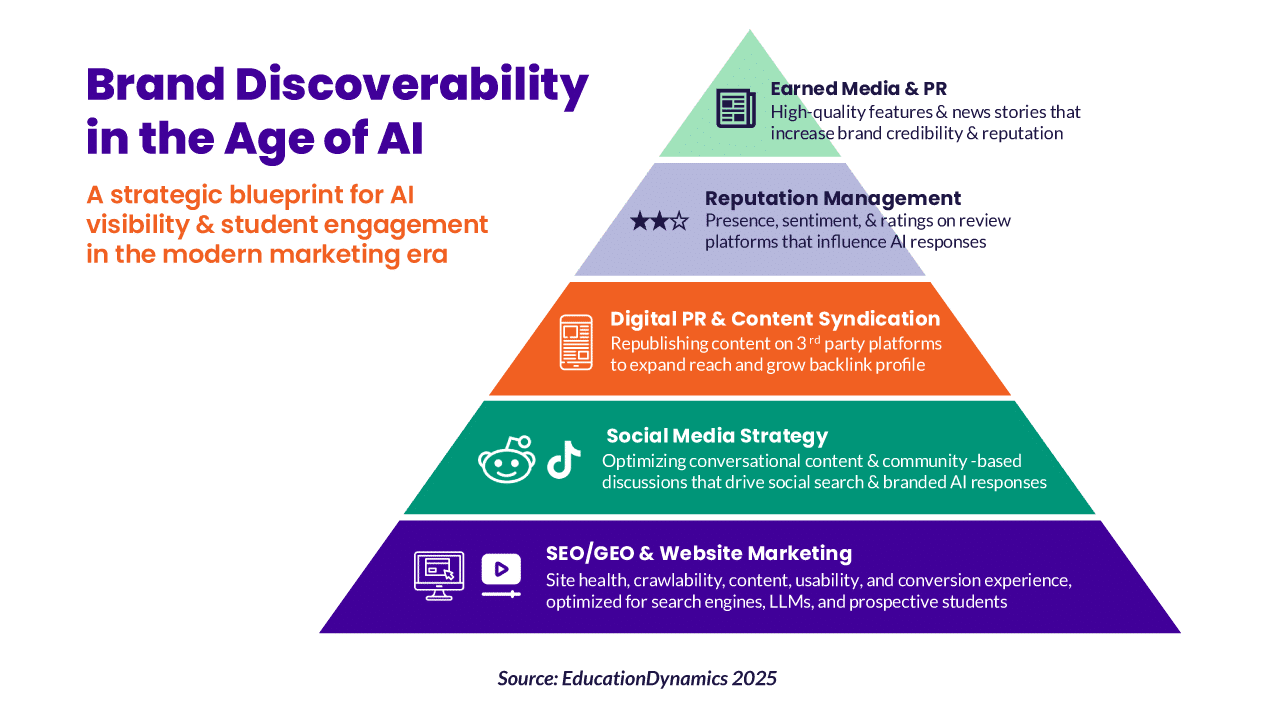
    • Mission-driven search engine optimization (SEO) and generative engine optimization (GEO) strategies that capitalize on these distinctive strengths 
    • Content creation that tells your institutional story authentically
    • Relationship-building programs that deepen community connections
    • Course scheduling systems that ensure students can access the right courses at the right terms

    These investments usually don’t generate immediate returns in the same way that purchasing 10,000 leads might. But they compound over time. They build an institution’s reputation. They create the conditions for sustainable enrollment growth rather than the enrollment roller coaster that exhausts everyone involved.

    Key Takeaways

    • Lead-chasing produces shallow growth that fades quickly and corrodes an institution’s culture. The alternative isn’t to abandon growth. It’s to anchor growth in the institution’s actual identity and what it genuinely offers.
    • Mission-aligned enrollment requires a commitment to optimizing the entire new student journey, from first awareness through graduation and beyond. It demands faculty involvement, genuine differentiation, and governance structures capable of learning and adapting.
    • Gone are the days when institutions could buy leads, work the leads, and generate students. That approach leads to poor outcomes for everyone: low conversion rates, disengaged employees, escalating costs, and high attrition.
    • The institutions that thrive in the coming decade won’t be those that outspend their competitors on lead generation. They’ll be the ones that know exactly who they are, communicate it with clarity and conviction, and build enrollment systems worthy of their mission.

    Stop thinking like the Yankees. Start building on the foundation you already have.

    Let Archer Help You With Enrollment Planning

    In my years of experience, I’ve helped many institutions establish a strong enrollment strategy. And I’m far from alone in my expertise at Archer Education. Our full-service team partners with colleges and universities of all kinds to help them build and scale their capacities. 

    Is your institution ready to work with a collaborative partner who takes the time to get to know you, then makes custom recommendations based on their decades of experience? Reach out to us today

    Source link

  • Purpose, strategy, and operations in that order – how to make a federation work

    Purpose, strategy, and operations in that order – how to make a federation work

    I’ve been doing some work with the University of London on the past, present, and future of university federations.

    I’ve looked at well over 60 kinds of different kinds of university partnerships, alliances, and coalitions, and the idea of a university federation avoids an easy definition. Crudely, it is a group of universities working together to achieve a shared goal but lots of kinds of partnerships would fall in and out of that definition. The University of London is the obvious example – it has seventeen independent members and it defines its mission as expanding access to higher education. Globally, the vast majority of other kinds of federated models do not work like this.

    Whose federation is it anyway?

    The University of Oxford describes its 36 colleges as operating within a “federal system” which are “independent and self-governing.” It seems odd to suggest a federation within an institution can exist (albeit the legal forms here complicate things) but federations are about the distribution of resources as much as regulatory structures.

    On this basis the University of the Arts London would also qualify as a kind of federation. The colleges maintain their own identity with their own expertise and reputation. Their work is framed about the idea of six colleges with one university. Similarly, the University of California has a single legal identity but with nine campuses. They are one institution with a single leadership but diverse enough to operate across different geographies, programmes, and sub-identities.

    There is perhaps then a difference between working in a federal way and being federated. This definition would encompass coalitions of universities working toward a single goal with some shared resources like The N8 research partnership. It would also include the University of the Arctic which is an almost entirely federal institution where its direction, governance, and activities, are directed by the shared agreement of its members.

    Scales

    Governance forms and organisational function are often but not always linked. The University of London’s membership has a formal governance responsibility to direct its activity while the University of London maintains its own strong central purpose and activities.  The University of the Highlands and Islands (UHI) is potentially both more centralised and devolved than the University of London. Its degree awarding powers are centrally held by the university but delivery of programmes, in both FE and HE occurs over 70 learning centres. Additionally, the Post-16 Education (Scotland) Act 2013 identifies UHI as a regional strategic body with responsibilities for planning, delivery, monitoring, and efficiency savings in further education across its operating area.

    At the slightly less federated end there is somewhere like the University Arts Singapore (UAS) which emerged as an alliance between LASALLE College of the Arts (LASALLE) and Nanyang Academy of Fine Arts (NAFA). UAS has a vice chancellor, each member has its own president (who are the deputy vice chancellors of UAS), and they lean into both their shared capacity and individual identity. As they state:

    As an alliance, UAS has the unique advantage of leveraging the strengths of both our founding members, LASALLE and NAFA, while allowing each to remain distinct colleges. UAS will work in close collaboration with the two arts institutions to lead and provide strategic direction, and will validate, confer and award UAS degrees offered by both arts institutions.

    There are lots of other examples including Paris Sciences et Lettres University which is a single institution with eleven constituent schools (some of which are several hundred years old.) To the Canadian model where the likes of the University of Toronto hold three religious independent institutions within their group where they share resources and maintain their own identities.

    Models

    The strictest definition of federation involves a legal form – but there is much in-between. A federation may be a shared brand, an informal network, a federated project with individual or shared ownership, a national or regional mission with shared funds, shared infrastructure with formal governance relationships, a group of universities with a single degree awarder, a coalition of providers with a shared and funded purpose, or an entirely devolved body that only exists through dint of the activities of its members.

    If a federation has lots of different forms it by extension has a lot of different purposes. Ideally, the form of the federation should follow the agreed purpose if it is to be successful. The strategic vision has to be big enough to make the difficult compromises that come with working together make sense. Cost-saving is unlikely to be big enough to motivate all the pieces within a federated ecosystem but improving international standing, delivering better teaching, and funding research more effectively, supported by the efficient allocation of resources, might be.

    Across federations there is often legislation and regulation that enables the constituent organisations to work together. This was the case with UAS, UHI has a long history of partnerships, funding, and regulation, while there is underpinning legislation in France to encourage the geographic coordination of research assets. It is noticeable that while the OfS has welcomed the idea of closing working together by institutions there isn’t actually a legislative or regulatory underpinning to make that easier.

    Success

    If a federation has a clear purpose and an accommodating regulatory environment it may have a reasonable chance of success. This still isn’t enough to wish one into being because of the operational complexity that can underpin such arrangements. Strategically, this includes whether it is more efficient, effective, or clear, to have a single governance, quality, and approval regime, whether resources are best shared or kept local, and whether staff should be separate or together. Again, much of this depends on federal form but sharing infrastructure between institutions even within federations is not that common. The sharing of resources should be the second order concern after the purpose of doing so but the practicalities can be complex, expensive, and absorb much organisational attention.

    It is therefore difficult to define success but it is possible to improve the chances of federations being successful. Federations should begin with a clear purpose, then look at how the strategic sharing of assets can achieve that purpose, and then work to the practicalities of sharing those assets. A federation is about purpose, governance, finance, and brand, but it is also about creating an ecosystem where partners believe the shared negotiation of purpose, strategy, and execution, is more powerful than a single organisation doing this alone. A federation is about giving something up, whether that is some identities or some resources, in the shared belief the collective gain will outweigh any individual loss.

    If federations are to become more of a feature of the higher education landscape the largest challenges may not be structural but cultural. Recent reforms of higher education in England were largely about greater competition between providers. A federation is to acknowledge that agglomeration benefits may be achieved through cooperation, consolidation, and the strategic deprioritisation of some work where others may have greater expertise.

    The central plank of the government’s recent white paper is that the homogeneity of the sector is an impediment to the efficient allocation of resources. If it is serious about specialisation, particularly within specific geographies, it should open up more routes to federal structures and the strategic benefits they may bring.

    James Coe is chairing a panel on federations at The Festival of Higher Education with the University of London. Tickets can be purchased here.

    Source link

  • President’s Role in the Enrollment Experience

    President’s Role in the Enrollment Experience

    Why Enrollment Should Be a Shared Institutional Priority

    The future hangs in the balance as enrollment management at your institution spirals into chaos. 

    Siloed growth initiatives are relegated solely to marketing departments, which bear the full weight of institutional pressure yet lack the authority to grow enrollment throughout the entire funnel. Overburdened marketing teams bombard campus stakeholders with complex, opaque data and demand astronomical digital marketing budgets that few truly understand. It’s just easier to say no. 

    Meanwhile, admissions teams and faculty pursue divergent, often conflicting strategies to recruit students, each operating in isolation with little coordination. 

    Student success teams, critical to retaining and supporting new enrollees, are entirely excluded from strategic discussions, leaving vital continuity efforts out of the equation. 

    As these disconnected forces collide, the institution risks a catastrophic decline in enrollment, eroding its mission and future viability — an unfolding crisis in which collaboration is abandoned and the system teeters on the brink of collapse.

    This isn’t the latest thriller from your favorite streaming platform but instead a worst-case scenario of what some higher education institutions face today. The only one who can save them? You, the university president.

    The President as Chief Enrollment Champion

    It would be easy to assume that enrollment success and growth are mandates of marketing, admissions, and student support teams, as they focus on enrollment key performance indicators (KPIs), customer relationship management (CRM) systems, return on investment (ROI), lead-to-enrollment (L2E), and other such tools and metrics. For many university presidents and leaders, the details of enrollment management success are often isolated from broader priorities, such as mission, strategy, and resource allocation, even if enrollment growth is mentioned in the strategic plan. 

    Enrollment success is the lifeblood of institutional stability. The president and provost set the tone, vision, and degree of urgency around enrollment success initiatives. Without executive involvement, schools and departments compete instead of collaborating, pitting enrollment management teams against each other in a crowded market. This approach can lead to silos, missed opportunities, and uneven accountability. At worst, this approach leads to finger-pointing and a cycle of frustration and disappointment across the president’s cabinet.

    While marketing and enrollment management teams are the frontline drivers of enrollment strategies, the ultimate success of growth and student satisfaction hinges on the strategic leadership of university presidents and provosts. Effective leadership necessitates active engagement and oversight to ensure that these efforts are successfully integrated into the university’s priority initiatives. 

    Strong executive involvement signals holistic institutional commitment. This helps break down barriers that can impede enrollment success and diminish the student enrollment experience, such as disconnects between the operational teams supporting enrollment management and the academic teams safeguarding quality, reputation, and ranking. 

    Here, we discuss why the university president must champion ambitious and responsible enrollment. We explore how executive leadership can ensure that enrollment efforts are appropriately resourced; aligned under a single vision; and integrated across governance, academics, operations, and administration to achieve the most compelling metrics: exceptional student experiences and outcomes.

    Ensuring Adequate Resources and Support

    One of the key ways presidents and provosts can bolster enrollment success is by ensuring that marketing, recruitment, and student success teams are sufficiently resourced. No one expects executive leadership to be in the weeds of enrollment management operations. 

    However, having a working understanding of digital marketing and how it differs from event-driven marketing (for example, enrollment fairs or conferences) can be helpful during budget allocation conversations for marketing campaigns. 

    Equally important is ensuring that faculty and enrollment management staff have access to training and development opportunities to stay current in a rapidly evolving field, which is full of new tools and approaches, as well as a diverse ecosystem of third-party support opportunities. Faculty and staff are on the front line of student engagement. Presidents and provosts can cultivate an environment of continuous professional development focused on inclusive teaching, technology integration, and student engagement strategies. Well-supported faculty and staff are more effective in creating positive learning environments that attract and retain students. 

    Finally, presidents and provosts should invest in a process for new academic program development that assesses whether programs meet market demand and provide graduates with specific professional outcomes. 

    When components such as the above are underfunded, efforts to increase enrollment and enhance the student experience are likely to falter over time.

    Leveraging Modern Data and Analytics

    Are enrollment management staff using outdated and siloed technology systems that require significant manual work to develop basic reporting and analysis? This is a critical area for institutional-level investment and support. 

    Data-driven decision-making is essential in today’s competitive enrollment environment. Presidents and provosts should champion investments in analytics platforms that provide insights into prospective students’ behaviors and indicate their likelihood of enrollment, academic performance, and postgraduation outcomes. 

    Using this data, enrollment management and academic leadership can tailor recruitment strategies, optimize academic pathways, and identify at-risk students early, enabling targeted interventions that improve retention and graduation rates.

    Championing a Student-Centric Institutional Culture

    At the heart of enrollment and student success is a culture that prioritizes the student journey, from initial inquiry through graduation and beyond. While the traditional student journey may be well understood, that of the adult and online learner may require special analysis and support. 

    Presidents and provosts must champion this student-first culture by fostering collaboration across academic units, student services, and administrative departments, ensuring that every touchpoint enhances the student experience for all types of learners. 

    Establish Intentional Governance for Enrollment Success With Shared Performance Metrics 

    Enrollment growth and student success are inherently cross-functional. Presidents and provosts can foster collaboration by establishing formal structures with the authority to act, such as integrated enrollment planning committees or task forces that bring together academic leadership, student affairs, admissions, marketing, and technology teams. This helps align cabinet-level leaders around a unified enrollment vision. 

    These cross-functional collaborations ensure that strategies are coordinated, data-driven, and responsive to emerging trends. For example, aligning ambitious enrollment growth plans with course section scheduling and staffing planning ensures responsible outcomes, rather than having faculty leaders scramble at the last minute to find instructors to cover overfull admitted-student course sections.

    To ensure sustained focus, presidents and provosts should embed enrollment growth and student experience metrics into the university’s performance evaluations. This reinforces their importance across the institution and encourages all units to align their priorities accordingly. Shared accountability metrics should measure success from inquiry through graduation and be accessible to all teams through executive dashboards and regular reviews.

    Promoting Innovation and Building External Partnerships

    Staying competitive requires ongoing innovation and connection to the broader marketplace. Presidential and provost leadership should support the development of flexible academic pathways, such as online or hybrid programs, competency-based education, and microcredentials that appeal to diverse student populations. 

    Partnerships with industry, community organizations, and alumni can keep academic programs and curricula relevant, expand opportunities for students, and enhance the institution’s reputation. Presidents and provosts can lead efforts to establish these collaborations, opening pathways for internships, research projects, and employment while keeping a finger on the pulse of evolving industry and workforce skills needs and gaps.

    Demonstrating Visible Leadership and Accountability

    Finally, effective presidents and provosts demonstrate visible leadership by regularly communicating progress, celebrating successes, and holding units accountable for results. Transparent reporting on enrollment trends, student satisfaction, and graduation rates fosters a culture of continuous improvement. Training everyone to understand the basic KPIs that connect marketing, admissions, academics, and retention ensures that all are speaking the same language and working in partnership.

    Key Takeaways

    The strategic leadership of university presidents and provosts is essential for sustainable enrollment growth and a high-quality student enrollment experience. By actively championing student-centric culture, ensuring appropriate resourcing, fostering aligned governance and collaboration, leveraging data, and embedding metrics into institutional goals, executive leaders can create an environment where enrollment strategies are not only initiatives but also integral components of the university’s shared mission, leading to higher retention; better outcomes; and a stronger, more competitive institution.

    Increase Leadership’s Role in Your Enrollment Experience

    Archer Education partners with institutional leaders and admissions, marketing, and strategy teams to help them overcome enrollment challenges. Using tech-enabled, personalized enrollment marketing and management solutions, we can help your institution align its teams and create a strategic roadmap to sustainable growth. 

    Click here to request more information about Archer’s full-funnel engagement strategies and digital student experience technology.

    Source link

  • The 2026 Growth Strategy Higher Ed Needs Right Now

    The 2026 Growth Strategy Higher Ed Needs Right Now

    Why Playing It Safe Is the Riskiest Strategy 

    The convergence of changing demographics, economic volatility and the relentless disruption of AI presents every leader with a stark choice: drive transformative growth or manage a legacy of decline. The choice is yours.

    The era of steady traditional enrollment is over. Beginning in 2026, most institutions will confront a lasting decline in their core undergraduate market. At the same time, public faith in higher education’s value is weakening, leaving institutions to rebuild trust through proof, not promises.

    Findings from EducationDynamics’ 2026 Landscape of Higher Education Report highlight a critical truth: volatility is the new normal and transformation is no longer optional.

    Growth in this new era demands more than adaptation—it demands reinvention. Institutions must lead with strategy, act with urgency and build around the Modern Learner. Because in a market defined by disruption, there are only two paths forward: reinvent or risk irrelevance.

    Key Takeaway #1: An Unstable Economic and Employment Landscape 

    Economic volatility is rising as job creation slows, and uncertainty spreads. The workforce is growing more cautious than ambitious, and in this climate, the traditional promise of a college degree is under siege.

    College graduates still enjoy higher employment rates, yet public faith in that value is eroding. The perception gap is widening, and institutions can no longer rely on reputation alone to carry their story.

    This is the moment to lead with proof, not platitude.

    Institutions must demonstrate return on investment with clarity and consistency. Publish outcomes data. Showcase alumni success. Connect every program to real career mobility. This isn’t just about convincing students, it’s about rebuilding trust across the entire ecosystem of alumni, employers, policymakers and the public.

    In today’s economy, outcomes are the new currency of reputation. The institutions that clearly and consistently prove their value will be the ones that grow.

    Key Takeaway #2: A Radically Transformed Enrollment Environment 

    Institutions now operate in a fundamentally different enrollment landscape. The long-anticipated demographic cliff is no longer a future threat; it’s here. The 2025 cycle marked the high-water mark for traditional-aged undergraduates. From 2026 on, institutions will face a sustained and irreversible decline in their core market. 

    But this doesn’t have to be a crisis. It’s an opportunity to pivot and capture where growth has moved. The new lifeblood of higher education lies in: 

    • Adult learners seeking rapid reskilling in a volatile economy 
    • Dual-enrollment students accelerating their path to a degree 
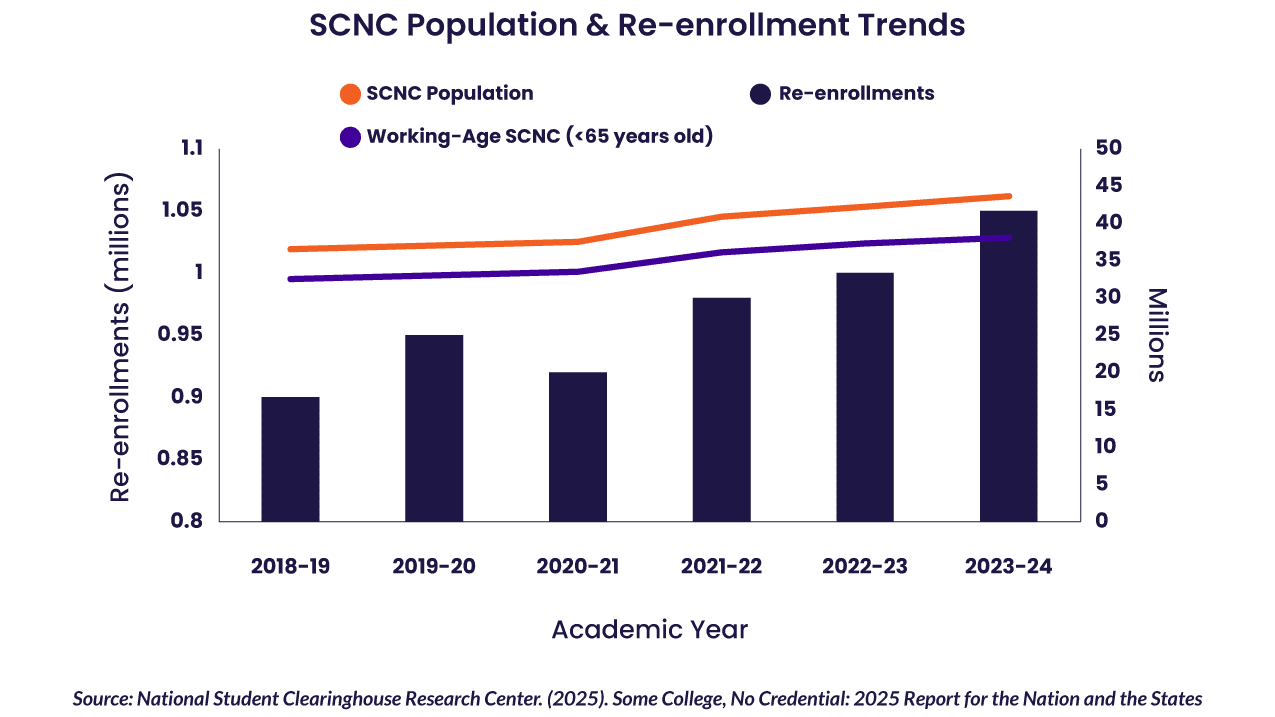
    • “Some college, no credential” learners returning to finish what they started 

    The lines between traditional and nontraditional students have disappeared. These aren’t separate segments—they’re one unified audience shaping the future of higher education.

    Leaders who continue to operate with outdated distinctions risk designing strategies for a market that no longer exists. Modern Learners value cost, convenience and career outcomes—and they expect institutions to deliver all three.

    This is the moment to retire the old playbook, embrace a new mindset and build for the learner who’s already redefining what comes next.

    Key Takeaway #3: AI Is an Unmistakable Force with Far-Reaching Implications 

    AI is accelerating change across every dimension of higher education, from how institutions engage to how graduates build careers. 

    While the technology itself isn’t new, its rapid integration is rewriting the rules. AI has fractured the traditional recruitment funnel. Modern Learners use AI-powered tools to search, compare and evaluate options before they reach an institution’s website. The student journey is now self-directed, hyper-personalized and constantly evolving, demanding that marketing and enrollment teams adapt in real time. 

    But AI’s impact extends far beyond recruitment. Its growing influence in the workforce is forcing institutions to rethink their academic mission. Institutions that lead will design education for the AI era by combining technical fluency with human-centered skills such as creativity, critical thinking and ethics. 

    Key Takeaway #4: AI Is an Unmistakable Force with Far-Reaching Implications 

    Incrementalism is now the greatest risk. In an age of constant disruption, small adjustments and siloed strategies hinder growth. The institutions that succeed will lead with clarity, agility and a unified vision centered on the Modern Learner. 

    Sustained growth demands leadership that acts decisively across three dimensions: 

    1. Align program portfolios with high-growth sectors. Move beyond tradition-bound curriculums. Invest in programs that meet labor-market demand and retire those that no longer serve a clear purpose. 
    2. Unify brand and enrollment strategies. The boundaries between undergraduate, graduate and online student populations are disappearing. Institutions must speak with one voice and focus on the three factors that drive every learner’s decision: cost, convenience and career outcomes. 
    3. Lead the conversation on value and outcomes. Public trust cannot be rebuilt through messaging alone. It must be earned through transparency, data and measurable results.

    This is the moment that will define the next decade of higher education. The difference between survival and sustainable growth hinges on decisive, informed action. Leaders must either seize this moment to shape the future or watch their institutions be defined by it. 

    From Insight to Action: Ten Strategic Imperatives for Sustainable Growth 

    The era of incremental adjustment is over. Conviction is now the currency of leadership. This moment demands bold leadership and a decisive strategy that converts disruption into a roadmap for measurable growth. 

    The EducationDynamics’ 2026 Landscape of Higher Education Report delivers that roadmap. Our Ten Strategic Imperatives are pragmatic, research-driven levers designed to help your institution build resilience and sustainable momentum for 2026 and beyond. 

    Imperative #1: Prove Outcomes. Protect Reputation.  

    Publish transparent results and illustrate career alignment to help students understand program value. 

    Imperative #2: Market ROI Relentlessly. 

    Lead with affordability and clearly communicate a projected and proven return on investment. 

    Imperative #3: Capture the Dual Enrollment Surge.   

    Build structured high school-to-degree pipelines. 

    Imperative #4: Own the Adult Learner Market.

    Offer flexible, online and stackable options with the support working learners need to balance their multiple priorities. 

    Imperative #5: Prioritize Accessibility through the Three C’s.  

    Deliver education that meets learners on cost, convenience and career outcomes. 

    Imperative #6: Lead in Responsible AI Adoption.  

    Optimize marketing for AI discoverability and AI powered platforms, while Integrating AI into advising, engagement and instruction. 

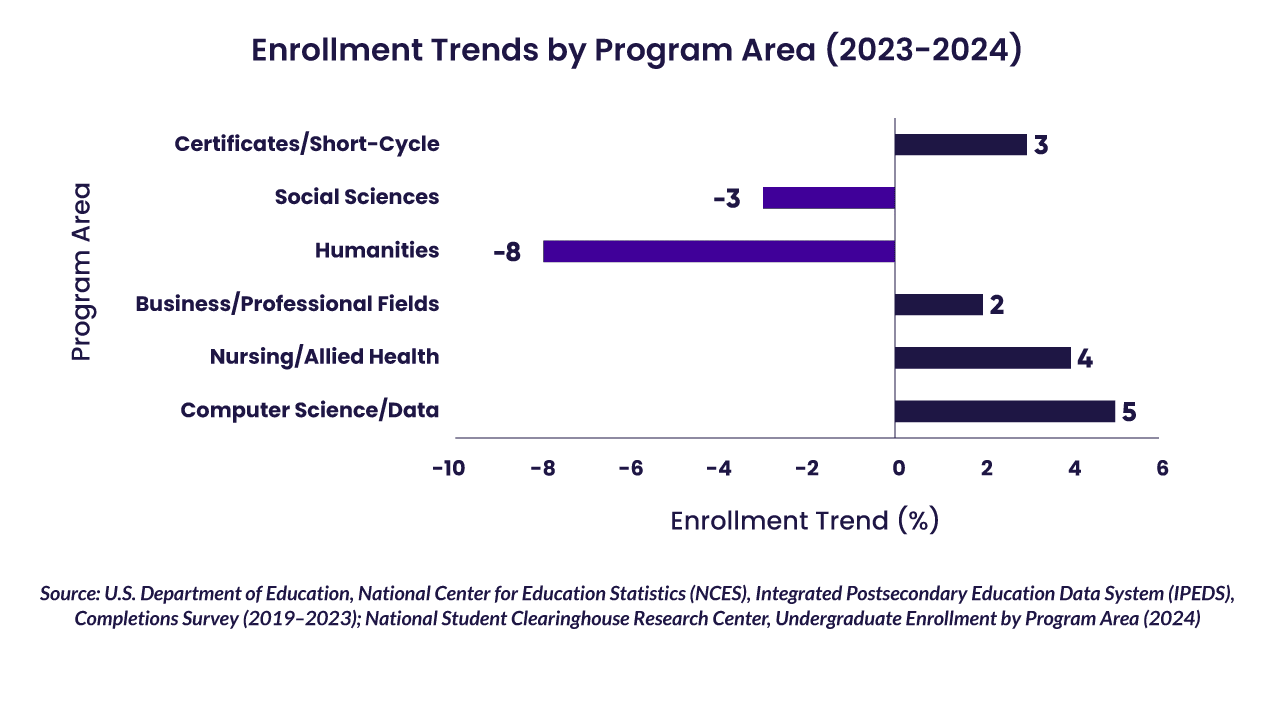
    Imperative #7: Reinvent Vulnerable Disciplines.  

    Reframe liberal arts around adaptability and skills attainment. 

    Imperative #8: Re-engage the Stopped-Out Majority. 

    Convert the 43 million with some college, no credentials into completers through credit recovery, tailored pathways and adult-first design. 

    Imperative #9: Stack Credentials into Careers.  

    Link short-term certificates to degree pathways. 

    imperative #10: Advocate for Policy Stability. 

    Simplify aid communication and push for predictable funding. 

    Together, these imperatives form a blueprint for how higher education can evolve from reactive adaptation to proactive growth. 

    Transform Disruption into Growth

    The time for caution has passed. Those who hesitate or fail to act with purpose will fall behind in a marketplace that does not wait. 

    At EducationDynamics, we partner with colleges and universities prepared to lead this transformation—those who understand that meeting the Modern Learner where they are is not just an enrollment strategy but the new mission of higher education. 

    For deeper insights and actionable strategies, download the full 2026 Landscape of Higher Education Report and learn how your institution can stay ahead of the curve. 

    Source link

  • First-Year Survey Data Prompts New Partnerships, Coms Strategy

    First-Year Survey Data Prompts New Partnerships, Coms Strategy

    Participation in extracurricular activities and campus events is tied to student retention, but a significant number of students don’t get plugged in. A 2024 survey by Inside Higher Ed and Generation Lab found that 26 percent of respondents had never attended a campus event and 35 percent weren’t involved in activities outside the classroom.

    About three in 10 college students said they’d be more involved on campus if they were more aware of the available extracurricular opportunities. Staff at the University of Arizona recognized this awareness gap and, for the past decade, have surveyed incoming students to identify their interests and provide them with tailored resources.

    The New Student Information Form provides campus leaders with actionable data and information about the students joining the Wildcat community.

    Survey Says

    According to a 2024 survey of student success leaders by Inside Higher Ed and Hanover Research, 44 percent of respondents said their institution is highly effective at collecting data for student success and 40 percent said their college effectively uses student success data to inform decisions and initiatives. One-third of respondents said their institution has built a culture of data around student success.

    How it works: The University of Arizona first launched the NSIF in 2012 to understand student interests and their previous experiences with extracurricular activities in high school, said Jenny Nirh, director of collaboration, communications and outreach of student success at Arizona. In 2021, the form was revamped by the student success office with a focus on anticipated student resource needs and other personal information that could be relevant to academic success, such as caregiver status.

    In a typical year, between 85 and 90 percent of incoming first-year and transfer students complete the form, representing as many as 8,000 students, said senior analyst Laura Andrews, who is responsible for NSIF. In 2024, 6,500 first-year students responded to the NSIF, an 88 percent response rate.

    When asked where they wanted to get plugged in during their first year, two-thirds of respondents indicated they were interested in internships, while 58 percent selected student employment and the same share chose academic clubs.

    Over the past five years, staff have seen students report the same anticipated needs. In 2024, the greatest share of students said they expect to need at least some help accessing and managing financial aid (63 percent) and academic supports (56 percent).

    In addition to focusing on their interests, the survey asked students about their perceptions of college and the campus community. While a majority of respondents expressed excitement about being a student at Arizona, one in five indicated they were unsure about their ability to fit in and a similar number said they were uncertain whether their peers would assist them if they needed help.

    A question about caretaking responsibilities was added in 2023 to identify those students and connect them with childcare or caregiving resources available on campus, Nirh said.

    Data in action: Using NSIF data, staff have been able to respond to individuals’ needs and create strategic initiatives within various departments and offices that ensure no student is left behind. Now, the student success department tailors communications to students based on responses and promotes relevant support services.

    Each college at the university is given a breakdown of survey results for their incoming students, including their interests and expectations. The report is often distributed to department heads and faculty or used for student outreach purposes.

    Using data, staff found that Pell Grant recipients were more likely than the general campus population to say they wanted help navigating financial aid (19 percentage points higher) and student employment (12 percentage points higher). In addition, first-generation students were 10 percentage points more likely than the average student to say they needed support asking for help. The Thrive Center within the student success division uses this data in their first-generation support initiative, First Cats, and in their efforts to boost financial wellness.

    The Housing and Residence Life Division conducts an end-of-year survey of residents about their support needs and whether students sought help; staff received similar responses to those articulated by incoming students in the NSIF months earlier. However, students said they were less likely to seek help for their personal development—including mental health, time management and socialization—than for navigating campus life.

    If your student success program has a unique feature or twist, we’d like to know about it. Click here to submit.

    Source link

  • Benefits of Centralized Marketing in Higher Ed Institutions

    Benefits of Centralized Marketing in Higher Ed Institutions

    Why Centralized Marketing Matters for Online Programs in Higher Ed

    At Archer, we’ve onboarded hundreds of institutional partners to help them grow their online programs. And while every partner is unique, there’s one pain point we encounter time and again: decentralized school-level marketing that creates more friction than momentum. 

    In many institutions, individual colleges or schools manage their own marketing campaigns, budgets, and creative direction. While this siloed approach offers an initial promise of agility and autonomy, it often leads to deeper problems in the market, such as: 

    • Fragmented messaging 
    • Inconsistent branding 
    • Internal competition 
    • Wasted spend as schools bid against each other 
    • Missed opportunities for reach and impact at the brand and portfolio level

    The result? Confused students consuming competing voices from the same institution, and internal marketing teams scrambling to scale best practices and measure impact — often without apples-to-apples data and reporting for performance comparisons. 

    Universities need an integrated marketing strategy that balances a holistic brand and portfolio-level approach with maintaining individual school-level autonomy for certain decisions and activities. This hybrid model unlocks collaboration, reduces conflict, and lifts visibility for all programs within a portfolio. 

    With shared goals, aligned messaging, and coordinated tactics across all of their schools, universities can amplify their brand and stretch their budgets further — delivering clear, compelling stories across myriad channels to prospective students. 

    Risks of Decentralized Marketing

    In some models of governance, decentralization can be a strength — empowering local leadership and ensuring responsiveness to specific community needs. But when it comes to marketing online university programs in a highly competitive environment, decentralization alone as a strategy is more often a liability than an asset. 

    Having different departments, schools, or programs run their own campaigns and technology stacks may seem like a way to move faster, but in practice, it creates challenges that can hinder online program growth. Let’s explore some examples.

    Brand Confusion          

    As prospective students evaluate your institution’s online offerings, they are not concerned with the internal structures of your institution. They expect clarity and consistency in the information you provide. When each college or division presents a different tone, design style, and creative messaging approach, you’re left with a weakened institutional brand. 

    Mixed marketing across digital ads, program pages, email drips, and even tuition and scholarship messaging can erode the trust and credibility you’ve been building with prospective students. For example, inconsistent explanations of scholarships or conflicting tuition information (e.g., on program pages and via tuition calculators) can trigger frustration or skepticism. 

    In short: Your audience — the prospective student — sees one university. If your university is in conflict with its own marketing, the brand loses power. 

    Inefficiency and Internal Competition

    Without centralized marketing oversight, different teams often end up targeting the same audiences with overlapping campaigns — sometimes even bidding against each other in paid channels. This dilutes your paid marketing efficacy by driving up your cost per lead, wasting precious budget dollars, and undermining the collective impact of your institution’s marketing investments. 

    Inconsistent Student Experience and Success Metrics

    Perhaps the most concerning result of decentralized marketing is a fragmented and uneven student journey. One program might offer seamless inquiry-to-enrollment processes, while another loses momentum after the application process due to poor follow-up and disconnected systems. 

    When your programs use different customer relationship management (CRM) platforms, it becomes difficult to track leads accurately and measure outcomes with consistency. Reporting becomes murky. Success metrics vary. Problems get misdiagnosed. 

    Instead of addressing the root causes of problems, your teams might blame each other (e.g., the marketing team and the admissions team) for the other’s perceived performance issues, when the real problem is systemic disconnection. 

    The Case for Centralized Marketing 

    Centralization doesn’t mean turning every school or program into a cookie-cutter version of the institution’s mission statement, and it doesn’t mean taking any team’s autonomy away. It’s about aligning around a shared strategy — one that empowers individual teams to execute effectively within a cohesive, coordinated framework. 

    Unified Brand Messaging 

    A strong, centralized brand platform allows your university to speak with one clear voice about its online programs, telling the story of: 

    • What your programs offer 
    • Who your programs serve 
    • Why your programs matter 

    This shared narrative should be rooted in your institution’s values and designed to build trust with prospective students. When every program draws from the same story and messaging pillars, it strengthens your presence across every touchpoint — from digital ads and landing pages to nurture emails and program brochures. Each program’s value propositions may differ, but the institution’s story endures. 

    Additionally, a unified approach enables your institution to leverage the brand and portfolio-level marketing that raises visibility across all your programs. For example, some institutions have an integrated marketing program for their undergraduate experience but lack a cohesive approach for their online graduate programs. This is a missed opportunity to build a portfolio-level branded presence through channels that individual schools may not be able to afford on their own. 

    A robust YouTube presence that highlights the benefits of your online graduate education experience (program agnostic), showcases your alumni and graduate education outcomes, and forefronts your strategic organizational partnerships that span individual schools and programs increases the impact for the entire institution with one investment.

    Integrated Campaign Planning 

    Centralized marketing brings together your paid media, content marketing, email strategy, and organic social media into one master plan. 

    Gone are the days of multiple teams across your institution launching disconnected campaigns, as central calendars and shared audience strategies help ensure each tactic contributes to every team’s strategic goals. This means reduced duplication, avoidance of internal bidding wars, and maximization of every marketing dollar. 

    However, your individual schools can and should have decision-making authority over the key value proposition definitions, target personas, and positioning of programs within their fields. This requires a collaborative conversation in an integrated campaign-planning scenario. 

    And schools should continue to develop campaigns where the impact is greatest for them — for example, hosting prospective student events and webinars, offering ambassador programs for prospective student questions, and attending events meaningful to their specific program field, such as at conferences and exhibit halls. 

    Shared Data and Measurement 

    In a world of data, perhaps the greatest and most immediate impact of centralized marketing will be felt in how your institution tracks performance holistically. With unified key performance indicators (KPIs) and shared access to insights, marketing teams at all levels — central and within academic schools — can identify what’s working for them, pivot when needed, and scale successful tactics across programs. 

    Teams can review where the branded portfolio-level efforts are causing the greatest lift in impressions and leads and determine together how school-level marketing activities can make the most impactful use of funds.

    What Centralized Marketing Looks Like in Practice 

    At Archer, we’ve seen institutions achieve dramatic improvements simply by unifying their marketing strategy — even if execution remains shared and distributed. With a strong central foundation in place, teams tap into shared creative resources, coordinate campaigns across programs, and drive stronger performance through unified media buying and consistent messaging. 

    At its best, centralized marketing can: 

    • Empower programs to amplify one another rather than compete 
    • Allow creative strategy to be produced once then repurposed widely 
    • Create paid efforts that are smarter, more cost effective, and better targeted 

    In sum, when your institution implements an integrated marketing model that fosters collaboration among academic schools, it can result in performance that is greater than the sum of its parts. 

    Archer Education knows what it takes to bring siloed departments together. Our unique partnership-based approach allows us to truly understand your institution, then implement efficiencies to ignite your online programs’ potential through a centralized marketing strategy that is balanced with school autonomy and meaningful participation. Contact us today to learn more.

    Source link

  • WEEKEND READING: Should the seminal Robbins report inform the forthcoming post-16 strategy?

    WEEKEND READING: Should the seminal Robbins report inform the forthcoming post-16 strategy?

    HEPI’s Director, Nick Hillman, spent Friday at a conference organised by SKOPE (the Centre for Skills, Knowledge, and Organisational Performance), part of the University of Oxford’s Department of Education. It was overseen by James Robson, Professor of Tertiary Education Systems, and featured the Minister for Skills, Baroness (Jacqui) Smith, among many others.

    In his opening address, Professor Robson articulated the growing consensus that, when it comes to post-school education, the time has come:

    1. to replace competition with coordination;
    2. to allow place-based approaches to flourish; and
    3. to unlock new opportunities for the benefit of students and employers.

    In her remarks, Jacqui Smith agreed, arguing for an end to ‘town / gown’ splits. The Minister emphasised she thinks higher education must reach out to other parts of the education sector: while she recognises the majority of future skills needs will be at a higher level, she wants to bring down the ‘artificial’ barriers between FE and HE in a ‘coordinated’ and ‘facilitated’ way.

    Some people in the audience interpreted this as meaning universities’ only hope of more money is to do the Government’s bidding and, either way, the higher education sector clearly needs to get ready for a more directive approach from a more active state. The basic idea seems to be to have everyone work together to raise productivity, level up the regions outside London and deliver more social mobility.

    It may sound lovely but these issues are as old as houses and, whenever I think of them, I think of those paragraphs from the Robbins committee – which was designed ‘to review the pattern of full-time higher education’ – that wrestle with freedom versus direction. The Robbins report struggled with the right level of co-ordination and, while much of what it said reflected Lionel Robbins’s liberal views, it also envisaged a role for oversight and direction:

    Will it be possible to secure the advantages of co-ordination while preserving the advantages of liberty? The question is of critical importance. Freedom of institutions as well as individual freedom is an essential constituent of a free society and the tradition of academic freedom in this country has deep roots in the whole history of our people. We are convinced also that such freedom is a necessary condition of the highest efficiency and the proper progress of academic institutions, and that encroachments upon their liberty, in the supposed interests of greater efficiency, would in fact diminish their efficiency and stultify their development. …

    We believe that a system that aims at the maximum of independence compatible with the necessary degree of public control is good in itself, as reflecting the ultimate values of a free society. We believe that a multiplicity of centres of initiative safeguards spontaneity and variety, and therefore provides the surest guarantee of intellectual progress and moral responsibility. We do not regard such freedom as a privilege but rather as a necessary condition for the proper discharge of the higher academic functions as we conceive them. …

    The difficulties are greatest when it is a question whether institutions of higher education should have the ultimate right to determine their own size. … if funds are available, refusal to co-operate in national policies or to meet national emergencies is an unsympathetic attitude, and it would be easy to think of reasons why it should be overruled. … If, when all the reasons for change have been explained, the institution still prefers not to co-operate it is better that it should be allowed to follow its own path. This being so, it must not complain if various benefits going to co-operating institutions do not come its way. … [My emphasis]

    it is unlikely that separate consideration by independent institutions of their own affairs in their own circumstances will always result in a pattern that is comprehensive and appropriate in relation to the needs of society and the demands of the national economy. There is no guarantee of the emergence of any coherent policy. And this being so, it is not reasonable to expect that the Government, which is the source of finance, should be content with an absence of co-ordination or should be without influence thereon. …

    It all goes to show, yet again, that there is no such thing as a new education policy question. 

    There are a number of tests we should perhaps apply to the let’s-coordinate-everything-to-elevate-skills approach that is likely to form the core of the forthcoming post-16 strategy / white paper that is due ‘soon’ – very soon if some of those attending the conference are to be believed and not at all soon if others there are to be believed.

    First, if we can’t even build a high-speed speed trainline on budget and on time, why are we so confident we can easily build an integrated skills and education system (and without a material increase in spending)? It is surely right to at least ask whether public authorities really do know so much about the future economy’s needs that individuals should cede control over who should study what and where. Clearly, Skills England could be important here, but it is an untested beast. (I note in passing that the Smiths, Jacqui and Phil [Chair of Skills England], are getting back together to do a webinar this week.)

    Secondly, the broken model that tends to be held up in contrast to the coming smooth one is a market in which there is lots of wasteful competition, excessive homogeneity and a lack of focus on the country’s needs. But the idea that the only alternative to a coordinated system is a pure and chaotic market is bunkum. We’ve not had a pure market in higher education and I’ve never met anyone who wants one. Neither the political centre nor the Far-byn (or is it Cor-age?) axis want one. Perhaps we are letting ourselves be blinded by the idea that there are only two options: a pure red-in-tooth-and-claw market, which is a caricature of what we have, and a cuddly coordinated system, which will be harder to deliver than we pretend.

    Thirdly, where is the space for education for education’s sake? As one member of the audience pointed out at the SKOPE conference, current discussions are so focused on ‘skills’ and the economy that education is sometimes becoming lost. Yet FE and HE collaboration is difficult at a practical and day-to-day level. Kath Mitchell, the Vice-Chancellor of Derby University, pointed out the challenges of running an FE college and a university together – for example pointing out that Buxton and Leek College is (absurdly) barred from receiving FE capital funding because it counts as part of the University of Derby.

    Fourthly, we should question the assumption underlying current critiques that our universities are much too homogeneous. They do have some things in common, though one might just as well point out that all education institutions that share a legally-protected title controlled by strict criteria, such as ‘university’, are always going to have some things in common. But I’ve visited pretty much every UK university, and many of them multiple times, and I would urge anyone who thinks they’re all the same to do something similar. Just compare the two universities I know best (as I’m on their boards), Manchester and Buckingham: the former is a research-intensive institution with a turnover of £1.4 billion,  12,000 staff and 47,000 students while the other is a teaching-intensive place (‘the home of two-year degrees’) with a turnover of £50 million, 500 staff and 3,500 students as well as the only private medical school in the UK. Or compare the LSE and UCA (the University of the Creative Arts). Or Falmouth University and Newcastle University. These things are not the same.

    Finally / fifthly, as Andy Westwood pointed out in his remarks at the SKOPE conference, devolution is ‘non-existent’ in large parts of the country. So what does ‘a coordinated place-based approach’ really mean there? It’s one thing if you’re in Greater Manchester; it’s quite another if you’re in a rural area far from the nearest town or city, college or university. Moreover, while it is true that the old Higher Education Funding Council for England (HEFCE) had a regional aspect to its work which we could well copy today, it was a big funder as well as a regulator and it had a substantial regional presence.

    Source link

  • A Re-Engagement Strategy for Administrators (opinion)

    A Re-Engagement Strategy for Administrators (opinion)

    In American higher education, teaching is our business, research our currency and service our obligation. It has always perplexed me that the pursuit of higher education administration has traditionally compelled individuals to move away from a continued practice of two of these core faculty functions. The path of a faculty administrator is typically marked by a shift away from teaching and research, an evolution that makes returning to the faculty for some almost an impossibility, after years of being disconnected from the disciplinary practices that propelled their trajectory through the faculty ranks to secure an administrative role in the first place.

    At Kennesaw State University, we are exploring a new approach to academic leadership that reverses this traditional model of administrative disconnect. Starting this past academic year, every senior academic administrator serving on the provost’s leadership team (including all deans) joined me (serving as provost) in a commitment to teaching or researching annually, with the goal of helping us better understand and serve our university community. For some, the move to formally carve out approximately 10 percent of their time for either teaching or research validates ongoing teaching and research practices, while for others, it provides administrative latitude to reignite their passion for teaching and/or research.

    KSU’s president, Kathy Stewart Schwaig, co-taught an honors course with me this past spring, leading this strategy by example. President Schwaig, who holds a Ph.D. in information systems and whose leadership trajectory has evolved through faculty ranks across two Georgia institutions, takes this philosophical commitment to staying connected to the business of higher education even a step further, as she is currently enrolled as a graduate student at Dallas Theological Seminary pursuing a master’s in biblical and theological studies.

    As Kennesaw State, a Carnegie-designated R-2 institution that serves a population of more than 47,800 students, some could see this strategy as a pragmatic way of extending the capacities of the senior academic administrators to serve the institution’s growing needs in research and teaching. At a time when the capacities of faculty colleagues are being optimized to serve one of the nation’s largest and fastest-growing public institutions, the members of the senior academic administrative team are committing to optimize their own collective capacities to serve the mission of the university.

    The consequences will be more than just pragmatic, however. The annual commitment to serve as a higher education practitioner in addition to a higher education administrator could help us pursue administrative approaches that are rooted in a pragmatic understanding of both the shifting needs of industry and the changing needs of students entering higher education today. And it can also help build goodwill among faculty colleagues, who sometimes feel university administrators fail to fully comprehend the growing challenges of the classroom and pressures of research productivity.

    Serving as provost, I have found my annual commitment to teaching an opportunity to inform administrative priorities. In fall 2020, when we struggled to comprehend how best to reopen and calibrate to the safety needs of the COVID pandemic, I was scheduled to teach a senior seminar course in the Department of Dance, while I served as dean of the College of the Arts at KSU. For a moment, I thought I should excuse myself from the added responsibilities of teaching a course at a time when my administrative capacities were being tested in rather unconventional ways. Better judgment prevailed, however, as I realized that out of every year that I continued to teach in my higher education career, this would be the semester when being in the classroom and experiencing the challenge alongside my faculty colleagues was most critical.

    I would be lying if I said the experience was transformative. The challenges of lecturing with a face mask to socially distant students, split into two groups and separated by technology and physical space, was an experience that most faculty would likely agree was frustrating. But serving as dean and being in the classroom all semester allowed me to skip past several steps to serve the needs of my faculty colleagues with an understanding and empathy that was experientially relevant.

    I am hoping that the impact of KSU’s administrative re-engagement strategy will be similarly impactful, ensuring that all senior academic administrators reignite their capacities to contribute to the teaching and research mission of the university. The idea seems to have been embraced at the outset by most; its sustainability, however, will require a continued institutional commitment and individual prioritization. While the true outcomes are yet to be empirically assessed, my hope is that this move will convert administrative faculty into faculty administrators, building their capacities to more effectively serve the growth of our institution with relevant, ongoing experiences in teaching and research.

    Ivan Pulinkala is the provost and executive vice president for academic affairs at Kennesaw State University.

    Source link

  • It’s up to universities to make the industrial strategy a success

    It’s up to universities to make the industrial strategy a success

    The industrial strategy is not only an economic document it is also a roadmap for how the country will be governed.

    At its heart is a simple premise. Places know what is best for people locally and power should be devolved to them. Not all powers, because some things like defence have to be coordinated at a national level, and certainly not lots of fiscal policy like taxation, but powers over things like spatial planning (where the government allows it), investment, and some parts of the R&D ecosystem.

    The ideal body for distributing these powers is the Mayoral Combined Authority (MCA). These are the collection of councils in one area, usually a city, that work together to achieve more than they could alone. The Liverpool City Region Combined Authority and the West Midlands Combined Authority are just two examples

    Process not an event

    In 1997 then Secretary of State for Wales Rob Davies called devolution “a process not an event”, and he was right. Powers are not spread evenly through the UK, London has quite a lot and a local town council has very few. And the propensity for government to operate through pots of money that local government bid for to do stuff is unusual by international comparisons. This level of financial control limits many places to being the delivery arm of government more so than independent decision makers in their own right.

    This patchwork approach also means higher education providers have a mixed relationship with the devolution story.

    Solely through an academic lens research intensive universities have done well out of (even if they do not like it) how centralised the UK is. The REF just isn’t interested in geography. It follows quality, impact, and environments wherever they may be. Previous research pots like the Regional Innovation Fund which apply a funding multiplier to places underserved by research funding are the exception not the norm.

    The industrial strategy is different in that it at least attempts some kinds of rebalancing in acknowledging that if the government funds the same things in the same places the same kinds of research outputs will be produced. The fact there is some money behind it is even better. As DK noted in his review of research in the industrial strategy:

    The £500m Local Innovation Partnerships Fund is intended to generate a further £1bn of additional investment and £700m of value to local economies, and there are wider plans to get academia and industry working together: a massive expansion in supercomputer resources (the AI research resource, inevitably) and a new Missions Accelerator programme supported by £500m of funding. And there’s the Sovereign AI Unit within government (that’s another £500m of industry investments) in “frontier AI”. On direct university allocation we get the welcome news that the Higher Education Innovation Fund (HEIF) is here to stay.

    The places that are located outside of major cities without large research portfolios have more reason to be sceptical about devolution. Deputy prime minister Angela Rayner has called for local leaders to “fill in the map” of devolution but this is easier said than done. Places have distinct histories, geographies, and can’t as easily be accommodated into MCAs as places like Greater Manchester.

    While there has been interest in towns from time to time, the Towns Fund provided some funding to some places on some research projects, they risk being left behind within a devolution system that prioritises larger conurbations.

    The universities problem

    Let’s take the government’s proposals at face value and assume it is going to implement the full version of the devolution agenda it is proposing. This would mean local government has more funding to buy land, freeports and investment zones will be streamlined to provide even more business incentives, the British Business Bank (among other funders) will release and coordinate capital aligned to regions and the eight industrial strategy priorities, a further £200m will be spent on further education in England, and a series of growth funds will run directly through mayors.There are more announcements to come on skills, local economic regulation and infrastructure.

    Universities are not losers in any of these measures but nor are they inevitably complementary to everything the governments wants to do. Former universities minister David Willetts, who had some reservations about the draft strategy, has softened his tone writing:

    Most of the key industries set out in that visual [the one explaining the industrial strategy priorities] are heavy users of higher education. Universities will play a crucial role in the strategy. One of the biggest risks to delivering it is the financial fragility of these core institutions. It is good to see them getting a vivid illustration as well – on page 73. But the Government has not yet taken the decisions needed to ensure they can thrive and continue to be such a national asset.

    This is the core problem. It is possible to imagine how industries may rely on universities but it is more difficult work out how universities, specifically, can deploy their capacity in the most effective ways. Universities cannot expect government money for everything they do but it is also true that if they fall over the industrial strategy will fall with them.

    Philosophically, the industrial strategy neither supports enormous state intervention nor is it a hands off document of supply-side reform. It sees the state as an enabling force which can reduce risks to business, catalyse investment, and reconfigure the public sector. The industrial strategy does not tell universities what to do, or even what they might do in great detail, because that is not what it is designed to do. It gives an approach and it is for universities to choose whether and how they follow it.

    Adapt or perish

    This suggests a significant period of adaptation for universities. If more investment and political attention is flowing through their places then being involved in their places becomes significantly more important. Fundamentally, the industrial strategy is not an instruction manual but it is a guide to the things that the government will and will not fund.

    There are lots of devolved things that universities would generally find unpalatable like top-slicing QR funds to MCAs. There are lots of things that universities could do and are doing to set an example which might one day be backed up by legislation. Organising regional bodies to coordinate the provision of education to meet local labour market needs. Forming joint research programmes and investment vehicles to form one front door for research in their area. Using their own research capacity to interrogate the best forms of devolution and devolved structures. And, perhaps most importantly, being embedded in the important but unglamorous business of transport and spatial planning.

    The bigger mental shift is that the industrial strategy has two core centres of control. Its eight priority industries and regions and clusters within them. The challenge for universities, if they want to see sustained government support for their work, is to answer how what they do supports those two agendas. This is not a PR exercise but a careful interrogation of the limits and approaches of universities in their places and within those core industries.

    In some places this might mean tweaking existing work, in others it might mean new partners or new projects, and in some it might mean a more fundamental reimagining of the shape of the education sector in a region. Given the perilous state of university finances it is the institutions that look like they have solutions that will do well in the era of uncertainty.

    The industrial strategy does not leave universities behind, but it might. The opportunity is for universities to shape the settlement they want through being proactive in shaping their regions. This is not about another civic strategy but about creating the governance apparatus to support economic growth. Anything short of this risks an economic agenda which is done to universities rather than with them.

    Source link

  • Podcast: Industrial strategy, cashpoint colleges, social mobility

    Podcast: Industrial strategy, cashpoint colleges, social mobility

    This week on the podcast we examine the government’s new industrial strategy and what it really means for higher education – from regional clusters and research funding to skills bootcamps and spin-out support.

    Will the plans finally integrate universities into the UK’s economic future, or is this another case of policy promises outpacing delivery?

    Plus we discuss the franchising scandal and the damning case for urgent reform, and ask whether new research on social mobility challenges the sector’s claims about access, aspiration, and advancement.

    With Katie Normington, Vice Chancellor at De Montfort University, Johnny Rich, Chief Executive at the Engineering Professors’ Council and Push, James Coe, Associate Editor at Wonkhe and presented by Mark Leach, Editor-in-Chief at Wonkhe.

    Higher education and the industrial strategy priority areas

    The cashpoint campus comeback franchising, fraud, and the failure to learn from the FE experience

    On the move: how young people’s mobility responds to and reinforces geographical inequalities

    Inequalities in Access to Professional Occupations

    Source link