Tag: Stress

  • K-12 districts are fighting ransomware, but IT teams pay the price

    K-12 districts are fighting ransomware, but IT teams pay the price

    Key points:

    The education sector is making measurable progress in defending against ransomware, with fewer ransom payments, dramatically reduced costs, and faster recovery rates, according to the fifth annual Sophos State of Ransomware in Education report from Sophos.

    Still, these gains are accompanied by mounting pressures on IT teams, who report widespread stress, burnout, and career disruptions following attacks–nearly 40 percent of the 441 IT and cybersecurity leaders surveyed reported dealing with anxiety.

    Over the past five years, ransomware has emerged as one of the most pressing threats to education–with attacks becoming a daily occurrence. Primary and secondary institutions are seen by cybercriminals as “soft targets”–often underfunded, understaffed, and holding highly sensitive data. The consequences are severe: disrupted learning, strained budgets, and growing fears over student and staff privacy. Without stronger defenses, schools risk not only losing vital resources but also the trust of the communities they serve.

    Indicators of success against ransomware

    The new study demonstrates that the education sector is getting better at reacting and responding to ransomware, forcing cybercriminals to evolve their approach. Trending data from the study reveals an increase in attacks where adversaries attempt to extort money without encrypting data. Unfortunately, paying the ransom remains part of the solution for about half of all victims. However, the payment values are dropping significantly, and for those who have experienced data encryption in ransomware attacks, 97 percent were able to recover data in some way. The study found several key indicators of success against ransomware in education:

    • Stopping more attacks: When it comes to blocking attacks before files can be encrypted, both K-12 and higher education institutions reported their highest success rate in four years (67 percent and 38 percent of attacks, respectively).
    • Following the money: In the last year, ransom demands fell 73 percent (an average drop of $2.83M), while average payments dropped from $6M to $800K in lower education and from $4M to $463K in higher education.
    • Plummeting cost of recovery: Outside of ransom payments, average recovery costs dropped 77 percent in higher education and 39 percent in K-12 education. Despite this success, K-12 education reported the highest recovery bill across all industries surveyed.

    Gaps still need to be addressed

    While the education sector has made progress in limiting the impact of ransomware, serious gaps remain. In the Sophos study, 64 percent of victims reported missing or ineffective protection solutions; 66 percent cited a lack of people (either expertise or capacity) to stop attacks; and 67 percent admitted to having security gaps. These risks highlight the critical need for schools to focus on prevention, as cybercriminals develop new techniques, including AI-powered attacks.

    Highlights from the study that shed light on the gaps that still need to be addressed include:

    • AI-powered threats: K-12 education institutions reported that 22 percent of ransomware attacks had origins in phishing. With AI enabling more convincing emails, voice scams, and even deepfakes, schools risk becoming test grounds for emerging tactics.
    • High-value data: Higher education institutions, custodians of AI research and large language model datasets, remain a prime target, with exploited vulnerabilities (35 percent) and security gaps the provider was not aware of (45 percent) as leading weaknesses that were exploited by adversaries.
    • Human toll: Every institution with encrypted data reported impacts on IT staff. Over one in four staff members took leave after an attack, nearly 40 percent reported heightened stress, and more than one-third felt guilt they could not prevent the breach.

    “Ransomware attacks in education don’t just disrupt classrooms, they disrupt communities of students, families, and educators,” said Alexandra Rose, director of CTU Threat Research at Sophos. “While it’s encouraging to see schools strengthening their ability to respond, the real priority must be preventing these attacks in the first place. That requires strong planning and close collaboration with trusted partners, especially as adversaries adopt new tactics, including AI-driven threats.”

    Holding on to the gains

    Based on its work protecting thousands of educational institutions, Sophos experts recommend several steps to maintain momentum and prepare for evolving threats:

    • Focus on prevention: The dramatic success of lower education in stopping ransomware attacks before encryption offers a blueprint for broader public sector organizations. Organizations need to couple their detection and response efforts with preventing attacks before they compromise the organization.
    • Secure funding: Explore new avenues such as the U.S. Federal Communications Commission’s E-Rate subsidies to strengthen networks and firewalls, and the UK’s National Cyber Security Centre initiatives, including its free cyber defense service for schools, to boost overall protection. These resources help schools both prevent and withstand attacks.
    • Unify strategies: Educational institutions should adopt coordinated approaches across sprawling IT estates to close visibility gaps and reduce risks before adversaries can exploit them.
    • Relieve staff burden: Ransomware takes a heavy toll on IT teams. Schools can reduce pressure and extend their capabilities by partnering with trusted providers for managed detection and response (MDR) and other around-the-clock expertise.
    • Strengthen response: Even with stronger prevention, schools must be prepared to respond when incidents occur. They can recover more quickly by building robust incident response plans, running simulations to prepare for real-world scenarios, and enhancing readiness with 24/7/365 services like MDR.

    Data for the State of Ransomware in Education 2025 report comes from a vendor-agnostic survey of 441 IT and cybersecurity leaders – 243 from K-12 education and 198 from higher education institutions hit by ransomware in the past year. The organizations surveyed ranged from 100-5,000 employees and across 17 countries. The survey was conducted between January and March 2025, and respondents were asked about their experience of ransomware over the previous 12 months.

    This press release originally appeared online.

    Latest posts by eSchool Media Contributors (see all)

    Source link

  • Student Wellbeing in the AI Era: Stress, Confidence, and Connection – A Global Snapshot

    Student Wellbeing in the AI Era: Stress, Confidence, and Connection – A Global Snapshot

    • This HEPI blog was authored by Isabelle Bristow, Managing Director UK and Europe at Studiosity.

    Studiosity’s ninth annual Student Wellbeing Survey, conducted by YouGov in November 2024, gathered insights from university students on their experiences and concerns, and made recommendations to senior leaders. This global research included panels from Australia, Canada, New Zealand, Saudi Arabia, Singapore, the UAE, the UK and the US (see below for the country sample size breakdown).

    The report highlights key learning on AI’s rapid integration into higher education and its impact on student wellbeing. The following are the key takeaways, specifically examining country-specific differences in student experiences with AI, alongside broader issues of stress, connection, belonging, and employability.

    AI Adoption and Its Impact

    AI is now a pervasive tool in higher education, with a significant 79% of all students reporting using AI tools for their studies. While usage is high overall, the proportion of students saying they use AI ‘regularly’ to help with assignments shows interesting variations by country:

    • UK: 17%
    • USA: 27%
    • Singapore: 31%
    • UAE: 38%

    This greater scepticism towards AI among UK students also shows up elsewhere, with students in the UK least likely among the eight countries to expect their university to offer AI tools.

    However, the widespread adoption of AI tools is linked to considerable student stress. The survey found that 68% of students report experiencing personal stress as a result of using AI tools for their coursework. From free text comments, this might be for a number of reasons, including the fear they might be unintentionally breaking the rules; there are also concerns that universities are not moving fast enough to provide AI tools, leaving students to work out for themselves how best to use AI tools. This highlights that navigating the effective and appropriate use of AI is a significant challenge that requires support.

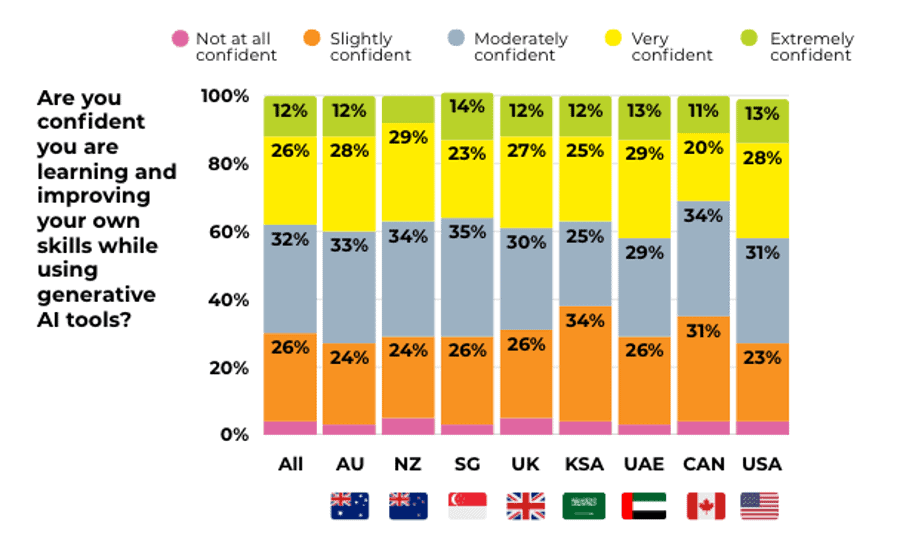
    Furthermore, the way AI is currently being used appears to be affecting students’ confidence in their own learning. Some 61% feel only ‘moderately’ or less confident that they are genuinely learning and improving their own skills when using generative AI.

    Perhaps as a result of this uncertainty, students often seek ‘confidence’ when using university-provided AI support, desiring guided tools that help them check their understanding and validate their genuine learning progress. This motivation was particularly strong in countries like:

    • New Zealand: 31%
    • Australia: 25%
    • UK: 25%

    This suggests a tension between unstructured AI use (linked to lower learning confidence) and the student desire for confidence-building support (which AI, when properly designed for learning, offers).

    Perceptions of how well universities are adapting to AI also vary globally, with 56% of students overall feeling their institutions are adapting quickly enough. However, scepticism is notably higher in certain regions:

    • UK: 53% feel institutions are not adapting fast enough
    • Canada: 52% feel institutions are not adapting fast enough

    Conversely, students in other countries feel their university is adapting fast enough to include AI support tools for study:

    • UAE: 72%
    • Singapore: 66%
    • Saudi Arabia: 65%
    • USA: 58%

    Study Stress: Beyond AI

    While AI contributes to stress, study stress is a broader, multi-faceted challenge for student wellbeing, with frequency and causes differing significantly across countries. Students reported experiencing stress most commonly on a weekly basis (29% overall), with more students than average in Australia and New Zealand (both 33%) experiencing stress on a weekly basis. However, the intensity increases elsewhere:

    • Saudi Arabia: 27% felt stressed daily
    • Canada: 24% felt stressed daily, and a notable 17% felt stressed constantly
    • USA: 16% felt stressed constantly

    The top reasons for general study stress also vary, pointing to the diverse pressures students face:

    • ‘Fear of failing’: significantly higher in the UK (61%) compared with the global average of 52%
    • ‘Not having enough time to balance other life commitments’: significantly higher in the UK (52%) and Australia (48%)
    • ‘Difficult course content’: Singapore (38%)
    • ‘Paying for degree’: Canada (35%) and the USA (31%)
    • ‘Sticking to the rules around integrity and plagiarism’: over-indexed in the UAE (23%) and Saudi Arabia (22%)

    Belonging and Connection

    A sense of belonging is a crucial component of student wellbeing, and the survey revealed variations across countries. Students in Australia (62%) and the UK (65%) reported lower overall belonging levels compared to the global average. What contributes to belonging also differs:

    • ‘Confidence to reach out to teachers’: significantly higher factor in the UK (64%)
    • ‘A flexible schedule to help balance work and study’: dominated as a top reason in Australia (63%) and Singapore (62%)
    • ‘Ease of connecting with a student mentor’: featured prominently in Saudi Arabia (47%), UAE (48%), and USA (43%)
    • ‘Access to mental health support’: over-indexed as a key reason for belonging in Saudi Arabia (47%) and Canada (44%)

    The study also explored direct connections, addressing concerns that AI might reduce human interaction. Students were largely neutral or unsure if generative AI impacted their interactions with peers and teachers (including 63% of students in the UK and 55% in New Zealand). In contrast, students in Saudi Arabia (64%) and the UAE (61%) were most likely to report more interaction due to AI use, followed by Singapore (42%) and the USA (41%).

    Beyond AI’s influence on connection, the survey found that four in ten students (42%) were not provided a mentor in their first year, although over half (55%) would have liked one. Difficulty asking questions of other students was also mentioned by one in ten (13%) students overall. This difficulty was reported more by:

    • Female students: 14% vs 10% for males
    • Older cohorts (50+ year olds): 18% vs 13% for 18-25 year olds
    • Students in the UK (17%), Australia (17%), and New Zealand (16%) compared to other regions.

    Employability Confidence

    Employability is another key area impacting student confidence and overall wellbeing as they look towards the future. The survey found that 59% of students are confident in securing a job within six months of graduation, an increase from 55% in 2024, though concerns remain higher in Canada and the UK. Overall, 74% agree their degree is developing necessary future job skills, although Canadian students were less confident here (68%). Specific concerns about the relevance of a job within six months were more pronounced among:

    • UK students: 20% disagree they will get a related job
    • Canadian students: 14% disagree

    Conclusion

    The YouGov-Studiosity survey provides valuable data highlighting the complex reality of student wellbeing in the current higher education landscape. Rapid AI adoption brings new sources of stress and impacts confidence in learning, adding to existing pressures from general study demands, financial concerns, belonging, connection, and employability anxieties. These challenges, and what supports students most effectively, vary significantly by country. Universities must respond to this complex picture by developing tailored support frameworks that guide students in navigating AI effectively, while also bolstering their sense of belonging, facilitating connections, addressing mental health needs, and supporting their confidence in future careers, in ways responsive to diverse national contexts.

    By country totals: Australia n= 1,234: Canada n= 1,042: New Zealand n= 528: Saudi Arabia n= 511: Singapore n= 1,027: United Arab Emirates n=554: United Kingdom n= 2,328: United States n= 3,000

    You can download further Global Student Wellbeing reports by country here.

    Studiosity is a HEPI Partner. Studiosity is AI-for-Learning, not corrections – to scale student success, empower educators, and improve retention with a proven 4.4x ROI, while ensuring integrity and reducing institutional risk.

    Source link

  • Being the Nurse in the Family: Balancing Caregiving and Self-Care Amidst Grief and Stress – Faculty Focus

    Being the Nurse in the Family: Balancing Caregiving and Self-Care Amidst Grief and Stress – Faculty Focus

    Source link

  • Teacher stress levels have surpassed pandemic-era highs

    Teacher stress levels have surpassed pandemic-era highs

    Key points:

    America’s K-12 educators are more stressed than ever, with many considering leaving the profession altogether, according to new survey data from Prodigy Education.

    The Teacher Stress Survey, which polled more than 800 K-12 educators across the U.S., found that nearly half of teachers (45 percent) view the 2024-25 school year as the most stressful of their careers. The surveyed educators were also three times more likely to say that the 2024-25 school year has been the hardest compared to 2020, when they had to teach during the height of the COVID-19 pandemic.

    Student behavior challenges (58 percent), low compensation (44 percent), and administrative demands (28 percent) are driving teacher burnout and turnover at alarming rates. Public school teachers were more likely to report stress from unrealistic workloads, large class sizes, school safety concerns, and student behavior issues than their private school counterparts.

    “The fact that stress levels for so many teachers have exceeded those of the pandemic era should be a wake-up call,” said Dr. Josh Prieur, director of education enablement at Prodigy Education and former assistant principal in the U.S. public school system. “Teachers need tangible, meaningful, and sustained support … every week of the year.”

    Additional key findings include:

    • The vast majority of teachers (95 percent) are experiencing some level of stress, with more than two-thirds (68 percent) reporting moderate to very high stress. K-5 teachers were the most likely to feel extremely/very stressed (33 percent). Sixty-three percent of teachers report that their current stress levels are higher than when they first started teaching. 
    • Nearly one in 10 teachers surveyed (9 percent) are planning to leave the profession this year, while nearly one in four (23 percent) are actively thinking about it. One-third of teachers do not expect to be teaching three years from now, likely because nearly half (48 percent) of teachers don’t feel appreciated for the work that they do.
    • Teachers are finding ways to prioritize their well-being, but time limits and job pressures often get in the way. Seventy-eight percent of teachers say they actively make time for self-care, but nearly half (43 percent) feel guilty for spending time on self-care and 78 percent have skipped self-care due to work demands. Implementing school-provided self-care perks and mandatory self-care breaks would appeal to teachers, with 85 percent and 76 percent taking advantage of each benefit, respectively.
    • Top solutions that would reduce teachers’ stress include a higher salary (59 percent), a four-day school week (33 percent), stronger classroom discipline policies (32 percent), and smaller class sizes (25 percent). Public school teachers were more likely to prefer a shorter week, while private school educators opted for higher pay. 

    “Teacher Appreciation Week should serve as the starting point for building systems that show we value teachers’ time, talent, and well-being,” said Dr. Prieur. “Districts can do this by investing in tools that reduce the burden on teachers, prioritizing time for self-care and implementing policies that reinforce teachers’ value as an ongoing commitment to bettering the profession.”

    This press release originally appeared online.

    Laura Ascione
    Latest posts by Laura Ascione (see all)

    Source link

  • Taking Grades (Stress) Out of Learning – Faculty Focus

    Taking Grades (Stress) Out of Learning – Faculty Focus

    Source link

  • “Am I Sure?” — A Mindful Question to Reduce Stress & Gain Perspective (Dr. Ryan Niemiec, VIA Strengths)

    “Am I Sure?” — A Mindful Question to Reduce Stress & Gain Perspective (Dr. Ryan Niemiec, VIA Strengths)

    How often do we let our assumptions add to our stress—without even realizing it? In this short video, Dr. Ryan Niemiec invites us to pause and ask one simple, powerful question: “Am I sure?” By gently challenging our perceptions, we create space for clarity, balance, and authenticity. Learn how mindfulness and the character strength of Perspective can help reduce stress and bring you back to what truly matters.

    Source link