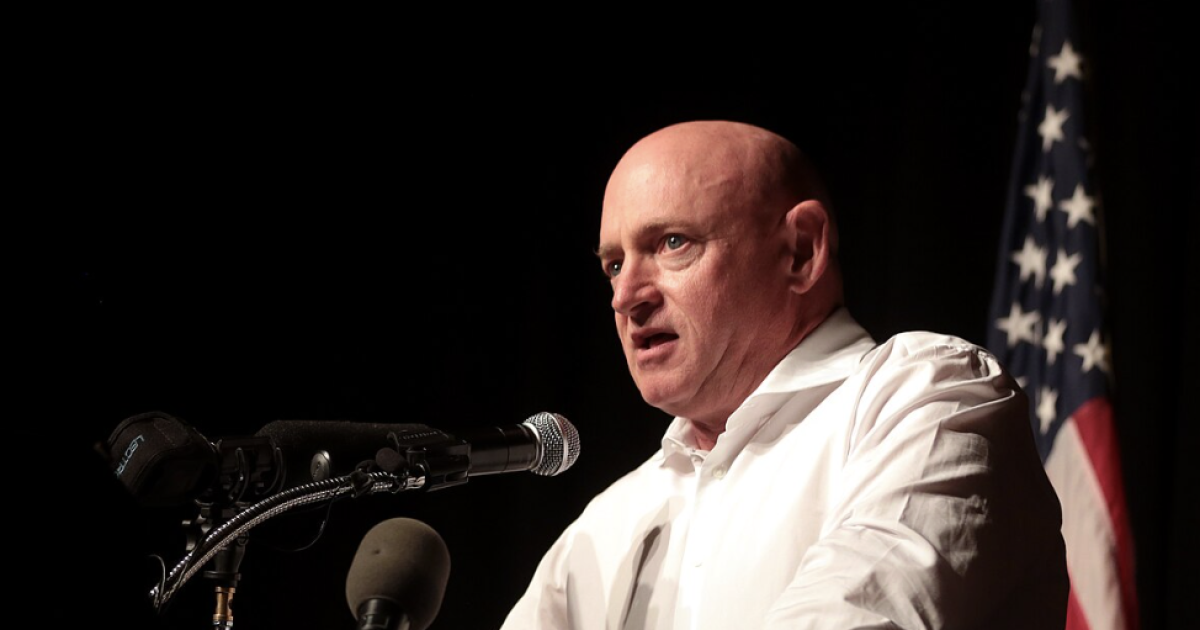
Defense Secretary Pete Hegseth says the Pentagon is moving to dock Senator Mark Kelly’s captain rank and retirement pension after Kelly released a video, joined by five Democratic congressional colleagues who also served in the military, saying “Our laws are clear: You can refuse illegal orders.”
On Monday, Hegseth wrote on X that the video was “reckless and seditious.” Hegseth also accused Kelly, a retired U.S. Navy captain and current member of the Senate Armed Services Committee, of “reckless misconduct” and said the Defense Department has initiated proceedings under 10 U.S.C. § 1370(f), which governs the rank of retired officers.
Despite Hegseth’s comments, Kelly merely stated the law. Page 402 of the Manual for Courts-Martial establishes that while orders are presumed to be lawful, that presumption “does not apply to a patently illegal order, such as one that directs the commission of a crime.” Indeed, servicemembers are only bound to follow “lawful orders” — not unlawful ones. Hegseth wants to argue that Kelly encouraged dereliction of duty, but simply stating the law is protected under the Constitution.
Here’s what you need to know about how the First Amendment governs active duty and retired servicemembers’ speech.
Can the government court-martial military retirees?
Yes, Congress has established that military retirees remain subject to military courts under 10 U.S.C. § 802(a)(4). Kelly served in the Navy for 25 years, so he’s subject to the Uniform Code of Military Justice.
Do military members have First Amendment rights?
Military members do have First Amendment rights, though military prosecution for speech-based offenses operates under a different constitutional framework than civilian cases.
In Parker v. Levy (1974), the Supreme Court grounded limits on active-duty service members’ speech in “military necessity,” reasoning that the armed forces are a “separate society” dependent on rank, discipline, and obedience. That logic doesn’t fit for retirees, whose speech typically poses no immediate risk to day-to-day order and discipline.
Can the military demote a retired servicemember?
By law, a service member’s retired grade is based on the “highest permanent grade” in which the officer served “satisfactorily.” But § 1370(f) allows the government to reconsider a retiree’s rank for things like fraud. Additionally, § 1370(f)(2)(D) allows demotion for “good cause” — a catchall provision left to the Pentagon’s discretion. Hegseth is arguing that Kelly violated UCMJ articles 133 and 134, constituting good cause.
Did Kelly commit “conduct unbecoming an officer” under Article 133?
Article 133 bans “conduct unbecoming an officer.” The Court of Appeals for the Armed Forces (CAAF), the highest appellate court for military justice, applies a simple test here. The accused must have committed an act, or used language, unbecoming an officer. Hegseth believes the video in question qualifies. But the bar is high. In United States v. Voorhees (2019), the CAAF described unbecoming conduct as “more serious than slight” misbehavior “of a material and pronounced character.”
When the alleged misconduct is otherwise protected speech, the CAAF layers on extra protections based on the First Amendment. The speech must pose a “clear and present danger” of “dishonoring or disgracing the officer, seriously compromis[ing]” the officer’s standing.
In United States v. Howe (1967), the court upheld an Article 133 conviction for an active-duty officer who called President Johnson an “ignorant fascist.” The court reasoned that, in context, such contempt toward senior civilian leadership presented a “clear and present danger” to military discipline.
Later, in United States v. Hartwig (1994), the CAAF upheld an active-duty officer’s conviction for sending a sexually explicit letter to a stranger he had reason to know was a minor. The court reasoned that this was inherently dishonorable.
Notably, the government hasn’t brought an Article 133 case against a retiree since Hooper v. Hartman (1958), leaving little guidance as to whether the CAAF might layer on additional speech protections (like Article 134’s nexus requirement, addressed below). Indeed, Hooper wasn’t even a speech case. It involved a servicemember’s same-sex relationship, now constitutionally protected under Lawrence v. Texas (2003).
Kelly didn’t dishonor or disgrace another officer, so the government’s theory must be self-disgrace. It’s hard then to see how accurately stating the law creates a “clear and present danger.” Unlike in Hartwig, stating the law isn’t inherently dishonorable conduct. The government will need to prove Kelly’s statement, not mere political disagreement, tends to disgrace him personally or brings disrepute to the officer corps.
In fact, the military’s 2024 Operational Law Handbook (page 86) expressly states that troops should learn the duty to refuse “manifestly” illegal orders. If troops are regularly taught this basic law-of-armed-conflict precept, why would it be “seditious,” as Hegseth suggested, for Kelly to remind servicemembers of that obligation?
Did Kelly “prejudice good order” under Article 134?
Article 134 prohibits “service discrediting” speech, meaning speech that could “prejudice… good order and discipline in the armed forces.” The Department of Defense Manual for Courts-Martial further states that under Article 134, “certain disloyal statements” may be “punishable,” including “praising the enemy, attacking the war aims of the United States, or denouncing our form of government with the intent to promote disloyalty or disaffection.”
What civilians can say freely, active-duty troops often can’t. Parker v. Levy’s “military necessity” doctrine allows limits on active-duty troops’ exercise of First Amendment rights, even though military courts do sometimes impose constraints on speech-based court-martials.
For example, in United States v. Wilcox (2008), the CAAF established a nexus test for service discrediting speech. If the speech is otherwise protected outside the military context, there must be a “reasonably direct and palpable connection between the speech and the military mission or military environment” before the court continues to balance First Amendment interests against the military’s interest in order.
In Wilcox, an army paratrooper was court-martialed under Article 134 for posting online comments supporting the KKK. Because the record showed no evidence that his comments were directed at service members, reached his unit, or had any demonstrated operational or disciplinary effect, the CAAF held that there was no nexus and thus dismissed the case.
In the retiree context, the nexus requirement functions as a free-speech safeguard. Without evidence tying a retiree’s comments to concrete disruption within the ranks of the military, an Article 134 court-martial will likely fail.
Kelly is no longer in the military, but his remarks were directed toward active service members. Still, the content of those comments matter. Telling troops to “refuse illegal orders” is not the same as telling them to refuse duty. It’s an articulation of the very real legal boundaries that service members must respect, as outlined in Article 92. The government will have to show that Kelly’s comments had some operational or disciplinary effect.
Hegseth has not yet offered any such proof.
What’s the significance of the Pentagon’s move against Kelly?
The law here is less developed than civilian First Amendment doctrine, making outcomes hard to predict. So, broad use of Articles 133 and 134 against retirees risks chilling their participation in public debate about U.S. military actions. This is especially risky for a sitting United States senator — one serving on the Armed Services Committee — elected by the citizens of his state specifically to debate and form U.S. policy, including military actions.
Under Articles 133 and 134 — as well as many others in the UCMJ — the Pentagon can stretch vague wording to punish active duty and retired servicemembers for ordinary criticism. But if the First Amendment means anything, civilians and veterans alike should be free to discuss — or even criticize — military policy without fear of punishment. As Eugene Fidell, a military law expert at Yale, predicted: “None of this will stand up.”
Many of America’s servicemembers have given their lives to protect these freedoms. Those who retire from service should not be refused those same liberties.