The University of Wisconsin-Stevens Point is teaming up with a community college to share space, offer joint programming and develop transfer pathways between the institutions.
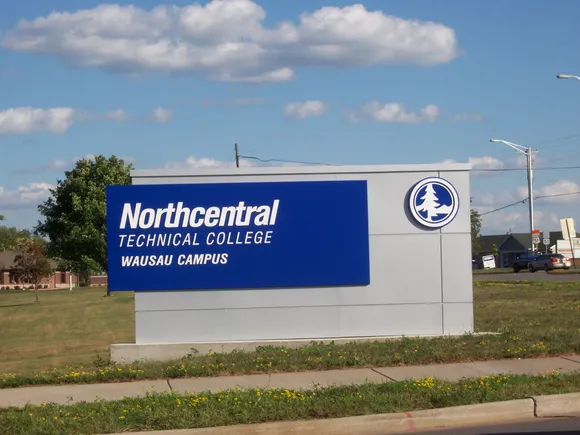
Under the partnership, UW-Stevens Point’s Wausau branch will relocate to nearby Northcentral Technical College’s campus in the city beginning in fall 2026.
Through the partnership, the university plans to increase degree programs in Wausau in high-demand fields like healthcare and business. For example, the two institutions are discussing collaborating on a surgical technician program, they said.
Dive Insight:
The partnership between UW-Stevens Point and NTC comes after years of steep enrollment decline at the university’s Wausau location and questions about the branch’s viability.
Between fall 2011 and fall 2023, full-time equivalent enrollment at UW-Stevens Point’s Wausau campus fell by a vertiginous 78.5% to just 232 students, according to institutional evaluations of the Universities of Wisconsin system by Deloitte last year.
The university’s Marshfield campus suffered a similar decline. Deloitte’s assessment of both campuses was that the sharp enrollment drop-offs “threaten the future viability” of those locations.
It also added pressure to the university as a whole. Without making operational changes, Deloitte forecast UW-Stevens Point would face mounting deficits in the years ahead.
NTC has also seen declines in recent years. Between 2018 and 2023, fall headcount declined 8.7% to 5,838 students at the technical college, per federal data.
The institutions hope that joining forces can help play to their strengths while offering students new reasons to attend each college. The UW-Stevens Point branch will offer bachelor’s and master’s degrees while NTC offers associate degrees and certificates.
“Students will have a seamless connection between UWSP and NTC,” Miranda Gentry-Siegel, executive of UW-Stevens Point’s Wausau campus. “Advisers from both schools will work together to find options that fit students’ interest and finances.”
The institutions also pointed to the potential for joint programs, collaboration between faculties on program design, combined student support services, and cost savings by reducing duplicated programs and services.
Faculty from UW-Stevens Point will stay employees of the university upon moving to teach at NTC’s campus, according to a FAQ page. It also signaled the possibility that some staff positions could be cut, noting that those who lose their positions will be “given the opportunity” to pursue jobs elsewhere in UW-Stevens Point or in the county government.
The university is working with Marathon County to determine future use of its current campus, which is about two miles from NTC.
After the move to NTC’s facilities, UW-Stevens Point will end its varsity sports programs in men’s basketball and women’s volleyballthrough the Wisconsin Competitive Sports League, the university said.
Several branch campuses within the Universities of Wisconsin system have shuttered in recent years.UW-Milwaukee closed its campus in Washington County in 2024 and its Waukesha campus this summer. However, the university is opening a center at Waukesha County Technical College to offer bachelor’s and graduate programs.
Additionally, UW-Platteville closed its Richland campus in 2023, and UW-Oshkosh shuttered its Fond du Lac branch in 2024.
Decatur, Illinois, has been losing factory jobs for years. A training program at a local community college promises renewal and provides training for students from disenfranchised communities
DECATUR, IL. — A fistfight at a high school football game nearly defined Shawn Honorable’s life.
It was 1999 when he and a group of teen boys were expelled and faced criminal charges over the incident. The story of the “Decatur Seven” drew national headlines and protests led by the Rev. Jesse Jackson, who framed their harsh treatment as blatant racism. The governor eventually intervened, and the students were allowed to attend alternative schools.
Honorable, now 41, was encouraged by support “from around the world,” but he said the incident was traumatizing and he continued to struggle academically and socially. Over the years, he dabbled in illegal activity and was incarcerated, most recently after a 2017 conviction for accepting a large amount of marijuana sent through the mail.
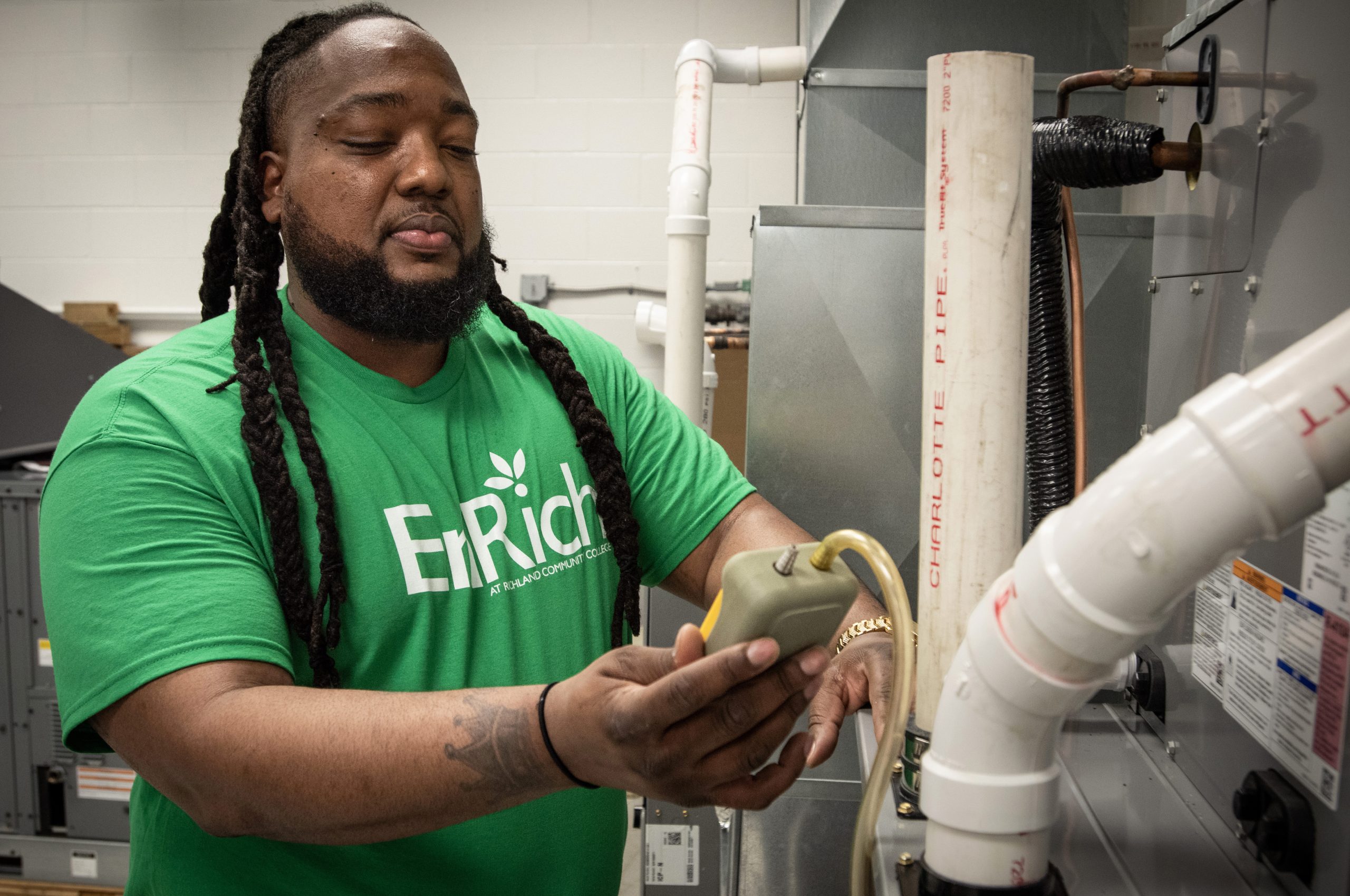
Today, Honorable is ready to start a new chapter, having graduated with honors last week from a clean energy workforce training program at Richland Community College, located in the Central Illinois city of Decatur. He would eventually like to own or manage a solar company, but he has more immediate plans to start a solar-powered mobile hot dog stand. He’s already chosen the name: Buns on the Run.
“By me going back to school and doing this, it shows my nephews and my little cousins and nieces that it is good to have education,” Honorable said. “I know this is going to be the new way of life with solar panels. So I’ll have a step up on everyone. When it comes, I will already be aware of what’s going on with this clean energy thing.”
Shawn Honorable graduated with honors last week from Richland Community College’s clean energy workforce training program in Decatur, Illinois, part of a network of hubs funded by the state’s 2021 Climate and Equitable Jobs Act. Credit: Lloyd DeGrane/Canary Media
After decades of layoffs and factory closings, the community of Decatur is also looking to clean energy as a potential springboard.
Located amid soybean fields a three-hour drive from Chicago, the city was long known for its Caterpillar, Firestone Tire, and massive corn-syrup factories. Industrial jobs have been in decline for decades, though, and high rates of gun violence, child poverty, unemployment, and incarceration were among the reasons the city was named a clean energy workforce hub funded under Illinois’ 2021 Climate and Equitable Jobs Act (CEJA).
Decatur’s hub, based at Richland Community College, is arguably the most developed and successful of the dozen or so established statewide. That’s thanks in part to TCCI Manufacturing, a local, family-owned factory that makes electric vehicle compressors. TCCI is expanding its operations with a state-of-the-art testing facility and an on-site campus where Richland students will take classes adjacent to the manufacturing floor. The electric truck company Rivian also has a factory 50 miles away.
“The pieces are all coming together,” Kara Demirjian, senior vice president of TCCI Manufacturing, said by email. “What makes this region unique is that it’s not just about one company or one product line. It’s about building an entire clean energy ecosystem. The future of EV manufacturing leadership won’t just be on the coasts — it’s being built right here in the Midwest.”
Powering Rural Futures:Clean energy is creating new jobs in rural America, generating opportunities for people who install solar panels, build wind turbines, weatherize homes and more. This five-part series from the Rural News Network explores how industry, state governments and education systems are training this growing workforce.
Related: Want to read more about how climate change is shaping education? Subscribe toour free newsletter.
The Decatur CEJA program has also flourished because it was grafted onto a preexisting initiative, EnRich, that helps formerly incarcerated or otherwise disenfranchised people gain new skills and employment. The program is overseen by the Rev. Courtney Carson, a childhood friend of Honorable and another member of the Decatur Seven.
“So many of us suffer significantly from our unmet needs, our unhealed traumas,” said Carson, who was jailed as a young man for gun possession and later drag racing. With the help of mentors including Rev. Jackson and a college basketball coach, he parlayed his past into leadership, becoming associate pastor at a renowned church, leading a highway construction class at Richland, and in 2017 being elected to the same school board that had expelled him.
Carson, now vice president of external relations at the community college, tapped his own experience to shape EnRich as a trauma-informed approach, with wraparound services to help students overcome barriers — from lack of childcare to PTSD to a criminal record. Carson has faith that students can overcome such challenges to build more promising futures, like Decatur itself has done.
“We have all these new opportunities coming in, and there’s a lot of excitement in the city,” Carson said. “That’s magnificent. So what has to happen is these individuals who suffered from closures, they have to be reminded that there is hope.”
Richland Community College’s clean energy jobs training starts with an eight-week life skills course that has long been central to the larger EnRich program. The course uses a Circle of Courage practice inspired by Indigenous communities and helps students prepare to handle stressful workplace situations like being disrespected or even called a racial slur.
“Being called the N-word, couldn’t that make you want to fight somebody? But now you lose your job,” said Carson. “We really dive deep into what’s motivating their attitude and those traumas that have significantly impacted their body to make them respond to situations either the right way or the wrong way.”
The training addresses other dynamics that might be unfamiliar to some students — for example, some male students might not be prepared to be supervised by a woman, Carson noted, or others might not be comfortable with LGBTQ+ coworkers.
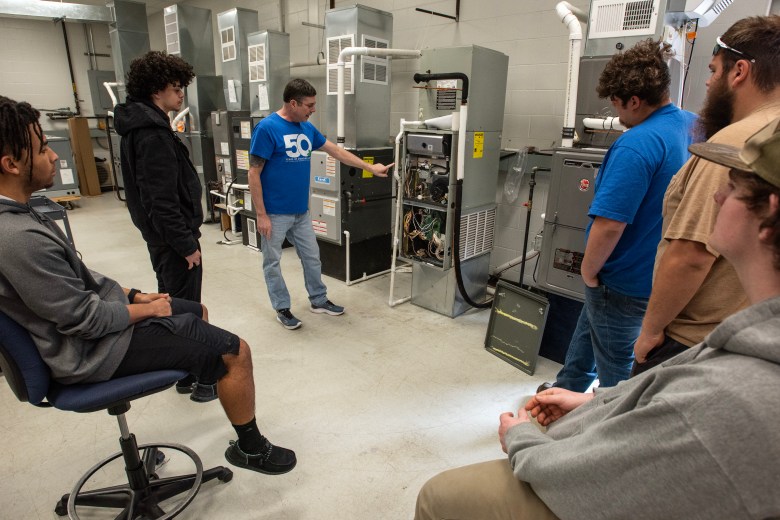
Karl Evans instructs Richland Community College students on the inner workings of a gas furnace. Credit: Lloyd DeGrane/Canary Media
Life skills are followed by a construction math course crucial to many clean energy and other trades jobs. During a recent class, 24-year-old Brylan Hodges joked with the teacher while converting fractions to decimals and percentages on the whiteboard. He explained that he moved from St. Louis to Decatur in search of opportunity, and he hopes to become a property manager overseeing solar panel installation and energy-efficiency upgrades on buildings.
Students take an eight-hour primer in clean energy fields including electric vehicles, solar, HVAC, and home energy auditing. Then they choose a clean energy track to pursue, leading to professional certifications as well as a chance to continue at Richland for an associate degree. Under the state-funded program, students are paid for their time attending classes.
Marcus James was part of the first cohort to start the program last October, just days after his release from prison.
He was an 18-year-old living in Memphis, Tennessee, when someone shot at him, as he describes it, and he fired back, with fatal consequences. He was convicted of murder and spent 12 years behind bars. After his release he made his way to Decatur, looking for a safer place to raise his kids. Adjusting to life on the outside wasn’t easy, and he ended up back in prison for a year and a half on DUI and drug possession charges.
Following his release, he was determined to turn his life around.
“After I brought my kids up here, I end up going back to prison. But at that moment, I realized, man, I had to change,” James told a crowd at an event celebrating the clean jobs program in March.
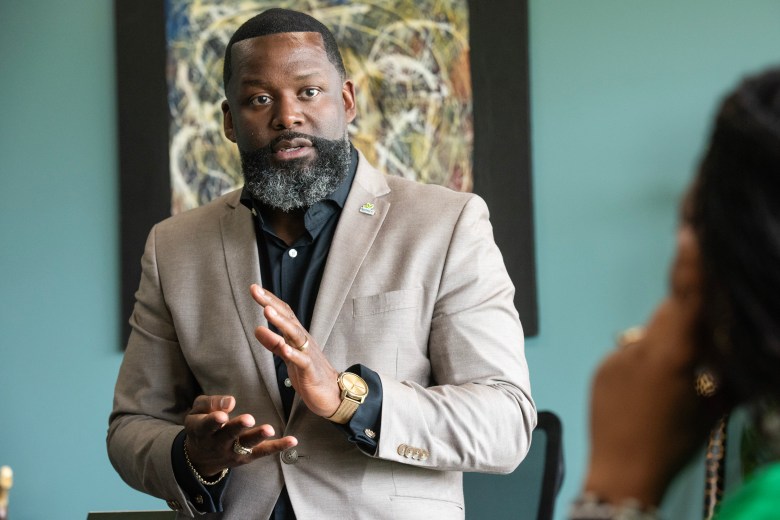
The Rev. Courtney Carson, vice president of external relations at the community college. Credit: Lloyd DeGrane/Canary Media
James said that at first, he showed up late to every class. But soon the lessons sank in, and he was never late again. He always paid attention when people talked, and he gained new confidence.
“As long as I put my mind to it, I can do it,” said James, who would like to work as a home energy auditor. Richland partners with the energy utility Ameren to place trainees in such positions.
“I like being out in the field, learning new stuff, dealing with homes, helping people,” James said, noting he made energy-efficiency improvements to his own home after the course.
Illinois’ 2017 Future Energy Jobs Act (FEJA) launched the state’s clean energy transition, baking in equity goals that prioritize opportunities for people who benefited least and were harmed most by the fossil fuel economy. It created programs to deploy solar arrays and provide job training in marginalized and environmental justice communities.
FEJA’s rollout was rocky. Funding for equity-focused solar installations went unspent while workforce programs struggled to recruit trainees and connect them with jobs. The pandemic didn’t help. The follow-up legislation, CEJA, expanded workforce training programs and remedied snafus in the original law.
Melissa Gombar is principal director of workforce development programs for Elevate, a Chicago-based national nonprofit organization that oversaw FEJA job training and subcontracts for a Chicago-area CEJA hub. Gombar said many community organizations tasked with running FEJA training programs were relatively small and grassroots, so they had to scramble to build new financial and human resources infrastructure.
“They have to have certain policies in place for hiring and procurement. The influx of grant money might have doubled their budget,” Gombar said. Meanwhile, the state employees tasked with helping the groups “are really talented and skilled, trying their best, but they’re overburdened because of the large lift.”
CEJA, by contrast, tapped community colleges like Richland, which already had robust infrastructure and staffing. CEJA also funds community organizations to serve as “navigators,” using the trust and credibility they’ve developed in communities to recruit trainees.
Richland Community College received $2.6 million from April 2024 through June 2025, and the Community Foundation of Macon County, the hub’s navigator, received $440,000 for the same time period. The other hubs similarly received between $1 million and $3.3 million for the past year, and state officials have said the same level of funding will be allocated for each of the next two years, according to the Illinois Clean Jobs Coalition.
CEJA hubs also include social service providers that connect trainees with wraparound support; businesses like TCCI that offer jobs; and affiliated entrepreneur incubators that help people start their own clean energy businesses. CEJA also funded apprenticeship and pre-apprenticeship programs with labor unions, which are often a prerequisite for employment in utility-scale solar and wind.
“The sum of the parts is greater than the whole,” said Drew Keiser, TCCI vice president of global human resources. “The navigator is saying, ‘Hey, I’ve connected with this portion of the population that’s been overlooked or underserved.’ OK, once you get them trained, send their resumes to me, and I’ll get them interviewed. We’re seeing a real pipeline into careers.”
The hub partners go to great lengths to aid students — for example, coordinating and often paying for transportation, childcare, or even car repairs.
“If you need some help, they always there for you,” James said.
In 1984, TCCI began making vehicle compressors in a Decatur plant formerly used to build Sherman tanks during World War II. A few decades later, the company began producing compressors for electric vehicles, which are much more elaborate and sensitive than those for internal combustion engines.
In August 2023, Gov. JB Pritzker joined TCCI President Richard Demirjian, the Decatur mayor, and college officials for the groundbreaking of an Electric Vehicle Innovation Hub, which will include a climatic research facility — basically a high-tech wind tunnel where companies and researchers from across the world can send EV chargers, batteries, compressors, and other components for testing in extreme temperatures, rain, and wind.
A $21.3 million capital grant and a $2.2 million electric vehicle incentive from the state are funding the wind tunnel and the new facilities where Richland classes will be held. In 2022, Pritzker announced these investments as furthering the state goal of 1 million EVs on the road by 2030.
Far from the gritty industrial environs that likely characterized Decatur workplaces of the past, the classrooms at TCCI feature colorful decor, comfortable armchairs, and bright, airy spaces adjacent to pristine high-tech manufacturing floors lined with machines.
“This hub is a game changer,” said Keiser, noting the need for trained tradespeople. “As a country, we place a lot of emphasis on kids going to college, and maybe we’ve kind of overlooked getting tangible skills in the hands of folks.”
A marketing firm founded by Kara Demirjian – Richard Demirjian’s sister – and located on-site with TCCI also received clean energy hub funds to promote the training program. This has been crucial to the hub’s success, according to Ariana Bennick, account executive at the firm, DCC Marketing. Its team has developed, tested, and deployed digital billboards, mailers, ads, Facebook events, and other approaches to attract trainees and business partners.
“Being a part of something here in Decatur that’s really leading the nation in this clean energy initiative is exciting,” Bennick said. “It can be done here in the middle of the cornfields. We want to show people a framework that they can take and scale in other places.”
With graduation behind him, Honorable is planning the types of hot dogs and sausages he’ll sell at Buns on the Run. He said Tamika Thomas, director of the CEJA program at Richland, has also encouraged him to consider teaching so he can share the clean energy skills he’s learned with others. The world seems wide open with possibilities.
“A little at a time — I’m going to focus on the tasks in front of me that I’m passionate about, and then see what’s next,” Honorable said. He invoked a favorite scene from the cartoon TV series “The Flintstones,” in which the characters’ leg power, rather than wheels and batteries, propelled vehicles: “Like Fred and Barney, I’ll be up and running.”
The Hechinger Report provides in-depth, fact-based, unbiased reporting on education that is free to all readers. But that doesn’t mean it’s free to produce. Our work keeps educators and the public informed about pressing issues at schools and on campuses throughout the country. We tell the whole story, even when the details are inconvenient. Help us keep doing that.
American University’s student government recently passed a referendum calling on the university to designate itself a sanctuary campus and limit its cooperation with federal immigration enforcement. Student protests broke out at the University of North Carolina Asheville, the University of Texas at Austin and elsewhere to push those campuses to embrace sanctuary status. A petition with the same demand from Colorado State University’s chapter of the Young Democratic Socialists of America garnered more than 3,000 signatures.
“It is of the utmost importance that students, staff, and community members see CSU committing to protect the most threatened students in this community,” read the student petition to Colorado State administrators.
The petitions and protests have also been fueled by student frustrations with universities’ compliance with other federal immigration actions. The Council on American-Islamic Relations and other groups sued Columbia University on behalf of students after federal immigration agents arrested Mahmoud Khalil, a green card–holding recent Columbia graduate, at his university-owned apartment because of his involvement in pro-Palestinian protests. Shortly afterwards, Department of Homeland Security agents searched two Columbia dorms, though no arrests were made. The CAIR lawsuit, which also targets the House of Representatives’ Committee on Education and the Workforce, led to an injunction that stopped the university from sharing more student records with lawmakers.
“While I await legal decisions that hold the futures of my wife and child in the balance, those who enabled my targeting remain comfortably at Columbia University,” Khalil said in a statement from an ICE detention center in Louisiana. “Columbia surrendered to federal pressure by disclosing student records to Congress and yielding to the Trump administration’s latest threats.”
The renewed push for sanctuary campuses harks back to President Donald Trump’s first term, when students at dozens of campuses petitioned their colleges to follow the lead of sanctuary cities and create boundaries for their cooperation with federal immigration officials. At the time, a handful of higher ed institutions agreed to designate themselves sanctuary campuses and protect undocumented students to the fullest extent the law allows. Many more made public declarations of support for undocumented students without actually embracing the title.
This time around, while some college and university leaders have promised they’ll support students in every way legally possible, few are eager to comment publicly on Trump’s immigration actions or use the sanctuary title, for fear of overpromising the protections they can offer or attracting unwanted attention to their campuses, potentially putting students or federal funds at risk.
The Trump administration has already gone after sanctuary cities, with Chicago among the first targeted for immigration raids. One of Trump’s early executive orders asserted that “sanctuary jurisdictions” shouldn’t receive federal funding. The Trump administration also sued the city of Chicago, the state of Illinois and New York State over their immigration policies last month. And recently, Republican lawmakers lambasted the mayors of Boston, Chicago, Denver and New York City for their sanctuary statuses at a contentious hearing before the House Committee on Oversight and Government Reform.
Some college leaders are clearly worried that using the term “sanctuary” could make them a target as well. Even the few colleges and universities that previously designated themselves sanctuary campuses seem hesitant to use, or discuss, the term. Inside Higher Ed reached out to eight higher ed institutions that have called themselves sanctuary campuses in the past. Three institutions declined interviews, and four didn’t respond to email requests for comment.
A spokesperson for a community college in the Southwest confirmed in an email that the institution “remains committed to serving and supporting all students” but no longer actively uses the term “sanctuary.”
“Because our top priority is student safety, we prefer not to comment further,” the spokesperson wrote.
‘Meaningful,’ ‘Risky’ or Both?
Current debates over the term “sanctuary” likely reflect some of the ways this political moment differs from Trump’s first term.
Notably, fears that federal immigration officials could venture onto campuses became a reality after Khalil’s recent arrest, heightening the risks of taking a public stand. Other federal immigration actions affecting students and scholars followed, including the arrest of Badar Khan Suri, an Indian postdoctoral fellow at Georgetown University.
A professor at an institution that previously declared itself a sanctuary campus emphasized that Khalil’s case made those working with undocumented students “even more alarmed.” During Trump’s first term, campuses ultimately weren’t a target of federal immigration actions, but the events of the past month at Columbia show that may no longer be true, said the professor, who spoke with Inside Higher Ed on condition of anonymity.
Another key difference between Trump’s first and second terms is that most of today’s undocumented students can’t participate in the Deferred Action for Childhood Arrivals program, which protects those brought to the U.S. as children before 2007 from deportation and allows them to work legally. That means many undocumented students are arguably more vulnerable than they were during Trump’s first term, the professor said. At the same time, campuses have far more infrastructure, resources and legal training to support undocumented students than in the past, they added.
The professor believes it’s still worthwhile for colleges to call themselves sanctuary campuses—or at least offer undocumented students some kind of public support—because it means a lot to affected students and the faculty and staff supporting them. It helps them feel “braver.”
“I think it’s both meaningful and risky,” they said. “In fact, I think it might be more meaningful now because it’s so risky.” But “I don’t necessarily think that using the word ‘sanctuary’ is the key. I think the key is saying something.”
College leaders likely believe “not speaking out is going to give them a layer of safety, because we’re not waving a flag, like, ‘Look over here,’” the professor added. “I get that, but I’m just not sure that it’s right.” They noted that even though Columbia cracked down on pro-Palestinian protesters, the Trump administration has shown no signs of letting up on the institution, vowing to strip it of hundreds of millions of federal dollars.
Even some college leaders who have long supported undocumented students have always had issues with the sanctuary designation, said Miriam Feldblum, executive director of the Presidents’ Alliance on Higher Education and Immigration. Her organization doesn’t encourage the term because she worries it’s amorphous and sends a confusing message to undocumented students.
To her, the label evokes the idea of “civil disobedience,” reminiscent of the way churches housed and shielded Central American refugees in the 1980s sanctuary movement. But campuses are still responsible for “complying with the law,” she said. If students interpret the term “sanctuary” to mean otherwise, she fears they might misunderstand what protections they do and don’t have.
“It’s actually not communicating clearly and transparently what the campus is going to do,” she said.
Feldblum believes students’ outrage toward Columbia over its handling of federal immigration actions reflects how easy it is to misunderstand campuses’ legal options. From her perspective, Columbia followed best practices by developing policies delineating private and public space on campus—where ICE can and cannot enter without a judicial warrant—and making sure immigration officials had the correct warrants when they came knocking. Feldblum argued a sanctuary campus would have done the same.
She emphasized that just because campus leaders take extra care with their language doesn’t mean they’re doing any less to support undocumented students. She said many campuses are furiously updating their protocols on how to handle ICE officials on campus and ramping up services and supports for undocumented students without a sanctuary label.
“The commitment to support students, to use the tools in our toolbox to make sure that we’re protecting students’ right to free speech, that we’re supporting our campuses so they are places for safe and supportive learning is very much at top of mind for campus leaders,” Feldblum said.
Maryam Ahranjani, professor of law at the University of New Mexico, expressed similar discomfort with the term “sanctuary”; she argued it “may not have the same meaning to everyone” and as a result can be “counterproductive.”
“There may be people who would actually support the goals of people in favor of a designation, but maybe they just don’t like the term,” Ahranjani said.
Instead of making a big national push for sanctuary, advocates of undocumented student should “think about how to get the support of highest-level leaders, presidents, provosts” on a set of specific goals informed by the needs and concerns of undocumented students’ on individual campuses, she added.
Colleges need plans in place for how they’d respond to ICE raids, but undocumented students could also be facing other problems that go unnoticed, like bullying or “how the current climate affects [their] ability to learn,” she said. “I think it’s important to talk to them about what their exact individual needs are.” But some advocates for sanctuary campuses insist the designation is needed now more than ever, with both undocumented populations and campus free speech squarely in the administration’s crosshairs.
Michelle Ming, political director at United We Dream, an immigrant youth advocacy organization, empathizes with campus leaders who fear for their federal funding but argues that colleges that don’t embrace sanctuary campus status deny undocumented students a sense of security, thus depriving them of the full benefits of the college experience.
“What is the point of having a school if it’s not going to be safe?” she said. To Ming, sanctuary means students “feel safe to go to class. They feel safe to go and do what they came to do—and paid to do—which is learn, further their education, discover what the next step in life is and form communities that really resonate with who they are and who they want to be. And that includes exercising free speech.”
Antonio Gramsci, the Italian Marxist philosopher and political theorist, famously wrote in his Prison Notebooks, “The old world is dying, and the new world struggles to be born: Now is the time of monsters.”
This phrase speaks not only to Gramsci’s time, but to our own: when older sociopolitical and economic structures are collapsing, but no new stable order has yet emerged.
In such transitional moments, Gramsci argued, uncertainty, instability and reactionary forces dominate, creating a breeding ground for extremism, authoritarianism and political “monsters”—figures or movements that thrive in times of disorder.
For Gramsci, an interregnum refers to a period when the ruling class can no longer maintain its dominance, but the emerging class or system has not yet fully consolidated power. This results in a vacuum of authority, where competing forces—both progressive and regressive—struggle for control.
In these moments the legitimacy of the old order erodes, but its institutions continue to function in a dysfunctional, decaying manner. New movements and ideologies arise, but they lack coherence, structure or the ability to fully replace the old system. Meanwhile, monstrous forces emerge—authoritarian leaders, reactionary movements and political opportunists who capitalize on the instability.
Gramsci saw this dynamic playing out in early-20th-century Europe, where the decline of traditional aristocratic and capitalist structures, coupled with the failures of liberal democracy, gave rise to fascism and Stalinism. He viewed these as monsters—political mutations that emerged from the chaos of transition.
Gramsci’s framework remains highly relevant today. The post–Cold War order—characterized by U.S. hegemony, economic globalization and liberal democracy—is unraveling, but a new, stable global system has not yet taken shape. In this vacuum, we are seeing:
The rise of authoritarian leaders (Putin, Xi, Erdoğan, Orbán, Trump) who exploit the failures of liberal democracy.
Resurgent nationalist and populist movements, fueled by economic stagnation, inequality and disillusionment with global institutions.
Economic disorder, as global supply chains, financial systems and labor markets undergo rapid disruption.
Technological and social transformations, including artificial intelligence–driven job displacement, misinformation and surveillance states.
In short, we are in another Gramscian interregnum, where the old world is collapsing but the new one remains undefined. The critical question remains: What kind of order will emerge from this instability, and at what cost?
The End of the Old Order and the Rise of an Interregnum of Monsters
The post–World War II geopolitical order, defined by American-led capitalism and Soviet-led state socialism, effectively collapsed with the dissolution of the Soviet Union in 1991. Yet, nearly four decades later, a stable new order has failed to materialize. The world remains in a state of flux—an era of competing powers, ideological uncertainty, economic fragmentation and political instability.
Slavoj Žižek’s characterization of our era as a time of “monsters” perfectly captures this interregnum, a period in which the old system has lost legitimacy but a new one has yet to take shape.
The “monsters” in Žižek’s vision are not just metaphorical; they include:
The resurgence of authoritarianism manifest in Chinese assertiveness, Russian revisionism and democratic backsliding in many countries.
Economic disruptions evident in supply chain crises, inflation and the decline of global economic integration.
Technological transformations, including drones, AI, cyberwarfare and social media–driven political instability.
Unstable alliances and shifting power centers resulting from the U.S.-China rivalry, the decline of U.S. hegemony and the European Union’s internal struggles.
This chaotic transition recalls other historical moments when an old international or regional order collapsed without an immediate replacement, creating instability, war and uncertainty.
Historical Parallels: When an Old Order Dies, but No New Order Has Yet Emerged
History is not a linear progression but a series of cycles, punctuated by moments of collapse and renewal. When dominant political, economic and ideological structures break down, they rarely give way immediately to a new, stable order.
Instead, the period between the death of the old system and the emergence of the new is often chaotic, violent and unpredictable. When great empires, ruling ideologies or geopolitical structures collapse, they leave behind a vacuum. This vacuum is rarely filled by a single force but instead becomes a battleground of competing factions, ideologies and power struggles. Only through conflict, negotiation and time does a new order finally emerge. Let me briefly describe several historical examples of such moments of transition, each marked by political fragmentation, war and economic collapse before a more stable system eventually took hold.
The Fall of the Roman Empire and the Dark Ages (Fifth–Eighth centuries CE): The fall of the Western Roman Empire, traditionally dated to 476 CE, was one of the most profound civilizational collapses in history. For centuries, Rome had maintained political unity, trade networks, infrastructure and a legal system that stretched across Europe, North Africa and the Middle East. But as Rome’s central authority weakened, it became vulnerable to external invasions and internal decay. The final blow came when the Germanic chieftain Odoacer deposed the last Western Roman emperor, Romulus Augustulus, in 476 CE.
However, the fall of Rome did not immediately give rise to a new political order. Instead, Europe entered a long period of fragmentation, instability and decline. The vast Roman infrastructure—roads, aqueducts, cities—began to deteriorate, trade networks collapsed and literacy declined. Warlords, petty kings and shifting barbarian kingdoms—Visigoths, Vandals, Ostrogoths and Franks—fought for dominance, carving up the former Roman provinces into competing territories.
The Eastern Roman Empire (Byzantium) continued to exist, but it could not restore unity to the West. It took centuries before Europe stabilized under the feudal order, where landowning lords, bound by obligations of service and protection, became the dominant power structure. Meanwhile, the Catholic Church filled part of the power vacuum left by Rome, gradually emerging as a unifying institution across medieval Europe.
The monsters of the era include warlords and barbarian kingdoms: Visigoths, Vandals and Ostrogoths carved up Roman territory through conquest and shifting alliances. And without a central government, Europe descended into a patchwork of feudal kingdoms, often engaged in constant warfare.
The Thirty Years’ War and the Birth of the Modern State (1618–1648): The Thirty Years’ War was one of the bloodiest and most devastating conflicts in European history, a war that erupted after the collapse of the Catholic-Protestant balance in the Holy Roman Empire. What began as a religious conflict between Catholic and Protestant states soon spiraled into a broader struggle for power involving nearly every major European state.
For three decades, mercenary armies ravaged the continent, plundering cities and decimating populations. Entire regions of Germany were depopulated, with famine and disease killing millions. The political and economic devastation was so extreme that some regions took over a century to recover.
Eventually, the Peace of Westphalia in 1648 ended the war and established a new political order based on sovereign states, setting the foundation for the modern nation-state system. The idea that rulers had the right to control their own territories without external interference—the principle of sovereignty—became the new international norm.
The monsters of the era included:
Mercenary armies: Private military forces, loyal only to the highest bidder, wreaked havoc across Europe.
Militant religious factions: Fanatical Catholic and Protestant forces carried out massacres in the name of faith.
Warlords and opportunists: The war allowed ambitious nobles and military leaders to seize power in the chaos.
The French Revolution and the Napoleonic Wars (1789–1815): The French Revolution (1789–1799) shattered the old European order by overthrowing the monarchy, aristocracy and feudal privileges. However, rather than leading to a stable democratic government, France descended into a decade of internal purges, political terror and war.
The Reign of Terror (1793–1794), led by Maximilien Robespierre and the Jacobins, saw thousands executed by the guillotine as the revolutionary government turned against itself. Meanwhile, the monarchies of Europe waged war to crush the revolution, fearing that its ideals would spread beyond France.
Out of this chaos rose Napoleon Bonaparte, a military leader who transformed revolutionary France into a new empire that briefly dominated Europe. His conquests spread the principles of nationalism and legal reform but also brought bloody war. Only with the Congress of Vienna (1815) did Europe regain a measure of stability, restoring monarchies and attempting to balance power between nations.
The monsters of the era included:
Revolutionary factions: Competing groups (Jacobins, Girondins) executed thousands in ideological purges.
Napoleon’s imperial vision: A charismatic leader who promised order, only to launch wars of conquest across Europe.
Mercenary armies: Warfare became a permanent state of existence, with shifting alliances.
The Aftermath of World War I and the Rise of Fascism (1919–1939): World War I (1914–1918) marked the beginning of the end of the age of empires, leading to the collapse of the Austro-Hungarian, Ottoman, German and Russian Empires. However, the war did not create a stable new order. Instead, the 1920s and 1930s saw economic depression, political instability and the rise of radical ideologies.
The Treaty of Versailles (1919) imposed harsh economic reparations on Germany, fueling resentment, hyperinflation and nationalist extremism. Meanwhile, the Great Depression (1929) devastated economies worldwide, discrediting democratic governments and strengthening totalitarian movements. By the 1930s, fascist regimes had emerged in Italy, Germany, Spain and Japan, ultimately leading to World War II.
The monsters of the era included:
Adolf Hitler and Benito Mussolini: Fascist leaders who exploited economic despair and nationalism to seize power.
Stalin’s purges: The Soviet Union’s totalitarian regime carried out mass executions and forced labor camps.
Militarist Japan: Japanese imperialists invaded China and Southeast Asia, committing atrocities on a massive scale.
The Post–Cold War Era and the War on Terror (1991–Present): The end of the Cold War in 1991 did not lead to universal peace. While the United States emerged as the dominant superpower, the global landscape became more unstable, with failed states, terrorism and regional wars filling the vacuum.
Yugoslavia’s violent breakup led to genocide and ethnic cleansing. The Sept. 11 attacks triggered the U.S.-led War on Terror (2001–), which destabilized the Middle East. ISIS emerged from the ruins of Iraq and Syria, proving that power vacuums create new threats.
The monsters of that era included extremist groups like Al-Qaeda, ISIS and other militant factions that thrived in collapsed states, and insurgencies and rogue states as failed governments allowed warlords and factions to seize power.
Every historical interregnum has followed a pattern: collapse, chaos, monsters and eventually, stability. Today, we stand in another such moment—what emerges next remains uncertain.
Our Present Moment: A New Interregnum, a New Time of Monsters
History does not move in a straight line. It is instead marked by periods of stability, where dominant powers enforce a relatively predictable order and periods of transition, where old systems collapse but no new framework has yet taken hold. These interregnums—moments between the death of one order and the birth of another—are often the most dangerous and unpredictable in human history.
Antonio Gramsci’s invocation of a “time of monsters” refers to the forces—political extremism, authoritarianism, war, economic collapse, technological upheaval—that emerge to fill the uncertainty and chaos left by the collapse of the old order.
Like past historical interregnums, our world today is trapped in an unstable and dangerous limbo.
The post–World War II order, which was largely defined by the Cold War’s bipolar structure, has now been gone for over three decades, but a stable replacement has yet to emerge. The unipolar world dominated by the United States after 1991 has weakened.
We are witnessing the decline of U.S. hegemony, the rise of new powers like China and the fragmentation of global politics into multiple competing spheres of influence. In the midst of this transition, we are already seeing conflict, chaos and the resurgence of political forces that many had assumed had been relegated to the past.
A new world order will eventually arise, but the crucial question remains: At what cost? If history is any guide, the period before the emergence of a new stable order is likely to be marked by war, social upheaval, economic instability and political extremism. The world we recognize today may be unrecognizable within a generation.
A Fractured World: The Breakdown of Global Stability
One of the defining features of interregnum periods is the dissolution of previous structures of power and authority. The last 30 years have seen:
The weakening of U.S. global leadership: After decades of post–Cold War dominance, the United States faces internal political instability, economic stagnation and diminishing global influence.
The rise of China as an alternative power: While not yet a global hegemon, China’s economic, military and technological rise directly challenges U.S. influence, particularly in Asia and Africa.
The return of revisionist states: Countries like Russia, Turkey and Iran seek to challenge, alter or overturn the international order and reshape their regional environments through military force and coercion, testing the limits of international norms.
The decline of global institutions: The United Nations, the World Trade Organization and other international bodies have been weakened, sidelined or ignored as major powers act unilaterally.
Instead of one dominant global system, the world is now fragmenting into competing blocs, including:
A China-led economic and technological sphere, including much of Asia, parts of Africa and South America.
A U.S.-led bloc, still influential in Europe and parts of the Pacific but facing internal and external challenges.
A growing zone of instability, including much of the Middle East, sub-Saharan Africa and Central Asia, where states are collapsing and nonstate actors (militias, terrorist groups, warlords) are gaining power.
These fractured realities mean that global cooperation—on everything from climate change to economic stability—has become harder than ever before.
The Return of Nationalism, Populism and Authoritarianism
When old orders collapse, people often turn to strongmen, radical ideologies and reactionary forces for answers. This is not new—the 1920s and 1930s saw the collapse of post–World War I democratic governments and the rise of fascism, communism and militarism. The same dynamic is unfolding today.
Right-wing nationalism is rising across the world, from Europe to India to the United States, driven by fears of economic decline, cultural change and political dysfunction.
Populist movements are destabilizing democracies, as leaders use rhetoric against elites, immigrants and globalization to build political power.
Authoritarian regimes are emboldened, seeing liberal democracies as weak and in decline. Russia’s invasion of Ukraine is the most striking example of this trend.
Polarization and political violence are increasing, as societies turn against themselves, fueled by disinformation and deep ideological divisions.
Rather than a world moving toward greater democracy and cooperation, we are witnessing a reversal of the democratic gains of the 20th century, with more countries turning toward illiberalism, autocracy and repression.
Economic Uncertainty and the Decline of Globalization
Another feature of historical interregnums is economic instability, as old economic systems break down and new ones struggle to take shape. Today, we are seeing:
A shift away from globalization: Many nations are moving toward economic nationalism, erecting trade barriers and focusing on domestic production.
Massive debt crises and inflation: Governments across the world are struggling with unsustainable debt, leading to potential financial crises and the erosion of the middle class.
Technological displacement: Automation and technology-driven foreign competition are rapidly replacing traditional jobs, with millions of workers facing economic uncertainty.
The rise of alternative currencies and financial systems, including digital currencies that could further destabilize traditional financial institutions.
The predictable economic order of the late 20th century—characterized by free trade, global markets and stable growth—is unraveling, creating opportunities for economic monsters like black-market economies, corporate monopolies and financial manipulation.
The Role of Technology: AI, Misinformation and Surveillance States
One of the most unprecedented factors of our modern interregnum is the power of technology to both stabilize and destabilize societies.
AI-driven disinformation is undermining trust. Social media algorithms and AI-generated content make it easier than ever to spread propaganda, conspiracy theories and false information, eroding the shared reality necessary for democratic governance.
Surveillance technology is empowering authoritarian states. Countries like China are perfecting digital authoritarianism, using facial recognition, AI and big data to monitor and control their populations.
Cyberwarfare is replacing conventional warfare—Future conflicts may not be fought with tanks and missiles but with hacked infrastructure, financial system disruptions and AI-driven attacks.
While technology has the potential to create solutions, it is currently being weaponized in ways that amplify chaos rather than order.
A New Order Will Emerge—but at What Cost?
Every historical interregnum has eventually given way to a new order, whether it was the birth of the nation-state system after the Thirty Years’ War, the formation of modern democracy after World War II or the collapse of communism leading to the globalized 1990s. But the transitions have rarely been peaceful.
What will it take for a new world order to emerge? Three possibilities stand out:
A negotiated, stable transition: Major powers could collaborate to reshape international institutions, preventing catastrophic conflict. This is the most hopeful outcome.
A prolonged period of instability and fragmentation: The world could remain in political, economic and military chaos for decades before a new dominant system arises.
A major global conflict or crisis forces a new order: As in the aftermath of World Wars I and II, only after widespread destruction will nations work together to build something new.
The ultimate question is: Will today’s leaders and institutions manage to shape a new order without the suffering and bloodshed that usually accompanies such transitions? Or are we doomed to repeat the violent cycles of history?
Until that question is answered, we remain in a dangerous interregnum—a time of uncertainty, instability and monsters.
Steven Mintz is professor of history at the University of Texas at Austin and recipient of the AAC&U’s 2025 President’s Award for Outstanding Contributions to Liberal Education.
When President Trump ordered a 90-day freeze on foreign aid, no one felt the impact more than the people of Sudan. Two years of civil war has left more than 25 million Sudanese starving in what is the largest humanitarian crisis the world has ever seen. Debora Patta reports.
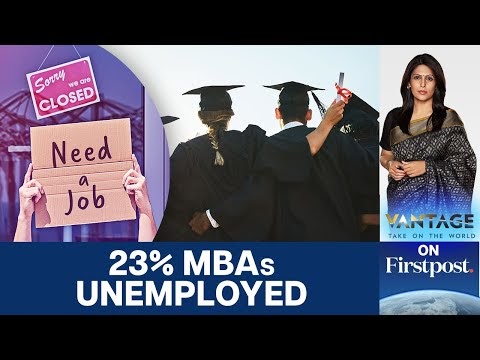
A new report has revealed that 23% of Harvard MBAs were jobless even three months after their graduation. Similar trends have been reported in top B-schools across the world. Once considered a sure-shot ticket to success, what explains the changing fortunes of MBA degrees?