Tag: Student

  • The Artist Who Set Chile’s Student Debt Ablaze

    The Artist Who Set Chile’s Student Debt Ablaze

    Born in 1983 in the southern neighborhoods of Santiago, Chile, Francisco Tapia Salinas—better known as Papas Fritas—emerged as an influential figure in contemporary art despite having limited formal training. Tapia’s unconventional path led him to become an internationally recognized artist, but it was his provocative 2014 performance piece, Ad Augusta per Augusta (“To the Elevated by the Difficult”), that catapulted him to fame and solidified his place in the global art scene.

    The title of the work was a direct reference to the motto of the now-defunct University del Mar, a private institution that had been shut down by Chile’s Ministry of Education. As the university’s closure left hundreds of students with substantial debt but no degree, Tapia was moved to take action. In an audacious statement of solidarity, he planned to “destroy the promissory notes and IOUs” that had burdened these students, who were trapped by years of financial obligations despite not completing their education.

    On the day of the performance, Papas Fritas and a group of students seized the campus and stole documents worth over 500 million Chilean pesos (roughly equivalent to millions of dollars in student debt). The artist then set the documents on fire, offering the ashes as a powerful visual symbol of resistance and a rejection of the deeply privatized educational system. Tapia’s act of defiance was followed by his self-reporting to the authorities.

    In a poignant five-minute video shared widely, Tapia declared, “It’s over, it’s finished. You don’t have to pay another peso of your student loan debt. We have to lose our fear, our fear of being thought of as criminals because we’re poor. I am just like you, living a shitty life, and I live it day by day — this is my act of love for you.” His words resonated deeply, especially among the university’s students, who were legally able to disavow their debts as a result of his intervention.

    The minimal legal consequences Tapia faced in light of local legislation underscored the paradox of a system that prioritizes privatization over the well-being of its citizens. His artistic intervention, which boldly confronted both the educational establishment and Chile’s deeply entrenched financial inequities, has since been hailed as an iconic piece of contemporary Chilean art.

    Ad Augusta per Augusta remains a testament to Tapia’s unflinching commitment to social justice, and his work continues to provoke discussions on the intersection of art, activism, and the privatization of education in Latin America.

    Source link

  • News Decoder helps launch digital student journalism tool

    News Decoder helps launch digital student journalism tool

    Gathering and assessing the quality of information is one of the most effective ways to develop media literacy, critical thinking and effective communication skills. But without guidance, too many young people fail to question the reliability of visual images and overly rely on the first results they find on Google.

    That’s why News Decoder has been working with the Swedish nonprofit, Voice4You, on a project called ProMS to create a self-guided digital tool that guides students in writing news stories.

    The tool, called Mobile Stories, is now available across Europe. It takes students step-by-step through the journalistic process. Along the way, they gain critical thinking skills and a deeper understanding about the information they find, consume and share.

    It empowers students to develop multimedia stories that incorporate original reporting for school, community or global audiences, with minimal input from educators. It comes with open-access learning resources developed by News Decoder.

    After a decade of success in Sweden, Voice4You partnered with News Decoder to help make the tool available across Europe and the globe. Throughout the ProMS project, new English language content suitable for high schoolers was developed and piloted in 21 schools in Romania, Ireland and Finland. The Mobile Stories platform has demonstrated remarkable potential in building student confidence and media and information literacy by providing a platform and an opportunity to produce quality journalism.

    From story pitch to publication

    Using the new international version of Mobile Stories, students have already published 136 articles on mobilestories.com, with another 700 currently in production. Their topics range from book reviews and reporting from local cultural events to in-depth feature articles on the decline in young people’s mental health and child labor in the fast fashion industry.

    “The tool looks like a blogging platform and on every step along the way of creating an article, students can access learning materials including video tutorials by professional journalists from around the world, articles and worksheets,” said News Decoder’s ProMS Project Manager Sabīne Bērziņa.

    Some of these resources, such as videos and worksheets are open access, available to all.

    Source link

  • Wraparound Support Network Aids College Student Math Completion

    Wraparound Support Network Aids College Student Math Completion

    Corequisite educational models are tied to higher pass and completion rates for students compared to remedial education, but ensuring learners are passing college-level courses often requires additional institutional investment.

    Middle Georgia State University reimagined its corequisite education model to embed tutors, peer mentors and success coaches in entry-level math courses. Now, students who are falling behind are identified on a weekly basis, allowing for targeted and individualized outreach.

    After the first term of the initiative, passing rates grew over 10 percentage points and withdrawals decreased, encouraging the university to scale the intervention to English courses and, starting next fall, STEM courses with high failure—D or F—or withdrawal rates.

    What’s the need: Middle Georgia State offers 29 sections of its corequisite math course, Qualitative Reasoning. The course has seen stagnant success rates over the past few years, even though the number of students enrolled in corequisites grew, said Deepa Arora, senior associate provost of student success at Middle Georgia State.

    Students who didn’t pass the class were less likely to stay enrolled and progress, prompting institutional leaders to consider new ways to engage these learners.

    How it works: The solution was to create a support network of professionals who assist learners.

    Faculty members are at the center of the initiative, flagging at-risk learners who are missing goals or failing to submit work.

    From there, student success coaches, who are embedded in the course’s learning management system, reach out to those students to share resources, create a success plan and make referrals. Coaches also initiate a follow-up a week later to see if students have completed any action.

    Depending on the student’s area of weakness, success coaches funnel them to one of two types of student employee: an embedded tutor or a peer mentor.

    Embedded tutors address primarily academic concerns, such as low grades. Tutors attend class sessions, provide content-specific coaching and host review sessions as well as set up appointments for learners who need additional assistance, Arora said.

    Corequisite learners who may be missing or not participating in classes are referred to a peer mentor, Arora said. In addition to teaching academic skills, peer mentors focus on a student’s sense of belonging and connection to the institution. They facilitate workshops, provide referrals to other support resources and connect students with classmates.

    Both tutors and mentors are paid positions for which students must meet certain qualifications: They need to have passed the relevant course, be enrolled at least part-time and fulfill role-specific training.

    Building better: The staffing changes were supported by revenue from tuition increases over the past two years. Faculty buy-in was also essential. “Faculty collaboration and cooperation with the success team was an integral part of the initiative and led to the development of a support ecosystem for the student,” Arora said.

    Prior to implementing the new model, faculty members were briefed on the initiative’s design and asked to provide feedback and meet with the success coaches to build relationships.

    Faculty didn’t receive any specific training other than guidance on how to identify at-risk students—those missing classes, earning low grades or failing to engage. Campus leaders also encouraged professors to send weekly communication regarding student performance and share related information about content with the success coach assigned to their section, Arora said.

    The impact: The initiative succeeded in its goal of improving student pass rates: 73 percent of students who attempted the course in fall 2024 passed, a 14-percentage-point increase from the previous fall’s rate. (Excluding withdrawals, 77 percent of fall 2024 students passed the course.)

    One trend the university noted was that the students who did fail were primarily in the online sections, suggesting that improvements to the in-person experiences were moving the needle.

    Additionally, the connection between faculty and success coaches broke down institutional silos through ensuring timely identification of barriers and sharing of best practices. Success coaches appreciated being embedded in the learning management system, as it gave them greater insight into where the students needed help.

    Support staff also noted increased student use of resources.

    What’s next: After the initial positive results, university leaders chose to extend the initiative this term to include all sections of Composition I and its corequisite support courses. “The plan is also to extend this strategy to all sections of Anatomy and Physiology I and II where additional support is needed to improve their success rates,” Arora said.

    The university will also invest in additional focus on online courses to close success gaps there.

    Do you have an academic intervention that might help others improve student success? Tell us about it.

    Source link

  • The power of pre-arrival student questionnaires

    The power of pre-arrival student questionnaires

    If you knew more about your incoming student body what would you do to change your pre-arrival, arrival and orientation, and induction to study practices?

    For example, if you knew that only 30 per cent of your incoming undergraduate students had experience of accessing learning materials in a school/college library, what library resource sessions would be provided on entry? Lack of library experience is exacerbated by the fact that since 2010, over 800 public libraries have closed in the UK.

    If the course and IT team knew that over one-third of new postgraduate taught students had limited or no experience of using a virtual learning environment, what enhanced onboarding approach could be adopted?

    If you knew that 12.4 per cent of undergraduate and 13.5 per cent of postgraduate taught students decided to study at a university closer to home due to the cost of living crisis, what teaching delivery pattern and support would you put in place for students who have a long commute?

    If you knew for 43.7 per cent of UG and 45.4 per cent of PGT respondents, their attendance in their last final year of study was 80% or below due to 34.6 per cent of undergraduates and 25.0 per cent of postgraduate taught students experiencing mental health and wellbeing issues, what support would you put in place?

    And if you knew that at undergraduate level, male respondents stated they were three times more likely to use sports facilities compared to mental health services, how could you promote mental health and wellbeing through sports?

    All of these examples are taken from previous iterations of pre-arrival questionnaires (PAQs), run at various universities around the UK.

    A lack of knowledge

    As a rule we know very little about the prior learning experiences, concerns, worries, and expectations of university study of our incoming students. It is an area where limited work has been undertaken, and yet it is such a critical one if we are to effectively bridge the transition from secondary to tertiary education.

    We have no idea about the different experiences of our incoming students by student characteristics, by region, or by type of institution. If we did, would institutions continue to be weighed, measured and judged in the same way as is currently the case?

    Through my (Michelle’s) own learning journey as a mature, working-class, mixed-race female whose parents had no educational aspirations for me, when I finally went to do a degree at a polytechnic, I struggled to get the support I needed especially in terms of learning how to learn again after a five-year study break.

    I was treated exactly the same as my 18-year-old classmates who had come straight from school. Assumptions were made that I should know and remember how to learn, and this was made very clear in negative feedback . But as we know, learning at school and college is different to university, and if you have been out of education for a while it can be a daunting experience reengaging with how to learn.

    In the various roles I have undertaken and through the creation of my whole university integrated student experience model (SET model), I recognised that to enable effective change to happen not only in the learning sphere but also the support one, we needed data to understand where and how to make change. So over 20 years ago, I started creating and undertaking pre-arrival academic questionnaires (PAQ) at undergraduate and postgraduate taught level to get insight into different prior learning experiences and how these may impact on concerns, worries and expectations of higher education.

    Purpose of the PAQ

    NSS metrics are informative but it is only a snapshot of the university experience of those that made it nearly to the end of their degree. It does not reflect the voice of incoming students, and it does not provide any real time indication of what kind of support new students need.

    The PAQ (formerly called the “entry to study survey”) is a powerful tool. Results can challenge change the assumptions of staff and university leaders, in terms of what they think they know about their incoming students. As with the postgraduate taught and postgraduate research experience surveys (PTES and PRES), the questions evolve to take into account of a changing environment, and the impact it has on our students (including things like Covid-19 and the cost of living crisis).

    The PAQ also provides a meaningful course activity early on. It gets students to reflect on their learning, both on their past learning journey and expectations of university study. Students answer a range of questions across six sections that cover prior learning experiences, concerns on entry, how they expect to study at university, identifying what they see as their priorities in the coming year, their strengths and weaknesses, and expected university study outcomes. As it is delivered as a course activity, students engage with it.

    Within three weeks of the PAQ survey closing, students get the headline findings along with relevant support and advice. This shows them that they are not alone regarding prior learning experiences, any concerns or worries they may have, and they know that their voice has been listened to.

    The information gleaned from the PAQ helps inform every area of a university’s work from Access and Participation Plans to recruitment, orientation and induction to study to policy and support.

    A national pilot

    In September 2025, AdvanceHE and Jisc, funded by the Office for Students will commence the first of two annual waves of a national pilot in England, using the UG and PGT PAQ work I have undertaken at the University of East London and other institutions The aims and objectives include:

    • To establish consistency in how the sector collects and acts upon information from students upon arrival around their learning styles, expectations, challenges and requirements.
    • To drive dedicated activity at the local level to close the gap between expectations, requirements and the actual experience upon arrival.
    • To provide robust data-led evidence to enable institutions to address inconsistencies in how different groups of students (for example by social background, qualification type, geography and demographics) begin their learning and develop a platform to progress to good outcomes.
    • To create a fuller understanding across the sector of the Pre-arrival experience, providing evidence for wider policy making and cross-sector activity.
    • To support providers in delivering a range of practical outcomes across different student groups, including improved wellbeing and belonging, improved continuation and attainment. Earlier and preventative intervention should further contribute to higher progression to further study or employment.

    The questions in the PAQ contribute valuable insights and knowledge that align with the themes in the University Mental Health Charter.

    How can you get involved in the National PAQ Pilot

    Participating is free of charge (although a Jisc Online Surveys licence is required). As a benefit of participation, participants will receive fast turnaround results, detailed benchmarking reports, resources to boost participation and an invitation to an end-of-cycle dissemination conference.

    In return for free participation, institutions are asked to proactively distribute and promote their survey at course level, drive transformation activity on the back of the results and develop a case study for each year of participation.

    We are currently welcoming expressions of interest as we look to confirm participation with a representative sample of 20-30 institutions in each year of the pilot. Please complete the survey form with your expression of interest by the end of April 2025, and we will be in touch soon.

    To raise specific questions or to set up a dedicated discussion please contact [email protected] or [email protected].

    Source link

  • List of Schools Where Student Visas Have Been Revoked Increases to 46. Arizona State Tops List.

    List of Schools Where Student Visas Have Been Revoked Increases to 46. Arizona State Tops List.

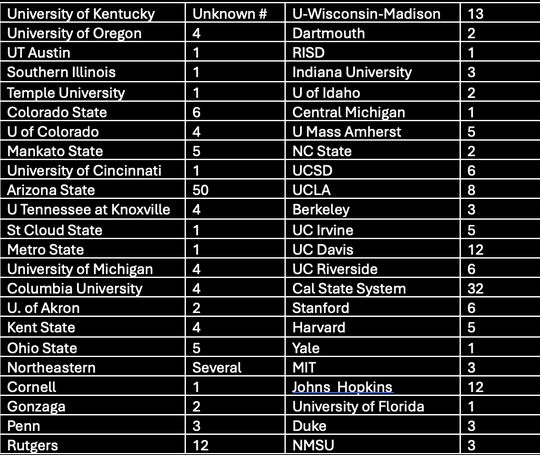
    According to WeAreHigherEd.org, there are now 46 schools where student visas have been revoked.  Arizona State tops the list at 50, followed by the University of Wisconsin-Madision (13), UC Davis (12), Rutgers (12), and Johns Hopkins (12) . The website includes profiles of a number of those students who have been detained. If you know of someone who has been abducted, you can report it here.

    Source link

  • UTS is showing how to achieve student equity now, not in 2050 – Campus Review

    UTS is showing how to achieve student equity now, not in 2050 – Campus Review

    The University of Technology Sydney (UTS) has taken bold steps to reach its own equity targets in a time when sector voices are calling on institutions to take action.

    Please login below to view content or subscribe now.

    Membership Login

    Source link

  • Weaponizing International Education and Student Mobility – Global Career Compass

    Weaponizing International Education and Student Mobility – Global Career Compass

    This title reflects the new reality we face in the U.S. since January 20, 2025 [the blog itself was written ahead of the 2018 mid-term elections in Mr. Trump’s last term]. I’m proud of my foresight –fragility and challenge are perfect adjectives for this new political moment and his second term.

    As we all now know, everything we’ve experienced since the election was predestined in the campaign. But not the scale. Not the confusion. Not the pain to so many innocent federal workers and their families. Not the unmooring of the lives of thousands of humanitarians whose lives were devoted to helping the poor and fighting for justice in the developing world. Nor to staffs in every corner of the federal bureaucracy…And so here I am today; writing to try to make myself feel better by sharing my perspective with followers of my blog. I haven’t been consistent in writing in this space since Covid hit. I have no idea who will read this post.

    For readers familiar with or who are working in the field of international education, I want you to know how much respect I have for your commitment and your pursuit of opening doors to the world for undergrads or high school students. For supporting experiential learning in the form of internships or service-learning; and designing immensely creative spaces for students to grow and challenge themselves.

    This not in any way a “normal” time. I never would have imagined to characterize a blog or essay as I have here – to suggest that the work of international educators is being weaponized by this new administration; by leaders in the State Department who have twisted the purpose of education abroad and cultural exchange to assess the worth of programs only by whether or not their goals support the political agenda of the President and his minions. To use international students and our visa system as tools to demonstrate how the government – the President- is following through on his promise to cleanse our society of differences, of diverse voices and color. Students, migrants, immigrants, even naturalized citizens – are all thrown into the same boat whose course is guided by hatred and inhumanity.

    Enough said.

    Source link

  • More Schools Report Visa Revocations and Student Detentions

    More Schools Report Visa Revocations and Student Detentions

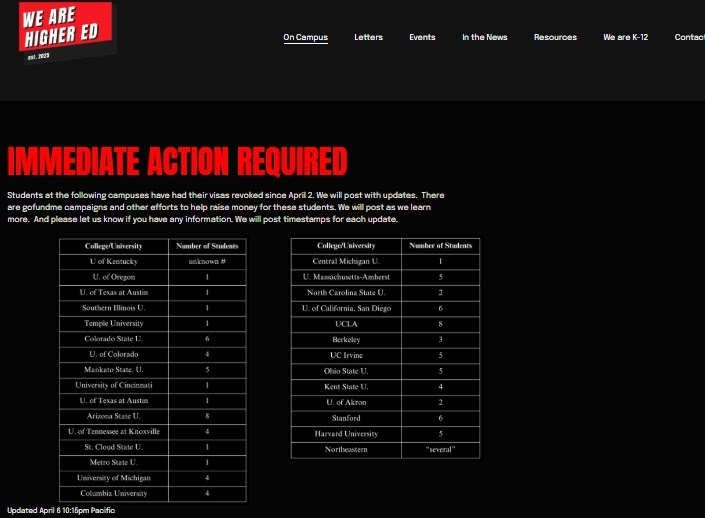
     Reports have surfaced of a significant increase in the number of international student visas being revoked and students being detained across various universities in the United States. This follows heightened immigration scrutiny, particularly under the administration of Donald Trump. According to Senator Marco Rubio, more than 300 international student visas have been pulled in recent months, primarily targeting students involved in political activism or minor infractions. WeAreHigherEd has named 30 schools where students’ visas have been revoked. 

    Campus Abductions — We Are Higher Ed

    Key Universities Affected

    • University of California System (UCLA, UC San Diego, UC Berkeley):
      Universities within the University of California system, which hosts a large international student population, have reported multiple visa cancellations. These revocations have affected students involved in pro-Palestinian protests, political activism, or perceived violations of U.S. immigration policies. For instance, the University of California has seen as many as 20 students affected in recent weeks.

    • Columbia University:
      At Columbia University, the case of Mahmoud Khalil, a student activist, has gained significant media attention. Khalil, who was detained and faced deportation, exemplifies the growing concerns over student rights and the growing impact of politically charged visa revocations.

    • Tufts University:
      Tufts University is currently battling the Trump administration over the case of Rümeysa Öztürk, a Turkish graduate student whose visa was revoked. Her detention and the ensuing legal battles highlight the growing tensions between academic freedom and government policy. Tufts and its student body are advocating for Öztürk’s release and seeking clarification on the legal processes involved.

    • University of Minnesota:
      At the University of Minnesota, one international graduate student was detained as part of an ongoing federal crackdown on visa violations. The U.S. Immigration and Customs Enforcement (ICE) actions continue to raise concerns over the rights of international students to remain in the country, especially as visa renewals and compliance checks become more stringent.

    • Arizona State University:
      Arizona State University has also reported incidents of international students having their visas revoked without prior notice. These revocations have affected students from various countries, creating uncertainty within the international student community at the university.

    • Cornell University:
      At Cornell University, international students have similarly faced unexpected visa cancellations. This has raised concerns about the ability of universities to adequately support their international student populations, as students are left to navigate the complexities of visa status without sufficient notice or explanation.

    • North Carolina State University:
      North Carolina State University is another institution where international students have had their visas revoked without notice. The university has expressed concern over the lack of clarity from immigration authorities, which has left students in a precarious situation.

    • University of Oregon:
      The University of Oregon has experienced several cases of international students having their visas revoked. This has been particularly troubling for students who were actively pursuing their education in the U.S. and now face the prospect of deportation or being forced to leave the country unexpectedly.

    • University of Texas:
      At the University of Texas, international students have faced visa issues, with several reports of revocations and detentions, affecting students who are working toward completing their degrees. This has sparked protests and advocacy efforts from both students and university administration, seeking more transparency in the process.

    • University of Colorado:
      The University of Colorado has similarly reported instances of international student visa revocations, particularly affecting those involved in political activism. The university has been working to support students impacted by these actions, although many are left in limbo regarding their ability to continue their studies.

    • University of Michigan:
      The University of Michigan has also been impacted by a wave of visa revocations. Similar to other institutions, students involved in political protests or activism have found themselves under scrutiny, facing the risk of detention or deportation. Students, faculty, and staff are pushing for clearer policies and legal protections to support international students, who are increasingly at risk due to the political environment.

    The Broader Implications

    These incidents of visa revocation and detentions are seen as part of a broader trend of increasing immigration enforcement under the Trump administration. Critics argue that these actions infringe upon students’ rights, potentially violating freedom of speech and academic freedom. International students, especially those participating in protests or political discourse, have found themselves at risk of being detained or deported, with little prior notice or transparency regarding the reasons for such actions.

    Moreover, the economic impact of these actions is significant. In 2023, a record 253,355 student visa applications were denied, representing a 36% refusal rate. This has major implications not only for the affected students but also for U.S. universities that rely heavily on international students for tuition revenue. The financial loss could be as much as $7.6 billion in tuition fees and living expenses, further emphasizing the broader consequences of these policies.

    Legal and Administrative Responses

    Many universities are rallying behind their international student populations, with advocacy efforts from institutions like Tufts University and Columbia University. These universities have criticized the abruptness of the visa cancellations and detentions, calling for more transparency and due process.

    However, despite these efforts, the political climate surrounding U.S. immigration remains volatile, and it is unclear whether policy changes will result in more lenient or more restrictive measures for international students.

    Conclusion

    These stories underscore the fragile position of international students in the U.S. today. With incidents of detentions and visa revocations increasing, students face significant challenges navigating the complexities of U.S. immigration law, particularly those involved in political or activist circles. University administrations and students alike continue to call for clearer policies, protections for international student rights, and more transparent practices to avoid the unintended consequences of politically motivated visa actions.

    This issue remains ongoing, with much at stake for both 

    Source link

  • Coalition announces harsher international student caps – Campus Review

    Coalition announces harsher international student caps – Campus Review

    The Coalition has said it would cap international students at 240,000 and triple the visa application fee to $5,000 for those applying to Group of Eight universities to free up room in the rental market.

    Please login below to view content or subscribe now.

    Membership Login

    Source link

  • Adapting TNE to student needs key, say stakeholders

    Adapting TNE to student needs key, say stakeholders

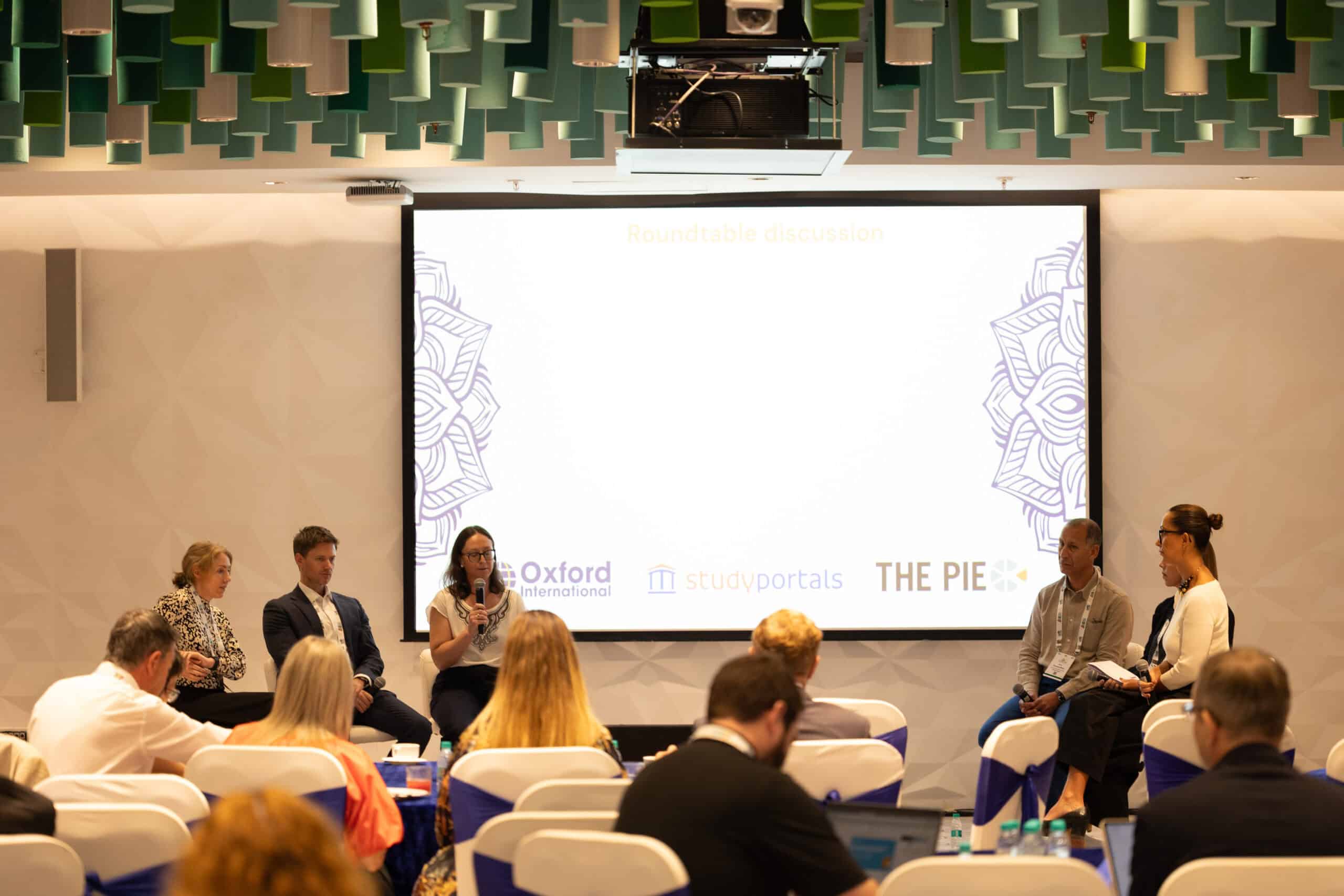
    The PIE News, in partnership with Oxford International Education Group (OIEG) and Studyportals, hosted a briefing where panelists explored university strategies, government collaboration, and financial sustainability for a successful TNE model.

    As international universities compete to establish TNE partnerships in India, the University of Southampton stands out, with its Delhi branch campus set to open in August 2025.

    Kasia Cakala, director of education pathways development at OIEG, which is collaborating with Southampton on the project, noted how education providers must continuously adapt to evolving expectations of the TNE model.

    “Not only do universities have to be mindful of the models they take in this very challenging market, but private providers like us also need to pivot, change, and adapt to support universities in their urgent needs,” stated Cakala at the briefing.

    “With Southampton, the key was defining a proposition that was not only sustainable but also aligned with government priorities and the domestic student ecosystem.”

    Cakala emphasised that as students from countries like India become more savvy, knowing what they need and expecting more from institutions, universities must adopt a “sophisticated market research strategy” to define their proposition, particularly when presenting expansion plans to government bodies.

    Private providers like us need to pivot, change, and adapt to support universities in their urgent needs
    Kasia Cakala, OIEG

    In light of the changing expectations, Carlie Sage, associate director, partnerships, APAC, Studyportals, underscored the importance of understanding student behaviour and market trends in shaping international education strategies.

    “A lot of universities still make decisions without really understanding the environment they’re operating in,” stated Sage. 

     “There’s amazing data out there that can help institutions navigate shifts, understand demand, identify gaps, and see what’s happening in real time.”

    According to Aziz Boussofiane, director, Cormack Consultancy Group, while TNE models need to be financially sustainable, they also need to be beneficial for both the university and the host country in the long run. 

    “For host countries, success (in TNE) means increasing capacity with quality provision – and for universities, it must align with their mission and strategic objectives,” stated Boussofiane, while addressing the audience. 

    “There are different drivers and processes depending on the market, whether it’s India or Nigeria, [and] it’s often about increasing in-country capacity and improving the quality of local providers.”

    While TNE is widely embraced by leading universities in major study destinations, challenges persist in building scalable models due to varying international perceptions of quality and value, which impact recognition, as previously reported by The PIE. 

    According to Daniel Cragg, director of Nous, while TNE is just another challenge for institutions, which are already dealing with academic workforce stress, new pressures from AI, and evolving student needs, the appetite for partnerships has only been rising. 

    “The appetite for collaboration is growing – universities want to share risk, balance success, and be more in-market experts,” said Cragg.

    “In international education, it feels like there’s a black swan event every three to four years. But universities constantly adapt, innovate, and thrive.”

    While universities in the UK and Australia have pushed through major TNE expansions in recent years, institutions in countries like New Zealand, though interested, prioritise strengthening their reputation and research over physical expansion.

    “New Zealand is a small player in TNE, but our partnerships focus on reputation and research rather than bricks-and-mortar expansion overseas,” stated Meredith Smart, international director, Auckland University of Technology

    “There’s a strong connection between our ranking strategy and our partnership strategy – reputation matters.”

    As the New Zealand government aims to boost international recruitment from emerging markets while strengthening educational partnerships in countries like India and Vietnam, institutions like AUT see an opportunity, while also learning from the missteps of their peers.

    “We are in a strong growth focus. The government wants us to grow. They’re desperate to win the next election, and I think they feel that international education can boost the economy,” stated Smart. 

    “New Zealanders love international students, but that could change as numbers rise. We must actively demonstrate the value of internationalisation to our economy, industries, and diplomatic relations.”

    This point was further reiterated by Cragg, who highlighted how working with governments in policymaking is essential. 

    “Working with governments to shape future visa policies is essential to ensuring sustainable international student growth,” he said. 

    “The value of international education extends across different areas of government, not just within universities.”

    Source link