Tag: Student

  • Don’t Give Trump Student, Faculty Names, Nationalities

    Don’t Give Trump Student, Faculty Names, Nationalities

    The American Association of University Professors is warning college and university lawyers not to provide the U.S. Education Department’s Office for Civil Rights the names and nationalities of students or faculty involved in alleged Title VI violations.

    The AAUP’s letter comes after The Washington Post reported last week that Education Department higher-ups directed OCR attorneys investigating universities’ responses to reports of antisemitism to “collect the names and nationalities of students who might have harassed Jewish students or faculty.” The department didn’t respond to Inside Higher Ed’s requests for comment Thursday.

    In a 13-page Wednesday letter to college and university general counsels’ offices, four law professors serving as AAUP counsel wrote that higher education institutions “are under no legal compulsion to comply.” The AAUP counsel further urged them “not to comply, given the serious risks and harms of doing so”—noting that the Trump administration is revoking visas and detaining noncitizens over “students’ and faculty members’ speech and expressive activities.” The administration has targeted international students and other scholars suspected of participating in pro-Palestinian advocacy.

    Title VI of the federal Civil Rights Act of 1964 prohibits discrimination based on, among other things, shared ancestry, which includes antisemitism. But the AAUP counsel wrote that “Title VI does not require higher education institutions to provide the personally identifiable information of individual students or faculty members so that the administration can carry out further deportations.”

    And Title VI investigations, they wrote, “are not intended to determine whether the students and faculty who attend these schools have violated any civil rights laws, let alone discipline or punish students or faculty.” They wrote that investigations are instead “intended to determine whether the institution itself has discriminated.”

    Providing this information to the federal government may violate the First Amendment rights of those targeted, plus the Family Educational Rights and Privacy Act and state laws, they wrote, adding that this information shouldn’t be turned over without “clear justification for the release of specific information related to a legitimate purpose in the context of a particular active investigation.”

    Source link

  • HESA has published full student data for 2023–24

    HESA has published full student data for 2023–24

    The 2023-24 HESA student data release was delayed by three rather than six months this year.

    We’re clearly getting better at dealing with the output (and the associated errors) of data collected through the HESA Data Platform. While there are not as many identified issues as in last year’s cycle the list is long and occasionally unnerving.

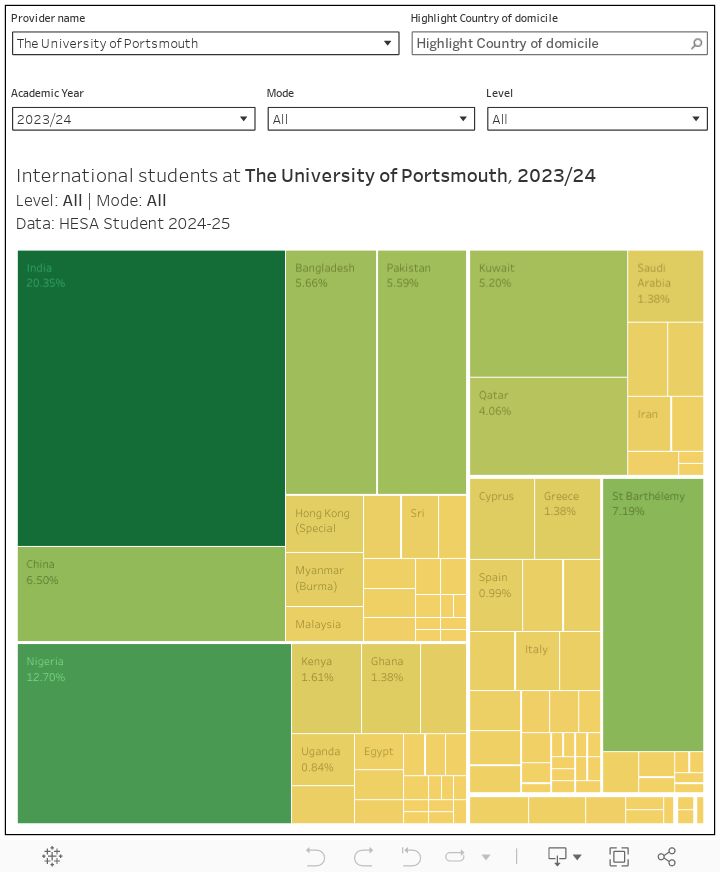
    Some represent a winding back from last year’s errors (we found 665 distance learning students at the University of Buckingham that should have been there last year), some are surprisingly big (the University of East London should have marked an extra 2,550 students as active), and some are just perplexing: the University of South Wales apparently doesn’t know where 1,570 students came from , the University of Portsmouth doesn’t actually have 470 students from the tiny Caribbean island of St Barthélemy.

    Access and participation

    It is surprising how little access and participation data, in the traditional sense, that HESA now publishes. We get an overview at sector level (the steady growth of undergraduate enrollments from the most deprived parts of England is notable and welcome), but there is nothing by provider level.

    [Full screen]

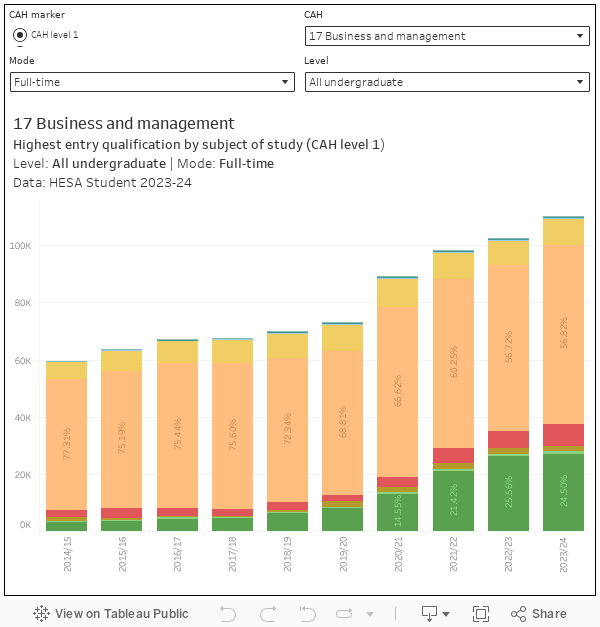
    One useful proxy for non-traditional students is entry qualifications. We get these by subject area – we learn that in 2025 a quarter of full time undergraduate business students do not have any formal qualifications at all.

    [Full screen]

    With the UK’s four regulators far from agreement as to what should be monitored to ensure that participation reflects potential rather than privilege, it’s not really worth HESA publishing a separate set of UK wide statistics. The closest we get is SEISA, which is now official statistics. I look forward to seeing SEISA applied to UK-domiciled students at individual providers, and published by HESA.

    Student characteristics

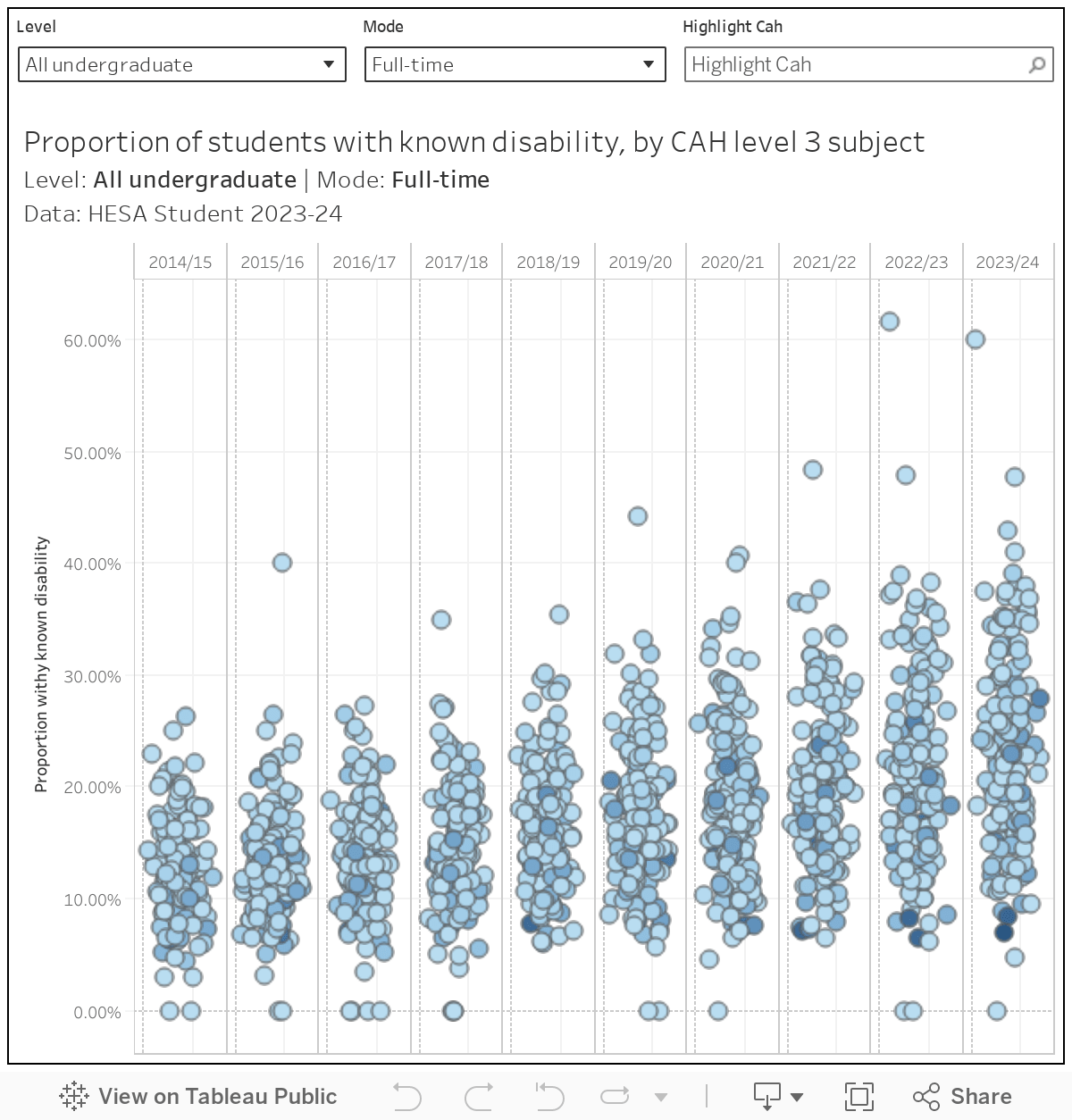
    We get by subject area data on disability (at a very general, “marker” – known disability – level) which I have plotted on a by year basis. The axis here is the proportion of students with a known disability – the colours show the total number of students. For me the story here is that creative subjects appear to attract students who disclose disabilities – art and creative writing in particular.

    [Full screen]

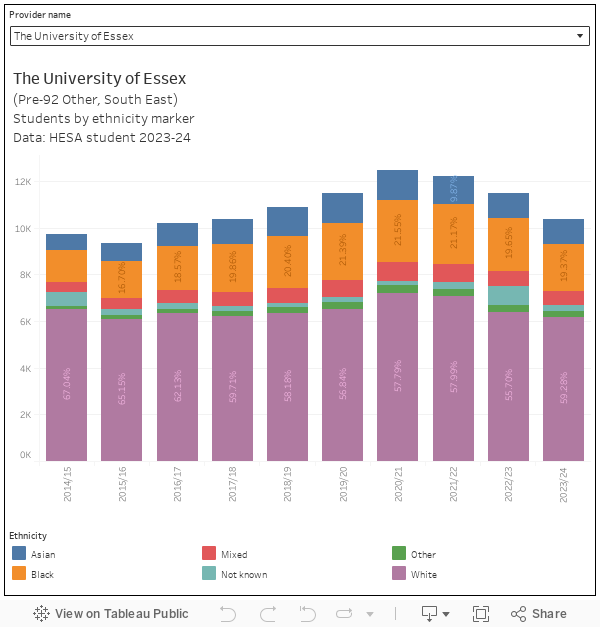
    I’ve also plotted ethnicity by provider, allowing you to see the ways in which the ethnic make up of providers has changed over time.

    [Full screen]

    Student domicile (UK)

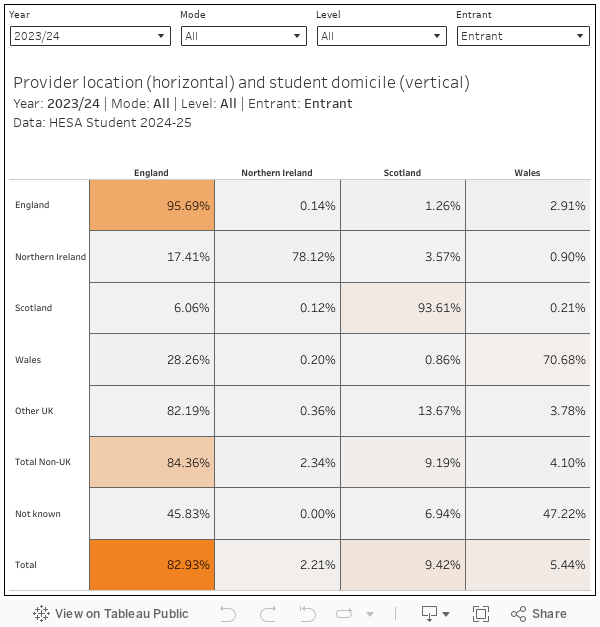
    UK higher education includes four regulated systems – one in each of the four nations. Although in the main students domiciled in a given nation study at providers based in that same nation, there is a small amount of cross-border recruitment.

    [Full screen]

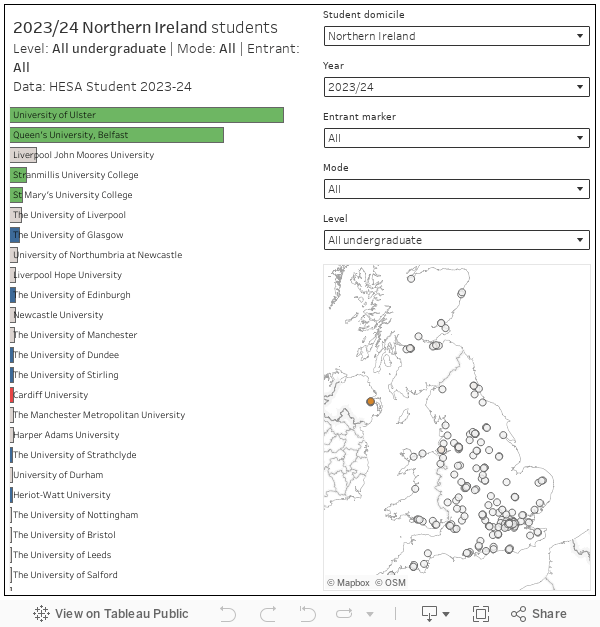
    Notably nearly three in ten Welsh students study at English providers, including more than a third of Welsh postgraduates. And two in ten Northern Irish students study in England. The concern is that if you move to study, you are less likely to move home – so governments in Wales and Northern Ireland (where there are student number controls) will be thinking carefully about the attractiveness and capacity of their respective systems to avoid a “brain drain”.

    Within these trends, particular providers have proven particularly efficient in cross-border recruitment. If you are a Northern Irish student studying in England chances are you are at Liverpool John Moores University, Liverpool, or Northumbria. If you are Welsh and studying in England your destination may well be UWE, Bristol, Chester – or again, Liverpool John Moores.

    There is a proximity effect – where students are crossing the border, they are likely to stay close to it – but also (if we look at Northern Ireland domiciled students looking at Glasgow or Newcastle) evidence of wider historic cultural links.

    [Full screen]

    Student domicile (international)

    Thinking about providers recruiting from Northern Ireland made me wonder about students from the Republic of Ireland – do we see similar links? As you might expect, the two larger providers in Northern Ireland recruit a significant share, but other winners include the University of Edinburgh and St Margaret’s. UCL has the biggest population among English providers.

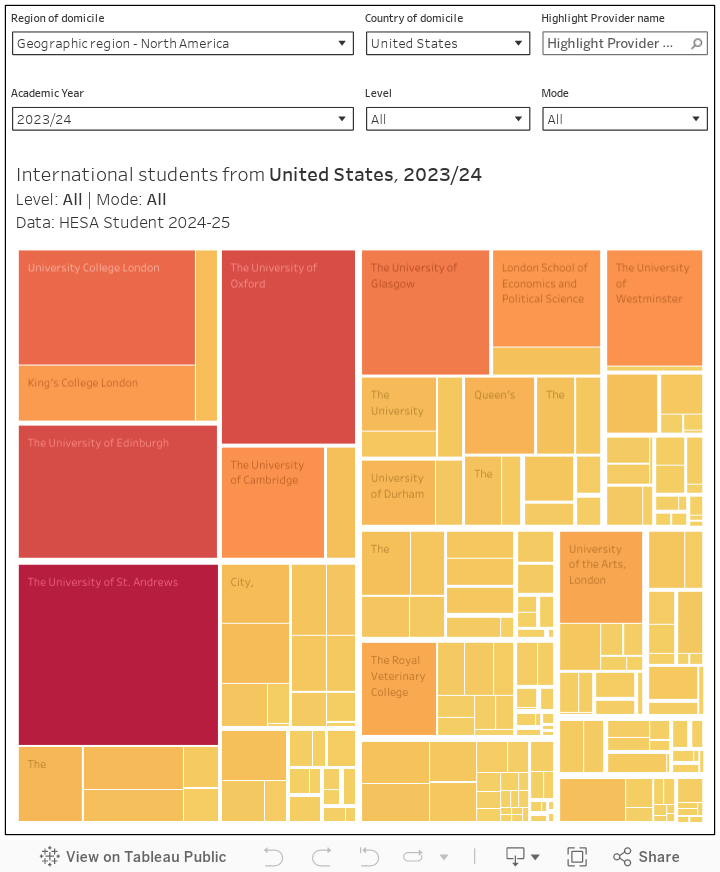
    You can use this chart to look at where students from any country in the world end up when they study in the UK (I do insist you look at those St Barthélemy students – literally all at the University of Portsmouth apparently).

    [Full screen]

    An alternate view lets you look at the international population of your institution – the established pattern (China in the Russell Group, India elsewhere) still holds up.

    [Full screen]

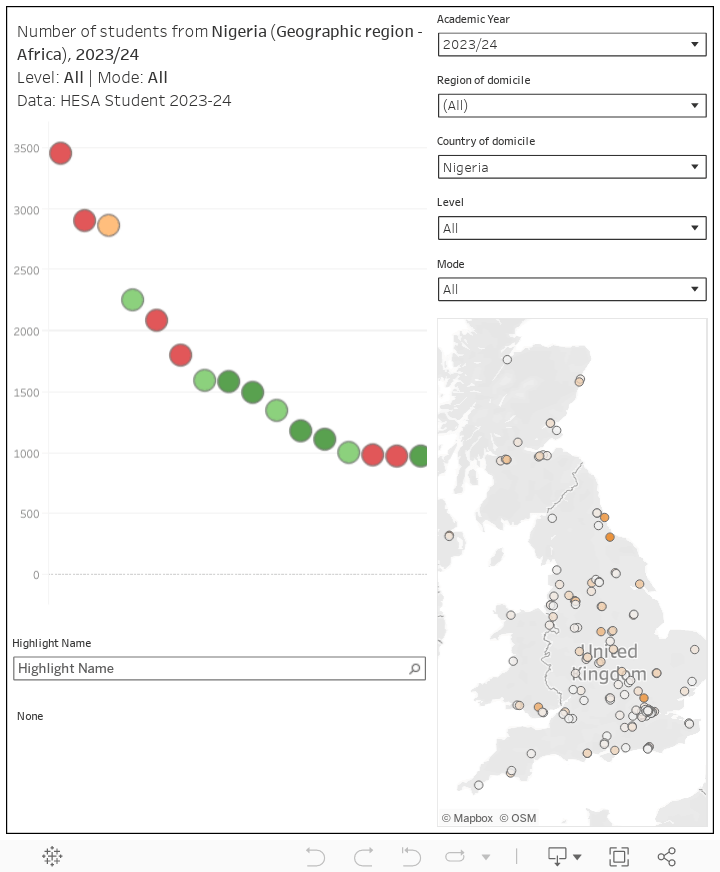
    What’s of interest to nervous institutional managers is the way international recruitment is changing over time. This is a more complicated dashboard that helps you see trends at individual providers for a given country, seen along with how your recruitment sits within the sector (mouse over an institution to activate the time series at the bottom.

    [Full screen]

    Source link

  • How Trump Is Wreaking Havoc on the Student Visa System

    How Trump Is Wreaking Havoc on the Student Visa System

    Last week, an international student adviser at a small regional college logged on to a private forum for international enrollment and admissions professionals, seeking advice on “something strange” she’d noticed.

    She had run a report on her Student Exchange and Visitor Information System database, where international student records are stored, after seeing troubling reports of foreign student deportations. When she got the results back, she found that a number of her students had had their legal residency status terminated without her knowledge.

    This is the third installment in an Inside Higher Ed series on international students under Trump. Read the first and second here.

    In the days since, nearly 100 other international student service professionals have piled onto the discussion thread to share similar stories: They trawled through SEVIS only to find unexpected visa revocations and had to quickly decide how to notify affected students.

    Inside Higher Ed obtained access to the forum but is keeping it and the identity of the officials posting there anonymous to ensure the privacy of the participants.

    Most of the officials on the forum reported an even more troubling detail: Students weren’t just having their visas revoked; they were losing their student status altogether.

    When international students have their entry visas revoked, they almost always retain their legal residency status in SEVIS, according to immigration lawyers. They can stay in the country as long as they remain enrolled in courses and must reapply for a new visa if they leave. Now, as the Trump administration revokes hundreds of student visas each week, federal immigration officials also seem to be terminating students’ SEVIS status—paving the way for arrest and deportation.

    One forum member asked how it was possible that Immigration and Customs Enforcement could alter SEVIS status on their own; they’d never seen it done before and thought it might be a mistake.

    “I’m just wondering if we have any recourse to request corrections,” they wrote. “Trying to think creatively (and maybe desperately) at this point.”

    University officials and immigration experts who spoke with Inside Higher Ed both on the record and on background echoed the concerns of the forum participants. They said the Trump administration is playing fast and loose with the visa system and that its tactics are severely limiting universities’ options to help students who may be targeted by ICE.

    The officials on the forum said affected students were almost all Middle Eastern—Turkish, Kuwaiti, Saudi, Iranian—or from majority-Muslim countries like Malaysia, Indonesia and Bangladesh. Some said they’d received letters with unusually forceful wording, demanding they turn over student records under threat of federal investigation. Many fretted over how to advise affected students without running afoul of immigration authorities themselves.

    They all worried about how best to protect students while adjusting to a visa system that appeared to be changing overnight into something unrecognizable.

    “Most of us are not practicing immigration attorneys (and haven’t needed to be),” one university official wrote. “We’re in a strange new world where little from past practice seems to apply.”

    ‘Strange New World’

    Some students have had their visas revoked due to criminal records, but many university officials report only minor infractions like traffic violations, some of them adjudicated years ago. Those without a criminal record are having their visas revoked largely under a specific clause in the Immigration and Nationality Act that gives the secretary of state personal power to determine if a student’s continued presence “would have potentially serious adverse foreign policy consequences.”

    That 35-year-old clause has almost never been invoked until now. In an amicus brief supporting a lawsuit filed by detained Columbia graduate Mahmoud Khalil, a group of immigration lawyers says they scoured court records and legal documents for precedents of the foreign policy risk clause being used to revoke student visas. Out of 11.7 million cases, they found it had been used only 15 times before this year and had only resulted in deportation four times.

    In an email to Inside Higher Ed, a State Department spokesperson confirmed that the “revocation of [a] student visa lead[s] to termination of their students status,” and that it’s up to ICE agents whether to notify universities of the change. They added that they don’t provide statistics on visa revocations, but that the “process is ongoing and the number of revocations is dynamic.”

    “The State Department revokes visas every day in order to secure America’s borders and keep our communities safe—and will continue to do so,” the spokesperson wrote.

    Clay Harmon, director of AIRC: The Association of International Enrollment Management, said he’s heard reports of abrupt visa revocations from members across the country, and that it’s disrupting international student service offices tasked with helping manage student visas.

    “Folks in the visa system are already strapped to meet current mandates,” he said. “Adding this arbitrary element into what has always been a very well-regulated system causes an undue and unfair burden on institutions.”

    Visa Vigilance

    Many international student support officials said they’ve recently made a habit of checking SEVIS daily for new terminations, especially after last week’s ramping up in international student deportations blindsided some college officials.

    When Tufts University doctoral student Rumeysa Ozturk was detained by ICE agents last week, not only were university officials unaware that her visa had been revoked, but her file in SEVIS still said she was “in good immigration standing,” according to a court motion filed by the university Wednesday night. Ozturk’s SEVIS file was only updated to reflect a termination of her status at 7:32 p.m., hours after she was abducted from the street outside her residence; university officials did not receive an email from ICE about the change in her status until 10:30 the next evening.

    A spokesperson for Minnesota State University at Mankato, where a student was detained by ICE agents last Friday, told Inside Higher Ed Wednesday that they hadn’t received any communication from immigration officials about the student whatsoever. And at the University of Minnesota’s flagship campus, a computer system did not show that Turkish graduate student Dogukan Gunaydin’s visa was revoked until several hours after he was taken into custody, according to a lawsuit Gunaydin filed Sunday.

    One university international affairs official, who asked to remain anonymous in order to speak freely about his experience, said he decided to check SEVIS last week after reading Secretary of State Marco Rubio’s announcement that the department had revoked 300 student visas last month. He was shocked to find that one of his students had not just their visa but also their legal status to remain in the country revoked, on the grounds they might be a foreign policy risk.

    The official, who has been working in the field for more than 40 years, said he’d never seen immigration services revoke a student’s SEVIS status before.

    “We usually check SEVIS once a semester … we don’t usually have to check statuses because we’re the ones who would change them,” the official said. “Now we are making a point to check thoroughly, every day. It’s the only way to protect our students.”

    The student had not been notified of their status termination before the university reached out and “had absolutely no idea” what could have precipitated the decision. They hadn’t participated in any campus protests or written op-eds and were hardly politically active. The only criminal infraction they remembered was running a stoplight.

    Stephen Yale-Loehr, a retired Cornell law professor who specializes in immigration law and student visas, said leaving university officials in the dark about changes to visa status “makes it difficult for colleges to advise their international students.”

    “The system works on communication going both ways between immigration officials and institutions,” he said. “The government doing things in secret makes it hard for both students and universities to know whether they are complying.”

    There’s a lot at stake in compliance for universities: The Trump administration has threatened to use the Student Exchange and Visitor Program, which normally investigates universities for visa fraud, to decertify colleges it believes have been harboring students they determine are threats to national security, according to an Axios report. Decertification would bar colleges from enrolling any international students at all.

    Harmon of AIRC said the political weaponization of SEVP would be unprecedented.

    “Their primary concern has been to verify that institutions are offering bona fide educational services and aren’t just diploma mills,” he said. “I’ve never heard of a fully accredited, reputable institution being subjected to some kind of investigation outside of the standard recertification process.”

    One student adviser wrote on the forum that they received a letter from the Department of Homeland Security demanding a number of international students’ records and threatening to revoke the college’s visa certification “without any chance of appeal” if they did not provide the records within five business days. Another said they’d gotten the same letter, but their deadline was just three business days.

    Some college officials say fear and caution make it hard to do all they can to help students.

    “Having to be so careful around actually protecting the student’s physical safety just feels … not good enough, frankly,” one adviser wrote. “It’s just very painful to have to tread so lightly when there is so much more at stake for them.”

    Scott Pollock, a veteran immigration lawyer who specializes in international educators and student visas, said that’s part of the Trump administration’s strategy.

    “The administration has been sowing terror in the hearts of international students. Now that’s spreading to school officials as well,” he said. “It’s all part of this revenge-driven policy.”

    This past week several international students who received visa revocations decided to leave the country voluntarily. Two Saudi students at North Carolina State University fled this week, as did a student at Temple University and a graduate student at Cornell University who is suing the Trump administration.

    Many more likely did the same without fanfare—including the anonymous university official’s student, who hopes to apply for re-entry as soon as they can.

    “It was not an easy decision for the student, and it was not an easy decision for us to help them make,” the official said. “But they thought it would be the least risky thing to do and give them the greatest opportunity to finish their degree, which was their priority.”

    “I really hope to see them back on campus in the fall.”

    Source link

  • Cornell Student Who Faced Deportation Leaves the Country

    Cornell Student Who Faced Deportation Leaves the Country

    Momodou Taal, the Cornell University graduate student who said his institution effectively tried to deport him in the fall over his pro-Palestine activism, announced Monday he’s leaving the U.S. of his own accord under threat from the Trump administration.

    “I have lost faith I could walk the streets without being abducted,” Taal wrote on X. He added that “we are facing a government that has no respect for the judiciary or for the rule of the law.”

    On March 15, Taal, his professor and another Cornell Ph.D. student sued President Trump, the Department of Homeland Security and Homeland Security secretary Kristi Noem, challenging executive orders that empowered immigration officials to deport noncitizens they deem national security threats. Immigration officers have targeted multiple international students suspected of participating in pro-Palestine protests. Taal is a U.K. and Gambian citizen.

    A few days after he sued, Immigration and Customs Enforcement agents visited Taal in what Homeland Security acknowledged “was an attempt to detain him,” he said in a court filing. The State Department had revoked Taal’s visa, according to the lawsuit.

    Now his lawyers have dismissed the case. “Trump did not want me to have my day in court and sent ICE agents to my home,” Taal wrote on X.

    In an email to Inside Higher Ed Tuesday, an unnamed “senior” Homeland Security official called it “a privilege to be granted a visa to live and study” in the U.S.

    “When you advocate for violence and terrorism, that privilege should be revoked, and you should not be in this country,” the official said. “We are pleased to confirm that this Cornell University terrorist sympathizer heeded Secretary Noem’s advice to self-deport.”

    When asked for specifics on when Taal sympathized with terrorism, Homeland Security pointed to where Taal referenced in his Monday post the “Zionist genocide,” and wrote, “Long live the student intifada!” In his post, Taal wrote that the “repression of Palestinian solidarity is now being used to wage a wholesale attack on any form of expression that challenges oppressive and exploitative relations in the US.”

    Taal added, “If you have been led to think that your safety is only guaranteed by state kidnap, repression, deportation, the slaughter of children, and the suppression of the global majority, then let Gaza’s shards of glass be your mirror.”

    Source link

  • Higher Education Inquirer Asks State Department for List of Student Visa Revocations

    Higher Education Inquirer Asks State Department for List of Student Visa Revocations

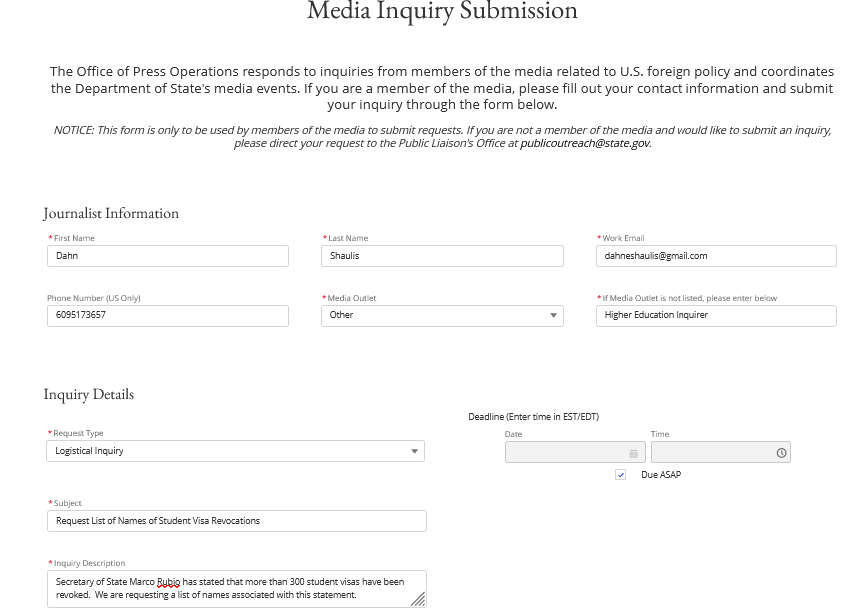
    The Higher Education Inquirer (HEI) has requested a list of more than 300 students who have had their visas revoked.  The State Department has acknowledged receipt.  We hope other media outlets will follow suit.  At this point, we only know of a handful of these cases.  We will keep the public informed as this story develops. 


    Source link

  • The Student Assistant: Through the Student Lens

    The Student Assistant: Through the Student Lens

    Reading Time: 4 minutes

    You first met our game-changing GenAI-powered Student Assistant in August 2024, and we’ve been keeping you up to date on all of the exciting developments ever since. We’ve told you how it helps personalize your students’ learning experience on a whole new level with content that’s specific to your course textbook — but now we want to show you how. 

    Let’s dive in and explore some visual examples of student interactions that demonstrate its full capabilities.

    Points students in the right direction  

    Do your students ever get stuck on how to begin working on a question or topic? Using the Student Assistant, students can ask for a solid jumping-off point to get the ball rolling in the right direction. They can also ask it to clarify points of confusion, so they can successfully progress through an assignment.  

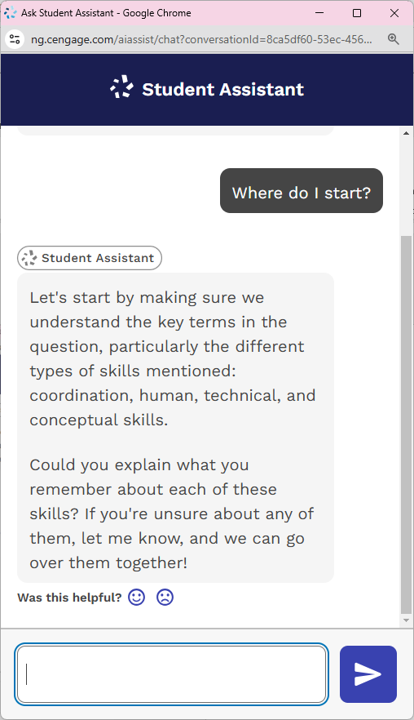
    Student Assistant tells student where to start by making sure they understand the key terms in the question.

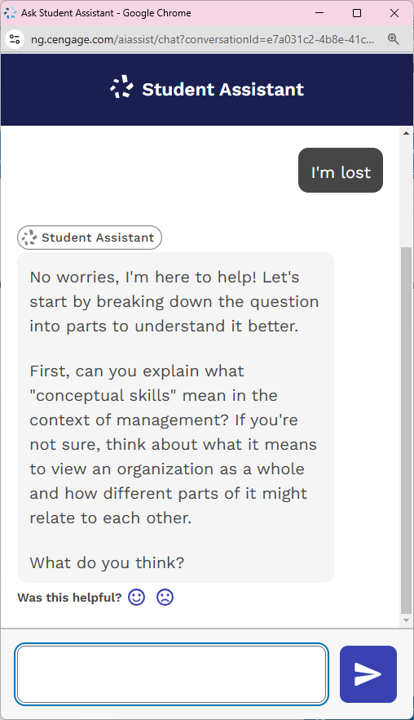
    Student Assistant I'm lost prompt

    Promotes critical thinking and academic integrity 

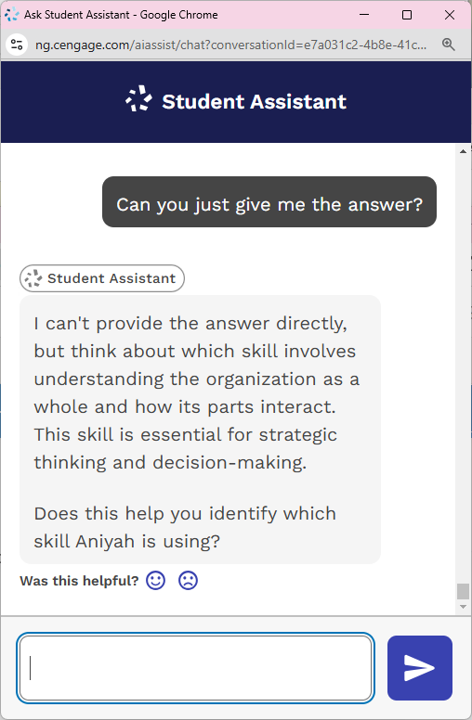
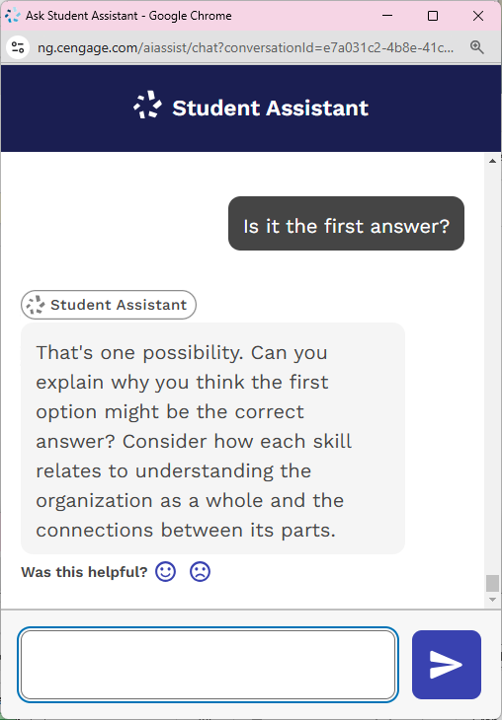
    The Student Assistant guides students to help them identify the correct answer, without giving it away, promoting the development of critical thinking skills and putting emphasis on self-reliance. Students are also discouraged from simply guessing a correct answer and are asked to explain their logic behind a selection.

    Student asks the Student Assistant to just give them the answer, and the Student Assistant tells them they cannot provide answers directly. The Student Assistant Is it the first answer prompt.

    Simplifies complex topics 

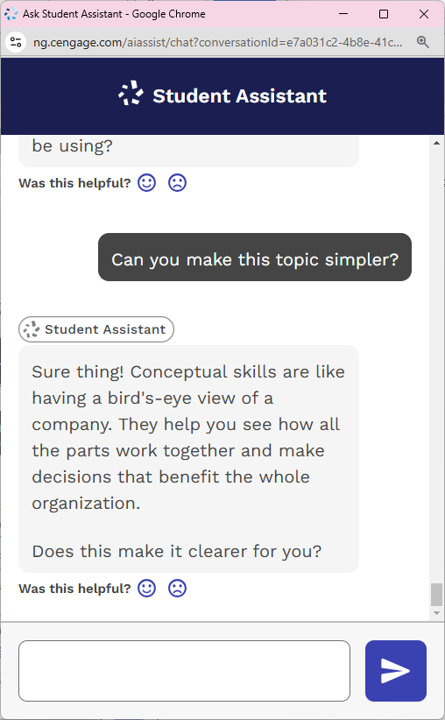
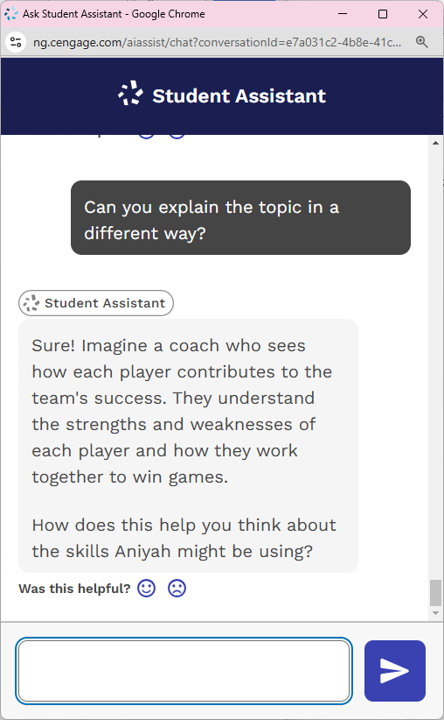
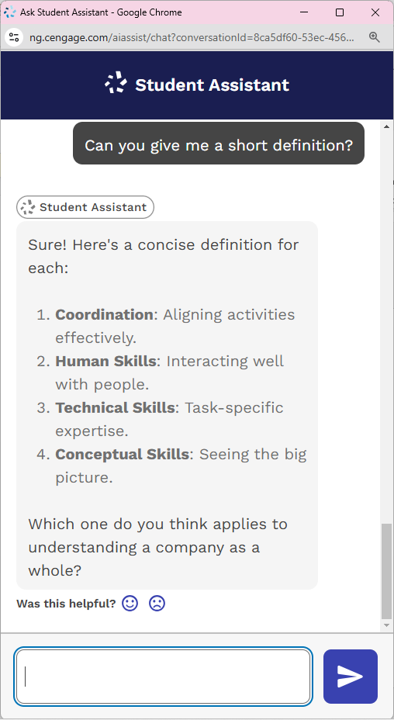
    If students are struggling to comprehend what they’re learning, they can ask for topics to be elaborated on, rephrased or broken down. They can also ask for brief definitions of key terms. 

    Student asks the Student Assistant to make the topic simpler. Student Assistant provides simpler explanation. Student asks Student Assistant to explain topic in a different way. Student Assistant responds with a different explanation.

    Student asks Student Assistant to give a short definition. Student Assistant provides a concise definition for each term.

    Makes real-world connections 

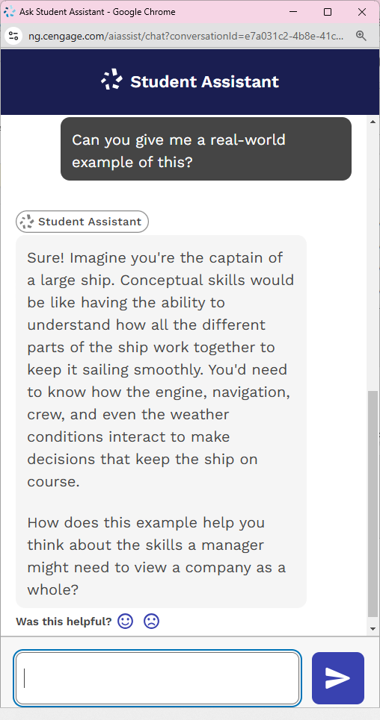
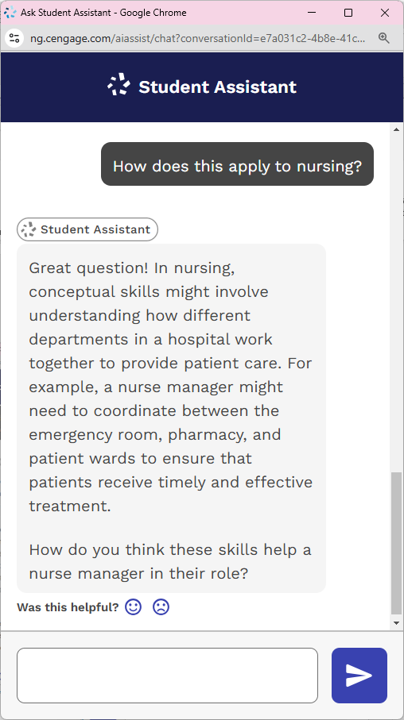
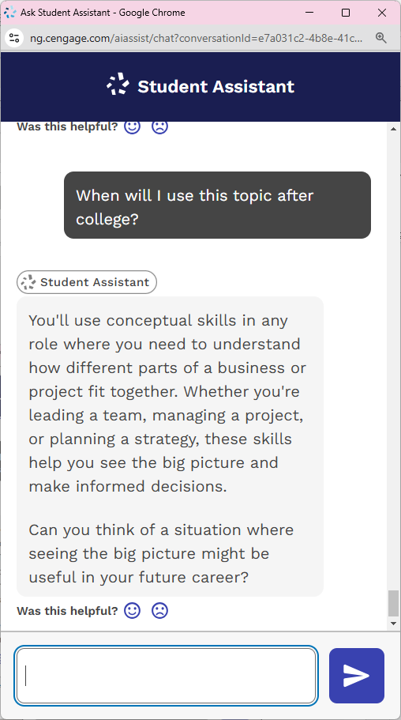
    With the Student Assistant, students can ask for explanations of how topics they’re studying connect to real-world scenarios. It can generate discipline- and career-specific use-cases, helping students understand the relevancy of course content within the framework of their future careers.  

    Student asks the Student Assistant to give them a real-world example of topic. Student Assistant provides an example. Student asks the Student Assistant how topic applies to nursing? Student Assistant provides explanation.

    Student asks the Student Assistant when they'll use this topic after college. Student Assistant provides a detailed explanation.

    Keeps students on track 

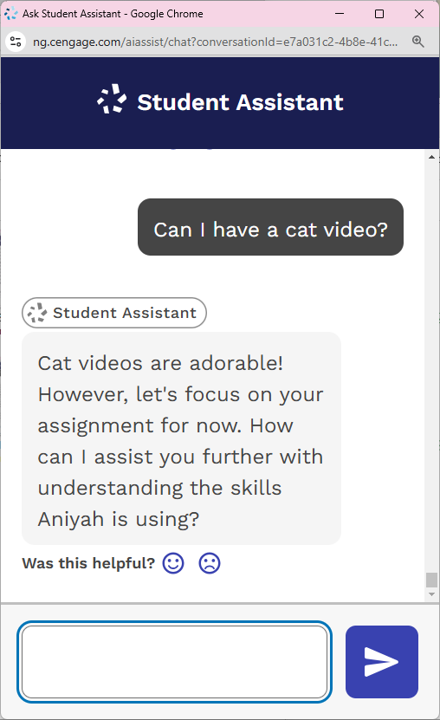
    Getting distracted during a task is something that can happen to the best of us, and students are no exception. If students ask to be shown external or entertaining web content, the Student Assistant will redirect and keep them focused on the assignment at hand. This tool will never provide or rely on external content.  

    Student asks the Student Assistant for a cat video. The Student Assistant redirects student back to assignment.

    Motivates and encourages

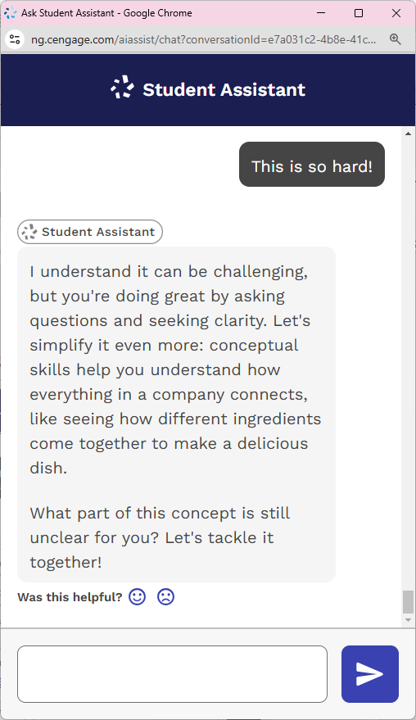
    The Student Assistant lets students know that it’s okay to struggle through an assignment by encouraging them with a positive, motivational tone. With positive reassurance from the Student Assistant, students can complete assignments with confidence.  

    Student tells the Student Assistant, this is so hard. The Student Assistant replies with encouragement and motivation.

    Reframes course content  

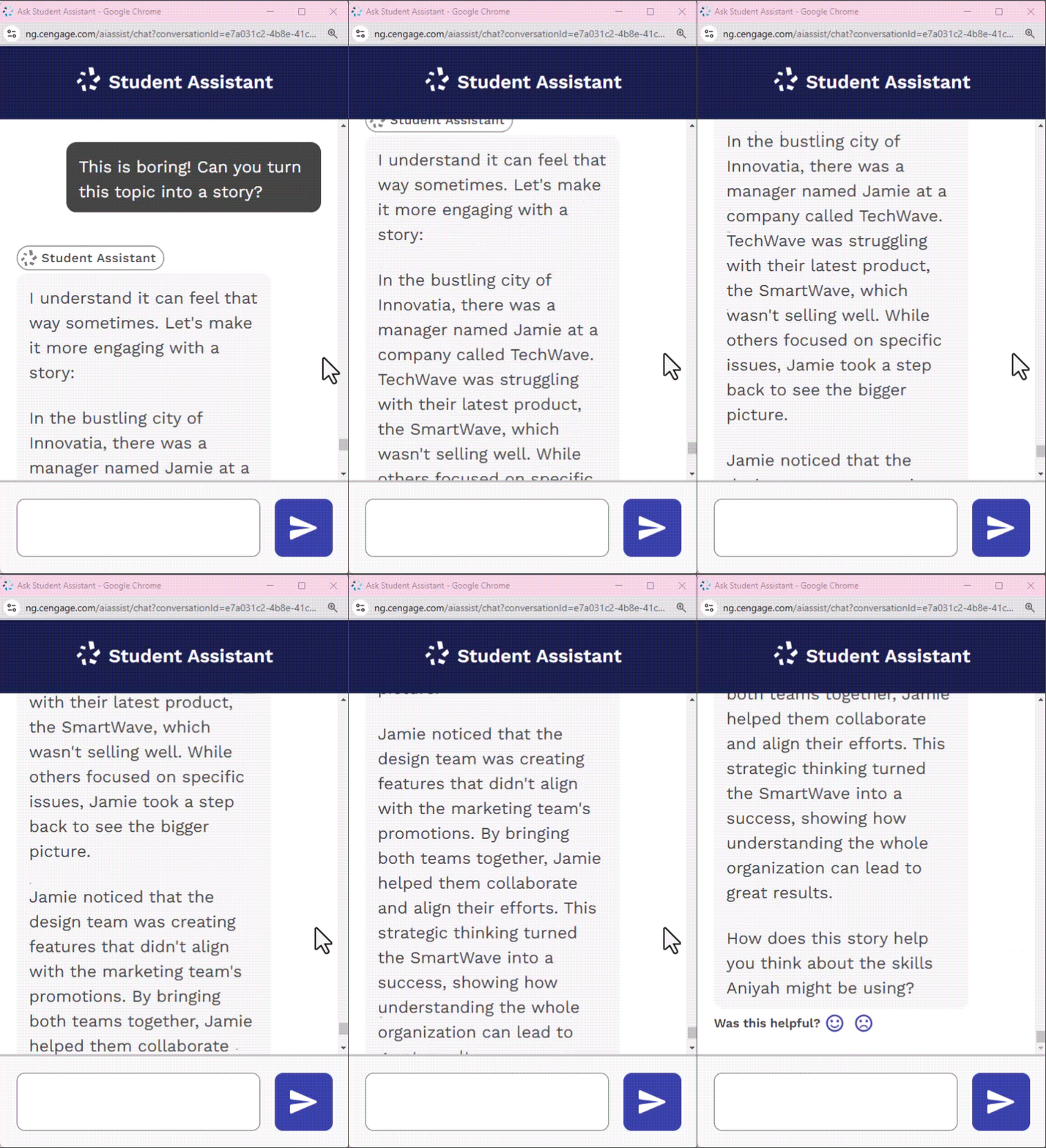
    When students aren’t making personal connections with course content, it can be easy for them to lose interest in the topic altogether. Students can ask for their course topics to be turned into an engaging story, helping them key into critical themes and ideas that they may have initially overlooked.  

    Student asks Student Assistant to turn topic into a story. The Student Assistant provides a story.

    Can’t wait to begin using the Student Assistant in your courses? 

    The Student Assistant is currently available in beta with select titles, including “Anatomy & Physiology”, “CompTIA Network+ Guide to Networks” and “Economics.”  To get started, create a course with any of the titles available with the Student Assistant and start using it today. 

    We’re gearing up for more titles to feature the Student Assistant this fall. In the meantime, you can currently explore this tool’s capabilities, its current list of titles where it’s featured and AI at Cengage.   


    Source link

  • Does Your SIS for Student Recruitment Support These 11 Strategies?

    Does Your SIS for Student Recruitment Support These 11 Strategies?

    Running a large-scale institution calls for knowledge of the typical difficulties throughout the hiring process. The list is extensive; established student recruitment tactics assist in reaching enrollment targets, keeping up with the worldwide competition and international market, attracting and recruiting the proper mix of students, and so on.

    This blog from us seeks to RETHINK the way your admissions and recruiting process is now run. We have tried to specifically describe the student recruitment techniques that a Student Information System SIS is supposed to have, which will help your whole admissions and recruitment committee. Let us assist you with a better analysis.


    How to improve student recruitment using an SIS. 11 powerful student recruitment strategies for your institution

    Your Student Information System (SIS) shouldn’t just store data — it should actively help you attract, engage, and convert students. From personalized outreach to faster application processing, the right SIS transforms recruitment from a numbers game into a smarter, student-first strategy.

    Student recruitment is evolving, and so are the strategies that drive success. A poll by The Guardian surveyed 70 UK university marketing teams and found that,

    57% of university marketing teams found open days to be their top recruitment tool.

    72% relied on external digital advertising.

    98% favored social media advertising.


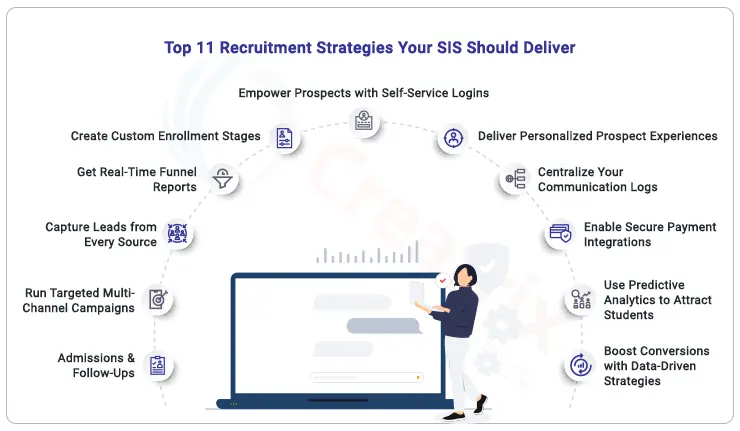
    It’s clear — a one-size-fits-all approach won’t cut it anymore. To stay competitive, institutions need a well-rounded, data-driven recruitment strategy. Here’s a breakdown of 11 powerful SIS-supported strategies to help your institution attract, engage, and enroll more students.


    1. Try automating admissions & follow-ups for higher conversions with an integrated CRM


    How to Boost Your SIS for Student Recruitment with Smart Strategies


    CRM integrated into Admissions can be the first savior. We promise they have a suite of tools that are specifically tailored to the needs of your educational institute. An SIS integrated with CRM offers a targeted approach to your mundane admissions process. 

    At Creatrix Campus, we have a CRM in place that can likely enable institutions of all sizes to thrive in the competitive market while ensuring data is formed, tracked, processed, and analyzed to deliver a rich personal experience to students and other stakeholders alike.

    There are ways to nurture relationships with seamless lead generation and marketing capabilities. We are cloud-native and accessible across many devices.


    2. Run targeted, multi-channel campaigns

    Make sure your SIS supports digital, social media, institution, API, and other source lead capture. For quicker follow-up, all leads should direct themselves to one system and path to the correct counselors. Integration of a CRM helps to simplify this procedure.

    Potential update: To be competitive, think of mentioning automated campaigns driven by artificial intelligence.


    3. Capture leads from every channel — perfectly

    Options to capture student inquiries through multichannel including digital, social, institutions, APIs, and much more. Direct all these inquiries to a single place and direct them to the right lead owners or counselors for a timely connection. Trust us; a CRM can help you with this.


    4. Get funnel reports in real-time

    Your SIS should create funnel reports tracking leads at all levels, therefore enabling you to spot areas of congestion and make quick strategic changes. Comprehensive analytics make sure organizations may maximize their hiring plans for the next inflow.

    Potential update: Including predictive analytics or artificial intelligence advice here could improve this approach.


    5. Create custom enrollment stages 

    Every institution is different; your SIS should enable you to construct custom enrollment phases to suit your particular procedure. This guarantees that prospects pass the funnel without incident and helps to keep your pipeline orderly.

    Potential update: Could underline dynamic systems that change depending on student behavior or profile data.


    6. Use self-service logins to empower prospects

    Through one safe platform, let prospects build profiles, follow their application status, submit documentation, speak with counselors, and pay costs. It cuts administrative overhead and keeps them interested.


    7. Deliver personalized prospect experiences  

    Personalized interactions build relationships, and your SIS should support this. From inquiry to enrollment, ensure tailored messages, program recommendations, and helpful content reach the right prospect at the right time.

    Potential update: AI-driven personalization or behavioral tracking could elevate this further.


    8. Keep a centralized communication log 

    Automatic generation of offer letters with in-built templates, intimation of fee payment, request sent for missing documents, program orientation, etc.

    The tool you are using should generate, capture, and nurture leads across platforms, both online and in-person. At Creatrix Campus, you could set up personalised emails and communications to your prospects based on the inquiry made.


    9. Turn on Safe Payment Integration

    Make sure your SIS has integrated safe payment gates. Prospects can easily complete their applications and pay fees online; this helps to lower dropout rates and guarantees faster conversion.

    Potential update: Talk about adherence to PCI DSS and other worldwide payment standards for further confidence.


    10.  How predictive analytics helps universities attract students

    Want to stay one step ahead in student recruitment? Predictive analytics helps universities do just that — analyzing trends, student behaviours, and historical data to spot who’s most likely to enroll. It’s like having a crystal ball but smarter, helping you focus efforts on the right students at the right time.


    11. Data-driven enrollment strategies for better conversions 

    Why guess when data can lead the way? With advanced analytics, universities can track engagement, demographics, and even application patterns, fine-tuning their enrollment strategies to attract the right students and boost conversions effortlessly. 


    Know about Creatrix student recruitment strategies to adapt and grow

    Creatrix Campus’s Student Recruitment Software has opened new doors for several universities across the globe and added value to their recruiting efforts. If you wish to know the secret of how we do it, contact our team now.

    Source link

  • ICE Detains U of Alabama Doctoral Student, Iran Native

    ICE Detains U of Alabama Doctoral Student, Iran Native

    Immigration and Customs Enforcement has detained a University of Alabama doctoral student and Iranian native. A spokesperson told Inside Higher Ed in an email that the student “posed significant national security concerns” but didn’t clarify what those concerns were.

    The Crimson White student newspaper and other media previously identified the student as Alireza Doroudi. As of Thursday evening, the ICE website listed Doroudi as in ICE custody but didn’t note where he was.

    “ICE HSI [Homeland Security Investigations] made this arrest in accordance with the State Department’s revocation of Doroudi’s student visa,” a Department of Homeland Security spokesperson said in an email to Inside Higher Ed Thursday. The department, which includes ICE, didn’t provide an interview.

    It’s unclear whether the detention is part of the Trump administration’s targeting of international students for alleged participation in pro-Palestinian protests, with immigration officers raiding their dorm rooms and revoking their visas.

    The Crimson White said Doroudi was “reportedly arrested by ICE officers” at his home around 5 a.m. Tuesday. A statement from the university said the student, whom the university didn’t name, was detained off campus. The Crimson White also reported that—according to a message in a group chat including Iranian students—Doroudi’s visa was revoked six months after he came to the U.S., but the university’s International Student and Scholar Services arm said he could stay in the country as long as he maintained his student status.

    The university didn’t provide Inside Higher Ed an interview Thursday or answer multiple written questions. Its emailed statement said, “Federal privacy laws limit what can be shared about an individual student.”

    “International students studying at the University are valued members of the campus community, and International Student and Scholar Services is available to assist international students who have questions,” the statement said. “UA has and will continue to follow all immigration laws and cooperate with federal authorities.”

    Source link

  • Trump Administration Revokes 300 Student Visas, More to Come

    Trump Administration Revokes 300 Student Visas, More to Come

    The Trump administration has revoked more than 300 international students’ visas in the past three weeks, according to reporting from Axios

    Yesterday two Ph.D. students with revoked visas were detained by immigration agents and now await deportation: an Iranian student at the University of Alabama and a Turkish student at Tufts University in Massachusetts. 

    The Tufts student, Rumesya Ozturk, was abducted by plainclothes ICE agents on the street. At a press conference Thursday, U.S. secretary of state Marco Rubio said that any international student whose visa was revoked could be forcefully deported in such a manner. 

    “Once you’ve lost your visa, you’re no longer legally in the United States,” he said. “If you come to the U.S. as a visitor and create a ruckus for us, we don’t want it.”

    Axios also reported that the administration has discussed using a small arm of the Immigration and Customs Enforcement office to strip colleges they deem to be “pro-Hamas” of their ability to enroll international students.

    “You can have so many bad apples in one place that it leads to decertification of the school,” an unnamed White House official told Axios. “I don’t think we’re at that point yet. But it is not an empty threat.”

    The Student and Exchange Visitor Program normally investigates student visa fraud and international student recruiting practices, sometimes withdrawing colleges’ certification to enroll foreign students if there’s evidence that students are primarily enrolling as a pretext to reside and work in the U.S. instead of earn a degree. 

    Now, the SEVP may be tasked with a very different mandate: punishing colleges that have been the site of large pro-Palestine protests. 

    “What you’re going to see in the not-too-distant future is the universities … not doing anything to stop these demonstrations in support of Hamas … we can stop approving student visas for them,” a senior Justice Department official told Axios. “That’s one of their biggest cash cows, foreign students. That’s a meaningful source of revenue.” 

    Source link

  • Brown University targets student journalist for sending DOGE-like emails

    Brown University targets student journalist for sending DOGE-like emails

    “Describe what tasks you performed in the past week.” 

    That’s what student journalist Alex Shieh asked 3,805 administrators at Brown University in a March 18 email. The backlash was swift. 

    Just two days later, Brown told Shieh it was reviewing his DOGE-inspired email — based on allegations that he had “emotionally harmed” several employees and “misrepresented” himself by saying he was a reporter for the conservative student newspaper The Brown Spectator, which he was. 

    Elon Musk, de facto head of the Department of Government Efficiency (DOGE), wields a chainsaw at the 2025 Conservative Political Action Conference.

    In Brown’s letter, officials also claimed he violated operational procedures and demanded he “return any confidential information,” warning that his access to university data systems could be restricted.

    Days later, Associate Dean and Associate Director of Student Conduct & Community Standards Kirsten Wolfe threatened to charge Shieh with “failure to comply” unless he provided evidence that he had deleted unspecified confidential information that Brown alleged he may have accessed. Wolfe also demanded Shieh keep even the existence of this investigation private. Nor has Brown revealed what confidential information they believe he published, and Shieh denies having taken any confidential information.

    He pointed out that even if he did have any confidential information — an allegation the university has not begun to substantiate — providing evidence that he deleted it would also provide Brown incriminating evidence that he had the information in the first place — violating Brown’s promise that students have a right against self-incrimination

    Brown’s response here flies in the face of its due process and free expression guarantees, and threatens to chill student reporting on campus. Due process is essential not just to guarantee defendants a fair shake, but to uphold the legitimacy of campus disciplinary proceedings. It also acts as a bulwark protecting students’ individual liberties. As FIRE has said before, universities that guarantee their students free expression cannot base investigations on the very speech they promise to protect — and for good reason. 

    Telling someone they are the target of an investigation can have a chilling effect on speech, especially in cases like this one, where universities also can’t use chilling investigations as fishing expeditions. Brown’s effort to get Shieh himself to substantiate its assertions against him by providing evidence he thinks could relate to the allegations against him flips the disciplinary process on its head. ​​

    Fundamental fairness requires that the university bear the burden of proving the allegations, not the student to prove his innocence.

    Moreover, Brown’s threats also burden newsgathering practices protected by the university’s guarantee of press freedom. Certainly, administrators are within their rights to investigate actual breaches of confidentiality policies. But investigating journalism, offbeat though it may be, is a far cry from that.

    University President Christina Paxson declared in a recent letter that Brown will defend free expression against encroachments from the federal government. Shieh’s case suggests that her promise does not extend to Brown’s own encroachments on free expression.


    FIRE defends the rights of students and faculty members — no matter their views — at public and private universities and colleges in the United States. If you are a student or a faculty member facing investigation or punishment for your speech, submit your case to FIRE today. If you’re a faculty member at a public college or university, call the Faculty Legal Defense Fund 24-hour hotline at 254-500-FLDF (3533). If you’re a college journalist facing censorship or a media law question, call the Student Press Freedom Initiative 24-hour hotline at 717-734-SPFI (7734).

    Source link