
Tag: StudentLed

  • Mass. College Launches Student-Led Basic Needs Center

    Mass. College Launches Student-Led Basic Needs Center

    An estimated 59 percent of all college students have experienced some form of housing or food insecurity in the past year, according to 2024 data from the Hope Center at Temple University. Closer to three in four students have lacked access to other basic needs, such as mental health care, childcare, transportation or technology.

    At Massachusetts College of Liberal Arts, it was students who first noticed their peers needed additional resources.

    Spencer Moser, MCLA’s assistant dean for student growth and well-being, teaches a leadership capstone course in which students complete a community-based service project. “One group of students was aware that some of their peers were attending classes hungry,” he recalled.

    As part of their assignment, students researched available resources to address basic needs insecurity and identified the need for a campus pantry.

    “The program started as a drawer at my desk,” Moser said. “Then it grew to fill a shelving unit, a closet and eventually its own space on campus.”

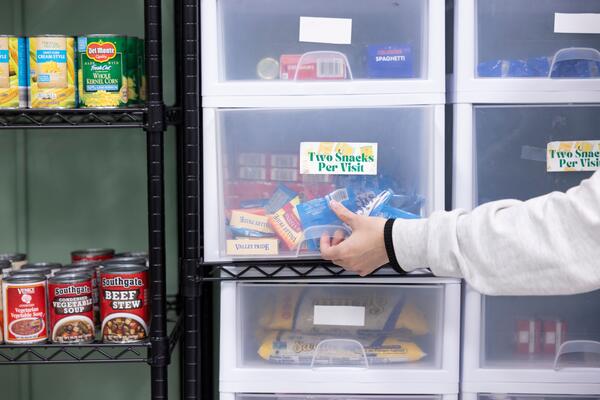
    Now, MCLA hosts an Essential Needs Center (ENC) on campus for any student who may face financial barriers to acquiring food, housing or other necessary items.

    How it works: Located in the campus center, the Essential Needs Center is open 24 hours a day from Monday to Thursday, with more limited hours on Fridays. The center provides students with food, housing and transportation assistance, seasonal clothes, and more.

    Students can utilize a variety of resources to address food insecurity, including grab-and-go or instant meals and free meal swipes for the dining hall, as well as help with their SNAP applications. The center’s website also provides links to recipes using MCLA food pantry staples to help students with minimal cooking experience prepare nutritious meals.

    One of the unique offerings of MCLA’s center is a build-a-bundle initiative that allows students to request a variety of personal health, kitchen, bathroom, bedroom or cleaning items, as well as school supplies. Students can submit a form online requesting supplies ranging from a first-aid kit to baking supplies and a bath mat.

    The pantry has a small budget from the college, which is supplemented by grants, a partnership with the Food Bank of Western Massachusetts and donor support. Interested donors can give nonperishable food items, toiletries or monetary contributions.

    Student supported: The ENC first started with students looking to support their classmates, and student leadership continues to be at the heart of the center’s work.

    “Students manage the inventory, make sure their peers know about this resource, staff the center,” Moser said. “The center is student-run and -managed, designed to be student-centric due to the belief that students know best what students’ needs are.”

    The pantry sees 400 to 500 students use the pantry regularly, for a total of 1,313 visits between November 2023 and January 2025, Moser said.

    In fall 2024 alone, ENC logged 729 visits—including from 96 first-time visitors—and distributed over 2,600 items.

    Other Models of Success

    Basic needs insecurity impacts college students across the country, hindering their academic progress and forcing them to choose between educational pursuits and personal needs. Here are some examples of how other colleges and universities are promoting student well-being.

    • Anne Arundel Community College students in Maryland created a cookbook featuring items exclusively from the campus pantry, many reflecting their traditions and cultures.
    • Some colleges allow students to pay off their parking tickets by donating food pantry items.
    • Pace University offers a monthly mobile market for students, faculty and staff to receive free food items that cannot be stored for longer in the permanent campus pantry.
    • The University of California, Davis, piloted a discounted food truck on campus at lunchtime, allowing students to receive a hot meal at a pay-what-you-can price.
    • Virginia Commonwealth University established mini pantries across campus with grab-and-go food items, modeled off the concept of a little free library.
    Source link

  • Student-Led Teaching Doesn’t Help Underprepared Students

    Student-Led Teaching Doesn’t Help Underprepared Students

    miodrag ignjatovic/E+/Getty Images


    Introductory STEM courses serve as a gatekeeper for students interested in majors or careers in STEM fields, and students from less privileged backgrounds are often less likely to succeed in those courses.

    As a result, researchers have explored what practices can make a difference in student outcomes in such courses, including creating sections with diverse student populations and offering grade forgiveness for students who performed poorly.

    A recent research article from the University of Texas at Austin examined the role peer instructors play in helping students from a variety of backgrounds. Researchers discovered that students who were enrolled in an interactive peer-led physics course section had worse learning outcomes and grades than their peers in a lecture section taught by an instructor. Students with lower SAT scores were also less likely to achieve a high grade in the student-taught class.

    The research: Historically, instructors teaching STEM courses have delivered content through lectures, with students taking a largely passive role, according to the paper. However, more active learning environments have been tied to higher student engagement and are largely preferred by learners. A May 2024 Student Voice survey by Inside Higher Ed found that 44 percent of respondents said an interactive lecture format helps them learn and retain information best, compared to 25 percent who selected traditional lectures.

    Interactive lectures can include instructors asking students questions throughout the class period or creating opportunities for them to reflect on course material, according to the paper. Peer instruction is touted as an effective means of flipped classroom teaching, requiring students to finish readings prior to class and reserving class time for interactive activities.

    While previous studies show the value of peer-led courses, much of that research focused on selective, private institutions, where students may have more similar backgrounds or levels of academic preparation, according to the authors of the new study.

    So researchers designed a study that would compare apples to apples: They looked at the outcomes for students learning physics in one course section taught by a professor versus one taught by fellow students to see which had a greater impact.

    The results: The paper analyzed the learning outcomes of two sections of students in an introductory mechanics course at a large public institution over three years. One section of the course was taught by a peer instructor, mostly in a small-group discussion format. The other section was taught by the professor using interactive lectures.

    Students completed identical homework and midterm exams on the same days and had the opportunity to attend identical tutoring sessions supported by teaching assistants.

    Though the course is designed for physics and astronomy majors, students from other majors participated as well. Each section had between 41 and 82 students, for a total of 367 students taking the course over three years.

    Not only did students in the peer-instruction section have lower grades, but students who had lower SAT scores from high school were less likely to demonstrate learning in fundamental concepts, as well as less likely to earn an A, compared to their peers with similar test scores taught by a professor. However, students with higher SAT scores made smaller gains (less dramatic grade increases or learning demonstrated) in the lecture section compared to students taught by peers, which researchers believe could mean that students with less academic preparation may benefit more from an instructor-led course, while their peers who had a high achievement history in high school could thrive more in a peer-led section.

    The analysis does not provide an explanation for why these differences exist, but researchers theorized that group work or peer dependency could result in some students being less knowledgeable about content matter because they trust others in the class to answer correctly. Creating postdiscussion follow-up questions can lessen this learning gap.

    We bet your colleague would like this article, too. Send them this link to subscribe to our newsletter on Student Success.

    Source link