When a member of staff claimed their course reading list was “diverse” because it included authors from the UK, North America, and Australia, it captured something problematic in higher education: an entrenched Eurocentric worldview dressed as global perspective.
Despite growing sector-wide commitments to equity, diversity and inclusion, many UK university curricula remain bounded by the ideas, voices and assumptions of the Global North. This isn’t just an issue of representation. It cuts to the core of what and whose knowledge counts and who the curriculum is for.
Universities have long functioned as what sociologist Remi Joseph-Salisbury calls “white spaces”; spaces where whiteness is not just numerically dominant, but culturally embedded. When students from minoritised backgrounds find their lived experiences absent from course readings, case studies, or teaching examples, the message is clear: they are not the imagined subject of the curriculum.
Lost in translation
This exclusion is rarely intentional. However, its effects are deeply felt. Students must expend emotional labour to navigate, challenge or mentally translate course content that does not reflect their experiences or worldviews. For some, this produces what scholars such as Smith and colleagues in 2014 have termed racial battle fatigue.
Language plays a significant role here. In many classrooms standard academic English, which is rooted in the speech of white, middle-class Britons, is upheld as the norm. Yet this language can be very different to that adopted by young people. Students who speak dialects such as Multicultural London English (MLE), or whose cultural references differ from the mainstream, are often seen as less articulate or capable. Even institutional communications, usually packed with acronyms like NSS, OfS, PGCert, and so on can create an impenetrable culture that alienates students unfamiliar with higher education’s bureaucratic vernacular.
Such institutional language is frequently seen in formal assessment briefs and feedback mechanisms, and so existing insecurities and barriers are reinforced. Minoritised students can struggle to link the assessments to their own lived realities and performance is impacted. These are factors that will contribute towards the ethnicity degree awarding gap, at many universities where white students tend to be awarded more top grades at the end of their studies than students from minoritised backgrounds.
From audit to agency
To address the ethnicity degree awarding gap, universities are now moving away from peer reviews or external examiner reports for assessments of teaching and learning materials. In their place, models of evaluation have been introduced that empower students to take the lead in assessing the inclusivity of their curriculum. This isn’t a symbolic gesture. Student reviewers can not only be trained in inclusive pedagogy and curriculum theory but bring a wealth of experiences and insights that add considerable value to curriculum.
Having a student review their teaching can be challenging for staff, but it should be viewed as a positive experience and an opportunity to develop. Practical, structured student feedback specifically about how the curriculum is experienced isn’t routinely available but by positioning students as co-creators rather than consumers of education and working with them to develop a negotiated curriculum universities can begin to develop what Bovill and Bulley in 2011 call “student–staff partnerships” in curriculum design. More importantly cultures of reflection will be built among both students and staff.
Indeed, the insights gathered by students provide fresh ideas and impetus for change. Universities should expect to see changes such as staff diversifying reading lists, incorporating non-Western knowledge systems, adopting and adapting podcasts and visual content, removing or clarifying colloquialisms, and reflecting more critically on their own teaching assumptions. Students also benefit as they gain a deeper understanding of learning and teaching at a personal and institutional level while developing skills that make them more employable.
Structural limits, and what they reveal
It is important that inclusion is not viewed as a compliance exercise. Inclusivity isn’t just about content or the material on reading lists, but about systems. Class times, unit design or professional frameworks can prevent meaningful change. These barriers resonate with what Sara Ahmed calls “non-performativity”; institutional practices that talk inclusion but do little to change the power structures that sustain inequality.
Too frequently in HE, students are asked for feedback at the end of a module; asked what is missing or could be improved. And too often, the work of inclusion is treated as a box-ticking exercise, rather than as a long-term commitment to changing institutional norms. Collaborations that give agency to students provide visible demonstration to staff and students that inclusion matters, and that they need to work together to take practical steps that make a real difference.
Importantly, in the same way that it is vital to reduce the burden of navigating racialised systems and institutional language, inclusive practice cannot rest on the unpaid labour of those most affected by exclusion. Students employed to do this work should be compensated, recognising their expertise and time – institutions must demonstrate their commitment to this work.
It is also important to address how gender, disability, class, and educational background also shape curriculum experience. This move reflects the understanding, drawn from Kimberlé Crenshaw’s work that inclusion must be multi-dimensional. One-size-fits-all interventions rarely address the complex realities students navigate.
Reimagining who defines knowledge
Curriculum audits on their own are not enough to drive change, A shift in culture is needed. The idea that academics alone define what is taught must be challenged, with students viewed not as passive recipients but as partners in learning.
If universities are to genuinely respond to the challenges of structural inequality, they must go beyond slogans and statements. They must create space for critique, redistribute power, and invite students to shape the educational experiences that shape them in return.
At a time when EDI initiatives in the higher education sector are facing pressure from right-wing popularist leaders it is perhaps now more important than ever that efforts to decolonise and diversify curricula continue to grow. The question for higher education institutions is whether they are willing to relax their control over whose knowledge counts.
Practical takeaways for sector professionals
Start small, but with structure. Begin with a pilot group of trained student reviewers and focus on a manageable number of modules.
Pay students. Their labour and insights are valuable; budget for it.
Support staff engagement. Offer training and development to help staff reflect and act without defensiveness.
Embed responses in course planning. Ensure that student input leads to visible, documented changes.
Build community, not compliance. Inclusion isn’t just about metrics; it’s about shared commitment to equity and belonging.
The authors are grateful for the contributions of Rebekah Kerslake and Parisa Gilani to this article.
But identifying how and when to deliver that content has been a challenge, particularly given the varying perspectives different disciplines have on generative AI and when its use should be allowed. A June report from Tyton Partners found that 42 percent of students use generative AI tools at least weekly, and two-thirds of students use a singular generative AI tool like ChatGPT. A survey by Inside Higher Ed and Generation Lab found that 85 percent of students had used generative AI for coursework in the past year, most often for brainstorming or asking questions.
The University of Mary Washington developed an asynchronous one-credit course to give all students enrolled this fall a baseline foundation of AI knowledge. The optional class, which was offered over the summer at no cost to students, introduced them to AI ethics, tools, copyright concerns and potential career impacts.
The goal is to help students use the tools thoughtfully and intelligently, said Anand Rao, director of Mary Washington’s center for AI and the liberal arts. Initial results show most students learned something from the course, and they want more teaching on how AI applies to their majors and future careers.
How it works: The course, IDIS 300: Introduction to AI, was offered to any new or returning UMW student to be completed any time between June and August. Students who opted in were added to a digital classroom with eight modules, each containing a short video, assigned readings, a discussion board and a quiz assignment. The class was for credit, graded as pass-fail, but didn’t fulfill any general education requirements.
Course content ranged from how to use AI tools and prompt generative AI output to academic integrity, as well as professional development and how to critically evaluate AI responses.
“I thought those were all really important as a starting point, and that still just scratches the surface,” Rao said.
The course is not designed to make everyone an AI user, Rao said, “but I do want them to be able to speak thoughtfully and intelligently about the use of tools, the application of tools and when and how they make decisions in which they’ll be able to use those tools.”
At the end of the course, students submitted a short paper analyzing an AI tool used in their field or discipline—its output, use cases and ways the tool could be improved.
Rao developed most of the content, but he collaborated with campus stakeholders who could provide additional insight, such as the Honor Council, to lay out how AI use is articulated in the honor code.
The impact: In total, the first class enrolled 249 students from a variety of majors and disciplines, or about 6 percent of the university’s total undergrad population. A significant number of the course enrollees were incoming freshmen. Eighty-eight percent of students passed the course, and most had positive feedback on the class content and structure.
In postcourse surveys, 68 percent of participants indicated IDIS 300 should be a mandatory course or highly recommended for all students.
“If you know nothing about AI, then this course is a great place to start,” said one junior, noting that the content builds from the basics to direct career applications.
What’s next: Rao is exploring ways to scale the course in the future, including by developing intermediate or advanced classes or creating discipline-specific offerings. He’s also hoping to recruit additional instructors, because the course had some challenges given its large size, such as conducting meaningful exchanges on the discussion board.
The center will continue to host educational and discussion-based events throughout the year to continue critical conversations regarding generative AI. The first debate, centered on AI and the environment, aims to evaluate whether AI’s impact will be a net positive or negative over the next decade, Rao said.
The university is also considering ways to engage the wider campus community and those outside the institution with basic AI knowledge. IDIS 300 content will be made available to nonstudents this year as a Canvas page. Some teachers in the local school district said they’d like to teach the class as a dual-enrollment course in the future.
Get more content like this directly to your inbox. Subscribe here.
The rapid adoption and development of AI has rocked higher education and thrown into doubt many students’ career plans and as many professors’ lesson plans. The best and only response is for students to develop capabilities that can never be authentically replicated by AI because they are uniquely human. Only humans have flesh and blood bodies. And these bodies are implicated in a wide range of Uniquely Human Capacities (UHCs), such as intuition, ethics, compassion, and storytelling. Students and educators should reallocate time and resources from AI-replaceable technical skills like coding and calculating to developing UHCs and AI skills.
Adoption of AI by employers is increasing while expectations for AI-savvy job candidates are rising. College students are getting nervous. 51% are second guessing their career choice and 39% worry that their job could be replaced by AI, according to Cengage Group’s 2024 Graduate Employability Report. Recently, I heard a student at an on-campus Literacy AI event ask an OpenAI representative if she should drop her efforts to be a web designer. (The representative’s response: spend less time learning the nuts and bolts of coding, and more time learning how to interpret and translate client goals into design plans.)
At the same time, AI capabilities are improving quickly. Recent frontier models have added “deep research” (web search and retrieval) and “reasoning” (multi-step thinking) capabilities. Both produce better, more comprehensive, accurate and thoughtful results, performing broader searches and developing responses step-by-step. Leading models are beginning to offer agentic features, which can do work for us, such as coding, independently. American AI companies are investing hundreds of billions in a race to develop Artificial General Intelligence (AGI). This is a poorly defined state of the technology where AI can perform at least as well as humans in virtually any economically valuable cognitive task. It can act autonomously, learn, plan, and adapt, and interact with the world in a general flexible way, much as humans do. Some experts suggest we may reach this point by 2030, although others have a longer timeline.
Hard skills that may be among the first to be replaced are those that AI can do better, cheaper, and faster. As a general-purpose tool, AI can already perform basic coding, data analysis, administrative, routine bookkeeping and accounting, and illustration tasks that previously required specialized tools and experience. I have my own mind-blowing “vibe-coding” experience, creating custom apps with limited syntactical coding understanding. AIs are capable of quantitative, statistical, and textual analysis that might have required Excel or R in the past. According to Deloitte, AI initiatives are touching virtually every aspect of a companies’ business, affecting IT, operations, marketing the most. AI can create presentations driven by natural language that make manual PowerPoint drafting skills less essential.
Humans’ Future-Proof Strategy
How should students, faculty and staff respond to the breathtaking pace of change and profound uncertainties about the future of labor markets? The OpenAI representative was right: reallocation of time and resources from easily automatable skills to those that only humans with bodies can do. Let us spend less time teaching and learning skills that are likely to be automated soon.
Technical Skills OUT
Uniquely Human Capacities IN
Basic coding
Mindfulness, empathy, and compassion
Data entry and bookkeeping
Ethical judgment, meaning making, and critical thinking
Mastery of single-purpose software (e.g., PowerPoint, Excel, accounting apps)
Authentic and ethical use of generative and other kinds of AI to augment UHCs
Instead, students (and everyone) should focus on developing Uniquely Human Capacities (UHCs). These are abilities that only humans can authentically perform because they need a human body. For example, intuition is our inarticulable and immediate knowledge that we know somatically, in our gut. It is how we empathize, show compassion, evaluate morality, listen and speak, love, appreciate and create beauty, play, collaborate, tell stories, find inspiration and insight, engage our curiosity, and emote. It is how we engage with the deep questions of life and ask the really important questions.
According to Gholdy Muhammad in Unearthing Joy, a reduced emphasis on skills can improve equity by creating space to focus on students’ individual needs. She argues that standards and pedagogies need to also reflect “identity, intellectualism, criticality, and joy.” These four dimensions help “contextualize skills and give students ways to connect them to the real world and their lives.”
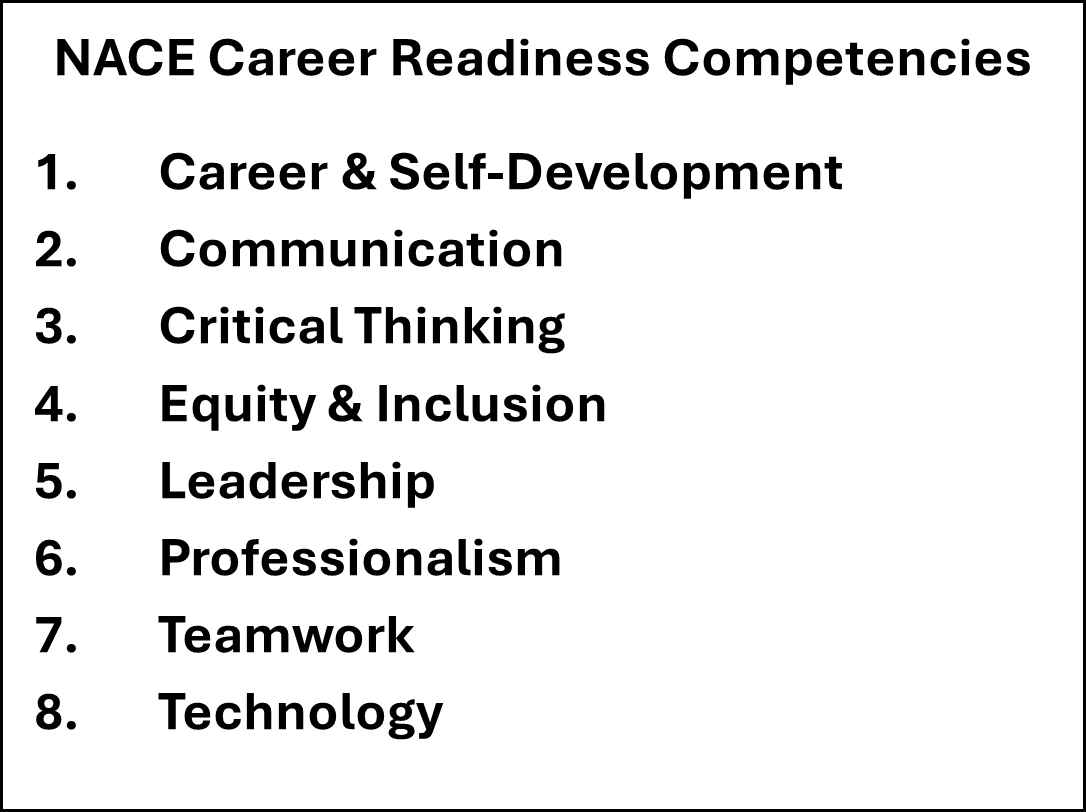
The National Association of Colleges and Employers has created a list of eight career readiness competencies that employers say are necessary for career success. Take a look at the list below and you will see that seven of the eight are UHCs. The eighth, technology, underlines the need for students and their educators to understand and use AI effectively and authentically.
For example, an entry-level finance employee who has developed their UHCs will be able to nimbly respond to changing market conditions, interpret the intentions of managers and clients, and translate these into effective analysis and creative solutions. They will use AI tools to augment their work, adding greater value with less training and oversight.
Widen Humans’ Comparative Advantage
As demonstrated in the example above, our UHCs are humans’ unfair advantage over AI. How do we develop them, ensuring the employability and self-actualization of students and all humans?
The foundation is mindfulness. Mindfulness is about being fully present with ourselves and others, and accepting, primarily via bodily sensations, without judgment and preference. It allows us to accurately perceive reality, including our natural intuitive connection with other humans, a connection AI cannot share. Mindfulness can be developed during and beyond meditation, moments of stillness devoted to mindfulness. Mindfulness practice has been shown to improve self-knowledge, set career goals, and improve creativity.
Mindfulness supports intuitive thinking and metacognition, our ability to think clearly about thinking. Non-conceptual thinking, using our whole bodies, entails developing our intuition and a growth mindset. The latter is about recognizing that we are all works in progress, where learning is the product of careful risk-taking, learning from errors, supported by other humans.
These practices support deep, honest, authentic engagement with other humans of all types. (These are not available over social media.) For students, this is about engaging with each other in class, study groups, clubs, and elsewhere on campus, as well as engaging with faculty in class and office hours. Such engagement with humans can feel unfamiliar and awkward as we emerge from a pandemic. However, these interactions are a critical way to practice and improve our UHCs.
Literature and cinema are ways to engage with and develop empathy and understanding of humans you do not know, may not even be alive or even exist at all. Fiction is maybe the only way to experience in the first person what a stranger is thinking and feeling.
Indeed, every interaction with the world is an opportunity to practice those Uniquely Human Capacities (UHCs):
Use your imagination and creativity to solve a math problem.
Format your spreadsheet or presentation or essay so that it is beautiful.
Get in touch with the feelings that arise when faced with a challenging task.
Many students tell me they are in college to better support and care for family. As you do the work, let yourself experience as an act of love for them.
AI Can Help Us Be Better Humans
AI usage can dull our UHCs or sharpen them. Use AI to challenge us to improve our work, not to provide short cuts that make our work average, boring, or worse. Ethan Mollick (2024) describes the familiar roles AIs can profitably play in our lives. Chief among these is as a patient, always available, if sometimes unreliable tutor. A tutor will give us helpful and critical feedback and hints but never the answers. A tutor will not do our work for us. A tutor will suggest alternative strategies and we can instruct them to nudge us to check on our emotions, physical sensations and moral dimensions of our work. When we prompt AI for help, we should explicitly give it the role of a tutor or editor (as I did with Claude for this article).
How do we assess whether we and our students are developing their UHCs? We can develop personal and work portfolios that tell the stories of connections, insights, and benefits to society we have made. We can get honest testimonials of trusted human partners and engage in critical yet self-compassionate introspection, and journalling. Deliberate practice with feedback in real life and role-playing scenarios can all be valuable. One thing that will not work as well: traditional grades and quantitative measures. After all, humanity cannot be measured.
In a future where AI or AGI assumes the more rote and mechanical aspects of work, we humans are freed to build their UHCs, to become more fully human. An optimistic scenario!
What Could Go Wrong?
The huge, profit-seeking transnational corporations that control AI may soon feel greater pressure to show a return on enormous investment to investors. This could cause costs for users to go up, widening the capabilities gap between those with means and the rest. It could also result in Balkanized AI, where each model is embedded with political, social, and other biases that appeal to different demographics. We see this beginning with Claude, prioritizing safety, and Grok, built to emphasize free expression.
In addition, AI could get good enough at faking empathy, morality, intuition, sense making, and other UHCs. In a competitive, winner-take-all economy with even less government regulation and leakier safety net, companies may aggressively reduce hiring at entry level and of (expensive) high performers. Many of the job functions of the former can be most easily replaced by AI. Mid-level professionals can use AI to perform at a higher level.
Finally, and this is not an exhaustive list: Students and all of us may succumb to the temptation of using AI short cut their work, slowing or reversing development of critical thinking, analytical skills, and subject matter expertise. The tech industry has perfected, over twenty years, the science of making our devices virtually impossible to put down, so that we are “hooked.”
Keeping Humans First
The best way to reduce the risks posed by AI-driven change is to develop our students’ Uniquely Human Capacities while actively engaging policymakers and administrators to ensure a just transition. This enhances the unique value of flesh-and-blood humans in the workforce and society. Educators across disciplines should identify lower value-added activities vulnerable to automation and reorient curricula toward nurturing UHCs. This will foster not only employability but also personal growth, meaningful connection, and equity.
Even in the most challenging scenarios, we are unlikely to regret investing in our humanity. Beyond being well-employed, what could be more rewarding than becoming more fully actualized, compassionate, and connected beings? By developing our intuitions, morality, and bonds with others and the natural world, we open lifelong pathways to growth, fulfillment, and purpose. In doing so, we build lives and communities resilient to change, rich in meaning, and true to what it means to be human.
The article represents my opinions only, not necessarily those of the Borough of Manhattan Community College or CUNY.
Brett Whysel is a lecturer in finance and decision-making at the Borough of Manhattan Community College, CUNY, where he integrates mindfulness, behavioral science, generative AI, and career readiness into his teaching. He has written for Faculty Focus, Forbes, and The Decision Lab. He is also the co-founder of Decision Fish LLC, where he develops tools to support financial wellness and housing counselors. He regularly presents on mindfulness and metacognition in the classroom and is the author of the Effortless Mindfulness Toolkit, an open resource for educators published on CUNY Academic Works. Prior to teaching, he spent nearly 30 years in investment banking. He holds an M.A. in Philosophy from Columbia University and a B.S. in Managerial Economics and French from Carnegie Mellon University.
Three private universities offer the best student experience out of all Australian institutions according to the latest student experience survey, with the University of Divinity ranked number one overall.
Please login below to view content or subscribe now.
Across the higher education sector in England some have been waiting with bated breath for details of the proposed new Teaching Excellence Framework. Even amidst the multilayered preparations for a new academic year – the planning to induct new students, to teach well and assess effectively, to create a welcoming environment for all – those responsible for education quality have had one eye firmly on the new TEF.
The OfS has now published its proposals along with an invitation to the whole sector to provide feedback on them by 11 December 2025. As an external adviser for some very different types of provider, I’m already hearing a kaleidoscope of changing questions from colleagues. When will our institution or organisation next be assessed if the new TEF is to run on a rolling programme rather than in the same year for everyone? How will the approach to assessing us change now that basic quality requirements are included alongside the assessment of educational ‘excellence’? What should we be doing right now to prepare?
Smaller providers, including further education colleges that offer some higher education programmes, have not previously been required to participate in the TEF assessment. They will now all need to take part, so have a still wider range of questions about the whole process. How onerous will it be? How will data about our educational provision, both quantitative and qualitative, be gathered and assessed? What form will our written submission to the OfS need to take? How will judgements be made?
As a member of TEF assessment panels through TEF’s entire lifecycle to date, I’ve read the proposals with great interest. From an assessor’s point of view, I’ve pondered on how the assessment process will change. Will the new shape of TEF complicate or help streamline the assessment process so that ratings can be fairly awarded for providers of every mission, shape and size?
Panel focus
TEF panels have always comprised experts from the whole sector, including academics, professional staff and student representatives. We have looked at the evidence of “teaching excellence” (I think of it as good education) from each provider very carefully. It makes sense that the two main areas of assessment, or “aspects” – student experience and student outcomes – will continue to be discrete areas of focus, leading to two separate ratings of either Gold, Silver, Bronze or Requires Improvement. That’s because the data for each of these can differ quite markedly within a single provider, so it can mislead students to conflate the two judgements.
Another positive continuity is the retention of both quantitative and qualitative evidence. Quantitative data include the detailed datasets provided by OfS, benchmarked against the sector. These are extremely helpful to assessors who can compare the experiences and outcomes of students from different demographics across the full range of providers.
Qualitative data have previously come from 25-page written submissions from each provider, and from written student submissions. There are planned changes afoot for both of these forms of evidence, but they will still remain crucial.
The written provider submissions may be shorter next time. Arguably there is a risk here, as submissions have always enabled assessors to contextualise the larger datasets. Each provider has its own story of setting out to make strategic improvements to their educational provision, and the submissions include both qualitative narrative and internally produced quantitative datasets related to the assessment criteria, or indicators.
However, it’s reasonable for future submissions to be shorter as the student outcomes aspect will rely upon a more nuanced range of data relating to study outcomes as well as progression post-study (proposal 7). While it’s not yet clear what the full range of data will be, this approach is potentially helpful to assessors and to the sector, as students’ backgrounds, subject fields, locations and career plans vary greatly and these data take account of those differences.
The greater focus on improved datasets suggests that there will be less reliance on additional information, previously provided at some length, on how students’ outcomes are being supported. The proof of the pudding for how well students continue with, complete and progress from their studies is in the eating, or rather in the outcomes themselves, rather than the recipes. Outcomes criteria should be clearer in the next TEF in this sense, and more easily applied with consistency.
Another proposed change focuses on how evidence might be more helpfully elicited from students and their representatives (proposal 10). In the last TEF students were invited to submit written evidence, and some student submissions were extremely useful to assessors, focusing on the key criteria and giving a rounded picture of local improvements and areas for development. For understandable reasons, though, students of some providers did not, or could not, make a submission; the huge variations in provider size means that in some contexts students do not have the capacity or opportunity to write up their collective experiences. This variation was challenging for assessors, and anything that can be done to level the playing field for students’ voices next time will be welcomed.
Towards the data limits
Perhaps the greatest challenge for TEF assessors in previous rounds arose when we were faced with a provider with very limited data. OfS’s proposal 9 sets out to address this by varying the assessment approach accordingly. Where these is no statistical confidence in a provider’s NSS data (or no NSS data at all), direct evidence of students’ experiences with that provider will be sought, and where there is insufficient statistical confidence in a provider’s student outcomes, no rating will be awarded for that aspect.
The proposed new approach to the outcomes rating makes great sense – it is so important to avoid reaching for a rating which is not supported by clear evidence. The plan to fill any NSS gap with more direct evidence from students is also logical, although it could run into practical challenges. It will be useful to see suggestions from the sector about how this might be achieved within differing local contexts.
Finally, how might assessment panels be affected by changes to what we are assessing, and the criteria for awarding ratings? First, both aspects will incorporate the requirements of OfS’s B conditions – general ongoing, fundamental conditions of registration. The student experience aspect will now be aligned with B1 (course content and delivery), B2 (resources, academic support and student engagement) and part of B4 (effective assessment). Similarly, the student outcomes B condition will be embedded into the outcomes aspect of the new TEF. This should make even clearer to assessors what is being assessed, where the baseline is and what sits above that line as excellent or outstanding.
And this in turn should make agreeing upon ratings more straightforward. It was not always clear in the previous TEF round where the lines between Requires Improvement and even meeting basic requirements for the sector should be drawn. This applied only to the very small number of providers whose provision did not appear, to put it plainly, to be good enough.
But more clarity in the next round about the connection between baseline requirements should aid assessment processes. Clarification that in the future a Bronze award signifies “meeting the minimum quality requirements” is also welcome. Although the sector will need time to adjust to this change, it is in line with the risk-based approach OfS wants to take to the quality system overall.
The £25,000 question
Underlying all of the questions being asked by providers now is a fundamental one: How we will do next time?
Looking at the proposals with my assessor’s hat on, I can’t predict what will happen for individual providers, but it does seem that the evolved approach to awarding ratings should be more transparent and more consistent. Providers need to continue to understand their education-related own data, both quantitative and qualitative, and commit to a whole institutional approach to embedding improvements, working in close partnership with students.
Assessment panels will continue to take their roles very seriously, to engage fully with agreed criteria, and do everything we can to make a positive contribution to encouraging, recognising and rewarding teaching excellence in higher education.
In the past 20 years in the U.S., mindfulness transitioned from being a new-age curiosity to becoming a more mainstream part of American culture, as people learned more about how mindfulness can reduce their stress and improve their well-being.
Researchers estimate that over 1 million children in the U.S. have been exposed to mindfulness in their schools, mostly at the elementary level, often taught by classroom teachers or school counselors.
I have been researching mindfulness in K-12 American schools for 15 years. I have investigated the impact of mindfulness on students, explored the experiences of teachers who teach mindfulness in K-12 schools, and examined the challenges and benefits of implementing mindfulness in these settings.
I have noticed that mindfulness programs vary in what particular mindfulness skills are taught and what lesson objectives are. This makes it difficult to compare across studies and draw conclusions about how mindfulness helps students in schools.
Some people might think mindfulness means simply practicing breathing, for example.
A common definition from Jon Kabat-Zinn, a mindfulness expert who helped popularize mindfulness in Western countries, says mindfulness is about “paying attention in a particular way, on purpose, nonjudgmentally, in the present moment.”
Essentially, mindfulness is a way of being. It is a person’s approach to each moment and their orientation to both inner and outer experience, the pleasant and the unpleasant. Fundamental to mindfulness is how a person chooses to direct their attention.
A few years ago, I decided to investigate school mindfulness programs themselves and consider what it means for children to learn mindfulness at schools. What do the programs actually teach?
I believe that understanding this information can help educators, parents and policymakers make more informed decisions about whether mindfulness belongs in their schools.
In 2023, my colleagues and I conducted a deep dive into 12 readily available mindfulness curricula for K-12 students to investigate what the programs contained. Across programs, we found no consistency of content, teaching practices or time commitment.
For example, some mindfulness programs in K-12 schools incorporate a lot of movement, with some specifically teaching yoga poses. Others emphasize interpersonal skills such as practicing acts of kindness, while others focus mostly on self-oriented skills such as focused attention, which may occur by focusing on one’s breath.
We also found that some programs have students do a lot of mindfulness practices, such as mindful movement or mindful listening, while others teach about mindfulness, such as learning how the brain functions.
Finally, the number of lessons in a curriculum ranged from five to 44, meaning some programs occurred over just a few weeks and some required an entire school year.
Despite indications that mindfulness has some positive impacts for school-age children, the evidence is also not consistent, as shown by other research.
Some experts believe, though, that the lack of results in this 2022 study on mindfulness was partially due to a curriculum that might have been too advanced for middle school-age children.
The connection between mindfulness and education
Since attention is critical for students’ success in school, it is not surprising that mindfulness appeals to many educators.
Research on student engagement and executive functioning supports the claim that any student’s ability to filter out distractions and prioritize the objects of their thoughts improves their academic success.
Even before social media, teachers perennially struggled to get students to pay attention. Reviews of multiple studies have shown some positive effects of mindfulness on outcomes, including improvements in academic achievement and school adjustment.
A 2023 report from the Centers for Disease Control and Prevention cites mindfulness as one of six evidence-based strategies K-12 schools should use to promote students’ mental health and well-being.
A relatively new trend
Knowing what is in the mindfulness curriculum, how it is taught and how long the student spends on mindfulness matters. Students may be learning very different skills with significantly different amounts of time to reinforce those skills.
Researchers suggest, for example, that mindfulness programs most likely to improve academic or mental health outcomes of children offer activities geared toward their developmental level, such as shorter mindfulness practices and more repetition.
In other words, mindfulness programs for children cannot just be watered down versions of adult programs.
Mindfulness research in school settings is still relatively new, though there is encouraging data that mindfulness can sharpen skills necessary for students’ academic success and promote their mental health.
In addition to the need for more research on the outcomes of mindfulness, it is important for educators, parents, policymakers and researchers to look closely at the curriculum to understand what the students are actually doing.
As policymakers look ahead to the bigger party conferences and students and staff ready themselves for the new academic year*, HEPI Director Nick Hillman takes a look ahead. [* Except in Scotland, where it has already begun.]
Information on HEPI’s own party conference events is available here.
Money’s Too Tight (to Mention)
When the Coalition Government for which I worked tripled tuition fees for undergraduate study to £9,000 back in 2012, it was a big and unpopular change. But it represented a real increase in support for higher education that led to real increases in the quality of the student experience, with improvements to staffing, facilities and student support services.
Because the fee rise shifted costs from taxpayers to graduates via progressive student loans, it enabled another fundamental change: the removal of student number caps in England. No longer would universities be forced to turn away ambitious applicants that they wanted to recruit. It was the final realisation of the principle that underlined the Robbins report of 1963: ‘courses of higher education should be available for all those who are qualified by ability and attainment to pursue them and who wish to do so.’ A higher proportion of students enrolled on their first-choice place. (It never ceases to amaze me how many people wish to return to a world in which your children and mine have unwarranted obstacles reimposed between them and attaining the degree they want.)
But back in 2012, no one in their wildest dreams thought the new fee level would be frozen for most of the next decade and more. After all, the fee rise was implemented using the Higher Education Act (2004), which had enabled Tony Blair to introduce the current model of tuition fees, and the Blair / Brown Governments to raise fees each year without any fuss.
Yet the political ructions caused by introducing £9,000 fees in 2012 made policymakers timid. Towards the end of the Conservatives’ time in office, Ministers bizarrely sought to make a virtue of their pusillanimity. Even as inflation was biting, the Minister for Higher Education (Rob Halfon) said raising fees was ‘not going to happen, not in a million years’.
The result has been a crisis in funding for higher education institutions that has changed their priorities. Top-end universities have looked to increase their income via more and higher (uncapped) fees from international students – hardly surprising, when an international student taking a three-year degree is worth £69,000 a year more than a home student! They have also sought to tempt UK students away from slightly less prestigious institutions.
Meanwhile, newer universities have been even more entrepreneurial. Limited in their ability to recruit lots of international students, they have instead shifted towards franchising, whereby other organisations pay them for the privilege of teaching their degrees.
Universities in the middle have had a particularly tough time. Most notably, many universities originally founded in the expansionary post-Robbins environment are struggling today. (It has been suggested that the tie-up between Kent and Greenwich is partly borne of necessity.) Plus with no fees for home students, Scottish universities have been hurting even more than those elsewhere.
Even though recruiting more people from overseas and large-scale franchising have helped some institutions to keep the wolf from the door, Ministers have condemned both. The UK Home Office want fewer international students and England’s Department for Education have promised new legislation to tackle the growth in franchising. (Six months ago, Bridget Phillipson wrote in the Sunday Times, ‘I will also bring forward new legislation at the first available opportunity to ensure the Office for Students has tough new powers to intervene quickly and robustly to protect public money’.)
No British university has ever gone bust but, as financial advisers know, the past can be a sorry guide to the future. When asked, Ministers say they would accept the closure of a university or two. But a university is usually a big local employer, a big supporter of local civic life and a source of local pride – and money. Most have been built up from public funds.
Closing a university would not just risk local upset. It would reduce confidence, including among those who lend to universities, and could even risk a domino effect, as people lose faith in the system as a whole, thereby putting the reputation of UK education at risk. So there are good reasons why, for example, Dundee University is currently being bailed out, even if it comes with a distinct whiff of moral hazard.
Bills, Bills, Bills
Students are hurting just as much as institutions. Contrary to the expectations of years gone by, the proportion of school leavers proceeding to higher education is barely rising. There is likely more than one cause, including negative rhetoric about universities from across the political spectrum and a false sense that degree apprenticeships for school leavers are plentiful.
The standard maximum maintenance support in England is now worth a little over £10,000, which is just half the amount students need.
Parents are expected to support their student offspring but they are not officially told how much they should contribute.
England’s household income threshold at which state-based maintenance support begins to be reduced has not increased for over 15 years. At £25,000, it is lower than the income of a single-earner household on the minimum wage.
As a result, according to the HEPI / Advance HE Student Academic Experience Survey, over two-thirds of students now undertake paid employment during term time, often at a number of hours that negatively affects their studies. These students are limited in their ability to take part in extra-curricular activities, for they are time poor as well as strapped for cash.
An increase in maintenance support is long overdue, just as an increase in tuition fees for home students is long overdue. But we could also perhaps help students help themselves by providing better information in advance about student life. In particular, given the epidemic of loneliness among young people, we should remind them that you are more likely to be lonely if your room is plush but you do not have enough money left over for a social life than if your living arrangements are basic but your social life is lively.
The Masterplan
The Government came to office claiming to have a plan for tackling the country’s challenges. But more than a year on, the fog has not cleared on their plans for higher education. Patience is now wearing gossamer thin. As Chris Parr of Research Professional put it on Friday, ‘Still we wait.’ As far as we can discern from what we know, it seems universities will be expected to do more for less – on civic engagement, access and economic growth.
Higher education institutions have made it clear, including through Universities UK’s Blueprint, that they are keen to play their part in national renewal. But it is not only the financial squeeze that limits their room for manoeuvre. Political chaos as well as the geography of Whitehall threaten the institutional autonomy that has been the key ingredient of UK universities’ success.
Unlike in the past, there are different regulators, Ministers and Departments for the teaching and learning functions of universities on the one hand and their research functions on the other, meaning coordinated oversight is missing. The latest machinery of government changes risk another dog’s dinner, as ‘skills’ continue to bounce around Whitehall, newly residing for now (but who knows for how long) in the Department for Work and Pensions. Meanwhile, the Department for Science, Innovation and Technology is thought to have less regard for university-based research than for research conducted elsewhere, at least in contrast to the past.
Moreover, each of the two Ministers with oversight of higher education institutions (Baroness Smith and Lord Vallance) are newly split across two Whitehall departments, with one foot in each. This sort of approach tends to be a recipe for chaos. (As I saw close up during my own time in Whitehall, split Ministers usually reside primarily in just one of their two departments, the one where their main Private Office is situated.)
The choice now is clear. If Ministers want to direct universities more than their predecessors, then they need to fund them accordingly. But if Ministers want universities to play to their own self-defined strategies in these fast-changing times, then they should reduce the barriers limiting their capacity to behave more entrepreneurially.
Over the past three years, the number of high school students taking college courses has increased more than 20 percent, making them a growing share of all undergraduates, according to data from the National Student Clearinghouse Research Center.
Dual enrollment can help high school students get a head start on their college degree. In addition to expediting the amount of time it takes to complete a two- or four-year degree, concurrent-enrollment courses may be cheaper or subsidized for high school students, reducing the costs associated with a college degree.
A recent study by Tyton Partners investigates why students participate in dual enrollment and how the experience shapes their perceptions of college.
Students say: A majority of surveyed students participating in dual enrollment were high school seniors (76 percent); 24 percent were juniors.
Most high schoolers took only one or two college courses (58 percent); just 19 percent were enrolled in four or more. While one-third of students took courses online, two-thirds attended in person at a local college.
The primary motivation for students to engage in dual enrollment was to get ahead on college credits and reduce tuition costs (51 percent). One in five students said they were looking for more advanced coursework.
The data also pointed to dual enrollment’s role as a pipeline to higher education. Three in five students said they strongly agree with the statement “My dual-enrollment experience is preparing me for college,” and a similar share indicated they feel like they belong at their college.
Dual-enrollment students worry about affordability in higher education; one in five said they do not feel they have the resources to pay for college. Research shows that dually enrolled students are more likely to receive grants and scholarships when they attend college, compared to their peers who are not concurrently enrolled.
Over half of dual-enrollment students said the experience made them more motivated to attend college (57 percent), while one-third said their interest in higher education remained unchanged; 6 percent said the experience was a turnoff that made them less interested in college.
One notable trend was that dual-enrollment participants who later enrolled in college full-time were more likely to pursue natural and physical sciences compared to the general undergraduate population. Thirty-seven percent of current college students who had taken college courses while in high school said they were studying natural and physical sciences, compared to 29 percent of their peers without concurrent-enrollment credits. Conversely, non-dual-enrollment students elected humanities and social science majors at higher rates (37 percent) than their dual-enrollment peers (31 percent).
“While this may reflect the interests of students who opt into dual enrollment, it also highlights the potential of dual enrollment pathways to attract and support learners aiming for more technical or science-focused careers,” according to the report.
Looking ahead: More colleges have implemented or expanded dual-enrollment offerings since 2020, in part to reverse flagging enrollment numbers, but also to expand access to higher education. However, equity gaps still persist in terms of who is aware of or participating in concurrent enrollment.
In a survey of academic advisers and administrators, 45 percent of respondents said they expect their institution to increase resources for dual enrollment support over the next three years.
College staff and leaders identified college transition programs (28 percent) and academic planning tailored to future degree pathways (28 percent) as the most impactful supports for dual-enrollment students.
The HEPI blog was kindly authored by Fiona Ellison, Co-Director, Unite Foundation
University is often described as a transformative experience, full of growth, challenge, and discovery. But for care-experienced and estranged students, the journey through higher education is often shaped by the absence of family support, financial insecurity, and a lack of belonging. The Unite Foundation has taken a deep dive into the latest findings from the HEPI and Advance HE Student Academic Experience Survey 2025 (SAES), offering a clear picture of these students’ realities and developing a call to action.
The cost of insecurity
Care-experienced & estranged students are much more likely to drop out of university but we also know from the findings from the SAES that they’re much more likely to consider dropping out as well:
43% of care–experienced students and 44% of estranged students have considered withdrawing from university, compared to 28% of their peers.
Whilst the survey doesn’t give us insight into the reasons why, it does provide clues. For example, care-experienced students are experienced and estranged students work significantly more hours in paid employment:
Care–experienced students work on average 11.3 hours/week, and estranged students work 11.1 hours/week, compared to 8.8 hours/week for other students.
This extra workload often stems from limited access to family financial support and a student finance system that doesn’t fully meet the needs of independent students. As HEPI highlighted in their work on minimum income standards those studying without financial support, even with the full maintenance loan, would still need to work over 20 hours at minimum wage to achieve the minimum income standard needed to survive at university.
We see this increased workload play out in students’ ability to attend lectures and complete academic work:
44% of care experienced students requested deadline extensions, compared to 29% of non-care experienced students.
It’s no wonder that only 79% of care-experienced students complete their undergraduate degrees compared to 89% of non-care-experienced students, and just 64% achieve a good honours degree compared to 77% of their non-care-experienced peers. We don’t have reliable data on estranged students – but that’s for another blog! If students are having to work longer hours just to afford to live, then it’s no wonder academic studies will often take a back seat.
However, there is a shining light. Housing is more than shelter – it’s a foundation for success. The Unite Foundation has, over the last 14 years, provided free, year-round accommodation to care-experienced and estranged students, removing a major barrier to continuity and wellbeing. Data published to celebrate our 10th birthday found that there is ‘strong evidence that the scholarship improves educational outcomes of the students we support, specifically in year-to-year progression and completion’.
These figures highlight how housing insecurity and financial pressure can directly impact academic persistence and performance – but whilst there is a simple answer, not enough institutions are truly looking at the evidence-based solution to address the inequality this group of students face.
Loneliness and the need for community
One of the most striking findings within the report is the prevalence of loneliness:
45% of estranged students and 36% of care experienced students feel lonely “all or most of the time,” compared to 27% of other students.
Loneliness affects mental health, engagement, and retention. While it’s encouraging that loneliness among care-experienced students has decreased from 48% in 2023, the rise among estranged students signals a need for targeted support.
For this group of students, studying without the support network of family means the lack of ready-made networks needed when times are hard. The All of Us community was designed by and for care-experienced and estranged students to connect with peers – whether online or in real life. The handy guide #AllOfUsLocal is a practical toolkit that institutions can take to help create a community in your institution to create ways to support care experienced and estranged students to avoid isolation.
A mixed picture on wellbeing
Encouragingly, care-experienced students report similar levels of wellbeing to their non-care-experienced peers:
Life satisfaction: 6.7 vs. 6.6
Happiness yesterday: 6.2 for both groups
Anxiety yesterday: 4.6 for both groups
However, estranged students consistently report lower scores:
Happiness yesterday: 5.9
These differences underscore the emotional toll of estrangement and the importance of tailored support that ensures estranged students can access at any point – given we know for many students estrangement happens through their academic journey.
What next?
The Student Academic Experience Survey continues gives us the evidence about what this group of students thinks and feels about their time in higher education – it makes for some pretty tough reading. However, there isn’t anything new or surprising in the report for those of us that work in this space.
We now need to move beyond data and turn these insights into action. Universities, policymakers, and sector leaders must work together to ensure that care-experienced and estranged students are a target for activity. To do this, we need:
Universities to prioritise year-round, affordable accommodation – Institutions should commit to providing or partnering on secure, year-round housing options for care-experienced and estranged students, recognising housing as a foundation for academic success.
Targeted financial support and flexible funding models – Review and adapt bursary and hardship funding to reflect the true cost of living for independent students, especially those without family support.
Better data collection and visibility – Universities and sector bodies must improve the identification and tracking of estranged students to ensure their needs are recognised and met.
Embedding community-building initiatives – Adopt and promote tools like #AllOfUsLocal to reduce loneliness and foster belonging on campus. You can join our HE Peer Professionals network to share your challenges, celebrate successes and learn from others about how to support community-building activities.
At the Unite Foundation, we’ll shortly launch our new strategy, which will include practical steps that higher education institutions can take to ensure a focus on housing plays a key role in driving equality for care-experienced and estranged students. If you want to be the first to know about what we’re up to, do sign up to our newsletter.
Over 60,000 students have benefited from the math program built on how the brain naturally learns
A new analysis shows that students using ST Math at Phillips 66-funded schools are achieving more than twice the annual growth in math performance compared to their peers. A recent analysis by MIND Research Institute, which included 3,240 students in grades 3-5 across 23 schools, found that this accelerated growth gave these schools a 12.4 percentile point advantage in spring 2024 state math rankings.
These significant outcomes are the result of a more than 10-year partnership between Phillips 66 and MIND Research Institute. This collaboration has brought ST Math, created by MIND Education, the only PreK–8 supplemental math program built on the science of how the brain learns, fully funded to 126 schools, 23 districts, and more than 60,000 students nationwide. ST Math empowers students to explore, make sense of, and build lasting confidence in math through visual problem-solving.
“Our elementary students love JiJi and ST Math! Students are building perseverance and a deep conceptual understanding of math while having fun,” said Kim Anthony, Executive Director of Elementary Education, Billings Public Schools. “By working through engaging puzzles, students are not only fostering a growth mindset and resilience in problem-solving, they’re learning critical math concepts.”
The initiative began in 2014 as Phillips 66 sought a STEM education partner that could deliver measurable outcomes at scale. Since then, the relationship has grown steadily, and now, Phillips 66 funds 100% of the ST Math program in communities near its facilities in California, Washington, Montana, Oklahoma, Texas, Illinois, and New Jersey. Once involved, schools rarely leave the program.
To complement the in-class use of ST Math, Phillips 66 and MIND introduced Family Math Nights. These events, hosted at local schools, bring students, families, and Phillips 66 employee volunteers together for engaging, hands-on activities. The goal is to build math confidence in a fun, interactive setting and to equip parents with a deeper understanding of the ST Math program and new tools to support their child’s learning at home.
“At Phillips 66, we believe in building lasting relationships with the communities we serve,” said Courtney Meadows, Manager of Social Impact at Phillips 66. “This partnership is more than a program. It’s a decade of consistent, community-rooted support to build the next generation of thinkers and improve lives through enriching educational experiences.”
ST Math has been used by millions of students across the country and has a proven track record of delivering a fundamentally different approach to learning math. Through visual and interactive puzzles, the program breaks down math’s abstract language barriers to benefit all learners, including English Learners, Special Education students, and Gifted and Talented students.
“ST Math offers a learning experience that’s natural, intuitive, and empowering—while driving measurable gains in math proficiency,” said Brett Woudenberg, CEO of MIND Education. “At MIND, we believe math is a gateway to brighter futures. We’re proud to partner with Phillips 66 in expanding access to high-quality math learning for thousands of students in their communities.”
About MIND Education MIND Education engages, motivates and challenges students towards mathematical success through its mission to mathematically equip all students to solve the world’s most challenging problems. MIND is the creator of ST Math, a pre-K–8 visual instructional program that leverages the brain’s innate spatial-temporal reasoning ability to solve mathematical problems; and InsightMath, a neuroscience-based K-6 curriculum that transforms student learning by teaching math the way every brain learns so all students are equipped to succeed. Since its inception in 1998, MIND Education and ST Math has served millions and millions of students across the country. Visit MINDEducation.org.
About Phillips 66 Phillips 66 (NYSE: PSX) is a leading integrated downstream energy provider that manufactures, transports and markets products that drive the global economy. The company’s portfolio includes Midstream, Chemicals, Refining, Marketing and Specialties, and Renewable Fuels businesses. Headquartered in Houston, Phillips 66 has employees around the globe who are committed to safely and reliably providing energy and improving lives while pursuing a lower-carbon future. For more information, visit phillips66.com or follow @Phillips66Co on LinkedIn.
eSchool Media staff cover education technology in all its aspects–from legislation and litigation, to best practices, to lessons learned and new products. First published in March of 1998 as a monthly print and digital newspaper, eSchool Media provides the news and information necessary to help K-20 decision-makers successfully use technology and innovation to transform schools and colleges and achieve their educational goals.