Tag: students

  • Hard up for students, more colleges are offering college credit for life experience, or ‘prior learning’

    Hard up for students, more colleges are offering college credit for life experience, or ‘prior learning’

    PITTSBURGH — Stephen Wells was trained in the Air Force to work on F-16 fighter jets, including critical radar, navigation and weapons systems whose proper functioning meant life or death for pilots.

    Yet when he left the service and tried to apply that expertise toward an education at Pittsburgh’s Community College of Allegheny County, or CCAC, he was given just three credits toward a required class in physical education.

    Wells moved forward anyway, going on to get his bachelor’s and doctoral degrees. Now he’s CCAC’s provost and involved in a citywide project to help other people transform their military and work experience into academic credit.

    What’s happening in Pittsburgh is part of growing national momentum behind letting students — especially the increasing number who started but never completed a degree — cash in their life skills toward finally getting one, saving them time and money. 

    Colleges and universities have long purported to provide what’s known in higher education as credit for prior learning. But they have made the process so complex, slow and expensive that only about 1 in 10 students actually completes it

    Many students don’t even try, especially low-income learners who could benefit the most, according to a study by the Western Interstate Commission for Higher Education and the Council for Adult and Experiential Learning, or CAEL.

    “It drives me nuts” that this promise has historically proven so elusive, Wells said, in his college’s new Center for Education, Innovation & Training.

    Stephen Wells, provost at the Community College of Allegheny County in Pittsburgh. An Air Force veteran, Wells got only a handful of academic credits for his military experience. Now he’s part of an effort to expand that opportunity for other students. Credit: Nancy Andrews for The Hechinger Report

    That appears to be changing. Nearly half of institutions surveyed last year by the American Association of Collegiate Registrars and Admissions Officers, or AACRAO, said they have added more ways for students to receive these credits — electricians, for example, who can apply some of their training toward academic courses in electrical engineering, and daycare workers who can use their experience to earn degrees in teaching. 

    Related: Interested in innovations in higher education? Subscribe to our free biweekly higher education newsletter.

    The reason universities and colleges are doing this is simple: Nearly 38 million working-age Americans have spent some time in college but never finished, according to the National Student Clearinghouse Research Center. Getting at least some of them to come back has become essential to these higher education institutions at a time when changing demographics mean that the number of 18-year-old high school graduates is falling.

    “When higher education institutions are fat and happy, nobody looks for these things. Only when those traditional pipelines dry up do we start looking for other potential populations,” said Jeffrey Harmon, vice provost for strategic initiatives and institutional effectiveness at Thomas Edison State University in New Jersey, which has long given adult learners credit for the skills they bring.

    Being able to get credit for prior learning is a huge potential recruiting tool. Eighty-four percent of adults who are leaning toward going back to college say it would have “a strong influence” on their decision, according to research by CAEL, the Strada Education Foundation and Hanover Research. (Strada is among the funders of The Hechinger Report, which produced this story.)
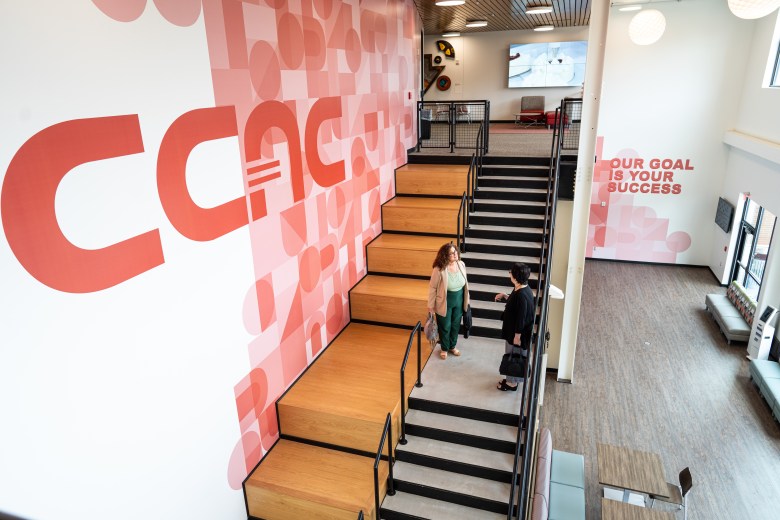
    The Center for Education, Innovation & Training at the Community College of Allegheny County in Pittsburgh. The college is part of a citywide effort to give academic credit for older students’ life experiences. Credit: Nancy Andrews for The Hechinger Report

    When Melissa DiMatteo, 38, decided to get an associate degree at CCAC to go further in her job, she got six credits for her previous training in Microsoft Office and her work experience as everything from a receptionist to a supervisor. That spared her from having to take two required courses in computer information and technology and — since she’s going to school part time and taking one course per semester — saved her a year.

    “Taking those classes would have been a complete waste of my time,” DiMatteo said. “These are things that I do every day. I supervise other people and train them on how to do this work.”

    On average, students who get credit for prior learning save between $1,500 and $10,200 apiece and nearly seven months off the time it takes to earn a bachelor’s degree, the nonprofit advocacy group Higher Learning Advocates calculates. The likelihood that they will graduate is 17 percent higher, the organization finds.

    Related: The number of 18-year-olds is about to drop sharply, packing a wallop for colleges — and the economy 

    Justin Hand dropped out of college because of the cost, and became a largely self-taught information technology manager before he decided to go back and get an associate and then a bachelor’s degree so he could move up in his career.

    He got 15 credits — a full semester’s worth — through a program at the University of Memphis for which he wrote essays to prove he had already mastered software development, database management, computer networking and other skills.

    “These were all the things I do on a daily basis,” said Hand, of Memphis, who is 50 and married, with a teenage son. “And I didn’t want to have to prolong college any more than I needed to.”

    Meanwhile, employers and policymakers are pushing colleges to speed up the output of graduates with skills required in the workforce, including by giving more students credit for their prior learning. And online behemoths Western Governors University and Southern New Hampshire University, with which brick-and-mortar colleges compete, are way ahead of them in conferring credit for past experience.

    “They’ve mastered this and used it as a marketing tool,” said Kristen Vanselow, assistant vice president of innovative education and partnerships at Florida Gulf Coast University, which has expanded its awarding of credit for prior learning. “More traditional higher education institutions have been slower to adapt.”

    It’s also gotten easier to evaluate how skills that someone learns in life equate to academic courses or programs. This has traditionally required students to submit portfolios, take tests or write essays, as Hand did, and faculty to subjectively and individually assess them. 

    Related: As colleges lose enrollment, some turn to one market that’s growing: Hispanic students

    Now some institutions, states, systems and independent companies are standardizing this work or using artificial intelligence to do it. The growth of certifications from professional organizations such as Amazon Web Services and the Computing Technology Industry Association, or CompTIA, has helped, too.

    “You literally punch [an industry certification] into our database and it tells you what credit you can get,” said Philip Giarraffa, executive director of articulation and academic pathways at Miami Dade College. “When I started here, that could take anywhere from two weeks to three months.”

    Data provided by Miami Dade shows it has septupled the number of credits for prior learning awarded since 2020, from 1,197 then to 7,805 last year.

    “These are students that most likely would have looked elsewhere, whether to the [online] University of Phoenix or University of Maryland Global [Campus]” or other big competitors, Giarraffa said.

    Fifteen percent of undergraduates enrolled in higher education full time and 40 percent enrolled part time are 25 or older, federal data show — including people who delayed college to serve in the military, volunteer or do other work that could translate into academic credit. 

    “Nobody wants to sit in a class where they already have all this knowledge,” Giarraffa said. 

    At Thomas Edison, police academy graduates qualify for up to 30 credits toward associate degrees. Carpenters who have completed apprenticeships can get as many as 74 credits in subjects including math, management and safety training. Bachelor’s degrees are often a prerequisite for promotion for people in professions such as these, or who hope to start their own companies.

    Related: To fill ‘education deserts,’ more states want community colleges to offer bachelor’s degrees

    The University of Memphis works with FedEx, headquartered nearby, to give employees with supervisory training academic credit they can use toward a degree in organizational leadership, helping them move up in the company.

    The University of North Carolina System last year launched its Military Equivalency System, which lets active-duty and former military service members find out almost instantly, before applying for admission, if their training could be used for academic credit. That had previously required contacting admissions offices, registrars or department chairs. 

    Among the reasons for this reform was that so many of these prospective students — and the federal education benefits they get — were ending up at out-of-state universities, the UNC System’s strategic plan notes.

    “We’re trying to change that,” said Kathie Sidner, the system’s director of workforce and partnerships. It’s not only for the sake of enrollment and revenue, Sidner said. “From a workforce standpoint, these individuals have tremendous skill sets and we want to retain them as opposed to them moving somewhere else.”

    Related: A new way to help some college students: Zero percent, no-fee loans

    California’s community colleges are also expanding their credit for prior learning programs as part of a plan to increase the proportion of the population with educations beyond high school

    “How many people do you know who say, ‘College isn’t for me?’ ” asked Sam Lee, senior advisor to the system’s chancellor for credit for prior learning. “It makes a huge difference when you say to them that what they’ve been doing is equivalent to college coursework already.”

    In Pittsburgh, the Regional Upskilling Alliance — of which CCAC is a part — is connecting job centers, community groups, businesses and educational institutions to create comprehensive education and employment records so more workers can get credit for skills they already have.

    That can provide a big push, “especially if you’re talking about parents who think, ‘I’ll never be able to go to school,’ ” said Sabrina Saunders Mosby, president and CEO of the nonprofit Vibrant Pittsburgh, a coalition of business and civic leaders involved in the effort. 

    Pennsylvania is facing among the nation’s most severe declines in the number of 18-year-old high school graduates. 

    “Our members are companies that need talent,” Mosby said. 

    There’s one group that has historically pushed back against awarding credit for prior learning: university and college faculty concerned it might affect enrollment in their courses or unconvinced that training provided elsewhere is of comparable quality. Institutions have worried about the loss of revenue from awarding credits for which students would otherwise have had to pay.

    That also appears to be changing, as universities leverage credit for prior learning to recruit more students and keep them enrolled for longer, resulting in more revenue — not less. 

    “That monetary factor was something of a myth,” said Beth Doyle, chief of strategy at CAEL.

    Faculty have increasingly come around, too. That’s sometimes because they like having experienced students in their classrooms, Florida Gulf Coast’s Vanselow said. 

    Related: States want adults to return to college. Many roadblocks stand in the way 

    Still, while many recognize it as a recruiting incentive, most public universities and colleges have had to be ordered to confer more credits for prior learning by legislatures or governing boards. Private, nonprofit colleges remain stubbornly less likely to give it.

    More than two-thirds charge a fee for evaluating whether other kinds of learning can be transformed into academic credit, an expense that isn’t covered by financial aid. Roughly one in 12 charge the same as it would cost to take the course for which the credits are awarded. 
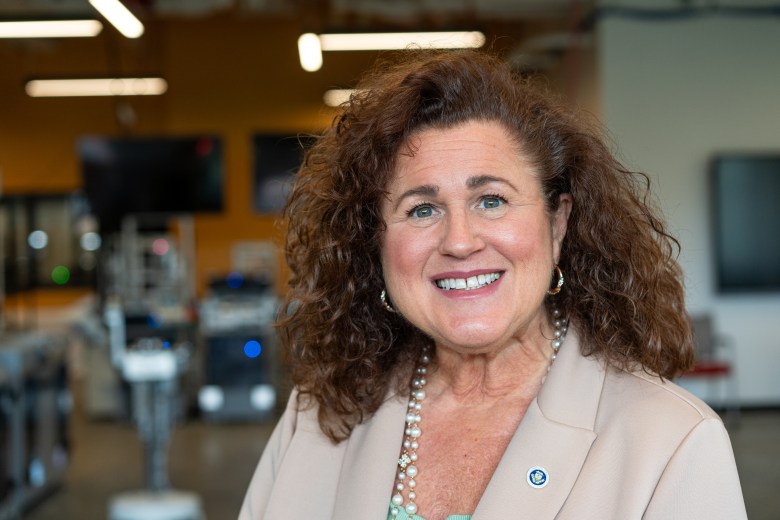
    Debra Roach, vice president for workforce development at the Community College of Allegheny County in Pittsburgh. The college is working on giving academic credit to students for their military, work and other life experience. Credit: Nancy Andrews for The Hechinger Report

    Seventy percent of institutions require that students apply for admission and be accepted before learning whether credits for prior learning will be awarded. Eighty-five percent limit how many credits for prior learning a student can receive.

    There are other confounding roadblocks and seemingly self-defeating policies. CCAC runs a noncredit program to train paramedics, for example, but won’t give people who complete it credits toward its for-credit nursing degree. Many leave and go across town to a private university that will. The college is working on fixing this, said Debra Roach, its vice president of workforce development.

    It’s important to see this from the students’ point of view, said Tracy Robinson, executive director of the University of Memphis Center for Regional Economic Enrichment.

    “Credit for prior learning is a way for us to say, ‘We want you back. We value what you’ve been doing since you’ve been gone,’ ” Robinson said. “And that is a total game changer.”

    Contact writer Jon Marcus at 212-678-7556, [email protected] or jpm.82 on Signal.

    This story about credit for prior learning was produced by The Hechinger Report, a nonprofit, independent news organization focused on inequality and innovation in education. Sign up for our higher education newsletter. Listen to our higher education podcast.

    The Hechinger Report provides in-depth, fact-based, unbiased reporting on education that is free to all readers. But that doesn’t mean it’s free to produce. Our work keeps educators and the public informed about pressing issues at schools and on campuses throughout the country. We tell the whole story, even when the details are inconvenient. Help us keep doing that.

    Join us today.

    Source link

  • How can students’ module feedback help prepare for success in NSS?

    How can students’ module feedback help prepare for success in NSS?

    Since the dawn of student feedback there’s been a debate about the link between module feedback and the National Student Survey (NSS).

    Some institutions have historically doubled down on the idea that there is a read-across from the module learning experience to the student experience as captured by NSS and treated one as a kind of “dress rehearsal” for the other by asking the NSS questions in module feedback surveys.

    This approach arguably has some merits in that it sears the NSS questions into students’ minds to the point that when they show up in the actual NSS it doesn’t make their brains explode. It also has the benefit of simplicity – there’s no institutional debate about what module feedback should include or who should have control of it. If there isn’t a deep bench of skills in survey design in an institution there could be a case for adopting NSS questions on the grounds they have been carefully developed and exhaustively tested with students. Some NSS questions have sufficient relevance in the module context to do the job, even if there isn’t much nuance there – a generic question about teaching quality or assessment might resonate at both levels, but it can’t tell you much about specific pedagogic innovations or challenges in a particular module.

    However, there are good reasons not to take this “dress rehearsal” approach. NSS endeavours to capture the breadth of the student experience at a very high level, not the specific module experience. It’s debatable whether module feedback should even be trying to measure “experience” – there are other possible approaches, such as focusing on learning gains, or skills development, especially if the goal is to generate actionable feedback data about specific module elements. For both students and academics seeing the same set of questions repeated ad nauseam is really rather boring, and is as likely to create disengagement and alienation from the “experience” construct NSS proposes than a comforting sense of familiarity and predictability.

    But separating out the two feedback mechanisms entirely doesn’t make total sense either. Though the totemic status of NSS has been tempered in recent years it remains strategically important as an annual temperature check, as a nationally comparable dataset, as an indicator of quality for the Teaching Excellence Framework and, unfortunately, as a driver of league table position. Securing consistently good NSS scores, alongside student continuation and employability, will feature in most institutions’ key performance indicators and, while vice chancellors and boards will frequently exercise their critical judgement about what the data is actually telling them, when it comes to the crunch no head of institution or board wants to see their institution slip.

    Module feedback, therefore, offers an important “lead indicator” that can help institutions maximise the likelihood that students have the kind of experience that will prompt them to give positive NSS feedback – indeed, the ability to continually respond and adapt in light of feedback can often be a condition of simply sustaining existing performance. But if simply replicating the NSS questions at module level is not the answer, how can these links best be drawn? Wonkhe and evasys recently convened an exploratory Chatham House discussion with senior managers and leaders from across the sector to gather a range of perspectives on this complex issue. While success in NSS remains part of the picture for assigning value and meaning to module feedback in particular institutional contexts there is a lot else going on as well.

    A question of purpose

    Module feedback can serve multiple purposes, and it’s an open question whether some of those purposes are considered to be legitimate for different institutions. To give some examples, module feedback can:

    • Offer institutional leaders an institution-wide “snapshot” of comparable data that can indicate where there is a need for external intervention to tackle emerging problems in a course, module or department.
    • Test and evaluate the impact of education enhancement initiatives at module, subject or even institution level, or capture progress with implementing systems, policies or strategies
    • Give professional service teams feedback on patterns of student engagement with and opinions on specific provision such as estates, IT, careers or library services
    • Give insight to module leaders about specific pedagogic and curriculum choices and how these were received by students to inform future module design
    • Give students the opportunity to reflect on their own learning journey and engagement
    • Generate evidence of teaching quality that academic staff can use to support promotion or inform fellowship applications
    • Depending on the timing, capture student sentiment and engagement and indicate where students may need additional support or whether something needs to be changed mid-module

    Needless to say, all of these purposes can be legitimate and worthwhile but not all of them can comfortably coexist. Leaders may prioritise comparability of data ie asking the same question across all modules to generate comparable data and generate priorities. Similarly, those operating across an institution may be keen to map patterns and capture differences across subjects – one example offered at the round table was whether students had met with their personal tutor. Such questions may be experienced at department or module level as intrusive and irrelevant to more immediately purposeful questions around students’ learning experience on the module. Module leaders may want to design their own student evaluation questions tailored to inform their pedagogic practice and future iterations of the module.

    There are also a lot of pragmatic and cultural considerations to navigate. Everyone is mindful that students get asked to feed back on their experiences A LOT – sometimes even before they have had much of a chance to actually have an experience. As students’ lives become more complicated, institutions are increasingly wary of the potential for cognitive overload that comes with being constantly asked for feedback. Additionally, institutions need to make their processes of gathering and acting on feedback visible to students so that students can see there is an impact to sharing their views – and will confirm this when asked in the NSS. Some institutions are even building questions that test whether students can see the feedback loop being closed into their student surveys.

    Similarly, there is also a strong appreciation of the need to adopt survey approaches that support and enable staff to take action and adapt their practice in response to feedback, affecting the design of the questions, the timing of the survey, how quickly staff can see the results and the degree to which data is presented in a way that is accessible and digestible. For some, trusting staff to evaluate their modules in the way they see fit is a key tenet of recognising their professionalism and competence – but there is a trade-off in terms of visibility of data institution-wide or even at department or subject level.

    Frameworks and ecosystems

    There are some examples in the sector of mature approaches to linking module evaluation data to NSS – it is possible to take a data-led approach that tests the correlation between particular module evaluation question responses and corresponding NSS question outcomes within particular thematic areas or categories, and builds a data model that proposes informed hypotheses about areas of priority for development or approaches that are most likely to drive NSS improvement. This approach does require strong data analysis capability, which not every institution has access to, but it certainly warrants further exploration where the skills are there. The use of a survey platform like evasys allows for the creation of large module evaluation datasets that could be mapped on to NSS results through business intelligence tools to look for trends and correlations that could indicate areas for further investigation.

    Others take the view that maximising NSS performance is something of a red herring as a goal in and of itself – if the wider student feedback system is working well, then the result should be solid NSS performance, assuming that NSS is basically measuring the right things at a high level. Some go even further and express concern that over-focus on NSS as an indicator of quality can be to the detriment of designing more authentic student voice ecosystems.

    But while thinking in terms of the whole system is clearly going to be more effective than a fragmented approach, given the various considerations and trade-offs discussed it is genuinely challenging for institutions to design such effective ecosystems. There is no “right way” to do it but there is an appetite to move module feedback beyond the simple assessment of what students like or don’t like, or the checking of straightforward hygiene factors, to become a meaningful tool for quality enhancement and pedagogic innovation. There is a sense that rather than drawing direct links between module feedback and NSS outcomes, institutions would value a framework-style approach that is able to accommodate the multiple actors and forms of value that are realised through student voice and feedback systems.

    In the coming academic year Wonkhe and evasys are planning to work with institutional partners on co-developing a framework or toolkit to integrate module feedback systems into wider student success and academic quality strategies – contact us to express interest in being involved.

    This article is published in association with evasys.

    Source link

  • Why students reject second-language study – Campus Review

    Why students reject second-language study – Campus Review

    Students are turning away from learning a second language other than English because they don’t see it as a viable qualification even though it is a core skill in other countries, experts have flagged.

    Please login below to view content or subscribe now.

    Membership Login

    Source link

  • Embracing complexity in writing instruction

    Embracing complexity in writing instruction

    Key points:

    Early in our careers, when we were fresh-faced and idealistic (we still are!) the prepackaged curriculum and the advice of more experienced colleagues was the go-to resource. Largely, we were advised that teaching writing was a simple matter of having students walk through and complete organizers, spending about one day for each “stage” of the writing process. At the end of the writing unit, students had finished their compositions–the standardized, boring, recreated ideas that we taught them to write.

    As we matured and grew as teachers of writing, we learned that teaching writing in such simplistic ways may be easier, but it was not actually teaching students to be writers. We learned with time and experience that writing instruction is a complex task within a complex system.

    Complex systems and wicked problems

    Complexity as it is applied to composition instruction recognizes that there is more than just a linear relationship between the student, the teacher, and the composition. It juggles the experiences of individual composers, characteristics of genre, availability of resources, assignment and individual goals, and constraints of composing environments. As with other complex systems and processes, it is non-linear, self-organizing, and unpredictable (Waltuck, 2012).

    Complex systems are wicked in their complexity; therefore, wicked problems cannot be solved by simple solutions. Wicked problems are emergent and generative; they are nonlinear as they do not follow a straight path or necessarily have a clear cause-and-effect relationship. They are self-organizing, evolving and changing over time through the interactions of various elements. They are unpredictable and therefore difficult to anticipate how they will unfold or what the consequences of any intervention might be. Finally, they are often interconnected, as they are symptoms of other problems. In essence, a wicked problem is a complex issue embedded in a dynamic system (Rittel & Webber, 1973).

    Writing formulas are wicked

    As formulaic writing has become and remains prevalent in instruction and classroom writing activity, graphic organizers and structural guides, which were introduced as a tool to support acts of writing, have become a wicked problem of formula; the resource facilitating process has become the focus of product. High-stakes standardized assessment has led to a focus on compliance, production, and quality control, which has encouraged the use of formulas to simplify and standardize writing instruction, the student writing produced, and the process of evaluation of student work. Standardization may improve test scores in certain situations, but does not necessarily improve learning. Teachers resort to short, formulaic writing to help students get through material more quickly as well as data and assessment compliance. This serves to not only create product-oriented instruction, but a false dichotomy between process and product, ignoring the complex thinking and design that goes into writing.

    As a result of such a narrow view of and limited focus on writing process and purpose, formulas have been shown to constrain thinking and limit creativity by prioritizing product over the composing process. The five-paragraph essay, specifically, is a structure that hinders authentic composing because it doesn’t allow for the “associative leaps” between ideas that come about in less constrained writing. Formulas undermine student agency by limiting writers’ abilities to express their unique voices because of over-reliance on rigid structures (Campbell, 2014; Lannin & Fox, 2010; Rico, 1988).

    An objective process lens: A wicked solution

    The use of writing formulas grew from a well-intentioned desire to improve student writing, but ultimately creates a system that is out of balance, lacking the flexibility to respond to a system that is constantly evolving. To address this, we advocate for shifting away from rigid formulas and towards a design framework that emphasizes the individual needs and strategies of student composers, which allows for a more differentiated approach to teaching acts of writing.

    The proposed framework is an objective process lens that is informed by design principles. It focuses on the needs and strategies that drive the composing process (Sharples, 1999). This approach includes two types of needs and two types of strategies:

    • Formal needs: The assigned task itself
    • Informal needs: How a composer wishes to execute the task
    • “What” strategies: The concrete resources and available tools
    • “How” strategies: The ability to use the tools

    An objective process lens acknowledges that composing is influenced by the unique experiences composers bring to the task. It allows teachers to view the funds of knowledge composers bring to a task and create entry points for support.

    The objective process lens encourages teachers to ask key questions when designing instruction:

    • Do students have a clear idea of how to execute the formal need?
    • Do they have access to the tools necessary to be successful?
    • What instruction and/or supports do they need to make shifts in ideas when strategies are not available?
    • What instruction in strategies is necessary to help students communicate their desired message effectively?

    Now how do we do that?

    Working within a design framework that balances needs and strategies starts with understanding the type of composers you are working with. Composers bring different needs and strategies to each new composing task, and it is important for instructors to be aware of those differences. While individual composers are, of course, individuals with individual proclivities and approaches, we propose that there are (at least) four common types of student composers who bring certain combinations of strategies and needs to the composition process: the experience-limited, the irresolute, the flexible, and the perfectionist composers. By recognizing these common composer types, composition instructors can develop a flexible design for their instruction.

    An experience-limited composer lacks experience in applying both needs and strategies to a composition, so they are entirely reliant on the formal needs of the assigned task and any what-strategies that are assigned by the instructor. These students gravitate towards formulaic writing because of their lack of experience with other types of writing. Relatedly, an irresolute composer may have a better understanding of the formal and informal needs, but they struggle with the application of what and how strategies for the composition. They can become overwhelmed with options of what without a clear how and become stalled during the composing process. Where the irresolute composer becomes stalled, the flexible composer is more comfortable adapting their composition. This type of composer has a solid grasp on both the formal and informal needs and is willing to adapt the informal needs as necessary to meet the formal needs of the task. As with the flexible composer, the perfectionist composer is also needs-driven, with clear expectations for the formal task and their own goals for the informal tasks. Rather than adjusting the informal needs as the composition develops, a perfectionist composer will focus intensely on ensuring that their final product exactly meets their formal and informal needs.

    Teaching writing requires embracing its complexity and moving beyond formulaic approaches prioritizing product over process. Writing is a dynamic and individualized task that takes place within a complex system, where composers bring diverse needs, strategies, and experiences. By adopting a design framework, teachers of writing and composing can support students in navigating this complexity, fostering creativity, agency, and authentic expression. It is an approach that values funds of knowledge students bring to the writing process, recognizing the interplay of formal and informal needs, as well as their “what” and “how” strategies; those they have and those that need growth via instruction and experience. Through thoughtful design, we can grow flexible, reflective, and skilled communicators who are prepared to navigate the wicked challenges of composing in all its various forms.

    These ideas and more can be found in When Teaching Writing Gets Tough: Challenges and Possibilities in Secondary Writing Instruction.

    References

    Campbell, K. H. (2014). Beyond the five-paragraph essay. Educational Leadership, 71(7), 60-65.

    Lannin, A. A., & Fox, R. F. (2010). Chained and confused: Teacher perceptions of formulaic writing. Writing & Pedagogy, 2(1), 39-64.

    Rico, G. L. (1988). Against formulaic writing. The English Journal, 77(6), 57-58.

    Rittel, H. W. J., & Webber, M. M. (1973). Dilemmas in a general theory of planning. Policy Sciences, 4(2), 155–169.

    Sharples, M. (1999). How we write : writing as creative design (1st ed.). Routledge. https://doi.org/10.4324/9780203019900

    Waltuck, B. A. (2012). Characteristics of complex systems. The Journal for Quality & Participation, 34(4), 13–15.

    Latest posts by eSchool Media Contributors (see all)

    Source link

  • High school speech and debate allows students to find common ground

    High school speech and debate allows students to find common ground

    This story about high school speech and debate was produced by The Hechinger Report, a nonprofit, independent news organization focused on inequality and innovation in education. Sign up for the Hechinger newsletter.

    DES MOINES, Iowa — Macon Smith stood in front of a nearly empty classroom 1,000 miles from home. He asked his opponent and the two judges in the room if they were ready to start, then he set a six-minute timer and took a deep breath.

    “When tyranny becomes law, rebellion becomes duty,” he began. 

    In front of Macon, a 17-year-old high school junior, was a daunting task: to outline and defend the argument that violent revolution is a just response to political oppression.

    In a few hours, Macon would stand in another classroom with new judges and a different opponent. He would break apart his entire argument and undo everything he had just said.

    “An eye for an eye makes the whole world blind,” Macon started.

    It doesn’t really matter what opinion Macon holds on violence or political oppression. In this moment in front of the judges, he believes what he’s saying. His job is to get the judges to believe with him.

    Related: A lot goes on in classrooms from kindergarten to high school. Keep up with our free weekly newsletter on K-12 education.

    Macon was one of more than 7,000 middle and high school students to compete in the National Speech and Debate Tournament this summer in Iowa, run by an organization that is celebrating a century in existence.

    In that time, the National Speech and Debate Association has persevered through economic and social upheaval. It is entering its next era, one in which the very notion of engaging in informed and respectful debate seems impossible. The organizers of this event see the activity as even more important in a fracturing society.

    “I don’t think there’s an activity in the world that develops empathy and listening skills like speech and debate,” said Scott Wunn, the organization’s president. “We’re continuing to create better citizens.” 

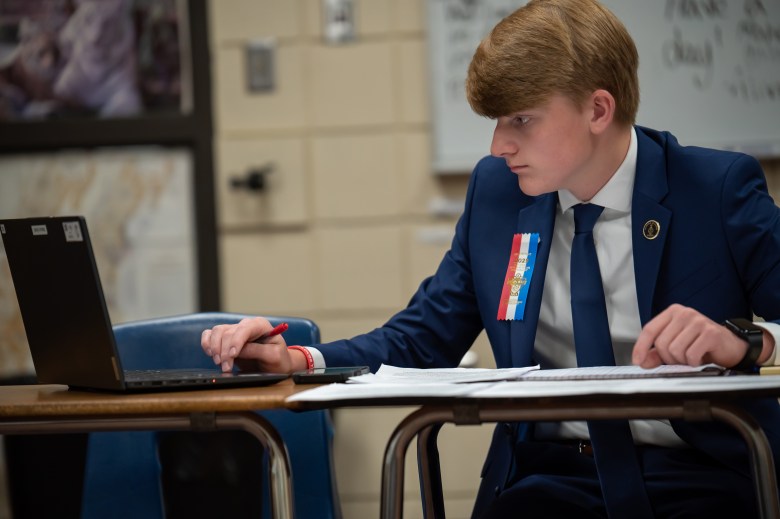
    Macon Smith, a rising senior from Bob Jones Academy in South Carolina, competes in the third round of the Lincoln-Douglas Debate at the National Speech and Debate Tournament in Iowa this summer. Credit: Meenakshi Van Zee for The Hechinger Report

    Though the tournament is held in different cities around the country, for the 100th anniversary, the organizers chose to host it in Des Moines, where the association’s headquarters is based.

    Preparing for this competition was a year in the making for Macon, who will be a senior at Bob Jones Academy, a Christian school in Greenville, South Carolina, this fall. Students here compete in more than two dozen categories, such as Original Oratory, in which they write and recite their own 10-minute speeches, or Big Questions, where they attempt to argue broad, philosophical ideas. 

    Macon’s specialty, the Lincoln-Douglas Debate, is modeled after a series of public, three-hour debates between Abraham Lincoln and Sen. Stephen Douglas in 1858. In this event, two students have just 40 minutes to set up their arguments, cross-examine each other and sway the judges.

    “Even if I don’t personally believe it, I can still look at the facts and determine, OK, this is a good fact, or it’s true, and argue for that side,” Macon said.

    Debaters often have to tackle topics that are difficult, controversial and timely: Students in 1927 debated whether there was a need for a federal Department of Education. In 1987, they argued about mandatory AIDS testing. In 2004, they debated whether the United States was losing the war on terror. This year, in the Public Forum division, students debated whether the benefits of presidential executive orders outweigh the harms. 

    Related: Teaching social studies in a polarized world

    While the speech and debate students practiced for their national event, adults running the country screamed over each other during a congressional hearing on state sanctuary policies. A senator was thrown to the floor and handcuffed during a press conference on sending the National Guard to immigration enforcement protests in Los Angeles. Most Americans feel political discourse is moving in the wrong direction — both conservatives and progressives say talking politics with someone they disagree with has become increasingly stressful and frustrating

    Speech and debate club, though, is different.

    “First of all, it gives a kid a place to speak out and have a voice,” said Gail Nicholas, who for 40 years has coached speech and debate at Bob Jones Academy alongside her husband, Chuck Nicholas, who is Macon’s coach. “But then also learn to talk to other people civilly, and I think that’s not what’s being modeled out there in the real world right now.” 

    Macon Smith, a rising senior from Bob Jones Academy in South Carolina, shows off the notes that he took during debates at the National Speech and Debate Tournament in Iowa. Credit: Meenakshi Van Zee for The Hechinger Report

    On the second day of the competition in a school cafeteria in West Des Moines, Macon was anxiously refreshing the webpage that would show the results of his rounds to learn whether he would advance to semifinals.  

    For most of the school year, Macon spent two days a week practicing after school, researching and writing out his arguments. Like many competitors, he has found that it’s easy to make snap judgments when you don’t know much about an issue. Decisively defending that view, to yourself and to others, is much harder.  

    “I tend to go in with an opinion and lose my opinion as the topic goes on,” said Daphne DiFrancesco, a rising senior from Cary Academy in Cary, North Carolina.

    Traveling for regional events throughout the school year means Macon has become friends with students who don’t always share his conservative views. He knows this because in debate, discussing politics and religion is almost unavoidable.

    “It doesn’t make me uncomfortable at all,” Macon said. “You don’t want to burn down a bridge before you make it with other people. If you stop your connection with a person right at their political beliefs, you’re already cutting off half of the country. That’s not a good way to conduct yourself.”

    Macon, and other students in the clubs, said participating has made them think more deeply about their own beliefs. Last year, Macon debated a bill that would defund Immigration and Customs Enforcement, an agency he supports. After listening to other students, he developed a more nuanced view of the organization. 

    “When you look at the principle of enforcing illegal immigration, that can still be upheld, but the agency that does so itself is flawed,” he said.

    Related: ‘I can tell you don’t agree with me’:’ Colleges teach kids how to hear differing opinions

    Henry Dieringer, a senior from L.C. Anderson High School in Austin, Texas, went into one competition thinking he would argue in favor of a bill that would provide work permits for immigrants, which he agrees with. Further research led him to oppose the idea of creating a federal database on immigrants.

    “It made me think more about the way that public policy is so much more nuanced than what we believe,” Henry said. 

    On the afternoon of the second day of the national tournament, Macon learned he didn’t advance to the next round. What’s sad, he said, is he probably won’t have to think this hard about the justness of violent revolution ever again. 

    “There’s always next year,” Macon said.

    Callista Martin, 16, a rising senior from Bainbridge High School in Washington state, also didn’t make the semifinals. Callista and Macon met online this year through speech and debate so they could scrimmage with someone they hadn’t practiced with before. It gave them the chance to debate someone with differing political views and argument styles.

    Macon Smith, a rising senior from Bob Jones Academy in South Carolina, takes notes during a round of the Lincoln-Douglas Debate at the National Speech and Debate Tournament in Iowa. Credit: Meenakshi Van Zee for The Hechinger Report

    “In the rounds, I’m an entirely different person. I’m pretty aggressive, my voice turns kind of mean,” Callista said. “But outside of the rounds, I always make sure to say hi to them before and after and say things I liked about their case, ask them about their school.”

    Talking to her peers outside of rounds is perhaps the most important part of being in the club, Callista said. This summer, she will travel to meet with some of her closest friends, people she met at debate camps and tournaments in Washington.  

    Since Callista fell in love with speech and debate as a freshman, she has devoted herself to keeping it alive at her school. No teacher has volunteered to be a coach for the debate club, so the 16-year-old is coaching both her classmates and herself.

    A lack of coaches is a common problem. Just under 3,800 public and private high schools and middle schools were members of the National Speech and Debate Association at the end of this past school year, just a fraction of the tens of thousands of secondary schools in the country. The organization would like to double its membership in the next five years.

    That would mean recruiting more teachers to lead clubs, but neither educators nor schools are lining up to take on the responsibility, said David Yastremski, an English teacher at Ridge High School in New Jersey who has coached teams for about 30 years.

    It’s a major time commitment for teachers to dedicate their evenings and weekends to the events with little supplemental pay or recognition. Also, it may seem like a risk to some teachers at a time when states such as Virginia and Louisiana have banned teachers from talking about what some call “divisive concepts,” to oversee a school activity where engaging with controversial topics is the point.

    “I primarily teach and coach in a space where kids can still have those conversations,” Yastremski said. “I fear that in other parts of the country, that’s not the case.” 

    Related: A school district singled out by Trump says it teaches ‘whole truth history’ 

    Dennis Philbert, a coach from Central High School in Newark, New Jersey, who had two students become finalists in the tournament’s Dramatic Interpretation category, said he fears for his profession because of the scrutiny educators are under. It takes the fun out of teaching, he said, but this club can reignite that passion.

    “All of my assistant coaches are former members of my team,” Philbert said. “They love this activity [so much] that they came back to help younger students … to show that this is an activity that is needed.”

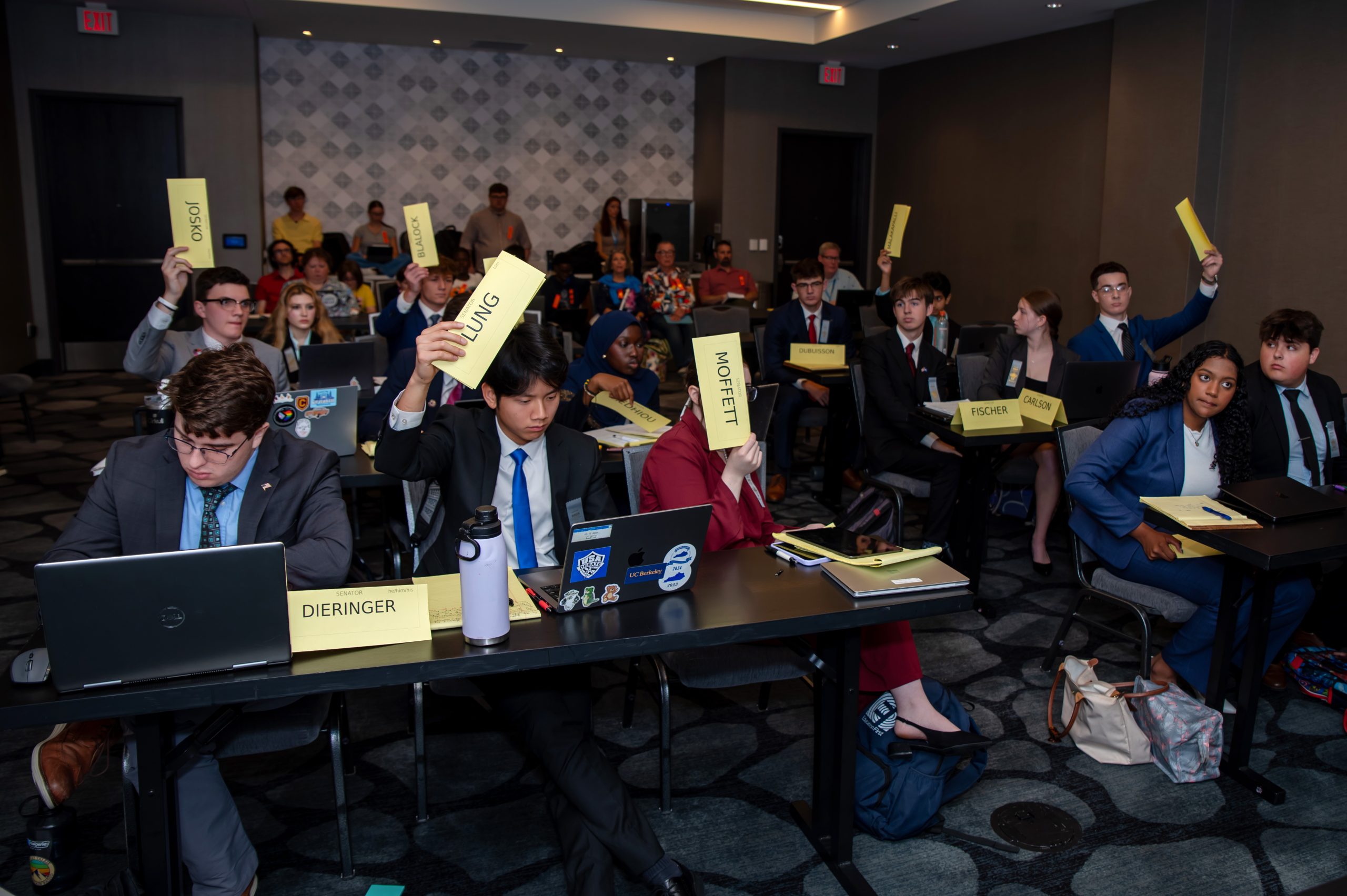
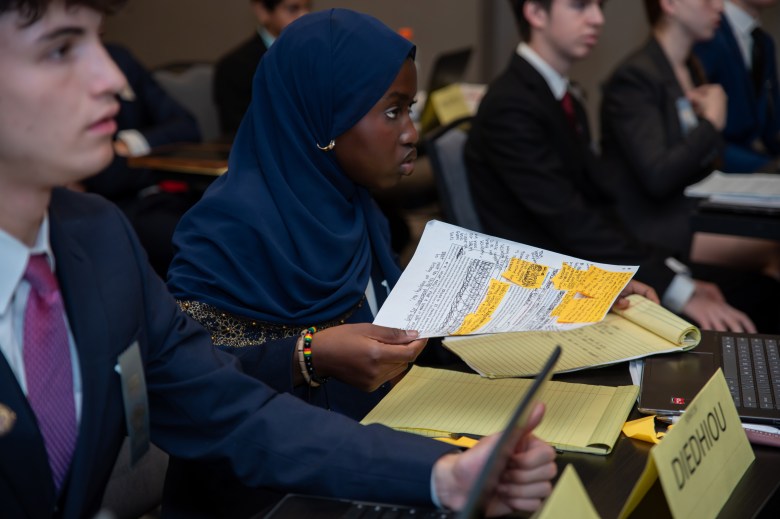
    On the other side of Des Moines, Gagnado Diedhiou was competing in the Congressional Debate, a division of the tournament that mimics Congress and requires students to argue for or against bills modeled after current events. During one round, Gagnado spoke in favor of a bill to shift the country to use more nuclear energy, for a bill that would grant Puerto Rico statehood, and against legislation requiring hospitals to publicly post prices.

    Gagnado Diedhiou, a senior from Eastside High School in South Carolina, competing in the first round of the Congressional Debate at the National Speech and Debate Tournament in Iowa in June. Credit: Meenakshi Van Zee for The Hechinger Report

    Just like in Congress, boys outnumbered girls in this classroom. Gagnado was the only Black teenager and the only student wearing a hijab. The senior, who just graduated from Eastside High School in Greenville, South Carolina, is accustomed to being in rooms where nobody looks like her — it’s part of the reason she joined Equality in Forensics, a national student-led debate organization that provides free resources to schools and students across the country.

    “It kind of makes you have to walk on eggshells a little bit. Especially because when you’re the only person in that room who looks like you, it makes you a lot more obvious to the judges,” said Gagnado, who won regional Student of the Year for speech and debate in her South Carolina district this year. “You stand out, and not always in a good way.”

    Camille Fernandez, a rising junior at West Broward High School in Florida, said the competitions she has participated in have been dominated by male students. One opponent called her a vulgar and sexist slur after their round was over. Camille is a member of a student-led group — called Outreach Debate — trying to bridge inequities in the clubs. 

    “A lot of people think that debate should stay the same way that it’s always been, where it’s kind of just — and this is my personal bias — a lot of white men winning,” Camille said. “A lot of people think that should be changed, me included.” 

    Despite the challenges, Gagnado said her time in debate club has made her realize she could have an influence in the world.

    “With my three-minute speech, I can convince a whole chamber, I can convince a judge to vote for this bill. I can advocate and make a difference with some legislation,” said Gagnado, who is bound for Yale. 

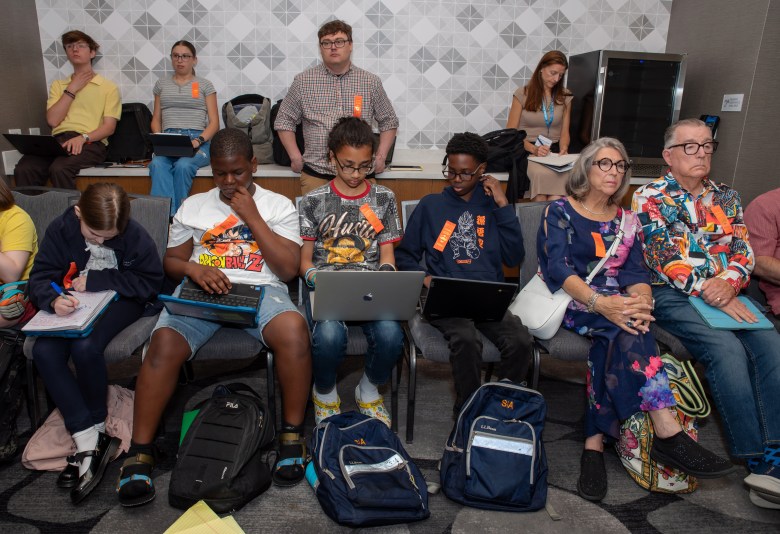
    About 10,000 people attended the National Speech and Debate Tournament in Iowa this June during the organization’s centennial anniversary. Credit: Meenakshi Van Zee for The Hechinger Report

    A day before the national tournament’s concluding ceremony, a 22-year-old attendee rushed the stage at the Iowa Event Center in Des Moines during the final round of the Humorous Interpretation speech competition, scaring everyone in the audience. After he bent down to open his backpack, 3,000 people in the auditorium fled for the exits. The man was later charged with possession of a controlled substance and disorderly conduct. For a brief moment, it seemed like the angry discourse and extreme politics from outside of the competition had become a part of it. 

    In response, the speech and debate organization shifted the time of some events, limited entrances into the building and brought in metal detectors, police officers and counselors. Some students, Gagnado among them, chose not to return to the event. 

    Still, thousands of attendees stayed until the end to celebrate the national champions. During the awards ceremony, where therapy dogs roamed the grounds, Angad Singh, a student from Bellarmine College Preparatory in California competing in Original Oratory, took the national prize for his speech on his Sikh identity and the phrase “thoughts and prayers” commonly repeated by American leaders after a tragedy, titled “Living on a Prayer.”

    “I’ve prayed for change,” Singh told the audience. “Then I joined speech and debate to use my voice and fight for it.”

    This story about high school speech and debate was produced by The Hechinger Report, a nonprofit, independent news organization focused on inequality and innovation in education. Sign up for the Hechinger newsletter.

    The Hechinger Report provides in-depth, fact-based, unbiased reporting on education that is free to all readers. But that doesn’t mean it’s free to produce. Our work keeps educators and the public informed about pressing issues at schools and on campuses throughout the country. We tell the whole story, even when the details are inconvenient. Help us keep doing that.

    Join us today.

    Source link

  • Trump Team Weakens Bipartisan Law That Protects Students and Veterans From Predatory Colleges (David Halperin)

    Trump Team Weakens Bipartisan Law That Protects Students and Veterans From Predatory Colleges (David Halperin)

    On the eve of the 4th of July holiday, when they probably hoped no one was paying attention, the Trump Department of Education issued an Interpretive Rule that will make it easier for for-profit colleges to evade regulations aimed at protecting students, and especially student veterans and military service members, from low-quality schools.

    The Department’s 90-10 rule, created by Congress, requires for-profit colleges to obtain at least ten percent of their revenue from sources other than taxpayer-funded federal student grants and loans, or else — if they flunk two years in a row — lose eligibility for federal aid. The purpose is to remove from federal aid those schools of such poor quality that few students, employers, or scholarship programs would put their own money into them.

    For decades, low quality schools have been able to avoid accountability through a giant loophole: only Department of Education funding counted on the federal side of the 90-10 ledger, while other government funding, including GI Bill money from the VA, and tuition assistance for active duty troops and their families from the Pentagon, counted as non-federal. That situation was particularly bad because it motivated low-quality predatory schools, worried about their 90-10 ratios, to aggressively target U.S. veterans and service members for recruitment.

    After years of efforts by veterans organizations and other advocates to close the loophole, Congress in 2021 passed, on a bipartisan basis, and President Biden signed, legislation that appropriately put all federal education aid, including VA and Defense Department money, on the federal side of the ledger.

    The Department was required by the new law to issue regulations specifying in detail how this realignment would work, and the Department under the Biden administration did so in 2022, after engaging in a legally-mandated negotiated rulemaking that brought together representatives of relevant stakeholders. In an unusual development, that rulemaking actually achieved consensus among the groups at the table, from veterans organizations to the for-profit schools themselves, on what the final revised 90-10 rule should be.

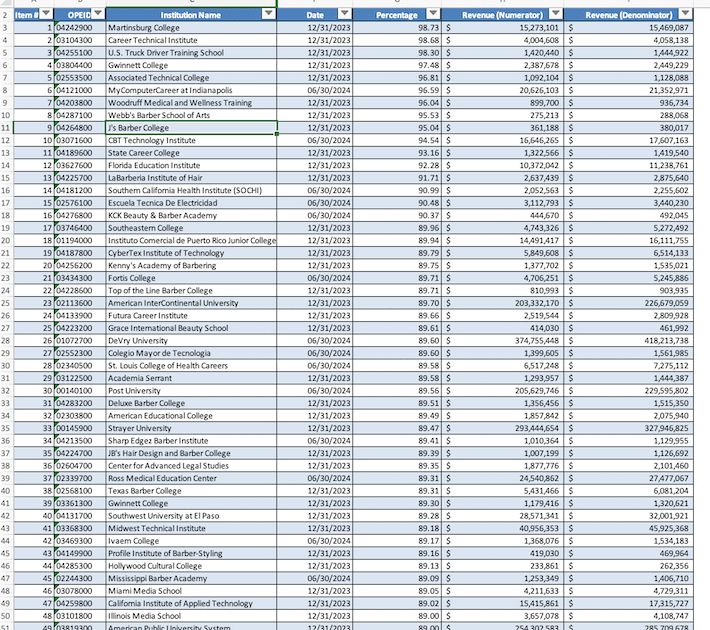
    The new rule took effect in 2023, and when the Department released the latest 90-10 calculations, for the 2023-24 academic year, sixteen for-profit colleges had flunked, compared with just five the previous year. These were mostly smaller schools, led by West Virginia’s Martinsburg College, which got 98.73 percent of its revenue from federal taxpayer dollars, and Washington DC’s Career Technical Institute, which reported 98.68 percent. Another 36 schools, including major institutions such as DeVry University, Strayer University, and American Public University, came perilously close to the line, at 89 percent or higher.

    The education department last week altered the calculation by effectively restoring an old loophole that allowed for-profit colleges to use revenue from programs that are ineligible for federal aid to count on the non-federal side. That loophole was expressly addressed, via a compromise agreement, after Department officials discussed the details with representatives of for-profit colleges, during the 2022 negotiated rulemaking meetings.

    All the flunking or near-flunking schools can now get a new, potentially more favorable, calculation of their 90-10 ratio under the Trump administration’s re-interpretation of the rule.

    In the lawless fashion of the Trump regime, the Department has now undermined a provision of its own regulation without going through the required negotiated rulemaking process. (The Department’s notice last week included a labored argument about why its action was lawful.)

    As it has done multiple times over its first six months, the Trump Department of Education, under Secretary Linda McMahon, has again taken a step that allows poor-quality predatory for-profit colleges to rip off students and taxpayers.

    Source link

  • America’s future depends on more first-generation students from underestimated communities earning an affordable bachelor’s degree

    America’s future depends on more first-generation students from underestimated communities earning an affordable bachelor’s degree

    I recently stood before hundreds of young people in California’s Central Valley; more than 60 percent were on that day becoming the first in their family to earn a bachelor’s degree.

    Their very presence at University of California, Merced’s spring commencement ceremony disrupted a major narrative in our nation about who college is for — and the value of a degree.

    Many of these young people arrived already balancing jobs, caregiving responsibilities and family obligations. Many were Pell Grant-eligible and came from communities that are constantly underestimated and where a higher education experience is a rarity.

    These students graduated college at a critical moment in American history: a time when the value of a bachelor’s degree is being called into question, when public trust in higher education is vulnerable and when supports for first-generation college students are eroding. Yet an affordable bachelor’s degree remains the No. 1 lever for financial, professional and social mobility in this country.

    Related: Interested in innovations in higher education? Subscribe to our free biweekly higher education newsletter.

    A recent Gallup poll showed that the number of Americans who have a great deal of confidence in higher education is dwindling, with a nearly equal amount responding that they have little to none. In 2015, when Gallup first asked this question, those expressing confidence outnumbered those without by nearly six to one.

    There is no doubt that higher education must continue to evolve — to be more accessible, more relevant and more affordable — but the impact of a bachelor’s degree remains undeniable.

    And the bigger truth is this: America’s long-term strength — its economic competitiveness, its innovation pipeline, its social fabric — depends on whether we invest in the education of the young people who reflect the future of this country.

    There are many challenges for today’s workforce, from a shrinking talent pipeline to growing demands in STEM, healthcare and the public sector. These challenges can’t be solved unless we ensure that more first-generation students and those from underserved communities earn their degrees in affordable ways and leverage their strengths in ways they feel have purpose.

    Those of us in education must create conditions in which students’ talent is met with opportunity and higher education institutions demonstrate that they believe in the potential of every student who comes to their campuses to learn.

    UC Merced is a fantastic example of what this can look like. The youngest institution in the University of California system, it was recently designated a top-tier “R1” research university. At the same time, it earned a spot on Carnegie’s list of “Opportunity Colleges and Universities,” a new classification that recognizes institutions based on the success of their students and alumni. It is one of only 21 institutions in the country to be nationally ranked for both elite research and student success and is proving that excellence and equity can — and must — go hand in hand.

    In too many cases, students who make it to college campuses are asked to navigate an educational experience that wasn’t built with their lived experiences and dreams in mind. In fact, only 24 percent of first-generation college students earn a bachelor’s degree in six years, compared to nearly 59 percent of students who have a parent with a bachelor’s. This results in not just a missed opportunity for individual first-generation students — it’s a collective loss for our country.

    Related: To better serve first-generation students, expand the definition

    The graduates I spoke to in the Central Valley that day will become future engineers, climate scientists, public health leaders, artists and educators. Their bachelor’s degrees equip them with critical thinking skills, confidence and the emotional intelligence needed to lead in an increasingly complex world.

    Their future success will be an equal reflection of their education and the qualities they already possess as first-generation college graduates: persistence, focus and unwavering drive. Because of this combination, they will be the greatest contributors to the future of work in our nation.

    This is a reality I know well. As the Brooklyn-born daughter of Dominican immigrants, I never planned to go away from home to a four-year college. My father drove a taxi, and my mother worked in a factory. I was the first in my family to earn a bachelor’s degree. I attended college as part of an experimental program to get kids from neighborhoods like mine into “top” schools. When it was time for me to leave for college, my mother and I boarded a bus with five other students and their moms for a 26-hour ride to Vanderbilt University in Nashville, Tennessee.

    Like so many first-generation college students, I carried with me the dreams and sacrifices of my family and community. I had one suitcase, a box of belongings and no idea what to expect at a place I’d never been to before. That trip — and the bachelor’s degree I earned — changed the course of my life.

    First-generation college students from underserved communities reflect the future of America. Their success is proof that the American Dream is not only alive but thriving. And right now, the stakes are national, and they are high.

    That is why we must collectively remove the obstacles to first-generation students’ individual success and our collective success as a nation. That’s the narrative that we need to keep writing — together.

    Shirley M. Collado is president emerita at Ithaca College and the president and CEO of College Track, a college completion program dedicated to democratizing potential among first-generation college students from underserved communities.

    Contact the opinion editor at [email protected].

    This story about first-generation students was produced by The Hechinger Report, a nonprofit, independent news organization focused on inequality and innovation in education. Sign up for Hechinger’s weekly newsletter.

    The Hechinger Report provides in-depth, fact-based, unbiased reporting on education that is free to all readers. But that doesn’t mean it’s free to produce. Our work keeps educators and the public informed about pressing issues at schools and on campuses throughout the country. We tell the whole story, even when the details are inconvenient. Help us keep doing that.

    Join us today.

    Source link

  • What students complain about: Ombudsman – Campus Review

    What students complain about: Ombudsman – Campus Review

    The National Student Ombudsman (NSO) has shared the themes and types of the 1,500 student complaints made to the watchdog in its first five months.

    Please login below to view content or subscribe now.

    Membership Login

    Source link

  • 10 (and counting…) Google goodies for your classroom

    10 (and counting…) Google goodies for your classroom

    Key points:

    Google enthusiasts, unite.

    During an ISTELive 25 session, Dr. Wanda Terral, chief of technology for Tennessee’s Lakeland School System, took attendees through a growing list of Google tools, along with some non-Google resources, to boost classroom creativity, productivity, and collaboration.

    Here are just 10 of the resources Terral covered–explore the full list for more ideas and resources to increase your Google knowledge.

  • Harvard “Indifference” to Jewish Students Violates Law

    Harvard “Indifference” to Jewish Students Violates Law

    The Health and Human Services Department announced Monday that Harvard University’s “deliberate indifference” regarding discrimination against Jewish and Israeli students violates federal law.

    The HHS Office for Civil Rights said Harvard is violating Title VI of the Civil Rights Act of 1964, which prohibits discrimination based on shared ancestry, including antisemitism.

    The finding, similar to one HHS announced against Columbia University in May, adds to the Trump administration’s pressure on both Ivy League institutions to comply with its demands. It has already cut off billions in federal funding.

    HHS’s Notice of Violation says that a report from Harvard’s own Presidential Task Force on Combating Antisemitism and Anti-Israeli Bias, combined with other sources, “present a grim reality of on-campus discrimination that is pervasive, persistent, and effectively unpunished.”

    “Reports of Jewish and Israeli students being spit on in the face for wearing a yarmulke, stalked on campus, and jeered by peers with calls of ‘Heil Hitler’ while waiting for campus transportation went unheeded by Harvard administration,” the Notice of Violation says.

    In a statement, Harvard said it is “far from indifferent on this issue and strongly disagrees with the government’s findings.”

    “In responding to the government’s investigation, Harvard not only shared its comprehensive and retrospective Antisemitism and Anti-Israeli Bias Report but also outlined the ways that it has strengthened policies, disciplined those who violate them, encouraged civil discourse, and promoted open, respectful dialogue,” the statement said.

    In April, the federal government ordered Harvard to audit academic “programs and departments that most fuel antisemitic harassment or reflect ideological capture” and report faculty “who discriminated against Jewish or Israeli students or incited students to violate Harvard’s rules” after the Oct. 7, 2023, start of the ongoing Israel-Hamas war. The government also ordered Harvard to, among other things, stop admitting international students “hostile to the American values and institutions inscribed in the U.S. Constitution and Declaration of Independence, including students supportive of terrorism or anti-Semitism.”

    “HHS stands ready to reengage in productive discussions with Harvard to reach resolution on the corrective action that Harvard can take,” HHS Office for Civil Rights director Paula M. Stannard said in a news release.

    Source link