According to the Substance Abuse and Mental Health Services Administration, nearly one in three young adults 18 to 25 have experienced a mental illness. Psychologist Mia Nosanow joins “GMA” for more.


According to the Substance Abuse and Mental Health Services Administration, nearly one in three young adults 18 to 25 have experienced a mental illness. Psychologist Mia Nosanow joins “GMA” for more.

For today’s higher education institutions, attracting the right students is more important than reaching a high volume of applicants. Traditional enrollment models that rely on casting a wide net and filtering through broad pools of applicants are no longer enough. Colleges and universities must instead adopt data-informed, personalized strategies that focus on quality over quantity.
Liaison’s suite of advanced tools makes this possible, offering data-focused insights, real-time engagement capabilities, and tailored outreach options. This approach not only streamlines recruitment but also ensures a stronger match between students and their chosen programs, leading to higher yield and retention rates and ultimately providing a more fulfilling educational journey.
Historically, institutions have used a “funnel” approach to undergraduate admissions and recruitment, beginning with a large pool of prospective students and narrowing the field. But with today’s intensified competition, this model is proving less effective. Rather than expanding the top of the funnel by acquiring more student names, “flipping the funnel” is a strategic approach that begins with the end goal in mind: enrolling and retaining the students who will thrive at your institution.
Flipping the funnel shifts the focus from raw numbers to meaningful connections. Instead of mass marketing, this approach encourages institutions to recruit based on the distinct needs, goals, and interests of each student cohort. Just as each program or field has unique strengths, each student brings unique aspirations and potential. This customized outreach means that a prospective engineering student, for instance, might receive information about hands-on lab opportunities, while a fine arts student sees highlights of campus studios and faculty profiles. Liaison’s Enrollment Marketing and CRM solutions facilitate this tailored approach, allowing schools to reach specific audiences on digital platforms with messages that resonate with individual student interests.
Understanding how to recruit undergraduate studentswho are likely to succeed and remain engaged throughout their academic journey requires a clear understanding of those students. Creating detailed student personas—representations of ideal applicants based on real data—lets institutions tailor their outreach with pinpoint accuracy. For example, Liaison’s CRM solutions facilitate this process by analyzing key data points such as academic background, geographic location, and behavioral insights, helping teams identify the students most likely to flourish and stay enrolled.
With clear student personas in mind, institutions can deliver customized messaging that aligns with students’ priorities. For example, a prospective first-generation student may be most interested in affordability and support services, while a STEM-oriented applicant might respond better to information about research facilities and career pathways. Crafting communications based on these personas enhances engagement and strengthens student bonds from the beginning. By sending recruitment messages that truly speak to students’ goals, institutions foster a sense of belonging, which in turn improves retention and satisfaction rates.
Data analytics has become an essential tool for individualizing outreach to connect with the right students with the right message at the right time. Real-time data enables institutions to track student responses, identify prospective students’ preferences, and adapt strategies based on what works best. Liaison’s AI solutions are designed for this agile approach, allowing institutions to monitor interactions and adjust their recruitment efforts dynamically throughout the enrollment cycle.
With predictive and prescriptive analytics, schools can employ advanced tactics like retargeting, which reconnects with students who may have previously shown interest but haven’t yet committed. By capturing students’ attention during “micro-moments” as they browse social media or search online, institutions can stay relevant and timely in their communications. This data-informed approach—using Liaison’s Enrollment Marketing and digital services—increases enrollment numbers and forms trust with students by providing content that aligns with their journeys. The result? Stronger engagement and a greater likelihood of success.
In higher education, student recruitment requires a thoughtful, data-centered approach that emphasizes quality over quantity and personalization over generalization. By leveraging tools like Liaison’s Enrollment Marketing, TargetX, Outcomes, Search, and Othot, institutions can move beyond traditional methods and create recruitment strategies that attract students who are well-suited to their programs. By creating tailored recruitment strategies aligned to student cohort needs, you inspire students with a stronger sense of belonging and deeper engagement throughout the enrollment cycle. That, in turn, drives long-term success on your campus.
To discover how Liaison’s technology solutions can transform your recruitment practices, reach out to us today. Our team is ready to help you implement data-backed, individualized outreach strategies that benefit your institution and future students alike. Contact us for a demo or a consultation to see how Liaison’s tools can elevate your enrollment efforts!
About the Author
Craig Cornell is the Vice President for Enrollment Strategy at Liaison. In that capacity, he oversees a team of enrollment strategists and brings best practices, consultation, and data trends to campuses across the country in all things enrollment management. Craig also serves as the dedicated resource to NASH (National Association of Higher Education Systems) and works closely with the higher education system that Liaison supports. Before joining Liaison in 2023, Craig served for over 30 years in multiple higher education executive enrollment management positions. During his tenure, the campuses he served often received national recognition for enrollment growth, effective financial aid leveraging, marketing enhancements, and innovative enrollment strategies.

December 18th, 2024 by IEFA
The Master of Business Administration (MBA) degree is the pinnacle of business qualifications for students dreaming of becoming captains of industry. Earning a highly sought-after MBA can ensure a bright future full of opportunities for advancing a career in business. With a median $125,000 starting salary for MBA graduates in the U.S., it’s no wonder international students want to attend American business schools in record numbers.
This post explores what it means to earn an MBA for international students in the U.S. We look at what an MBA is all about and why these qualifications are in such high demand. Read on to discover more about the best U.S. schools for getting an MBA and what you’ll need to do to get into one.
Earning an MBA is a significant achievement. Professionals holding this prestigious degree are recognized as individuals who’ve met and passed the stringent MBA requirements.
Known for covering the high-level essentials of modern business administration through specialized topics and themes, MBA programs are designed to prepare students to manage dealings across various industries and contexts.
Ultimately, MBA graduates join a select membership of professionals recognized as leaders in business around the world.
A Master of Business Administration degree is a professional master’s level academic qualification. It’s recognized around the world as a critical requirement for advancing to the upper echelons of modern business careers. MBA programs in the U.S. are offered by business schools associated with universities providing the resources, faculty and accreditation for MBAs.
MBAs generally take two years to complete. The degree requires intensive work, and most students entering programs hold prior real-world work experience. MBAs typically culminate with the submission of a dissertation. Some programs require students to complete a major project or to pass a comprehensive exit examination.
Most MBAs follow a course structure built around core courses. These cover the essentials of business administration, including analytical, functional and ethical subjects. The first year of the MBA program usually consists of core courses followed by a second year of elective courses. These electives allow students to specialize in their chosen MBA field, exposing them to business administration theory and practice.
Most MBA course content in U.S. programs follows a case method structure. This helps students develop critical strategic decision-making skills in real-world scenarios using practical learning activities and simulated consulting projects to reinforce concepts. Many MBA programs also involve exposure to corporate experts and business executives, providing MBA students with a higher level of experience and opportunity than many other master’s level programs.
A prerequisite for almost all U.S. MBA programs is that applicants hold an undergraduate degree, usually with a focus on business or commerce. Applicants must meet various MBA program entry criteria. These may include demonstrating previous academic excellence, a comprehensive work history, and submitting essays and letters of recommendation.
Students will likely be required to write and pass an entrance examination before gaining entry to an MBA program. In the U.S., MBA program applicants will likely need to complete one of two exams:
Students should also be able to demonstrate previous work experience, often exceeding five years and, in some cases, 10. This includes applicants for an MBA for international students in the U.S.
International students must meet the same work experience, academic performance and entry exam requirements as American applicants. However, non-U.S. students will be required to complete relevant language proficiency tests, including TOEFL, IELTS, TOEIC, PTE, or, in some cases, Duolingo accreditation. International students who complete their undergraduate degrees at U.S. colleges are exempted from these English proficiency requirements.
All U.S. university business schools accept international student MBA program applications, with some even offering scholarships and incentives to attract more foreign participants.
While most universities around the world offer MBA programs, and a growing number of private institutions are doing the same, the U.S. still sets the gold standard for business administration qualifications. That’s why thousands of ambitious students from around the world seek to earn an MBA for international students in U.S. colleges and universities.
Many U.S. business schools full-time MBA programs are STEM-designated degrees. This means that qualifying international student graduates may apply for the F-1 24-month STEM-optional practical training (OPT) extension. The visa extension allows three years of authorized work in the U.S. before requiring sponsorship for any employment-based nonimmigrant or immigrant visas. Not all schools offer this benefit, but those that do attract international students looking to remain in the U.S. for work purposes after earning their MBA.
Different MBAs around the world hold varying degrees of power – and earning potential. Stanford’s Graduate School of Business 2023 MBA graduates, for example, could expect a $248,000 average base salary, with 84% finding work within three months of graduating. By comparison, MBA graduates of the Frankfurt School of Finance and Management in Germany attracted salaries of under $103,000 on average, with just 75% employed within three months of receiving their degrees. A 2023 study indicated that over 90% of employers in the lucrative finance, consulting and technology industries expect to hire MBA graduates.
Four of the world’s top five business schools (and 11 out of the top 20) are in the U.S. The unprecedented access to academic resources, business expertise, facilities and knowledge offered by these institutions is hard to find elsewhere. Students receive next-level support, and the very best business administration professors are linked predominantly to top U.S. universities. Students rub shoulders with the finest talent, allowing for unrivaled networking opportunities. And knowing you hold an MBA from a U.S. institution provides confidence and prestige.
Here’s a quick overview of the various MBA programs for international students in the U.S. and specializations available at most U.S. business schools.
Like many other undergraduate and postgraduate degrees, MBA programs offer a range of structures and configurations.
Whichever MBA type works for you, ensure you fully understand what each one entails. Also, not all business schools offer MBA programs in various structures, so make sure you know what’s available and what isn’t.
Most MBA programs require students to specialize in a chosen field or business profession. You can pick your elective subjects, usually in the program’s second year. While there are many MBA specializations available, these are among the most common U.S. MBA programs currently.
There are many other MBA specializations available at U.S. business schools, such as entrepreneurship, health administration, IT, logistics, and even agriculture. Every year, new MBA programs are emerging to meet the changing needs of the business world.

There are nearly 400 business schools in the U.S., and over 270 U.S. universities offer MBA courses and degrees. Many of these business schools rank in the top 50 globally, with the likes of Harvard, Stanford and Wharton business schools consistently taking spots in the top five.
We’ve picked five of the most recognized and respected U.S. business schools offering sought-after MBA programs for students thinking about earning an MBA for international students in the U.S.
University of Pennsylvania | Intl. Student Ratio: 31% | Admission Tests: TOEFL, IELTS, PTE
The University of Pennsylvania’s Wharton School is a top MBA destination for students looking to specialize in the finance field. Recognized as one of the best finance MBA degrees in the world, Wharton’s innovative course offerings and extensive research programs make it an attractive prospect for students from around the globe. Learn more about Wharton’s application requirements for international students.
Harvard University | Intl. Student Ratio: 39% | Admission Tests: TOEFL, IELTS, PTE, Duolingo
Harvard’s Business School ranks in the top three for its business management MBA, global MBA and entrepreneurship MBA qualifications. The school’s extensive networks and high-profile faculty make this business school a top pick for international students hoping to reach the top of the business world. HBS’s admission requirements are famously tough, but the massive opportunities an HBS MBA provides make applying for one here worth the effort.
Stanford University | Intl. Student Ratio: 36% | Admission Tests: TOEFL only
The Stanford Graduate School of Business is seen as offering the best MBA qualifications for students with entrepreneurial dreams. With close ties to Silicon Valley and groundbreaking innovation, the Stanford Graduate School of Business often tops the rankings lists for most valuable MBAs. With a 7% acceptance rate, It’s no surprise that only the best international students will be admitted into the program.
The University of Chicago | Intl. Student Ratio: 36% | Admission Tests: TOEFL, IELTS, PTE, Duolingo
Chicago’s Booth School of Business offers a well-balanced range of MBA qualifications, though many graduates end up working as world-class consultants. Booth’s finance and economics MBA qualifications are recognized as among the finest in the world, and the school’s diverse student body accommodates many international students. Admission requirements for Booth are also less rigorous than other top business schools.
Northwestern University | Intl. Student Ratio: 39% | Admission Tests: TOEFL, IELTS, Duolingo
Located just north of Chicago, the Kellogg School of Management’s myriad MBA programs are particularly attractive to international students hoping to become top-level tech and financial sector management consultants. MBA graduates of this prestigious institution have access to a 55,000-strong alumni network across the globe. Visit their international students admissions page to learn more about applying for an MBA at the Kellogg School of Management.
Like other undergraduate and postgraduate degrees at U.S. universities, studying for an MBA for international students in the U.S. can be expensive.
The average tuition for attending a full-time MBA program at a U.S. business school varies widely, but most top programs cost between $30,000 and $60,000 per year. The best schools, like those mentioned above, can reach as high as $75,000 a year or more, just for tuition. That doesn’t include living expenses.
Financing your MBA education can come through various avenues. Not very many international students can afford to pay so much up-front. But they can turn to resources that make funding an MBA possible.
Some business schools offer scholarships and fellowships to assist applicants with covering their tuition and living expenses during their program. International students are generally excluded from applying for federal financial aid. However, some business schools don’t discriminate between U.S. and non-U.S. citizen applicants when awarding scholarships or fellowships. You can browse some of them here.
It may be worth exploring external, non-university financial aid options to assist with funding an MBA for international students in the U.S. Some organizations and private entities, both inside and outside the U.S., have programs to assist international MBA students specifically.
The most accessible, flexible and popular way to fund your MBA education is through student loans. Widely available and effective at providing the necessary funds to cover the costs of the degree, student loans can make these programs accessible to talented students around the world. Some student loans are even available without a cosigner or collateral opening up MBA programs to support all of the world.
Aside from being the first nation to offer advanced degrees in business, the U.S.’s status as the leading economy in the world makes earning a U.S. MBA valuable. The country is home to many of the globe’s largest companies and organizations. This gives top business schools access to leading corporate executives, resources and, importantly, networking opportunities.
Though ranking as one of the most expensive master’s-level qualifications available, the return-on-investment potential of pursuing an MBA outranks almost every other qualification. With more and more employers seeking top MBA talent and these degrees boasting a remarkably higher starting salary for MBA graduates over their peers, earning an MBA at a U.S. business school can lead to business success. Discover the MBA opportunities available to international students in the U.S. (and around the world) and how to access financial aid to pay for it. Visit International Education and Financial Aid.

When students get their student maintenance loans, they get the first instalment a lot earlier than their university gets the corresponding tuition fee payment.
That might help explain the curious case of disparities between pulldown – but there’s a sound theory to it. Students without savings could face a cashflow issue if it was any other way.
It’s becoming a problem for universities too. The Office for Students’ (OfS) financial sustainability update report highlights low liquidity levels in the sector – especially during certain points in the annual cycle.
That matters because universities have to meet minimum liquidity requirements in the registration conditions in England. A failure to maintain those levels can also impact “going concern” status and breach some lending covenants.
In the past, cash flow imbalances tended to be offset by other income sources, borrowing, or cross-subsidies, such as from international student fees.
But given how universities operate and the demands on cash before those SLC payments come in, there is in some providers a disproportionate reliance on arrears payments from SLC-funded students compared to other funding sources.
For non-SLC funded students, universities typically charge fees upfront (or at least in front-loaded advance instalments) or get payments for stuff like government-funded apprenticeships monthly. Research funding streams also match payments to incurred costs.
But the SLC’s payment profile for undergrads is 25:25:50 – so universities face significant upfront costs in the first two terms and then wait longer than standard 30-day payment terms to receive funds, forcing them to bridge the gap using other resources.
So the University Alliance has a proposal – switch those payments to 40:40:20 to improve the sector’s funding position:
Even if the move was phased first to 33:33:33 and then to 40:40:20 it would have an immediate impact on the current situation which has been adversely impacted by the previous administration’s approach to international student recruitment through restrictive visa policies.
The current system is going to have to undergo change anyway, given the potential implications of the LLE. I note in passing that one of the most common student leader manifesto goals this year is better, less front-loaded instalments – surely the principle (and the issue in terms of cashflow) cuts both ways.
But UA’s proposal might not land in quite the way intended – partly because the Student Loans Company is under pressure to increase yield.
DfE’s “Tailored Review” of the Student Loans Company back in July 2019 talked of the rapidly increasing size of the student loan book, and the increasing importance and value of having a robust, well-resourced and effective repayment strategy which actively seeks to maximise yield.
That said that the SLC is hamstrung by IT systems which do not “adequately facilitate the use of smart diagnostics for effective modelling, proactive use of data analytics and more precise customer segmentation” to minimise repayment leakage:
Indeed, unverified customers account for c. £7bn of uncollected repayments (although many of these would not be in a position to repay)
September’s SLC board minutes noted that its CEO had been along to DfE’s Audit and Risk Committee, where the department led an item on the student finance loan book, with an emphasis on its “scale and yield potential”.
And its newly published Business Plan for 2024-25 says it will work with partners in DfE to progress proposals to “improve repayment customer verification rates”, “improve data quality to increase verification and yield” and look at options to apply stronger sanctions to customers not adhering to the terms and conditions of their student finance repayments.
Some of that is about the SLC’s systems – but one of the problems noted in the National Audit Office’s report into franchising is that there is often “insufficient evidence” that students are attending and engaging with their courses:
In determining a student’s eligibility for loan payments, and before making payments, SLC uses lead providers’ data to confirm students’ attendance. Lead providers self-assure their own data… there is no effective standard against which to measure student engagement, which attendance helps demonstrate, and there is no legal or generally accepted definition of attendance. Providers themselves determine whether students are meaningfully engaged with their course.
So in a set of circumstances where the NAO and the Public Accounts Committee (PAC) are already worried about attendance and engagement, and providers are worried about their own cashflow, it seems unlikely that DfE is going to be receptive of a proposal to give providers more of the money early – especially if, in the case of franchised provision, it can’t just claw it back from the lead provider if there’s a problem like the Applied Business Academy.
As we noted back in October, the government’s response to the NAO and the PAC was that it published guidance on attendance management in May, against which providers can be held to account “in relation to the release of SLC tuition fee payments”.
That said that there is an “understanding and acceptance” across the sector that providers should have in place published attendance and engagement policies, so that students understand the commitment expected of them and the respective process a provider follows if attendance expectations are not met.
It also said that in any circumstance where a provider does not have a published policy, the department “expects” that one will exist from the 2024-25 academic year – but it’s pretty clear talking to people around the country that that goal hasn’t been meaningfully met in large parts of the sector, at least in terms of a policy that both covers home students and is “auditable”.
And part of the difficulty there is what is or isn’t meant by “attendance”.
The Attendance Management guidance says:
Attendance means participation in a course by a student, including, but not limited to, teaching face-to-face or blended study, in line with a provider’s published attendance policy. A provider should communicate its policy to a student and have an auditable process in place to support the action it may take when a student does not meet attendance expectations.
It goes on to say that providers have flexibility to ensure every student engages with a course, and that the student and/or the course may require greater or less attendance than another due to circumstances or content.
SLC told me that there is no difference between “attendance” and “engagement” – the definition of “attendance” for student finance purposes is active and ongoing engagement. Crucially, it said that “attendance” doesn’t have to mean “in person”, or “studying on campus”.
But the conflation of “attendance” and “engagement” doesn’t seem to apply when a course is designed and designated. Noting that “blended learning” combines traditional classroom teaching with online learning and independent study, it says that there has been some confusion as to whether these courses should be coded as distance learning courses:
Courses of any teaching method are distance learning if the students only attend occasionally, for example once a term. If students attend regularly, for example once a week, and follow a structured timetable, the course is not distance learning and you should not add it to CMS as such.
That paragraph draws a clear distinction between attendance and engagement. Its two scenarios also appear to draw a distinction between (physical) attendance and “engagement”:
The difference between Scenario 2 and the patterns of attendance being seen by many providers around the country this term is that in that scenario, the course is designed not to include regular physical attendance.
SLC told me that whether it’s distance or in-person, engagement on a course is required and confirmation of that engagement is therefore required for SLC to make a fee loan payment on the student’s behalf.
Ongoing engagement is not part of the definition of in-person or distance learning. That distinction relates to the attributes of the course that is supplied by the provider, as to whether the course has elements of in-person learning or if the student is not required to be in-person.
But the obvious question is as follows. Notwithstanding codified exemptions for disabled students, if a course is designed as blended, would an acceptable “attendance management” policy for a course of that sort allow a student to engage all term, but only occasionally physically attend?
If yes, and Kate’s HND wasn’t designed as blended, and her mate Kathy was on a course that was designed as blended, that would seem to mean that they could both have exactly the same attendance and engagement pattern, but Kathy would get a maintenance loan while Kate wouldn’t.
If, on the other hand, a course was designed as blended and requiring regular in-person attendance, and SLC would expect an attendance/engagement policy to enforce that regular in-person attendance, there’s plenty of providers right now falling foul of those expectations.
So you end up with three categories:
It may well be the case that SLC is stuck with the definitions it has – which in part date back to the Teaching and Higher Education Act 1998.
But if it’s the case that it’s OK for an attendance policy to not actually require regular in-person attendance, it’s hard to believe that whatever size and shaped-problem that DfE and the SLC have with student loan fraud is going to get anything other than worse.
And in the end, this all comes back to an old problem – not knowing what’s going on underneath headline non-continuation.
Remember those risks that OfS identified in its insight brief on subcontracting:
Whether we’re looking at a select group of partnerships as OfS published data on last week or directly taught provision, while we know what percentage of UG students don’t make it to the second year, we don’t know what proportion:
In many ways, what we have here is (yet) another iteration of the stretch involved in a single level playing field. There have been endless tales down the years of Russell Group alumni not really “engaging” at all for entire years, and in some cases entire degree courses – only to pull it out of the bag at the end. It’s an adult environment, after all.
On the other hand, with another part of the sector now under close scrutiny over ghost students of differing definitions – just as the FE sector saw scandals over in the 90s – it doesn’t feel like that kind of legend is to be allowed.
In terms of the cashflow thing, if DfE and the SLC are going to push more of the money upfront, they’re surely going to want to know the percentages and numbers in each of the above categories.
And the accuracy of those percentages and numbers involves providers being sure about “enough” engagement – in an auditable way across the diversity of programmes and reasonable adjustments – to tick the box in the data return to SLC three times a year.
It does feel like there’s some distance to go on all of that as it stands.

When co-creating with under-represented groups, the most important element for success is a relational approach.
We need to embody core values – such as respect, inclusivity, fairness and consideration – in order to ensure that collaborators have a safe space which allows them to thrive.
Care experienced students have support needs which are often not well understood by the teams who are in place to help. By co-creating resources with local college students who have experience of the care system, we were able to help to provide our tutors with guidance to help them in their support role.
As the number of young people in care in the UK increases and universities face regulatory pressure to enable access and participation in higher education, we will see more students with care experience entering higher education.
So it is vital that universities empower them to overcome the obstacles they have already faced and help them achieve their best outcomes.
Although it is a myth that care-experienced young people are more likely to end up in prison than in university, the reality is still that the outcomes for care experienced young people are not good.
The Care Leavers Association produced a report in 2015 advising that while children in care and care leavers account for less than 1 per cent of the population, over 25 per cent of the adult prison population has previously been in care.
This, when contrasted with data from the Office for Students, which tells us that in 2018-19 only 13 per cent of pupils who were looked after for 12 months or more, entered higher education compared to 43 per cent of all other pupils, is a glaring call to action.
Our local authority, Devon, has pledged to add care experience as a protected characteristic under the Equality Act, as recommended by an independent review into children’s social care. This should go some way to ensuring that young people with care experience are protected from discrimination.
Our recent initiative focused on ways of working with care-experienced young people, not just as participants but as expert colleagues, whose insights and lived experiences would be integral to the project’s success.
The relational approach that informed our planning exceeded our hopes, allowing us to create a truly collaborative environment where both the young people and our academic community benefited profoundly and meaningfully.
The local authority approached the university about work experience opportunities, and our team of two set about designing a week-long suite of mutually beneficial skills-shares and development opportunities. The care experienced individuals who joined us were invited as experts.
They were studying at local colleges, but have considered university in the future. At the time of the work experience week they were aged 18 – 19. We had not set any parameters for the local authority, our intention being to work with individuals who wanted to take up our offer. These young adults brought invaluable perspectives that informed the creation of resources to improve the support offered to care-experienced students.
Their contributions were not just helpful—they were essential, producing outcomes that would have been impossible without their input. This was not a one-sided effort but a partnership in which their voices were central to the development process.
The week was carefully designed to be balanced, trauma-informed, and safe. It wasn’t about providing generic work experience but about creating a bespoke environment where each young person could belong, see and feel that they mattered, and then identify and pursue their own developmental goals with confidence.
The rooms, resources, colleagues, and plans were all designed to facilitate a relaxed and respectful collegiate atmosphere.
We began with talk (and coffee): co-creating and sharing a space to talk and to share experiences, expertise and aspirations.
The subsequent self-assessment exercises, such as SWOT analyses and personal development plans, allowed the care experienced people to reflect from a place of safety and to articulate their strengths, areas for growth, and personal objectives for the week and beyond.
This self-directed approach ensured that they were not only contributing to the university’s resources but also advancing their own skills and confidence. The care experienced people became educators, delivering presentations and engaging in microteaching sessions for staff. These opportunities allowed for the young people to refine their communication skills, build their confidence, and further establish themselves as knowledgeable contributors.
Throughout the week, we prioritised creating a safe and supportive environment. Trust was foundational to the initiative, enabling the young people to fully engage and showcase their expertise and talents.
We deliberately involved colleagues from various departments and used different spaces across the campus, which helped to familiarise the young people with the university setting and adding to their cultural capital. We approached colleagues who shared our approach towards fully inclusive and respectful collaboration to run workshops and facilitate ideas sharing. This relational pedagogy – centred on trust, respect, and mutual learning – allowed for a rich exchange of knowledge and skills.
The resources produced during this week were nothing short of exceptional. Covering topics such as finance for care-experienced students, trauma-informed tutoring, and the traits of a supportive tutor, these materials are now invaluable assets for our Academic Personal Tutors.
Such resources are polished, professional, and most importantly, deeply rooted in the lived experiences of care-experienced individuals. The impact of these resources will be felt across the university, enhancing the support we provide to care-experienced students in a way that truly reflects their needs.
The week culminated in a resource-showcase, which was attended by academics and professional services colleagues from across the university, as well as external stakeholders.
This was a special moment, for all involved: either observing or being our colleagues-for-the-week, mingling at the showcase tables to talk about their design rationale and why supporting the care leaver agenda is so important. It was an event that helped to highlight to the young people the quality and significance of the resources that they had developed.
The feedback that we received from the young people matched our aspirations for the week: they felt supported, empowered, efficacious.
The success of this initiative has inspired us to expand the model. We plan to repeat the experience with other care-experienced young people and extend it to work alongside other underrepresented groups.
Our goal is not only to support those already within our institution, but also to demonstrate that higher education is a welcoming and inclusive space for everyone. By continuing to adopt a relational approach that values the contributions of all students as expert colleagues, we can create a more equitable and supportive academic environment.
This initiative was a sobering reminder that the messages that society tells young people about their potential become their inner voice.
It was also testament to the power of collaboration, mutual respect, and the genuine belief that every student, regardless of their background, has the potential to belong in, and contribute to, the academic community. We must remember that while we work to support widening participation students, they also have much to teach us.
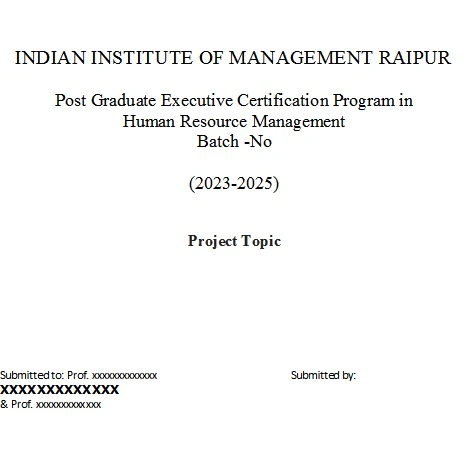
Our support included preparing an initial synopsis draft, and then once it’s approved, we prepare the final iim project report based on university mentors. Feedback. We offer complete handholding for all students who are looking to seek complete assistance from research to data analysis with primary data surveys and statistical analysis.
Our service also includes industrial guides who help with the project synopsis draughting, final year reports, viva support, and guidance until the iim project pdf is accepted in accordance with the university guidelines. We believe in well-researched, quality work and affordable fees to cater to all income group students, from working professionals to students who have not yet started earning.
Our support included preparing an initial synopsis draft, and then once it’s approved, we prepare the final iim project report based on university mentors. Feedback. We offer complete handholding for all students who are looking to seek complete assistance from research to data analysis with primary data surveys and statistical analysis.
Our service also includes industrial guides who help with the project synopsis draughting, final year reports, viva support, and guidance until the iim project report pdf is accepted in accordance with the university guidelines. We believe in well-researched, quality work and affordable fees to cater to all income group students, from working professionals to students who have not yet started earning.

Title: Some College, No Credential Learners: Measuring Enrollment Readiness
Source: Straighterline, UPCEA
UPCEA and StraighterLine carried out a survey to examine the driving factors, obstacles, preparedness, and viewpoints of individuals who started but did not finish a degree, certificate, technical, or vocational program. This population, according to the National Student Clearinghouse Research Center, has grown to 36.8 million, a 2.9 percent increase from the year prior. A total of 1,018 participants completed the survey.
Key findings related to respondents’ readiness to re-enroll include:
Key findings related to enrollment funnel experiences include:
Click to read the full white paper.
—Nguyen DH Nguyen
If you have any questions or comments about this blog post, please contact us.