Tag: students

  • How to Equip Your Students With Essential Soft and Hard Skills Using Ed Tech

    How to Equip Your Students With Essential Soft and Hard Skills Using Ed Tech


    Today’s employers don’t just hire based on educational achievement. They’ve increasingly prioritized higher-order learning skills during the hiring process. To help students become job ready and land a role in the current workforce, professors need to empower learners with the necessary 21st-century skills, often called ‘soft skills.’

    This guide lays out key information on how to create opportunities for skill-based learning to help smoothen the transition from college to the workforce. It will also describe how to develop these skills in students while they’re still in the classroom. Most significantly, you’ll learn how educational technology can sharpen the essential soft skills students need beyond your course.  

    Below are 15 soft and hard skills that make up 21st-century learning.

    The 4 Cs of 21st-Century Learning

    The first four of these higher-order learning skills are widely considered the most vital 21st-century skills in the classroom for students to learn. Commonly known as the 4 Cs of 21st-century learning, they comprise:

    1. Critical thinking:

    Critical thinking is about problem-solving, and being able to bring a skeptical, discerning perspective to assertions of fact and opinion. Students are given opportunities to question and challenge the information presented to them. Troubleshooting and IT support are two hard skills that rely heavily on critical thinking as a foundation and are in-demand skills for the wide variety of technology-based careers in today’s job market.

    How Top Hat helps: Donna M. Smith, a math instructor, is a recipient of the Top Hat Black Educator Grant. A teacher of College Algebra at Sierra College, she has leveraged Top Hat to build a framework that helps students learn how to develop critical-thinking skills, and other soft skills like teamwork, adaptability and time management. She uses this framework to provide students with practice opportunities that demand specific actions from students, then gauges their higher-order learning using Top Hat’s range of assessment tools, spanning all six levels of Bloom’s Taxonomy. As a result, she reports, she’s found her students’ rate of success improved dramatically.

    In the same vein, 93 percent of students surveyed in a Top Hat research report said the variety of assessment types Top Hat offers help them learn how to develop critical-thinking skills.

    2. Creativity:

    This is the process of approaching problems from a variety of perspectives, including ones others might not notice. It helps develop trust in one’s own instincts and helps students seek out new solutions to old problems.

    3. Communication skills:

    This is the ability to convey thoughts and ideas clearly and effectively. In a 21st-century education, that includes being able to communicate well digitally, from texts, emails and social media, to podcasting and video conferencing.

    How Top Hat helps: Top Hat’s Discussion feature helps develop skill-building via collaboration in the classroom. While not all students are always on an equal playing field when it comes to comfort in group discussions, this Top Hat feature meets students where they are by allowing them to respond to comments and questions from any device. They can use simple text or incorporate images, sound bites and videos to propel the conversation forward. Teachers can even employ anonymity to make students comfortable engaging in sensitive topics. Teachers can use this Top Hat feature to drive up classroom participation significantly.

    4. Collaboration:

    This is the ability to work with others as a team to solve a problem or achieve a shared goal. It helps develop the abilities to share control, pitch solutions and discuss and decide with others the best course of action. It also helps students learn to effectively deal with others who may not agree with them, develop the critical abilities to resolve conflicts effectively and consider different viewpoints from their peers.

    Research shows that students who enter the workforce with knowledge and experience in the 4 Cs of 21st-century learning tend to be more adaptable and flexible in the constantly-shifting workplace environment. The 4 Cs of 21st-century learning, in turn, empower students to work better across cultures and are more prepared to take on leadership roles.

    Key Higher-Order Learning Skills

    Other important 21st-century skills in the classroom include:

    5. Problem-solving:

    This is the use of both conventional and innovative methods to solve different types of unfamiliar problems. It involves identifying and asking meaningful questions to clarify different viewpoints and arrive at more effective solutions.

    How Top Hat helps: The Top Hat Assignment feature enables teachers to provide students with interactive homework assignments that actively engage them in their own higher-order learning outside the classroom. A multimedia-friendly tool with 14 easy-to-use question types and automatic grading, this versatile feature keeps collaboration, communication and other essential skills front and center. It incorporates reading, answering questions and viewing media with worksheets, case studies and simulations to help students develop a deeper understanding of a problem and a multifaceted approach to its potential solutions. An added benefit for instructors is that it provides insights into students’ comprehension, participation and completion in real-time.

    6. Information literacy:

    This includes the ability to access, evaluate, utilize and manage information, critically and efficiently. It also involves the accurate and creative application of available information to the current problem or issue. It requires managing data flow from multiple sources, and the application of fundamental legal and ethical knowledge regarding access to and use of that information.

    7. Technology skills and digital literacy:

    Often abbreviated as ICT literacy (Information, Communication and Technology,) this is the collective set of abilities that allow students to effectively apply digital technologies to researching, evaluating, organizing and communicating information across digital channels. This may include using computers, mobile devices, social networks and other communication tools. Jobs in machine learning, product management and software development require understanding of technological platforms and apps. Individuals in these careers must be proficient in these skills in order to suceed.

    How Top Hat helps: Top Hat improves general literacy and digital literacy at the same time with Interactive Textbooks. Dynamic courseware incorporates text with high-quality images, videos and 3D simulations to captivate students’ interest and help them absorb and retain information better. They include case studies and customizable, interactive assessments, and students can access them anytime and from any device. Teachers can use Top Hat’s interactive textbooks in combination with physical textbooks, or on their own.

    Incorporating interactive textbooks and other digital technologies also helps students with skill-building and better prepare them to enter the 21st-century workforce by providing one-to-one computing, giving them the technology required to utilize their higher-order thinking skills in coursework.

    8. Media literacy:

    This includes the ability to analyze media and create media products. It involves understanding how, why and for what purpose various entities construct media messages, including what values and viewpoints they choose to include or exclude, and why. It also examines how people interpret messages differently and how that influences behaviors and beliefs. 

    9. Global awareness:

    This is the use of 21st-century skills to comprehend and address issues of global magnitude, and to collaborate with those from diverse backgrounds. It also involves taking an equitable or inclusive mindset when presenting new information. For example, educators might draw connections between cultural references in an English or cultural studies course. Teaching students the importance of global awareness also starts with reflecting on current and real-time events in your teaching, such as incorporating case studies on political or social uprisings.

    10. Self-direction:

    This is the ability to effectively set goals and manage time, as well as to work independently. It requires determining tangible and intangible criteria for success and balancing short-term tactical goals with long-term strategic ones. It also requires demonstrating initiative and commitment and working independently, including defining, prioritizing, monitoring and completing tasks without oversight, while reflecting on past experiences and learning from them.

    11. Social skills:

    This is the ability to effectively interact with others and work in diverse teams. Students recognize the appropriate times to listen or speak while remaining open-minded to diverse values and ideas. Students also learn how to conduct themselves professionally in a respectful manner, including when working with people from different backgrounds. Those looking to pursue careers in nursing or other areas of healthcare must be proficient in providing both emotional and physical care to patients. Common hard skills required for these careers include Basic Life Support (BLS), Patient Safety and Critical First Aid.

    12. Perseverance:

    This is the ability to persist in a determined effort in spite of obstacles and setbacks. It requires many of the other higher-order thinking skills, including problem-solving and self-direction, to employ effectively.

    How Top Hat helps: Top Hat’s 21st-century learning suite includes many tools that help educators make sure no student falls behind. Not least among them is learning insights. By tracking every interaction between a student and the software automatically, Top Hat enables you to see which students need additional help, in what area and when. Gauge attendance, progress, comprehension, participation—and act on these insights proactively in real-time.

    13. Literacy skills:

    Basic literacy skills include the abilities to create, comprehend, analyze, absorb, retain and recall written information. In the 21st-century workplace and modern economy, they especially apply to business, economic, financial, health and entrepreneurial interests.

    14. Civic literacy:

    Students become familiar with how civic decisions have local and global implications. This type of literacy involves effective participation in civic life by remaining informed and comprehending the processes of government. It also requires knowing how to exercise citizenship rights and obligations.

    15. Social responsibility:

    This encompasses everything from human rights, labor practices, the climate and the environment, fair operating practices, consumer issues and community involvement and development. It requires accountability, transparency, ethical behavior and respect for stakeholder interest, the rule of law, international norms of behavior and human rights.

    Why 21st-Century Skills Are Important

    Importance of Soft Skills for Students

    At its most basic level, teaching 21st-century skills, like critical thinking, provides a framework for higher-order learning. Beyond that, however, it also helps students develop the skills that ensure they will thrive when they leave the classroom and enter the workforce.

    Today’s workplaces are changing constantly, and the role of technology is ever-evolving and growing. That means that persistent, continual learning is essential to succeed and an emphasis on the importance of soft skills for students. Today’s graduates require not only the knowledge and skills for their chosen careers, but critical-thinking skills to navigate an always-changing landscape.

    Good for the World

    The greater community also benefits from new workers entering the workforce with a 21st-century education. The wellbeing of our broader society requires workers with competence and experience in:

    • Civic engagement
    • Critical thinking
    • Digital literacy
    • Effective communication
    • Global awareness

    Graduates equipped with these higher-order learning skills comprehend their role as good citizens and their connection to their neighbors and their shared environment. This way, they are more tolerant, they think more equitably and they aim to build a more diverse workforce. They are empowered to approach all they do in their work with a civic-minded focus.

    Conclusion

    As a 2017 research review in Nurse Education in Practice reported, “Technology has advanced in quantity and quality; recognized as a requirement of 21st-century learners.” Integrating curricula on critical thinking and other soft skills in your classroom will help your students enter the 21st-century workplace better equipped to meet the challenges facing future workers and leaders. As technology becomes an increasingly inseparable part of the working world, it’s becoming more evident that teachers who make effective use of it have an advantage in helping students prepare for life beyond the classroom.

    The developers and designers of Top Hat, including professional educators themselves, are singularly focused on employing the latest in 21st-century education technology to help educators empower students to achieve these aims.

    References

    Ross, D. (2017, April 24). Empowering Our Students with 21st-Century Skills for Today. Getting Smart. www.gettingsmart.com/2017/04/24/empowering-students-21st-century-skills/

    What is social responsibility? (n.d.). ASQ. asq.org/quality-resources/social-responsibility

    LinkedIn Jobs on the Rise 2022: The 25 U.S. roles that are growing in demand (2022, January 18). LinkedIn. https://www.linkedin.com/pulse/linkedin-jobs-rise-2022-25-us-roles-growing-demand-linkedin-news/


    Source link
  • Are students fleeing to the south to avoid The Woke? Three possible answers.

    Are students fleeing to the south to avoid The Woke? Three possible answers.

    The three answers to the question in the title, in case you want to cut to the chase, are “Yes,” “No,” and “Maybe but we really can’t tell for certain.”

    This has been a point of discussion for some time.  The completely neutral publication Southern Living, with absolutely nothing to gain from publishing this piece, for instance, was convinced it was true back in 2022. 

    The American Thinker had similar observations, but made it about politics in this piece. And finally, among the articles I’ve seen, at least, is this one, in The Free Press where the money quote is “Even if I could have gotten into Harvard, I wouldn’t have gone,” an observation which seems like it was made for a gif.

    There are a lot of anecdotes in these articles, of course, and we all know that three anecdotes are more than enough to build a story upon: My lawyer’s neighbor’s son’s girlfriend is going to Alabama because she liked the rush videos, for instance, can be the basis for a whole research paper in sociology.  Or, of course, an article in a publication that pays by the word.

    I have a stubborn old-fashioned preference for data, however.  And–just to spoil the fun–even data won’t tell us everything we need to know to answer the question.  But it’s a good start, and it’s perhaps a bit more robust than political hit pieces described as documenting societal trends.

    And good news for all of you who don’t like to interact with Tableau visualizations: This one is just pictures.

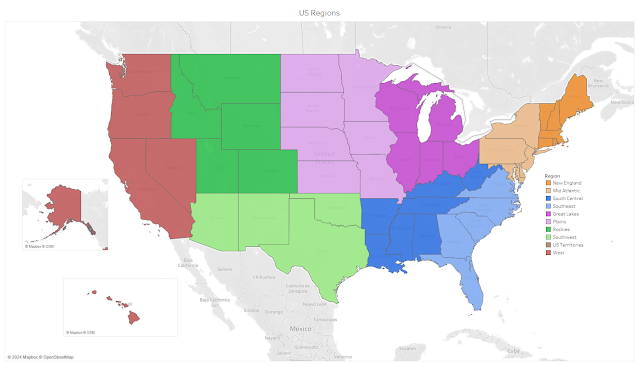
    First, let’s take a look at the shape of the market to have a place where we can put our feet down.  We’ll start with WICHE data, which I’ve found to be very reliable, but of course imperfect, showing high school graduates over time, with years after 2019 being projections.  For all of these views, I’ve broken things out by my own state regions, colored on this map. (Click it or any image to view larger).

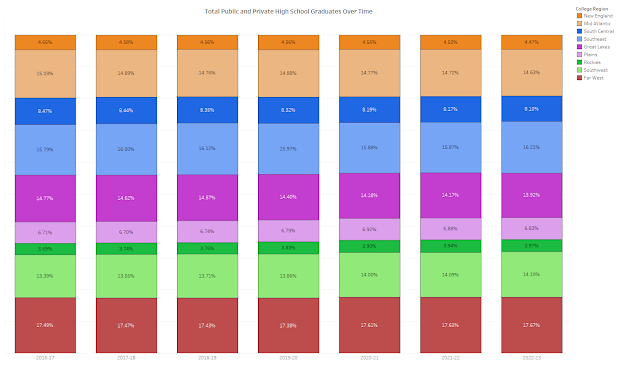
    Here is the breakdown of high school graduates by these regions, showing the percentage of total in each year. Columns total to 100% in each year.

    If you know anything at all about higher education data, you already see a problem as we try to establish some framework: Each state and each region has different college going patterns.  In wealthier states, and states with higher educational attainment among parents, college-going rates are higher.  Within states, there are differences too: About 8% of all college students in the US attend community colleges in California, for instance, and almost all of those students are California residents.

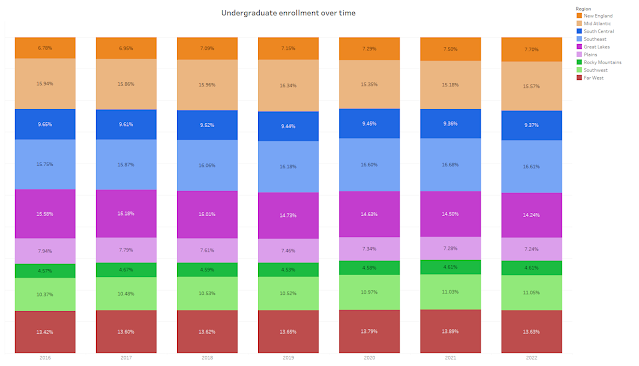
    Now, let’s take a look at undergraduate enrollment over this same period.  Because much of the national discussion is focused on first-time freshmen, I’ve limited this enrollment set to only those traditional, four-year institutions that enroll undergraduates and accept freshmen.  I’ll just call this The Filter Set going forward.

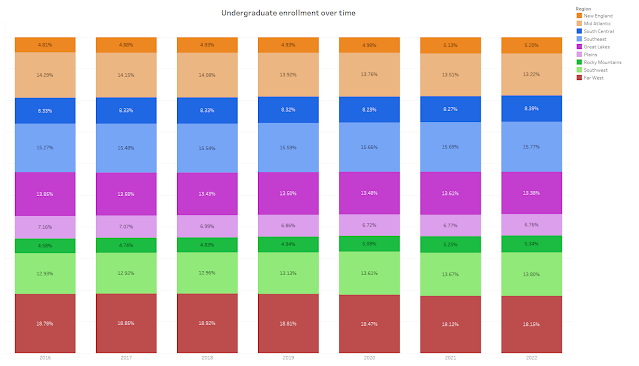
    You’ll probably notice that the patterns are about the same, but you see the effect of the California Community Colleges here: Many more students don’t attend four-year colleges in the state, which makes it different from other parts of the country.  For reference, here is the same visualization showing all undergraduate enrollment in all institutions (not just in The Filter Set).  You’ll note the re-balancing, which is a function of the vast majority of college students going to college close to home.

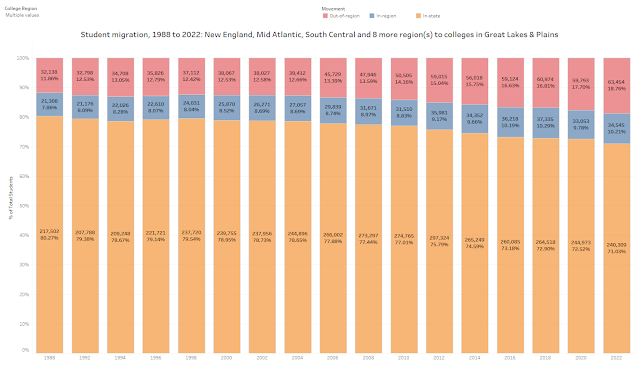
    Here is the historical pattern of first-year student migration, from 1988 to 2022.  As you can see, about seven of ten students stay in their own state for college, which means the number of students who cross state lines is small, making even big swings in those patterns hard to measure and describe as meaningful.  It’s also interesting to note that more students today are more mobile than in the past, for a lot of reasons I won’t go into here, but as always, you can start the finger pointing with Ronald Reagan. 

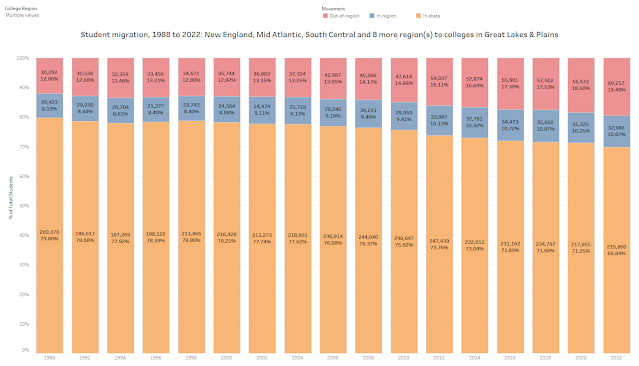
    For the sake of clarity (or confusion) here is the same data for The Filter Set.  Similar pattern, slightly different numbers.  More students cross state lines to attend these institutions with wider draws.

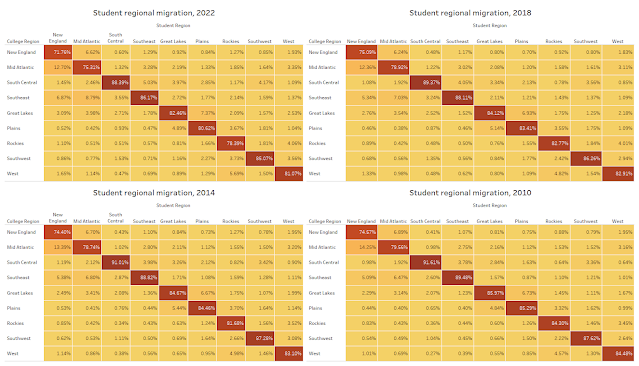
    And if you want to break it out a little bit, here is a view over time of The Filter Set and the migration patterns between regions in 2010, 2014, 2018, and 2022. 

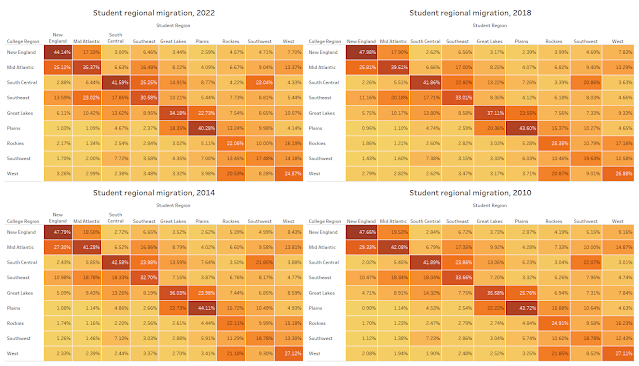
    And this data shows only those students who left their home state and who attended one of the colleges in the Filter Set, to help amplify the migration patterns. 

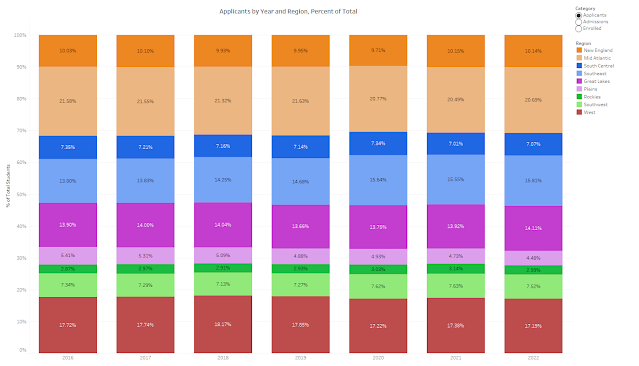
    Over time, the percentage of first-year applications submitted has grown in the Southeast, but not the Southcentral region.  Actually, what’s remarkable about this chart is the consistency over time.

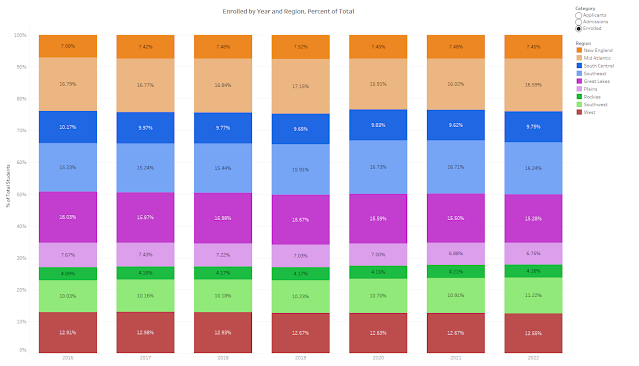
    The breakouts of enrolling first-year students by region?  Also stable and showing similar patterns.

    So, maybe there is a slight trend along the margins of college attendance.  But what’s causing it?  Most social scientists (going out on a limb here) would say it’s probably best when researching a problem like this to dive more deeply than interviews with a dozen students who fit the pattern you’re trying to demonstrate.  What I see in the overall patterns appears to follow population shifts, which is probably the biggest “duh” of all: If population in the Southeast is growing, you’d expect college enrollment to grow as well.  

    But let’s discount that obvious answer for a moment.

    Why would students be applying to more southern locations?  Well, first, they’re easier to get into, in general. 

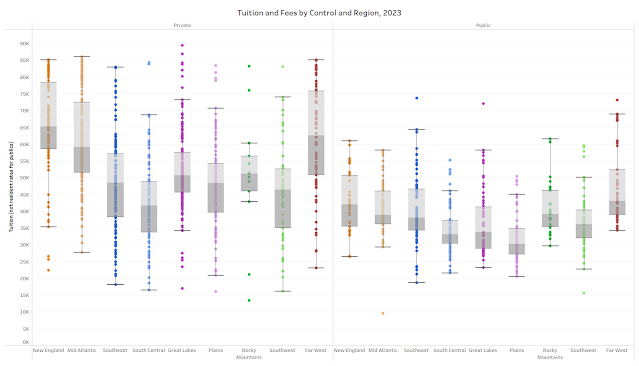
    For another thing, they cost a lot less, on average, based on sticker price.  Each dot represents one college, and the gray boxes cover the middle 50%, with the divider between dark gray and light gray showing the median.  You can see that for both public and (especially) private colleges, tuition seems to be much lower than other places. I’ve not tried to normalize this by Carnegie type or selectivity, to be clear.

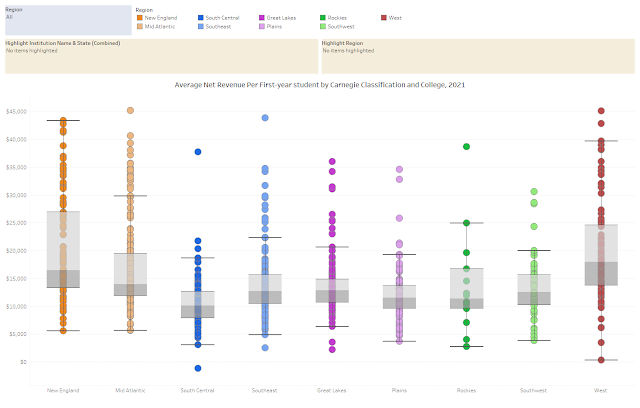
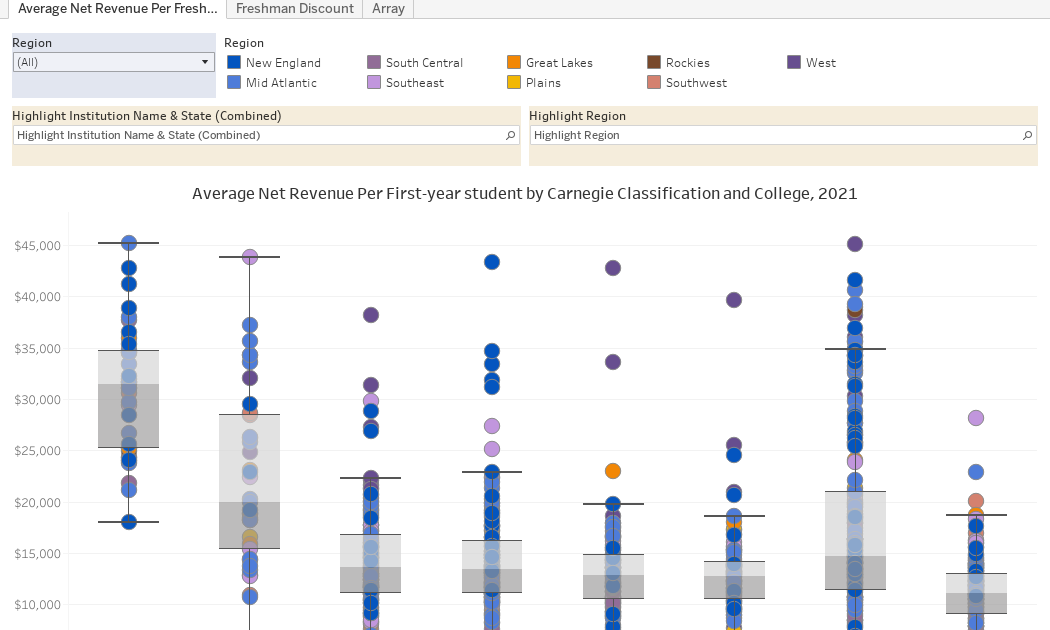
    Private colleges in the south net a lot less cash per freshman, too.  This does not always mean students pay less, but it’s a pretty sure bet in general it costs less after aid to go south as well. (I only calculate this for private institutions because discount rates at publics are fairly meaningless given different tuition levels and state funding models, in case you were wondering.)

    But the publics do a pretty good job of funding nonresidents, too. They recruit hard and roll out the welcome mat for students, especially on price.

    We don’t have 2023 data yet, and we won’t have 2024 data for about another 18 months, at least, so maybe we’ll wake up one morning and find that these small sample size stories are dead-on.  But I seriously doubt it.  For every student fleeing the north because of The Woke, there is probably a student fleeing the less Woke states below the Mason-Dixon Line.

    And yet, we know many–perhaps most–17-year-olds are afflicted with still-undeveloped prefrontal cortices that might keep them from being political, rational, and/or sophisticated when it comes to college choice.

    The answer to the headline?  You probably already knew the answer, didn’t you?  The lesson is that media pundits who look at a little bit of data and talk to a few people to confirm their perspectives often shape the narrative, which gets stuck in the collective consciousness of the American conversation.  It’s not something I can fix.  Maybe you can make a little dent if you share this with people.

    But it’s important, when we see increasing criticism of our institutions, and increased turmoil on campuses, that we–the people who work in higher education–provide the balanced and rational perspective we so often claim to impart to our graduates.

    Source link
  • Private college discount rates for first-year students, 2021

    Private college discount rates for first-year students, 2021

    Two quick additions/clarifications to this:  The definition of full-pays is those students who receive no institutional funds.  EM people don’t care where the cash comes from, only the discount.  Second, yes, I know some institutions use endowments to pay for institutional aid.  That percentage is likely very small, although concentrated at a few institutions.

    Before we begin, here is what this post does not do:

    • It will generally not tell you where you can get low tuition, with a very few exceptions.  And when it does, it won’t be at one of “those” colleges.
    • It will not tell you which colleges are likely to close soon, although after the fact, you can probably find a closed college and say, “Aha! Right where I expected it would be!”
    • It will not show you net costs to students.
    • It will not adjust for things like church support, enormous endowments, or the cost of living in that high-priced city where Excellence College or Superior University is located.

    Got it?  Good.

    This will show you the discount rate on first-year students at about 1,000 four-year, private, not-for-profit colleges in 2021-22.  Discount as I define it is the total unfunded institutional financial aid divided by the total charged (gross) tuition and fees.  A university that charges (published tuition and fees times the number of students) $10,000,000 and awards $4,000,000 in aid has a discount rate of 40%.  At most colleges, this discount is simply an accounting transaction, much like a coupon to save a dollar on a sandwich at Subway.  That, of course, is a gross over-simplification of the “what” of discounting, and it doesn’t touch the “why” of discounting at all.  But if you want an explanation, I’ll gladly talk to your trustees for a reasonable fee.

    And there is a difference between discount and net revenue, although at any given tuition charge, the two are perfectly related.  Unfortunately, as  you’ll soon, see, colleges all set their own tuition.  To wit:

    • A college charging $50,000 with a 20% discount has net revenue (the cash you can spend) of $40,000 per student.
    • That same college with a 50% discount has just $25,000 per student.
    • A college charging $30,000 with a 10% discount has $27,000 per student.
    • That same college with a 40% discount has $18,000 per student.

    As a college, you don’t care where the cash comes from: Pell grants, state grants, loans, or the student’s family.  This means, hypothetically, a student with low institutional aid might pay less than one with more aid.  Confused?  Good.

    If you use this with your trustees to explain your own college’s market position, consider supporting my costs of time, hosting and software by buying me a coffee.  Just click here to do so.  If you counsel high school students, or your a parent of a prospective college student, must keep reading and don’t feel any obligation at all.

    Here is the data, in three views.  The first two are box and whisker plots, where half of the colleges fall inside the gray box on each column to show you the middle 50%.

    The first view shows net revenue per freshman student, arrayed by the institution’s Carnegie type.  Use the controls to filter region, highlight region, or highlight an individual college.  To do the latter, type any part of the name in the box, hit enter, and select from the options.  Hover over dots for details; each dot is a college.

    The second view is identical, but it shows discount rate, the number people obsess over while missing the more important net revenue figure.

    The third view shows those two values arrayed, with the same highlighters, allowing you to filter on Carnegie type, or even the percentage of the students who are full-pay (that is, they get no institutional aid at all.)

    You’ll soon see that discount and net revenue don’t seem to be big issues at the big name, strongly endowed institutions.  That’s because, at many of these places, undergraduate education is essentially a sideline business, and only a minor source of revenue.  The money they bring in (or don’t) on this presumably core function of the university is managed to best optimize to reputation or selectivity, or other factors (including, sometimes, mission).

    Note that I’ve done my best to remove some outliers with wild data that throw the charts off.  Many of these are colleges I have never heard of, and they’re tiny.  Others are places with strong religious missions (like Yeshivas or Seminaries) that may be externally funded in ways this can’t account for. 

    Enjoy

    Source link
  • Can Go Higher students save the environment? By Barbara Milne, Go Higher Study Skills Tutor – ALL @ Liverpool Blog

    Can Go Higher students save the environment? By Barbara Milne, Go Higher Study Skills Tutor – ALL @ Liverpool Blog

    Sustainability and the challenges of protecting our environment are key concerns for the Go Higher Diploma and for the University as a whole. A couple of weeks into semester two, our students were invited to work on a PowerPoint presentation and voice over, focusing on the topic of sustainability and / or the environment.

    The range of topics which they chose to focus on and research was hugely impressive. The task enabled them to not only develop their investigative and PowerPoint skills but also to highlight an issue which was important to them personally.

    Our Go Highers embraced this task, producing work of a high quality: innovative, dynamic, and engaging. By way of example, here are some titles: ‘Sustainability in Fashion’; ‘The important role frogs play in environment’, through to ‘Dogs’ ‘business’’ and its impact on our environment, to the fascinating subject of ‘Light Pollution’, collectively, a wide-ranging and diverse bank of work.

    I chatted with one of our Go Higher, who, reflecting on their presentation, highlighted positive aspects of their ‘PowerPoint experience’. They observed that ‘the presentation was a nice way to lead into the start of the new semester’. They noted, with appreciation, the freedom to select their theme within the topic remit, adding that ‘there were opportunities to settle on a subject that might not be widely known’, drawing attention to it, through the medium of PowerPoint.

    A further reflection highlighted the usefulness of having a sample presentation, plus rough working notes, as part of the task guidance. This advice served as an alarm bell, warning that not everything, however relevant and interesting, could be included within the five slide limit, so encouraging the development of discerning editing skills. The nature of this task was commented on as being instrumental in ‘taking the pressure off’, affording an opportunity to concentrate efforts on an item of work that would receive constructive comment, rather than a grade.

    A positive outcome, resulting from the presentation task, was pinpointed  during our conversation –  the interconnection between this assignment and the forthcoming Philosophy podcast  – feedback evidencing that the path towards making a podcast had been eased, because of the experience of providing a commentary to a PowerPoint presentation, speaking to an audience, a practice run for the podcast. This is a feature of Go Higher: there are linkages throughout the different modules with students supported to develop their skills and potential at a pace that is right for them.

    It’s terrific to see how much hard work has gone into producing engaging presentations that are both engaging and informative. Well done everyone!

    Image by Freepic

    Source link
  • 10 Budget-Friendly Meal Prep Ideas For Busy College Students

    10 Budget-Friendly Meal Prep Ideas For Busy College Students


    10 Budget-Friendly Meal Prep Ideas For Busy College Students


    Source link

  • Traveling to Europe with Rural Communication Students

    Traveling to Europe with Rural Communication Students

    Hi everyone! It’s September and summer and officially over! 🙁

    Summer is one of those sacred times of year for faculty to determine the next steps of their faculty career. From my dear colleague who is focused on his retirement to new faculty members who are focused on their new research agenda, everyone is focused on renewal. Our department faculty members usually travel to work at state parks, volunteer in the community, and participate in professional development activities.

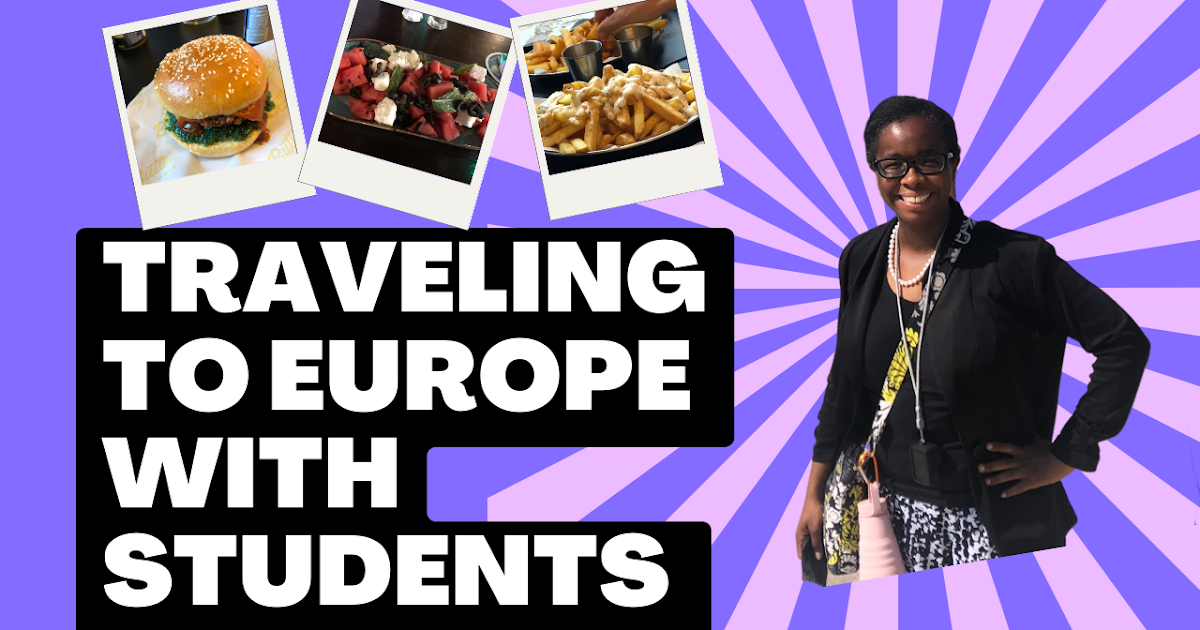
    This summer, we traveled on a study abroad experience to Scotland, Ireland, and England. This was an incredible journey with 17 students from our university. I have not traveled outside of the country for a year and the students were filled with excitement from the end of the spring semester. 

    The trip to Europe was long and uneventful. We traveled with EF Tours and it was definitely an adventure. Many of our rural students have never traveled outside of the country before this adventure and they learned many new skills along their journey. I was proud of their progress.

    During the study abroad experience, I also had an opportunity walk a mile by myself in Ireland. Previously, I have ALWAYS traveled in groups – large groups and small groups. However, when most of the attendees wanted to participate in an activity together and I had to travel back to the hotel to pick up an item – I had the opportunity be independent. I walked by myself across the city to the hotel. This prepared me for another big adventure that I had this summer. Summer 2023 was filled with solo adventure travel for this female faculty member.

    We also had an opportunity to view the Book of Kells in Ireland. It was a great experience and the library that housed the book of Kells (the Bible) was one of the most beautiful libraries I’ve ever visited.

    This was my second time to visit the palace in England. There is always a crowd at Buckingham palace and the students enjoyed snapping pictures with the statues.

    Who am I kidding? I enjoyed snapping pictures as well! It was crowded and it was definitely an adventure.

    I’ve only heard about it on YouTube from flight attendants, but Primark lived up to its reputation. The clothes were inexpensive, high quality, and were gorgeous! I was very excited to buy professor clothes at Primark!

    Overall, we had a great time. The students enjoyed themselves and I did as well. I learned a lot about European culture and I added two additional countries to my list. In fact, I added THREE new countries to my list (more about that later). Another day, another post. 😉

    Let me know if you have any questions about traveling with students. They are a trip – literally! I cannot remember the last time that I laughed so hard. Traveling with rural students enables them to be themselves while experience a whole new world.

    Until next time!

    J. Edwards

    ***

    Check out my book – Retaining College Students Using Technology: A Guidebook for Student Affairs and Academic Affairs Professionals.

    Remember to order copies for your team as well!


    Thanks for visiting! 


    Sincerely,


    Dr. Jennifer T. Edwards
    Professor of Communication

    Executive Director of the Texas Social Media Research Institute & Rural Communication Institute

    Source link

  • How Students Can Use AI Without Violating Academic Integrity – Sovorel

    How Students Can Use AI Without Violating Academic Integrity – Sovorel

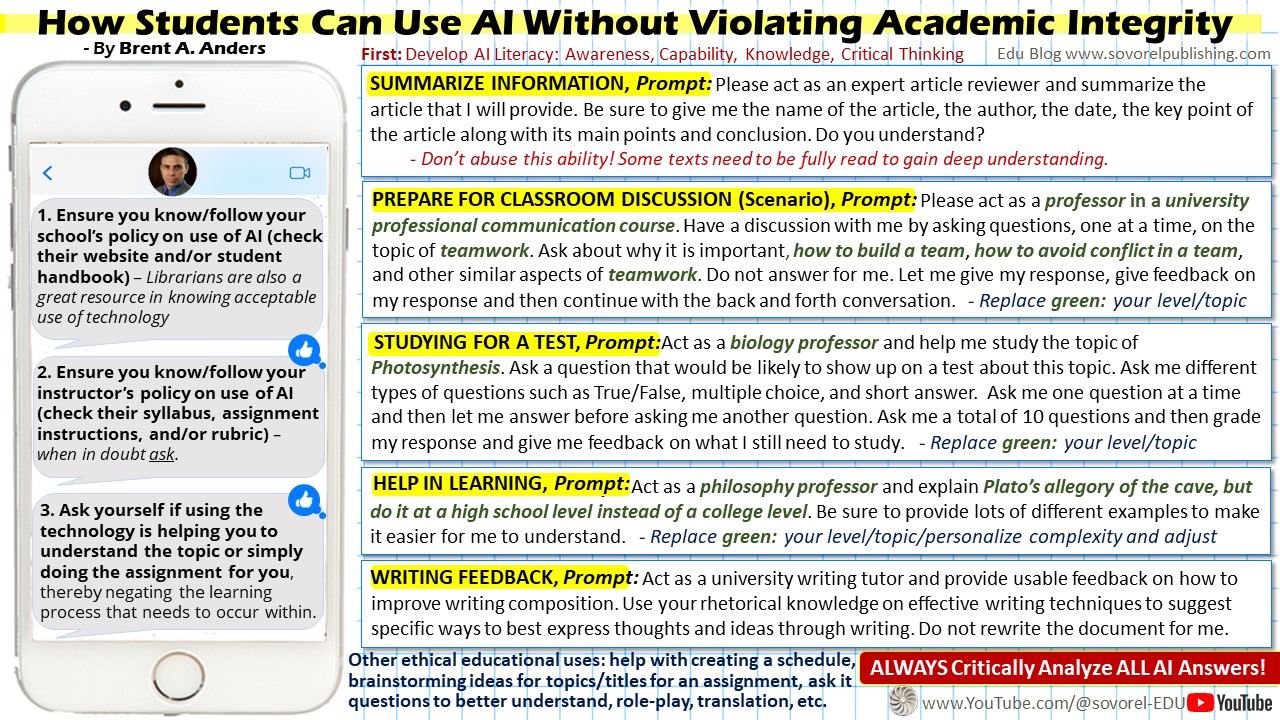
    For all of us in academia that are now working on properly developing AI Literacy within ourselves so as to then be able to develop AI Literacy within our students, we must ask ourselves how have we directly developed students to properly use AI in an ethical matter without violating academic integrity. We must ensure that we are taking all the necessary steps to set students up for success in multiple ways: Freshman orientation, school assemblies, posters, class discussions/activities, etc. all to help students understands that there are different ways of using AI and that its use is appropriate at times and not appropriate at other times.

    The associated Infographic has been designed to directly help students in understanding how to use AI in a proper manner and specifically in a way that will not violate academic integrity. For a full and detailed explanation of this infographic, please check out the associated video:

    AI Literacy is a necessity now. Students are already using AI. We in academia must ensure that they know not only how to use AI, but to use it effectively and ethically. Please use this infographic, please share this infographic with as many students and academics as possible so that we can help as many students as possible.

    What are your thoughts? What would you add to help students even more?

    Source link

  • Empowering Instructors & Students – Sovorel

    Empowering Instructors & Students – Sovorel

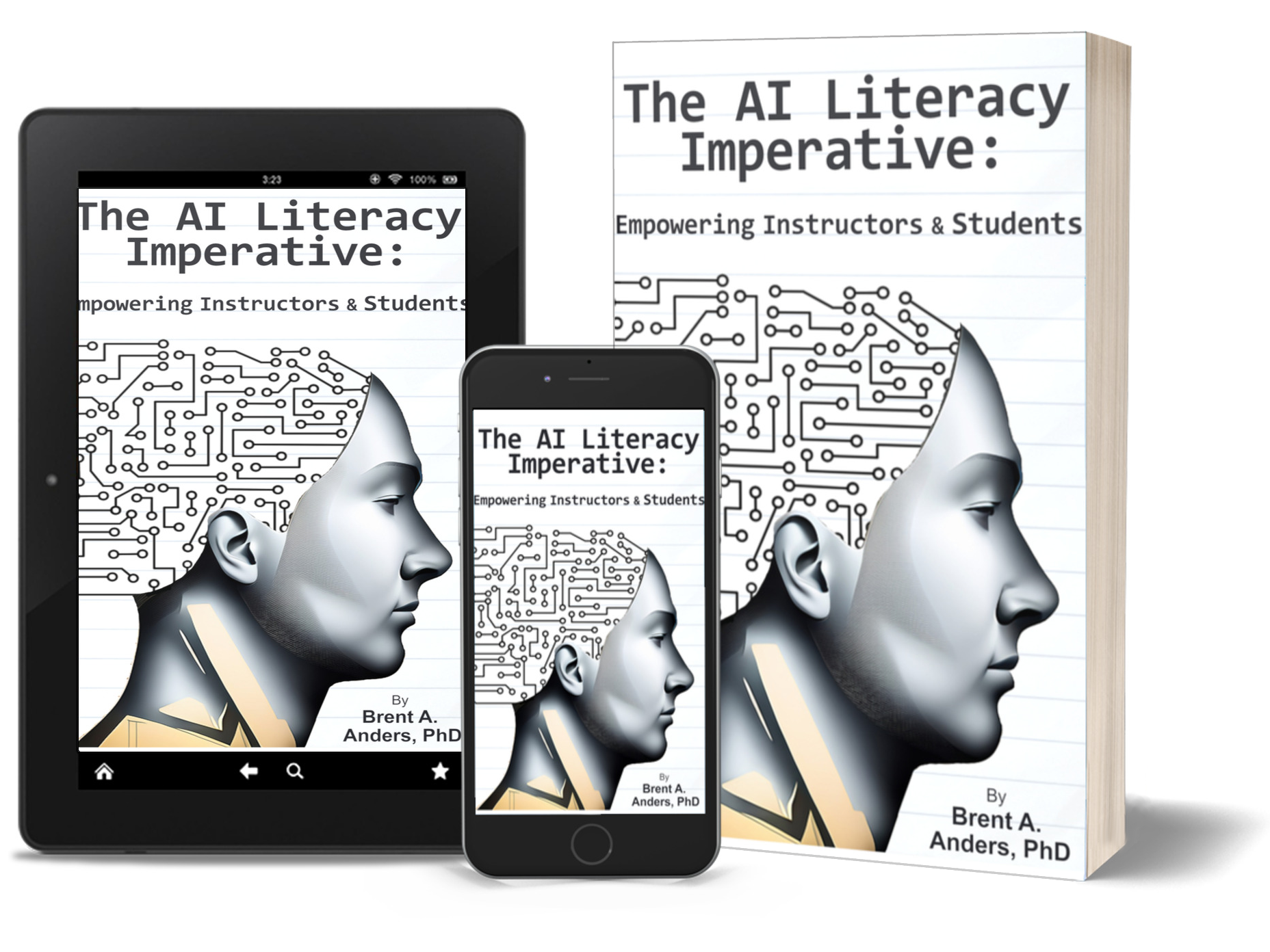
    This is my new book that I am very excited about because I think that it can really help a lot of people, especially instructors (at all levels) and students. It is vital and truly an imperative that we in academia help develop AI Literacy. Available on Amazon as an ebook, paperback, or hardback: https://www.amazon.com/AI-Literacy-Imperative-Empowering-Instructors/dp/B0C51RLPCG

    BOOK DESCRIPTION:

    The AI Literacy Imperative: Empowering Instructors & Students” is a seminal work that delves into the critical need for everyone to have AI Literacy in modern society, especially in academia. The book explains how educators must have a deep understanding of the key aspects of AI literacy: Awareness, Capability, Knowledge, and Critical Thinking, to effectively teach this vital skill to students.

    Drawing upon extensive research and practical experience, author Brent A. Anders, PhD. presents a comprehensive guide for instructors to integrate AI literacy into their curriculum. By exploring the fundamental concepts and applications of AI, this book empowers educators to equip their students with the skills necessary for success in both their professional and personal lives in our new AI integrated society.

    Throughout the book, a deep understanding of the complexities of AI and its implications for society are demonstrated. Through a rigorous exploration of the latest research and pedagogical considerations, the book provides educators with a clear roadmap for teaching AI literacy in a way that is understandable, manageable, motivational, and upholds academic integrity.

    “The AI Literacy Imperative: Empowering Instructors & Students” is a must-read for educators, students, instructional designers, librarians, researchers, and everyone else. By providing a comprehensive and easy-to-understand guide on the main components of AI literacy, covering everything from overreliance, writing assignments with AI, deepfakes, ethical considerations, future possibilities, and much more in-between, this book helps everyone better understand AI, use it more effectively in education, and help create a better AI integrated.

    Source link

  • New & NOteworthy – work REadiness Bootcamp for Autistic Students

    New & NOteworthy – work REadiness Bootcamp for Autistic Students

    Colleges are enrolling more students on the autism spectrum. However, one-third of the graduates with autism are not finding jobs. Here is how Rochester Institute of Technology is trying to change that with their Career Ready Bootcamp.

    Source link

  • Why Do So Few American Students Study Abroad? – Edu Alliance Journal

    Why Do So Few American Students Study Abroad? – Edu Alliance Journal

    Why is that a problem?

    December 5, 2022 by Dean Hoke: In the newest edition of the 2022 Open Doors Report, US university’s international student enrollment shows encouraging signs. International students coming to the United States are reported at 948,519, which nears the pre-pandemic level. However, the number of Americans studying abroad in 2020-21 was 14,549 compared to 162,633 in 2019-20 and the high watermark of 350,000 in 2018-19.

    The chart below shows how long US students study overseas.

    Of the 350,000 students in 2018-19 who studied overseas, the majority either studied abroad for a summer or a short term.

    What is the profile of the American student who studies abroad?

    The number of US students who study abroad represents only 2.7% of the American university students who attend four-year and above institutions. Students who study abroad tend to be juniors or seniors in undergraduate school, female, Caucasian, have financial means, and study in Europe.

    What countries have the largest number of students studying abroad?

    T.I.M.E. Association, located in France, conducted a study in 2021 of UNESCO mobility data which reported 5.6 million international students worldwide to determine the top countries with the most outgoing students studying in another country. They looked at the “long-term mobility of students to complete a whole study cycle and acquire a degree (Bachelor, Master or PhD) abroad. The top countries university students leave to study abroad are:

    • China – 993,367
    • India – 375,055
    • Germany – 122,538
    • Viet Nam – 108.527
    • South Korea – 101,774
    • France – 99,488
    • United States – 84,349 (long-term studies)

    Students from other countries study abroad primarily due to the:

    • Future Employment Opportunities, be it at home or abroad
    • Quality of institution and program
    • Meet a diverse range of people
    • Study and learn differently
    • Self-reliance and being on your own
    • Meeting new friends and lifelong networking
    • Seeing your culture from a different point of view

    How important are students studying abroad to the business community as future employees?

    Businesses worldwide are putting a higher emphasis on international experience. Most big and small companies are trying to attract business and partnerships with international partners.  In a 2014 survey titled U.S. Business Needs for Employees with International Expertise, 800 executives in US companies were surveyed to identify the demand for corporate employees with international competence, including international skills and/or knowledge of foreign languages and world areas. The results of the 2014 survey call for a continuing need for international business education in the US, with increased emphasis on intercultural communication, foreign language skills, and international experience. The 800 represented a broad cross-section of Industries and the number of employees.

    Some interesting facts come out:

    • 39% failed to fully exploit international business opportunities due to insufficient internationally competent personnel in the past five years
    • 39% have no foreign offices, and all international operations are handled in the US
    • 43% state that overall business would increase a great deal if more international expertise were available on staff
    • 60% state that an appreciation for cross-cultural differences is of great importance for professional staff, followed by Understanding country legal and government requirements (59%) and understanding of local markets and business practices (58%)
    • 83% state their company will place a greater emphasis on international competence among management and employees over the next ten years

    Additional studies support that studying abroad helps employers and helps students get jobs. In 2016, The Institute for the International Education of Students (IES), founded in 1950, conducted a comprehensive survey of 1205 of its alumni. 

    Here are the key points from the study:

    • 93% who entered the workforce were employed within six months
    • 89% of those who entered graduate school earned admissions in their first or second-choice school
    • 50% felt that their IES Abroad Program experience helped them to get this first job

    The American Passport Project

    How can we encourage and support students to study abroad?

    In a recent interview with Higher Ed Without Borders  (in which I am a co-host), we asked Dr. Allan Goodman, CEO of the IIE, about a new program they established in 2021 titled The American Passport Project. Dr. Goodman commented that studying abroad is one of the best ways that students can acquire global skills and create personal and professional opportunities. Furthermore, it’s a part of IIE’s mission to increase participation and diversity in studying abroad and extend these benefits to all students regardless of socioeconomic status.  However, students of limited financial means find it more difficult to participate in studying abroad due to financial hurdles, which could bar them from moving forward.

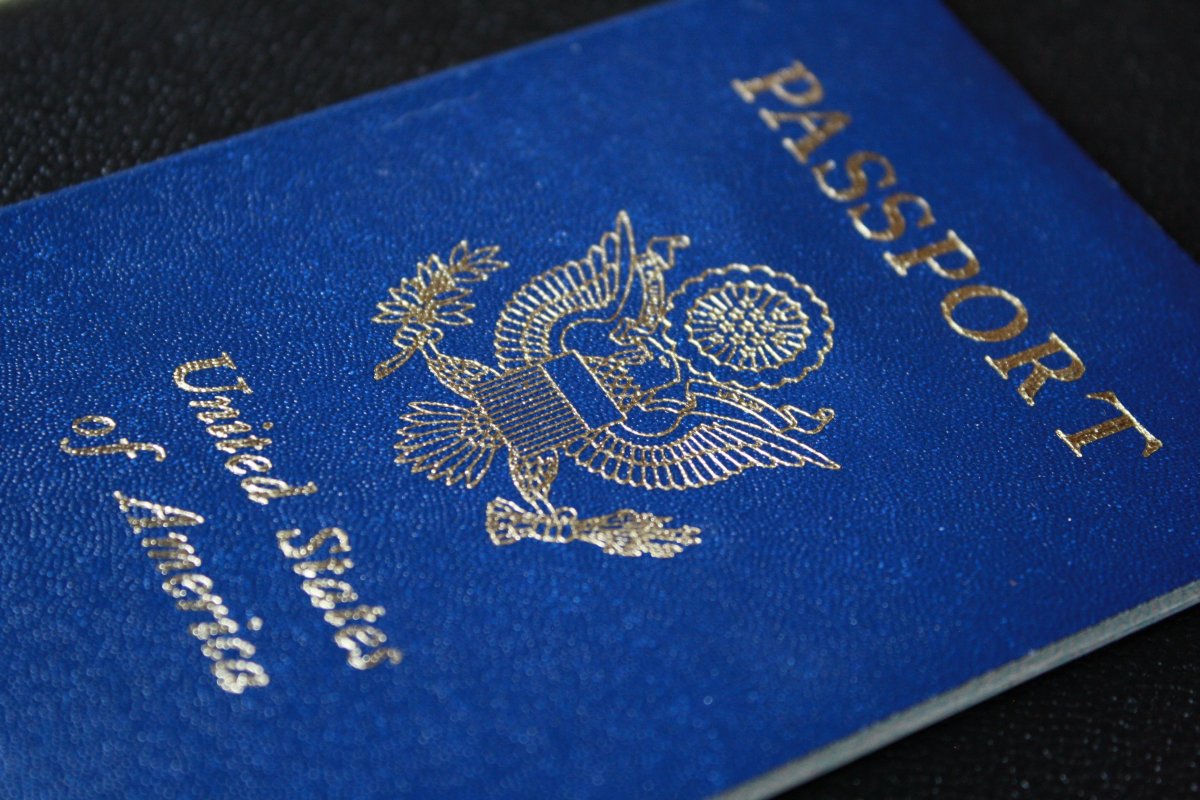
    The American Passport Project plans to have enabled 10,000 students to be awarded passports by the end of this decade. IIE will help 1,000 college students obtain U.S. passports annually by awarding funds to 40 U.S. colleges and universities in the IIE Network. Each institution will identify 25 of its first-year students who are eligible for Pell grants. Eligibility will be limited to first-year students to ensure that they have ample time remaining in their college career and receive guidance from their advisors to map out a study abroad plan. Competitive institutions will demonstrate grant need, support obtained, and impact on study abroad participation.

    First Year Results

    • In the inaugural year, nearly 200 institutions applied for the grant to support students obtaining U.S. passports. These institutions informed IIE of the various ways they could utilize the grant to support targeted student populations.
    • Forty institutions were selected, and more than 50% of institutions chosen represent minority-serving student populations (HBCU, HSI, MSI) or are community colleges.
    • Nearly 50% of U.S. states are represented (33% South, 32% Midwest, 25% Northeast, and 10% West).
    • The majority are expanding their diversity, equity, access, and inclusion efforts by targeting these top 4 student populations: students with demonstrated financial need, racial/ethnic minorities, students who have never traveled abroad, and first-generation students.

    In a follow-up interview with Lindsay Calvert, IIE’s lead for the Passport Project, I asked about the program’s status and the number of students approved by IIE as of November 2022.

    • One thousand one hundred twenty-two students have been nominated by their awarding institutions and approved by IIE to be supported with the IIE-granted funds to help them obtain their U.S. passport and engage them in study abroad planning.
      • 778 students from the first cohort
    • 344 from the second cohort)
    • Some institutions can quickly able to identify, nominate, and confirm students. Others have been challenged with their outreach and recruitment, so this process can span over a year to fulfill the goal of 25 students per campus.
    • Since the Passport Project aims to support first-year students, they anticipate them to study abroad in the 2023/24 academic year and subsequent years of their undergraduate term.

    The Senator Paul Simon Study Abroad Program

    In November 2022, The Senator Paul Simon Study Abroad Program Act of 2022 , was introduced by U.S. Senators Dick Durbin (D-Ill.) and Roger Wicker (R-Miss.) and U.S. Representatives Cheri Bustos (D-Ill.) and John Katko (R-N.Y.) The act seeks to expand access to study abroad for U.S. college students by enhancing the State Department’s Increase and Diversify Education Abroad for U.S. Students (IDEAS) program and formally renaming it as the “Senator Paul Simon Study Abroad Program.” Inspired by the vision of the late Sen. Paul Simon (D–Ill.) and the recommendations of the congressionally-appointed Commission on the Abraham Lincoln Study Abroad Fellowship Program, the legislation would advance four national goals:   

    1. One million U.S. college students will study abroad annually for credit
    2. Study abroad participants will more closely represent the demographics of the undergraduate population in terms of gender, ethnicity, students with disabilities, income level, and field of study
    3. A significantly greater proportion of study abroad will occur in nontraditional destinations outside Western Europe  
    4. Higher education institutions will make studying abroad a critical component of a quality higher education

    U.S. higher education institutions could apply for federal grants, individually or in a consortium, to help them institute programs that would move the country toward achieving these objectives. 

    Conclusion

    I have long wondered why so few Americans go overseas to study, even for a summer. Aren’t they seeing the benefits that students from other countries see? Are they not aware that by studying abroad, they increase their chances of graduation and employment? Perhaps most university students are unaware of studying overseas or believe they can’t afford the cost or cannot give up a part-time job to be away for the summer.

    Organizations like IIE are helping address increasing study abroad opportunities with its American Passport Program by emphasizing minorities and non-elite schools. The proposed Simon bill also helps address the issue and pushes for a million students to study abroad, but it remains to be seen if it will pass. It will take bi-partisan support and a higher public profile to get through the upcoming Congress. Last and not least are higher education institutions themselves. While the larger state institutions and elite privates have programs and resources to help promote study abroad, that is not necessarily the case with thousands of other colleges and universities. While most schools have international affairs offices, they need more personnel and budget to adequately promote or financially support students. Their priority in fundraising for such programs is lower than other needs.

    We need businesses that will benefit from these students and federal and state governments to help promote and partially subsidize. If companies and governments want to compete for an increasing share of international business successfully, they need employees who have spent time abroad.


    Dean Hoke is Co-Founder and Managing Partner Edu Alliance a higher education consulting firm located in Bloomington, Indiana and Abu Dhabi, United Arab Emirates. Dean received his Bachelor of Arts degree from Urbana University in Ohio, his Master of Science from The University of Louisville, and a graduate of the Wharton School of Business Executive Management program. Since 1975 Dean has worked in the higher education and broadcasting industry, serving in senior leadership roles specializing in international education, marketing, communications, partnerships, and online learning.

    He currently serves as Chairperson Elect of the American Association of University Administrators , Advisory Board of the School of Education, Franklin University and is Co-Host of the Podcast series Higher Ed Without Borders  and Distance Learning Roundtable. Dean is actively engaged in consulting projects in international education, branding, business intelligence, and online learning leading projects in the United States, the Middle East, Africa, and Asia. Dean resides in Bloomington, Indiana

    Source link