Tag: study

  • Many students decide they’re not a ‘math person’ by the end of elementary school, new study shows

    Many students decide they’re not a ‘math person’ by the end of elementary school, new study shows

    This story was originally published by Chalkbeat. Sign up for their newsletters at ckbe.at/newsletters.

    Roughly half of middle and high schoolers report losing interest in math class at least half the time, and 1 in 10 lack interest nearly all the time during class, a new study shows.

    In addition, the students who felt the most disengaged in math class said they wanted fewer online activities and more real-world applications in their math classes.

    Those and other findings published Tuesday from the research corporation RAND highlight several ongoing challenges for instruction in math, where nationwide student achievement has yet to return to pre-pandemic levels and the gap between the highest and lowest-performing students in math has continued to grow.

    Feeling bored in math class from time to time is not an unusual experience, and feeling “math anxiety” is common. However, the RAND study notes that routine boredom is associated with lower school performance, reduced motivation, reduced effort, and increased rates of dropping out of school.

    Perhaps unsurprisingly, the study found that the students who are the most likely to maintain their interest in math comprehend math, feel supported in math, are confident in their ability to do well in math, enjoy math, believe in the need to learn math, and see themselves as a “math person.”

    Dr. Heather Schwartz, a RAND researcher and the primary investigator of the study, noted that the middle and high school years are when students end up on advanced or regular math tracks. Schwartz said that for young students determining their own sense of math ability, “Tracking programs can be a form of external messaging.”

    Nearly all the students who said they identified as a “math person” came to that conclusion before they reached high school, the RAND survey results show. A majority of those students identified that way as early as elementary school. In contrast, nearly a third of students surveyed said they never identified that way.

    “Math ability is malleable way past middle school,” Schwartz said. Yet, she noted that the survey indicates students’ perception of their own capabilities often remains static.

    The RAND study drew on data from their newly established American Youth Panel, a nationally representative survey of students ages 12-21. It used survey responses of 434 students in grades 5-12. Because this was the first survey sent to members of the panel, there is no comparable data on student math interest prior to the pandemic, so it doesn’t measure any change in student interest.

    The RAND study found that 26% percent of students in middle and high school reported losing interest during a majority of their math lessons. On the other end of the spectrum, a quarter of students said they never or almost never lost interest in math class.

    There weren’t major differences in the findings across key demographic groups: Students in middle and high school, boys and girls, and students of different races and ethnicities reported feeling bored during a majority of math class at similar rates.

    Dr. Janine Remillard, a professor at the University of Pennsylvania Graduate School of Education and expert in mathematics curriculum, said that in many math classes, “It’s usually four or five students answering all the questions, and then the kids who either don’t understand or are less interested or just take a little bit more time — they just zone out.”

    Over 50% of students who lost interest in almost all of their math classes asked for fewer online activities and more real-world problems, the RAND study shows. Schwartz hypothesizes that some online math programs represent a “modern worksheet” and emphasize solo work and repetition. Students who are bored in class instead crave face-to-face activities that focus on application, she said.

    During Remillard’s math teacher training classes, she puts students in her math teacher training class into groups to solve math problems. But she doesn’t tell them what strategy to use.

    The students are forced to work together in order to understand the process of finding an answer rather than simply repeating a given formula. All of her students typically say that if they had learned math this way, they would think of themselves as a math person, according to Remillard, who was not involved in the RAND study.

    Chalkbeat is a nonprofit news site covering educational change in public schools.

    For more news on STEM learning, visit eSN’s STEM & STEAM hub.

    Latest posts by eSchool Media Contributors (see all)

    Source link

  • How To Effectively Remember Everything You Study

    How To Effectively Remember Everything You Study

    Have you ever struggled with remembering what you study? You studied for hours before the test, but you just can’t seem to recall anything once you see the question.

    If this sounds like you, you’re in the right place. There are many students who’ve experienced the same thing as you, and don’t worry- there is a way to overcome it.


    As an affiliate partner of various brands and sponsored content, we may earn commission on qualifying purchases. Disclaimer | Advertise With Us


    In this post, I’ll reveal 7 strategies that will help you truly remember what you study. Save this post so you can reference it later, and let’s get started!

    1. Pay Attention The First Time

    This is a given; if you want to effectively learn and remember information, you have to pay attention the first time you’re exposed to it!

    Whether you’re listening to a lecture, watching a video recording, reading a textbook, or something else, pay attention to actively think through every sentence you’re hearing.

    This also means taking notes, asking questions, making diagrams, drawing connections, etc; I’ll go into more detail on these strategies soon in the post, but know that paying attention is crucial!

    If the source of information (the lecture, the textbook, etc) was reliable and informative, you should already have a basic understanding of everything you’re supposed to study. 

    However, if the source of information wasn’t very reliable and informative, you may be left confused. But don’t give up here! Once you are able to, find another source of information where you can pay attention and learn.

    classroom with whiteboard and desk with stationery

    2. Take Notes That Work

    While you are absorbing this new information for the first time, you should start practicing some supplemental strategies to make sure you can still remember what you’ve learned later. In essence, just listening isn’t enough.

    Instead, try taking notes! Here’s where the nuances come in: simply writing down every highlighted term the textbook mentions is not effective note-taking. Your notes should help you remember information in your own way, and copying down short phrases from the textbook will not do that.

    So follow these steps:

    1. Preview the content before you begin. Note important headings and concepts and outline your notes.
    2. Think before you write. Before copying down a fact, ask yourself: do I already know this? Is this relevant? Does this make sense to me? How can I reword it to make it more intuitive?
    3. Draw diagrams. Especially for subjects in science, diagrams can be extremely useful in understanding a process or element.
    4. Make connections. You should try to connect one word to another, one concept to another, one theme to another, and even something from your textbook to something in real life!
    crop female student writing notes while sitting with laptop on bench

    YOU’LL LOVE THIS POST: How To Take Notes You’ll Actually Use


    3. Use Spaced Repetition

    Spaced repetition is a learning strategy where you are repeatedly exposed to the same information in a spaced time interval. This schedule can vary for different people, but the idea is the same: repetition builds memory.

    When practicing spaced repetition, follow these steps:

    1. Plan ahead

    Always plan ahead and schedule a few study sessions or blocks of time to focus exclusively on what you’re re-learning. Here’s where you should take note of the time interval. The suggested schedule of reviewing after first exposure is: after 1 hour, after a day, after 2 days, after a week, after 2 weeks, after a month, then monthly or quarterly.

    1. Review in a set order

    When reviewing material, don’t choose random concepts based on how you’re feeling. Make sure to follow a certain order (that you should plan out beforehand)! It could be chronological (in the order that you learned the information) or in order of difficulty (the more confusing it is, the earlier you can review).

    1. Make new connections 

    You should always gain something new in every repetition, and one way to ensure that this happens is to make new connections. This could mean connections within the chapter, connections with other chapters, or connections with real life!

    how to study for long hours

    4. Ask & Answer Questions

    This is a review strategy called active recall, but it is also something you can practice while taking notes. And as the phrase suggests, this strategy involves proposing questions related to a specific topic, then answering them to the best of your ability.

    While taking notes, you can quickly skim through a small section before writing anything down, then think of a question and revolve your notes around that question.

    While reviewing, you can go through each question and answer them without looking at your notes. Afterward, you can refer to it and make changes if necessary.

    This is a great reviewing strategy for any time, and you can create flashcards to help you study on the go. Active recall is a truly effective way to remember what you study, so try practicing it regularly!

    Affirmations for College Students

    RELATED POST: How To Transform The Way You Study In 7 Days


    5. Teach Someone Else

    You may have tried to explain a concept to someone before and realized midway that you just found a new way to understand and apply the concept. Or you may have realized that you were wrong in your understanding.

    Either way, you’ve benefited from this exchange. Teaching someone else is different from teaching yourself; you often have to clarify points you understand easily and answer questions you’ve never thought about before.

    Therefore, teaching someone else is a valuable experience. It helps you review the things you understand clearly, identify holes in your knowledge, and make new connections to remember the concept better.

    So whenever you’re hosting a study session, don’t be afraid to offer to teach someone else something (or help them review a concept). You’re helping them, but you’re also helping yourself. It’s a win-win!

    couple of students doing homework together

    6. Review Routinely

    Something to remember is that reviewing isn’t a one-time thing. It needs to be a long-term, regular commitment. Even if you’re not practicing spaced repetition (which you should!), build review habits into your daily life.

    A common misconception is that you have to spend at least an hour (on average, based on the size of the workload) to have an effective review session. In truth, just 15 minutes a day can make a difference.

    Like I mentioned before, flashcards are a great way to practice active recall, and they don’t take that much time to go through! Therefore, these could be something you practice daily.

    Of course, there are other review strategies you can practice weekly or even monthly, such as revising your notes and holding group study sessions. As long as you build a routine, your review will be effective.

    self study for the SAT

    7. Take Breaks

    Last but not least, remember to take breaks often when studying! Please do not study for days on end, because you (and your brain) will experience burnout, and all your extra efforts to remember what you’ve learned will go to waste.

    During long study sessions, use a Pomodoro timer to schedule your focus and rest intervals. Allow yourself to truly detach from your studies during your break, and come back more energized than before.

    Every few weeks (or however often you feel is truly necessary), take a few hours or a day off to relax and care for yourself. Acknowledge that you’ve worked hard, and resume your studies more motivated than ever!

    Self Care Ideas for Students

    Conclusion

    Congrats, you’ve reached the end of this post! I hope these strategies were helpful for remembering what you study; leave a comment with what you like to do to remember what you study!

    If you’re looking for more posts like this, here are a few I think you’d enjoy:

    How to actually remember what you study
    How to remember everything you study
    ultimate life planner

    Source link

  • How To Motivate Yourself To Study When You Don’t Feel Like It

    How To Motivate Yourself To Study When You Don’t Feel Like It

    Maintaining the motivation to study is a difficult task. Sometimes, you can find yourself down in the dumps, with no motivation and completely unproductive.

    However, having these peaks and dips in motivation and productivity is completely normal. Even the best and most productive students lose motivation sometimes!


    As an affiliate partner of various brands and sponsored content, we may earn commission on qualifying purchases. Disclaimer | Advertise With Us


    But what successful students do differently is that they recognize their lack of motivation and take steps to get back on track.

    If you’ve had trouble staying or getting motivated to study, then this is the post for you. Learn the most effective steps to motivate yourself to get back to studying, and become a more successful student today!

    Give yourself a pep talk

    Sometimes, a small pep talk is the most effective way to cheer yourself up and calm yourself down. If your demotivation is because of stress and overwhelm, a pep talk could be all that you need to get back on your feet.

    So when you find yourself procrastinating and avoiding your studies, sit back and give yourself a small pep talk. Think of your goals and how you’d like to achieve them, and repeat affirmations like “I can do it, this is simple, this will get me closer to my goals,” etc.

    Make a list or two

    If you are overwhelmed by seemingly a lot of things to do, try making a to-do list. Break down all the big tasks into smaller, actionable steps, and list out everything you need to tackle.

    Be careful not to under-list (where you don’t put some tasks because they’re relatively small) or over-list (where you list out every single thing you do during the day). 

    Instead, simply list out the things you need to do that are not daily habits or routines. For example:

    • Homework assignments
    • Part of a long-term project
    • An important email you have to reply to
    • An application you need to fill out
    • Plans you have to make
    • Anything specific and important

    If you’d like to go the extra mile, you can also create a not-to-do list to prevent distractions. On this list, you’ll write down possible distractions like:

    • Watching a drama
    • Going on Instagram
    • Going on YouTube
    • Oversnacking
    • Taking a nap

    Though it may seem overwhelming to have a (potentially large) list of things you need to do, once you complete it– and you will, it will give you a great sense of achievement. All you need to do is get started.


    YOU’LL LOVE THIS POST: 10 New Habits To Build This School Semester


    Work with a friend

    Working in a group can sometimes be distracting, but other times, it can be extremely beneficial. Your friends– especially if you’re working on similar tasks– can act as a source of motivation and increase your productivity while still being relaxed.

    Simply host a study session at a library or café (or even on FaceTime or Discord if you have to stay virtual), bring your homework and supplies, and study together.

    Having a friend next to you can be comforting and motivating, and you can help each other out when you come across difficult problems.

    Lastly, a friend can help keep you focused on your work. Whenever either or any of you get distracted, the other(s) can point it out and get you back on track.

    Set up a workspace

    Sometimes, facing a cluttered and disorganized desk is all it takes to demotivate you from studying. If your workspace is a mess, you’ll not only have trouble physically finding enough space to do work, but mentally struggle to focus, too.

    Therefore, make it a habit to routinely clean and organize your workspace. Use desk organizers to store pens and highlighters, and shelves and trays to place small items. Throw away all the useless things and organize everything else.

    Your study space should be a comfortable place for you to stay in, especially since you’ll be doing high-maintenance work there for long periods of time. So figure out how you could customize it to your liking, and keep it so!

    If you’d like to see a detailed guide with exact steps to organize your desk, check out this post:

    Take a break

    If you’re feeling unmotivated due to burning out and overworking yourself, it’s time to take a break. Even the most productive students take breaks routinely, and you need to learn how and when to take breaks to be more productive overall.

    While studying, you can implement the Pomodoro method – study for 25 minutes, and rest for 5. I like to customize this a little, where I complete one or two tasks on my to-do list (that will take be 25-40 minutes), then take a small break.

    Find what system works best for you (it will take some trial and error), then follow it strictly. Taking breaks is totally okay, but you just have to learn how to manage your time correctly to maximize productivity while taking breaks.

    Just do it

    Lastly, if all else fails, you simply need to start. Forcing yourself to study is almost never a good idea, but for some people and at certain times, it’s the only method that works.

    If you’ve been procrastinating for a long time, realize that you need to stop, yet just can’t bring yourself to do it, take a deep breath and just do it.

    Force yourself to sit down at your desk (or wherever you need to be) and put away your phone or other distracting items, and get working. 

    I’ve tried this method before, and I found that once you start and persist for 10 minutes, you can usually push through until you complete what needs to get done.

    Find study motivation when you don't feel like it

    Conclusion

    I hope this post was helpful and that you managed to learn a new way of motivating yourself to study! Remember that having highs and lows in motivation and productivity is completely normal, and all you need to do is to build the right habits and follow the right steps.

    Leave a comment below with how you motivate yourself to study when you don’t feel like it! And if you’re looking for more posts like this, check these out:

    How to motivate yourself to study when you don't want to
    ultimate life planner

    Source link

  • Spirit of adventure – meet the Nepalese study abroad guides

    Spirit of adventure – meet the Nepalese study abroad guides

    Nepal has long been synonymous with the legendary ‘Sherpa’ mountain guides, skilled in helping international travellers explore the Himalayas.

    There is also however, a more recent tradition of local education guides helping their compatriots to seek out adventure and opportunity through study abroad.

    In the past, this demand favoured Australia as a study destination, but since the Albanese government introduced increased visa restrictions, that demand has increasingly turned to alternative destinations like the US, France, Japan and the UK.

    According to ONS data, more than 9,000 study visas were issued to Nepalese students studying in the UK as of March 2024 but the true number is undoubtedly higher in the year since.

    The PIE News visited Franklin International, a leading local agent, to better understand the factors supporting growth.

    Away from the chaotic streets of Kathmandu, where thousands of agent offices operate within a square mile in a district known as ‘Putalisadak’, Franklin International has chosen instead to base its national headquarters in the foothills of peaceful Pokhara.

    Here we find an operation that feels more like a family than an agency. There aren’t any cut-outs of Big Ben; instead, they favour a comfortable working atmosphere for staff and students.

    There is an office full of people diligently running document checks, taking calls, and running webinars with their prospective students across Nepal.

    I meet a team packing for a 17-day tour of the country to meet applicants face-to-face – giving them a chance to outline important next steps and reassure family members.

    There are entire rooms of people dedicated to supporting universities like the University of Roehampton and the University of East London, for whom they facilitate close operational relationships that deliver hundreds of compliant student enrolments.

    “The UK demand is still in its infancy,” company CMO and co-founder, Deepak Khadka tells me.

    “The number of students applying has grown rapidly, but the knowledge about the UK process is limited among most people,” he continues.”There are too many agents looking for short-cut commission – so we have had to build a system in partnership with British universities to focus on the compliance checks they need.”

    This is a price-sensitive market, with only 15-20 universities offering financially viable course options. This has created a unique bubble where large numbers of students are following each other to the same university in each intake. Word of mouth is a key driver of demand.

    This volume has, in turn, triggered an explosion in Nepalese agent activity as the potential for high commission levels is clear.

    At a higher education event in Kathmandu, The PIE met teams of young friends, often still in their 20s or early 30s, keen to get involved and cash-in on prospective students from their neighbourhoods.

    “We have a choice to make in Nepal,” explains Khadka. “We either compete as agents, or we try and work together to best support the students.”

    Having completed his doctorate in agent supply chains from UWS, his understanding of the Nepalese market is crucial.

    “We try to act as supportive guides for these other guys. They have so much energy and ambition – but we must make sure the professional compliance is water-tight when processing applications,” he tells The PIE. “We have the expertise to do this correctly. We call this the Official University Representative network to convey that message.”

    Khadka is keen to stress that he and his fellow agents care far more about the students they work with than pitting themselves against one another.

    “I care about Nepal’s future. We don’t want to make the same mistakes as other countries or regions,” he says.

    “We want our young people to succeed in their study abroad adventures – and I would rather work together for a better system, than get drawn into a territorial battle. We are proud that this model is being recognised by our UK partners and local officials here.”

    Overseas education agencies must have government approval to operate in Nepal, leading to conflict over online aggregator models trying to undercut this licensing.

    I care about Nepal’s future. We don’t want to make the same mistakes as other countries or regions
    Deepak Khadka, Franklin International

    Local protocol can be complicated as students need to obtain a ‘No Obligation Certificate’ from the government to study abroad, and many turn to government-backed student finance options to prepare their budgets.

    Vidhi Mistry, head of international operations for the University of Roehampton, explains her approach to the market: “In Nepal, when there are thousands of agents, it’s not about being everywhere. A university doesn’t need to work with every agent.

    “A right partnership is about aligning values, intent and quality that prioritises reputation and longevity. Agents can elevate the sector or dilute it. Exclusivity when earned and aligned isn’t a restriction, it is a strategy for sustainable growth [in a chaotic market].”

    The PIE spoke to Sajan, a Nepalese student who has an offer to study at the University of West Scotland London campus. He explained his reasoning for working with an agency.

    “I have friends already at UWS London and they love it. I didn’t need help with choosing which university or course I wanted, but I had to make sure my finances and visa are processed correctly,” he says. “My father and I have been guided to understand my required budget and each step of the process. I am very grateful.”

    With the UK government announcing future plans to tighten visa issuance for countries linked to asylum claims, and to clamp down on universities linked to poor compliance metrics – it is important the Nepal market doesn’t grow too fast, too soon.

    Strong demand will undoubtedly bring greater competition, so only time will tell if universities and agents can get regulate themselves to realise the opportunity.

    Source link

  • Among explosions and gunfire, a quiet place to study

    Among explosions and gunfire, a quiet place to study

    A 2017 study found that 45% of the adult population of the Kashmir Valley — around 1.8 million people — suffer from some form of psychological distress. It reported high rates of depression, anxiety and post-traumatic stress disorder.

    The most recent India-Pakistan escalation on May 7, involving cross-border shelling, further worsened conditions, damaging homes and killing civilians in border districts like Uri, Poonch and Kupwara.

    Jan said such stories often lead her to question what went wrong in their society and why such tragedies continue to emerge from her homeland. Her parents advised her to shift to a private reading hall. She describes the atmosphere there as refreshing — a place filled with peers preparing for the same exam. The environment, she says, is motivating and focused, making it easier to concentrate and feel a sense of community.

    Spaces for students

    In recent years, the trend of private reading halls has seen a sharp rise across Kashmir. More and more students now prefer these dedicated spaces over studying at home, seeking focus and stability amid the turmoil. While such reading halls were once limited to urban centres like Srinagar and semi-urban towns like Anantnag and Baramulla, they’ve now expanded into far-flung areas such as Achabal and Kupwara — regions located miles away from the city hubs.

    Muazim Altaf, a pharmacy graduate and the owner of Pulse Library in Achabal — where Jan studies — recalls how the idea for the reading hall came to him. 

    He noticed that many students from nearby villages were travelling all the way to Srinagar, which is 70 kilometres from Achabal, staying in hostels just to access reading halls and a better study environment. “That’s when I thought, why not create something similar here in Achabal?” he said.

    In October last year, he opened Pulse with the intention of offering an affordable alternative to students who couldn’t afford hostel rents in Srinagar. The initiative wasn’t purely profit-driven, he said. His goal was to support local students by providing a productive study space within their own region.

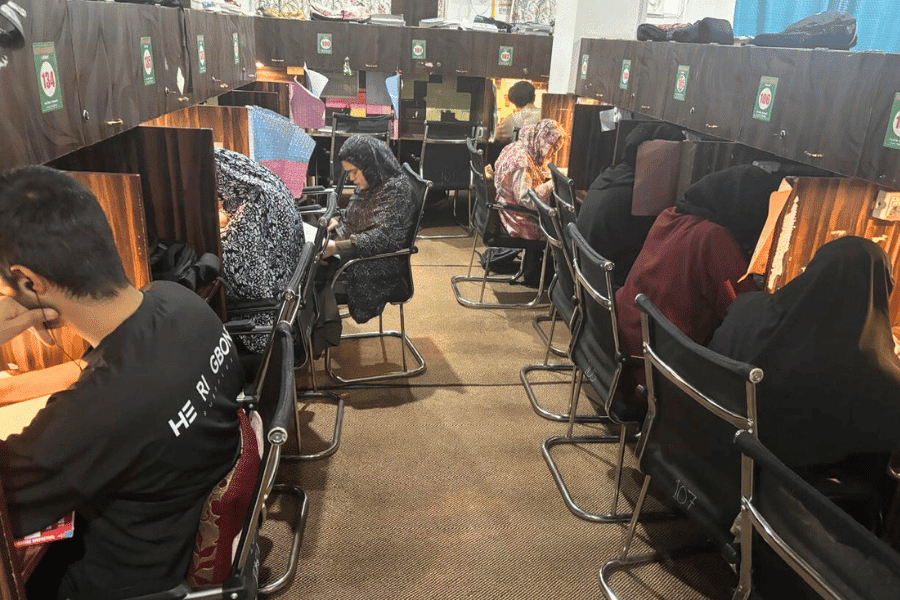
    Initially, he started with 60 study cabins, which were fully booked within days. Encouraged by the overwhelming response, he expanded the facility. “Now we have 120 cabins, all booked until June,” he said. Each student is charged a modest monthly fee of nine pounds to use the space.

    He admits he hadn’t anticipated such a strong turnout. Students aged 17 to 29 now frequent Pulse — some preparing for competitive entrance exams, while others focus on passing exams required for government jobs. 

    One trend stood out to him: nearly 60% of the students are girls.

    A hunger to learn

    In 2022, more than 250,000 people visited just 131 public libraries across Jammu and Kashmir, highlighting both a hunger for learning and the shortage of adequate study spaces. With thousands of aspirants preparing for exams, existing public libraries are overwhelmed and operate only during daytime hours, making it tough for students who need longer study sessions.

    In response, young people across the region have stepped in, launching private reading halls that offer 24/7 access. Equipped with Wi-Fi, heating, cooling, kitchen spaces and discussion zones, these modern study hubs have quickly become essential for serious exam takers in Kashmir.

    Javed Pathaan, a recent PhD graduate from Kashmir University, runs a private reading hall in Srinagar’s Rajbagh area. “Having personally gone through the rigors of competitive exam preparation, I understand how valuable these extras can be,” he said. “Students who study for long hours need occasional breaks, so we’ve created a designated space for short naps.”

    He said that young students face intense mental and physical strain while preparing for exams in a conflict-ridden region. That’s why many choose private services like his over free public libraries.

    Shazir Ahangar, who wants to pass an exam to get a government job in Kashmir, shifted to Pulse Library at Achabal after leaving the public library in Anantnag. He found the public facility overcrowded and said it was hard to concentrate there. 

    “They’re open for just eight to nine hours a day, which isn’t enough when you’re preparing for competitive exams,” he said.

    The exchange of knowledge

    One of Ahangar’s main concerns was the lack of basic facilities. The public libraries he visited didn’t offer air conditioning during summer or designated kitchens for making tea or coffee. Nor do they have discussion rooms. 

    “At Pulse, it’s more than just studying,” he added. Students engage in group discussions, exchange ideas and even enjoy small breaks together. He especially appreciated the privacy provided by individual study cabins.

    Last year, Manan Bhat, 28, from Soura area of Srinagar, secured the 88th rank in India’s civil service exam, a major feat considering that every year, more than one million people appear for India’s Civil Services Examination, but fewer than 1,000 candidates are selected.

    When he first began coming to reading halls they were often nearly empty. “Now, they’re packed with students,” he said. 

    Manan said that the biggest advantage of reading halls is the individual focus they offer, allowing students to concentrate without distractions. He also highlighted how being surrounded by peers preparing for similar exams creates a supportive environment that encourages the exchange of knowledge.

    Safe spaces to study

    Owners of reading halls often play an active role in encouraging students, staying in touch with their parents to share updates on their performance and dedication. The atmosphere in these halls is competitive, similar to coaching centres.

    Muazim Altaf said that admitting students to the reading hall comes with significant responsibility, as parents place a great deal of trust in them. 

    “We share weekly reports with parents, including details like how much time their children spend studying and whether they arrive on time,” he said. This becomes especially crucial in a region battling widespread drug addiction. Parents often urge him to keep a close watch on their children. According to Muazim, any form of indiscipline or violation of library rules results in immediate expulsion.

    In December last year, Shri B.L. Verma, the minister of state for social justice and environment, told the Indian parliament that more than 823,000 people in Jammu and Kashmir — around 8% of the region’s population — use drugs of some kind, including cannabis, opioids or sedatives.

    Basit Fayaz, who recently secured an All India Rank of 70 in the national exam that determines placement in professorships and research fellowships, believes that joining a reading hall played a crucial role in his success. He said that without the focused study environment it offered, cracking the exam — let alone making it to the top 100 — would have been nearly impossible.

    “The reading hall in Achabal [Pulse] provided exactly the kind of calm and distraction-free atmosphere I needed,” he said, adding that it helped him stay insulated from the recurring disturbances like crackdowns and gunfights that are common in Kashmir.

    Fayaz appreciated the peer group he found there. He recalled how group discussions and study sessions with fellow NEET aspirants added great value to his preparation. He added that without such spaces, constant exposure to conflict-related events often disturbs one’s mental state and heightens anxiety.

    “In situations like escalations between India and Pakistan, gunfights or political crackdowns, these spaces help us stay focused and shielded from the chaos,” Fayaz said.


    Questions to consider:

    1. What distractions from studying do so many young people in the Kashmir region face?

    2. How can political turmoil at the national level affect people who live far from city centres?

    3. How important is it for you to have a safe, quiet space to study?


    Source link

  • Data breach reporting lags in education, study finds

    Data breach reporting lags in education, study finds

    This audio is auto-generated. Please let us know if you have feedback.

    Dive Brief:

    • It took the education sector 4.8 months on average to report data breaches following ransomware attacks between 2018 and 2025, according to a report released last week by Comparitech.
    • Colleges and schools had the highest average reporting time for ransomware data breaches when compared to the business, government and healthcare sectors, Comparitech found in its analysis of over 2,600 U.S. ransomware attacks. 
    • At the same time, education companies — counted separately from colleges and schools — saw even higher reporting times at 6.3 months. Waiting months to disclose a data breach is dangerous, given that stolen data can be on the dark web before victims even know a breach happened, wrote the researchers for Comparitech, a cybersecurity and online privacy product review website.

    Dive Insight:

    Delayed reporting of data breaches comes at a time when schools and ed tech companies alike are grappling with the ongoing threat of ransomware attacks.

    Illustrating the prolonged response times for ransomware breaches, the latest Comparitech report pointed to Texas’ Alvin Independent School District confirming just this month that a June 2024 data breach impacted nearly 48,000 people. The data involved names, Social Security numbers, credit and debit card numbers, financial account information, medical and health insurance information, and state-issued IDs. 

    Organizations often wait to disclose a data breach because they are unsure if data was stolen following a ransomware attack until the hacker posts the stolen information on the dark web, Comparitech said. 

    “Data theft is a common component of ransomware attacks, so it’s not unreasonable for companies to assume hackers stole data, even if there isn’t any evidence to suggest data theft at first,” researchers wrote. “The worst thing to do is to jump to the conclusion that data hasn’t been stolen.”

    The FBI also advises against paying threat actors following a ransomware attack. If organizations pay a ransom, it still doesn’t guarantee any data will be recovered, the agency’s website states, adding that ransom payments can actually encourage more attacks.

    K-12 school districts have been especially concerned about a widespread breach of student and staff data across North America following a December 2024 ransomware attack on ed tech provider PowerSchool. 

    Though PowerSchool disclosed the cybersecurity incident about a week later, the company allegedly told districts not to worry about sensitive student and staff information being exposed. Five months later, however, PowerSchool publicly confirmed that, despite paying a ransom to threat actors, multiple school districts were being extorted with the same information stolen in the December incident.

    Since then, over 100 school districts — including Tennessee’s largest school system, Memphis-Shelby County Schools — have sued PowerSchool for negligence, breach of contract and false advertising.

    Source link

  • Over 5k HE job cuts in Canada since study permit caps

    Over 5k HE job cuts in Canada since study permit caps

    • Over 5,000 higher education jobs in Canada have been cut since the government clamped down on study permit numbers – with Ontario, British Columbia and Quebec the hardest hit.
    • The thousands of job cuts tracked by a higher education expert are just those that have been made public, with the possibility that there have been many more.
    • Institutions are also having to consolidate the programs they offer, as billions of dollars worth of budget cuts make their mark.

    More than 5,000 jobs have been lost in the post-secondary education sector in Canada since the federal government first imposed a study permit cap in January 2024, according to research from higher education consultant Ken Steele. Further restrictions – capping study permits at a scant 473,000 – were introduced in September.

    But the cuts collated by Steele are just the ones that have been made public. A number of institutions are not disclosing their drops in employment in teaching and administration.

    With Liberal Mark Carney triumphing in last month’s election, his new government must address worries about jobs disappearing, such as in the auto manufacturing sector, due to US President Donald Trump’s punishing tariffs.

    Slashing jobs in education – due to the government’s own actions – is a huge mistake, Steele said.

    “The unilateral imposition of extreme, abrupt, student visa caps have thrown Canadian higher education into crisis, decimated our reputation abroad and precipitously destroyed one of our major ‘export’ industries,” he told The PIE News.

    For the past year, Steele has been tracking reported job losses at universities and colleges across the country. As expected, programs that relied heavily on international students were forced to make the biggest cuts.

    According to Steele’s data, Mohawk College in Hamilton, Ontario, has eliminated almost 450 positions. The University of Windsor, also in Ontario, has reduced employment by 157 spots.

    The total of 5,267 cuts across the country almost certainly underreports the actual job losses. “Many institutions are keeping quiet about their cuts, including the Ontario private colleges that were partnering with public colleges,” he noted.

    It’s not just jobs that are being slashed. Post-secondary institutions have been forced to eliminate programs and reduce spending.

    Fanshawe College in London, Ontario, appears to lead the way in getting rid of programs. It has suspended 50 fields of study, including advanced live digital media, construction project management and retirement residence management. In all of Canada, Ontario colleges are the top eight for suspending programs, accounting for two-thirds of the 453 cuts.

    The financial hit is significant. “So far, I have tracked CAD$2.2 billion in budget hits at post-secondary schools across the country,” Steele said. This includes last year’s cuts as well as planned reductions for next year.

    If Canada reopened its doors tomorrow, it would likely take until at least 2030 to recover the international enrolment momentum we had just two years ago
    Ken Steele, education consultant

    Ontario was most reliant on international revenues and has been hardest hit by the study permit cap. Steele’s figures suggest that 70% of the cuts have struck that province, with British Columbia and Quebec also suffering. The remaining seven provinces faced more modest losses.

    In Vancouver last month, dozens of staff and faculty at several post-secondary institutions staged a protest of the study permit cap. Taryn Thompson, vice-president of the Vancouver Community College Faculty Association, said there have been 60 layoffs at her school alone, with more expected in the coming months.

    The big question is: Will the new federal government ease the cap? The issue of post-secondary funding was hardly raised at all during the election campaign, overshadowed by concerns about Trump’s threats to annex Canada.

    There’s also the concern about restoring Canada’s reputation following the study permit debacle.

    “If Canada reopened its doors tomorrow, it would likely take until at least 2030 to recover the international enrolment momentum we had just two years ago,” warned Steele.

    Source link

  • Class of 2025 grads are experiencing disconnect between job expectations and reality, study finds

    Class of 2025 grads are experiencing disconnect between job expectations and reality, study finds

    This audio is auto-generated. Please let us know if you have feedback.

    Class of 2025 graduates’ expectations seem to be clashing with reality during their job search, especially when it comes to pay, job preferences and beliefs about the job market, according to an April report from ZipRecruiter. 

    For instance, some graduates have found that the job search is taking longer than they expected. About 82% of those about to graduate expect to start work within three months of graduation, but only 77% of recent graduates accomplished that, and 5% said they’re still searching for a job.

    “Navigating the transition from campus to career can be a challenge for new grads, especially given the unpredictable market this class is stepping into,” Ian Siegel, co-founder and CEO of ZipRecruiter, said in a statement.

    In a survey, additional disconnects surfaced. About 42% of recent graduates reported they didn’t secure the pay they wanted. Although soon-to-be graduates said they expected to make six figures — $101,500 on average — the average starting salary for recent graduates was $68,400.

    Those about to graduate also said they want flexibility, but recent graduates said that’s harder to achieve than they hoped. About 90% of recent graduates said schedule flexibility is important to them, yet only 29% said they had flexible jobs.

    Amid shifting job market conditions, college graduates feel both confident yet cautious about their job prospects and the economy, according to a Monster report. Employers that offer flexibility, purpose and growth opportunities will attract and retain the next generation of top talent, a CareerBuilder + Monster executive said.

    Compensation conversations could remain a challenge in 2025, especially as pay transparency feels contentious, according to a report from Payscale. To combat this, employers can listen to employees and lead with fairness through pay transparency, a Payscale executive said. 

    Despite the challenges, job seekers entered 2025 with optimism, according to an Indeed report. Job seekers’ interest will likely remain steady but face more competition since job availability has remained stagnant in recent months, an Indeed economist said.

    Source link

  • Unis should get behind Country University Centres and Regional Study Hubs – Campus Review

    Unis should get behind Country University Centres and Regional Study Hubs – Campus Review

    In the heart of Broken Hill, 22-year-old Hannah Maalste is pursuing a Bachelor of Health and Medical Science, a path that once seemed out of reach due to her remote location and lack of an ATAR.

    Please login below to view content or subscribe now.

    Membership Login

    Source link

  • Three-quarters of global study decisions determined by cost

    Three-quarters of global study decisions determined by cost

    International students are increasingly looking for affordable destinations and alternative programs rather than give up on study abroad due to increasing costs, a new ApplyBoard survey has shown.  

    While 77% of surveyed students ranked affordable tuition fees as the most important factor shaping study decisions, only 9% said they planned to defer their studies based on these concerns, according to a recent student survey from ApplyBoard edtech firm.  

    “Students weren’t planning to wait for things to change,” said ApplyBoard senior communications manager Brooke Kelly: “They’re considering new destinations, adjusting which programs they apply to, and accepting that they have to balance work with study, but they’re still planning to study abroad,” she maintained.  

    Just over one in four students said they were considering different study destinations than originally planned, with Denmark, Finland, Nigeria and Italy the most popular emerging destinations.  

    Additionally, 55% of students said they would have to work part-time to afford their study abroad program.  

    After affordability, came employability (57%), career readiness (49%), high-quality teaching (47%), and program reputation (45%), as factors shaping student decision-making.  

    With students increasingly thinking about work opportunities, software and civil engineering topped students’ career choices, with nursing as the second most popular field. Tech fields including IT, cybersecurity, and data analysis also showed strong interest. 

    What’s more, interest in PhD programs saw a 4% rise on the previous year, while over half of students were considering master’s degrees, indicating that students are increasingly prioritising credentials and post-study work opportunities.  

    [Students are] considering new destinations, adjusting which programs they apply to, and accepting that they have to balance work with study, but they’re still planning to study abroad

    Brooke Kelly, ApplyBoard

    The study surveyed over 3,500 students from 84 countries, with the most represented countries being Nigeria, Ghana, Canada, Pakistan, Bangladesh and India.  

    Given its share of international students, it should be noted that China is absent from the top 10 most represented countries.  

    As students’ priorities shift and currencies fluctuate, “diversity will be key to mitigate against increased volatility and to ensure campuses remain vibrant with students from all around the world,” said Kelly.  

    Meanwhile, institutions should increase communication about scholarships and financial aid, offer more hybrid learning experiences and highlight programs on different timelines such as accelerated degrees, she advised.  

    While alternative markets are on the rise, 65% of respondents said they were only interested in studying in one of the six major destinations, with Canada followed by the US, UK, Australia, Germany and Ireland, in order of popularity.  

    Despite Canada’s international student caps, the largest proportion of students said they were ‘extremely’, ‘very’ or ‘moderately’ interested in the study destination, highlighting its enduring appeal among young people.  

    While stricter controls on post study work were implemented in Canada last year, in a rare easing of policies, the IRCC recently said that all college graduates would once again be eligible for post study work.  

    This change, combined with the fact that international students can still be accompanied by their dependants while studying in Canada, is likely to have contributed to it maintaining its attractiveness, according to Kelly.  

    Source link