

Tag: subcontracted

  • Outcomes data for subcontracted provision

    Outcomes data for subcontracted provision

    In 2022–23 there were around 260 full time first degree students, registered to a well-known provider and taught via a subcontractual arrangement, that had a continuation rate of just 9.8 per cent: so of those 260 students, just 25 or so actually continued on to their second year.

    Whatever you think about franchising opening up higher education to new groups, or allowing established universities the flexibility to react to fast-changing demand or skills needs, none of that actually happens if more than 90 per cent of the registered population doesn’t continue with their course.

    It’s because of issues like this that we (and others) have been badgering the Office for Students to produce outcomes data for students taught via subcontractual arrangements (franchises and partnerships) at a level of granularity that shows each individual subcontractual partner.

    And finally, after a small pilot last year, we have the data.

    Regulating subcontractual relationships

    If anything it feels a little late – there are now two overlapping proposals on the table to regulate this end of the higher education marketplace:

    • A Department of Education consultation suggests that every delivery partner that has more than 300 higher education students would need to register with the Office for Students (unless it is regulated elsewhere)
    • And an Office for Students consultation suggests that every registering partner with more than 100 higher education students taught via subcontractual arrangements will be subject to a new condition of registration (E8)

    Both sets of plans address, in their own way, the current reality that the only direct regulatory control available over students studying via these arrangements is via the quality assurance systems within the registering (lead) partners. This is an arrangement left over from previous quality regimes, where the nation spent time and money to assure itself that all providers had robust quality assurance systems that were being routinely followed.

    In an age of dashboard-driven regulation, the fact that we have not been able to easily disaggregate the outcomes of subcontractual students has meant that it has not been possible to regulate this corner of the sector – we’ve seen rapid growth of this kind of provision under the Office for Students’ watch and oversight (to be frank) has just not been up to the job.

    Data considerations

    Incredibly, it wasn’t even the case that the regulator had this data but chose not to publish it. OfS has genuinely had to design this data collection from scratch in order to get reliable information – many institutions expressed concern about the quality of data they might be getting from their academic partners (which should have been a red flag, really).

    So what we get is basically an extension of the B3 dashboards where students in the existing “partnership” population are assigned to one of an astonishing 681 partner providers alongside their lead provider. We’d assume that each of these specific populations has data across the three B3 (continuation, completion, progression) indicators – in practice many of these are suppressed for the usual OfS reasons of low student numbers and (in the case of progression) low Graduate Outcomes response rates.

    Where we do get indicator values we also see benchmarks and the usual numeric thresholds – the former indicating what OfS might expect to see given the student population, the latter being the line beneath which the regulator might feel inclined to get stuck into some regulating.

    One thing we can’t really do with the data – although we wanted to – is treat each subcontractual provider as if it was a main provider and derive an overall indicator for it. Because many subcontractual providers have relationships (and students) from numerous lead providers, we start to get to some reasonably sized institutions. Two – Global Banking School and the Elizabeth School London – appear to have more than 5,000 higher education students: GBS is around the same size as the University of Bradford, the Elizabeth School is comparable to Liverpool Hope University.

    Size and shape

    How big these providers are is a good place to start. We don’t actually get formal student numbers for these places – but we can derive a reasonable approximation from the denominator (population size) for one of the three indicators available. I tend to use continuation as it gives me the most recent (2022–23) year of data.

    [Full screen]

    The charts showing numbers of students are based on the denominators (populations) for one of the three indicators – by default I use continuation as it is more likely to reflect recent (2022–23) numbers. Because both the OfS and DfE consultations talk about all HE students there are no filters for mode or level.

    For each chart you can select a year of interest (I’ve chosen the most recent year by default) or the overall indicator (which, like on the main dashboards is synthetic over four years) If you change the indicator you may have to change the year. I’ve not included any indications of error – these are small numbers and the possible error is wide so any responsible regulator would have to do more investigating before stepping in to regulate.

    Recall that the DfE proposal is that institutions with more than 300 higher education students would have to register with OfS if they are not regulated in another way (as a school, FE college, or local authority, for instance). I make that 26 with more than 300 students, a small number of which appear to be regulated as an FE college.

    You can also see which lead providers are involved with each delivery partner – there are several that have relationships with multiple universities. It is instructive to compare outcomes data within a delivery partner – clearly differences in quality assurance and course design do have an impact, suggesting that the “naive university hoodwinked by low quality franchise partner” narrative, if it has any truth to it at all, is not universally true.
    [Full screen]

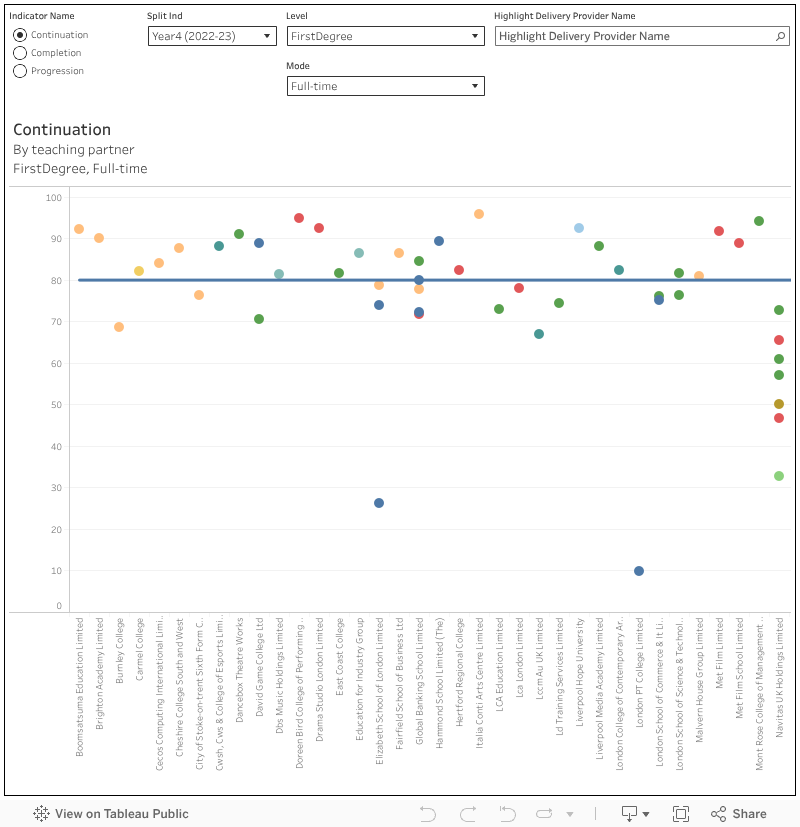
    The charts showing the actual outcomes are filtered by mode and level as you would expect. Note that not all levels are available for each mode of study.

    This chart brings in filters for level and mode – there are different indicators, benchmarks, and thresholds for each combination of these factors. Again, there is data suppression (low numbers and responses) going on, so you won’t see every single aspect of every single relationship in detail.

    That said, what we do see is a very mixed bag. Quite a lot of provision sits below the threshold line, though there are also some examples of very good outcomes – often at smaller, specialist, creative arts colleges.

    Registration

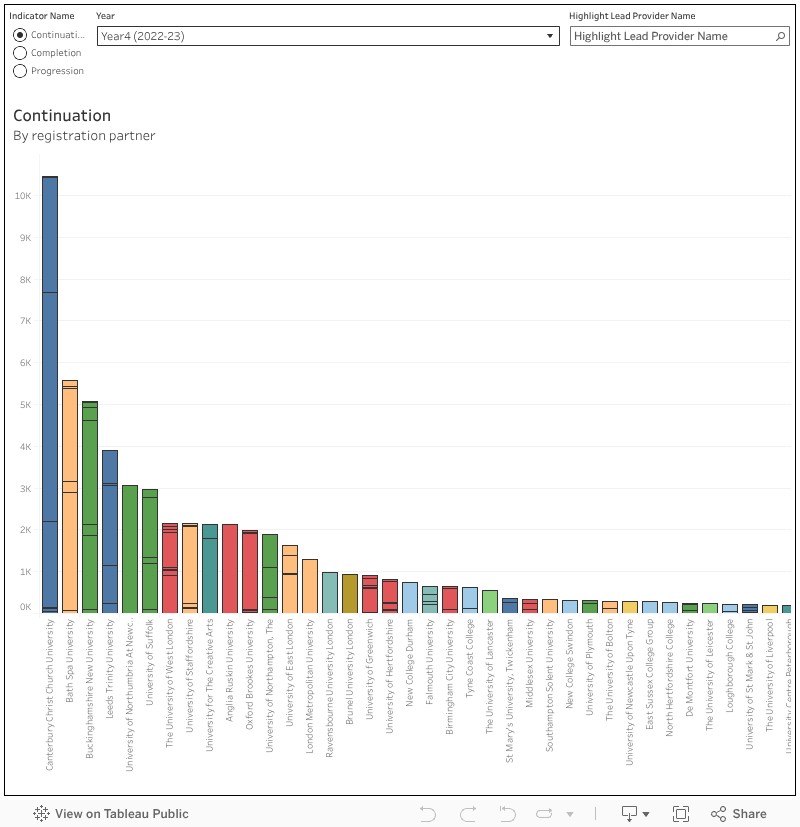
    I’ve flipped those two charts to allow us to look at the exposure of registered universities to this part of the market. The overall sizes in recent years at some providers won’t be of any surprise to those who have been following this story – a handful of universities have grown substantially as a result of a strategic decision to engage in multiple academic partnerships.
    [Full screen]

    Canterbury Christ Church University, Bath Spa University, Buckinghamshire New University, and Leeds Trinity University have always been the big four in this market. But of the 84 registered providers engaged in partnerships, I count 44 that met the 100 student threshold for the new condition of registration B3 had it applied in 2022–23.

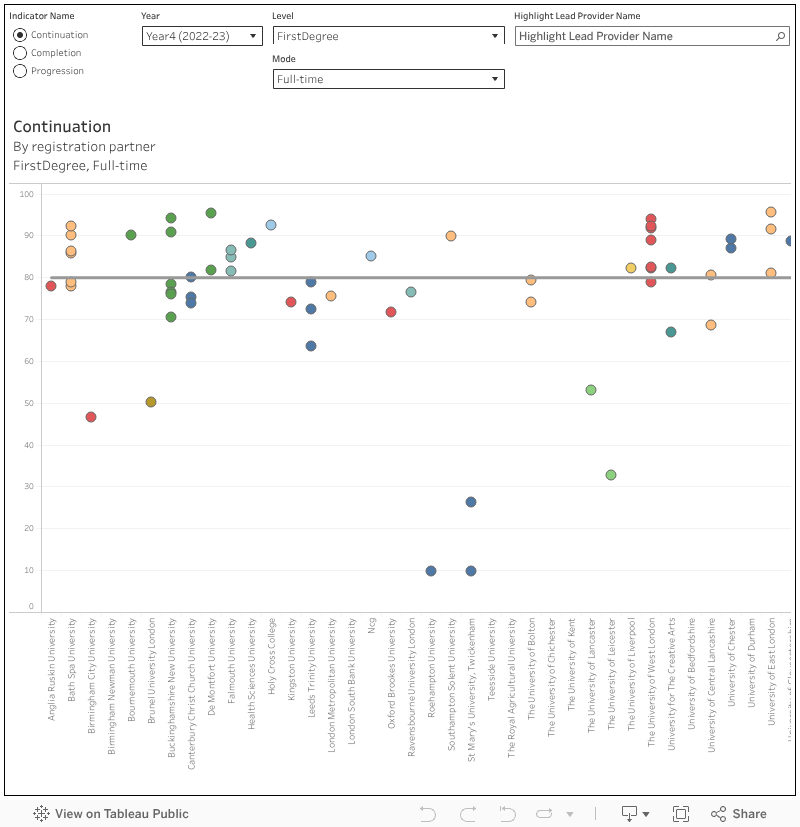
    Looking at the outcomes measures suggests that what is happening across multiple partners is not offering wide variation in performance, although there will always be teaching provider, subject, and population variation. It is striking that places with a lot of different partners tend to get reasonable results – lower indicator values tend to be found at places running just one or two relationships, so it does feel like some work on improving external quality assurance and validation would be of some help.
    [Full screen]

    To be clear, this is data from a few years ago (the most recent available data is from 2022–23 for continuation, 2019–20 for completion, and 2022–23 for progression). It is very likely that providers will have identified and addressed issues (or ended relationships) using internal data long before either we or the Office for Students got a glimpse of what was going on.

    A starting point

    There is clearly a lot more that can be done with what we have – and I can promise this is a dataset that Wonkhe is keen to return to. It gets us closer to understanding where problems may lie – the next phase would be to identify patterns and commonalities to help us get closer to the interventions that will help.

    Subcontractual arrangements have a long and proud history in UK higher education – just about every English provider started off in a subcontractual arrangement with the University of London, and it remains the most common way to enter the sector. A glance across the data makes it clear that there are real problems in some areas – but it is something other than the fact of a subcontractual arrangement that is causing them.

    Do you like higher education data as much as I do? Of course you do! So you are absolutely going to want to grab a ticket for The Festival of Higher Education on 11-12 November – it’s Team Wonkhe’s flagship event and data discussion is actively encouraged. 

    Source link

  • OfS consults on a condition of registration for subcontracted provision

    OfS consults on a condition of registration for subcontracted provision

    Cast your mind back to the end of January this year.

    The Department for Education proposed that all providers delivering a course via a franchise model to more than 300 students should register with the Office for Students.

    The rationale was straightforward. An increasingly large number of students were studying at, effectively, unregulated providers – with the connection to the lead provider achieved via an office in the registry and subject to varying (shall we say) levels of oversight in terms of quality, standards, and – frankly – probity (as we and others have extensively reported).

    That consultation concluded in April, and we have heard very little about these plans since. So when, just before summer recess, the Office for Students announced its own consultation on regulating franchise provision one could be forgiven for assuming that the two approaches would somehow link together.

    Information requirement

    What OfS has suggested addresses the other end of the issue – while DfE wants to register delivery providers, OfS wants to put a new condition of registration (E8) onto institutions with more than 100 students taught via subcontractual arrangements. The condition is not an arduous one – it basically suggests that a lead provider should have adequate governance and oversight of risks concerning subcontractual provision, and be prepared to share key information about these arrangements (a so-called “Comprehensive source of information”, or CSol). In return OfS can demand more information (“monitoring”) and make “directions” for the lead provider to start or stop doing stuff. All this would, consultation pending, come into force in January 2026.

    Now, it would be fair to wonder whether this kind of effective governance in the public interest is already covered in conditions E1 and E2, and the information end of things feels a little bit F3. It is neither unreasonable nor arduous to expect providers to have adequate governance or to publish information – though it is questionable (given the applicability of these existing registration conditions) that this will have any meaningful impact on provider activity.

    In other words, if you don’t have effective arrangements in place regarding subcontractual provision, you are already in breach of condition E2 and will face consequences. Just ask Leeds Trinity University, now £115,000 poorer as a result – and, as the consultation suggests, just the tip of a very large iceberg of provision where OfS has been regulating quietly behind the scenes.

    Rationale

    So why the need for E8? If providers are already required to be transparent around governance arrangements and oversight, why do we need another condition to do the same thing for subcontractual relationships? And if there are additional informational needs, or a need to limit what a particular provider can do, why not do a specific condition of registration relating to subcontractual activity? Or why not wait a few weeks to see whether DfE brings the people doing the actual course delivery into its regulatory ambit? OfS says:

    We consider that implementing a general ongoing condition of registration sends a clearer signal to the sector about our expectations for managing subcontractual partnerships now and in the future. Including our requirements in the regulatory framework in this way provides greater transparency for all providers and for other stakeholders.

    We are, once again, in the realms of vibes-based regulation: the purpose of this requirement is to make it look like OfS is finally doing something to address the problems with subcontractual provision that have been visible to the media since at least 2014.

    In the weeds

    You’ll look in vain within the consultation for any mention of OfS’ own long-promised publication of definitive data on the size and shape of franchised provision – now possibly coming in the last quarter of 2025 (following a very small pilot release last year). Where this gets interesting is the methodology for calculating where or not you are over the threshold (a total of 100 – headcount – students studying via subcontractual arrangements at relevant providers) as calculated by the OfS’ own student number methodology and that would be returned via HESES. While OfS has not yet been confident enough in this data to release it in full, it is somehow content to rely on it for regulation.

    The 100 isn’t an exact cut off: if you generally recruit more than 100 subcontractual students but happen not to one year, you are still in scope – likewise if you make changes to your plans so that you will recruit more than 100 (or are “materially likely” to do so) you are in scope already. Or if OfS decides you are in scope, you are in scope.

    To be clear, this isn’t all such arrangements. The use of the term “relevant” excludes by definition any provision in a state-funded school, FEC, sixth form, designated institution (FHEA 1992 section 28), provider of NHS services, local authority, or police and crimes commissioner. Also exempt in your calculation are students subcontracted to any provider with degree awarding powers authorised by or under an Act of Parliament or a Royal Charter (so all taught or research DAPs, basically).

    Back end

    For clarity, the traditional way in which subcontractual arrangements are regulated is via the registering provider – and these OfS proposals are an attempt to bring some of what should be going on already out a bit further into the open. The existing transparency conditions of registration (F1, which operationalises section 9 of HERA) don’t cover governing (or academic quality and standards) documentation. Indeed, OfS has been historically light on governance transparency – which is why it isn’t always easy to figure out what is going on inside a given provider.

    It’s not so long ago that OfS was lambasting providers for “gold plating” internal quality assurance processes in a long-sustained campaign to flush out those in the sector who cleave to the much older doctrines of the UK Quality Code. You know, nonsense like:

    Providers and their partners agree proportionate arrangements for effective governance to secure the academic standards and enhance the quality of programmes and modules that are delivered in partnership with others. Organisations involved in partnership arrangements agree and communicate the mutual and specific responsibilities in relation to delivering, monitoring, evaluating, assuring and enhancing the learning experience.

    A big chunk of the documentation that OfS is asking for here (in the comprehensive source of information) is basically documentary proof that a provider is compliant with principle 8 of the UK Quality code (including the QAA’s recent guidance), not that you will be thanked by the regulator for pointing this out. Perhaps some of that “gold-plating” was important after all.

    But there is one place where OfS goes further: it asks for a “strategic” rationale for entering into each subcontractual arrangement. We don’t get any guidance on what a suitable rationale would be, just that it must fit with a provider’s vision and strategic intent. Case law here is going to be fascinating.

    Front end

    From a student protection perspective OfS would gain powers to compel those franchising out provision to make changes to the terms of these agreements or the governance or process involved in running them – in extremis the regulator could require that an arrangement ends immediately, students have their fees refunded, and the registering provider steps in to teach out the remaining student. It can also tell you to stop recruiting students onto subcontracted out courses, or limit the number of students that can be recruited.

    This is a large improvement on current arrangements, which have largely been predicated on a provider having an up-to-date student protection plan and being able to deliver on it. The fee refund requirement, in particular, should make anyone that is knowingly partnering with someone offering students a sub-par experience sit up and pay attention.

    It’s not perfect, however: the January DfE proposal on franchising and partnerships was interesting precisely because it broke with established practice on subcontractual arrangements – those delivering teaching would be regulated, whether or not they were awarding the degrees in question. If OfS could intervene directly with a delivery provider, surely that would be quicker than going via the registration provider – the measures in this consultation would then be usable for purely punitive reasons (and, as above, duplicate other conditions of registration)

    OfS has followed the DfE lead in excluding most publicly funded provision from these regulations – it made sense to exclude schools, colleges, and the NHS from active regulation as they are already regulated elsewhere. If the purpose of these OfS proposals is to ensure that the universities that are subcontracting out do so with a level of strategic intent, it seems unlikely that someone is incapable of making a strategically poor or under-resourced commitment to work with an FEC or sixth form: surely these arrangements also deserve a level of scrutiny?

    And – frankly – why shouldn’t providers involved in subcontracting be required to publish information about it (rather than hold it until OfS asks for it)? The current concerns with this style of provision have developed precisely because agreements and fee-splitting agreements can remain obscure – a bit of public accountability for these kinds of decisions would do a lot to separate out the good and valuable subcontractual arrangements from the more questionable partnerships.

    Source link