So. This is the last blog of the academic year. Service resumes Tuesday, 2 September.
It’s been a long year. I’m pretty tired. How about you?
This was the year it all kind of came crashing down: not just here in Canda, but everywhere else too. It’s too long to go through and my more faithful readers already know the story. It’s not just in Canada. In France, Australia, and the UK, we saw institutions having similar problems: all these fantastic higher education institutions we’ve collectively built and, quite simply, nobody wants to pay for it. Not through public funds, not through private fees. Nobody wants to pay for it.
And then there’s American higher education would probably be going through something similar this year, only a greater catastrophe arrived first. I’ll pass over this in silence.
Here in Canada, the sector is increasingly friendless. Parents and students seem less convinced that universities in particular represent good value. And governments are simply indifferent, not because they dislike universities necessarily, but because they dislike or distrust the knowledge economy universities are built to serve.
Unfortunately, I think it is going to get worse. Not a single government in Canada released a budget this year which took into account the effects of US tariffs. The result? Allegedly healthy federal and provincial balance sheets are going to get pounded this year and next (and the especially unhealthy ones — BC and Quebec in particular — are going to be especially ugly). Deficits as far as they eye can see. As the saying goes, no one is coming to save us.
I have no doubt that community colleges will find ways to get through this, because they have so far through this crisis mostly shown themselves to have the ability to do what it takes to right the ship. They might not look too good after another round or two of cuts, and it’s not impossible that a few rural colleges might disappear or shrink radically because what they get from governments and domestic tuition fees just isn’t enough to properly serve their communities, but on the whole, I think they will be ok.
Universities, on the other hand. Well, that’s a different story.
About a year ago, I said that the biggest change universities were going to have to undergo in this new financial age was shifting from a belief that every problem had a revenue-side solution to one in which every problem has a cost-side solution. Institutions can no longer solve their short-term problems by just recruiting another hundred international students. They actually have to change the way they do business. They have to change processes. They have to think about production functions and work processes in a way they haven’t before. And they have to do it while trying to pivot to new missions that give them more traction with government and the public.
I am here to say that I don’t think it’s going so well.
The message that “there is no one coming to save us” has, thankfully, penetrated fairly deeply in universities. Maybe not quite everywhere (hello, VIU!), but in most places. But what I am not sure has penetrated quite so deeply is the corollary that actual change is necessary. My (admittedly limited) vantage point on the sector is that:
I still see universities spending inordinate amounts of time trying to come up with new revenue-based solutions. It’s a habit they have a hard time kicking.
Universities are deeply resistant to doing more than the bare minimum of restructuring to meet immediate financial needs. The idea that deep structural change might be necessary remains pretty much anathema. This bare minimum approach means that when the next round of government cuts come – due to recession, or national re-armament or whatever – they are just going to have to cut again, and again, and again. There is very little sign of anyone trying to get ahead of the curve to make both big cuts and big investments in new areas that will help them survive the turmoil.
I still hear, distressingly often, senior people in universities utter the worst seven words in all of higher education: “we just gotta tell our story better”. Universities are reluctant to face the possibility that governments and the mass public don’t love them the way they are and that they may need to actually, you know, change.
We need to stop acting like the research university of today – which in Canada is really only a creature of the 1970s or perhaps 1960s — is eternal. Universities can die, and have done so rather frequently across history. Universities are the product of particular configurations of social and economic forces. And now, at the moment when the western world is basically re-considering the entire post-WWII order, the idea that universities are going to be uniquely immune to change is bananas. Past performance — which I think has been pretty good — is not a guarantee of future safety.
I am not saying here that universities shouldn’t fight for their own corner: they should! Often more vigorously than they currently do (see my piece on Bill 33, or on how they need to gear up for a fight with Bay Street over whether temporary residents will be international students or TFWs). But they can’t do it by digging in on the status quo.
And so, I will end the academic year by repeating something I said a few months ago. To survive this coming period, universities are going to need:
Ambition. Don’t waste time doing small things.
Experimentation. The worst possible thing right now is an addiction to “the way we’ve always done things”
Dissemination. No one institution got us into the mess. No one institution is going to get out of it alone, either. Institutions need to commit to sharing the results of their experimentation.
I know every university in Canada can, if it chooses, commit to those three things. I have faith. And I believe that if they do, our university sector will come out as strong or stronger than any system in the world.
But any institution that chooses not to commit to them…well, I think they are going to have some issues in the next three years. Serious ones.
It’s up to us. Rest up this summer. Re-charge. We’re all going to need it in ‘25–’26.
Morning everyone. The days are getting long, so that means it’s getting close to the time when I need to wrap up this blog for the (northern hemisphere) summer. And that, in turn, means book report time, where I round up everything I’ve read on higher education for the past six months.
(If you’re looking for non-higher education recommendations: Terry David Martin’s The Affirmative Action Empire: Nations and Nationalism in the Soviet Union 1923-1939 will re-wire your thinking about what the early Stalinism actually looked like, and Ashoka Mody’s India is Broken will probably do the same for post-Independence India. Can’t give you much on the fiction side because most of what I have read is pretty meh, but if you’re into the detective genre, I can recommend Inspector Imanishi Investigates by Seicho Matsumoto. Not quite as good as his earlier Tokyo Express – which is the most brilliant novel-length thriller based on train timetables ever written – but still pretty good.)
Let’s start with institutional histories, of which I read two: A European University: The University of Helsinki 1640-2010 and A History of Temple University Japan: An Experiment in International Education. The first is an absolute doorstopper (over 800 pages – down from about 1500 in the original Finnish) but from a scholarly perspective it is genuinely top-notch. Because fundamentally it is not just a history of the university, but an intellectual history of the country as a whole. In that sense, it recalls my favourite book of last year Université de Montréal: une historie urbaine et internationale, but also to some extent Martin Friedland’s history of the University of Toronto. The Temple Japan was also pretty interesting. Branch campuses don’t often get their own histories, and this one is a doozy: a roller-coaster story which shows exactly how hard it is to lay down roots in a country where you don’t really speak the language, where government is mostly hostile, and your partners – even where they are legitimate (which not all of Temple’s were) – don’t always have similar goals in mind. Great stuff.
Searching for Utopia: Universities and Their Histories by Hanna Holborn Grey is a good short book with a misleading title. It’s not actually about the histories of the American university, but a history of the ideas that animate them and how these ideas echo across a century or more, animated for the most part by the words of Robert Hutchins (U Chicago) and Clark Kerr (U California).
I was in Japan for a bit back in March, and so decided to pick up Shigeru Nakayama’s Science, Technology and Society in Postwar Japan. It’s at least 25 years out of date but it is a pretty interesting read as a kind of pre-history of the modern Japanese scientific enterprise and helpful to understand why university science is such a small part of the overall equation. I also read Grant Black’s Education Reform Policy at a Japanese Super Global University, a book about Tsukubu U, from Routledge. It reads like a Master’s thesis and is mostly pretty banal, but it does have just enough interesting nuggets about how top-tier institutions in Japan are re-imagining their offerings in the early twenty-first century to make it worth a skim at least.
Two books I read focusing specifically on American university finances were Let Colleges Fail: The Power of Creative Destruction in Higher Educationby Richard K. Vedder and Joshua Travis Brown’s Capitalizing on College: How Higher Education Went from Mission-Driven to Margin-Obsessed. You can skip the Vedder book; over his career he has written a lot of useful stuff about college cost structures but now in his 80s this (apparently) farewell book contains far too much “colleges are woke so fuck ‘em” for my taste. Capitalizing on College is a lot more interesting, containing as it does eight case studies of religious colleges and how the various financial strategies they have adopted to stave off financial decline have worked out. The answer – mostly pretty badly except for the one who traded God for Mammon – might not sound riveting or surprising, but the routes that each institution takes towards the bottom of the canyon are varied and collectively tell a pretty interesting story, all of which come down to “nobody really wants to pay for higher education”. Thought-provoking even if it is 50-100 pages longer than it needed to be and is too casual with use of the term “neoliberal”.
Sticking with the theme of books with lots of institutional case studies, I also polished off two books that are heavy on case studies: Inside College Mergers: Stories From the Front Lines (Mark La Brance, editor) and Strategic Mergers in Higher Education by Ricardo Azziz, Guilbert Henschke, Lloyd Jacobs and Sonita Jacobs. The former is seven first-person accounts of mergers, some of which worked and some of which didn’t (which is great because failure cases are always underexplored in the literature), while the latter is a more analytical look at university mergers over time. The latter is arguably the more significant book both because of its attempts at theory-building (its typology of mergers is particularly helpful, I think) and because in many ways its checklists of how to run a merger right are actually applicable to all universities at all times! Its inclusion of European and Canadian experiences are commendable, even if they get some of the details wrong and is awkwardly-placed in a book which is fundamentally America-focused. Two thumbs up anyway.
Tenure Tracks in European Universities, (free download at the link) is a collection of essays edited by Elias Pekkola and Taru Siekkinen. Following the introduction of global rankings, there was a widespread desire to copy this North American invention partly in order to incentivize greater productivity, but also to make researcher careers more attractive to international scholars (broadly speaking, the old European systems were nicer to early career academics and much harder on mid-career academics than the North American system). Generally speaking, tenure never replaced the old hierarchy but rather now sits uneasily beside it, but the specific manner in which reform was implemented differed from place to place, and this book is a very helpful overview.
Two books on UK higher education to look out for. The first was The Secret Lecturer by…well, it’s a secret (the idea is a play on a series of articles and books in the Guardian called The Secret Footballer, in which a professional talked a lot about what goes on behind the scenes on a professional soccer team…the footballer was never named but most people think it was Dave Kitson). It was interesting in many ways, showing what day-to-day life in a UK university looks like, and it is in many ways very disappointing. It’s a bit blighted by the lecturer’s insistence on centering his own views about the relationship between universities and the arms trade, but that’s a minor quibble: I sure would like a Canadian equivalent. The second was Higher Imagination: A Future for Universities by British/Australian policy wonk Ant Bagshaw, which was…intriguing. Some bits of it will probably enrage a lot of faculty – in particular the bits about being relentlessly focused on programs as “products”, but the bits stressing that one of the key outputs of universities should be “joy” are pretty original (and, IMHO, true, even if it would be madness for any institution to say stuff like this out loud).
Education, Skills and Technical Change: Implications for Future US GDP Growth is a book I should have read when it came out a few years ago. It’s a series of quite technical economic papers from some of the biggest names in US economics, not about higher education itself, for the most part, but mostly about returns to skills. Of the two which are more specifically about institutional production functions, the one by Caroline Hoxby is interesting, the other one, about the rise in college costs, is garbage (as the article’s discussant in the book, Sandy Baum, ably points out). It’s one of those books where you don’t necessarily need to buy all the results, or believe that the results hold outside the United States, but you do just sort of stand slack-jawed in wonder at how many different ways they have to analyze a problem thanks to a system of economic and institutional data collection which doesn’t suck the way Canada’s does.
The Promise of Higher Education: Essays in Honour of 70 Years of the International Association of Universities: (also availableas a free download here) is a boatload of short ideas on the idea of higher education written on the occasion of the International Association of Universities. Most of the individual articles are forgettable – the way to best experience this book is as a kind of mood music in favour of higher education’s greatest kumbaya themes. But a couple are superb: in particular Simon Marginson and Lili Yang’s dissection of Chinese versus Western conceptions of institutional autonomy, as well as Pedro Teixera and Manja Klemencic’s article on the Civic Role of universities (also of interest is Daniel Levy’s screed against management-led institutional activism, which might be the politest and most substantive critique of institutional DEI approaches ever written).
The Learning-Centered University, whose author Steven Mintz I interviewed back here, is a book that was somewhat let down by poor editing. The subject is interesting and Mintz is well-informed on the subject, but while the material is good, it’s presented in a somewhat disorganized fashion, which undermines the point a bit. Knowledge Towns: Colleges and Universities as Talent Magnets, by David Staley and Dominic Endicottis…almost interesting. That is to say: it has an interesting thesis about how cities can use educational institutions to re-define themselves, especially in periods of demographic change, but it is marred by some wishful thinking about the flexibility of institutional forms and a bunch of wishful thinking about things like “micro-colleges”. Finally, there was Polarized by Degrees: How the Diploma Divide and the Culture War Transformed American Politics by Matt Grossman and David Hopkins, which is probably of more interest to political scientists studying voting patterns than it is to educationists trying to work out how to de-polarize the sector in the current environment of wild right-wing vandalism.
On the subject of science more generally, I read Science of Scienceby Alexander Krauss (open access version available here), which is an interesting approach to the subject without being anywhere near as revolutionary as the author claims. His central insight, though – that the history of science is to a very large extent a history of methodologies and the measurement tools that permit new methodologies to sprout – is pretty interesting and I am looking forward to the companion volume coming out later this year called The Motor of Scientific Discovery. In the history of science category, I also picked up Scientific Babel: the Language of Science from the Fall of Latin to the Rise of English by Michael Gordin which is about how over the course of two centuries English won out over German, French, Russian and a plethora of constructed languages like Volapuk, Esperanto and Ido (many of which, to my surprise, were actually constructed with the specific intention of being languages for the transmission of sciences) to become the lingua franca of sciences. It’s terrific and I heartily endorse it.
I think that’s it. Hope you get some good reading this summer and if you find anything you think I need to read, drop me a line!
We’re entering what would normally be the long-awaited reprieve of summer—a time to write, think, travel, to escape the demands of the academic year. But this will not be a normal summer.
Faculty may long for a break, but the government is actively operationalizing Project 2025, a blueprint for remaking every public institution, with higher education being the crown jewel of its antidemocratic agenda. At his 100-day rally in Michigan, Donald Trump declared, “We’ve just gotten started. You haven’t even seen anything yet.” Christopher Rufo, architect of the right-wing culture war, promises to plunge higher education still further into “an existential terror.”
We recommend mobilizing on two simultaneous fronts this summer: by operationalizing mutual academic defense compacts (MADCs), and through direct activism. We must forge powerful alliances for mass protest. We suggest one often-overlooked but deeply strategic constituency— veterans.
Recent opinion polls show that most Americans oppose the Trump administration’s approach to higher education. This public sentiment gives us a crucial opening—and we must seize the momentum as we move into summer.
Mobilize and Form Unlikely Alliances
Faculty can take simple, student-centered actions this summer—sharing stories of student impact over social media using #DegreesForDemocracy, or highlighting the real-world outcomes of their teaching and research with #WhatWeBuild—to demonstrate the value of higher education and help galvanize public support. Op-eds and blog posts that highlight how higher ed strengthens local communities, drives economic growth and improves American public health and well-being are also powerful tools.
In addition, faculty must begin to mobilize on the streets for mass peaceful protest. This will require reaching beyond our usual circles and forming big-tent coalitions. Now is not the time for ideological purity or partisan hesitation. The threat we face at this point goes beyond conventional liberal-versus-conservative disagreement; it is an attack on democratic institutions, civil liberties and public education itself.
One particularly powerful, and perhaps surprising, potential partner in this moment is the veteran community. As a start, we urge faculty to consider aligning with veterans this Friday for the June 6 D-Day anniversary protest: Veterans Stand Against Fascism Nationwide at the National Mall, as well as at more than 100 other venues across the country. This is a great way for higher ed to show up in the lead-up to the June 14 No Kings Day protests.
Why Join With Veterans?
The shared legacy of the GI Bill links veterans and higher education. A public alliance with veterans has the potential to lend more political credibility to faculty and foster broader public empathy that will disrupt the Trump administration’s strategy of divide and conquer.
From Black WWII veterans who catalyzed the civil rights movement to anti–Vietnam War resistance, veterans have consistently served on the front lines of social change. Today, they are standing up to deep cuts to the Department of Veterans Affairs; the elimination of diversity, equity and inclusion initiatives; and dangerous reductions to the veteran workforce—issues that mirror the assaults on higher education.
Professors and veterans are natural allies in more ways than many realize. Since the passage of the GI Bill in 1944, millions of veterans have earned college degrees and experienced upward mobility through higher education. Veterans are a protected class under antidiscrimination law and recipients of DEI programming. The veterans’ centers and services we have created to support them are now under threat from the Trump administration’s ideological dismantling of DEI. While trust in most American institutions—including higher education—has declined, polling shows that the military remains one of the few institutions still trusted by a majority of Americans. This trust is rooted in the military’s demographic breadth: Its members come from every region, ethnicity, income bracket and political background.
In contrast, higher education suffers from an image problem—often caricatured as elite, out of touch and overly partisan. Yet many of the most trusted professionals in society—nurses, teachers, first responders, small business owners and veterans themselves—were trained and mentored in our classrooms. Building visible alliances with veterans can help reshape public perceptions of academia, challenging the dominant narratives that seek to isolate and delegitimize higher education.
Operationalize Mutual Academic Defense Compacts
While public protest builds pressure, cross-institutional coalition building creates networks for effective resistance. Faculty and university senates across the country are approving mutual academic defense compact resolutions, which call for universities to join in shared defense of any participating institution that comes under government attack. But this is just the beginning. We need more, and these resolutions need to be operationalized through the creation of MADC task forces of administrators and faculty on as many campuses as possible. Presidents and chancellors need to endorse both the compacts and the task forces.
We must use this summer to refine model MADC resolution language to align with institutional legal and financial requirements, to prepare for the passage of resolutions and creation of MADC task forces in the early fall, and to build the infrastructure that will allow these coalitions to function as coordinated networks of protection, resistance and shared strategy.
We’ve been struck by how many faculty members lack formal structures for self-governance on their campuses. Shared governance is a foundational pillar of academic freedom—though often overshadowed by the more visible right to pursue scholarship free from interference. We’re working with campuses to strengthen existing faculty governance organizations with the establishment of Stand Together groups, and where none exist, we’re helping to establish American Association of University Professors and other advocacy chapters to fill that crucial gap.
This summer, we must think strategically—and expansively. This summer calls for alliance building across our sister institutions of higher ed and across diverse nonacademic interest groups. The stakes are nothing less than the future of democracy.
Jennifer Lundquist is a professor of sociology at the University of Massachusetts Amherst.Kathy Roberts Forde is a professor of journalism at the University of Massachusetts Amherst.Together, the authors co-foundedStand Together for Higher Ed.
We’re entering what would normally be the long-awaited reprieve of summer—a time to write, think, travel, to escape the demands of the academic year. But this will not be a normal summer.
Faculty may long for a break, but the government is actively operationalizing Project 2025, a blueprint for remaking every public institution, with higher education being the crown jewel of its antidemocratic agenda. At his 100-day rally in Michigan, Donald Trump declared, “We’ve just gotten started. You haven’t even seen anything yet.” Christopher Rufo, architect of the right-wing culture war, promises to plunge higher education still further into “an existential terror.”
We recommend mobilizing on two simultaneous fronts this summer: by operationalizing mutual academic defense compacts (MADCs), and through direct activism. We must forge powerful alliances for mass protest. We suggest one often-overlooked but deeply strategic constituency— veterans.
Recent opinion polls show that most Americans oppose the Trump administration’s approach to higher education. This public sentiment gives us a crucial opening—and we must seize the momentum as we move into summer.
Mobilize and Form Unlikely Alliances
Faculty can take simple, student-centered actions this summer—sharing stories of student impact over social media using #DegreesForDemocracy, or highlighting the real-world outcomes of their teaching and research with #WhatWeBuild—to demonstrate the value of higher education and help galvanize public support. Op-eds and blog posts that highlight how higher ed strengthens local communities, drives economic growth and improves American public health and well-being are also powerful tools.
In addition, faculty must begin to mobilize on the streets for mass peaceful protest. This will require reaching beyond our usual circles and forming big-tent coalitions. Now is not the time for ideological purity or partisan hesitation. The threat we face at this point goes beyond conventional liberal-versus-conservative disagreement; it is an attack on democratic institutions, civil liberties and public education itself.
One particularly powerful, and perhaps surprising, potential partner in this moment is the veteran community. As a start, we urge faculty to consider aligning with veterans this Friday for the June 6 D-Day anniversary protest: Veterans Stand Against Fascism Nationwide at the National Mall, as well as at more than 100 other venues across the country. This is a great way for higher ed to show up in the lead-up to the June 14 No Kings Day protests.
Why Join With Veterans?
The shared legacy of the GI Bill links veterans and higher education. A public alliance with veterans has the potential to lend more political credibility to faculty and foster broader public empathy that will disrupt the Trump administration’s strategy of divide and conquer.
From Black WWII veterans who catalyzed the civil rights movement to anti–Vietnam War resistance, veterans have consistently served on the front lines of social change. Today, they are standing up to deep budget cuts to the Department of Veterans Affairs; the elimination of diversity, equity and inclusion initiatives; and dangerous reductions to the veteran workforce—issues that mirror the assaults on higher education.
Professors and veterans are natural allies in more ways than many realize. Since the passage of the GI Bill in 1944, millions of veterans have earned college degrees and experienced upward mobility through higher education. Veterans are a protected class under antidiscrimination law and recipients of DEI programming. The veterans’ centers and services we have created to support them are now under threat from the Trump administration’s ideological dismantling of DEI. While trust in most American institutions—including higher education—has declined, polling shows that the military remains one of the few institutions still trusted by a majority of Americans. This trust is rooted in the military’s demographic breadth: Its members come from every region, ethnicity, income bracket and political background.
In contrast, higher education suffers from an image problem—often caricatured as elite, out of touch and overly partisan. Yet many of the most trusted professionals in society—nurses, teachers, first responders, small business owners and veterans themselves—were trained and mentored in our classrooms. Building visible alliances with veterans can help reshape public perceptions of academia, challenging the dominant narratives that seek to isolate and delegitimize higher education.
Operationalize Mutual Academic Defense Compacts
While public protest builds pressure, cross-institutional coalition building creates networks for effective resistance. Faculty and university senates across the country are approving mutual academic defense compact resolutions, which call for universities to join in shared defense of any participating institution that comes under government attack. But this is just the beginning. We need more, and these resolutions need to be operationalized through the creation of MADC task forces of administrators and faculty on as many campuses as possible. Presidents and chancellors need to endorse both the compacts and the task forces.
We must use this summer to refine model MADC resolution language to align with institutional legal and financial requirements, to prepare for the passage of resolutions and creation of MADC task forces in the early fall, and to build the infrastructure that will allow these coalitions to function as coordinated networks of protection, resistance and shared strategy.
We’ve been struck by how many faculty members lack formal structures for self-governance on their campuses. Shared governance is a foundational pillar of academic freedom—though often overshadowed by the more visible right to pursue scholarship free from interference. We’re working with campuses to strengthen existing faculty governance organizations with the establishment of Stand Together groups, and where none exist, we’re helping to establish American Association of University Professors and other advocacy chapters to fill that crucial gap.
This summer, we must think strategically—and expansively. This summer calls for alliance building across our sister institutions of higher ed and across diverse nonacademic interest groups. The stakes are nothing less than the future of democracy.
Jennifer Lundquist is a professor of sociology at the University of Massachusetts Amherst.Kathy Roberts Forde is a professor of journalism at the University of Massachusetts Amherst.Together, the authors co-foundedStand Together for Higher Ed.
Perhaps you just haven’t had time to keep up with the advent of agentic AI. Or you simply didn’t realize that AI is not just a fad in higher education; rather, it is our best hope to survive the pervasive budget cuts and dropping enrollments. Or, perhaps based on your look at AI tools in 2023, you found them too unreliable and subject to hallucinations to take them seriously. Here’s hoping that this summer provides you a bit of time spread across the season to catch up with the technology and begin the fall term with the knowledge and experience to make AI the best professional assistant you have ever had.
Instead of facing a stack of projects and problems alone, you will have a Ph.D.-knowledge virtual assistant working at speeds far exceeding human thought:
“According to OpenAI, o3 earned a record-breaking score on the ARC-AGI visual reasoning benchmark, reaching 87.5 percent in high-compute testing—comparable to human performance at an 85 percent threshold. The model also scored 96.7 percent on the 2024 American Invitational Mathematics Exam, missing just one question, and reached 87.7 percent on GPQA Diamond, which contains graduate-level biology, physics, and chemistry questions.”
These assistants work 24-7, without vacation or holiday breaks. At the end of long day of work, you can pose complex problems to an advanced deep research model and it will conduct research, compose a detailed report, and prepare follow-up questions while you are eating dinner (I have experienced this myself; reading the results over dessert is so much more satisfying). I have also awakened in the early hours of a Sunday morning with a great idea to pursue for work. I tapped it in directly to one of the advanced models and awakened to a 20-plus-page report complete with comprehensive citations and suggestions for further research later that morning.
AI developers have made great strides in avoiding hallucinations and off-target results. Among the improvements are the utilization of retrieval-augmented generation, a natural-language processing technique that taps an expansive database to “enhance the context and accuracy of generated text.” Those who may have stopped using AI because of errors of the past will be surprised to see the far more consistent and accurate results of today. Despite these improvements, I continue to recommend that users submit nearly identical prompts to two or three of the leading models of AI. Although my motivation for that recommendation primarily is that you are likely to gain additional, useful information from the added results.
Today, most of the leading models provide multimodel features that can input, process and output various types of data beyond text, such as images, audio and video. This enables engaging the prompter via voice communication. It supports the generation of stunning images and rather brief video segments. Google’s Notebook LM tool accepts input documents and related media about which it can create a podcast, allow listeners to ask questions and get audio responses, create crossword puzzles based on your lecture notes, and even create virtual debates.
The tools I most commonly use are those from OpenAI, particularly o3; those from Google, particularly Gemini 2.0 Flash for general work and Gemini 2.5 Pro for detailed research; and Anthropic’s Claude 3.7 Sonnet. However, there are many more models available today that may better meet your needs or preferences. One of the projects I have been pursuing lately is tracking research, new treatments and other emerging information about a particular disease. I am using Gemini 2.5 Pro and ChatGPT o3, running updates every week. The results have been comprehensive and well cited. Notably, ChatGPT o3 noticed that I had been asking for reports every Tuesday and asked if I would like it to run the same prompt every Tuesday and email the results to me. Such an action could be considered elementary agentic AI, in which the tool can analyze needs, create a plan of action and with permissions take autonomous actions:
“Agentic AI is an AI system that acts autonomously, adapts in real time, and solves multi-step problems based on context and objectives. They are built of multiple AI agents that leverage large language models (LLMs) and complex reasoning. This enables them to have enhanced decision-making abilities and natural language understanding, facilitating more effective and intuitive user interactions.”
The power of AI agents is only beginning to be realized; 2025 has been dubbed the year of the agent. It is anticipated that millions of agents will be created by the end of the year. Their potential is enormous, reaching beyond the individual to take actions on behalf of a human.
So, how can you get on top of this AI trend this summer? Prompt engineering—asking questions in proper context, detail and format—is a good place to begin. You might consider enrolling in one of the many low-cost or free prompt engineering online classes. The Google Prompting Essentials course is $49 through Coursera. It takes just a few hours, and successful completion results in a certificate. There are also a number of YouTube videos that condense the contents of the microcourse. You may want to browse the Coursera catalog section on prompt engineering, which lists scores of classes from industry leaders, commercial vendors, colleges and universities that last from a few weeks to a few months in length. Many provide professional certificates.
I suggest you begin a course—many are self-paced—or one of the informal YouTube videos, then begin using the tools at every possible opportunity. Iterative prompting is the name of the game. Try reframing the prompt, providing additional information and including examples of what you are seeking for the tool to better understand your expectations.
Use your one or two chosen tools as often as possible. Ignore non-AI search tools for a while. You will notice that AI searching gets right to the best solutions rather than first listing the responses in order of those who paid for their place in the search response, as using Google to ask a question does.
Searching topics as they arise four or five times a day, refining each of those search prompts to better understand the capabilities of each tool, and searching across a wide variety of topics and disciplines will advance your expertise and comfort with AI. By the time classes begin in the fall, you will be prepared to save much time and effort by using AI. You will also be able to integrate AI into your daily routine, become more productive and share your expertise with your colleagues and students.
As this semester comes to an end and summer vacation approaches, I’ve decided to slow down and take this season as an opportunity to reset. For me, summer is more than just a break from classes; it’s a time to reconnect with myself, reflect on everything I’ve experienced, and dive into stories that stir the soul. This year, I’m choosing books that entertain, challenge, heal, and expand the way I see the world.
Here’s my curated summer reading list, filled with stories from powerful voices across cultures, themes of identity, and quiet moments of transformation.
Pinterest
Men Who Hate Women by Laura Bates
This book is at the top of my list because I want to understand more about the online communities and ideologies that shape modern misogyny.
Pinterest
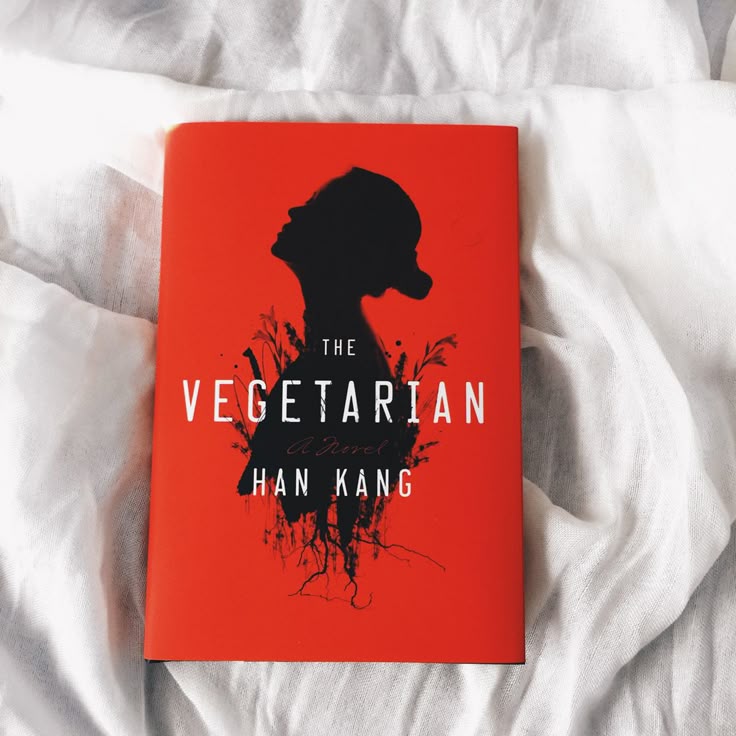
The Vegetarian by Han Kang
A haunting and surreal novel that explores one woman’s quiet rebellion against societal expectations. I’ve heard it’s unsettling and beautiful all at once.
Pinterest
The Stationery Shop by Marjan Kamali
I am a big fan of historical fiction, and this one is about love and loss set against the backdrop of political upheaval in 1950s Tehran. I hope it’ll be the kind of book that makes yoy cry and smile in the same chapter.
Pinterest
A Tale for the Time Being by Ruth Ozeki
This book has been on my list for a while. Blending time, memory, and the interconnectedness of human experience. I think it’s going to be one of those profound, mind-opening reads that makes you think about life, time, and the way we tell our stories.
Pinterest
The Forest of Enchantments by Chitra Banerjee Divakaruni
Chitra Banerjee Divakaruni is one of my favourite authors. I love the way she writes. This is a retelling of the Ramayana through Sita’s perspective. I’m excited to experience this retelling, not just as a story, but as a reflection of womanhood, resilience, and strength.
Pinterest
More Days at the Morisaki Bookshop by Satoshi Yagisawa
I adored the first book in this series; it was gentle, nostalgic, and filled with the kind of warmth that lingers long after you’ve closed the pages. I’m expecting the same comforting experience with this one.
Marketing your summer camp successfully requires a well-rounded approach integrating digital strategies to maximize reach and engagement. With families and students searching online for the perfect summer experience, schools must stay ahead of the competition by adopting fresh, innovative methods.
This blog explores ten of the best summer camp marketing strategies to ensure your program stands out.
Struggling with enrollment?
Our expert digital marketing services can help you attract and enroll more students!
1. Leverage Content Marketing to Build Trust and Authority
You’ve probably heard this before, but we’ll say it again: Content is king! One of the most effective ways to promote your summer camp is by creating blog posts, videos, and articles about the benefits of attending your camp. This helps engage prospective attendees and parents. Highlight success stories, showcase daily camp activities, and provide insights into what makes your program unique.
The first step to creating an effective summer content marketing campaign is choosing what platforms to use. You might be wondering, “Where can I promote my summer camp?” The best places include social media sites like Facebook, Instagram, and TikTok, as well as Google Ads and YouTube for targeted paid campaigns.
Local community websites, parenting blogs, and school newsletters are effective promotional channels. Focus on building credibility and encouraging trust among parents evaluating different options.
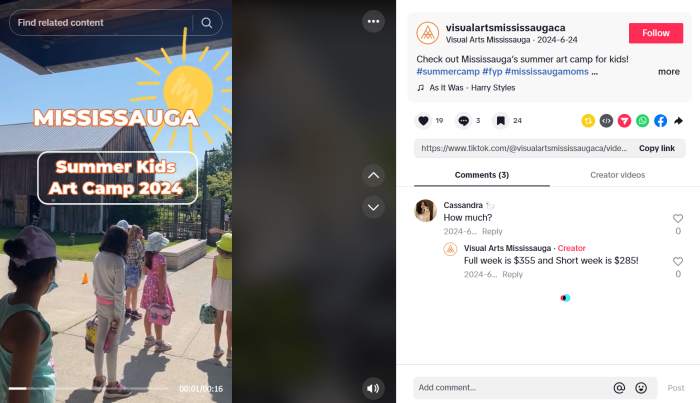
Example:Here is a simple way to garner interest in your summer camp program. Visual Arts Mississauga posts a video of the activities they provide, including studio and outdoor creative activities, a variety of themes (a new one each week), and special guests. Try filming a few brief snippets of your daily camp activities and list some of your campers’ favorite things about the experience. With minimal editing and some upbeat music, you can certainly catch the attention of a parent searching for a positive camp experience for their child. It worked for Visual Arts Mississauga!
As you can see in the comments, a parent inquired for pricing information. The great thing about social media platforms like TikTok? You can answer questions directly. Don’t forget to obtain permission from parents and campers before posting them.
Source: Visual Arts Mississauga | TikTok
2. Optimize Your Website for Search Engines
If your website isn’t optimized for search engines, you’re missing a significant number of potential campers. Search Engine Optimization (SEO) ensures that your summer camp appears when families search for programs online. By enhancing your site’s structure, improving page speed, and using long-tail keywords like “summer camp programs in (insert your location here),” you can improve visibility.
To further enhance visibility, you should optimize your summer camp program pages by structuring them with clear headings, engaging descriptions, and high-quality images of camp activities. Adding frequently asked questions (FAQs) to the page improves user experience and provides quick answers to common inquiries.
Internal linking to other relevant pages, such as registration forms or blog posts, boosts SEO by keeping visitors engaged. Additionally, integrating schema markup allows search engines to understand the content better, increasing the chances of appearing in featured snippets.
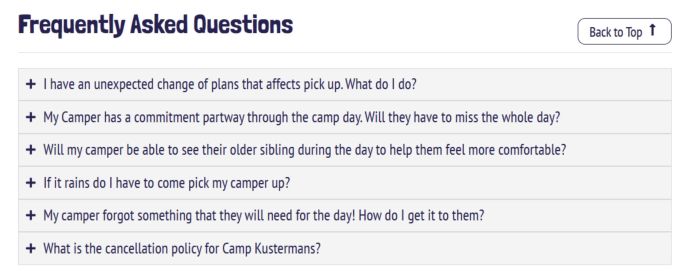
Example: This is what an FAQ section could look like on your camp landing page. Adding structured data to your FAQs increases the likelihood of appearing as a featured snippet on search engines. Be sure to use conversational language to optimize for voice search results. Don’t forget to leverage your FAQs for content planning. This is a great way to add value for site visitors – providing the answers they’re searching for in detail in more detail.
Source: Kustermans
3. Create a Strong Social Media Presence
Beyond posting regularly, an effective social media strategy involves using platform-specific features to maximize engagement. Instagram Stories and Reels allow you to share real-time updates, camper testimonials, and behind-the-scenes glimpses of camp life.
Facebook Groups can build a community of returning campers and interested parents, fostering discussion and sharing updates. TikTok offers a creative space to showcase fun camp activities through short, engaging videos that appeal to younger audiences.
Additionally, paid social media advertising is a great way to extend your reach. By running targeted ad campaigns on platforms like Facebook and Instagram, you can ensure your summer camp marketing efforts reach families actively looking for programs.
Geo-targeting and interest-based targeting allow you to refine your audience, ensuring your ads reach parents who are most likely to enroll their children. Running contests and giveaways on social media can also increase engagement and word-of-mouth promotion as parents and campers share your content with their networks.
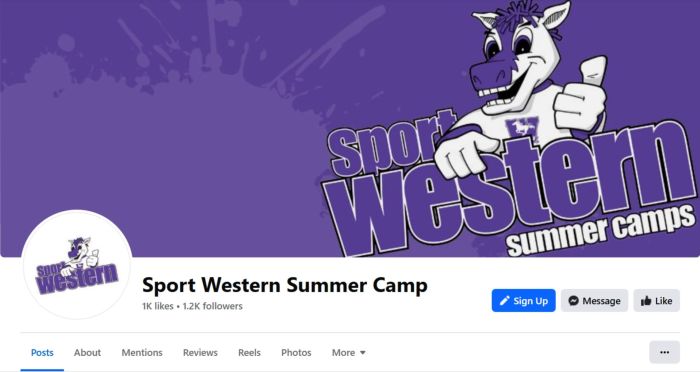
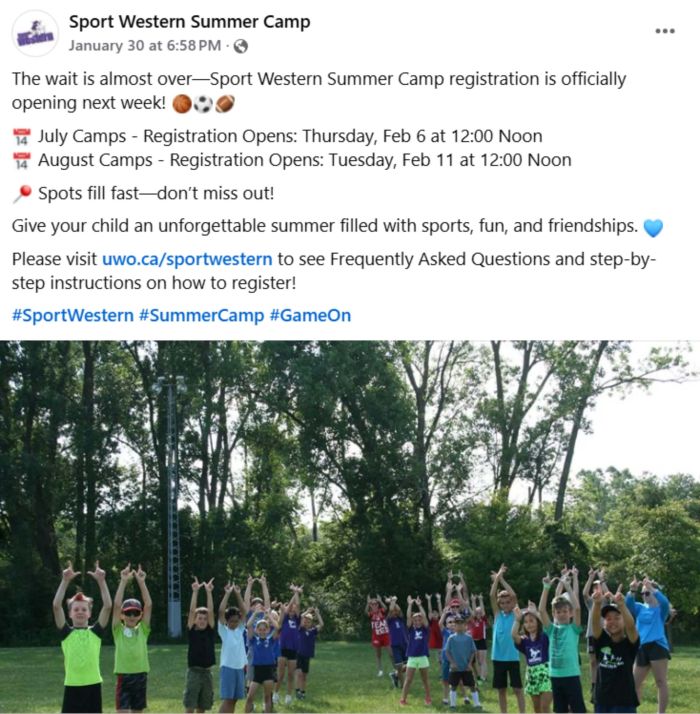
Example:Here, Western University uses its active Facebook page to maintain a strong presence, notify parents of important dates, build anticipation for the summer, and show off all of the fun activities in store. Their page features consistent branding setting them apart from other school summer camps.
Source: Sport Western Summer Camp | Facebook
4. Utilize Email Marketing Campaigns
Email marketing remains a powerful tool for reaching prospective campers and their families. Sending out newsletters with enrolment updates, discounts, and testimonials keeps your audience informed and engaged.
An effective email marketing strategy involves segmentation, where prospective families are grouped based on their engagement levels, preferences, and past interactions. You can ensure that each recipient receives relevant messaging by tailoring content to different segments, such as new inquiries, returning campers, and families who haven’t yet completed registration.
Drip email campaigns are particularly valuable for nurturing leads. These automated sequences gradually provide information about your camp, from program details to testimonials, making it easier for parents to commit. Additionally, incorporating visually appealing emails with compelling subject lines improves open rates and engagement.
5. Targeted Digital Advertising Campaigns
Traditional advertising is still effective, relevant, and part of a well-rounded marketing campaign. “How do I advertise my summer camp?” you ask. To advertise your summer camp using targeted ads, leverage platforms like Google Ads, Facebook, and Instagram to target parents actively searching for summer programs. By utilizing geo-targeting, interest-based segmentation, and retargeting campaigns, you can maximize ad visibility, drive inquiries, and increase enrolment conversions efficiently.
Google Ads enables your summer camp to appear at the top of search results when parents look for camp programs, increasing visibility. Running display ads and retargeting campaigns ensures that those who have previously visited your website are reminded of your offerings, improving conversion rates. Additionally, YouTube Ads allow you to showcase engaging video content of camp activities, testimonials, and program highlights to attract more interest.
Facebook and Instagram Ads offer detailed audience segmentation tools, allowing you to reach parents based on location, interests, and browsing behavior. Carousel, video, and story ads create immersive experiences that engage prospective campers and their families. To further boost engagement, A/B testing different ad creatives and copy variations helps refine messaging to determine what resonates best with your audience.
A/B testing involves creating multiple versions of an advertisement, landing page, or email to determine which version performs best. In digital advertising, A/B testing can compare different ad headlines, images, calls to action, and audience targeting strategies.
Advertisers can analyze performance metrics such as click-through rates (CTR), conversion rates, and engagement levels by running multiple variations simultaneously. The winning version can then be scaled for maximum impact, ensuring your budget is allocated to the most effective ad variations.
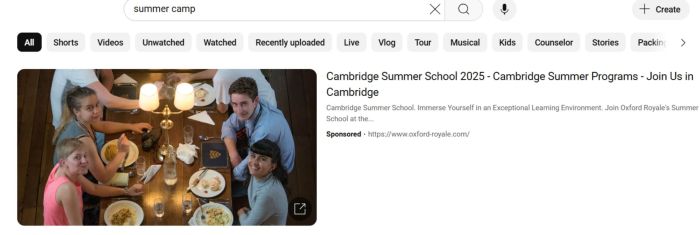
Example: When you invest in YouTube ads like the one pictured below, you can show up at the top of the platform’s summer camp search results and greatly expand your reach.
Source: YouTube
6. Encourage Camper and Parent Testimonials
Word-of-mouth remains a powerful marketing tool. Encouraging past campers and their parents to leave reviews on Google, Facebook, and your website adds credibility to your program. Video testimonials are particularly effective at providing an authentic look into the camp experience. Families researching camps trust peer reviews, and showcasing positive experiences helps establish trust and attract new registrations.
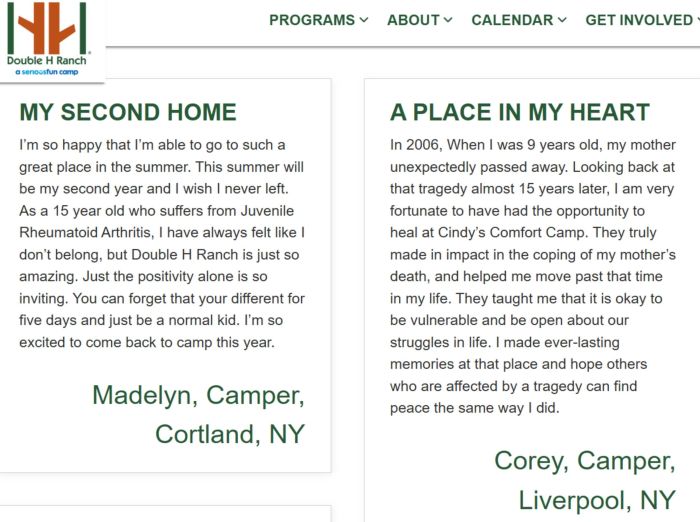
Example:Encourage happy campers to leave high-value testimonials highlighting how your program has positivly impacted their lives. The two pictured below are excellent examples of moving word-of-mouth endorsements that improve your program’s public reception and potentially incite desired action.
Source: Double H Ranch
7. Develop an Ambassador Program
Leveraging past campers as ambassadors can create a community-driven summer camp marketing effect that builds long-term brand loyalty. Encouraging past attendees to share their experiences and recommend your camp to friends and family fosters authentic promotion.
One of the most effective approaches is a structured referral program, where returning campers receive discounts or perks when they bring a friend. Offering rewards such as camp merchandise, VIP experiences, or exclusive access to special activities can further incentivize participation.
When working with minors as ambassadors, schools should obtain parental consent, follow child privacy regulations such as COPPA, and ensure that all promotional activities align with ethical guidelines to protect student identity and well-being.
Beyond peer referrals, partnering with local influencers, parenting bloggers, and community leaders can significantly amplify your reach. Inviting these ambassadors to visit your camp, create content, and share their experiences with their followers can increase visibility among parents searching for reputable programs. Providing them with branded hashtags, social media templates, and storytelling prompts ensures consistent and compelling messaging.
To sustain engagement, camps should maintain an ongoing relationship with ambassadors by featuring them in newsletters, social media posts, and alumni spotlights. Creating private groups or online communities for ambassadors fosters a sense of belonging and motivates them to continue advocating for your camp. Implementing an easy-to-use referral tracking system helps measure success and refine strategies for maximum impact.
8. Highlight Your Camp’s Unique Selling Points (USPS)
In a competitive summer camp market, it is crucial to clearly define and communicate your camp’s unique selling points (USPs) to stand out from the rest. Parents and campers have many choices, so highlighting what makes your camp different will help you attract the right audience and increase enrolment.
A USP is a distinct feature or quality that sets your camp apart. To effectively market your camp, you must identify and promote these features across your website, social media, and advertising campaigns. Below are some strong examples of USPs that summer camps can highlight:
Specialized Programs
Small Camper-to-Counselor Ratio
Exclusive Locations
Highly Qualified Staff
Customizable Camp Experiences
Unique Themes or Storylines
Exclusive Partnerships
All-Inclusive Pricing and Amenities
Once you’ve identified your USPs, ensure they are featured prominently on your website homepage, camp brochures, social media posts, and digital advertising. Use testimonials from past campers and parents to reinforce the uniqueness of your offerings.
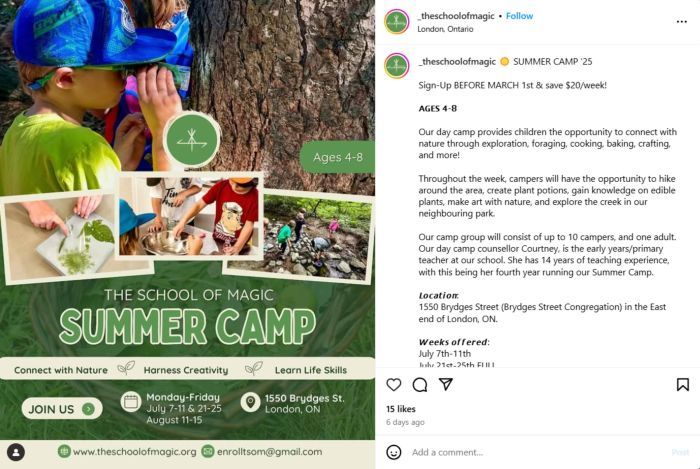
Example: The School of Magic is unique because of its emphasis on connecting with nature and developing real-world skills. Those unique selling points are evident in the Instagram post below. What sets your summer camp program apart?
Source: The School of Magic
9. Partner With Schools and Community Organizations
Collaborating with schools and local community centers broadens your marketing reach. Schools can distribute flyers and email newsletters promoting your camp, while community organizations can help you reach families looking for summer activities. Building partnerships with educational institutions ensures that your camp gains credibility and visibility in trusted spaces where families make enrolment decisions. Create a buzz around any partnerships in your content across various platforms.
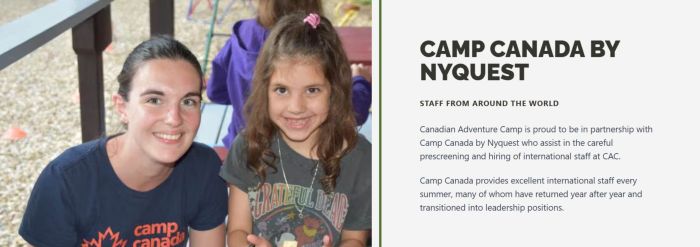
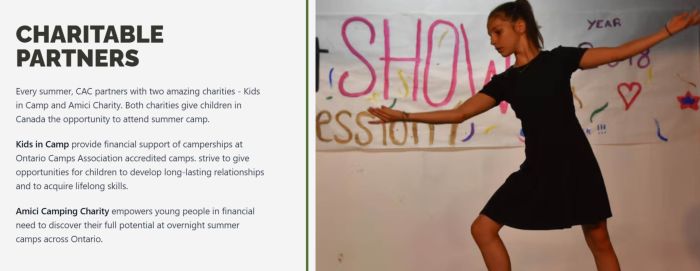
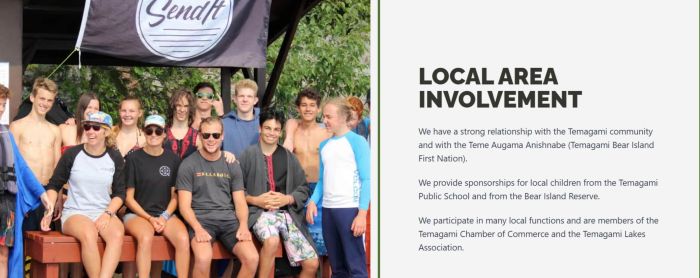
Example: On its website, the Canadian Adventure Camp has a tab called Memberships and Partnerships. There, they list and explain their collaborations and community involvement, showcasing how they add value for campers, families, and those in need. If you’re collaborating with any organization or if you’re involved in charity work, be sure to highlight how you make a difference!
Source: Canadian Adventure Camp
10. Optimize Your Camp’s Mobile Experience
With more parents researching and booking camps on their smartphones, having a mobile-optimized digital presence is essential. A slow or non-responsive website can drive potential campers away, leading to lost enrolment opportunities. To ensure a seamless mobile experience, camps should prioritize mobile usability in all aspects of their digital marketing strategy.
Responsive web design is the foundation of a successful mobile experience. Your website should automatically adjust to different screen sizes, ensuring readers can easily browse your camp’s programs, pricing, and enrolment details on any device. Without this adaptability, parents may abandon their search in favor of a competitor with a more mobile-friendly platform.
Fast load times are another critical factor. If a webpage takes too long to load, parents may become frustrated and leave before completing the registration process. Optimizing images, minimizing unnecessary code, and leveraging browser caching can significantly improve site speed. Google prioritizes fast-loading websites in search results, meaning that a well-optimized mobile site can enhance your summer camp advertisement efforts by increasing visibility in search rankings.
Once a parent arrives on your site, easy navigation and registration are essential. Mobile users should be able to access key pages; such as program descriptions, schedules, and pricing, within a few taps. Registration forms should be concise, requiring only necessary information, and offer autofill features to streamline the process.
Providing click-to-call and chat features offers immediate communication options for parents with questions. A simple button allowing users to call directly from their mobile device or engage in a live chat session with a representative can make a huge difference in converting inquiries into sign-ups. Chatbots can also be used for quick responses outside of business hours, ensuring prospective campers receive the information they need when they need it.
Finally, mobile-friendly payment options make transactions seamless. Integrating secure, one-click payment solutions like Apple Pay, Google Pay, or PayPal can speed up registration and reduce drop-offs. Parents should be able to complete payment without switching devices or navigating through a complex checkout system.
Boost Your Camp Enrolment Today!
Marketing a summer camp successfully requires a well-rounded, strategic approach that meets parents and campers where they are—online! By leveraging SEO, content marketing, social media, email campaigns, paid advertising, and mobile optimization, you can increase visibility, boost engagement, and ultimately drive more enrolments. Highlighting your camp’s unique selling points, developing a strong ambassador program, and ensuring a seamless mobile experience will set your camp apart in a competitive market.
With the right mix of digital marketing techniques, your summer camp can attract the right audience and maximize registrations year after year. Whether refining your summer camp advertisement strategy, improving your website, or launching targeted ad campaigns, a data-driven approach ensures long-term success.
At Higher Education Marketing, we specialize in helping camps and educational institutions implement proven digital marketing strategies that deliver results. If you’re ready to take your summer camp marketing to the next level, reach out to us today to learn how we can help you achieve your enrolment goals.
Struggling with enrollment?
Our expert digital marketing services can help you attract and enroll more students!
We are excited to announce the all-new EdTechTeacher Summer Learning Pass for 2023! Educators familiar with our last 20 years of high-quality workshops can now access EVERY workshop held this summer with one low-cost membership of $195. We are conducting 12 amazing workshops over six weeks that consist of three live one-hour webinars and a host of helpful resources.
Join us live for instruction and discussion or watch recorded sessions later, whatever works best for your summer schedule! Workshops are designed for teachers of all grade levels, instructional coaches, curriculum coordinators and school leaders. Learn more and register here! (PDF VERSION OF SUMMER FLIER HERE)
While studying abroad in Rome, I not only experienced the super touristy spots, but I also had the opportunity to live like a local and explore the hidden gems of Rome. Here are my top five things to do in Rome (although there are a lot more!).
Source: https://tinyurl.com/y7837cce
Explore The Monuments
A trip to Rome isn’t complete without visiting all of the historical Roman landmarks, no matter how touristy – and crowded – they can get. From the Pantheon to the Colosseum, the Roman Forums, and the Spanish steps, there is an abundance of sights to see in Rome, and it never gets old experiencing ancient, Roman history. Make sure to watch your belongings carefully, however, as pickpockets are abundant in crowded, touristy areas.
Source: https://tinyurl.com/ydf2jb6t
Bike Around Villa Borghese
A hidden, Roman gem I learned about – although it is still a bit touristy – is biking in Villa Borghese. You can bike around the gardens, stop for a picnic lunch in the grass, and walking through numerous museums and buildings. It is also close to many of the other monuments in Rome, making it easily accessible.
Source: https://tinyurl.com/yd6l273b
Visit Trastevere
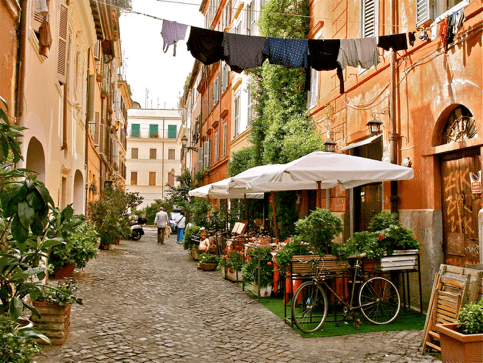
One of my favorite places in Rome is the neighborhood of Trastevere. From the cute little shops to the amazing restaurants, this area of a Rome is a must. Although there are many cool, and hidden, neighborhoods in Rome, I am biased as I lived in Trastevere and fell in love. I would highly recommend starting in la Piazza di Santa Maria – which is located right by the famous Santa Maria church – and walk around the area from there. This is a place you don’t want to miss!
Source: https://tinyurl.com/kwrwqbb
Travel around the Street Markets
Another highlight of Rome is the street markets. Food, produce, gifts, and other goods are sold during weekday mornings and on the weekends. One of the most popular tourist markets is in Campo dei Fiori, which has food, any kind of pasta you could think of, and local, fresh produce. It is open every morning except on Sundays. Another amazing market – for fresh veggies, fruit, fish, and meat – is the Piazza San Cosimato market, which is open every morning except on Sundays. My personal market favorite, however, is the flea market located around the Via Portuense area in Trastevere. This market has EVERYTHING you could ever need at great prices! Clothing, toiletries, sunglasses, and other goods are sold here every Sunday morning-afternoon. Again, make sure to keep your belongings close at the markets, as the high volume of people brings out the pickpockets and other petty thieves.
Source: https://tinyurl.com/ya85rk5k
EAT, EAT AND EAT!!
Of course, when in Rome you must eat! Here is a – very condensed – list of my favorite restaurants in Rome:
La Gelateria Frigidarium – a touristy, but AMAZING, gelato place (near Campo dei Fiori)
Dar Poeta – the BEST pizza I have ever had and I still dream about it (located in Trastevere)
Pimms – a great place for cheap salads and good risotto (in Trastevere)
Donkey Punch – a casual sandwich joint for a quick bite (in Trastevere)
Capa Toast – slightly touristy panini place (located in Trastevere)
Ristorante Maccheroni – a casual dinner place with some of the best pasta at great prices (in the Piazza delle Coppelle near the Pantheon)
ABOUT THE AUTHOR: Jolie Blair is a rising senior at Emory University from Sun Valley, Idaho. She is double majoring in Theater Studies and Public Health and has a passion for the arts, writing, and traveling. She studied abroad for the 2016 fall semester in Rome, Italy and had an experience of a lifetime, which she loves to share with those who want to listen (and even those who don’t like her 140lb Great Dane!).