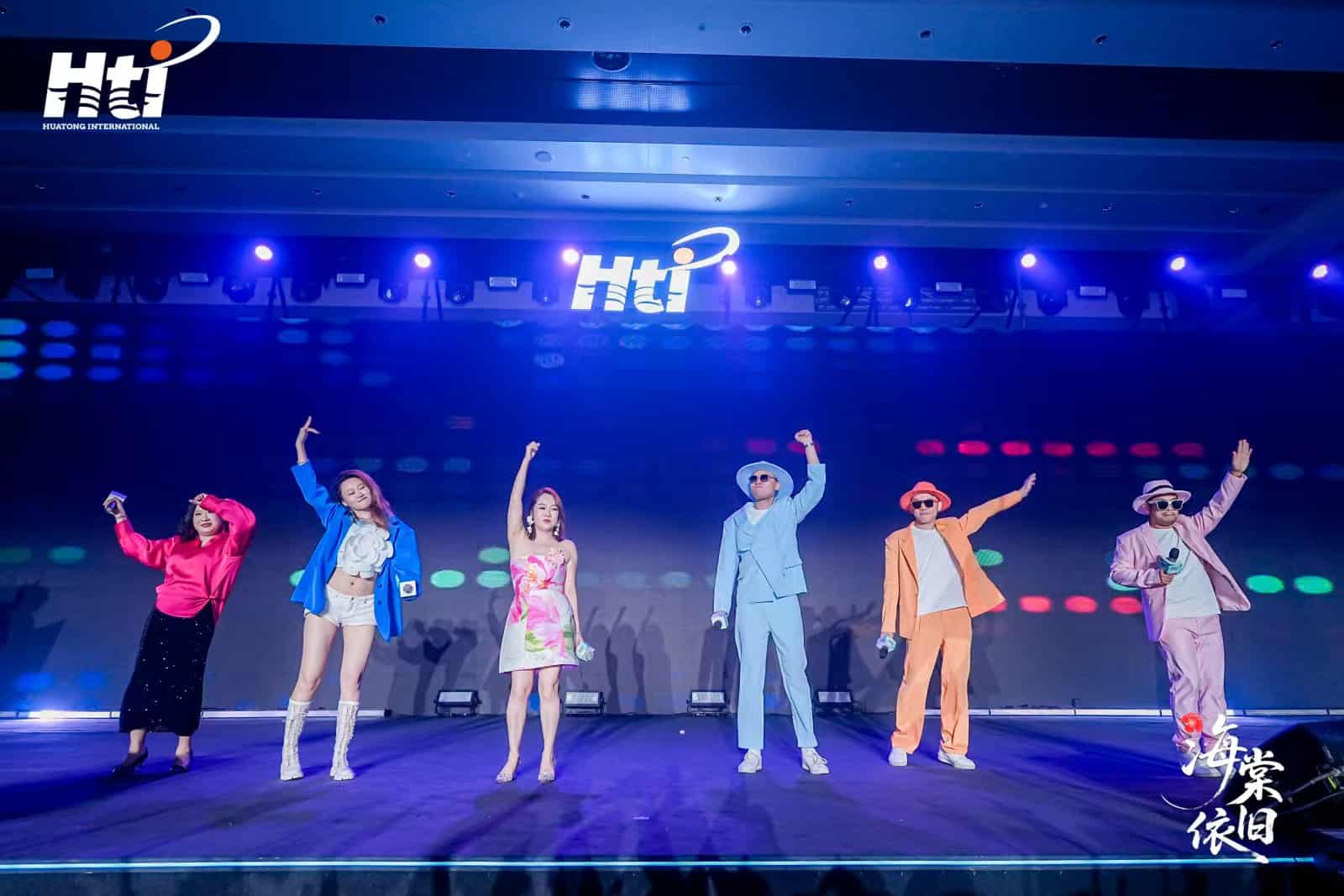
If you’ve scrolled through LinkedIn lately, you may have seen something that looks more like Eurovision than a typical education conference: university staff singing, recruitment agents dancing, and national teams battling it out for ‘best in show’ on a brightly lit stage in China’s tropical Sanya.
The annual summit of global recruitment and international education consultancy HUATONG International‘s (Hti Edu) has been running since 2014, originally under the iae China banner before continuing under Hti’s own branding from 2023.
The final night of the conference features performances by Hti staff, university representatives and country teams from the UK, Australia, Canada and other destinations. Acts range from institution-led and mixed national groups to collaborations with professional musicians.
“The social bonding aspect is a strong focus of the event as we strive to forge cross cultural understanding and friendships that transcend pure business. Hti has always espoused that relationships make partnerships,” explained Mark Lucas, Hti’s senior vice president of global partnerships and business development.
“It is hugely popular with the attendees and very competitive between the country-based acts in a ‘frenemies’ way, as each country tries to take the honours of the ‘best in show,’” said Lucas.
“The event is held near the end of the year and all attendees from Hti’s amazing team to the channel partners, institutions and service providers work incredibly hard throughout the year – this is chance to unwind, meet people from around the world and embrace the diversity and talent that is so evident and present in the world of International education.”
For Lucas, the entertainment is not a distraction from business – it is part of it.
This is chance to unwind, meet people from around the world and embrace the diversity and talent that is so evident and present in the world of International education Mark Lucas, HUATONG International
“We are very good at blending a serious, relevant and very full educational and business format with meaningful and fun social events. We are unusual in the fact that the social and performance aspect of the summit has become a very pivotal part of the whole event,” said Lucas.
Alongside the spectacle sits a packed program of policy and professional content, from embassy-led visa briefings and destination updates to sessions on transnational education, AI, employability and wider sector shifts.
The summit now draws around 1,000 delegates – including 600 hand-picked recruitment partners from across China, alongside universities, service providers and government officials from major study destinations.
“For our channel partners, an invite to the summit is awarded based on their efforts. It is very competitively sought after and as they tell us each year, often the highlight of their year.”
The same applies to institutions: because total attendance is capped, only around 150 institutions, service providers, and commercial partners are invited to the summit. As a result, many lock in their place for the next event as soon as the current one ends.
According to Lucas, the event seeks to provide a platform to allow for the organisation’s priority partner institutions to directly engage with its channel and recruitment partners in a “controlled training and social context” – noting that this approach was “not the norm for B2B businesses.”
“Hti takes a very different approach and trusts that our priority partner institutions will not seek to work directly with our extensive network of channel partners and creating an opportunity to bring their key advantages and sector positioning directly to a select group of 600 channel partners.”
Alongside universities, the summit also brings together the wider service ecosystem that supports international students, including finance, health insurance, testing and accommodation providers.
KISSIMMEE, Fla. — It’s not a rebrand. But the Moms for Liberty group that introduced itself three years ago as a band of female “joyful warriors” shedding domestic modesty to make raucous public challenges to masks, books and curriculum, is trying to glow up.
The group’s national summit this past weekend at a convention center outside Orlando leaned into family (read: parental rights), faith — and youth. The latter appeared to be a bid to join the cool kids who are the new face of conservatism in America (hint: young, Christian, very male), as well as a recognition of the group’s “diversity,” which includes grandparents, men and kids.
But even as the youth — including 20- and 30-something podcasters and social media influencers, as well as student members of the late Charlie Kirk’s Turning Point USA — brought a high-energy vibe, stalwart members got a new assignment. Where past Moms for Liberty attendees were urged to run for school board, this year they were encouraged to turn their grievances into legal challenges.
Moms for Liberty CEO and co-founder Tina Descovich acknowledged that while many of them had experienced backlashes as a result of running for school board or publicly challenging books, curricula and policies, they needed to continue the fight. (The more pugnacious co-founder, Tiffany Justice, is now at Heritage Action, an arm of right-wing think tank The Heritage Foundation.)
“You have lost family, you have lost friends, you have lost neighbors, you’ve lost jobs, you’ve lost whole careers,” she said. Yet she insisted that it was vital that they “shake off the shackles of fear and stand for truth or we are going to lose Western civilization as a whole.”
Related: Become a lifelong learner. Subscribe to our free weekly newsletter featuring the most important stories in education.
The gathering held up “the free state of Florida” as an example of Republican policies to be emulated, including around school choice and parental rights. The state’s attorney general, James Uthmeier, boasted of having created a state Office of Parental Rights last spring, describing it as “a law firm for parents.”
He trumpeted the state’s lawsuit against Target over the “market risks” of LGBTQ+ pride-themed merchandise and encouraged parents to reach out with potential legal actions. “If you’re identifying one of these wrongs that’s violating your rights and then subjecting our kids to danger and evil, then we want to know about it,” he said. “And we’re going to bring the heat in court to shut it down.”
Tina Descovich, CEO and co-founder of Moms for Liberty, was interviewed on Real America’s Voice, a conservative news and entertainment network that set up a remote studio outside of the Sun Ballroom at the Moms for Liberty national summit. Credit: Laura Pappano for The Hechinger Report
The shifting legal landscape, not just in Florida but nationally, had speakers gushing about the opportunity to file new challenges, particularly in the wake of the Supreme Court decision in Mahmoud v. Taylor in June. It gives parents broad power to object to school materials, including with LGBTQ+ themes, and the right to remove their children from public school on days when such materials are discussed.
“This is where we need to take that big Supreme Court victory and start fleshing it out,” said Matt Sharp, senior counsel at Alliance Defending Freedom, a Christian law firm. He added that they were “needing warriors, joyful warriors, to file cases to start putting meat on the bones of what that does.”
The directive to file suit was not just around opt-out policies, which were the basis for the Mahmoud case. (Moms for Liberty has opt-out forms and instructions on its website.) Rather, attendees were also urged to file lawsuits in support of school prayer; against school policies that let students use different names and pronouns without parental consent (what Moms for Liberty terms “secret transitions”); and to give parents access to surveys students take at school, including around mental health.
“We need people willing to stand up legally and be, you know, named plaintiffs,” Kimberly S. Hermann, president of the Southeastern Legal Foundation, a conservative policy group, said on a panel featuring two moms who sued their school districts. Winning a lawsuit or even just bringing one in one state, said Hermann, can get other school districts and states to adopt policies, presumably to avoid lawsuits themselves.
“One offensive litigation can have this amazing ripple effect,” she said. She and others made clear that there is staff to provide support. The legal groups will “stand with you,” said Sharp, “whether you’re passing the law or passing the local policy all the way to litigating these cases.”
Even as speakers criticized public schools particularly around LGBTQ+ issues, not as a form of inclusion but as foisting views into classrooms, they relished the chance to infuse their values into schools.
Filing these lawsuits is more than “just fighting for your role as parents,” Sharp told parents in a breakout session. “You’re ultimately fighting for your kids’ ability to be in their schools and make a difference, to be the salt and light in those classrooms with their friends and to take our message of freedom, of faith, of justice and to really spread it all across the schools.”
Overall, this year’s Moms for Liberty event lacked the obvious drama of recent years. The flood of protesters in 2023 in Philadelphia required a large police presence and barricades around the hotel, along with warnings not to wear Moms for Liberty lanyards on the streets.
This year, there were no protests. That was partly because the event was held in a secluded resort convention center that could accommodate 800 (larger than the 500-ish of past hotels). But the group failed to fill the venue or attract much media attention. There was on-location broadcast by Real America’s Voice, a conservative news and entertainment network, from a set outside the Sun Ballroom. (Steve Bannon interviewed Descovich on his show, “The War Room.”)
It also didn’t draw opposition because protesters had a bigger target. Saturday saw “No Kings” rallies across the country, with thousands decrying what they see as President Donald Trump’s authoritarianism. “I forgot it was happening since they’re mostly ignored these days,” state Sen. Carlos Guillermo Smith, (D-Orlando) and a senior advisor to LGBTQ+ rights group Equality Florida, said in a text message about the Moms for Liberty event. Liz Mikitarian, founder of the national group, Stop Moms for Liberty, which is based in Florida, said the moms “are still a threat” but not worth organizing a protest against.
It was also a quieter affair than last year’s in Washington, D.C. There, Trump’s appearance fed a party atmosphere with Southern rock, sequined MAGA outfits and a cash bar. (This year, Trump appeared, but only in a prerecorded video message.)
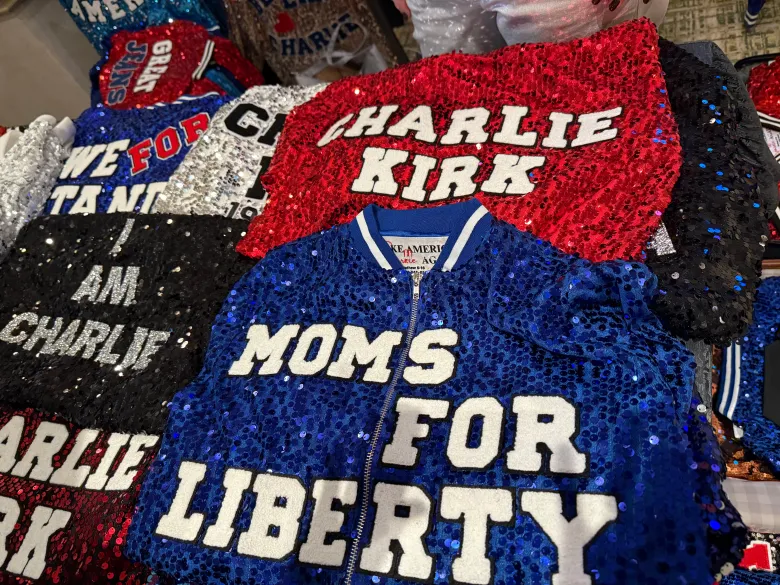
Sequined merchandise for sale at the Moms for Liberty gathering by the company Make America Sparkle Again included tops and jackets that paid tribute to Charlie Kirk, the slain founder of Turning Point USA. Credit: Laura Pappano for The Hechinger Report
The three-day event, of course, aired familiar grievances in familiarly florid language — conservative school choice activist Corey DeAngelis railed against teacher unions over the “far-left radical agenda that they’re trying to push down children’s throats in the classroom.” Other sessions covered the expected — the alleged dangers of LGBTQ+ policies, in sports, restrooms, school curricula and books — but there was also discussion of concerns (shared on left and right) over youth screen use, online predators and artificial intelligence.
The event made room for MAHA, the Make America Healthy Again movement led by Robert F. Kennedy Jr., the secretary of Health and Human Services. Descovich interviewed Dr. Joseph Ladapo, the Florida surgeon general who is working to eliminate all vaccine mandates for the state’s schoolchildren.
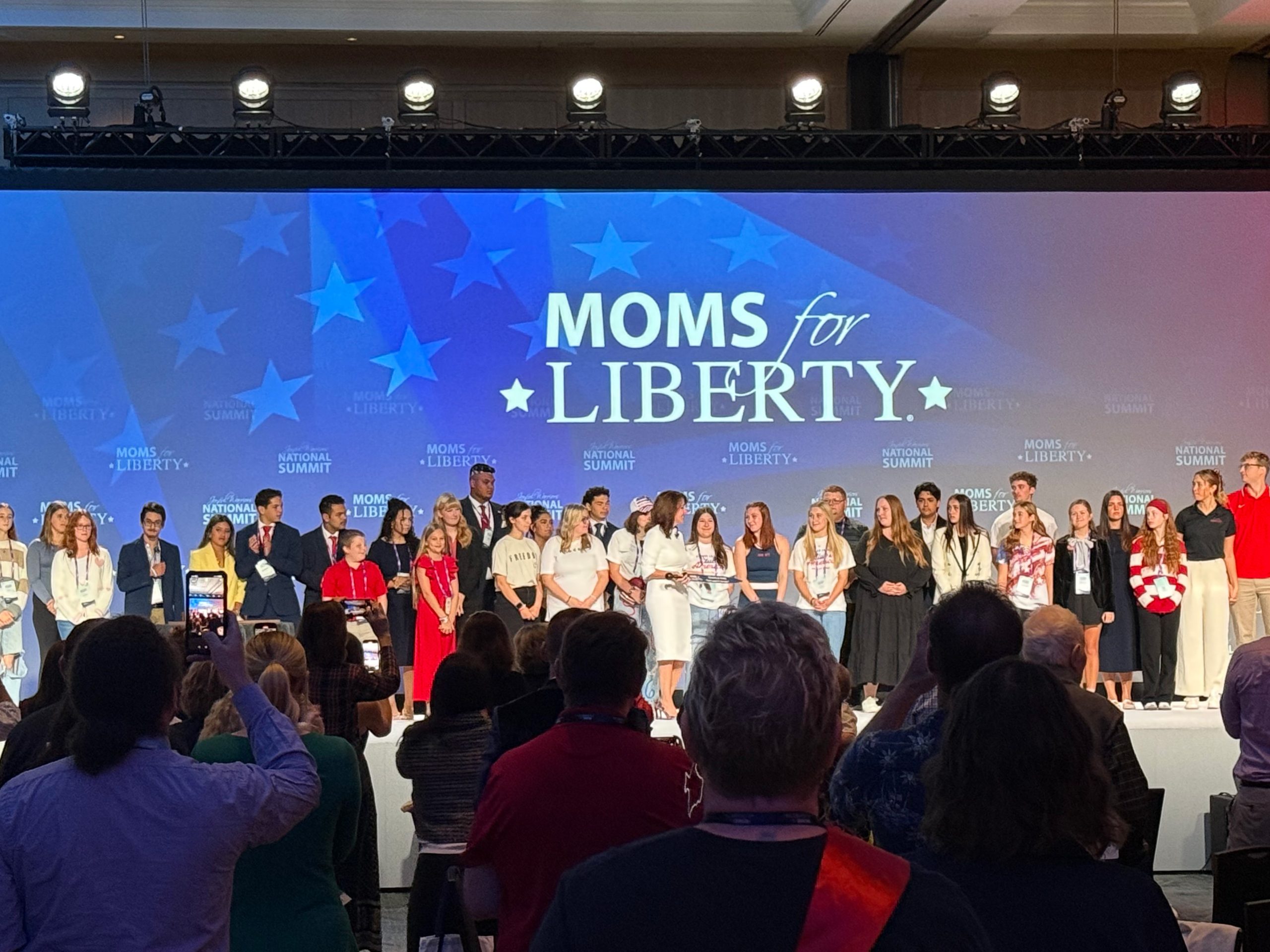
But the move by Moms for Liberty to attract young conservatives elevated the energy in the room. It was apparent not only in a tribute to Kirk, the slain founder ofTurning Point USA, which trains young conservatives on high school and college campuses. About 40 Florida TPUSA members took the ballroom stage to accept the “Liberty Sword,” the group’s highest honor, posthumously awarded to Kirk.
It also showed up in a breakout session of mostly conservative social media influencers and podcasters who offered tips on using humor and handling online trolls: Lydia Shaffer (aka the Conservative Barbie 2.0), Alex Stein, Gates Garcia, Kaitlin Bennett, Angela Belcamino (known as “The Bold Lib,” who said she was surprised to have been invited), and Jayme Franklin, who in addition to her podcast is the Gen Z founder of The Conservateur, a conservative lifestyle brand that The New Yorkercalled “Vogue, But for Trumpers.”
They have built huge followings based on their compulsion to provoke. “We need to go back to biblical values of what it means to be a real man and what it means to be a real woman,” urged Franklin. “People want that guidance, and that needs to begin at church. We need to push people back into the pews.”
Their inclusion, like that of conservative commentator Benny Johnson, who moderated a panel, “Fathers: The Defenders of the Family,” appeared to recognize a need to expand the base — and be edgier. Johnson charged out on stage and trumpeted that “God’s first commandment to us was, ‘Go, be fruitful, multiply.’ Go make babies!!!!” He quipped that “right-wing moms, they’re happier, right?” and asked the crowd, “Any trad wife moms out there?”
The phrase is shorthand for a woman who embraces a traditional domestic role, often with an emphasis on fashion and style. Johnson — who credited Kirk for prodding him to find Jesus, get married and become a father (he has four children) — argued that Republicans, especially those in Gen Z, should embrace the traditional nuclear family identity as a winning political move.
“We are the party of parents. We are the party of children,” he said, adding that traditional values were already dominating culture and politics. “We live in a center-right country. And I’m tired of pretending that we don’t,” he said, and showed a map of red and blue votes in the 2024 presidential election. “This is the shift. You live in a red kingdom.”
Contact editor Caroline Preston at 212-870-8965, via Signal at CarolineP.83 or on email at [email protected].
The Hechinger Report provides in-depth, fact-based, unbiased reporting on education that is free to all readers. But that doesn’t mean it’s free to produce. Our work keeps educators and the public informed about pressing issues at schools and on campuses throughout the country. We tell the whole story, even when the details are inconvenient. Help us keep doing that.
The University of Maine cancelled its annual summit on floating offshore wind power as federal support for renewable energy wanes, Maine Publicreported.
The university decided against holding the American Floating Offshore Wind Technical Summit, or AFLOAT, “in recognition of changing federal policies and priorities,” university spokesperson Samantha Warren said in a statement. The university’s Advanced Structures and Composites Center has hosted the summit since 2020.
The state of Maine came out with an energy plan this year that includes offshore wind as a pivotal part of meeting renewable energy goals. But the Trump administration has shown opposition to such projects—the federal government suspended a $12.5 million grant to the University of Maine’s floating offshore wind power program this spring. The university nonetheless moved forward with the grant project, launching an experimental floating wind turbine a month later.
The university has no plans at this time to revive AFLOAT in the future, Warren told Maine Public. But the university plans to hold private meetings with relevant parties, like industry, research and government leaders, “given growing interest in commercializing its cutting-edge technology, which has promising applications that advance the nation’s economy and security well beyond ocean energy.”
It is already 93 degrees, but temperatures are rising further outside the Tampa Convention Center—especially for the young man dressed in a dinosaur costume. Also sporting a Tom Brady Tampa Bay Buccaneers jersey, he is loudly debating immigration with another young man in a smart suit on the pavement. Across the street, a handful of protesters face off against a growing number of right-wing influencers with cameras.
Inside the building, political strategist Steve Bannon is denouncing billionaire Elon Musk as “evil” while filming a live TV broadcast. Thousands of young college students cheer when border czar Tom Homan threatens to beat up a heckler in the crowd. And a YouTuber leads the audience in a mass “Trump dance party” to the tune of YMCA.
Welcome to the Student Action Summit 2025. Organized by youth activist organization Turning Point USA (TPUSA), the three-day annual conference is billed as the premier event for conservative college students to debate ideas, network and hear from top Republicans. They include Tucker Carlson, Donald Trump Jr. and, of course, Charlie Kirk, who founded the movement as an 18-year-old college dropout.
More than 5,000 people attended this year’s event in Florida, held July 11–13, and Times Higher Education was there to learn what matters to college conservatives today, what issues are dividing this branch of the MAGA movement, and whether this youthful “red wave” can reshape U.S. electoral politics.
As a countdown clock ticks down to zero, a DJ pumps up the well-dressed young crowd—advised to style themselves after Donald Trump’s permanently besuited youngest son Barron—with Rednex’s Cotton Eye Joe and The Killers’ Mr. Brightside. Along with the big hitters, students also hear from Happy Gilmore actor Rob Schneider, founder of the Dark Web marketplace Silk Road, Ross Ulbricht, and fitness trainer Jillian Michaels across an eclectic and often bizarre three days.
Kirk’s fingerprints are all over the summit. Owing to the slightly chaotic nature of the schedule, he is often timetabled to appear in two places at the same time—particularly tricky given that, as the podcaster Dan Nunn puts it, “Charlie can’t even walk around: he’s like a rock star.”
He kicks off the summit on the vast East Hall stage by hitting some issues that Republicans of all ages can agree on—namely, religion and immigration. The 31-year-old activist and podcaster praises the audience for helping reverse decades of declining church attendance (many of them attend a service in the Convention Center on Sunday morning) and for helping TPUSA fight the “spiritual sickness throughout the West.” Talks are regularly interrupted by football-style chants of “Christ is King” or “God is great.”
Kirk also gets loud acclaim when he says that no foreigner should be allowed to own a home or get a job before a U.S. citizen, and draws an even bigger cheer when he mentions President Trump’s plans for mass deportation of illegal migrants. Even legal migration comes under fire over the convention weekend, and Homan, the former chief of Immigration and Customs Enforcement (ICE), is treated like a rock star, his frequent mentions of buzz phrases such as “send them home” chanted back to him from the floor.
Abortion is mentioned on stage, as one might expect. Riley Gaines, a former college swimmer who became an activist after finishing tied for fifth in a race with a trans woman, praised Trump as the most pro-life president in modern history. And the issue is brought up repeatedly in interviews with THE—often by young men.
Many speakers are also very keen to stress the importance of reproduction and “traditional” families. Michael Knowles, a political commentator and YouTuber, calls falling birth rates in the U.S. an “existential crisis.” He welcomes the “trad wife” trend on social media—right-wing women promoting their role as stay-at-home moms—and praises young women for rejecting the corporate rat race, “to the horror of the feminists.” A middle-aged audience member, who gets a massive round of applause when he reveals he has 12 children, wants to help convince the college generation of the “beauty of big families.”
Kirk also ploughs that furrow. He tells the audience that the real threat to the U.S. is not racism or environmentalism, but low birth rate. And he tells those listening online what they are missing out on by not being there in person. “If you want to find your future husband or wife … you should be here in Tampa, Florida, because there’s a lot of eligible bachelors and bachelorettes here.”
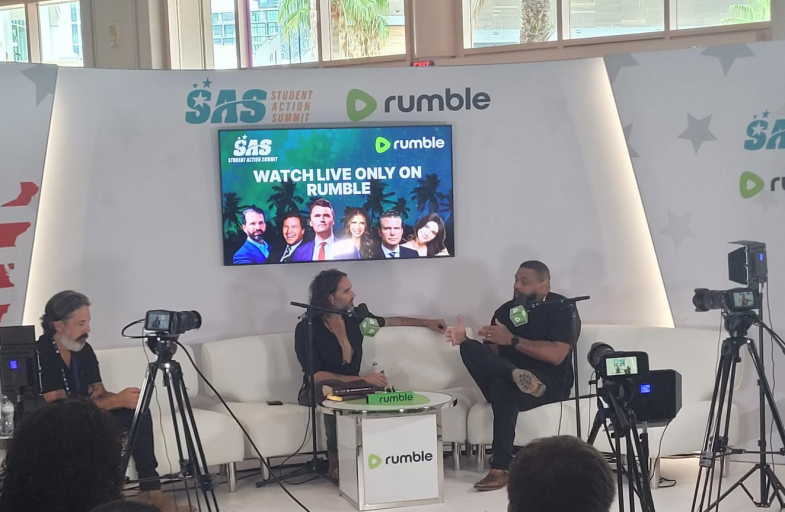
Equally, however, conservative attitudes to dating and sex are evident. Brandon Tatum, a former college football player, police officer and now online activist, advises against “hooking up with people and doing all this crazy stuff.” Brett Cooper, a child actor turned online activist, warns delegates not to party too much or waste time playing video games. And comedian Russell Brand, currently awaiting trial in the U.K. for rape, sexual assault and indecent assault (he has pleaded not guilty), also praises family values and religion while denouncing pornography and claiming that Jesus was opposed to bad government. During his strange 20-minute speech-cum-rap in front of one of the largest audiences of the weekend, Brand explains how he turned to God following a life of crack and heroin addiction, a “pursuit of carnality” and an “all-you-can-eat buffet” of hedonism.
Source: Patrick Jack
Russell Brand (center) at the Turning Point USA Student Action Summit 2025
Away from the main hall lies the exhibition floor. Here, students can take selfies with political consultant Roger Stone—pardoned by Trump in 2020 after being convicted of lying to Congress, obstruction of justice and witness tampering relating to a Congressional inquiry into Russian attempts to boost Trump’s 2016 election campaign. They can also pick up free copies of a book on the “untold story behind the Vatican’s rising influence in America,” challenge their friends to a pull-up contest or play cornhole.
You can also buy just about anything—provided it has some red, white and blue on it. There’s a stall to “Make Coffee Great Again,” “Trump 2028” hats are on sale for $30 (£23), and there are even cool pads to keep your head cool under them—as well as vibration plates for “advanced whole-body vibration therapy.”
Attendees can also hear from a wide range of fringe groups. A “Blexit” stall promotes “free thinking and empowerment” at historically black colleges and universities and is dedicated to bringing “traditional American principles to urban communities.” Wilbur Sims, strategic manager of student movement at Blexit, said, “We’re trying to educate people …and get away from a victimhood mentality within the black community.”
A surprisingly large number of families, many with young children, mingle with the students, as do some retirees. Steve, a 75-year-old lifelong Republican from Florida, hopes that TPUSA can help ensure the Democrats never get back into power. But there are a few signs of a divide between the younger and older generations.
Guns, which receive very few mentions from the stage, are one. Gun ownership has, for generations, been a mainstay of right-wing identity, but two lonely young men at the National Rifle Association stall express concern that their classmates are not interested in the Second Amendment (the right to bear arms).
The other dividing line is Israel. The most prominent stall on the exhibition floor is that of the International Fellowship of Christians and Jews (IFCJ), featuring hundreds of Israeli flags. Some college students nearby pose for pictures with a giant cardboard cut-out of Israeli prime minister Benjamin Netanyahu, but when Michele Bachmann, a former member of Congress and board member of the IFCJ, begins to discuss the “unprecedented” amount of antisemitism on college campuses, the hall empties out. And during a debate on day three, Dave Smith, a comedian and regular guest on the popular Joe Rogan podcast, warns of the “tremendous” influence of Israel in U.S. politics. And in the wake of the U.S. attack on Iran during Israel’s recent 12-day assault on the country, Smith elicits cheers when he criticizes “neoconservatives” for starting foreign wars—in contravention of the isolationism typically adopted by “America First” advocates. One young man and woman express their skepticism of the U.S.–Israel alliance and are convinced that convicted sex offender Jeffrey Epstein was a Mossad agent.
Epstein may have died by suicide in 2019, but his presence is keenly felt at the convention. The event occurs amid the MAGA backlash to attorney general Pam Bondi’s comment that the sex trafficker’s “client list”—which, according to Musk, includes Donald Trump, but which right-wing figures are convinced contains prominent Hollywood stars and Democratic politicians—does not, in fact, exist. Despite saying that homes and jobs are more important, Kirk admits the Epstein issue still matters. And in conversation with him, journalist Megyn Kelly calls it a “scandal of the right’s making.” When she asks the audience how many of them think it is an important story, everyone puts their hand up.
Hours later, media personality Tucker Carlson devotes almost his entire 30-minute speech to the issue, while Bannon sees it as symptomatic of the problems with the “deep state.” Even former college athletes Gaines and Tatum devote considerable time to talking about Epstein—with vocal prompting from the crowd.
The TPUSA president at the University of Alabama believes the issue is so important for this crowd because Bondi’s decision not to publish any of the Justice Department’s files on Epstein fits in with their skeptical worldview and their concern that they are being “lied to,” he said.
That sense also permeates the MAGA view of COVID-19. Bannon is cheered when he claims the pandemic originated from a “Chinese Communist Party bioweapon dropped in Wuhan.” There are frequent references over the weekend to the supposedly nefarious “mask mandates,” cancelled proms and young adults’ lost years—for which Kirk calls for a national apology.
“Nobody likes being lied to, and [young people] lived through COVID in a way that adults did not,” according to Nunn, host of the America First and the constitutionalist Nunn Report podcast. “They got their social lives shut down, they got their schools shut down, and then they found out it was all bullshit.” Since they blamed the Democrats for that, he believes that universities became less efficient “leftist breeding grounds” when that cohort arrived on campus.
Chase, a student from Florida, says COVID was a big factor in pushing his generation to the right. “So many people were lied to during that period of time and it definitely brought to light the corruption in the Democratic Party,” he tells THE. TPUSA is important because it helps students learn that they cannot trust mainstream media and must “seek out your own truth.”
The pandemic is clearly still an issue for Owen, a student in Michigan, where Democratic governor Gretchen Whitmer was caught breaking public health protocols at a restaurant in 2021. “I don’t really think that what the left was pushing made rational sense to the youth vote at the time, and it still doesn’t make sense now,” he said. “It’s just the hypocrisy of it all—you’re telling me not to leave my house, yet you’re going out and having parties without wearing masks closer than six feet.” Source: Patrick Jack
A striking omission from the stages of a conference targeted at students is higher education itself—despite the fact that Trump’s crackdown on prominent universities’ funding and autonomy has previously been cheered by many figures on the right. When prompted, however, delegates express universal scorn for universities.
John Paul Leon, TPUSA chapter president at University of California, Berkeley, tells THE he is becoming increasingly worried by academia’s left-wing consensus and “moral superiority,” particularly around “discriminatory” diversity, equity and inclusion (DEI) measures. David Goodwin, president of the Association of Classical Christian Schools and co-author of Battle for the American Mind with defense secretary Pete Hegseth, says higher education is a “mess”; and while institutions should be free to do whatever they want, he believes that they should expect to forgo government funds if they choose to defy the administration’s policies in areas such as DEI or choice of research topics. And Owen, who attends a private college, welcomes Trump’s attacks on universities because they are “indoctrinating students with wrong ideas.” International students, particularly “military-age males,” should be sent home, he adds.
Carol Swain, a retired professor of political science and law at Vanderbilt University and one of the few academics at the event, also welcomes Trump’s fight with Harvard because universities have “lost sight of the original purpose” of the sector, which was to educate minds by exposing individuals to divergent viewpoints. “Now the Ivy League has lost some of its allure, I believe there’s an opportunity for some state colleges and universities and some universities that were considered less prestigious to rise just by doing what the Ivy League hasn’t done, which is educate and create an environment where you have free speech, are following the Constitution, creating opportunities, [and] not practicing discrimination,” she said.
As for the effects of research funding cuts on the academic strength of the U.S., Swain says most papers in recent decades have been “garbage.” The “people that have pushed the beliefs that minorities have been discriminated against … lowered the standards in certain fields, and the emphasis on lived experience as opposed to research and data … has hurt academic research.”
But Jennifer Burns, director of academics at Turning Point Education, does not believe universities are solely to blame, claiming that grade schools are failing to prepare students properly: “If you’re building a house and your foundation is sinking and cracking, then the frame of the house is going to be cracked. It’s not the fault of the carpenters who put up the beams, it’s the cement layers. [Students] are not trained in how to think, so they’re going into college at the whim of a radical college professor and they’re soaking that up.”
TPUSA advocates for a “classical Christian education,” and some attendees propose private, conservative Christian liberal arts colleges such as Hillsdale in Michigan, or New Saint Andrews in Idaho, as exemplars of what higher education should be. Lennox Kalifungwa, digital engagement officer at New Saint Andrews, expresses the view that “the only true education is a Christian education because Christianity has the exclusive when it comes to truth and freedom.”
“Woke” students and academics, meanwhile, are a reoccurring punching bag on the convention floor—particularly those with a specific hair color. Kirk, who rose to fame through viral videos debating with left-wing students, calls them “purple-haired jihadis,” Homan bemoans “people with purple hair and nose rings,” Tatum deplores “liberal non-binaries” and Trump Jr. condemns “raging libtards.”
Such critiques are also usually tied up with anti-trans and anti-gay language. Trump Jr., a long-time ally of Kirk, whose daughter, Kai, is a college-level golfer at the University of Miami, proudly boasts of having been anti-trans since 2017 and sees it as being a “losing issue” for the Democrats. One student tells THE that drag queens reading children stories cause “horrible developmental issues” and contribute to rising suicide rates. Knowles celebrates the Trump-imposed end of the “preposterous ideology” of trans people, calling it “deader than disco,” the cancellation of LGBTQ+ pride parades due to lack of attendance and pop musician Jojo Siwa’s announcement that she no longer identifies as a lesbian. “Nature is healing,” he says with a laugh.
A lone protester who interrupts Homan is called a “loser,” a “moron,” an “asshole” and someone who “sits down when he pees”—to huge chants of “U-S-A.” Homan, who says he “wake[s] up like a kid in a candy shop every day” as border czar, offers to fight the man before his speech is over.
Outside are a few more dissenters. A handful of middle-aged Floridians, who fear TPUSA is “indoctrinating the youth,” hold a sign that says “MAGA—Movement Against Genuine Academics”—perhaps in reference to Kirk’s creation of the Professor Watchlist, which lists scholars who “discriminate against conservative students and advance leftist propaganda.” They are soon joined by a rag-tag group of a few dozen young students, some dressed as characters from the dystopian TV show TheHandmaid’s Tale and others wearing the Guy Fawkes masks popularized by the hacker collective Anonymous. Vicky Tong, spokesperson for the Tampa Bay Students for a Democratic Society, says they want to show that not everyone in Florida supports the “sexist, homophobic, anti-trans, anti-immigrant” agenda of TPUSA.
Back inside the hall, speakers emphasize that while right-wingers are in the majority here, they are “outnumbered” on campus. Many express fear of being accused of sexual harassment or being cancelled for using the wrong pronoun. Kirk calls them “warriors” and praises them for putting up with threats and intimidation. “What they’re doing is one of the hardest things to do in the United States of America. They are deciding to be less popular on campus,” he says.
Source: Justin Sullivan/Getty Images
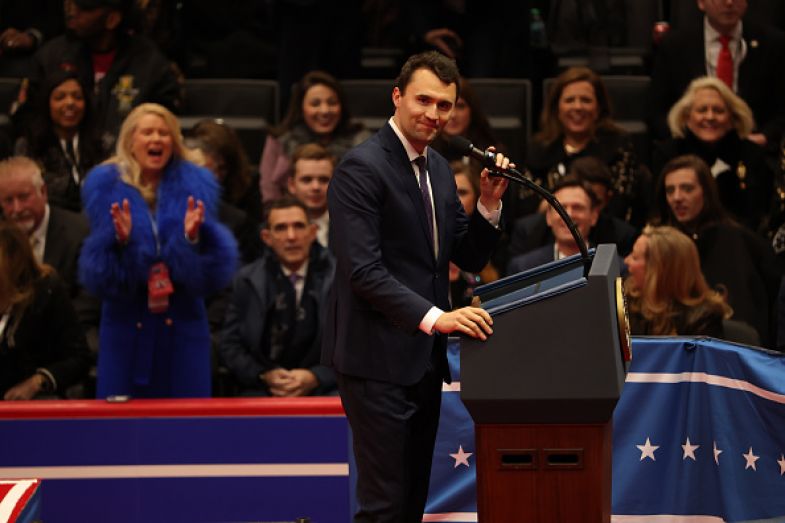
Charlie Kirk speaks at Donald Trump’s inauguration on 20 January 2025
Some of the big names can sympathize. Trump Jr. used to attend “every cool person party” in New York before his father became involved in politics and the invites dried up. “These people that I thought were friends for decades, they don’t call any more.” He encourages students to “feed off the hate,” while Kelly urges them not to be “sheep” and follow along with what their left-wing professors say just to get good grades. “Don’t call yourself a feminist because your teacher will give you pats on the head. Stand up for what you really believe in, and that’s how we spread the good word,” she said.
Fox News host Greg Gutfeld, who has come under fire for attempting to “reclaim” the word “Nazi,” complains that “left-wingers were the cool kids” when he was young. And that sense of not fitting in on campus is clearly a big reason that some of the attendees are here—many of them thanks to a TPUSA stipend (the organization is largely funded by donations). Leon, who studies in the “belly of the [progressive] beast” at Berkeley and went viral for a video where he confronts a liberal student, says he is called a fascist daily, but at TPUSA “you can find life-long friends, your forever friends, or maybe you can find your wife too.” Dylan Seiter, president of TPUSA at Texas A&M University, told students during a breakout session that “the libs want to drag us down to their level and make us seem like we’re some nasty, hateful people, but in reality, we’re not. And it’s our duty and our jobs to prove them wrong.”
Indeed, some delegates confess that they are only here to hang out and socialize, and nearby bars such as Harpoon Harry’s Crab House are packed with older students before the day’s events are even over. But this social element is not just for fun, it is also for networking. As Kirk puts it: “Marriages will happen this weekend. Lifetime friendships will happen this weekend. Careers will start this weekend.” And as well as selling “I survived college without becoming a liberal” T-shirts, the TPUSA Alumni Association is consciously attempting to replicate the college networks of Ivy League schools to help get MAGA graduates into top jobs. TPUSA also tries to persuade students to work on the “front lines” of the culture war. One recruitment video urges young people not to become doctors or lawyers, but to get a job with “real impact.”
Many speakers are convinced that they are already having an impact, crediting a “red wave” of students with delivering Trump’s landslide victory in 2024, a “shot heard around the world.” Bannon thanks them for being “the hardest core of the hardcore” and the “tip of the tip of the spear” in “winning” the 2016 and 2020 elections as well.
“This is the greatest generational realignment since Woodstock,” says Kirk. “We have never seen a generation move so quickly and so fast, and you guys are making all the liberals confused.” Accordingly, Republican Party luminaries show up in force. Michael Whatley, chair of the Republican National Committee, shakes hands on the exhibition floor and multiple members of Trump’s top team—including director of national intelligence Tulsi Gabbard and homeland security secretary Kristi Noem—deliver speeches. However, these politicians generate far less buzz than social media stars such as Gaines and Cooper.
Still, Kirk warns that Washington is taking right-wing students for granted and “messing up” a once-in-a-generation opportunity to deliver a “death blow” to the Democratic Party by failing to fully deliver on their promises—such as by publishing the Epstein list. And Swain agreed. “If these [elected] officials compromise and they prove themselves to be no different than the politicians they replaced, it’s going to be harder for [young] people to stay enthusiastic,” he said.
As one attendee puts it, conservative students have been “lurking in the shadows” for decades. Kirk has successfully dragged them out into the sunlight. The challenge he and Trump now face is one that will be familiar to the “radical left”— keeping momentum, holding the various factions together in the face of political realities, and delivering on their promises.
In an era where higher education faces unprecedented challenges and opportunities, the recent Meltwater Summit offered crucial insights for leaders navigating a rapidly changing landscape. This gathering of creative minds, brand leaders and technology experts explored the critical intersection of compelling storytelling, branding and the power of artificial intelligence. Explore strategic takeaways poised to reshape how institutions connect with prospective students, build brand equity and harness AI to drive creative processes.
Creativity Flows with You
Reese Witherspoon set the tone with an honest reflection on the nature of creativity: it’s constantly flowing but rarely on a set schedule. The challenge isn’t finding ideas—it’s cultivating the environment and carving out dedicated time for them to flourish. The solution? Clear, consistent and intentional communication. Whether you’re bridging teams or brainstorming with collaborators, creating space for dialogue is what truly transforms good ideas into great ones. At EducationDynamics, we aren’t just completing tasks; we are constantly collaborating with each of our partners to ensure we produce the best content possible. Our solutions span creative services, brand strategy, awareness marketing and more—turning inspiration into action and strategy into results.
AI: A Teammate, Not a Replacement
AI emerged as a powerful ally throughout Meltwater Summit sessions, particularly when leveraged for the content creation process. One standout tactic shared was the “sandwich approach” to content creation, a straightforward framework for combining human creativity with AI support:
Draft with Intent: Begin by outlining your core message or ideas. This first layer is where your expertise and objectives take shape, setting the foundation for compelling content.
Expand with AI: Use AI tools to build upon your draft—generating copy variations, enhancing clarity or exploring new angles you may not have considered.
Refine with Purpose: Continue to refine and rework AI-enhanced content through your own lens. Strengthen the structure, sharpen the voice and align it with your audience and brand tone. Great content takes more than one pass; it’s built through deliberate iteration.
The takeaway was clear—AI isn’t here to replace your creativity. It should be used to to amplify it. When used intentionally, it becomes a partner in the process, helping ideas take shape faster than before.
At EducationDynamics, we embrace AI as a collaborative tool that helps streamline ideation and improve efficiency. It should be a jump-off point, not a final destination, supporting the creative process without replacing the human insight that drives it.
Prompt Writing with AI
AI can be an amazing content marketing tool, especially when used to generate fresh ideas, streamline workflows, and tailor messaging for specific audiences. In order to achieve these goals using AI, effective prompt writing is also a critical asset.
While a typical Google search might consist of just a few words, an effective AI prompt can span hundreds. The more detail you provide, the better your results will be. Don’t hesitate to ask AI to evaluate or improve your original prompt; collaboration is your asset when using AI. Treat an AI assistant as a teammate. Work with it, and understand it is there to work the foundation, not complete it.
Important Tip: Protect your data. Avoid sharing sensitive information with public AI tools, and use secure, private systems that align with your institution’s compliance and governance policies.
Smarter Workflows with AI
AI isn’t just for writing. It can streamline your entire workflow. From summarizing analytics and setting alerts for media mentions to helping coordinate across teams, AI is becoming an indispensable partner in day-to-day operations.
The takeaway: AI won’t take your job—but it might take over the tasks that are holding you back from your best work.
Content That Captures and Connects
Creative content marketing has the power to elevate your institution’s voice and drive meaningful engagement across platforms. Today’s most effective content does more than inform; it creates an emotional connection. That means capturing content that feels real, engaging and multi-layered. Even one filming session can yield a wealth of valuable content. In each filming session, aim to produce the following:
A core message or question
Authentic behind-the-scenes footage
At EducationDynamics, our creative services span the full content spectrum—including Organic Social strategies designed to help institutions tell their stories in ways that resonate and inspire, reaching students right at their fingertips.
Strategic Content Planning
For university marketing leaders and content marketing managers alike, every piece of content should align with your larger content calendar and overarching brand goals. Don’t post just to fill the gap. Each piece should serve one (or more) of three purposes:
Educate: Deliver useful and relevant information.
Engage: Spark genuine conversation and connection.
Encourage: Motivate your audience to act, advocate, or explore further
In higher education, for example, students crave content that both informs and resonates emotionally. Whether highlighting everyday moments or preparing for crisis communication, a plan—and a designated point of contact—ensures you can respond quickly and effectively.
Always ask: How does this content deepen connections, build school pride or inform? You’re not just telling a story—you’re shaping your institution’s impact.
Build With Intention
From AI integration to authentic content creation, one message echoed throughout this year’s Meltwater Summit: success in today’s digital world means being intentional.
The institutions that thrive are the ones building with purpose, thoughtfully engaging audiences and effectively leveraging technology. They listen, adapt and invest in strategies that meet the Modern Learner where they are, contributing to overall brand health and engagement.
Purposeful creation begins with understanding your community, amplifying their voices and delivering value through every interaction. As a higher education marketing agency, we empower institutions to transform attention into enrollment and inspire students to become advocates.
Your institution has the foundation: vision, community and purpose. With the right tools and the right partner, you can turn that foundation into measurable growth that aligns with your goals. If you are ready to grow with intention and engage on a deeper level, EducationDynamics is here to support you.
As higher education navigates rapid change, the Meltwater Summit, held in New York City in May, was a gathering of creative minds, brand leaders and technology experts. The Summit made one thing clear: compelling storytelling, intentional branding and the thoughtful use of artificial intelligence are interconnected forces that shape lasting reputations. Institutions that invest in purposeful content and strategic technology integration are best positioned to lead with both credibility and measurable impact, connecting brand reputation and revenue growth as part of a unified strategy.
Meltwater is a leading platform in media intelligence, powering reputation management, press monitoring and social listening. At EducationDynamics, we use Meltwater to uncover trends, track brand perception and guide strategies across channels for our partners.
This year, I had the opportunity to attend the Meltwater Summit—a two-day event designed for marketing and communications professionals focusing on how data and creativity shape brand strategy. In my role as Senior Social & Visual Strategist at EducationDynamics, I was especially tuned into the evolving role of social media.
The conversations throughout the Summit reaffirmed the importance of developing content strategies that are cohesive, intentional and fully aligned with broader brand goals. Explore the key takeaways we gathered from the event and how they can benefit higher education marketers.
Reese Witherspoon set the tone with a powerful opening session, delivering honest reflection on the nature of creativity. Creativity is constantly flowing but rarely on a set schedule. The challenge isn’t finding ideas—it is cultivating the environment and carving out dedicated time for them to flourish. The solution? Clear, consistent and intentional communication. Whether you’re bridging teams or brainstorming with collaborators, creating space for dialogue is what truly transforms good ideas into great ones.
What we learned about the creative process is clear: creativity is not merely a component but a foundational pillar of your university’s reputation. When internal teams collaborate, align and ideate together, they build a cohesive and authentic brand that shapes how your institution is seen from the outside.
Moreover, it is important to recognize that your organic social efforts, website content, press releases and all other communications are not isolated channels. They form an interconnected ecosystem. Each piece of content plays a role within a broader narrative of your institution’s reputation. Thinking holistically about how every element comes together and ensures that your university’s story is consistent and impactful at every touchpoint.
For university marketing leaders and content managers, content should do more than fill space—it should move the needle. Every asset should align with your broader strategy, reinforce your institution’s brand and serve at least one of the following purposes:
Educate: Share timely, valuable information your audience can trust.
Engage: Spark genuine conversation and connection.
Encourage: Motivate your audience to act, advocate, or explore further.
Today’s Modern Learners seek content that not only informs but also resonates with their experiences and aspirations. Whether showcasing everyday moments or navigating a crisis, having a clear plan—and a designated point of contact—ensures your team can respond with timely, thoughtful responses.
As you develop your content, ask yourself: Does this content deepen connection, build school pride or inform? Does it strengthen our institution’s reputation? If it does not accomplish any of this, you are just creating noise.
Success in today’s digital landscape demands intentionality. It is not just about telling stories—it is about using every piece of content strategically to shape perception, deepen engagement and build a brand that endures.
To build a brand that endures, every content piece should be seen as an opportunity to reinforce your institution’s voice and values. Strategic content creation, especially through organic social, plays a vital role in shaping how your audience connects with and trusts your brand.
When aligned intentionally, organic social media is a powerful channel that strengthens brand affinity while complementing awareness and digital marketing efforts across multiple channels. Creative content marketing, particularly in video, continues to grow in importance as a relevant medium for establishing reputation. Today’s audiences prefer content that feels authentic and emotionally resonant. To capture that depth, institutions should plan how content will be used across multiple channels. For example, to get the most out of every filming session, aim to capture:
A core message or question
Authentic behind-the-scenes footage
Action shots
Introductory context
Relatable soundbites
These assets do more than fill channels. They bring your strategy to life across multiple touchpoints in a format that is both attention-grabbing and engaging. When your content reflects lived experiences and community voices, it fosters trust and connection. In today’s crowded digital space, trust is a vital currency that drives reputation and results.
No conference in 2025 is complete without discussions of AI. Throughout the Summit, AI was highlighted as a powerful ally, particularly when leveraged within the content creation process. One key tactic shared was the “sandwich approach,” a straightforward framework for combining human creativity with AI support:
Draft with Intent: Outline your core message and ideas based on your expertise.
Expand with AI: Use AI tools to generate variations, improve clarity or explore new angles.
Refine with Purpose: Edit and polish AI-enhanced content to match your brand voice and audience.
Strong results also depend on clear, detailed prompts. Providing AI with context like tone, audience and format helps produce relevant output. Beyond content creation, AI can streamline workflows, freeing marketers to focus on strategy and adding creative touches.
At EducationDynamics, we view AI as a collaborative tool that boosts efficiency and creativity. It serves as a jump-off point, not the final destination, supporting the work driven by our team’s vision.
Meltwater reinforced that when AI is thoughtfully integrated into the creative process, it does not replace your unique insight. Instead, it amplifies it, freeing your team to focus on the meaningful and strategic work that shapes your institution’s brand.
If one message stood out at this year’s Meltwater Summit, it was that creativity and strategic content creation are essential to building a compelling strong and enduring reputation.
The institutions best positioned to thrive are those that engage their audiences intentionally, invest in the right technologies and meet the Modern Learner where they are.
Purposeful creation begins with understanding your community, amplifying their voices and delivering value through every interaction. As a higher education marketing agency, we empower institutions to transform attention into enrollment and inspire students to become advocates.
Your institution already has the foundation: vision, community and purpose. With the right tools and the right partner, you can turn that foundation into measurable growth that aligns with your goals. If you are ready to grow with intention and engage on a deeper level, EducationDynamics is here to support you.
This audio is auto-generated. Please let us know if you have feedback.
SAN DIEGO — The higher education sector is facing an onslaught of challenges, including attacks from the Trump administration, fading public confidence and the demographic cliff. But higher education leaders didn’t shy away from these issues at the annual ASU+GSV Summit, an education and technology conference held this week in San Diego.
“The moment is actually a productive moment for us, because we can and should and will use some of the chaos in order to build new kinds of institutions, new infrastructures, new ways of thinking,” said Ted Mitchell, president of the American Council on Education, during a discussion Wednesday.
Below, we’re rounding up three key takeaways from higher education leaders on where the sector needs to go and how it can be more innovative.
Higher ed needs to refocus on student success
Mitchell pointed to multiple threats converging in the higher education sector, including eroding public confidence in colleges and universities. That forces the sector to grapple with important questions.
“What are we delivering? Is it the right thing? Is it being delivered to the right people? And is it being delivered to the right people in the right way?” Mitchell said. “I think that the answer to all of those is, ‘Not quite,’ and so that’s the existential threat.”
He pointed to the national college completion rate, which measures the share of first-time students at degree-granting institutions who complete their credentials within six years. That rate has risen slightly above 60% in recent years.
“One hundred percent of the people who come to our doors want a degree,” Mitchell said. “But we disappoint 40% of them. And over time, that has accreted into a group of people in America — Americans who are our community — who say it didn’t work.”
But centering student success can reverse that trend, Mitchell suggested. Carnegie Classifications, a popular system for categorizing colleges and universities that’s housed at ACE, is using that focus to bring changes to its framework.
For example, the system plans to release new classifications in the coming weeks based on student access and earnings, with an emphasis on measuring whether colleges have student bodies representative of their regions.
“We’re going to look at institution by institution — are you serving the students in the communities that you serve?” said Timothy Knowles, president of the Carnegie Foundation for the Advancement of Teaching.
A crisis can spur innovation
Fear can be a motivator to embrace innovation, said Kathleen deLaski, founder of the nonprofit Education Design Lab.
“Let’s not waste a good crisis,” deLaski said during a panel Tuesday.
She pointed to enrollment challenges at community colleges. In 2023, The Hechinger Report found that they had shed just over one-third of their students since 2010. However, after years of declines, fall enrollment has been ticking up at public two-year colleges since 2022, according to the National Student Clearinghouse Research Center.
Community college leaders began looking for new educational models amid the enrollment crunch, deLaski said. And recently, interest in short-term credentials have been fueling some of the sector’s enrollment gains.
“It’s in the new kinds of short-term pathways, certificates, even dual enrollment in high school,” deLaski said.
That’s also been a focus at Education Design Lab. Since 2021, the nonprofit has worked with over 100 community colleges to create “micro-pathways” — two or more stackable credentials that can be completed in under a year. The pathways are intended to result in jobs at or above the local region’s median wage and put students on track to earn an associate degree.
Innovation could come from unexpected places
Disruption to higher education is more likely to come from certain areas of the sector than others, Paul LeBlanc said Tuesday. LeBlanc is the co-founder of Matter and Space, an artificial intelligence and education company, and he previously led Southern New Hampshire for two decades.
“Where it is hardest are institutions that are first with sterling reputations and big endowments,” he said. “That’s a huge impediment to innovation.”
Public systems with strong unions may also struggle to be disruptive, LeBlanc said, though he added he was not anti-union.
On the other hand, colleges often seen as innovative don’t typically fall into those buckets.
He gave the example of Southern New Hampshire University, which he described as an “unknown, small, whatever-tier” college before it turned into an online behemoth serving over 160,000 students during his tenure.
LeBlanc also pointed to Arizona State University, the college that helped launch the annual conference. Arizona State’s enrollment has ballooned in the past two decades, reaching over 180,000 in-person and online students in the 2023-24 academic year. The university’s president, Michael Crow, has been largely credited with transforming the university into one with a national brand.
“It was kind of the joke school. It was a safety school, it wasn’t the flagship,” LeBlanc said, adding that Crow had “lots of running room” to reinvent the university.
Other innovators could come from these types of spaces.
“Look for the innovators to be on the boundaries, the unknown, the unencumbered places that have the freedom and the movement to want to sort of reinvent themselves,” LeBlanc said.
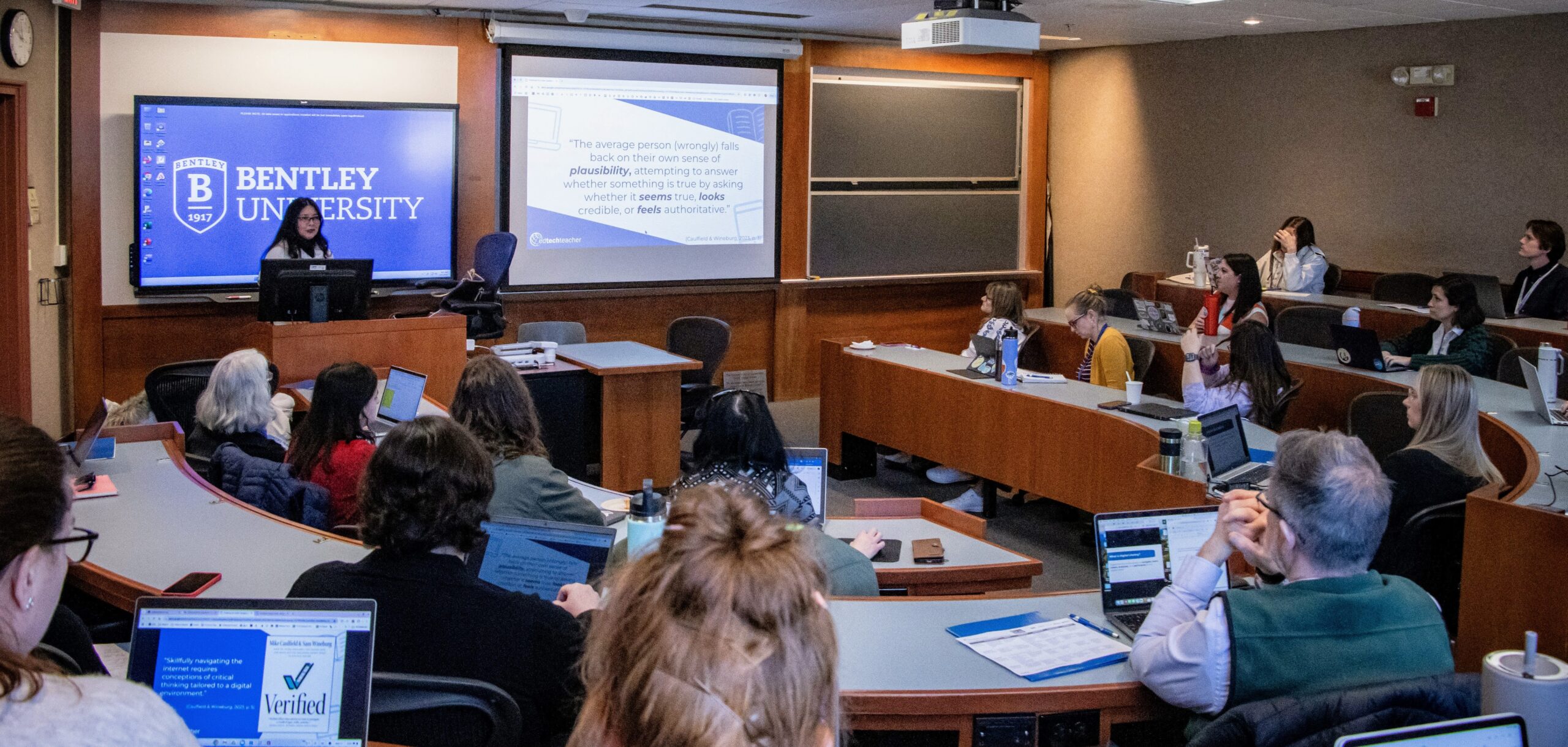
On March 11th, I had the privilege to attend and present at EdTechTeacher’s AI in EDU Summit at Bentley University in Massachusetts. It’s been quite some time since I’ve presented in person at a conference, and let me tell you, I’ve certainly missed the adrenaline rush and camaraderie of in-person back-and-forth conversations.
The day was a whirlwind, and there was so much to take in! I wish there was a way for me to clone myself because I wanted to attend everything. But since that wasn’t an option, I can only provide a limited review of my time there. So I hope that I do justice to the many amazing educators I had the chance to talk with and learn from.
Here are my take-aways from the day:
Schools and districts need an AI Policy.
More importantly, this policy needs to be crafted with the voices of all stakeholders AND be flexible enough to be revised as AI platforms and capabilities change over time.
Student learning outcomes need to drive AI use.
Aside from the many useful, innovative, and enlightening uses of AI in the classroom for teaching and learning, it is important to make sure that learning objectives drive the what, how, and why of technology integration. It’s equally imperative that educators look at student learning to see to what extent AI is helping students to engage in deeper learning as opposed to superficial knowledge.
Be curious and not judgmental.
Okay, I totally stole that from Ted Lasso. But it’s true. AI tools can evoke a sense of excitement but also dread — sometimes both at the same time. I encourage everyone to be open to the possibilities of how AI can help level the playing field for teachers and students across demographics, regions, and socio-economic levels. I acknowledge that there are legitimate concerns with using AI (first and foremost, student privacy), but let’s begin these conversations of AI use with an open mind and sense of wonder.
Don’t be afraid to pivot.
I can’t be the only one who was thinking one way about AI (in general) or a particular AI tool only to change my mind when more information became available. With the many AI tools and platforms available (and emerging), it is very likely that your opinion on the value of that tool for teaching and learning will change with product updates, regular use, and/or shifting priorities for student learning. My advice? Keep the conversations flowing and recognize that opinions will fluctuate with the ever-changing landscape and reach of AI.
There are so many different perspectives when it comes to AI use and the projected impact of AI for teaching and learning. But what I keep coming back to is the fact AI is a tool. It’s a medium for learning. It’s not a silver bullet. What is going to move the needle in terms of improving student outcomes is creating meaningful learning experiences grounded in research-based best practices with measurable metrics. Period.
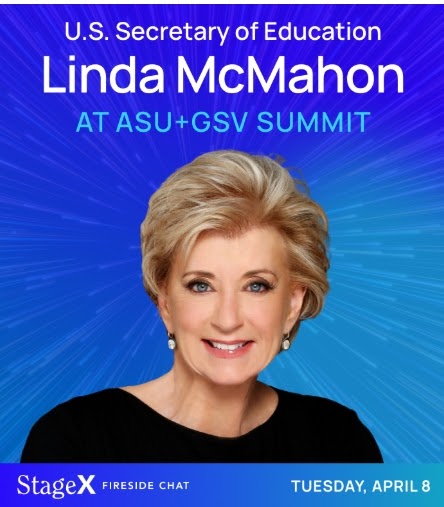
On April 8, 2025, US Secretary of Education Linda McMahon will give a fireside chat at ASU+GSV, an edtech conference held in San Diego, California.
President Trump has tasked McMahon with dismantling the federal agency that oversees federally funded K-12 and higher education programs. In less than two weeks she has done just that.
Half of ED’s staff have already been fired or taken a payout, and the $1.7T student loan portfolio is likely to be transferred to the US Treasury.
There is no word yet on whether there will be demonstrators at the conference, but we expect some form of vocal nonviolent resistance. AFT President Randi Weingarten is also scheduled to appear.
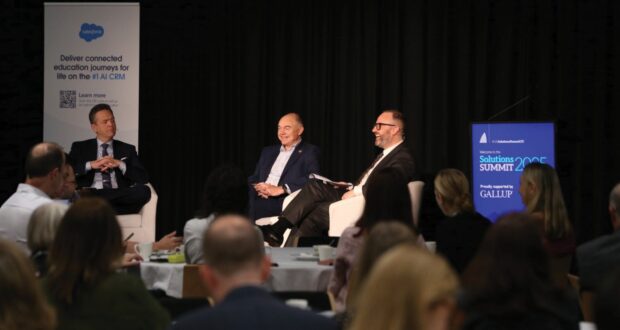
The Universities Australia Solutions Summit brought together university leaders, academics and government together in Canberra last week.
The annual event is run by the vice-chancellor’s membership body UA, and this year’s Summit aimed to support national priorities with an exchange of ideas on everything from workforce productivity to Trump’s America.
This episode of HEDx includes reflections of the event from James Cook University vice-chancellor Simon Biggs, University of Queensland deputy vice-chancellor Alphia Possamai-Inesedy and more.



 Source: Patrick Jack
 Source: Patrick Jack
  Source: Justin Sullivan/Getty Images