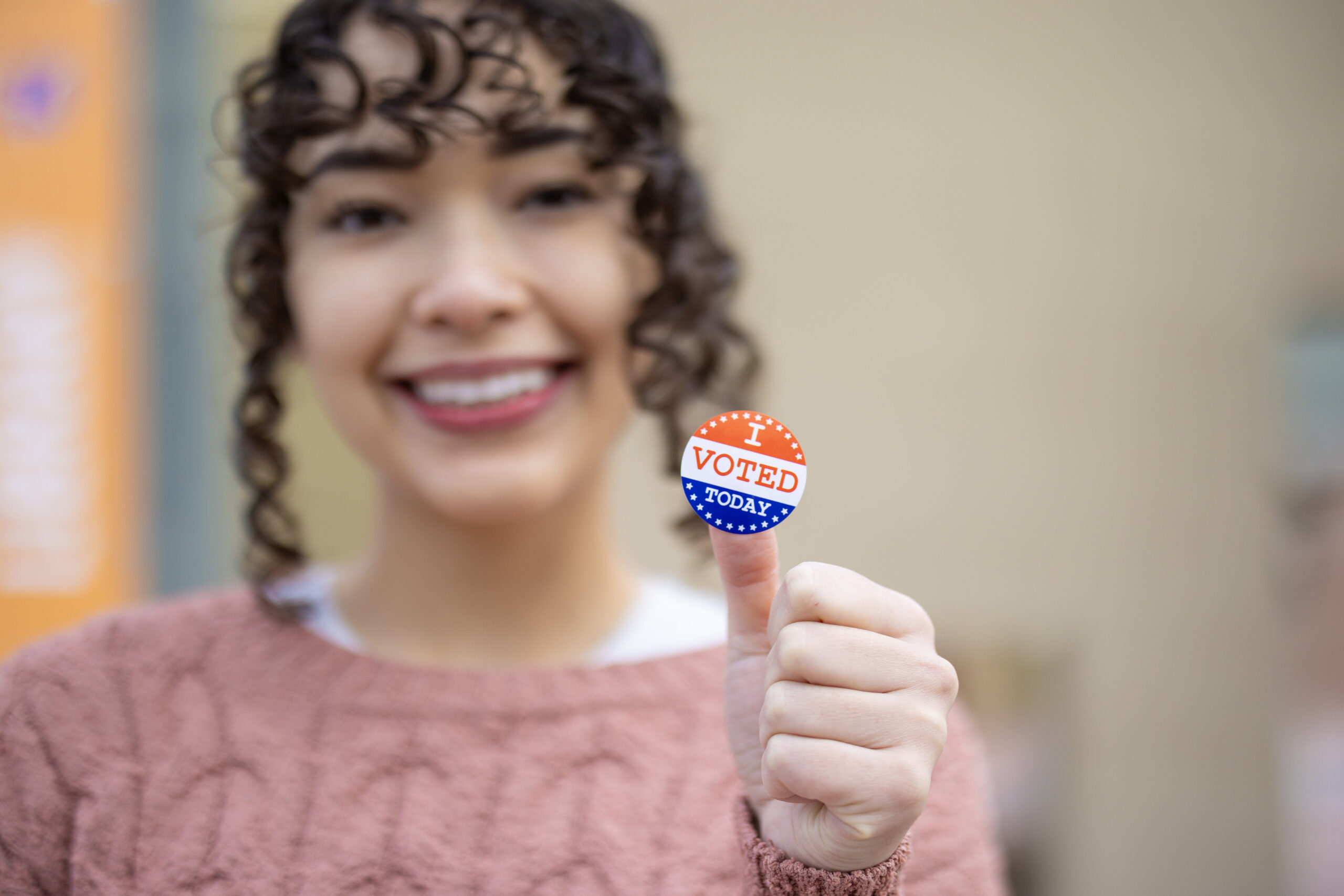
The United States typically sees an uptick in the general public’s interest in civic issues during presidential election years. According to the Pew Research Center, Americans more closely follow the news during such years, and the 2024 election cycle was no exception to what Pew calls the “typical election year surge” (Younis 2020).
On college campuses, this trend can be palpable as well, with students, faculty, and staff feeling more inclined to get involved in civic affairs in some way. Yet it can be difficult to know how to do so, especially on campuses where there is not already a robust civic participation infrastructure.
This article offers a retrospective on our incipient effort in fall 2024 at SUNY Plattsburgh to grow an organization – dubbed simply Plattsburgh Votes – to educate students (in a nonpartisan manner) about voting and to ultimately boost turnout. This is intended to provide guidance for others seeking to galvanize student voting and to create a foundational civic infrastructure on their own campuses for future election cycles. It outlines our approach to conceptualizing student voter engagement, details some key organizational support that is widely accessible to campuses, and reflects on the relative success of different methods of outreach to students.
Understanding the Student Voter Gap
The perception that the latest cohort of young adults is somehow less civically-inclined or interested in politics and current events is, ironically, a trope that recurs with each successive generation. Survey data, however, seem to contradict this notion for members of both the Millennial Generation and Generation Z. According to the American National Election Survey (a reputable source of data widely utilized by political scientists) for instance, young voters (defined as people aged 18-29) in fact show higher levels of interest in elections and public affairs since the turn of the millennium compared to what they reported on surveys conducted between 1976 and 2000 (Holbein and Hillygus 2020, 9).
In this vein, when conceptualizing Plattsburgh Votes, my collaborator Dr. Daniel Lake (Associate Professor of Political Science) and I channeled the framework for understanding young voters’ behavior offered by political scientists John Holbein and Sunshine Hillygus. Hillygus and Holbein note that while young people indeed exhibit a threshold level of interest in elections and civic affairs, there is still a disconnect between these attitudes and their rates of actual voting. Further, many of them intend to vote, but simply do not manage to – a gap that reaches 30% in some ANES data. As the authors summarize the situation, “young people are not turned off by politics…and yet they are not voting in US elections” (Holbein and Hillygus 2020, 8).
To explain the disconnect, they point to what behavioral scientists call “noncognitive skills” as the key impediment to voting among young people. The definition of noncognitive skills varies by context, but they generally refer to “patterns of thought, feeling, and behavior” rather than cognitive aptitudes like reasoning, understanding, and problem solving” (Bjorklund-Young 2016). Noncognitive skills are critical in what Hillygus and Holbein call “follow through” for young people in navigating the practical obstacles and time costs associated with voting, which can be formidable for those unfamiliar with the system (Holbein and Hillygus 2020, 14).
Our voter education efforts at SUNY Plattsburgh were therefore oriented toward ameliorating some of these practical barriers to voting, and in the process, helping reinforce the cultivation of the noncognitive skills that students need in order to be civically engaged.
Helping Students Navigate Location-Based Voting Decisions
One reality that became apparent very quickly is that students largely do not have difficulty registering to vote in some capacity before they arrive at college. Our on-the-ground experience echoed the data for our campus tabulated by the National Study of Voting, Learning, and Engagement (NSLVE) project at Tufts University, which is available for most campuses in the United States (National Study of Learning, Voting and Engagement 2025). Our latest NSLVE data indicated a registration rate above 70 percent even during the 2022 midterm election cycle. Whether this is due to efforts by K-12 institutions, the success of “motor voter” laws that enable registration when applying for a driver license or other ID, or some other factor, a large majority of the students we contacted through various outreach efforts indeed reported that they were already registered to vote. This of course has implications for how we address our practical guidance: if the majority of them are successfully registered, what is it that they still need help with?
Our experience with Plattsburgh Votes indicates that possibly the most significant remaining hurdle is young people’s relative lack of awareness that voting is a location-specific activity. Perhaps the most important work conducted by our organization involved the tabling efforts, class visits, and digital outreach geared specifically toward helping students make proactive decisions about where they wanted to vote (using either their home or college address), to check where they were indeed registered, and to request absentee ballots. Yet judging by the volume of students who were still unaware that these options required decisive action before a deadline, it is clear that earlier and more emphatic efforts are necessary to help students actually follow through on their intentions.
Peer-to-Peer Outreach: What Worked—and What Didn’t
Another significant takeaway from the fall 2024 initiative concerns the importance of peer influence in student voter education. As Dr. Allison Rank, a political scientist, veteran organizer, and director of SUNY Oswego’s robust “Vote Oswego” initiative emphasized in guidance to our group, students are more receptive to information delivered face-to-face by a peer than from faculty or another authority figure in any medium. Thanks to our submission of an action plan with the All-In Democracy Challenge – which “outline[s] a campus’ landscape, leadership team, goals, strategies and tactics, and evaluation processes” for encouraging voter participation – we were consequently eligible to apply for and receive a mini-grant from All-In that was used to hire three student interns (ALL IN Campus Democracy Challenge 2025). Using collectively generated presentations and educational material, these interns took the lead in delivering our in-person educational outreach efforts during the fall 2024 semester.
Yet we learned quickly that in-person outreach efforts led by student peers still must be strategically responsive to the realities of how students apportion their time and attention. Informational classroom visits by student advocates can be especially effective because students can be coached through a process like (re-)registering or requesting a ballot on the spot, minimizing the need for subsequent steps to be completed on their own. To that end, our group likewise concluded that it behooves organizers to focus classroom visits on one discrete process (e.g. “requesting a ballot to vote by mail”) rather than delivering a presentation that covers all relevant aspects of voting comprehensively.
Other forms of outreach were less successful, however. For instance, the student interns reported dismal attendance at the “voting office hours” that they held in common areas of the college residence buildings. While it is possible that our method of publicizing their availability through emails from the residence life director was suboptimal in garnering student attention, the experience also seemed to indicate significant reluctance on the part of students to plan in advance to seek out help and proactively ask questions. Instead, approaches in which the voter education organization’s representatives initiate the contact seem more promising.
The Untapped Power of Pledges
Finally, one tactic which Plattsburgh Votes did not have the time or resources to pursue extensively in fall 2024 was securing pledges from students to take particular voting actions.
Both research as well as conventional wisdom in grassroots organizing holds that people are generally more likely to follow through on an action when they have pledged to take it. Political science researchers testing whether pledging to vote affected voter turnout in fact found specifically that first-time young voters were likeliest to follow through and vote when they pledged to (Costa, Schaffner, and Prevost 2018). It seems promising, then, for both our organization and any others engaging in student voter education to brainstorm methods of soliciting pledges from students and then following up to remind them of their pledges as deadlines approach.
The campus-specific data on 2024 voter turnout from NSLVE is not yet available. Preliminary reports from the CIRCLE organization at Tufts (which administers the program) estimates that youth turnout in 2024 was down from 2020 to a rate of around 42%, but was stronger in battleground states like Pennsylvania (Center for Information and Research on Civic Learning and Engagement 2025).We are confident that Plattsburgh Votes was able to have some impact on closing the gap between registration rate and actual voter turnout, but the precise magnitude remains to be seen. Regardless, it is clear that continued effort on campuses is necessary. The efforts must find creative, contextually-sensitive ways to account for the role that “noncognitive skills” play in affecting voting behavior and help students with the procedural aspects of voting so that they can successfully follow through on their intentions.
Dr. Ben Medeiros is Assistant Professor of Communication Studies at SUNY Plattsburgh. His teaching and research focus on political communication, media law, and digital media culture. Medeiros is on the editorial board of the journal Communication & Democracy and the author of the book Reputation Management Online: America’s ‘Right To Be Forgotten’ (Routledge/National Communication Association, 2022).
References
ALL IN Campus Democracy Challenge. “Campus Action Plan Development.” ALL IN Challenge. Accessed June 18, 2025. https://allinchallenge.org/resources/action-plans/.
Bjorklund-Young, Alanna. What Do We Know About Developing Students’ Non-cognitive Skills? Baltimore: Johns Hopkins Institute for Education Policy, June 2016. https://jscholarship.library.jhu.edu/server/api/core/bitstreams/e7ed674e-6fab-4339-95e2-50c0d78e6833/content.
Center for Information and Research on Civic Learning and Engagement. “The Youth Vote in 2024.” CIRCLE. Accessed June 18, 2025. https://circle.tufts.edu/2024-election.
Costa, Mia, Brian F. Schaffner, and Alicia Prevost. “Walking the Walk? Experiments on the Effect of Pledging to Vote on Youth Turnout.” PLoS One 13, no. 5 (May 29, 2018): e0197066. https://doi.org/10.1371/journal.pone.0197066.
Holbein, John B., and D. Sunshine Hillygus. Making Young Voters: Converting Civic Attitudes into Civic Action. Cambridge: Cambridge University Press, 2020.
National Study of Learning, Voting and Engagement. “About NSLVE.” National Study of Learning, Voting and Engagement. Accessed June 18, 2025. https://nslve.tufts.edu/about-us.
Younis, Mohamed. “In U.S., Attention to Politics Shows Typical Election Year Surge.” Gallup. September 23, 2020. https://news.gallup.com/poll/320738/attention-politics-shows-typical-election-year-surge.aspx.