Tag: super

  • OPINION: Bad Bunny’s Super Bowl performance should last well beyond halftime and extend to classrooms 

    OPINION: Bad Bunny’s Super Bowl performance should last well beyond halftime and extend to classrooms 

    by Tony DelaRosa, The Hechinger Report
    February 10, 2026

    During Sunday’s Super Bowl halftime show, my family, a mix of Filipinos and Cubans, was a hot and beautiful mess. We deeply resonated with the unapologetic pride, critical history and cultural wealth Puerto Rican star Bad Bunny brought to our living room. 

    We smiled and cried, all while salsa-stepping to Bad Bunny’s performance. We immediately texted our extended families to invite them to share this beautiful moment: from the entire delivery in Spanish to the set design that showcased Puerto Rico’s rich agricultural history, and the performer handing his newly minted Grammy award to a Latino child — a symbol of a young Bad Bunny and perhaps the future of immigrant youth. 

    Bad Bunny delivered an exquisite lesson in forging a sense of belonging and interrogating democracy. As a public educator and researcher on race and well-being, I believe his performance should be taught in all classrooms this week to spark critical discussions on immigration, history and kinship amid an era of social and political division. Here are some lessons we can all learn from Bad Bunny:

    1) Spotlighting multilingual belonging and power 

    Bad Bunny sang in Spanish the entire time. On the global stage, that challenges the expectation that English is the price of admission and belonging. Many new immigrant youth who speak only Spanish deserve classroom lessons that allow them to use their language to express their full selves, emotionally and intellectually. Conversely, for students who speak only English, this forces them to put themselves in their Spanish-speaking peers’ shoes to grasp the lesson and empathize with their diverse experiences. A question I would ask to spark discussion about multilingual belonging and power is: 

    “Who is expected to assimilate through language or behavior, and what does that expectation teach us about who is seen to belong?”

    2) Teaching critical history

    Bad Bunny’s performance is an example of political art. It incorporated aspects of Puerto Rico’s struggles with colonialism through the power grid issues tied to “El Apagón” (The Black Out). Although Puerto Rico receives federal funding each year, frequent power outages persist due to insufficient support for long-term infrastructure repair and maintenance. A question I would ask students regarding critical history is: 

    “How does limiting access to infrastructure (i.e., water, electricity and housing) prevent belonging?” 

    3) Symbolism 

    Bad Bunny’s performance was also a masterpiece in symbolism. The opening sugar cane field invoked Puerto Rico’s history of industrial slave labor, and was also an homage to the jibarro, or the iconic Puerto Rican countrymen. The celestial light blue Puerto Rican flag Bad Bunny marched with was reminiscent of the pro-independence movement from the 1868 “Grito de Lares” revolt inspired by the Cuban Revolutionary Party of New York. The flag was birthed in diaspora, and was once deemed a crime to wave it. To incorporate critical questions about symbolism, one can ask: 

    “What does the layering of the sugar cane field, jibarro and the pro-independence flag say about counter-narratives, diaspora, and belonging?” 

    4) Allyship and Expansiveness  

    Allyship and expansiveness were huge themes in Bad Bunny’s performance. Toward the end, Bad Bunny explicitly names Cuba, Bolivia, Canada, México, Haiti, Nicaragua, Jamaica and other countries, all while holding up their flags to show the rich tapestry and expansiveness of America beyond solely the United States. This decentering of the U.S. is a part of his larger counter-statement against the Trump administration. A strong discussion question on allyship could be: 

    “How can educators foster the well-being of all their students’ identities through recognition and explicit teaching of shared histories of oppression and cultural wealth?” 

    Beyond this Super Bowl performance, I hope educators invest time in including more of Bad Bunny’s work in their curriculum and lesson plans. His work not only focuses on Puerto Rican and broader issues of belonging and democracy tied to Latinx communities, but also on other colonial relationships, as in his song “Lo que le Pasó a Hawaii” (“What happened to Hawaii.”) 

     His work demonstrates joy through art and resistance. Teaching Bad Bunny is not just about embedding pop culture into your lesson; it’s about giving students the opportunity to explore critical histories, identities, and languages that help foster a sense of collective healing. 

    Tony DelaRosa is a co-founder of the NYC Men Teach Asian American initiative and a PhD candidate at the University of Wisconsin-Madison’s educational leadership and policy analysis department. He’s the author of the award-winning book “Teaching the Invisible Race.” His work has appeared in NBC News, Harvard Ed Magazine, Mochi Magazine and elsewhere.   

    This story about Bad Bunny was produced by The Hechinger Report, a nonprofit, independent news organization focused on inequality and innovation in education. Sign up for Hechinger’s weekly newsletter.

    This <a target=”_blank” href=”https://hechingerreport.org/opinion-bad-bunnys-super-bowl-performance-should-last-well-beyond-halftime-and-extend-to-classrooms/”>article</a> first appeared on <a target=”_blank” href=”https://hechingerreport.org”>The Hechinger Report</a> and is republished here under a <a target=”_blank” href=”https://creativecommons.org/licenses/by-nc-nd/4.0/”>Creative Commons Attribution-NonCommercial-NoDerivatives 4.0 International License</a>.<img src=”https://i0.wp.com/hechingerreport.org/wp-content/uploads/2018/06/cropped-favicon.jpg?fit=150%2C150&amp;ssl=1″ style=”width:1em;height:1em;margin-left:10px;”>

    <img id=”republication-tracker-tool-source” src=”https://hechingerreport.org/?republication-pixel=true&post=114797&amp;ga4=G-03KPHXDF3H” style=”width:1px;height:1px;”><script> PARSELY = { autotrack: false, onload: function() { PARSELY.beacon.trackPageView({ url: “https://hechingerreport.org/opinion-bad-bunnys-super-bowl-performance-should-last-well-beyond-halftime-and-extend-to-classrooms/”, urlref: window.location.href }); } } </script> <script id=”parsely-cfg” src=”//cdn.parsely.com/keys/hechingerreport.org/p.js”></script>

    Source link

  • WEEKEND READING: On legal education: is AI churning out super or surface-level lawyers?

    WEEKEND READING: On legal education: is AI churning out super or surface-level lawyers?

    Join HEPI for a webinar on Thursday 11 December 2025 from 10am to 11am to discuss how universities can strengthen the student voice in governance to mark the launch of our upcoming report, Rethinking the Student Voice. Sign up now to hear our speakers explore the key questions.

    This blog was kindly authored by Utkarsh Leo, Lecturer in Law, University of Lancashire (@UtkarshLeo)

    UK law students are increasingly relying on AI for learning and completing assessments. Is this reliance enhancing legal competence or eroding it? If it is the latter, what can be done to ensure graduates remain competent?

    Studying law equips students with key transferable skills – such as evidence-based research, problem solving, critical thinking and effective communication. Traditionally, students cultivate doctrinal (and procedural) knowledge by attending lectures, workshops and going through assigned academic readings. Thereafter, they learn how to apply legal principles to varying facts through assessments and extracurriculars like moot courts and client advocacy. In this process, they learn how to construct persuasive arguments and articulate ideas, both orally and in writing. However, with widely available and accessible Gen AI, students are taking shortcuts in this learning process.

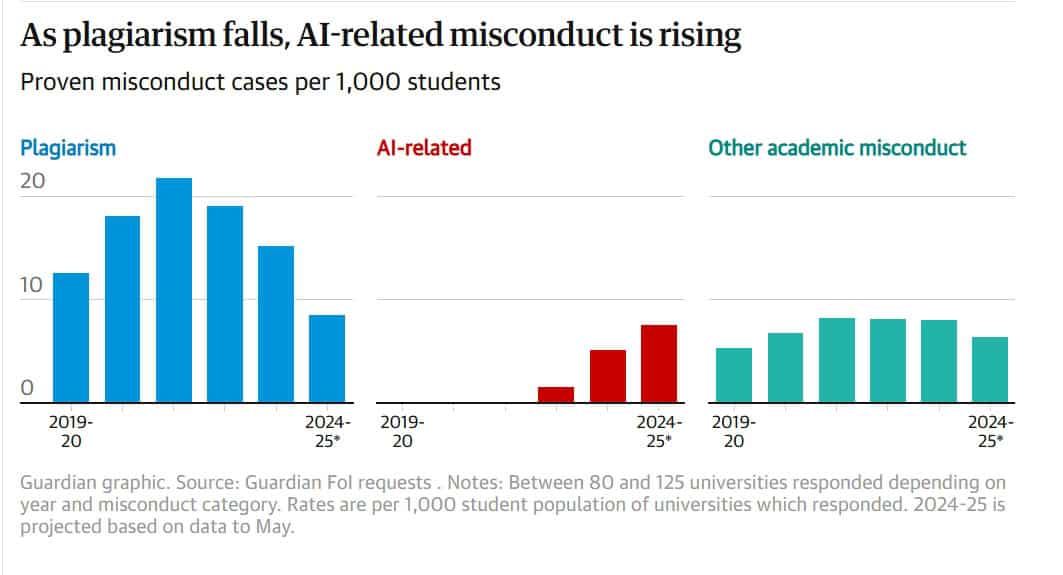
    The HEPI/Kortext Student Generative AI Survey 2025 looked into AI use by students from a range of subjects. It paints a grim picture: 58% of students are using AI to explain concepts and 48% are using it to summarise articles. More importantly, 88% are using it for assessment related purposes – a 66% increase compared to 2024.

    Student Generative AI Survey 2025, Higher Education Policy Institute

    Rooted in inequality

    Students are relying on shortcuts largely due to rising economic inequality. Survey data published by the National Union of Students shows 62% of full-time students work part-time to survive. This translates into reduced studying time, limited participation in class discussions and extracurriculars. Understandably, such students may find academic readings (which are often complex and voluminous) as a chore, further reducing motivation and engagement. In this context, AI offers a quick fix!

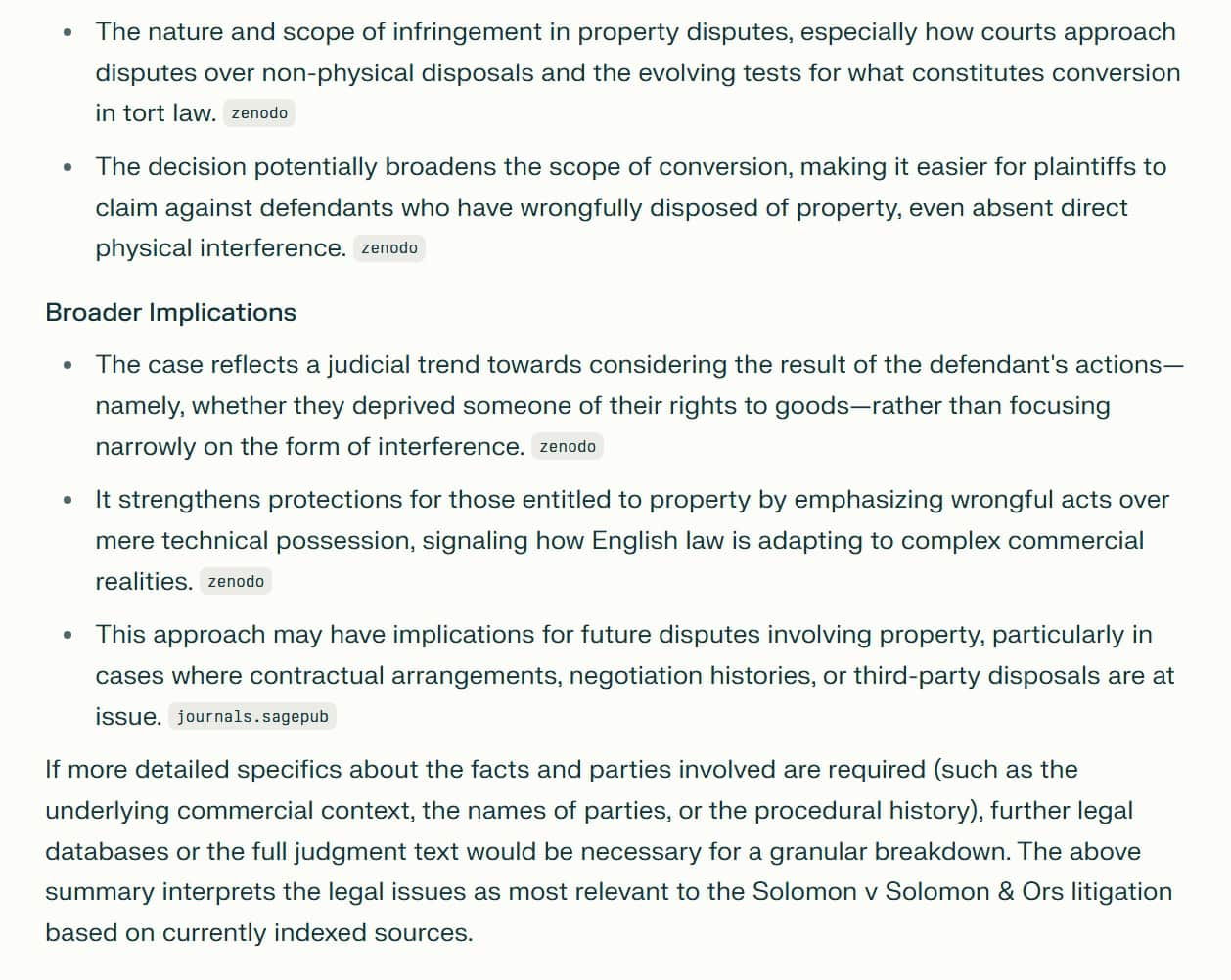
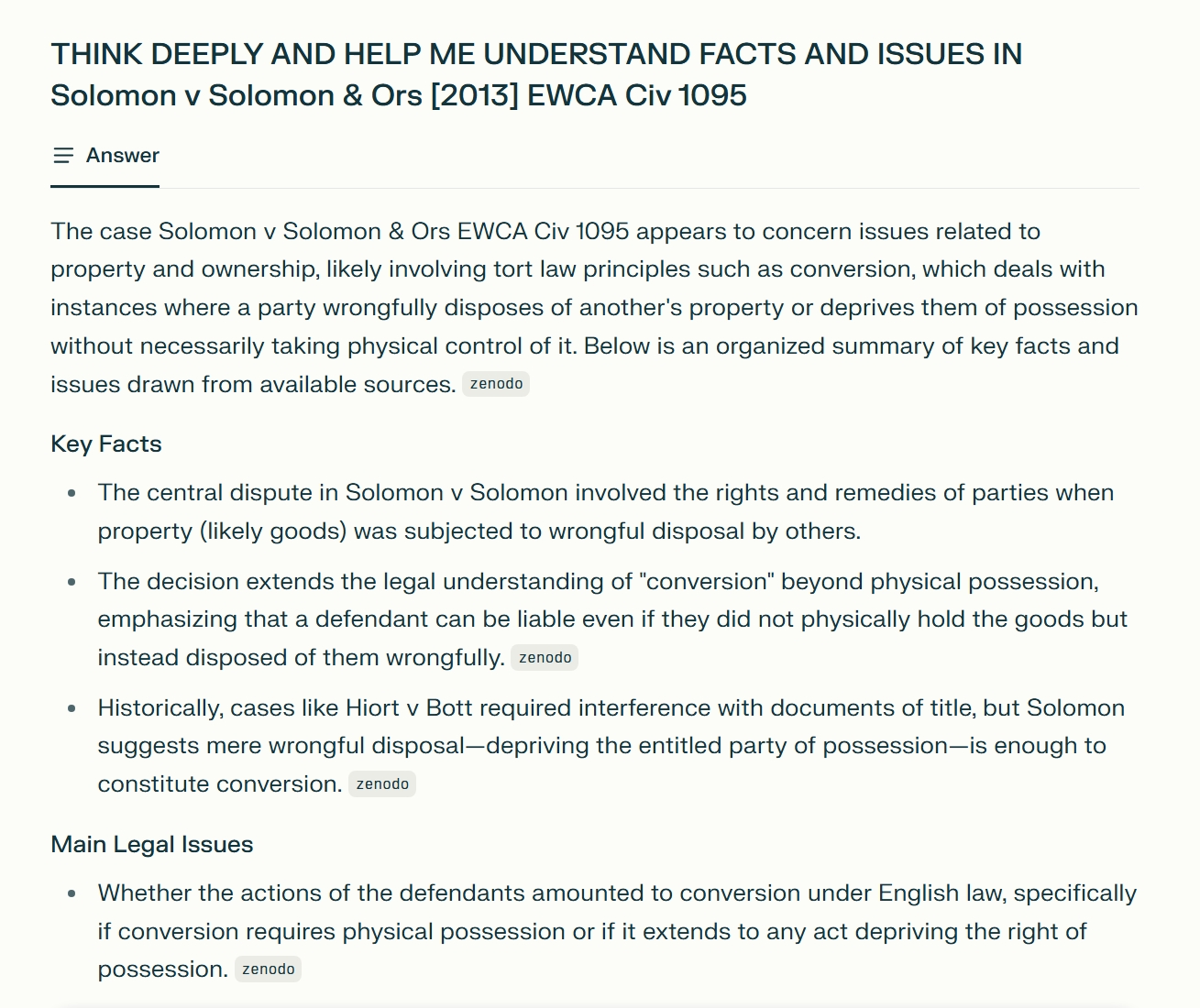
    Prompt and output generated by perplexity.ai on 7 November 2025 showing AI-produced case summaries.

    The problem with shortcuts

    Quick fixes, as shown above, promote overreliance: resulting in cognitive replacement. Most LLB first-year programmes aim to cultivate critical legal thinking: from the ability to apply the law and solve problems in a legal context to interpreting legislative intent to reading/finding case law and developing the skills to spot issues, weigh precedents and constructing legal arguments. Research from neuroscience shows that such essential skills are acquired through repeated effort and practice. Permitting AI usage for learning purposes at this formative stage (when students learn basic law modules) inhibits their ability to think through legal problems independently – especially in the background of the student cost-of-living crisis. 

    More importantly, only 9 out of more than 100 universities require law degree applicants to sit the national admission test for law (LNAT) – which assesses reasoning and analytical abilities. This variability means we cannot assume that all non-LNAT takers possess the cognitive tools necessary for legal thinking. This uncertainty reinforces the need to disallow AI use in first-year law programmes to ensure students either gain or hone the necessary skills to do well in law school.

    Technical discussion

    Furthermore, from a technical perspective, the shortcomings of AI summaries are well known. AI models often merge various viewpoints to create a seemingly coherent answer. Therefore, a student relying on AI to generate case summaries enhances the likelihood of detaching them from judicial reasoning (for example, the various structural/substantive principles of interpretation employed by judges). It risks producing ill-equipped lawyers who may erode the integrity of legal processes (a similar argument applies to statutes).

    Alongside this, AI systems are unreliable: from generating fake case-law citations to suggesting ‘users to add glue to make cheese stick to pizza.’ Large language models (LLMs) use statistical calculation to predict the next word in a sequence – therefore, they end up hallucinating. Despite retrieval-augmented generation – a technique for enhancing accuracy by enabling LLMs to check web sources – the output generated can be incorrect if there is conflicting information. Furthermore, without thoughtful use, there is an additional concern that AI sycophancy will further validate existing biases. Hence, despite the AI frenzy, first year students will be better off if they prioritise learning through traditional primary and secondary sources.   

    How to ensure this?

    Certainly, we cannot prohibit student’s from using AI in a private setting; but we can mitigate the problem of overreliance by designing authentic assessments evaluated exclusively through in-person exams/presentations. This is more likely to encourage deeper engagement with the module. Now more than ever, this is critical. Despite rising concerns of AI misuse and the inaccuracy of AI text detection primarily due to text perplexity (high false positives; especially for students for whom English is not their first language), core law modules (like contract law and criminal law) continue to be assessed through coursework (for either 50% or more of the total module mark).

    However, sole reliance on in-person exams will not suffice! To promote deeper module engagement (and decent course pass rates), the volume of assessments will need to be reduced. As students are likely to continue working to support themselves, universities could benefit from the support and cooperation of professional bodies and the Office for Students. In fact, in 2023, the Quality Assurance Agency highlighted that universities must explore innovative ways of reducing the volume of assessments, by ‘developing a range of authentic assessments in which students are asked to use and apply their knowledge and competencies in real-life’.   

    To promote experiential learning, one potential solution could be to offer assessment exemption based on moot-court participation. Variables such as moot profile (whether national/international), quality of memorial submitted, ex-post brief presentation on core arguments, and student preparation could be factored to offer grades. Admittedly, not all students will pursue this option; however, those who choose to participate will be incentivised.

    Similarly, summer internships or law clinic experiences can be evaluated through patchwork assessment where students can complete formative patches of work on client interviews, case summaries and letters before action, followed by a reflective stitching piece highlighting real world learning and growth.

    Delayed use of gen AI – year II and onwards

    It is crucial to emphasise that despite the critique of Gen AI, its vast potential to enhance productivity cannot be overlooked. Nevertheless, what merits attention is that such productivity is contingent on thoughtful engagement and basic domain specific knowledge – which is less likely to be found in first year law students.

    Thus, a better approach is to delay approved use of AI until the second year of law. To ensure graduates are job ready, modules such as Alternative Dispute Resolution and Professional Skills could go beyond prompting techniques to include meaningful engagement with technology: through domain specific AI tools, contract review platforms and data-driven legal analytics ‘to support legal strategy, case assessment, and outcomes’.

    Communication skills remain key

    Above all, despite advances in tech, law will remain a people-centred profession requiring effective communication skills. Therefore, in the current climate, law school education should emphasise oral communication skills. Prima facie, this approach may seem disadvantageous to students with special needs, but it can still work with targeted adjustments.

    In sum, universities have a moral responsibility to churn out competent law graduates. Therefore, they must realistically review the abilities of AI to ensure the credibility of degrees and avoid mass-producing surface-level lawyers.

    Acknowledgement: I am grateful to Rachel Nir, Director of EDI at the School of Law and Policing, University of Lancashire, for her insightful comments and for kindly granting the time allowance that made this research possible.

    Source link