Since the COVID-19 pandemic, high superintendent turnover rates have not let up — and that’s not surprising, said Wendy Birhanzel, a district leader in Colorado.
Nearly a quarter (23%) of the 500 largest districts experienced a change in their superintendency between July 1, 2024 and July 1, 2025, according to a September report by ILO Group, a national education strategy and policy firm. This turnover is up from last year’s survey results showing a 20% rate and a notable uptick from pre-pandemic averages ranging from 14% to 16%, ILO Group found.
The job of a superintendent “became a very different role” after COVID-19 shuttered school buildings nationwide in March 2020, said Birhanzel, who is in her seventh year as superintendent at Harrison School District 2 in Colorado Springs, Colorado. “Education is very politicized right now, and can be a little tricky to navigate from all the different sides of everyone in their opinions.”
Birhanzel said she mentors superintendents in Colorado and throughout the country, and she finds many saying they are “overwhelmed by the constant pressure” from their school boards, students’ families or school staff who are unhappy with the district.
While it’s difficult to pinpoint the exact cause of high superintendent turnover nationwide, one underlying reason may be the “real tension” that’s emerged in communities since the pandemic, said Julia Rafal-Baer, CEO of ILO Group and Women Leading Ed, a national network for women education leaders.
From controversial COVID-19 policies to rules on screens and devices and growing district enrollment and financial challenges, she said, things have “come to a head” and landed on district leaders.
Moreover, the superintendency is one of the most influential roles in K-12 as it directly impacts high-level strategy as well as the teacher workforce and their working conditions, Rafal-Baer said.
“And yet we are paying less attention to the fact that the churn [in the superintendency] that we thought would be temporary is our new normal, and it’s straining our districts when students need that kind of steady, effective leadership,” she said.
Many districts typically outline a five-year strategic plan with set missions and goals that then acts as a blueprint for the system’s needs, said Dennis Willingham, superintendent at Walker County School District in Jasper, Alabama.
Superintendent turnover is concerning because that means district leaders are likely not staying long enough to execute those five-year strategies effectively, he said.
Then when a new superintendent steps into the role, they may want to take the district into a totally different direction, Willingham said, which can be discouraging and confusing to school communities.
Birhanzel also noted that superintendent turnover can lead to “a domino effect” with more district turnover in other roles like administrators, principals, teachers and even bus drivers. “It goes deeper than just one position,” she said.
Despite the high turnover, just one-third of superintendent roles are held by women, according to ILO Group data. Even with year-over-year improvement, parity between men and women won’t be reached until 2054 if the current pace continues, the firm said.
What can be done?
Willingham and Birhanzel agreed that much of the pressure put on superintendents stems from disagreements or tension with their school boards. While both superintendents reported good relationships with their boards, they said they recognized that the positive dynamic they experience can be rare.
Pressure from strained school board relationships “takes away the focus” from the school system and “also the joy of being a superintendent,” Willingham said.
Both superintendents emphasized that board support is key to retaining district leaders. If the superintendent and board are unified, it’s easier to move forward with strategic plans and focus on students and staff, Willingham said.
Birhanzel cautioned that superintendents should consider that relationship before accepting the job. It’s important to go where the board “aligns with what you believe in and your why,” she said. If that compatibility isn’t there, she added, “then that won’t be good for anyone in the system.”
A shift is also needed in society’s mindset about the value of a superintendent, Birhanzel said. Superintendent turnover may be common because communities and school boards associate firing these leaders with a way to make a change. But if that’s a frequent move, she said, it will be difficult for the school system to be successful.
Overall, Birhanzel said, a cultural change is needed to get rid of the idea that firing a superintendent is the answer to a problem — instead of working together to find a solution. “In way too many cases, do we see politics drive decisions of who leads school districts instead of [who is] the best leader for students?”
The role of superintendent can be isolating, Birhanzel acknowledged. That’s why it’s important to foster more networks and support systems for those in the role. There’s a high need for mentorship, especially for prospective women superintendents, Birhanzel added.
In September, Women Leading Ed released guidance outlining ways districts can go beyond mentorships by intentionally coaching and sponsoring future leaders, particularly women.
While efforts are underway to address the underrepresentation of women in district leadership, the issue persists, leading Birhanzel to ask, “How long is it going to take to change these numbers?”
Your job now requires a new level of transparency that you are reluctant to provide. This media crisis will burn for several more days if we sit silent. We are in a true leadership moment and I need you to listen to your communications expert. I can make your job easier and more successful.
Signed,
Your Communications Director
As superintendents come under more political fire and frequent negative news stories about their school districts circulate, it is easy to see where the instinct to not comment and just focus on the work might kick in. However, the path forward requires a new level of transparency and truth-telling in communications. In fact, the work requires you to get out in front so that your teachers and staff can focus on their work.
I recently spoke with a school district facing multiple PR crises. The superintendent was reluctant to address the issues publicly, preferring one-on-one meetings with parents over engaging with the media or holding town hall-style parent meetings. But when serious allegations of employee misconduct and the resulting community concerns arise, it’s crucial for superintendents to step forward and take control of the narrative.
While the details of ongoing human resources or police investigations cannot be discussed, it’s vital to inform the community about actions being taken to prevent future incidents, the safeguards being implemented, and your unwavering commitment to student and staff safety. All of that is far more reassuring than the media reporting, “The district was not available for comment,” “The district cannot comment due to an ongoing investigation,” or even worse, the dreaded, “The school district said it has no comment.”
Building trust with proactive communication
A district statement or email doesn’t carry the same weight as a media interview or an in-house video message sent directly to community members. True leadership means standing up and accepting the difficult interviews, answering the tough questions, and conveying with authentic emotion that these incidents are unacceptable. What a community needs to hear is the “why” behind a decision so that trust is built, even if that decision is to hold back on key information. A lack of public statement can be perceived as indifference or a leadership void, which can quickly threaten a superintendent’s career.
Superintendents should always engage with the media during true leadership moments, such as district-wide safety issues, school board meetings, or when the public needs reassurance. “Who Speaks For Your Brand?” looks at a survey of 1,600 school staff who resoundingly stated that the superintendent is the primary person responsible for promoting and defending a school district’s brand. A majority of the superintendents surveyed agreed as well. Promoting and defending the district’s brand includes the negative–but also the positive–opportunities like the first day of school, graduation, school and district grade releases, and district awards.
However, not every media request requires the superintendent’s direct involvement. If it doesn’t rise to the severity level worthy of the superintendent’s office, an interview with a department head or communications chief is a better option. The superintendent interview is reserved for the stories we decide require it, not just because a reporter asks for it. Reporters ask for you far more than your communications chief ever tells you.
It is essential to communicate directly and regularly with parents through video and email using your district’s mass communication tools. You control the message you want to deliver, and you don’t have to rely on the media getting it right. This is an amazing opportunity to humanize the office. Infuse your video scripts with more personality and emotion to connect on a personal level with your community. It is far harder to attack the person than the office. Proactive communications help build trust for when you need it later.
I have had superintendents tell me that they prefer to make their comments at school board meetings. School board meeting comments are often insufficient, as analytics often indicate low viewership for school board meeting live streams or recordings. In my experience, a message sent to parents through district alert channels far outperforms the YouTube views of school board meetings.
Humanizing the superintendent’s role
Superintendents should maintain a consistent communications presence via social media, newsletters, the website, and so on to demonstrate their engagement within schools. Short videos featuring interactions with staff and students create powerful engagement opportunities. Develop content to create touch points that celebrate the contributions of nurses, teachers, and bus drivers, especially on their national days of recognition. These proactive moments of engagement show the community that positive moments happen hourly, daily, and weekly within your schools.
If you are not comfortable posting your own content, have your communications team ghostwrite posts for you. You never want a community member asking, “What does the superintendent do all day? We never see them.” If you are posting content from all of the school visits and community meetings you attend, that accusation can never be made again. You now have social proof of your engagement efforts and evidence for your annual contract review.
Effective communication is a superintendent’s superpower. Those who can connect authentically and show their personality can truly shine. Many superintendents mistakenly believe that hard work alone will speak for itself, but in today’s politically charged landscape, a certain amount of “campaigning” is necessary while in office. We all know the job of the superintendent has never been harder, tenure has never been shorter, and the chance of being fired is higher than ever.
Embrace the opportunity to engage and showcase the great things happening in your district. It’s worth promoting positive and proactive communications so that you’re a seasoned pro when the challenging moments come. There might just be less of them if you get ahead.
Greg Turchetta, Apptegy
Greg Turchetta is the Strategic Communications Advisor at Apptegy and was the Senior Chief Communications Officer for the Richland School District in Columbia, South Carolina.
Latest posts by eSchool Media Contributors (see all)
NORMAN, Okla. — Sometimes, Jakob Topper teaches his Christian faith to his 6-year-old daughter using children’s Bible stories illustrated with teddy bears. Other days, he might use her kid-friendly Bible featuring Precious Moments figures as characters. One thing he knows for sure: The King James version is not on the reading list, given some of its adult themes of sexual assault and incest.
As a parent and a Baptist pastor, Topper opposes Oklahoma’s state superintendent of public instruction’s mandate to put a King James Version Bible in every grade 5–12 classroom. The father of three is also not keen on the state’s newly proposed social studies standards that would require biblical lessons starting in first grade.
“I want the Bible taught to my daughter, and I want to be the one who chooses how that’s done,” said Topper, who also has a 1-year-old and a 3-year-old and is pastor of NorthHaven Church in Norman, a university town. “If we’re talking about parental choice, that’s my choice. I don’t want it to be farmed out to anyone else.”
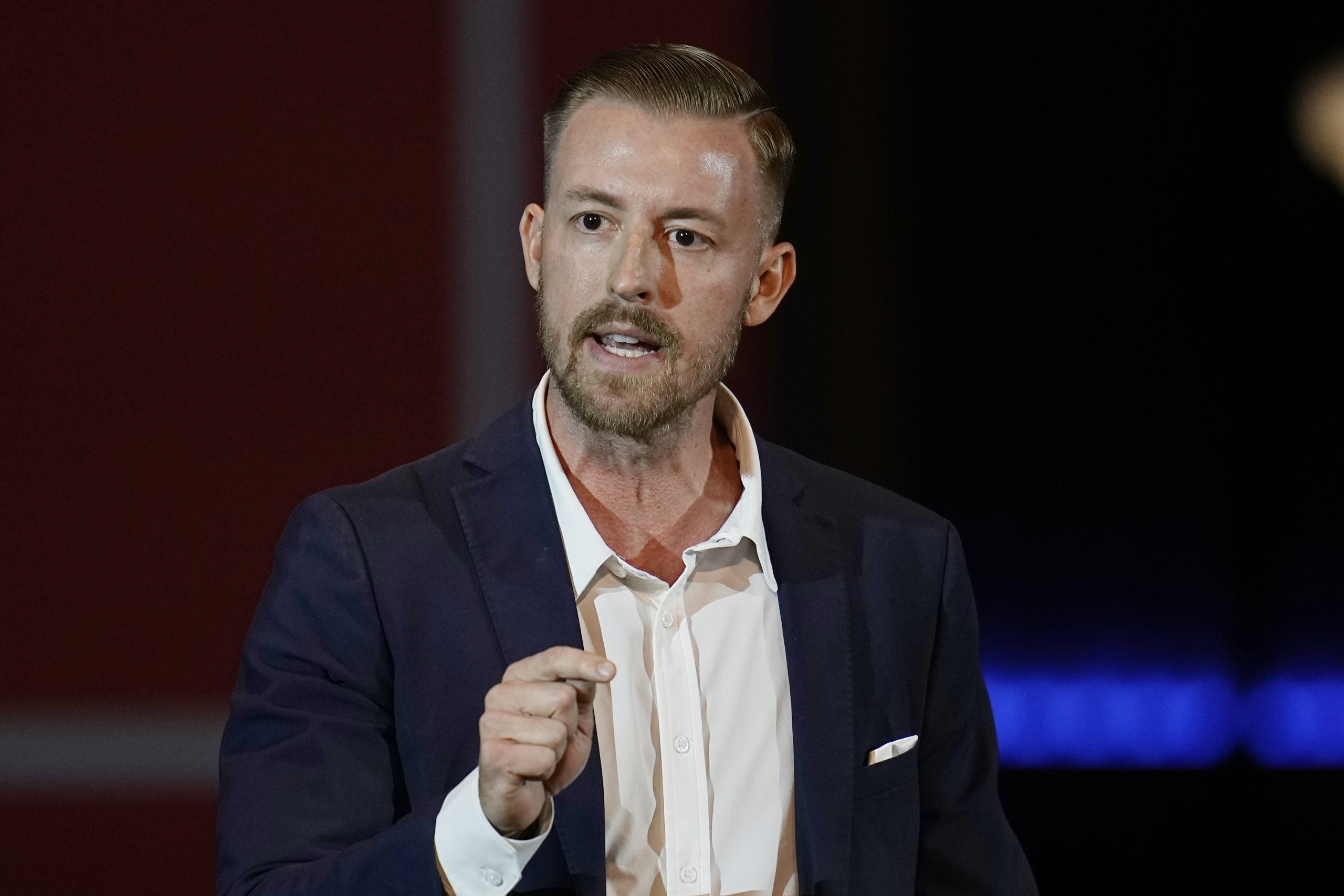
Norman, a central Oklahoman city of about 130,000, is an epicenter of resistance to the Bible mandate that the state superintendent of public instruction, Ryan Walters, announced last June. Opposition here has come from pastors, religion professors, students, parents, teachers, school board members and the school district superintendent, among others. The prevailing philosophy among Norman residents, who are predominantly Christian, is that they do not want the state — and namely, Walters — mandating how children should be taught scriptures. They want their children to learn from holy books at home or in church.
Pastor Jakob Topper, of NorthHaven Church, says he prefers to teach his children about the Bible rather than placing that responsibility on teachers. Credit: Mike Simmons for The Hechinger Report
Many residents see Walters’s pitch as a play for national attention, given his abundance of social media posts praising Donald Trump, who campaigned on returning prayer to schools and as president has established a White House Faith Office and a task force to root out “anti-Christian bias.” In September, Walters proposed spending $3 million to buy 55,000 copies of the Bible that has been endorsed by the president and for which he receives royalties. More recently, Walters — who in February clashed with his state’s governor for proposing that public schools track students’ immigration statuses — made media lists as a possible candidate for Trump’s education secretary. He was not picked.
But beyond Walter’s national aspirations, the Bible mandate also seems like an attempt at one-upmanship, with other states angling to infuse Christianity into public schools. Louisiana, for instance, is in a court battle over its push for Ten Commandments posters in schools. Texas fought off Democratic opposition to approve an optional Bible-infused curriculum and financial incentives for school districts that use the materials. A slew of states have passed or promoted similar measures, including ones allowing chaplains to act as counselors in schools. Unsurprisingly, Walters, too, has advocated for displaying the Ten Commandments in every classroom and also has backed the conversion of a private virtual Catholic school into a charter school; the Supreme Court plans to hear oral arguments on the case on April 30.
It goes without saying that Walters’s crusade is multifaceted. But fundamentally, all of his efforts amount to teaching the Bible “in inappropriate ways in public schools,” said Amanda Tyler, author of “How to End Christian Nationalism” and executive director of the Baptist Joint Committee for Religious Liberty, a Washington, DC–based organization of attorneys, ministers, and others who advocate for religious freedom. “He’s saying you can’t be a good American citizen if you don’t understand the Bible,” she added. “It’s this merger of American and Christian identities, the idea that only Christians are true Americans.”
On March 10, the Oklahoma Supreme Court dealt a blow to Walters’s plans: It issued a temporary stay prohibiting the state’s department of education from purchasing 55,000 Bibles with certain characteristics and from buying Bible-infused lessons and material for elementary schools.
The stay stems from a lawsuit led by Americans United for Separation of Church and State on behalf of 32 plaintiffs, including parents, clergy, students and teachers. The group, which is suing Walters, claims the Bible mandate violated the state’s prohibition against using state funds for religious purposes and the state’s own statutes allowing local district control over curriculum.
As of now, until the court issues a final ruling, its decision marks a victory in Americans United’s attempt to stop Walters, said Alex Luchenitser, the organization’s associate legal director: “It protects the separation of church and state. It protects the religious freedom of students.” Speaking about the court’s stay, Walters, through spokeswoman Grace Kim, said in a statement: “The Bible has been a cornerstone of our nation’s history and education for generations. We will continue fighting to ensure students have access to this foundational text in the classroom.”
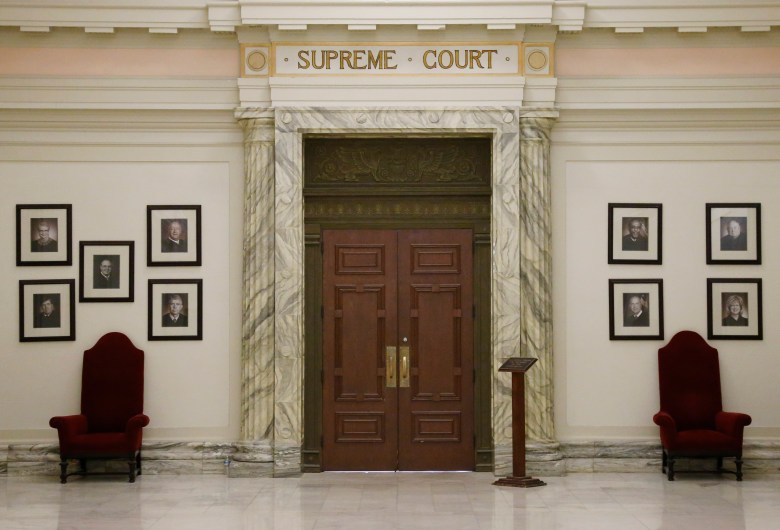
Oklahoma Supreme Court, pictured in the state Capitol building, in March issued a stay that would prohibit the state education department from purchasing Bibles and Bible-infused lessons for elementary students. Credit: Sue Ogrocki/ Associated Press
Meanwhile, Walters was also sued separately last summer by a parent in Locust Grove who contended the mandate violated the state and federal constitutions. The state education department has denied the claims of both suits and contended in legal briefs that using the Bible for its secular value does not violate the state’s constitution.
Walters’s mandate has also sparked concern because of the proposed social studies standards that followed. The standards, which were initially released in December and would require legislative approval, mention the Bible and its historical impact more than 40 times. Several of the standards attempt to erroneously frame the Bible, and specifically the Ten Commandments, as the foundation of American law. Biblical scholars from the University of Oklahoma and elsewhere believe these standards promote the long-standing trope of Christian nationalism, which is premised in part on the false idea that the nation’s founding documents stemmed from the Bible. (The founders were Bible readers, but not necessarily fans of the same versions or holy texts in general. In fact, Thomas Jefferson cut up pages of the Bible to remove mention of miracles or the supernatural.)
For example, Walters’s standards would require students in first grade to learn about David and Goliath, as well as Moses and the Ten Commandments, because the standards cite them as influences on the American colonists and others. Second graders would be asked to “identify stories from Christianity that influenced the American colonists, Founders, and culture, including the teachings of Jesus the Nazareth (e.g. the ‘Golden Rule,’ the Sermon on the Mount).”
“These new standards,” said a news release from the state department of education, “reflect what the people of Oklahoma — and all across America — have long been demanding of their public schools: a return to education curricula that upholds pro-family, pro-American values.” (Walters’s press office, despite repeated requests, did not make the state superintendent available for an interview.)
Critics in Oklahoma and elsewhere see Walters’s Bible mandate as part of a broader Christian nationalist movement. “I think Oklahoma is the test case for the nation,” said Dawn Brockman,a Norman school board member.
Walters, though, has been steadfast in his belief that the mandate is legal and critical for the education of Oklahomans. In the fall, after Americans United sued, Walters wrote on X: “The simple fact is that understanding how the Bible has impacted our nation, in its proper historical and literary context, was the norm in America until the 1960s and its removal has coincided with a precipitous decline in American schools.”
But nothing is simple about the history of the Bible in America’s schools. When public schools started to open in the 1800s, some required regular Bible readings. From the beginning, that practice was controversial: Schools typically favored the King James Version, pitting Protestants against Catholics, and riots over school Bible readings broke out from the 1840s into the 1870s, said Mark Chancey, a professor of religious studies at Southern Methodist University in Dallas. By 1930, 36 states allowed Bible reading to be a requirement or an option, but another dozen banned such activities.
A few decades later, a Pennsylvania family sued their school district for heeding the state’s 1949 law requiring the reading of 10 Bible verses and the recitation of prayers at the start of each school day. In 1963, just a year after a similar opinion, the Supreme Court ruled that requiring in-school Bible readings and prayers was unconstitutional. After those rulings, daily teaching from the Bible, for the most part, was halted, Chancey said, but backlash continued, with critics charging that removing prayer and Bible readings from schools had led to a decline in the morality of schoolchildren.
In subsequent decades, the Supreme Court ruled against clergy-led prayer and prayer over the loudspeakers at football games in several school-related cases. But in a seeming reversal, in 2022, the high court ruled in favor of allowing a football coach to conduct midfield, postgame prayers, shifting the legal landscape. The majority’s opinion on the football coach’s prayer has prompted politicians and states to further test the limits of the separation of church and state. In February, lawmakers in Idaho and Texas even proposed measures to allow daily Bible readings in public schools again.
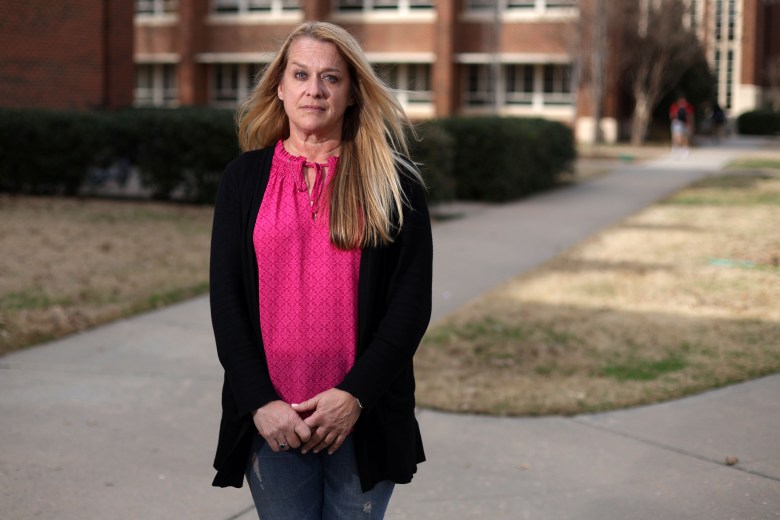
Darcy Pippins, who teaches Spanish at Norman High School, said she doesn’t feel qualified to teach about the Bible. Credit: Mike Simmons for The Hechinger Report
In Norman, many teachers reacted to news of the Bible mandate with concern and fear. Spanish teacher Darcy Pippins,who is in her 27th year at Norman High, said she sometimes teaches about Catholicism because it is the religion of the Spanish-speaking world. But putting a Bible in every classroom and teaching from it is different. “I just don’t feel comfortable,” said Pippins, also a parent. “I’m not qualified to teach and to incorporate the Bible into what I teach.’’
Other teachers, said Brockman, the school board member, worried about professional repercussions were they not to follow the mandate, given that Walters had already targeted at least one Norman teacher in the past for objecting to bans on particular books.
Nick Migliorino, the public school system’s superintendent since 2017, was the first superintendent in the state to publicly oppose the Bible mandate. When asked about it in a July interview with a local paper, he responded: “I’m just going to cut to the chase on that. Norman Public Schools is not going to have Bibles in our classrooms, and we are not going to require our teachers to teach from the Bible.”
Other superintendents followed, and by late July, at least 17 school district leaders said they had no plans to change curriculum in response to the Bible mandate, according to a report by StateImpact Oklahoma.
In an interview at his district’s headquarters, Migliorino emphasized that his school system already teaches how different religions affect history. Bibles, he noted, are accessible to students through the library. Migliorino added that the state superintendent had no authority to make school districts follow the mandate and that it would result in pushing Christianity on students.
“It’s a captive audience, and that is not our role to push things onto kids,” he said. “Our role is to educate them and to create thinkers.”
Oklahoma already has a 2010 measure allowing school districts to offer elective Bible classes and to give students the latitude to pick the biblical text they prefer to use. But unlike Walters’s mandate, it allows for different biblical perspectives, said Alan Levenson, chair of Judaic history at the University of Oklahoma and a biblical scholar. Even still, there has never been widespread interest in a Bible elective in Norman, said Jane Purcell, the school system’s social studies coordinator. Nor was there much interest in such a class when she taught in Florida. Since 2006, at least a dozen states have passed laws promoting elective Bible classes.
This may be, in part, because educators worry about potential issues with teaching Bible courses, said Purcell: “It’s very easy for it to appear to be proselytizing.”
Walters, for his part, has not taken any of this pushback in stride. At a July 31 state board of education meeting, he lashed out against “rogue administrators” who opposed him, saying of the left: “They might be offended by it, but they cannot rewrite our history and lie to our kids.”
After the public schools superintendent publicly rejected Walters’s mandate, community members and teachers in Norman expressed relief. Meg Moulton, a realtor and mother of three, came to a July board meeting to thank the superintendent in person. “I’m a Christian mama,” she said. “I love teaching my kids about God. I love going to church.”
But, she added, “Ryan Walters’s mandate makes it so that teachers and students who may not be Christians…[or] who may believe something different, are going to be essentially forced to learn something that they may not believe in.”
Students and others I met with at a popular Norman coffee shop said they were concerned about how Walters’s mandate could affect religious minorities, women, and members of the LGBTQ+ community. “What Ryan Walters is trying to push goes in line with a lot of trends of kind of pushing back against LGBTQ,” said Isandro Moreno,a 17-year-old senior at Norman High.
Phoebe Risch, a 17-year-old senior at Norman North, the town’s other public high school, said Walters’s mandate was part of what motivated her to restart her high school’s Young Democrats club and recruit roughly 30 members. Risch, already upset about her state’s readiness to ban abortion following the Supreme Court’s overturn of Roe v. Wade, fears that requiring Bible-based instruction could lead to the promotion of the idea that women are submissive. “As a young woman, the implications of implementing religion into our schools is a little scary,” she said, “especially because Oklahoma is already a very conservative state.”
Among the half dozen teens attending a confirmation class in December at Oklahoma City Reform temple B’nai Israel, most opposed the mandate, except for one. She said she supported it as long as the classroom teacher was careful and encouraged critical thinking.
One teen recounted tearily how, during class the previous week, a friend had drawn a swastika on her paper as a taunt. “Stuff like that is so normalized,” she said. “It’s antisemitism. If that’s so normalized, normalizing Christianity further, it’s just worse.”
Imad Enchassi, an imam who oversees an Oklahoma City mosque and also chairs the Islamic Studies department at Oklahoma City University, said he worries that Superintendent Ryan Walter’s policies will further isolate Muslim children. Credit: Mike Simmons for The Hechinger Report
Imad Enchassi, an imam who oversees an Oklahoma City mosque and serves as chair of Islamic studies at Oklahoma City University, echoed similar fears for the Muslim community. “We’re already experiencing Islamophobia. Muslim kids who wear the headscarf already have been told they’re going to hell because they don’t believe in the Bible or they don’t believe in Jesus,” he said. “When curriculum mandates one religion over the other, that will further isolate our children.”
Some Oklahomans, though, do support the mandate. And at one of the state board of education meetings where Walters touted it, three residents expressed support for the idea — during public comment — as did at least one board member. That board member said he thought biblical literacy was important, while other supporters see the Bible mandate as a way to instill morality in the public schools. Ann Jayne,a 62-year-old resident of Edmond, about 15 miles north of Oklahoma City, makes a point of letting Walters know on his Facebook page that she’s praying for him, because she believes public schools need to instill Christian values. “I think we need church in the state,” she said. “I don’t see a problem with God being back in the school. Nobody is forcing them to become a Christian.”
Since last summer, Walters’s efforts to push Christianity have only become bolder. In mid-November, he announced the opening of the Office of Religious Liberty and Patriotism, which would, among other things, investigate alleged abuses against religious freedom and patriotic displays. Two days later, he announced that he was sending 500 Bibles to Advanced Placement government classes. He also emailed superintendents around the state with the order to show their students a one-minute-and-24-second video announcing the religious liberty office and praying for newly elected President Trump.
At a Christmas parade in Norman in early December, some residents called the video embarrassing, with many superintendents, including Norman’s, having declined to show it. However, while many residents seem to abhor the Bible mandate, they do not agree on how religion should be handled in public life. Despite some religious diversity and some liberal leanings common in a university town, Norman skews religiously conservative. That dichotomy means many residents see the Bible as so sacrosanct that they don’t want it taught in schools, yet they see no problem with other Christian-oriented school activities.
In some cases, residents like school board member Brockman, who is also a former teacher and lawyer with training on the First Amendment, have objected to school promotion of the religious aspects of Christmas. When she was a teacher at one of Norman’s two high schools, she asked to stop the playing of overtly religious Christmas songs in the halls during passing periods. She saw it as a “gentle reminder that the Supreme Court says we need to remain neutral on religion.” Her wish was granted. “They took it down with some consternation and played the Grinch in my honor.”
Residents have also quibbled over what to call the parade featuring Santa each December. Should it be called the Norman holiday or Christmas parade? It’s now known as the Norman Christmas Holiday Parade. In early December, the city’s mix of liberal and conservative influences shone through the glitz during the parade. The Knights of Columbus float had a sign that said “Merry CHRISTmas.” Norman’s Pride organization participated, with its human angels wearing wings lit up in rainbow colors.
Tracey Langford, watching the parade from the back of her SUV, was dressed in a red stocking cap and a red sweatshirt that read “Santa, define good,” a jab at the fact that she is a lawyer who cares about legal definitions. To her, the Bible mandate is a clear violation of separation of church and state.“Every home here has a Bible…. We don’t need to spend a dollar to get a Bible in every classroom,” said Langford, a lawyer at the University of Oklahoma and a parent of a first grader in Norman schools and a 15-year-old in a private school.
Traci Jones, a parent of both a Norman sixth grader and fifth grader, likewise asked, “Who’s supposed to be teaching these kids the Bible? Is it just a random person? What if it’s an atheist or someone who has totally different beliefs than me?” As a nondenominational Christian, she added, “I think it’s wack to ask these poor teachers to teach that.”
What happens next may ultimately be decided in a courtroom. There is no sign yet when final opinions may be issued in either lawsuit.
State lawmakers at recent appropriation hearings said they were worried about the directive’s constitutionality, and in fact, in March, the Senate Appropriations’ Education Subcommittee said it did not consider Walters’s $3 million request to purchase Bibles. The next day Walters announced he was launching a national campaign with a country singer to get Bibles donated to Oklahoma schools. (The legislature gets the final word on the Bible purchases, a line item in the education budget, and the standards, which the state board of education approved in late February.) Meanwhile, the fate of religion’s place in public schools on a national level likely will rest with the Supreme Court, with various lawsuits against state measures promoting Christianity making their way through the court system.
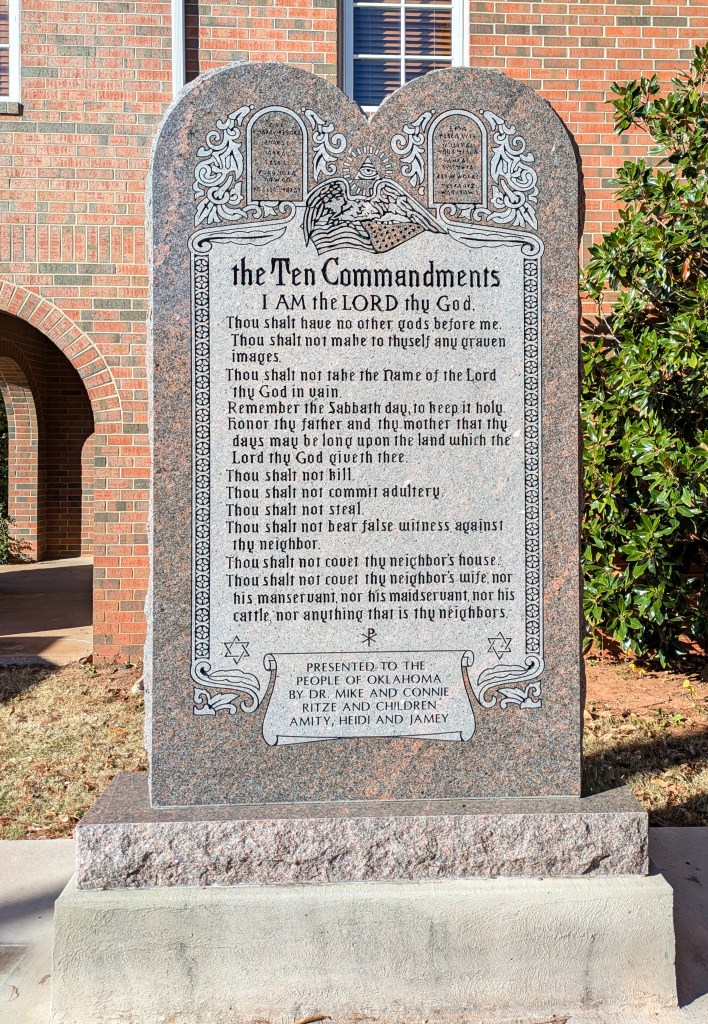
A Ten Commandments monument that sat on Oklahoma State Capitol grounds until the state Supreme Court ruled its presence violated the separation of church and state. It now is at the headquarters of a conservative lobbying group. Credit: Linda K. Wertheimer for The Hechinger Report
In Norman, Jakob Topper, Kyle Tubbs and other Baptist pastors I met with at the headquarters of a statewide Baptist church organization were increasingly aghast at Walters’s mixing of religion and politics. Rick Anthony, pastor of Grace Fellowship, a Baptist church, centered his November 17 sermon on such concerns. “Almost comically, we’ve heard this week about a video made that was ordered to be shown to all children in the public schools and then sent to their parents,” he said. “Our question is…where are our voices as our political leaders cozy up to faith leaders, all the while destroying our faith institutions?”
Kaily Tubbs, Tubbs’s wife and a fifth grade teacher in Norman schools, said the mandate conflicts with her personal belief on how faith should be handled in schools. She spoke also as a mother of a kindergartener and a third grader, both in Norman schools. “Our faith is really important to us,” she said. “I don’t want it to be used as a prop in a classroom.”
Topper said that at his church, the majority of his congregation believes in separation of church and state. He said he is aware of the religious diversity that exists in his town, too, and has both Muslim and Jewish neighbors. Like Anthony, he spoke with his congregation about Walters’s mandate, though in an informal weeknight meeting at his church, rather than as part of a formal sermon. “I wish,” he said, “that Jesus was left out of schools and left for the religious realm.”
Contact editor Caroline Preston at 212-870-8965, via Signal at CarolineP.83 or on email at [email protected].
The Hechinger Report provides in-depth, fact-based, unbiased reporting on education that is free to all readers. But that doesn’t mean it’s free to produce. Our work keeps educators and the public informed about pressing issues at schools and on campuses throughout the country. We tell the whole story, even when the details are inconvenient. Help us keep doing that.
Virginia Military Institute’s Board of Visitors voted 10 to 6 on Friday against a contract extension for Major General Cedric Wins, a VMI graduate and the first Black leader in the college’s history.
All 10 votes against the extension came from members appointed by Republican governor Glenn Youngkin, though four Youngkin appointees voted to renew the contract, joining two holdovers named to the board by Democratic governors, The Richmond-Times Dispatch reported.
Wins’s contract expires June 30.
The vote will end a contentious tenure for Wins, who joined VMI in 2021. He replaced General J. H. Binford Peay III, who led the college from 2003 to 2020, when he stepped down after an investigation determined systemic racism and sexism went unchecked under his watch.
Wins’s tenure at VMI, where he was tasked with righting the ship amid the fallout from the investigation, has been marked by controversy. He has faced off with alumni, whom he accused of spreading mistruths about VMI’s curricular offerings; clashed with student journalists over alumni involvement in the campus newspaper; and faced accusations that he went too far with diversity, equity and inclusion initiatives at VMI, which didn’t accept Black students until 1968 and women until 1997.