The school superintendent’s role has grown more complex and demanding over the past five years with unprecedented pressures around funding, staffing, safety and politics, as well as the continuing commitment to students’ academic growth and well-being, a mid-decade survey of superintendents shows.
The survey of 1,095 superintendents, conducted by AASA, The School Superintendents Association, was the first update since the COVID-19 pandemic disrupted in-person learning and caused dips in academic achievement.
It’s also the first survey in AASA’S American Superintendent study series since a record number of school shootings early in the 2020s spawned fears of safety and heightened efforts to safeguard campuses. And that’s all in addition to the emergence of culture wars over books bans and diversity, equity and inclusion programs.
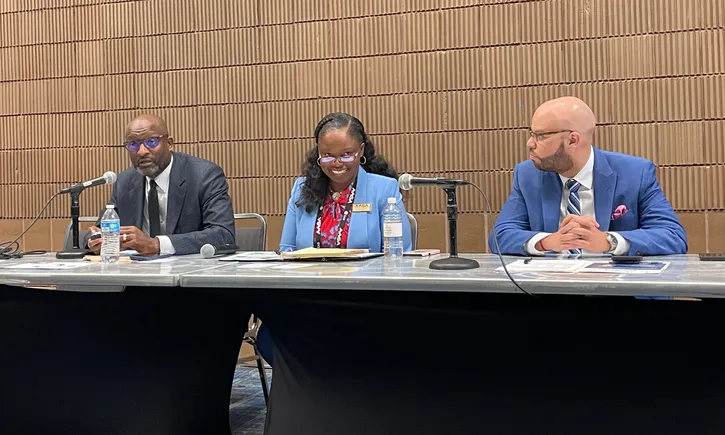
“I think my colleagues would tell you that the civility in communication to public officials plummeted, and I think people just felt that pressure,” said David Law, AASA president and superintendent of Minnesota’s Minnetonka Public School District. Law spoke during a Thursday briefing about the survey results. “This report about how hard the job is, it doesn’t surprise me. It’s a different job.”

David Law is superintendent of Minnesota’s Minnetonka Public School District and president of AASA.
Despite the challenges and the fact that the vast majority of superintendents reported at least moderate stress levels, a similarly high proportion of respondents said they were satisfied or very satisfied with their current superintendency. Watching students grow and succeed was superintendents’ greatest fulfillment, according to survey results.
Some 89% of superintendents said they were currently satisfied or very satisfied in their job, down slightly from 92% in 2020. Additionally, 59% of respondents said they planned on staying in the superintendency in the next five years. That’s up from 51% in 2010.
AASA’s national decennial studies began a century ago, in 1923. The most recent survey, which was conducted in fall 2024, covered superintendents from 49 states representing rural, suburban and urban districts of various student counts, although 70% of respondents worked in districts with fewer than 3,000 students.
Areas of strengths and challenges
As CEOs of their districts, superintendents have to deal with a broad scope of responsibilities. The survey found that superintendents were most likely to identify their areas of strength as an instructional leader or visionary for their district (40%) and for fostering a positive district and school climate (35%). The least common areas of strength cited were in crisis management (15%) and managing the daily politics of the job (14%).
When asked to pick up to five issues that consume the bulk of their time, most respondents said finance (54%), followed by personnel management (44%), superintendent-board relationships (41%), facility planning and management (41%), and conflict management (39%).
The top two issues that superintendents said most frequently prevented them from doing their core work as an educational leader in the past year were state bureaucracy and mandates (53%) and federal bureaucracy and mandates (40%). Other leading obstacles included social media issues (35%) and political divisions in the community (29%).
When asked to state the biggest problem facing public schools in their district, superintendents most often answered funding, followed by politics and staffing.
Support from communities
A high percentage of superintendents overall said they felt somewhat or very supported by their communities (91%). However, the range varied by district size, with 88% of leaders of districts with fewer than 1,000 students reporting such support, compared to at least 94% at districts enrolling between 3,000 to 24,999 students and those in districts of 50,000 students and more.
One explanation of this trend is that community support in rural districts — where fiscal and human resources are more sparse and where student populations are likely smaller — may be linked “less to symbolic trust and more to the tangible capacity of the district to deliver services,” the report said. On the other hand, while community engagement in urban districts that typically have large student populations often occurs “in a politically charged environment,” those districts tend to have broader advocacy networks and media visibility.
Broken down by race, only 37% of Black superintendents said they felt very supported by their community, compared to 48% of White superintendents. That difference, the report said, “reflects persistent racialized barriers that undermine the legitimacy of leaders of color, particularly when they pursue equity-focused agendas.”
Shawn Joseph, interim superintendent of Maryland’s Prince George’s County Public Schools, said during AASA’s briefing that superintendents and especially district leaders of color “have become targets in these political storms, facing organized resistance and in many cases, threats to their tenure.”
Joseph added that “equity work is no longer quietly debated. It’s, in fact, publicly contested, yet our commitment to fairness, dignity and opportunity must remain unwavering.”
In a notable shift from decades earlier and as a direct result of the pandemic experience, superintendents are now engaging more with their communities, the report said. About 67% engage their communities in advisory or planning activities on at least a monthly basis.
“This is a shift that reflects what we learned in crisis, that trust cannot be episodic,” said Joseph, who is also an assistant professor and co-director of the Urban Superintendent Academy at Howard University. “It has to be consistent, it has to be transparent, and it has to be deeply human.”
AASA attributes increased superintendent engagement with their communities to several factors. First, the pandemic taught superintendents that community trust is vital and must be nurtured continuously. Second, political polarization in education has meant superintendents must engage proactively to keep misinformation from spreading.
Last, the proliferation of digital communication platforms has brought more frequent contact and has given leaders access to families through virtual town halls, webinars and social media, according to the report.
Who is leading districts?
Superintendents remain majority White and male, and on average they are 53 years old, the survey found. But the percentage of women superintendents did jump from 13% in 2000 to 30% in 2025.
Superintendents of color represent 10% of district leaders. Since 2020, the proportion nearly doubled of superintendents who identified as Black or African American or Hispanic/Latinx.
While the diversification of superintendents is a positive trend, the report said both women and people of color remain “dramatically underrepresented” in the superintendency. The report calls for examining the demographics of superintendents in relation to pipelines to district leadership and the job market for superintendents.
“Leaders from underrepresented backgrounds bring essential lived experiences that shape how they understand and respond to the needs of diverse student and teacher populations,” the report said.
Here are other data points from the AASA superintendents survey:
- Nearly 60% of respondents said they had two to eight years of experience in a superintendent role.
- About 75% of superintendents report spending less time with their families.
- The youngest superintendent was 29 years old and the oldest 79.
- Although Hispanic or Latinx superintendents only make up 4% of the superintendent population, they represent 47% of all superintendents leading districts with 51% or more students identified as multilingual learners and 50% of superintendents leading districts with 51% or more students who are immigrants or refugees.
- Women superintendents were more likely than male superintendents to lead districts where more than 51% or more of students were racial or ethnic minorities, eligible for free or reduced-priced lunch or qualified for special education services.