by Nirvi Shah, The Hechinger Report
December 5, 2025
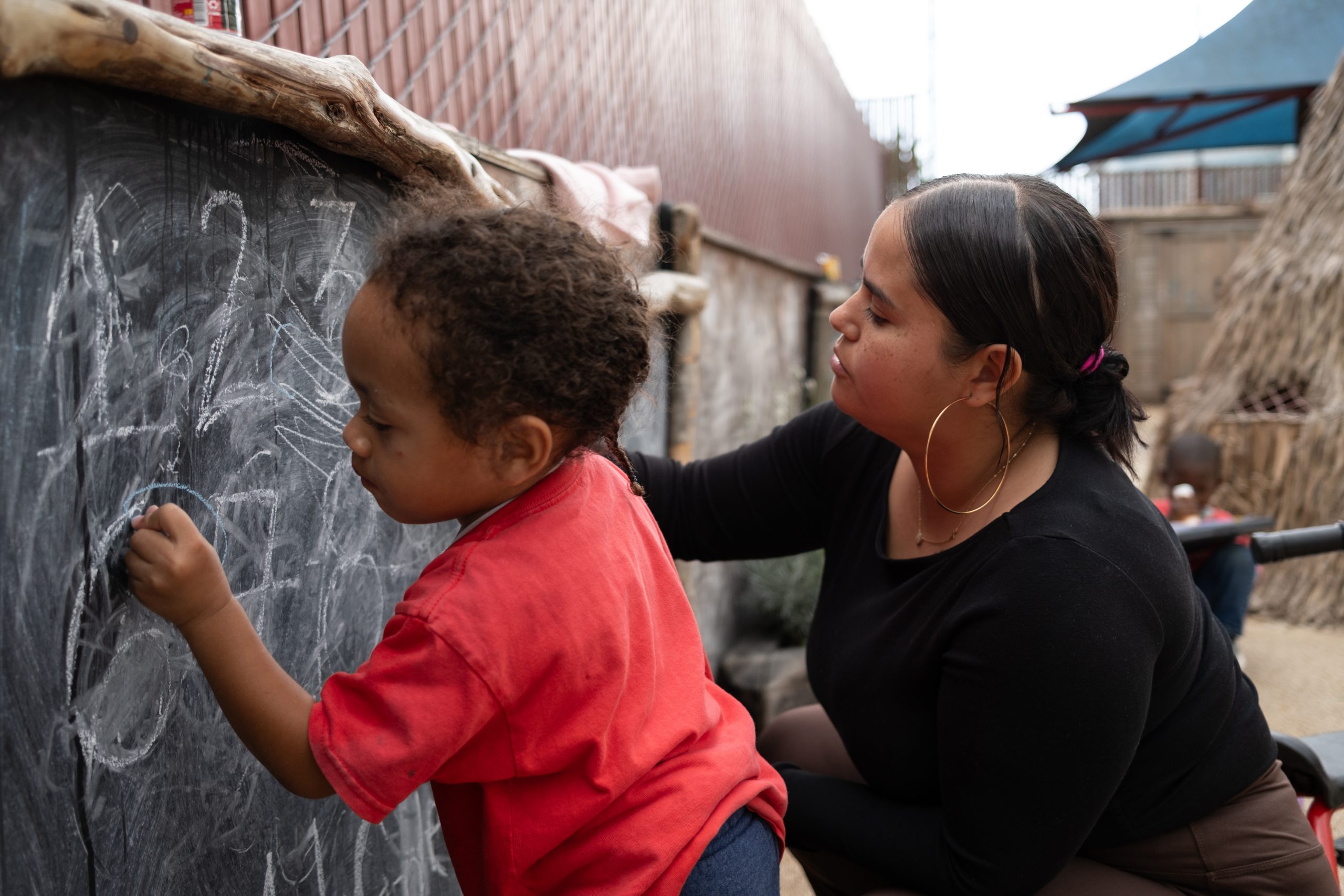
SAN FRANCISCO — In a playground outside a YMCA, Mayra Aguilar rolled purple modeling dough into balls that fit easily into the palms of the toddlers sitting across from her. She helped a little girl named Wynter unclasp a bicycle helmet that she’d put on to zoom around the space on a tricycle.
Aguilar smiled, the sun glinting off her saucer-sized gold hoop earrings. “Say, ‘Thank you, teacher,’” Aguilar prompted Wynter, who was just shy of 3. Other toddlers crowded around Wynter and Aguilar and a big plastic bin of Crayola Dough, and Aguilar took the moment to teach another brief lesson. “Wynter, we share,” Aguilar pressed, scooting the tub between kids. “Say, ‘Can you pass it to me?’”
Aguilar and Wynter are both new at this. Wynter has been in the structured setting of a child care center only since mid-August. Aguilar started teaching preschoolers and toddlers, part-time, in February.
It has been life-changing, in different ways, for them both. Wynter, an only child, is learning to share, count and recognize her letters. Aguilar is being paid to work and earning her first college credits — building the foundation for a new career, all while learning new ways to interact with her own three kids.
Early educators are generally in short supply, and many who attempt this work quickly quit. The pay is on par with wages at fast food restaurants and big box stores, or even less. Yet unlike some other jobs with better pay, working with small children and infants usually requires some kind of education beyond a high school diploma. Moving up the ladder and pay scale often requires a degree.
What’s different for Aguilar compared to so many other people trying out this profession is that she is an apprentice — a training arrangement more commonly associated with welders, machinists and pipefitters. Apprentice programs for early childhood education have been in place in different parts of the country for at least a decade, but San Francisco’s program stands out. It is unusually well, and sustainably, funded by a real estate tax voters approved in 2018. The money raised is meant to cover the cost of programs that train early childhood educators and to boost pay enough so teachers can see themselves doing it for the long term.
Related: Young children have unique needs and providing the right care can be a challenge. Our free early childhood education newsletter tracks the issues.
Some policy experts see apprenticeships as a potential game changer for the early educator workforce. The layers of support they provide can keep frazzled newcomers from giving up, and required coursework may cost them nothing. “We want it to be a position people want to go into as opposed to one that puts you in poverty,” said Cheryl Horney, who oversees the Early Learning Program that employs apprentices at Wu Yee Children’s Services in San Francisco, including the site where Aguilar works.
Aguilar, 32, is paid to work 20 hours a week at the Wu Yee Children’s Services’ Bayview Early Learning Center, tucked inside a Y in a residential neighborhood a little under a mile from San Francisco Bay. She works alongside a mentor teacher who supports and coaches her. The apprenticeship covers the online classes, designed just for her and other apprentices and taught live from City College of San Francisco, that Aguilar takes a few nights a week. She was given all the tools needed for her courses, including a laptop, which she also uses for homework and discussions with other apprentices outside of class.
After high school, Aguilar had tried college, a medical assistant program that she quit after a few months. That was more than 10 years ago. She hadn’t touched a computer in all that time. When she was enrolling her youngest daughter at another Wu Yee location, Aguilar saw a flyer about the apprenticeship program and applied. She is finding this work to be a far better fit: “This — I think I can do it. This, I like it.”
The need for more early educators is longstanding, and in recent years there’s been a push for early educators to get postsecondary training, both to support young children’s development and so the roles command higher salaries. For example, a 2007 change in federal law required at least half of teachers working in Head Start to have bachelor’s degrees in early childhood education by 2013, a goal the program met.
Despite efforts to professionalize the workforce, salaries for those who work with young children remain low: 87 percent of U.S. jobs pay more than a preschool teacher earns on average; 98 percent pay more than what early child care workers earn. In 2022, Head Start lead teachers earned $37,685 a year on average.
Apprenticeships are seen as one way to disrupt that stubborn reality: Would-be teachers are paid while being trained for everything from entry-level roles that require a small number of college credits or training to jobs, like running a child care center, that require degrees and come with more responsibility and even higher pay. According to a June 2023 report from the Bipartisan Policy Center, a think tank, 35 states have some kind of early childhood educator apprenticeship program at the city, regional or state level, and more states are developing their own programs. U.S. Department of Labor data shows that more than 1,000 early educator apprentices have completed their programs since the 2021 fiscal year. Early Care & Educator Pathways to Success, which has received Labor Department grants to help set up apprenticeship programs, estimates the numbers are far larger given its work has cultivated hundreds of apprentices in 21 states, including Alaska, California, Connecticut and Nebraska.
These programs can be complicated to launch, however. They sometimes require painstaking work to find colleges that will provide coursework specific to local regulations and at hours that work for apprentices who may be in classrooms much of the workday as well as tending to their own children. They require money to pay the apprentices — on top of whatever it already costs to run child care centers and pay existing staff. The apprentices also typically need other layers of support: coaching, computers, sometimes child care and even meals for apprentices’ own kids as they study and take exams.
In San Francisco, Horney advocated for her employer to set up an apprenticeship program for staffers at its 12 Head Start centers even before the tax money became available. She recalled losing teachers to chain retailers like Costco and Walgreens where they found less stressful jobs with more generous benefits. When she arrived in San Francisco to work in the classroom, with five years of experience and a bachelor’s degree, she was paid $15 an hour. “Now the lowest salary we pay is $28.67 for any sort of educator,” she said, and the wages and apprenticeships are even drawing people from other counties and stabilizing the San Francisco early educator workforce. “It has helped immensely.”
Other parts of the country have seen success with similar initiatives.
The YWCA Metro St. Louis in Missouri, which hasn’t had a single teacher vacancy for the last two years at the child care centers it oversees, credits its apprenticeship program. In Guilford County, North Carolina, vacancies and staff turnover were a plague until recently, but an apprenticeship program for entry-level early educators has kept new teachers on the job.
Elsewhere, there is hope for those kinds of results. In the Oklahoma City area, an apprenticeship program started in 2023 just yielded its first graduate, who worked in a child care center for two years and completed a 288-hour training program. Curtiss Mays, who created the program for teachers at the group of Head Start centers he oversees, was in the midst of trying to hire 11 educators just as the first apprentice earned a credential that allows her to back up other teachers.
“It’s a pretty major project,” Mays said. “We hope it’s the start of something really good.” Mays worked with the Oklahoma Department of Labor to set up the apprenticeship program, which he said has already pulled one person out of homelessness and is helping to lure more aspiring teachers. It will pay for education all the way through a bachelor’s degree if apprentices stick with it.
Apprenticeship programs can be costly to run, but bipartisan federal legislation to support them has never gained traction. (Advocates note that apprenticeships can cost far less than a traditional four-year college degree.) Labor Department money for organizations that help set up and grow early childhood educator apprenticeships helped increase the number of apprentices in so-called registered apprenticeship programs — ones that are proven and validated by the federal agency. But some of those grants were axed by the Trump administration in May.
In San Francisco, while setting up apprenticeships was as labor intensive as in many other places, the 2018 real estate tax provides a new and deep well of money to propel the early educator apprentice effort. The money pays for all of the things that are letting Aguilar and dozens of others in the county earn at least 12 college credits this year. In two semesters, Aguilar will have the credentials to be an associate teacher in any early education program in California. Other apprentices across San Francisco, in Head Start centers, family-owned child care programs, even some religious providers, can work toward associate or bachelor’s degrees using the new tax revenue to pay for it.
Long before the ballot measure across the bay in San Francisco, Pamm Shaw dreamed up the forerunner of an early educator apprenticeship program in a moment of desperation.
It was over a decade ago, and Shaw, who was then working at the YMCA East Bay overseeing a collection of Head Start centers, said her agency was awarded a grant to add spaces for about 100 additional infants. Except her existing staff didn’t want to work with children younger than 3. So Shaw sent notices to the roughly 1,000 families with children enrolled in YMCA East Bay Head Start programs at the time and convinced about 20 people, largely parents of children enrolled in Head Start, to consider the role. She pulled together the training that would qualify the parents to become early educators — 12 college credits in six months.
The education piece, Shaw realized, was a huge draw. Some of the parents had spent 10 years working toward associate degrees on their own without completing them. Giving them the chance to earn those degrees in manageable chunks — while getting paid and receiving raises relatively quickly as their education advanced — proved a powerful recruitment tool. “It changed their lives,” Shaw said. And these new teachers had their eyes opened to how what they would be doing wasn’t just babysitting. They took away lessons they used with their own children — who in turn took notice of their parents studying. “It’s actually child care,” said Shaw. “So much happens in the first year of life that you never get to see again. Never, ever, ever.”
It changed Shaw’s life, too, and inspired many other apprenticeship programs all over. Her role morphed into fundraising to build out the apprenticeship pipeline. The program, now baked into the YMCA of the East Bay system, reflected the overall early educator workforce: It was made up entirely of women, mostly women of color, some of them immigrants and many first-generation college students. By the time Shaw retired a few years ago, more than 500 people in the Berkeley area had completed the early educator apprenticeship program.
Erica Davis, a single mom, is one of its success stories. When she met Shaw, Davis said, she was relying on public assistance and jobs caring for other people’s children, while taking care of a daughter with significant medical needs, as well as her toddler-age son. Davis was at a Head Start dropping off paperwork for the family of a child in her care when an employee told Davis her young son might be eligible for Head Start too. He was, and as Davis enrolled him, she learned about Shaw’s apprenticeship program. Davis missed the first window to apply, but as she put it, “I was blowing their phone up. I needed to get in.”
That was 2020. By this spring, Davis will have earned her bachelor’s degree from Cal State East Bay. She works full-time at a Richmond, California, Head Start center while taking classes and supporting her kids, now in high school and elementary school. She can afford to rent a two-bedroom apartment, owns a car and no longer relies on state or federal assistance to pay bills. She’s on the dean’s list, and, she said proudly, she can squat 205.
“I didn’t take my education seriously,” Davis, 41, said of her younger self. “I feel like I’m playing catch-up now.” She is in her element at the YMCA of the East Bay Richmond Parkway Early Learning Center, reading to children, working on potty training and leading the kids through coloring-and-pasting exercises. She has even become an informal coach for newer apprentices. The network and family feel of these apprenticeships is some of what helps many succeed, she said. “I have a sad story, but it turned into something beautiful.”
Related: The dark future of American child care
While Davis said she prefers the flexibility of taking classes at her own pace, other apprentices thrive in the kind of classes Aguilar attends, with a live instructor who starts off leading students in a mindfulness exercise. That is the same approach to teaching apprentices at EDvance College in San Francisco, which works exclusively with early childhood apprentices, according to its president and CEO, Lygia Stebbing.
The college provides general education classes in reading, math and science for apprentices pursuing degrees, taught through an early childhood lens so it feels approachable and relevant. And every lesson can be applied nearly in real time, unlike other paths to degrees, in which in-person teaching experience comes only after many classes, Stebbing said. Before beginning classes, apprentices get a crash course in using technology, from distinguishing between a tablet and a laptop to using Google Docs and Zoom, “so they can jump right into things,” she said. A writing coach and other student support staff are available in the evenings, when apprentices are taking courses or doing homework. Because many of the apprentices are older than typical college students and may even have used up their federal Pell Grants and other financial aid taking courses without earning a degree, the college works with foundations and local government agencies to offset the cost of courses so graduates don’t end up in debt.
“We’ve really put the student at the center,” Stebbing said.
For Mayra Aguilar, her mentor teacher Jetoria Washington is a lifeline who can help her unstick an issue with any aspect of the apprenticeship — in the classes she takes or the classroom where she works. Taking courses online means she can be home with her own kids in the evenings. Earning money for the hours she spends in the classroom means she is not going into debt to earn the credential she needs to find a full-time job. The constellation of support has helped her shift from feeling in over her head to feeling ready to keep working toward a college degree.
And she is having fun. On the playground, one of the kids had the idea to trace another with sidewalk chalk, working on their pencil grip as much as they were playing. Except it wasn’t just the other kids: They traced Aguilar, too. When it was time to go back inside, powdery green and pink lines crisscrossed the back of her brown pants and black blouse. She wasn’t bothered.
“I love the kids,” she said. “They always make me laugh.”
Aguilar has even picked up skills that she uses with her own children, something many apprentices describe.
Now, she sometimes says to her youngest daughter, “Catch a bubble.” That’s preschool speak for “Be quiet.” When a teacher needs the toddlers’ attention, kids hear this phrase, then fill their cheeks with air.
Most of the time, at home and at work, a brief silence follows. Then the kids look up, ready to hear what comes next.
Contact staff writer Nirvi Shah at 212-678-3445, on Signal at NirviShah.14 or [email protected].
Reporting on this story was supported by the Higher Ed Media Fellowship.
This story about preschool teachers was produced by The Hechinger Report, a nonprofit, independent news organization focused on inequality and innovation in education. Sign up for the Hechinger newsletter.
This <a target=”_blank” href=”https://hechingerreport.org/one-city-finding-early-educators/”>article</a> first appeared on <a target=”_blank” href=”https://hechingerreport.org”>The Hechinger Report</a> and is republished here under a <a target=”_blank” href=”https://creativecommons.org/licenses/by-nc-nd/4.0/”>Creative Commons Attribution-NonCommercial-NoDerivatives 4.0 International License</a>.<img src=”https://i0.wp.com/hechingerreport.org/wp-content/uploads/2018/06/cropped-favicon.jpg?fit=150%2C150&ssl=1″ style=”width:1em;height:1em;margin-left:10px;”>
<img id=”republication-tracker-tool-source” src=”https://hechingerreport.org/?republication-pixel=true&post=113662&ga4=G-03KPHXDF3H” style=”width:1px;height:1px;”><script> PARSELY = { autotrack: false, onload: function() { PARSELY.beacon.trackPageView({ url: “https://hechingerreport.org/one-city-finding-early-educators/”, urlref: window.location.href }); } } </script> <script id=”parsely-cfg” src=”//cdn.parsely.com/keys/hechingerreport.org/p.js”></script>