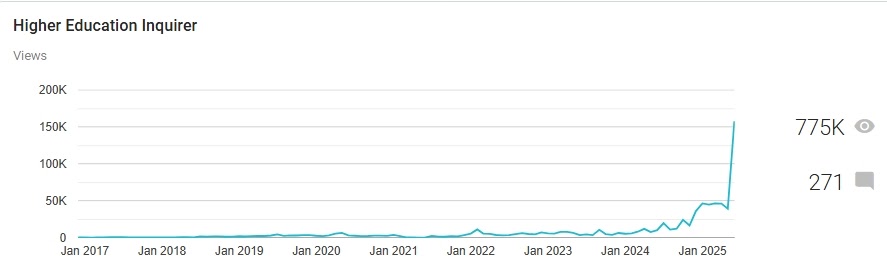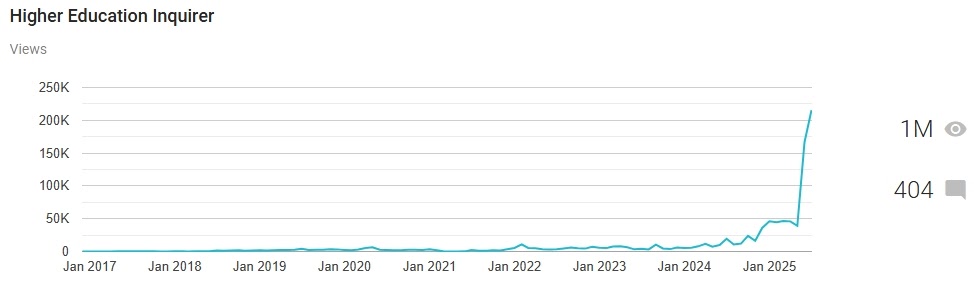
The Higher Education Inquirer has reached a major milestone: more than 1 million total views since its founding, with over 200,000 views in July 2025 alone—a record-breaking month for the independent investigative site. This surge in readership reflects growing public concern with the state of U.S. higher education, especially at a time of increasing economic precarity, political unrest, and institutional dysfunction.
As corporate media outlets continue to downsize or ignore coverage of student debt, credential inflation, predatory schools, and the exploitation of academic labor, readers are seeking more critical, independent voices. HEI, which has long focused on underreported stories within the higher education-industrial complex, is becoming a go-to resource for policymakers, whistleblowers, journalists, and everyday people trying to make sense of the education economy.
Most Viewed Stories in July 2025
A few standout articles reveal key themes that are resonating with readers:
1. “Camp Mystic: A Century of Privilege, Exclusion, and Resilience Along the Guadalupe”
Views: 8,730
This deeply researched piece on the elite girls’ camp in Texas struck a nerve with readers interested in the intersection of inherited wealth, segregation, and performative philanthropy. Camp Mystic serves as a metaphor for the parallel institutions that shape American leadership in quiet, exclusive ways—far from public scrutiny.
Trend: Growing interest in how generational wealth and private networks perpetuate elite power and influence, especially through educational institutions.
2. “The Big Beautiful Bill”: A Catastrophic Blow to College Affordability
Views: 1,290
This analysis of new legislation affecting federal student aid programs explores how a bill dressed in populist language has real consequences for working-class and middle-income families. Readers responded to its dissection of policy doublespeak and the structural defunding of public education.
Trend: Rising awareness of how both major political parties contribute to the erosion of affordable education—often under misleading rhetoric.
3. “Santa Ono: Take the Money and Run”
Views: 956
A pointed critique of University of Michigan President Santa Ono’s high salary and revolving-door administrative career drew in readers frustrated by bloated leadership pay and lack of institutional accountability.
Trend: Increased public scrutiny of university presidents and boards of trustees, especially at elite institutions.
4. “List of Schools with Strong Indicators of Misconduct, Evidence for Borrower Defense Claims”
Views: 943
This database-style article provided a valuable resource for former students, journalists, and attorneys. By documenting schools with troubling records, it supported those filing Borrower Defense to Repayment claims and highlighted the ongoing fallout from the for-profit college boom.
Trend: Continued demand for actionable consumer information amid the Biden Administration’s limited and politically fraught debt relief efforts.
5. “Degrees of Discontent: Credentialism, Inflation, and the Global Education Crisis”
Views: 900
This global take on the failures of credential-driven economies resonated with a wide audience—from jobseekers with degrees they can’t use to educators struggling to make sense of shifting academic value.
Trend: A philosophical and economic reckoning with credentialism, especially as degrees lose value while tuition and debt skyrocket.
6. “Layoffs at Southern New Hampshire University”
Views: 826
Coverage of SNHU, a major player in online education, shed light on the darker side of “innovation”: layoffs, overwork, and instability for faculty and staff.
Trend: Growing doubts about the long-term sustainability and labor ethics of the online education model.
7. “Universities Brace for Endowment Tax Hike, Rethink Investment Strategies”
Views: 687
A timely piece on elite university endowments caught the eye of readers interested in how wealth hoarding and financial engineering are baked into modern academia.
Trend: Rising critiques of nonprofit tax loopholes and the financialization of higher ed.
8. “Liberty University in Black and White”
Views: 684
This critical examination of Liberty University’s public image, internal contradictions, and links to right-wing political power explored how Christian nationalist ideology operates through higher education.
Trend: High interest in the political roles of conservative religious institutions and their ties to the culture wars.
9. “Corruption, Fraud and Scandal at Los Angeles Community College District (LACCD Whistleblower)”
Views: 615
A whistleblower-centered article on LACCD corruption revealed widespread misuse of funds and institutional cover-ups, especially in facilities projects.
Trend: Rising demand for investigative journalism focused on local corruption in publicly funded institutions.
10. “Agency Information Collection Activities…Borrower Defense to Loan Repayment Universal Forms”
Views: Not Yet Indexed
While bureaucratic in title, this article was shared among policy experts and debt activists for its breakdown of how regulations—and public comment periods—impact real people trying to discharge fraudulent debt.
Trend: Readers are becoming more engaged in regulatory policy and more skeptical of federal agencies’ ability or willingness to protect consumers.
What Readers Want
What these stories show is a distinct pattern: readers want more accountability, more transparency, and less propaganda from the education system that has long promised prosperity and delivered precarity. They’re fed up with bloated administrative salaries, empty credentials, elite hypocrisy, and legislative betrayal.
Thanks to grassroots support and collaborations with students, whistleblowers, and journalists, the Higher Education Inquirer continues to grow in both reach and relevance.
As we pass 1 million views, we’re not just marking clicks—we’re tracking the pulse of a system in crisis. And we’re not done yet.