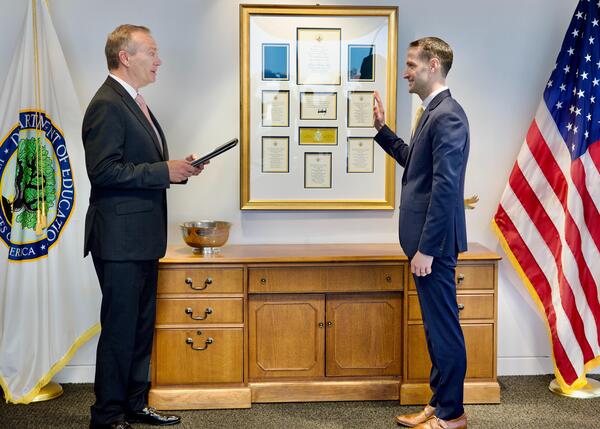
Nicholas Kent, a career higher education policy expert and now the Department of Education’s under secretary, has made his priorities for American colleges and universities clear—controlling student debt, building public trust and ensuring students experience a positive return on investment.
“If colleges and other postsecondary institutions merit taxpayer investment, it is because they equip American citizens with the skills and knowledge needed to thrive in this rapidly-evolving economy,” he said in his first letter to the department’s staff. “The ‘higher education industrial complex’ must be shaken up by competition, accountability, and a future-focused mindset.”
The letter was Kent’s first statement since being confirmed late Friday and sworn in early Monday morning. It is one of few times he has discussed what he plans to prioritize since President Trump nominated him to be the most senior official focused on postsecondary education in February.
Over all, Kent’s missive elicited praise and caution from higher education experts.
Some say his years of experience, combined with his resistance to the status quo, make him a prime appointee. Others worry that despite his promises of accountability and workforce development, he will focus more on the vitality of the market and less on consumer protection. Others still are encouraged simply by the fact that he’s focused on constructive regulation, not culture war–focused litigation.
“I feel a little bit like a broken record, because I keep coming back to it, but it’s so refreshing to be talking about things like accountability, outcomes, value and career-aligned education pathways, compared to what we have been talking about for the last six months with this administration,” said Jon Fansmith, senior vice president for government relations at the American Council on Education. “Hopefully the confirmation of Nicholas Kent will help reorient the Trump administration toward productive policy outcomes.”
A first-generation college student and Pell Grant recipient, Kent has spent the entirety of his career in higher education. Most recently, he served as deputy education secretary for Virginia governor Glenn Youngkin. But before that he advocated primarily for private institutions, working with both Career Education Colleges and Universities, which represents some for-profit colleges, and Education Affiliates, a for-profit college company that faced public scrutiny in 2013 after a whistleblower accused the company of fraud.
Critics say Kent’s ties to for-profit colleges, which they see as predatory, should have disqualified him from the job. But Education Secretary Linda McMahon voiced confidence in him.
His “technical expertise and vast experience in higher education will serve as an invaluable asset to the Department of Education team,” McMahon said in a statement Monday. “Not only will he work to fulfill President Trump’s vision for accreditation, accountability reforms, and more, but he will also be a great benefit to current and aspiring postsecondary students, faculty, and staff.”
In his letter to department staff, Kent provided little granular detail, though he’s expected to say more at several upcoming rule-making sessions. He did speak generally on a few topics, like increasing access to alternative postsecondary pathways, protecting campus free speech and helping students feel empowered by their postsecondary options.
“President Trump has entrusted me with a weighty task: to restore the greatness of American higher education and ensure that our taxpayer-supported colleges, universities, vocational schools, and other postsecondary programs are genuinely helping young Americans,” he wrote. “High school graduates should enter college with a clear direction. The taxpayer money spent on their education should have a direct impact on their ability to contribute to the workforce. [And] the federal government should be less focused on making legacy institutions ‘too big to fail’ and making students skilled enough to succeed.”
Kent also reiterated a point which Trump and McMahon have been making since the earliest days of the chief’s second term in office: The Department of Education and its Office of Federal Student Aid are failing to properly manage student loans.
“By no means should this Department administer a $1.7 trillion student loan portfolio—the fifth largest financial servicer in the country—that is 25 percent in default,” he said.
Unlike McMahon and Trump, however, Kent did not explicitly reference moving loan services to a different agency or department, like the Small Business Administration or Treasury. That said, the tone of his letter made it clear he thinks that the current system must change.
“Colleges should not be increasing their tuition each year, enabled by generous federal loan subsidies, without having to answer for their students’ outcomes,” Kent wrote.
Some policy experts like Preston Cooper, a senior fellow at the American Enterprise Institute, a conservative think tank, said they were “thrilled” to see Kent confirmed and characterized his letter as “right on the mark.”
Others, like Fansmith from ACE, weren’t quite as enthusiastic but still remained hopeful. He noted that while he likely won’t always agree with Kent on how to solve a problem, at least they will start on the same page and agree there is a problem that policy should be used to address.
“Maybe my expectations are too high,” Fansmith said. But “the letter, in a lot of ways, is a positive sign in terms of what we have repeatedly wanted from this administration—which is engagement and working with the community around matters of policy to reform and improve the higher education system.”
But Wesley Whistle, a project director for student success and affordability at New America, a left-leaning think tank, called the new under secretary’s view of public doubt in higher ed too narrow, his concerns about free speech unlicensed and his emphasis on accountability just rhetorical.
“I respect that Mr. Kent brings personal experience as a first-generation Pell recipient. But will that truly guide his approach?” Whistle said. “They’ve gone after Harvard, Columbia and other elite schools and have launched investigations into many public colleges over DEI, but where has their oversight been in terms of protecting students from fraud and poor outcomes?”
If the Trump administration really cares about improving student outcomes and holding colleges accountable, “they should make sure there is sufficient staff to properly oversee higher education and protect students and taxpayers,” he added. “It’s what students deserve and Americans want.”