Tag: Syllabi

  • Fla. Board Says Syllabi, Reading Lists Must Be Posted Publicly

    Fla. Board Says Syllabi, Reading Lists Must Be Posted Publicly

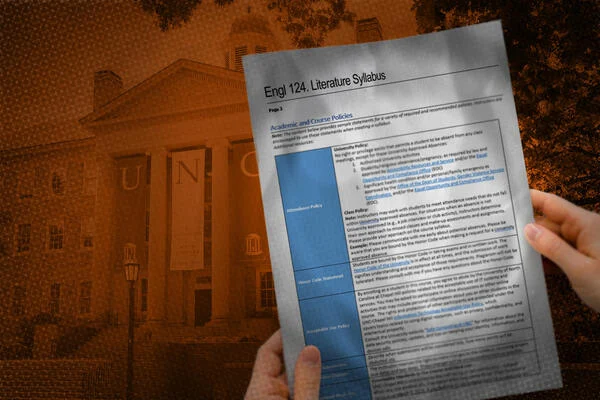
    Photo illustration by Justin Morrison/Inside Higher Ed | Liudmila Chernetska, Davizro and DenisTangneyJr/iStock/Getty Images

    Faculty at all Florida public universities must now make syllabi, as well as a list of required or recommended textbooks and instructional materials for each class, available online and searchable for students and the general public for five years.

    The new policy is part of an amendment to the Florida Board of Governors’ regulation on “Textbook and Instructional Materials Affordability and Transparency,” and it passed unanimously without discussion at a board meeting Thursday. On the agenda item description, board officials cited improved transparency as the impetus for the rule, which is meant to help students “make informed decisions as they select courses.” But some faculty members say it’s designed to chill academic freedom and allow the public to police what professors teach in the classroom.

    “Many of my colleagues and I believe that this is yet another overreach by political appointees to let Florida’s faculty know that they are being watched for potentially teaching any content that the far right finds problematic,” said John White, a professor of English education and literacy at the University of North Florida. He said officials at his institution told faculty members they must upload their syllabi for 2026 spring semester classes to Simple Syllabus, an online syllabi hosting platform, by December.

    “Florida’s universities are being run in an Orwellian manner, and working as a faculty member in Florida is increasingly like living in the world of Fahrenheit 451,” he said.

    According to the approved amendment, professors must post the syllabi “as early as is feasible” but no fewer than 45 days prior to the start of class. Public syllabi must include “course curriculum, required and recommended textbooks and instructional materials, goals and student expectations of the course, and how student performance will be measured and evaluated, including the grading scale.” Individualized courses like independent study and theses are exempt from the rule.

    The Florida Board of Governors did not respond to Inside Higher Ed’s questions about the amended policy, including a question about when it will start being enforced.

    Concerns About Faculty Safety

    It’s not a unique policy, even in Florida. Since 2013, the University of Florida has required professors to post their syllabi online—but only three days prior to the start of class, and they have to remain publicly available for just three semesters. Now, all Florida public universities, including the University of Florida, must follow the new rules. A UF spokesperson told Inside Higher Ed the university is waiting for the Board of Governors to share guidance about when the new policy will be enforced.

    “Even before the rule, most faculty members have been posting anyway to advertise their course. Faculty members in fact prefer to post in advance and certainly have nothing against posting,” said Meera Sitharam, a professor in the department of computer and information science and engineering, and president of the University of Florida’s 2,150-member United Faculty of Florida union. The faculty she spoke with primarily took issue with the new 45-day deadline, which is “quite early for a posting containing all the details” of a syllabus, she said. They are also concerned that they will no longer be able to make changes to reading lists midsemester.

    “A good-quality discussion class would permit the instructor to assign new reading as the course proceeds. This would now be disallowed,” Sitharam said. “The effect of this is likely to be that an overlong reading list is posted by the faculty member just to make sure that they don’t miss anything they might want to assign. And much of the reading list may never be assigned.”

    Texas similarly requires all faculty at public institutions to make a version of their syllabus public. Indiana implemented a law in July requiring public institutions to publish all course syllabi on their websites, and this fall, the University System of Georgia introduced a new policy requiring faculty to post syllabi and curriculum vitae on institution websites.

    Some faculty members in those states have seen firsthand the risks of posting syllabi online; several professors have been harassed and doxed over course content in their online syllabi. Florida faculty are concerned the same thing could happen to them; several faculty members believe that the board passed the rule with the intent of siccing the general public on professors who teach about topics that conservative politicians don’t like.

    “The sole purpose is to subcontract out the oversight of all of our courses, so that if there’s some independent entity or individual that wants to look at the College of Education at Florida State, and they spend two months doing a deep dive into all of the classes, then they’ll come up with: ‘Here at Florida State we found these five classes that don’t meet [our standards],’” said William Trapani, communications and multimedia studies professor at Florida Atlantic University. “Why else would you have that capacity to make this data bank and make it publicly accessible for five years?”

    Stan Kaye, a professor emeritus of design and technology at the University of Florida, sees concerns about the policy as overblown. “I cannot see why making syllabi public at a public institution is a problem for anyone—I would think that promoting your work and subject is generally a good thing,” he said. “If you are afraid you are teaching something illegal or that lacks academic integrity and you want to keep it secret, that should be a problem.”

    Faculty safety is the primary concern for James Beasley, an associate professor of English and president of the faculty association at North Florida.

    “The most important issue related to this requirement is the safety of our faculty, both online and in person. The concern is that faculty will be exposed to external trolls of course content and that the publication of course locations will expose faculty to location disclosures,” Beasley said in an email. While it is typical for syllabi to include course meeting times and locations, the new board policy does not require that information to be posted online.

    Trapani also said that because of the five-year syllabus retention period, faculty are worried they could be retroactively harassed for teaching about something the public finds unfavorable from a class several years ago. White has similar concerns.

    “I’m teaching a course that utilizes neo-Marxist theory to critique the idea of meritocracy—will the Board of Governors or members of the public falsely claim I’m teaching communism or that I’m teaching students to hate their country? If a history professor or a social studies education professor is discussing redlining or Jim Crow laws, will they later be critiqued for teaching students about institutionalized racism or sexism?” White said.

    Ultimately, Trapani believes the amended syllabi policy is an attempt to insulate the Board of Governors from public criticism.

    “Florida will make a lot more sense to outsiders if its policymaking is viewed through a lens of fear,” he said. “They’ve deputized an army of outsiders to pore through records older than most students’ time at the university—all so that they cannot be accused of missing something … It’s just another way in which faculty employment conditions and physical safety are made more precarious by the endless barrage of false claims about our teaching practices.”

    Josh Moody contributed to this report.

    Source link

  • UNC Campuses Split on Whether Syllabi Are Public Documents

    UNC Campuses Split on Whether Syllabi Are Public Documents

    Photo illustration by Justin Morrison/Inside Higher Ed | Liudmila Chernetska and Davizro/iStock/Getty Images

    As right-wing groups increasingly weaponize Freedom of Information Act requests to expose and dox faculty members who teach about gender, race and diversity, University of North Carolina system campuses are split over whether syllabi and other course materials should be subject to public records requests.

    In July, officials at the University of North Carolina at Chapel Hill determined that the documents are not automatically subject to such requests after the Oversight Project, founded by the conservative think tank the Heritage Foundation, requested that the university hand over any course materials from more than 70 classes that contained one of 30 words or phrases, including “gender identity,” “intersectionality,” “queer” and “sexuality.” Officials ultimately denied the request, writing, “There are no existing or responsive University records subject to disclosure under the North Carolina Public Records Act. Course materials, including but not limited to exams, lectures, assignments and syllabi, are the intellectual property of the preparer.”

    The requested materials are protected by copyright policies, a UNC Chapel Hill spokesperson told Inside Higher Ed. “The university has a longstanding practice of recognizing faculty’s intellectual property rights in course materials and does not reproduce these materials in response to public records requests without first asking for faculty consent,” they wrote in an email.

    But an hour’s drive west, at the University of North Carolina at Greensboro, officials decided just the opposite. Professors were asked to hand over their spring 2025 syllabi in response to a Freedom of Information Act request earlier this fall, said Chuck Bolton, a professor of history at UNC Greensboro and chair of the Faculty Senate. He is among dozens of faculty members who were asked to upload their syllabi into a central database.

    “The Public Records Act is inclusive in its coverage and unless there is an explicit exception, which this is not, it is covered,” UNC Greensboro spokesperson Diana Lawrence said in an email. “As a matter of public policy, transparency should take [precedence] over questions where there is doubt and we do not believe that the Federal Copyright Act provides a specific exemption or preempts what has been passed in state law.”

    Which university is interpreting the law correctly? It’s hard to know, said Hugh Stevens, an attorney who specializes in public records and FOIA law and litigation at the law firm Stevens Martin Vaughn & Tadych. There is no case law specific to this question, and the answer likely depends on how different course materials—from lecture notes to syllabi to course descriptions—are defined under the law.

    “It’s probably a matter of degree,” Stevens said. “Something that you post online for your class to read, it’s pretty hard to say those are not subject to [public records requests]. But on the other hand, the materials that you use to prepare to teach your class, but which are never published to anybody, are certainly, in my view, copyrightable and proprietary.”

    For years, UNC Greensboro put syllabi online as part of an accreditation requirement, said Jeff Jones, a history professor and head of the institution’s American Association of University Professors chapter. After the university’s website was redesigned and accreditation procedures changed, the syllabi were no longer posted.

    The UNC system doesn’t have a policy that specifies how syllabi are treated under open-records laws, leaving the decision up to individual campuses. The policy “does not discuss distribution of course materials” and “essentially covers the basic functions and procedures involved with records requests,” said UNC system spokesperson Andy Wallace.

    But the system does define copyrightable works, which include coursework produced by faculty members, Wallace added.

    Lawrence, the Greensboro spokesperson, did not respond to questions about whether the university’s records request was also from the Oversight Project and whether it has already provided the material. The FOIA request has not been made public, but Bolton, the history professor, believes it’s a narrower request than what UNC Chapel Hill received and that it is focused exclusively on syllabi.

    The opposing interpretations of the law from two universities in the same public system have left faculty confused and worried about their safety as right-wing groups rifle through course materials for any terminology they don’t like, usually related to gender identity, sexuality or race. Faculty members at Texas A&M University, the University of Houston and George Mason University, among others, have been targeted and sometimes threatened on social media for their instruction and teaching materials. Bolton said he knows of several UNC Greensboro faculty members who have been doxed.

    “Faculty have been upset and scared and freaked out about it, because there are people that seem to be [making FOIA requests] because they are trying to create gotcha moments by taking certain things out of context,” he said.

    Michael Palm, an associate professor of media and technology studies and cultural studies at UNC Chapel Hill, said in an email that while many faculty are glad Chapel Hill decided not to release the requested course materials, some expressed frustration about the lack of transparency. “We were disappointed when we learned through news reports that UNC Chapel Hill’s lawyers had decided not to respond to the requests, rather than having that decision communicated to us by administrators,” he said.

    Some professors are also concerned about how long and how vigorously the university will continue to protect faculty. “We are all concerned about the increasing political interference into our classrooms and attempts to quash our academic freedom,” said Erik Gellman, a history professor at Chapel Hill.

    Bolton, at UNC Greensboro, has similar worries.

    “This is a tough time for universities,” he said. “There are a lot of attacks coming from a lot of different directions, and that increases the anxiety and anger on behalf of the faculty, because we know that these kinds of things are not being done just because people want to find out what’s on our syllabus for intellectual reasons. They’re doing it for more nefarious reasons.”

    Source link

  • Texas Systems Review Course Descriptions, Syllabi

    Texas Systems Review Course Descriptions, Syllabi

    As conservative Texas politicians identify and target faculty who teach about gender identity, officials at six Texas public university systems have ordered reviews of curriculum, syllabi and course descriptions.

    The impetus is clear: Texas A&M University fired a professor, demoted two administrators and pushed out its president after conservative politicians lambasted the institution for a lesson on gender identity in a children’s literature class. Their criticism hinged on the fact that the topic was not reflected in the brief course catalog description for the class. Before he resigned, Texas A&M president Mark Welsh ordered an audit of all courses at the flagship campus, which the system Board of Regents quickly extended to all Texas A&M institutions.

    “The Board has called for immediate and decisive steps to ensure that what happened this week will not be repeated,” the regents wrote in a statement posted on X. “To that end, the Regents have asked the Chancellor to audit every course and ensure full compliance with applicable laws.”

    Other systems soon followed. On Sept. 29, University of North Texas system chancellor Michael Williams instructed the president of each institution to “conduct an expedited review of their academic courses and programs—including a complete syllabus review to ensure compliance with all current applicable state and federal laws, executive orders, and court orders,” he wrote in a letter. The review is due Jan. 1.

    The University of Texas system is reviewing all courses on gender identity to “ensure compliance and alignment with applicable law and state and federal guidance, and to make sure any courses that are taught on a U.T. campus are aligned with the direction and priorities of the Board of Regents,” according to a statement from the system. The review will be discussed at the Board of Regents meeting in November.

    System leaders at several public institutions have cited Texas House Bill 229, President Donald Trump’s Jan. 20 executive order and a Jan. 30 letter from Gov. Greg Abbott that said, “All Texas agencies must ensure that agency rules, internal policies, employment practices, and other actions comply with the law and the biological reality that there are only two sexes—male and female.” Yet no current federal or state laws prohibit public university professors from teaching about transgender identity.

    A University of Houston system spokesperson told The Texas Tribune that it is completing a review of general education courses in compliance with Texas Senate Bill 37, which took effect this fall. The law requires public universities to complete a curriculum review every five years, but the first reviews aren’t due until 2027. Texas Woman’s University is also conducting a review of all academic courses and programs, the Tribune reported.

    Texas Tech University ordered its faculty to ensure that course content complies with Texas and U.S. law, as well as the federal and gubernatorial executive orders that declare the existence of only two genders—male and female. The resulting oral policies—which officials are purposely not writing down—severely limit what faculty can teach about gender identity and effectively erase transgender people and topics from the curriculum.

    It’s unclear how each of the six university systems will respond after their reviews are complete, and whether courses will be censored or entirely removed from the catalog.

    “Faculty are highly trained experts in their fields of study. It harms education for faculty to be told what to teach by politicians,” Brian Evans, President of the Texas Conference of the American Association of University Professors, told Inside Higher Ed by email. “For example, it is impossible to teach about gender without recognizing that there are countless gender identities and gender expressions across the world, the ideology that there are only two genders being only one of those.”

    The conservative politicians who have gone after institutions and faculty for teaching about gender identity have found professors through syllabi and course information posted online. As the risk of doxing grows, faculty are working to keep their information private, but new technology and Texas law are adding complications.

    Hundreds of American colleges and universities are now requiring their faculty to upload syllabi to Simple Syllabus, a third-party platform that offers uniform syllabus templates and easy editing; it also allows faculty to embed syllabi into campus learning management systems. According to the company’s website, more than 500 colleges and universities currently use the platform. Institutions may limit who can view the syllabi—for example, Clemson University requires users to log in with university credentials.

    But other institutions—including the University of Houston, Texas A&M University and the University of Texas at Austin—allow the general public to view their Simple Syllabus pages. This may be in part due to Texas House Bill 2504, a 15-year-old law that requires public institutions to provide publicly accessible syllabi that include major assignments and exams, required or recommended readings, and a general description of lecture or discussion topics.

    Andrew Joseph Pegoda, a lecturer in the Women’s, Gender and Sexuality Studies Department at the University of Houston, experienced the risks of this public access firsthand. In August, a conservative news site published a piece targeting Pegoda for teaching two courses that include queer theory in the curriculum and that, according to the news site, exemplify “indoctrination in women’s and gender studies departments.”

    “I realized that they got their information from Simple Syllabus,” Pegoda said. The platform allows users to search posted syllabi at an institution using keywords—for example, searching the word “queer” on the Simple Syllabus page for one Texas university returned four different syllabi that included the term.

    The spotlight on Pegoda came and passed quickly, largely because his name wasn’t included in the article’s headline. “I’m glad it wasn’t worse than it was. It could have been more direct or more vicious,” he said.

    Simple Syllabus spokesperson Matthew Compton-Clark said the company has not received any reports of targeting via the platform. “We take data privacy extremely seriously, and are a faculty-first organization,” he wrote in a statement to Inside Higher Ed. “We provide multiple privacy features, giving faculty the ability to set not just their entire syllabus private, but individual components as well. This same feature also exists for the institution, allowing the school to set the visibility of the entire syllabus, or individual parts of the document based on their state-specific legislation.”

    The Texas law does not require the public syllabi to include class meeting times or locations, though many professors don’t amend the public versions of their materials to exclude that information. Pegoda said he’s been advised to “put minimum detail in the public Simple Syllabus and then to provide a more regular syllabus to students,” he said.

    But, in the wake of the incident at Texas A&M, that may not work, he said. “Now professors are being encouraged to very specifically detail everything in the syllabus so as to not potentially get fired or have student complaints.”

    Source link

  • Bringing C.H.A.O.S to Chaos: Syllabi with an AI Usage Policy – Faculty Focus

    Bringing C.H.A.O.S to Chaos: Syllabi with an AI Usage Policy – Faculty Focus

    Source link

  • Bringing C.H.A.O.S to Chaos: Syllabi with an AI Usage Policy – Faculty Focus

    Bringing C.H.A.O.S to Chaos: Syllabi with an AI Usage Policy – Faculty Focus

    Source link

  • Biology syllabi lack learner-centered principles

    Biology syllabi lack learner-centered principles

    A course syllabus serves as a road map for navigating the upcoming term and content that will be covered, but researchers believe it could support students’ self-directed learning as well.

    A November study published in the Journal of Research in Science Teaching, authored by a team of faculty from Auburn University and the University of Alabama at Birmingham, shows few introductory biology syllabi engage students in effective study habits or encourage help-seeking behaviors, instead favoring content.

    The research highlights opportunities to address the hidden curriculum of higher education and support success for historically marginalized students.

    What’s the need: Some college students lack effective study habits, and these gaps are often a piece of larger equity concerns for marginalized groups, highlighting limited opportunities or resources for underprivileged communities.

    Introductory science, technology, engineering and mathematics courses, in particular, often serve as gatekeepers, limiting which students can pursue these degree programs and resulting in less diverse STEM degree attainment.

    Today’s college students also demonstrate less college readiness in their academic skills, due in part to remote instruction as a result of the COVID-19 pandemic.

    Often, colleges or universities will create co-curricular interventions such as workshops to teach these skills or introduce best practices in a first-year seminar course. While these can be effective, institutions may lack the resources or time to deliver the interventions, which researchers say underscores a need for alternative strategies that reach students.

    Researchers theorized that embedding within the syllabus explicit instruction to promote three skills—study behaviors, metacognitive evaluation or academic help-seeking—could impact student success.

    Methodology: Researchers evaluated 115 introductory biology syllabi from 94 unique institutions, including 48 percent research-intensive institutions, 29 percent minority-serving institutions, 72 percent publics and 61 percent with enrollment over 10,000 students.

    A Deeper Look at STEM Syllabi

    A Worcester Polytechnic Institute study found instructors could help create a more inclusive learning environment in STEM courses through tailoring their syllabus to feature elements like materials from diverse scholars and accessibility statements. Read more here.

    One engineering professor at the University of Massachusetts at Amherst redesigned her syllabus as a zine, or miniature magazine, to promote student engagement and build community in the classroom.

    Syllabi were categorized by having the presence of study behaviors, academic help-seeking and metacognition suggestions; the type of suggestions of those three factors; and the quality of these recommendations (effective or ineffective).

    Further syllabus analysis covered four factors to gauge how learner-centered they were, including having clear and appropriate learning goals and objectives, aligned and define assessment activities, a logically sequenced course schedule, and a positive and organized learning environment. Each syllabus was awarded between zero and 48 points, with higher scores indicating they were more learner-centered.

    The findings: Among the 115 syllabi evaluated, only 14 percent earned a score of at least 31 to be considered learner-centered. Around three in 10 syllabi were considered “content-centered,” earning a score of 16 or less. Researchers theorized faculty may lack time or interest when creating their own syllabi, instead relying on templates from the institution or previously generated documents.

    Design by Ashley Mowreader

    Only 3.5 percent of syllabi showed evidence of reducing opportunity gaps in STEM courses, which researchers defined as de-emphasizing course rules, encouraging the use of external resources for continued learning outside the classroom and emphasizing the role of students in their own learning.

    “Most of the syllabi in our sample provided learning resources but focused primarily on course policies and did not address students as engaged learners,” according to the study.

    A majority of syllabi did offer suggestions for study behaviors, metacognition or approaches for academic help-seeking (61 percent), although the greatest share of these only addressed help-seeking (45 percent). When the syllabus did share advice to seek help, many just provided a list of resources, and fewer encouraged students to utilize them.

    “Only 17.9 percent of syllabi provided a listing of academic help-seeking resources, encouragement to use those resources, and an explanation on how to use those resources,” researchers wrote, with the explanation piece critical for addressing equity gaps and the hidden curriculum of higher education.

    Of the syllabi that provided recommendations for students’ study behaviors, a significant number gave students unhelpful advice or shared practices that are not affirmed with research.

    “We found that most biology syllabi endorsed effective study strategies such as self-testing and spacing,” researchers wrote. “However, we also found that syllabi recommended strategies that have been described as ineffective for long-term learning (e.g., re-reading textbooks and re-writing notes).”

    Twenty-nine percent of syllabi recommended only effective, evidence-based study habits. A greater share (42 percent) offered both effective and ineffective techniques, and 24 percent only offered ineffective behaviors.

    Just because the syllabus was lacking details on how to study or practice metacognition doesn’t mean it was absent from the class entirely, researchers noted, as instructors may discuss these topics in class or provide additional resources with this information. This presents an opportunity for instructors to make themselves more aware of evidence-based practices to close equity gaps and bring the syllabus into better alignment with their pedagogy, according to the study.

    Do you have an academic intervention that might help others improve student success? Tell us about it.

    Source link

  • Three Examples of Interactive Syllabi (Designed with Open Educational Resources from a University Library)

    Three Examples of Interactive Syllabi (Designed with Open Educational Resources from a University Library)

    Last week, I had the opportunity to present at the Open Education Conference. It was virtual and the content was definitely interesting! 

    My session was held on Monday, October 18 • 3:45pm – 4:25pm and it was titled, “Designing an Interactive OER Syllabus as an Equitable Practice”. 

    During the session, I talked about my interactive OER syllabus and I had the opportunity to network with some amazing colleagues. One of the amazing faculty members from my institution attended as well – shout out to Dr. Trina Geye!

    I am passionate about open educational resources and I like fact that OERs can save students money. This is very important for our Texas college students. Open Educational Resources are equitable resources!

    Here are the notes from the presentation:

    I know some of you are wondering WHY I incorporate OERs instead of textbooks for my courses…. This is why…

    • Day-One Access/No-Cost (Equitable)
    • Easier for the Student
    • Mobile Access
    • Linkable to Canvas
    • Easier for the Professor (Updates/Changes)

    I always emphasize partnering with the library to find additional educational resources. Here are some starting points!

    • Podcast Links
    • Guides from Prior Semesters (Student Approved Work)
    • YouTube Videos
    • Database Article Links
    • E-Books
    • Lib Guides

    As you transition from semester-to-semester, I always recommend this checklist for “refreshing” your OER syllabus:

    • Check Your Links
    • Check for More Relevant Resources
    • Develop a Pre and Post Semester Checklist
    • Integrate Your OER Endeavors with Research

    In fact, here’s a copy of my OER syllabi:

    I also design a syllabus and Canvas tour for my students to help them become more familiar with the content.

    Students in my classes (both graduate and undergraduate students) REALLY enjoy the free resources and they are also “more up-to-date” than a traditional textbook.

    Have any questions about OERs? Contact me.

    ***

    Enjoy!

    Check out my book – Retaining College Students Using Technology: A Guidebook for Student Affairs and Academic Affairs Professionals.

    Remember to order copies for your team as well!

    Thanks for visiting! 


    Sincerely,


    Dr. Jennifer T. Edwards
    Professor of Communication

    Executive Director of the Texas Social Media Research Institute & Rural Communication Institute

    Source link