Tag: Systems

  • No Frogs Were Actually Harmed in Describing Systems Thinking – Teaching in Higher Ed

    No Frogs Were Actually Harmed in Describing Systems Thinking – Teaching in Higher Ed

    This post is one of many, related to my participation in  Harold Jarche’s Personal Knowledge Mastery workshop.

    As we round down our time in the PKMastery workshop, I’m now presented with a topic that is both familiar, yet still incredibly challenging for me: systems thinking. One of the best books I read in my MA was The Fifth Discipline: The Art & Practice of the Learning Organization. I discovered that I didn’t have a digital copy (where I like to keep highlights) and was fortunate to find it on sale for $1.99, plus a digital credit that made it “free”.

    The key dimensions of the disciplines of the learning organization are listed by Senge in the introduction:

    • Systems thinking: He describes here how rain happens, with a bunch of different events that happen across distance, time, and space, yet: “… they are all connected within the same pattern. Each has an influence on the rest, an influence that is usually hidden from view. You can only understand the system of a rainstorm by contemplating the whole, not any individual part of the pattern.” We use systems thinking to be more effective at seeing the full picture and associated patterns, as well as to find ways to facilitate change.
    • Personal mastery: Senge distinguishes the multiple meanings of the word mastery. Yes, it can mean dominance over another, yet can also have to do with proficiency. He defines personal mastery as, “…the discipline of continually clarifying and deepening our personal vision, of focusing our energies, of developing patience, and of seeing reality objectively.”
    • Mental models: These baked in assumptions, over-generalized beliefs impact how we understand and explain what happens and the actions we take as a result of those paradigms.
    • Building shared vision: Organizations that achieve great things do so through leadership capacity at developing a shared perspective on where the organization is headed. Senge describes: “When there is a genuine vision (as opposed to the all-too-familiar “vision statement”), people excel and learn, not because they are told to, but because they want to.”
    • Team learning: Senge encourages us to look to the Greeks’ practice of dialog vs discussion. When we are in dialog, our ideas are free-flowing and we can build a capacity to suspend our assumptions and actually think together. In contrast, the word discussion has ties with word like “percussion” and “concussion” and the idea of competitive ideation can take place.

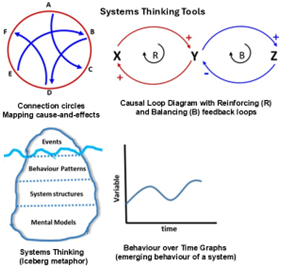
    Senge describes how the fifth discipline is systems thinking, because it weaves together the other disciplines toward intentional transformation. When we can visualize something better, we can understand it more effectively, as Jarche illustrates in a story about when NASA first released a picture of the earth, taken from space. He writes how:

    There are many ways to use visualization to understand data better. The real value of big data is using it to ask better questions. Visualization can be a conversation accelerator.

    Taking existing systems and using visualization to surface the ways the various parts of the system shape the other parts is vital in increasing our individual and collective abilities to learn.

    What Holds Us Back From Being a Learning Organization

    In chapter two, Senge writes about what he calls organizational learning disabilities. I’m not sure he communicates in such a way to support more of an asset-based framework for disability that many of us have become familiar with today. But I still want to list and describe them here, as this was my biggest takeaway from the book, reading it more than twenty years ago.

    1. “I am my position”

    “When asked what they do for a living, most people describe the tasks they perform every day, not the purpose of the greater enterprise in which they take part. Most see themselves within a system over which they have little or no influence. They do their job, put in their time, and try to cope with the forces outside of their control. Consequently, they tend to see their responsibilities as limited to the boundaries of their position.”

    1. “The enemy is out there”

    “When we focus only on our position, we do not see how our own actions extend beyond the boundary of that position. When those actions have consequences that come back to hurt us, we misperceive these new problems as externally caused. Like the person being chased by his own shadow, we cannot seem to shake them.”

    1. The illusion of taking charge

    “All too often, proactiveness is reactiveness in disguise… True proactiveness comes from seeing how we contribute to our own problems. It is a. product of our way of thinking, not our emotional state.”

    1. The fixation on events

    Senge describes how we evolved out of societies where people had to be focused on events to survive, like watching for the saber-toothed tiger to show up and be able to respond immediately.

    “Generative learning cannot be sustained in an organization if people’s thinking is dominated by short-term events. If we focus on events, the best we can ever do is predict an event before it happens so that we can react optimally. But we cannot learn to create.”

    1. The parable of the boiled frog

    “Learning to see slow, gradual processes requires slowing down our frenetic pace and paying attention to the subtle as well as the dramatic… The problem is our minds are so locked in one frequency, it’s as if we can only see at 78 rpm; we can’t see anything at 33-1/3. We will not avoid the fate of the frog until we learn to slow down and see the gradual processes that often pose the greatest threats.”

    Remember that this is meant to be a metaphor to help us explain this phenomenon. No frogs were harmed in sharing this boiling frog apologue.

    1. The delusion of learning from experience

    “Herein lies the core learning dilemma that confronts organizations: we learn best from experience but we never directly experience the consequences of many of our most important decisions. The most critical decisions made in organizations have systemwide consequences that stretch over years or decades.”

    1. The myth of the management team

    “All too often, teams in business tend to spend their time fighting for turf, avoiding anything that will make them look bad personally, and pretending that everyone is behind the team’s collective strategy—maintaining the appearance of a cohesive team. To keep up the image, they seek to squelch disagreement; people with serious reservations avoid stating them publicly, and joint decisions are watered-down compromises reflecting what everyone can live with, or else reflecting one person’s view foisted on the group. If there is disagreement, it’s usually expressed in a manner that lays blame, polarizes opinion, and fails to reveal the underlying differences in assumptions and experience in a way that the team as a whole could learn from.”

    Senge goes on to describe what Chris Argyris from Harvard calls “skilled incompetence” (gift, non-paywalled article from HBR)- groups of individuals who get super good at making sure to prevent themselves from actually learning. Since we’re talking frogs a lot in this series of PKM posts, I can’t help but bring up another illustrative story having to do with skilled incompetence.

    The cartoon character Michigan J Frog would only dance and sing when the man who found him was alone. Any time that someone else entered the picture, the frog just sat there, making normal frog noises. Here’s a look at his antics:

    Looks to me like skilled incompetence and also some seriously skilled frog theatrics (but only when no one is looking).

    What Comes Next

    The next part of The Fifth Discipline is something Senge calls “the beer game.” It is a memorable look at what happens when we are unable to see the entire system, but only one part of it. Let’s just say there’s a supposed shortage of beer, and then lots and lots of beer. But you should read it, as I’m nowhere capturing the marvelous metaphor that is the beer game.

    Readers are also instructed how to map systems in this book, though it is a practice that I never mastered. Jarche links to Tools for Systems Thinkers: Systems Mapping, by Leyia Acaroglu. which gives a great introduction and series of maps to use to explore complex ideas. Acaroglu illustrates their value by describing:

    As a practicing creative change-maker, I use systems mapping tools like this all the time when I want to identify the divergent parts of the problem set and find unique areas in which to develop interventions. I also use them to gain clarity in complexity, and find it especially useful when working in teams or collaborating because it puts everyone on the same page.

    I pretty much want to take every class that Levia and her team have available on the Unschool of Disruptive Design site. I’m also thinking I had better settle myself down a bit and wrap up this PKMastery course before biting off anything more. That, plus a couple of big conferences coming up I still need to prepare for…

    Source link

  • How districts can avoid 4 hidden costs of outdated facilities systems

    How districts can avoid 4 hidden costs of outdated facilities systems

    Key points:

    School leaders are under constant pressure to stretch every dollar further, yet many districts are losing money in ways they may not even realize. The culprit? Outdated facilities processes that quietly chip away at resources, frustrate staff, and create ripple effects across learning environments. From scheduling mishaps to maintenance backlogs, these hidden costs can add up fast, and too often it’s students who pay the price. 

    The good news is that with a few strategic shifts, districts can effectively manage their facilities and redirect resources to where they are needed most. Here are four of the most common hidden costs–and how forward-thinking school districts are avoiding them. 

    How outdated facilities processes waste staff time in K–12 districts

    It’s a familiar scene: a sticky note on a desk, a hallway conversation, and a string of emails trying to confirm who’s handling what. These outdated processes don’t just frustrate staff; they silently erode hours that could be spent on higher-value work. Facilities teams are already stretched thin, and every minute lost to chasing approvals or digging through piles of emails is time stolen from managing the day-to-day operations that keep schools running.  

    centralized, intuitive facilities management software platform changes everything. Staff and community members can submit requests in one place, while automated, trackable systems ensure approvals move forward without constant follow-up. Events sync directly with Outlook or Google calendars, reducing conflicts before they happen. Work orders can be submitted, assigned, and tracked digitally, with mobile access that lets staff update tickets on the go. Real-time dashboards offer visibility into labor, inventory, and preventive maintenance, while asset history and performance data enable leaders to plan more effectively for the long term. Reports for leadership, audits, and compliance can be generated instantly, saving hours of manual tracking. 

    The result? Districts have seen a 50-75 percent reduction in scheduling workload, stronger cross-department collaboration, and more time for the work that truly moves schools forward.

    Using preventive maintenance to avoid emergency repairs and extend asset life

    When maintenance is handled reactively, small problems almost always snowball into costly crises. A leaking pipe left unchecked can become a flooded classroom and a ruined ceiling. A skipped HVAC inspection may lead to a midyear system failure, forcing schools to close or scramble for portable units. 

    These emergencies don’t just drain budgets; they disrupt instruction, create safety hazards, and erode trust with families. A more proactive approach changes the narrative. With preventive maintenance embedded into a facilities management software platform, districts can automate recurring schedules, ensure tasks are assigned to the right technicians, and attach critical resources, such as floor plans or safety notes, to each task. Schools can prioritize work orders, monitor labor hours and expenses, and generate reports on upcoming maintenance to plan ahead. 

    Restoring systems before they fail extends asset life and smooths operational continuity. This keeps classrooms open, budgets predictable, and leaders prepared, rather than reactive. 

    Maximizing ROI by streamlining school space rentals

    Gymnasiums, fields, and auditoriums are among a district’s most valuable community resources, yet too often they sit idle simply because scheduling is complicated and chaotic. Paper forms, informal approvals, and scattered communication mean opportunities slip through the cracks.

    When users can submit requests through a single, digital system, scheduling becomes transparent, trackable, and far easier to manage. A unified dashboard prevents conflicts, streamlines approvals, and reduces the back-and-forth that often slows the process. 

    The payoff isn’t just smoother operations; districts can see increased ROI through easier billing, clearer reporting, and more consistent use of unused spaces. 

    Why schools need facilities data to make smarter budget decisions

    Without reliable facilities data, school leaders are forced to make critical budget and operational decisions in the dark. Which schools need additional staffing? Which classrooms, gyms, or labs are underused? Which capital projects should take priority, and which should wait? Operating on guesswork not only risks inefficient spending, but it also limits a district’s ability to demonstrate ROI or justify future investments. 

    A clear, centralized view of facilities usage and costs creates a strong foundation for strategic decision-making. This visibility can provide instant insights into patterns and trends. Districts can allocate resources more strategically, optimize staffing, and prioritize projects based on evidence rather than intuition. This level of insight also strengthens accountability, enabling schools to share transparent reports with boards, staff, and other key stakeholders, thereby building trust while ensuring that every dollar works harder. 

    Facilities may not always be the first thing that comes to mind when people think about student success, but the way schools manage their spaces, systems, and resources has a direct impact on learning. By moving away from outdated, manual processes and embracing smarter, data-driven facilities management, districts can unlock hidden savings, prevent costly breakdowns, and optimize the use of every asset. 

    Latest posts by eSchool Media Contributors (see all)

    Source link

  • Texas Systems Review Course Descriptions, Syllabi

    Texas Systems Review Course Descriptions, Syllabi

    As conservative Texas politicians identify and target faculty who teach about gender identity, officials at six Texas public university systems have ordered reviews of curriculum, syllabi and course descriptions.

    The impetus is clear: Texas A&M University fired a professor, demoted two administrators and pushed out its president after conservative politicians lambasted the institution for a lesson on gender identity in a children’s literature class. Their criticism hinged on the fact that the topic was not reflected in the brief course catalog description for the class. Before he resigned, Texas A&M president Mark Welsh ordered an audit of all courses at the flagship campus, which the system Board of Regents quickly extended to all Texas A&M institutions.

    “The Board has called for immediate and decisive steps to ensure that what happened this week will not be repeated,” the regents wrote in a statement posted on X. “To that end, the Regents have asked the Chancellor to audit every course and ensure full compliance with applicable laws.”

    Other systems soon followed. On Sept. 29, University of North Texas system chancellor Michael Williams instructed the president of each institution to “conduct an expedited review of their academic courses and programs—including a complete syllabus review to ensure compliance with all current applicable state and federal laws, executive orders, and court orders,” he wrote in a letter. The review is due Jan. 1.

    The University of Texas system is reviewing all courses on gender identity to “ensure compliance and alignment with applicable law and state and federal guidance, and to make sure any courses that are taught on a U.T. campus are aligned with the direction and priorities of the Board of Regents,” according to a statement from the system. The review will be discussed at the Board of Regents meeting in November.

    System leaders at several public institutions have cited Texas House Bill 229, President Donald Trump’s Jan. 20 executive order and a Jan. 30 letter from Gov. Greg Abbott that said, “All Texas agencies must ensure that agency rules, internal policies, employment practices, and other actions comply with the law and the biological reality that there are only two sexes—male and female.” Yet no current federal or state laws prohibit public university professors from teaching about transgender identity.

    A University of Houston system spokesperson told The Texas Tribune that it is completing a review of general education courses in compliance with Texas Senate Bill 37, which took effect this fall. The law requires public universities to complete a curriculum review every five years, but the first reviews aren’t due until 2027. Texas Woman’s University is also conducting a review of all academic courses and programs, the Tribune reported.

    Texas Tech University ordered its faculty to ensure that course content complies with Texas and U.S. law, as well as the federal and gubernatorial executive orders that declare the existence of only two genders—male and female. The resulting oral policies—which officials are purposely not writing down—severely limit what faculty can teach about gender identity and effectively erase transgender people and topics from the curriculum.

    It’s unclear how each of the six university systems will respond after their reviews are complete, and whether courses will be censored or entirely removed from the catalog.

    “Faculty are highly trained experts in their fields of study. It harms education for faculty to be told what to teach by politicians,” Brian Evans, President of the Texas Conference of the American Association of University Professors, told Inside Higher Ed by email. “For example, it is impossible to teach about gender without recognizing that there are countless gender identities and gender expressions across the world, the ideology that there are only two genders being only one of those.”

    The conservative politicians who have gone after institutions and faculty for teaching about gender identity have found professors through syllabi and course information posted online. As the risk of doxing grows, faculty are working to keep their information private, but new technology and Texas law are adding complications.

    Hundreds of American colleges and universities are now requiring their faculty to upload syllabi to Simple Syllabus, a third-party platform that offers uniform syllabus templates and easy editing; it also allows faculty to embed syllabi into campus learning management systems. According to the company’s website, more than 500 colleges and universities currently use the platform. Institutions may limit who can view the syllabi—for example, Clemson University requires users to log in with university credentials.

    But other institutions—including the University of Houston, Texas A&M University and the University of Texas at Austin—allow the general public to view their Simple Syllabus pages. This may be in part due to Texas House Bill 2504, a 15-year-old law that requires public institutions to provide publicly accessible syllabi that include major assignments and exams, required or recommended readings, and a general description of lecture or discussion topics.

    Andrew Joseph Pegoda, a lecturer in the Women’s, Gender and Sexuality Studies Department at the University of Houston, experienced the risks of this public access firsthand. In August, a conservative news site published a piece targeting Pegoda for teaching two courses that include queer theory in the curriculum and that, according to the news site, exemplify “indoctrination in women’s and gender studies departments.”

    “I realized that they got their information from Simple Syllabus,” Pegoda said. The platform allows users to search posted syllabi at an institution using keywords—for example, searching the word “queer” on the Simple Syllabus page for one Texas university returned four different syllabi that included the term.

    The spotlight on Pegoda came and passed quickly, largely because his name wasn’t included in the article’s headline. “I’m glad it wasn’t worse than it was. It could have been more direct or more vicious,” he said.

    Simple Syllabus spokesperson Matthew Compton-Clark said the company has not received any reports of targeting via the platform. “We take data privacy extremely seriously, and are a faculty-first organization,” he wrote in a statement to Inside Higher Ed. “We provide multiple privacy features, giving faculty the ability to set not just their entire syllabus private, but individual components as well. This same feature also exists for the institution, allowing the school to set the visibility of the entire syllabus, or individual parts of the document based on their state-specific legislation.”

    The Texas law does not require the public syllabi to include class meeting times or locations, though many professors don’t amend the public versions of their materials to exclude that information. Pegoda said he’s been advised to “put minimum detail in the public Simple Syllabus and then to provide a more regular syllabus to students,” he said.

    But, in the wake of the incident at Texas A&M, that may not work, he said. “Now professors are being encouraged to very specifically detail everything in the syllabus so as to not potentially get fired or have student complaints.”

    Source link

  • Joining The Dots: Skills, regeneration, funding systems and Barrow-in-Furness. 

    Joining The Dots: Skills, regeneration, funding systems and Barrow-in-Furness. 

    This HEPI blog was kindly authored by Professor Julie Mennell, Vice-Chancellor of the University of Cumbria, and Martin Williams, Chair of the University of Cumbria. 

    Barrow-in-Furness, now in the county of Westmorland and Furness, exemplifies the Government’s approach to stimulating regeneration and growth. Considerable public money is being committed, and the University of Cumbria, as the local university, is deeply involved. We are proud of what we and others are trying to do and confidently expect that many benefits will result. But our involvement also reminds us how national systems, such as student financial support, cannot currently flex to support a nationally-mandated priority – and makes us wonder whether it is time for a little experimentation.   

    The Government’s reasons for focusing on Barrow are clear. Undoubtedly the town is in need of regeneration; its current health and education outcomes make depressing reading. However, Barrow is also the only place in the country where BAE Systems manufactures the nuclear-powered submarines, which are crucial to Britain’s national and global defence strategy. With a volatile international situation, these craft are in demand, and the order books at the Barrow shipyard are full for decades to come. Constructing nuclear submarines is a highly technical, labour-intensive business, and the company and its suppliers urgently need to grow and upskill their workforces. However, the local Furness population is ageing, and for decades, employers there have struggled to attract and retain skilled workers. To grow, Barrow has to improve its ‘liveability’ – in other words, a big regeneration effort.   

    Because the submarine programme is a national priority, Government has been prepared to intervene directly to support this goal. It has invested £220 million, coordinated by a Board chaired by a former Cabinet Secretary. Their recently published 10 Year Plan recognises the interconnectedness of what needs to happen, covering health, transport, education, skills, housing, environment and leisure. It is ambitious, but not unrealistic, given the underpinning demand from a large, profitable company and its associated supply chains. The Government’s recent Defence Industrial Strategy document quotes Team Barrow as a model on which to build.   

    The University of Cumbria has been deeply involved in the development of this Plan. We sit on the Team Barrow Delivery Board and will contribute to everything the Plan seeks to achieve. We are already BAE Systems’ main supplier of project managers, via degree apprenticeships. We train the nurses and healthcare workers that the town will need, and from this year, our new Medical School means we can provide a wider range of practitioners. We can produce the teachers to improve the schools, and the artists and environmental scientists to enhance Furness’s natural and cultural landscapes.    

    We can and will do more. This month the University opens a new campus, supported by Town Deal money, right next to the shipyard on Barrow Island. With BAE Systems, we are now creating new courses based there in mechanical engineering and computer science. There will be a new Doctoral Training Centre and Innovation Hub to develop and test potentially viable new products and processes and to attract more PhD-level skills into Furness. There is potential for even closer working with the local FE Colleges. We are investing, and we want to invest, and the public purse is supporting that investment. 

    But this is the supply side. Will it be enough to attract students and researchers at the speed and in the numbers that are wanted?        

    In a demand-led higher education system, this is primarily a matter for universities. We have to convince students to enrol. If they don’t come, our income will be directly affected. The onus is on us to sell our offerings, and on potential employers to give extra support to students if they think that is worthwhile.    

    Fair enough, but should that be the whole story in this case? The courses are being created in response to a Government goal. The faster the recruitment to these courses, the quicker the effect on the supply of local skills. We know there are barriers to overcome. It isn’t accidental that Barrow is currently a higher education cold spot. A lot of Barrovians come from families that believe university courses are not for them. BAE Systems are offering generous scholarships and paid placements for local students, but mindsets don’t change quickly. And how many people from outside the region will instinctively encourage their children or friends to consider a course in Barrow in Furness, offered by the University of Cumbria? Barrow is a remote and superficially not very attractive town. The University of Cumbria isn’t in ‘the Russell Group’. A new course, by definition, won’t appear in the Times league tables and won’t yet have employment outcomes (although as a university, we rank top in Northwest England on this measure). We believe they will be good quality courses, offering excellent prospects in the jobs market, but it will take time to establish their reputation.  

    The whole rationale behind the Barrow Rising programme is that Government intervention is needed if Barrow is to become what the country needs it to be. However, the Government’s Higher Education funding system offers no incentives for students to overcome their possible preconceptions. There is a ‘level playing field’ of student choice; any course, anywhere, attracts the same support. 12 years of this model has demonstrated its results. Students tend to play safe and favour longer-established, higher-prestige institutions. A perfectly sensible approach for them to take. But might the public interest right now be better served by a playing field that could be tilted slightly in favour of, for example, engineering courses in Barrow?   

    Fiddling with funding systems is tricky and prone to unintended consequences. Nevertheless, Barrow is a small place, of particular interest to Government and facing some particular challenges. It would surely be useful to the Government to know whether targeted financial incentives, nudging students towards strategically important courses in particular places, made a difference to behaviours. If successful, the approach could be applied to a few other selected priority areas or courses.   

    This would be a new step, but this Government has signalled it wants to think imaginatively in support of growth. With a higher education policy document expected in the autumn, is there space to experiment with a more strategic use of a tiny piece of the huge student finance budget? 

    Source link

  • Florida university system’s board to vote on creation of accrediting agency

    Florida university system’s board to vote on creation of accrediting agency

    This audio is auto-generated. Please let us know if you have feedback.

    Dive Brief: 

    • The State University System of Florida’s governing board plans to vote Friday to approve the creation of the Commission for Public Higher Education, a new accreditor formed by the state university system and five other Southern public higher education networks. 
    • The state’s Legislature has devoted $4 million to the Florida governing board to help with startup costs for the new accreditor, according to CPHE’s business plan. The accreditor expects the other five university systems to devote a similar level of resources to the effort. 
    • CPHE hopes to begin accrediting six institutions by June 2026 and to become recognized by the U.S. Department of Education by June 2028. Accreditors must operate for two years before the Education Department will recognize them. 

    Dive Insight: 

    Florida Gov. Ron DeSantis announced the formation of the new accreditor for public colleges in late June, criticizing diversity, equity and inclusion standards at existing agencies and framing the effort as a way to focus more on student outcomes. 

    The new accreditor’s business plan echoes those aims. 

    CPHE will laser-focus on student outcomes, streamline accreditation standards, focus on emerging educational models, modernize the accreditation process, maximize efficiency without sacrificing quality, and ensure no imposition of divisive ideological content on institutions,” it states. 

    Still, the new agency is a long way off from getting the Education Department’s recognition, which is required before its accreditation can grant colleges access to federal financial aid. The business plan notes that the Education Department usually takes at least two years to recognize a new accreditor after it submits its application, which it plans to submit in 2026

    The Education Department currently recognizes about two dozen institutional accreditors, according to a federal database. 

    Colleges that want to be accredited by CPHE will be able to retain their current agency while the new accreditor seeks the Education Department’s recognition, according to the business plan. Once it becomes federally recognized, colleges can make CPHE their primary accreditor and shed their other agency, if they wish.

    The founding members of the new accreditor are the State University System of Florida, the Texas A&M University System, the University System of Georgia, the University of North Carolina System, the University of South Carolina system and the University of Tennessee System

    Each system will appoint someone to sit on CPHE’s board of directors, which will establish accreditation standards and policies. 

    The new accreditor will also create a paid Interim Review Committee, which will conduct peer reviews of colleges and make recommendations to the board of directors about accreditation actions. The committee will report to CPHE’s board of directors and include academic experts, auditors and compliance officers

    The business plan credits recent federal policy changes for making it easier for colleges to jump to new accrediting agencies. 

    That includes a regulatory change during President Donald Trump’s first term that removed regional restrictions on the nation’s seven major accreditors, meaning they each can now represent colleges nationwide instead of only those located in their traditional geographic territories. 

    The business plan also points to May guidance from the Education Department to make it easier for colleges to switch accreditors and revoked more rigorous Biden-era policies on changing agencies. It also mentions a recent executive order from Trump that in part aims to streamline the process for recognizing new accrediting agencies. 

    The Education Department said it will decide on accreditation change requests within 30 days. If the agency doesn’t respond by that deadline, colleges will receive automatic approval unless they don’t meet the eligibility requirements. 

    One higher education expert has described the deadline as a “30-day rubber stamp,” arguing that it takes time and expertise to conduct such reviews. Yet the procedural changes are coming even as the Education Department attempts to shed roughly half of its staff

    Colleges will not be eligible to switch if they’ve faced accreditor sanctions within the last two years. However, they will be able to switch for a litany of other reasons, including objecting to their current accreditors’ standards. 

    Both Florida and North Carolina legislators have passed laws in recent years requiring public colleges to switch accreditors each cycle, which usually run between six to 10 years. The changes came after each state’s public university systems publicly spat with their accreditor, the Southern Association of Colleges and Schools Commission on Colleges. 

    SACSCOC accredits each college within the six founding members’ university systems. However, some institutions in Florida and Texas have begun the process of switching to new agencies, according to CPHE’s business plan.

    Source link

  • Integrating Systems Thinking to Enhance Liberal Arts Curriculum through Learner-Centered Teaching – Faculty Focus

    Integrating Systems Thinking to Enhance Liberal Arts Curriculum through Learner-Centered Teaching – Faculty Focus

    Source link

  • Improving State Longitudinal Data Systems

    Improving State Longitudinal Data Systems

    Title: Powering Potential: Using Data to Support Postsecondary Access, Completion, and Return on Investment
    Source: The Data Quality Campaign

    To make decisions about when and where to pursue their next educational credential, students and their families need to be able to understand the full picture of pursuing further education. They need access to real-time program information, which includes data on enrollment and completion, program performance, financial aid availability, employment, and return on investment.

    A new publication from the Data Quality Campaign highlights the current landscape and challenges of state data systems for postsecondary education and offers recommendations to align state and institutional data systems.

    Key findings include:

    How the existing postsecondary and workforce data landscape varies

    According to the report, nearly all states have agencies that oversee postsecondary institutions and collect some student or programmatic data within postsecondary student unit record systems (PSURSs). However, the authors note that agency-specific data are often disconnected from other sectors’ data. As a result, student information cannot connect with postgraduation outcomes, as is possible with statewide longitudinal data systems.

    Education and workforce data systems differ greatly across states. Sixty-eight percent of PSURSs connect to workforce data, but only 11 percent identify the industry and general occupation that individuals are employed in.

    States collect a variety of postsecondary data from institutions through a variety of methods, but the report emphasizes that states identify many common uses of the data, such as in supporting workforce alignment.

    Data challenges that states are facing

    The report observes that federal funding for states to develop data systems has been increasingly siloed, with different grant programs focusing on the development of data systems that each have a narrow focus (e.g., workforce and K–12 data).

    Education and workforce data systems identify students using different methods, making connecting individuals’ data and tracking their pathways difficult. However, the authors note that some states are making changes to improve matching accuracy.

    Recommendations for states to proactively use data in cooperation with postsecondary institutions

    The report recommends that states ensure data are used in collaboration with postsecondary institutions to inform policy and practice. This includes creating guided pathways and aligning institutions’ educational offerings with their states’ workforce needs. By evaluating trends in postsecondary completion, employment outcomes, and employment needs, policymakers can refine programs that guide students into pathways with high completion and high-paying careers.

    Institutions collect a variety of information about students, including enrollment demographics and course grades. According to the report, given many institutions’ limitations to do robust analysis, this information should be integrated with statewide data systems.

    States can use data to make the admissions and financial aid application processes easier for students and to streamline the process of enrolling in high-demand educational offerings. States and institutions can also leverage their shared data to identify students at higher risk of not completing their postsecondary program and tailor financial support, emergency aid, and academic supports to provide on-time interventions to these students.

    To read the full report from the Data Quality Campaign, click here.

    —Austin Freeman


    If you have any questions or comments about this blog post, please contact us.

    Source link

  • What Do Universities Use CRM Systems For?

    What Do Universities Use CRM Systems For?

    Reading Time: 7 minutes

    Customer Relationship Management (CRM) systems have become essential tools in higher education, transforming how universities interact with prospective students, current students, alumni, and other stakeholders. Whether you’re trying to track your enrollment funnel, streamline your recruitment process, or boost retention, CRM systems offer many unique marketing benefits for your institution. 

    You may have already encountered discussions about CRM platforms, but understanding their full potential in an educational context is key to optimizing your institution’s outreach, recruitment, and engagement efforts. Keep reading to learn more about higher education CRM systems, the unique marketing benefits they offer, and how you can get started.

    Struggling with enrollment?

    Our expert digital marketing services can help you attract and enroll more students!

    Understanding Higher Education CRM

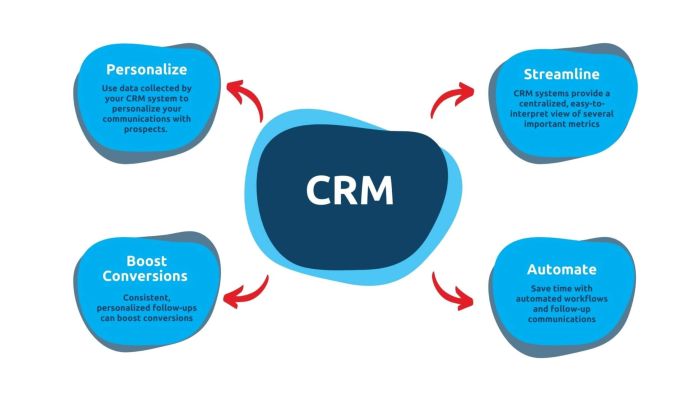
    What is a CRM in higher education? It’s a powerful software solution that helps universities manage relationships at every stage of the student lifecycle. Traditionally associated with sales and customer service in corporate settings, CRM technology has evolved to meet the specific needs of educational institutions. In higher education, a CRM can track interactions with prospective students, automate communication, and analyze data to improve engagement and conversion rates.

    Unlike a standard student information system (SIS), which focuses on administrative tasks like enrollment and grades, a CRM is designed for relationship-building. It allows universities to personalize outreach, streamline marketing efforts, and nurture students from the moment they express interest until they become engaged alumni. By integrating CRM technology into your institution’s marketing strategy, you can enhance recruitment efforts, improve retention rates, and foster long-term alumni engagement.

    HEM Image 2HEM Image 2

    Source: HEM

    Are you wondering how your university can unlock the benefits of a CRM? Reach out to learn about our tailored digital marketing solutions.

    The Benefits of CRM Systems for Universities

    What are universities using CRM for? Well, to be successful as an educational institution, building and maintaining positive relationships with prospective students is necessary. CRMs help schools manage those relationships at various stages of the enrollment funnel and offer valuable marketing benefits. 

    One of the most significant advantages of implementing a CRM in higher education marketing is the ability to centralize and manage vast amounts of student data efficiently. Rather than relying on disparate spreadsheets, email threads, and manual tracking, a CRM consolidates all interactions into a single platform, ensuring every team member has up-to-date information.

    A well-implemented CRM system helps streamline the recruitment process by automating lead nurturing. When prospective students submit inquiries through your website, attend a virtual event, or download a brochure, a CRM can trigger personalized email sequences, follow-up reminders, and targeted content recommendations based on their interests. This level of automation ensures that no lead is left unattended, allowing admissions teams to focus on high-value interactions.

    Beyond recruitment, CRM systems are crucial in improving student engagement and retention particularly when data from a Student Information System is integrated. Universities can use CRM and SIS analytics to monitor student behaviour, such as class attendance, engagement with academic advisors, or extracurricular activities. If a student begins to disengage, automated alerts can prompt intervention from faculty or student services, helping to improve retention rates and overall student satisfaction.

    Another key area where CRMs add value is in alumni relations and fundraising. By tracking alumni career paths, donation history, and event participation, universities can segment their alumni base and tailor communications accordingly. For instance, an alumni relations team can identify graduates likely to contribute to fundraising campaigns based on past engagement, ensuring that outreach efforts are strategic and effective.

    HEM Image 3HEM Image 3

    Source: HEM

    Implementing a CRM System in Your University

    Integrating a CRM into your university’s operations requires careful planning and execution. The first step is selecting a CRM that aligns with your institution’s needs. Some CRMs, like Salesforce Education Cloud, HubSpot, or Slate, are specifically designed for higher education, offering features tailored to student recruitment, engagement, and alumni relations.

    Prioritize Data Integration 

    Data integration is another challenge that universities must address. Many institutions already have multiple systems for student records, financial aid, and course management. Ensuring that the CRM integrates seamlessly with these existing platforms prevents data silos and a smooth flow of information across departments. This might require working closely with IT teams or investing in middleware solutions to facilitate integration.

    Measure Results and Plan Accordingly 

    Once a CRM is chosen, establishing clear goals and key performance indicators (KPIs) is crucial. Universities should determine what they want to achieve with their CRM, whether it’s increasing application rates, improving response times for inquiries, or boosting alumni donations. Setting measurable objectives ensures that the CRM is used strategically.

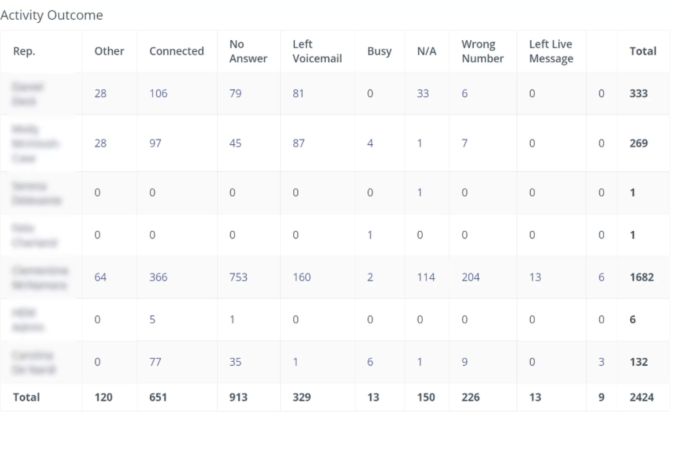
    Example: A great way to measure the success of your marketing efforts using a CRM is to track the outcomes of your communications as pictured below. This data is extremely valuable as now, you know how many prospects you were able to reach, how they responded to your communications, and whether you need to obtain more accurate contact information. This is just one of the metrics you can track using our Mautic CRM system.

    HEM Image 4HEM Image 4

    Source: HEM | Mautic

    Get Your Whole Team Involved 

    Staff training is another essential component of successful CRM implementation. A CRM is only as effective as the people using it, so ensuring that admissions teams, marketing departments, and student services personnel are comfortable navigating the system is paramount. Conducting regular training sessions, creating user guides, and designating CRM champions within each department can help drive adoption and maximize efficiency.

    Focus on Personalization

    To fully leverage the potential of a CRM, universities should also focus on personalization. With the data collected through a CRM, institutions can tailor communications to different student segments. For instance, a prospective student interested in business programs should receive targeted content about faculty research, alumni success stories, and upcoming application deadlines for the business school rather than generic university-wide messaging. Personalized engagement fosters stronger connections and increases the likelihood of conversion.

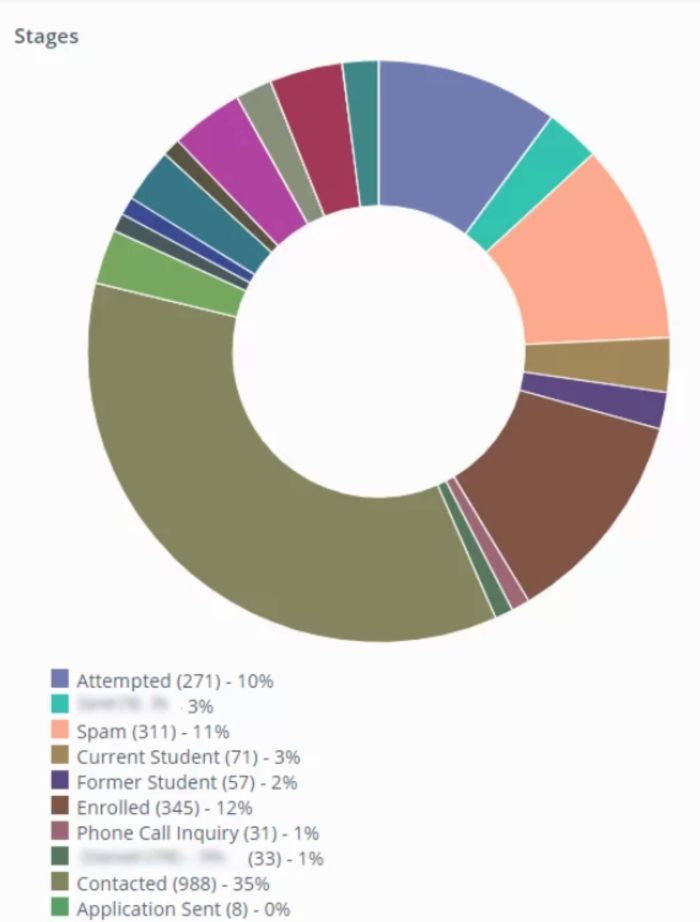
    Example: How do you personalize your university marketing efforts? A great place to start if you’re still learning about your ideal prospect is tailoring marketing communications for the stage of the enrollment funnel they’re in. Through segmentation, a CRM system like Mautic can divide your contacts into groups based on their current relationship with your institution. This approach ensures you reach each lead at the right time with the right message.

    HEM Image 5HEM Image 5

    Source: HEM | Mautic

    Automate for Efficiency

    Another best practice for CRM implementation is utilizing automation for efficiency. Many CRM platforms offer workflow automation features that simplify tasks such as sending event reminders, scheduling advisor meetings, and managing follow-ups. Automating repetitive processes reduces the administrative burden on staff, allowing them to focus on more strategic initiatives.

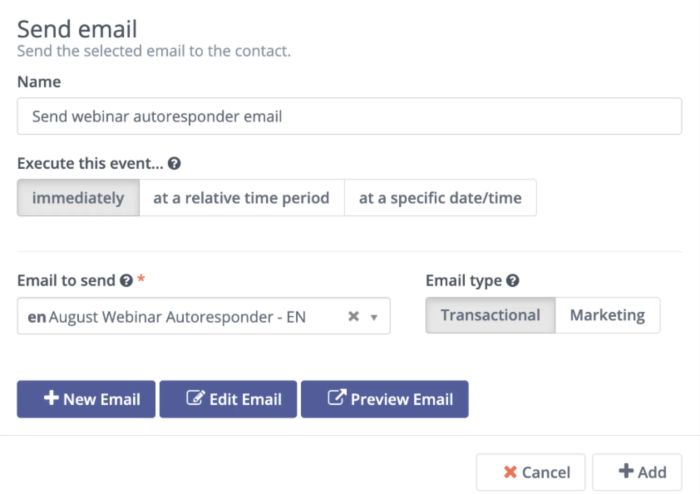
    Example: A CRM system will enable you to craft automated email and SMMs to increase efficiency and ensure timely, carefully worded responses every time. Here, you can see how Mautic allows you to personalize your messages, time them, and tailor them to the purpose of your communication – to promote your university or to collect specific admission information.

    HEM Image 6HEM Image 6

    Source: HEM | Mautic

    The Future of CRMs in Higher Education

    As technology continues to evolve, the role of CRMs in higher education will only expand. The rise of artificial intelligence and predictive analytics is already enhancing CRM capabilities, allowing universities to forecast enrollment trends, identify at-risk students before they drop out, and personalize outreach on a deeper level. Chatbots and AI-driven communication tools integrated into CRMs improve response times, ensuring prospective students receive instant answers to their inquiries.

    Moreover, the shift towards hybrid and online education models has made digital engagement more critical. Universities that effectively utilize their CRM systems can provide seamless virtual experiences, track online learning engagement, and maintain meaningful connections with students regardless of physical location.

    Choose a CRM Built for Higher Education

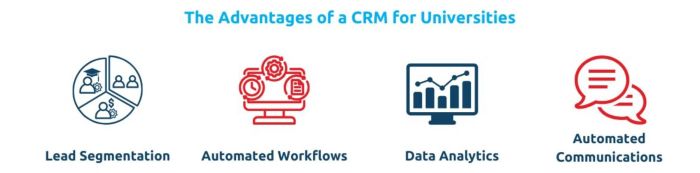
    Unique needs call for unique solutions. A CRM for universities offers specialized features such as student lifecycle tracking, automated admissions workflows, alumni engagement tools, and seamless integration with existing student information systems, ensuring a more efficient and personalized approach to student recruitment, retention, and engagement.

    One example of a CRM tailored specifically for higher education is Mautic by HEM. Developed from the Mautic open-source platform, Mautic by HEM offers a powerful combination of CRM and marketing automation designed to help universities streamline their lead management, supercharge their marketing efforts, and improve follow-up processes. 

    With tools for segmentation, automated workflows, email marketing, and analytics, Mautic by HEM enables institutions to track prospective students throughout the enrollment journey while optimizing team productivity. By leveraging this CRM, universities can enhance engagement, improve efficiency, and gain deep insights into recruitment and admissions efforts.

    For university marketers and administrators looking to stay competitive, embracing CRM is an absolute must. With the right approach, a CRM can transform how your institution engages with students, streamline processes, and ultimately achieve enrollment and retention goals.

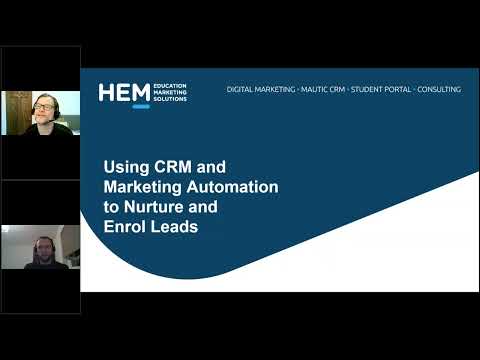
    Example: For a complete view of how our CRM system can help you to reinvent your marketing strategy. In one of our previous webinars, we explored how Mautic can help you boost enrollment through effective relationship management.

    YouTube videoYouTube video

    Source: HEM | YouTube

    Struggling with enrollment?

    Our expert digital marketing services can help you attract and enroll more students!

    Frequently Asked Questions

    Question: What is a CRM in higher education?

    Answer: It’s a powerful software solution that helps universities manage relationships at every stage of the student lifecycle.

    Question: What are universities using CRM for?

    Answer: Well, to be successful as an educational institution, building and maintaining positive relationships with prospective students is necessary. CRMs help schools manage those relationships at various stages of the enrollment funnel and offer valuable marketing benefits.

    Source link

  • Advantages of student information systems in Higher Education

    Advantages of student information systems in Higher Education

    Tune In To Our Audio Blog


    In this changing landscape, with constant shifts in student demographics, and enrollment behaviors due to globalization, can a rigid administrative process or a legacy student information system foster student success? As higher education decision-makers, provosts, and chief information officers, you know much better. With this as a starting point, the blog intends to discuss the several advantages of student information systems and how an expert solution provider adds to the effectiveness of an overall institution.
     

    The Advantages of Student Information System

    A Student Information System (SIS) offers numerous advantages for higher education institutions. An SIS manage and store student-related data throughout their academic journey.

    Here are some key advantages of implementing a Student Information System in higher education:


    1. A focused student performance

    The Student Information System offers a comprehensive and integrated platform with features that today’s students must look for.

    With smooth, efficient, and friendly student self-service options, the system rules out the challenges encountered by students while navigating complex administrative processes. Rather, the students have the advantage of focusing on their academics without running around for frustrating services related to their records, accounts, personal information, access to academic policies, registration and degree planning, dates and deadlines, financial aid and scholarships, grades, transcripts, etc.

    This online service mode lets students efficiently manage their tasks proactively, positively impacts their institution, and allows them to claim it publicly.


    2. Newer insights into student data


    student information system insights


    To institutions that struggle to collate meaningful and actionable data to make smart decisions, the SIS can be a boon. 

    Student Information System gives the decision-makers the advantage of key reporting features so institutions gain deeper insights into students’ data related to academics, attendance, assessments, credits, finances, library, grade book, etc. With instant data in hand, the institutional heads can compare, identify trends, report, and work towards continuous improvement towards improvement.


    3. A time saver with simplified and streamlined tasks


    how student information system saves time


    With role-based dashboard configuration, the entire team of faculty, student, and staff know their priorities that need to be performed, along with the tasks already done and accomplished. 

    The dashboard helps in reminding which activities an individual needs to perform and which of them are already done. For any action undone, the system keeps sending automated reminders and alerts so the stakeholders stay on track. 

    With every bit of data highlighted in a single view, users can channel their time and effort for better productivity and growth with minimum effort.
     

    4. A connecting point between faculty, students, and management


    student information system connects students and faculty


    Another advantage of the Student Information System lies in its capacity to easily connect Administrators, Teachers, and Parents under a single platform. Often integrated with the parent’s portal, the system sends push notifications and updates regularly about students’ marks, grades, attendance, and overall performance. 

    On the other hand, the staff, faculty, and parents can interact at different levels using the user-friendly web interface that discusses and improves student performance. Every role in the campus can have roles defined to them, which allows them to access the information they need, securely.
     

    5. Offers unlimited flexibility

    Most of the student information systems come with a flexible architecture with room for the greatest level of personalization. This gives institutions a boost to use tools that facilitate system alignment with the way they do things at their institution. 

    This way whenever the institution faces change, the SISs can change with it through configuration capabilities and a continuous delivery model. Curriculum planning, scheduling, academic policies, grading schemes, finance, billing, and more come with configuration options.
     

    6. Helps institutions envision student success

    Student Information System has tools to envision student success throughout the student journey. With successful LMS integration, it can have native engagement tools, enabling students to actively engage in the events that matter the most. Even for students who refrain from openly communicating inside a classroom, these tools instill the confidence to coordinate, raise a query, and get clarified.


    Conclusion

    Designed solely for higher education campuses, Creatrix Campus Student Information System offers comprehensive tools to make it easier for users to access the records they need to achieve their goals—from admission to alumni and beyond.
     

    Creatrix student information system features


    We have powerful tools to connect multiple departments on multiple campuses and automate academic processes so your institution can help students succeed. With a lower cost of ownership, easy customization and implementation, straightforward pricing, and customer support options for your institution’s evolving needs, Creatrix SIS helps you manage your campus community easily.  Some of our unique features are:

    • Intuitive user experience throughout the student lifecycle
    • Student data management with reports and dashboards
    • Self-service and mobile application capabilities
    • Seamless academic planning with student advising
    • Agility to change requirements as per institutional needs

    To unite your whole campus under an efficient, configurable, easy-to-use application that is delivered in the cloud, contact our team or request a demo.

    Source link

  • Big state systems were among those announcing cuts in January

    Big state systems were among those announcing cuts in January

    A new year is underway, but many colleges are still reeling from the fiscal challenges of 2024.

    With yawning budget gaps and bleak financial projections at some campuses, administrators are cutting jobs, academic programs and athletics options to plug holes and stabilize their finances.

    Here’s a look at cuts announced in January.

    Sonoma State University

    Facing a budget deficit estimated at nearly $24 million, the California State University campus is enacting deep cuts that will include dismissing dozens of faculty members, eliminating multiple programs and dropping athletics, according to an announcement from interim president Emily F. Cutrer.

    “The University has had a budget deficit for several years. It is attributable to a variety of factors—cost of personnel, annual price increases for supplies and utilities, inflation—but the main reason is enrollment,” Cutrer wrote in an announcement last month.

    She added that Sonoma State’s enrollment has dropped by 38 percent since 2015.

    On the personnel side, 46 faculty members, including tenured as well as adjunct professors, will not have their contracts renewed for the next academic year. An unspecified number of lecturers will also receive notices that “no work will be available in fall 2025,” Cutrer wrote. Four management and 12 staff positions are also being eliminated as part of Sonoma State’s cost-cutting measures.

    In addition, more than 20 programs have been identified for closure and others will be combined. University officials are also looking to close a half dozen academic departments.

    All 11 SSU athletic programs, which compete at the NCAA Division II level, will be eliminated. However, SSU coaches have announced plans to file a lawsuit in an effort to save their sports.

    California State University, Dominguez Hills

    Anticipated budget cuts also drove layoffs at this CSU campus in Southern California, which let go 32 employees last month, many probationary or temporary workers, LAist reported.

    “While these layoffs will be disruptive to our operations, the vast majority of our staff will remain employed at CSUDH continuing to provide the high level of support to our community that we are known for,” President Thomas Parham wrote in an email.

    Other institutions across California are also likely to introduce cost-cutting measures in the coming months due to anticipated decreases in state appropriations that will limit funding. The 23 institutions in the CSU system are bracing for state budget cuts of nearly $400 million.

    University of New Orleans

    After consolidating five colleges into two in December, the University of New Orleans laid off 30 employees last month as it chips away at a $10 million budget deficit, NOLA.com reported.

    Additionally, the university announced furloughs for full-time, nontenured employees last month, which local media outlets reported will affect nearly 300 workers.

    “While these actions are necessary, we are deeply sensitive to the hardship they undoubtedly will cause. We remain fully committed to supporting those who are affected through this transition,” President Kathy Johnson said in a January announcement. “Our focus remains on protecting UNO’s academic mission and its vital role in the New Orleans region. We are pursuing long-term strategies to increase enrollment, secure new funding, and enhance operational efficiency to avoid similar measures in the future.”

    St. Francis College

    The financially struggling institution in New York laid off 17 employees last month, The City reported. It follows other moves administrators have made in recent years—including previous layoffs, the sale of the Brooklyn campus and the elimination of athletic programs—to help fix St. Francis’s financial woes.

    Despite the institution’s recent struggles and multiple years of operating losses, President Tim Cecere offered the news outlet an optimistic outlook, noting that cost-cutting measures have put the college on a path toward sustainability.

    “The college hasn’t been this strong in years,” Cecere said. “We have zero debt, which not a lot of colleges can say. Every dollar that comes in is optimized for the benefit of the students.”

    St. Norbert College

    Jobs and programs are on the chopping block as the small Catholic institution in Wisconsin navigates financial issues, The Green Bay Press Gazette reported.

    At least 13 majors will be cut, including chemistry, computer science, history and physics.

    An unspecified number of faculty members are also expected to be laid off, the newspaper reported, as the college aims to shave $7 million in expenses ahead of the next fiscal year.

    Cleveland State University

    Efforts to cut spending prompted Cleveland State University to drop three athletic programs—wrestling, women’s softball and women’s golf—Ideastream Public Media reported.

    Cleveland State will also move its esports team from athletics to the College of Engineering.

    The move comes as the university whittles down a budget deficit that reportedly stands at $10 million. Last summer 50-plus faculty members took buyouts as part of cost-reduction efforts.

    Indiana University

    More than two dozen jobs were eliminated from the state flagship’s athletics department last month—part of a cost-reduction effort in response to the House v. NCAA settlement, which will require IU and other institutions to begin sharing revenue with athletes starting in the 2025–26 academic year, The Indianapolis Star reported.

    Of the 25 positions eliminated, 12 were reportedly vacant.

    Western Illinois University

    Furloughs for administrative employees who are not in a bargaining unit are expected as the regional public institution seeks to cut expenditures, Tri States Public Radio reported.

    WIU is reportedly dealing with a $14 million deficit for fiscal year 2025.

    The furlough program will run from the beginning of February through July 31 and is tiered by annual salary. Administrators making more than $150,000 will be required to take three unpaid days off each month, while those earning between $100,000 and $149,000 will be asked to take off two unpaid days each month and those making $99,999 to $75,000 will have to take off one unpaid day per month.

    Catholic University of America

    With the Catholic research university in Washington, D.C., facing a $30 million structural deficit, administrators are considering merging departments and potentially closing the Benjamin T. Rome School of Music, Drama, and Art, Catholic News Agency reported.

    Officials did not specify publicly whether job cuts would be included as part of the overall changes, which are expected to go before CUA’s Board of Trustees for approval in March.

    University System of Maryland

    Amid state budget cuts, Maryland’s public university system will likely be forced to lay off employees.

    Anticipating a funding cut of $111 million across the 11-campus system, officials may eliminate as many as 400 jobs through layoffs as well as closing vacant positions, The Baltimore Banner reported, which they estimate will save $45 million. Though a timeline for cuts was not announced, system chancellor Jay Perman said some jobs will be student facing, including advising, counseling and mental health services. Perman also noted that some faculty positions across the system will likely go unfilled.

    Source link