
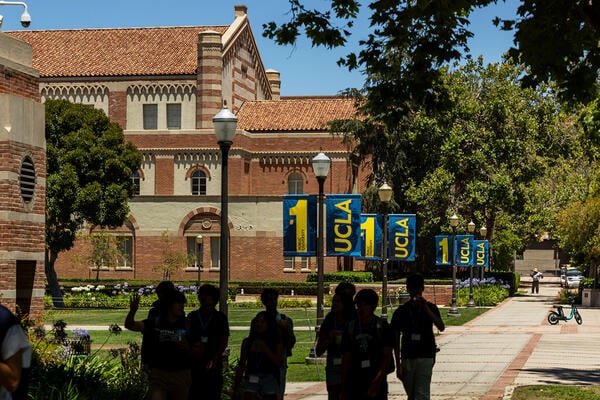
To date, the system has spent $162 million on fellows’ salaries, averaging about $7.36 million per year.
Juliana Yamada/Los Angeles Times/Getty Images
Starting next fall, the University of California system office will no longer pay for the UC President’s Postdoctoral Fellowship Program, a fellowship established in 1984 to encourage more women and minority Ph.D.s to pursue academic careers.
The fellowship program, available at all 10 UC campuses and three national laboratories, has inspired numerous copycats at other state universities, including at the University of Maryland, the University of Minnesota–Twin Cities, the University of Michigan and Pennsylvania State University. But its focus on recruiting diverse candidates has also been criticized by conservatives who claim it’s a pipeline for young hires with radical leftist politics.
The UC system office will stop providing financial support for the program beginning with fellows hired after summer 2025, a system spokesperson told Inside Higher Ed. Since 2003, the UC system office has paid the $85,000 salaries of PPFP fellows for their first five years on the faculty; then the UC campus where they are employed takes over. To date, the system has spent $162 million on PPFP faculty salaries, averaging about $7.36 million per year.
“Due to the severe budget constraints currently facing UC, the PPFP faculty hiring incentive is sunsetting as of fall 2025,” the spokesperson said in a statement. “While the University will continue to provide five years of salary support to PPFP fellows hired by summer 2025 and in earlier years, no new incentives will be provided going forward. Campuses will still be able to hire PPFP fellows as part of their normal search and hiring processes, but the additional financial contribution from the incentive program will no longer be available.”
The University of California system is facing a decline in state funding and pressure from the Trump administration to implement a number of changes that weaken or abolish diversity, equity and inclusion practices. In March, former system president Michael Drake announced a systemwide hiring freeze and other cost-saving measures. At the same time, the system board prohibited campus officials from asking job candidates to submit a diversity statement as part of the hiring process. In August, the Trump administration demanded that the University of California, Los Angeles, pay a $1.2 billion fine for allegedly failing to address antisemitism on campus, as well as overhaul numerous policies related to admissions, hiring, athletics, scholarships, gender identity and discrimination.
In a thread posted to Bluesky, Sarah Roberts, a professor of information studies, gender studies and labor studies at UCLA, called the PPFP program a “jewel in the crown for faculty development and recruitment at the University of California.”
“To my mind, not only is this a direct attack by a UC central admin content to capitulate and emulate the federal position that arrived via extortion letter, it is part of a much larger plan, congruent with UC central admin, of weakening and eliminating faculty governance and power,” Roberts wrote about the decision to end funding for the program.
Despite its origins, the PPFP no longer explicitly seeks women and minority candidates and instead considers applicants “whose life experiences and educational background would help to broaden the perspectives represented in the faculty of the University of California,” according to the website.
This is a recent change; in 2024, the PPFP webpage included the tagline “advancing excellence through faculty diversity.” The criteria also stated that “faculty reviewers will evaluate candidates according to their academic accomplishments, the strength of their research proposal, and their potential for faculty careers that will contribute to diversity and equal opportunity through their teaching, research and service. Faculty reviewers also may consider the mentor’s potential to work productively with the candidate and commitment to equity and diversity in higher education.”
The PPFP, and fellow-to-faculty programs at large, have drawn criticism from conservatives including John D. Sailer, a senior fellow at the Manhattan Institute who has written extensively on the programs. He believes they allow universities to recruit scholars who “embrace positions on the fringes of leftist politics.”
“Ideological screening has downstream consequences for our sensemaking institutions,” Sailer wrote in a February article. “Ultimately, the fellow-to-faculty model pushes conformity across once-distinct academic fields. As the UC professor put it, ‘it erodes disciplinary boundaries,’ flattening all forms of inquiry into a discussion of race and oppression.”