
ORLANDO, Fla. — Higher education policy reached a watershed moment last year.
Congress passed a massive spending package over the summer, dubbed the One Big Beautiful Bill Act, that makes major changes to federal student lending and other higher education policies. And the Trump administration pursued large-scale policy changes, such as new restrictions on international enrollment.
This year, colleges will begin to bear the brunt of many of those changes, with the end of the Grad PLUS loan program and the introduction of new lending caps taking effect July 1. The Trump administration is likewise expected to finalize several regulations governing the higher education sector in the coming days and months.
Meanwhile, lawmakers are weighing further changes to student aid in the federal government’s budget for fiscal 2026, including the potential elimination of some major programs.
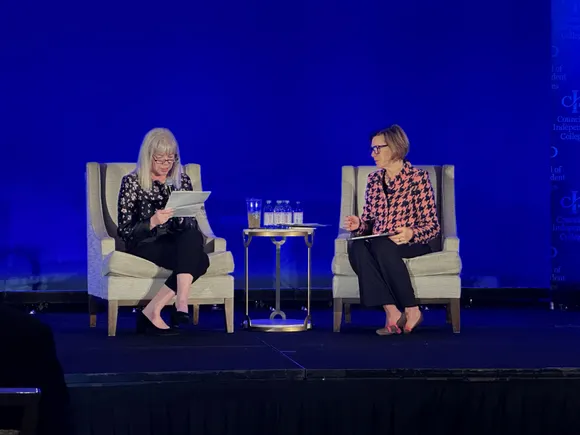
This week, higher education experts at the Council of Independent Colleges’ Presidents Institute — an annual gathering of hundreds of top leaders at private nonprofit institutions — broke down some of the policy changes expected in the year ahead and called on college presidents to advocate for their sector’s interests.
“We really all do rise or fall as a sector, certainly in terms of federal policy,” CIC President Marjorie Hass said during a conference event Wednesday. “Even the largest and loftiest institutions have discovered that.”
Congress is weighing major changes to federal student aid
Congressional lawmakers ended the longest government shutdown in history in November by passing a measure to continue federal funding through Jan. 30, 2026. But they still need to pass a budget package to fund the government for the rest of the fiscal year.
So far, proposals released from the House and Senate’s appropriations committees for higher education funding are drastically different.
The House’s version, for instance, would eliminate all funding for the Federal Supplemental Educational Opportunity Grant program, which provides need-based financial aid to undergraduate students. It would also lower funding for Federal Work-Study, which provides part-time employment to students to help them pay for college, to $779 million — $451 million less than 2025 levels.
However, the House’s plan would hold the maximum Pell Grant steady at $7,395.
Meanwhile, the Senate’s version would keep funding level for FSEOG, Federal Work-Study and the maximum Pell Grant.
“A lot of the student aid started about 50 some years ago,” Barbara Mistick, president of the National Association of Independent Colleges and Universities, said Wednesday. “If we want to continue to secure that student aid for the next decade, it’s on us.”
Mistick told conference attendees that it’s important for them to weigh in on these issues annually. “If you sent a letter last year, don’t think they’re still holding on to that letter and going to take a look at it again,” Mistick said.
Regulators mull which programs are “professional”
One of the biggest changes in the OBBBA is the end of the Grad PLUS loan program, which for two decades has allowed graduate students to borrow up to the cost of their attendance.
Lawmakers also capped graduate student lending at $100,000 for most programs and $200,000 for professional programs. The U.S. Department of Education convened a committee late last year to craft regulatory language to carry out the new legislation through a process called negotiated rulemaking.
That committee — composed of different higher education stakeholders, including college and student representatives — reached consensus on language specifying which programs are deemed professional and thus eligible for the higher lending caps.
However, the language drew immediate pushback for excluding some major fields, such as graduate nursing, occupational therapy and physician associate programs.
“If you’ve got deans and you’ve got nursing schools and health sciences programs on your campus, [or] other programs that were not deemed professional, get those professional organizations involved,” Mistick said.
Although the committee reached consensus on the regulatory language, the Education Department has not yet released its official proposal for the regulations, which will undergo public comment. Many health associations have called for the final rule to expand which fields are deemed professional.
“It’s really made a difference to see nurses step up and say, ‘How dare you not consider us to be professionals as well?’” Mistick said. “Having those other voices is really going to help us when we’re on the offense in the year ahead. … Can we expand this definition? Can Congress expand this definition? Can we raise this limit, this loan cap limit?”
To that end, congressional lawmakers representing New York have introduced a trio of bills recently to make changes to OBBBA’s new policies.
In December, Republican Rep. Mike Lawler introduced a bill that would codify in statute the definition of “professional degree” that exists in regulations and add to it over a dozen types of graduate programs as examples, including nursing, physical therapy, occupational therapy and physician associate.
Also that month, Democratic Rep. Timothy Kennedy introduced a measure that would allow all graduate students to qualify for the new $200,000 lending caps — not just those pursuing programs deemed professional. And Rep. Ritchie Torres, also a Democrat, pitched legislation that would reverse the lending restrictions created by OBBBA.
More hurdles for international students ahead
In the days and months ahead, the Trump administration is expected to release regulations that will further restrict the studies of international students in the U.S..
The U.S. Department of Homeland Security in August proposed regulations that would cap the length of time international students can pursue studies in the U.S. to four years. This would mark a drastic change from current policy, which allows international students to stay in the U.S. for as long as it takes to finish their programs.
If DHS’ plan is finalized as proposed, students on F and J visas would need to apply for extensions and undergo “regular assessments” to stay in the country after that period.
Mistick said Wednesday that the Trump administration is expected to issue the final rule this month, though it could differ from the initial proposal.
The Trump administration feels “like students come into the country in order to study at our institutions, and then take advantage of that to stay in the country,” Mistick said. In response, Mistick said, the administration wants to cap the duration of status to four years and one month.
“That means if a student doesn’t complete in four years and one month, they’re going to get sent back before their degree is completed,” Mistick said.
Colleges are also awaiting a regulatory proposal governing the Optional Practical Training program, which allows international students to stay in the U.S. for up to three years after they finish their programs to work in their fields of study. That proposal is also expected this month, Mistick said.
Although it has yet to be released, top Trump administration officials have taken a hostile stance toward OPT.