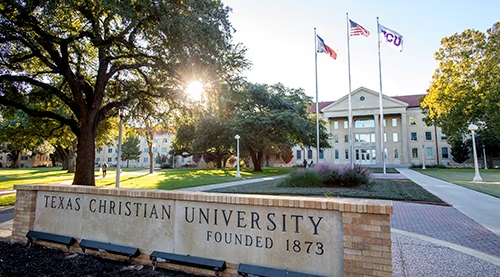
On June 1, Texas Christian University will close its stand-alone gender studies and race and ethnic studies departments and fold the majors and courses into the English Department, university leaders announced earlier this month.
The research university in Fort Worth is one of the first private institutions in the state to announce changes to its gender, sexuality and race-related academic programs after firings at Texas A&M University prompted the state’s public institutions to flag, censor and cut classes related to gender, sexuality, race and ethnicity.
In a meeting with English Department faculty on Oct. 22, TCU provost Floyd Wormley cited financial reasons for the change, asserting that political pressure “had no influence” on the decision to merge the Women and Gender Studies and Comparative Race and Ethnic Studies Departments into the English Department. But some faculty aren’t convinced. They say the move follows a decline in institutional support for the disciplines as the university faces immense pressure to eliminate any and all programming related to gender, race and ethnicity.
“The explanation from the administration is financial, and that doesn’t necessarily track with earlier correspondence with the department,” said Brandon Manning, an associate professor of gender and sexuality and race and ethnic Studies. The university is expanding its physical footprint and its student body, and “there are new programs and departments popping up daily,” he added. “TCU has been receiving considerable criticism online, and this seems to be a way to placate that criticism.”
A TCU spokesperson told Inside Higher Ed that conversations about merging the departments started more than two years ago. The two departments already share a leadership structure. The English Department wasn’t mentioned as a partner until the Oct. 17 announcement, said Alexandra Edwards, an English instructor at TCU.
The merger will affect seven faculty members, five of whom will likely follow the programs into the English Department. Other faculty and support staff will be deployed to other departments, Wormley and Sonja Watson, dean for the AddRan College of Liberal Arts, told faculty at the Oct. 22 meeting. The merger is part of a universitywide restructuring project and is primarily due to low enrollment in the two departments, they said. The Spanish and Modern Languages Departments will also be combined, and so will the Geology and Environmental Sciences Departments.
“Decisions are not based on academic content but on data,” a TCU spokesperson told Inside Higher Ed. “Students currently majoring in these programs have been notified that there will be no impact to their academic progress, meaning they will be able to complete their degrees as planned. TCU is growing and will need more faculty and staff—not less—to ensure that we meet the academic needs of students and demand for a TCU education.”
This fall, Critical Race and Ethnic Studies enrolled nine majors and minors, and Women and Gender Studies enrolled just two. The two programs have never been large; since becoming stand-alone departments in 2018, their highest combined enrollment was 31 majors and minors, in fall 2020. But using low enrollments to justify the merger is unfair, Edwards argued. The programs haven’t had a chance to flourish because of constant structural changes, she said.
“They have been through a ton of turmoil and leadership turnover and reassignment to various different colleges and units across the university, so for a long time they’ve been unable to become stable,” Edwards said. “I don’t see how gender studies or ethnic studies could become a priority in an English department that’s already … juggling a lot of competing interests and varied disciplines.”
Department chairs weren’t given any warning about the merger with the English department, and faculty were not consulted before the decision was made, according to notes from the Oct. 22 meeting shared with Inside Higher Ed. When faculty asked why, Wormley said it was within “the purview of the institution to make those decisions.”
A One-Man Campaign?
While TCU isn’t subject to the same state laws that eliminated diversity, equity and inclusion efforts at Texas’s public institutions, the university is still getting plenty of external pressure to ax its gender and race studies offerings. Faculty say the campaign to abolish related classes, programs and events at the university is led by Bo French, a TCU alum and the son of a sitting TCU board member. French is also chairman of the Tarrant County Republican Party and a conservative politician who was denounced by members of his own party for using slurs for gay people and people with disabilities.
French has berated the university online for what he described as “LGBTQ” and “radical Marxist” indoctrination. He celebrated on Oct. 10 when the university removed the “LGBTQ+” link from the “community initiatives” dropdown on its website. Three days earlier, he posted a poll on X asking followers if the university should “dismantle its entire racist DEI infrastructure and also stop offering courses in degenerate LGBTQ ideology.”
French interpreted the merger news as a partial victory. “This is simply hiding what they do in another department. Nothing changes,” he wrote on X on Oct. 22. “However, it does show that the public pressure is working. They are bending, but we have to make them break completely and eliminate these courses altogether.”
Since then, he has continued to wage a social media campaign against anything related to gender, sexuality or diversity at TCU. On Oct. 22 he also posted on X a photo of a lawn sign advertising campus Pride Month events, alongside the comment “I know a few things are happening behind the scenes at @TCU and I am now more hopeful than ever, but they haven’t happened yet and so stuff like this is still polluting the campus.”
Publicly, university officials have said little in response to criticism by French and others, Edwards said. She noted that she was harassed and doxed by conservatives in August 2024 over posts she made before she worked at TCU, and she was advised by administrators to “lay low” until the firestorm subsided. A former TCU Women and Gender Studies professor who received a threat of violence in response to a 2023 course titled The Queer Art of Drag was asked by police to leave campus for his own safety, Edwards said. More recently, a political science professor was doxed for online comments she made in the wake of conservative firebrand Charlie Kirk’s death.
Asked how the university has responded to political pressure and harassment of faculty, a spokesperson said, “The university has a thorough process to notify faculty and staff members and provide them with appropriate guidance and support to mitigate potential risks.”
In conversations with faculty, TCU leaders have acknowledged the pressures of the political landscape on the university, particularly on the gender and race studies departments, Edwards said. At the end of the Oct. 22 meeting, Watson told faculty she had been concerned about the future of the departments since Trump was inaugurated in January. During a March 28 meeting between faculty and Watson about combining the gender and race studies departments, Watson expressed concern about recent executive orders from President Trump.
“I think that we all know that the executive orders disproportionately affect [Comparative Race and Ethnic Studies], right? … As I said in the beginning, [I am] still very much committed to CRES and very much committed to growing the number of majors, and so I think the biggest challenge … is, how do we increase?” Watson said during the meeting, according to a recording obtained by Inside Higher Ed. “All liberal arts majors’ programs are having this issue for various reasons, but we see these issues manifest in a different way in both CRES and [Women and Gender Studies].”
In an all-hands meeting on April 4, TCU president Daniel Pullin and general counsel Larry Leroy Tyner explained the difficult bind the current national and state political landscapes have put the university in.
“If there’s a cliff that if you step off, there’s serious consequences, and [if] you don’t know where the edge of the cliff is, you stay way away from the edge,” Tyner said. “The combination of uncertainty and significant consequences creates the chilling effect.”
About a minute later, Pullin added that he and his cabinet are “trying to figure out how to stay as far away from that unknown cliff as possible so we can stay on mission and live our values and execute our plan.”
(This story has been updated to more accurately reflect the chronology of events precipitating the merger.)