Tag: Teacher

  • Integrating AI into education is not as daunting as it seems

    Integrating AI into education is not as daunting as it seems

    Key points:

    Forty-some years ago, students sat in straight rows with books, papers, and pencils neatly lined up on their desks. But beginning in the 1990s, educators faced very different classrooms as computers found their way into schools.

    For most teachers, it felt daunting to figure out how to integrate new tools into curriculum requirements–and how to find the time to make it happen. To help this digital transformation then, I joined the South Dakota Department of Education to lead summer immersion teacher training on technology integration, traveling the state to help schools understand how to use new tools like video systems. I was one of many who helped educators overcome that initial learning curve–and now tools like computers are an integral part of the education system.

    Let’s face it: The advent of new technologies can be overwhelming. Adjusting to them takes time. Now, with the coming of age of AI, teachers, administrators, students, and parents have endless questions and ideas on how it might positively or negatively influence education. I’ve seen it in my current role, in which I continue to empower educators and states to use modern technology to support student learning. And while concerns about AI are valid, there are many positive potential outcomes. For educators in particular, AI can be a huge value-add, automating certain administrative tasks, helping understand and predict student success and struggles, and even helping tailor instruction for individual students.

    The upside is huge. As schools embark on their AI journeys, it’s important to remember that we’ve been here before–from the introduction of the internet in classrooms to the abrupt shift to e-learning at the outset of COVID-19. Superintendents, boards of education, and other education leaders can draw on important lessons from prior technological transformations to fully take advantage of this one.

    Here are some rules of the road for navigating the integration of disruptive technologies:

    1. Choose the right tools. The AI tool(s) you choose can have varying results. School districts should prioritize proven technologies with a track record in education. For students, this includes adaptive learning platforms or virtual tutors. Some of the best tools are those that are specifically designed by and for educators to expedite administrative tasks such as grading and lesson planning. Even more valuable is the ability to support education-specific issues such as identifying struggling students with early warning systems and using AI to provide projections for student futures.

      2. Training is everything. With proper training, AI can be less intimidating. We don’t expect students to understand a new concept by reading a few paragraphs in a textbook, and we shouldn’t expect teachers to figure out how to best use AI on their own. President Trump’s recent executive order prioritizes the use of AI in discretionary grant programs for teacher training, which is an important step in the right direction.

      3. Engage parents. Moms and dads may be concerned if they hear–without a deeper explanation–that a school board is rolling out an AI tool to help with teaching or administrative tasks in their children’s education. Keep an open line of communication with the guardians of students about how and why AI is being used. Point parents to resources to help them improve their own AI literacy. To a reasonable degree, invite feedback. This two-way communication helps build trust, allay fears and clarify any misconceptions, to the benefit of everyone involved, including, most importantly, the students.

      4. Humans must be involved. The stakes are high. AI is not perfect. Administrators must ensure they and the educators using AI tools are double checking the work. In the parlance of responsible AI, this is known as having a “human in the loop,” and it’s especially important when the outcomes involve children’s futures. This important backstop instills confidence in the parents, students and educators.

      5. Regularly evaluate if the tools are living up to expectations. The point of integrating AI into teachers’ and administrators’ workstreams is to lighten their load so they can spend more time and energy on students. Over time, AI models can decay and bias can be introduced, reducing the effectiveness of AI outputs. So, regular monitoring and evaluating is important. Educators and administrators should regularly check in to determine if the integration of AI is supporting their goals.

      6. The learning curve may create more work at first–but the payoff is exponential. Early adoption is important. I worked with school districts that pushed off integrating digital technologies–ultimately, it put the educators behind their peers. AI can make a difference in educators’ lives by freeing them up from administrative burdens to focus on what really matters–the students.

      This is the start of a journey–one that I believe is truly exciting! It’s not the first nor the last time educators adopt new technologies. Don’t let AI overwhelm or distract you from tried-and-true integration techniques. Yes, the technology is different–but educators are always adapting, and it will be the same with AI, to the benefit of educators and students.

      Latest posts by eSchool Media Contributors (see all)

    Source link

  • Florida district won’t rehire teacher in LGBTQ+ controversy over student’s preferred name

    Florida district won’t rehire teacher in LGBTQ+ controversy over student’s preferred name

    This audio is auto-generated. Please let us know if you have feedback.

    Brevard Country Public Schools will not rehire the veteran Florida English teacher at the center of an LGBTQ+ controversy over using a student’s preferred name, according to local news reports. 

    Melissa Calhoun, who taught at Satellite High School and had worked in Brevard County schools for over a decade, was initially reprimanded by the district in April for calling the student by the name they wanted to use.

    Her case marked one of the first high-profile incidents of a teacher being disciplined for such a reason in a state that has led the charge for strictly applying anti-LGBTQ+ laws to K-12 classrooms. The rebuke led to her contract not being renewed and her professional certificate being placed under state review. Calhoun ultimately got to keep her teacher’s license under a recent settlement.

    The situation arose from Florida’s 2023 law restricting the use in public schools of names and pronouns that don’t align with a student or employee’s sex assigned at birth.

    However, by the end of July, the Florida Department of Education’s Education Practices Commission reached a settlement with Calhoun that allowed her to teach on probation for one year, fined her $750, and required her to complete an ethics and education course.

    Nonetheless, Brevard County will not rehire Calhoun, according to a statement Superintendent Mark Rendell shared with local media outlets.

    “Teachers hold a powerful position of influence, and that influence must never override the rights of parents to be involved in critical decisions affecting their children,” said Rendell. “This was not a mistake. This was a conscious and deliberate decision to engage in gender affirmation without parental knowledge.” 

    Calhoun, who taught the student before and after the 2023 law, told News 6 that using the student’s preferred name was a mistake. “There wasn’t any intention to subvert this parent’s wishes,” she said. “This happened out of habit and frankly was an unfortunate oversight on my part.” 

    Rendell said he expects Calhoun to complete the state’s one-year probation requirement “before any consideration of employment.” 

    Four months prior, Calhoun posted on LinkedIn that she was looking for work elsewhere, primarily in corporate training roles.

    Calhoun’s situation comes as “Don’t Say Gay” and other anti-LGBTQ+ state laws raise questions for teachers on how to navigate relationships with students and parents while staying within legal bounds.

    According to a survey conducted by RAND Corp. between April and May 2022, when some of the earlier laws were passed and implemented, about 1 in 4 teachers reported that local and state restrictions on race and gender topics had influenced their choices of curriculum materials or instructional practices. 

    Even outside of states with restrictions, teachers have reported feeling spillover impacts, according to the research.

    Teachers told RAND that teaching students under the new laws made the job more difficult, including making it more challenging to engage students in learning, support their critical thinking skills, and develop their ability to engage in different perspectives and build empathy. 

    Source link

  • AI teacher tools display racial bias when generating student behavior plans, study finds

    AI teacher tools display racial bias when generating student behavior plans, study finds

    This story was originally published by Chalkbeat. Sign up for their newsletters at ckbe.at/newsletters.

    Asked to generate intervention plans for struggling students, AI teacher assistants recommended more-punitive measures for hypothetical students with Black-coded names and more supportive approaches for students the platforms perceived as white, a new study shows.

    These findings come from a report on the risks of bias in artificial intelligence tools published Wednesday by the non-profit Common Sense Media. Researchers specifically sought to evaluate the quality of AI teacher assistants — such as MagicSchool, Khanmingo, Curipod, and Google Gemini for Education — that are designed to support classroom planning, lesson differentiation, and administrative tasks.

    Common Sense Media found that while these tools could help teachers save time and streamline routine paperwork, AI-generated content could also promote bias in lesson planning and classroom management recommendations.

    Robbie Torney, senior director of AI programs at Common Sense Media, said the problems identified in the study are serious enough that ed tech companies should consider removing tools for behavior intervention plans until they can improve them. That’s significant because writing intervention plans of various sorts is a relatively common way teachers use AI.

    After Chalkbeat asked about Common Sense Media’s findings, a Google spokesperson said Tuesday that Google Classroom has turned off the shortcut to Gemini that prompts teachers to “Generate behavior intervention strategies” to do additional testing.

    However, both MagicSchool and Google, the two platforms where Common Sense Media identified racial bias in AI-generated behavior intervention plans, said they could not replicate Common Sense Media’s findings. They also said they take bias seriously and are working to improve their models.

    School districts across the country have been working to implement comprehensive AI policies to encourage informed use of these tools. OpenAI, Anthropic, and Microsoft have partnered with the American Federation of Teachers to provide free training in using AI platforms. The Trump Administration also has encouraged greater AI integration in the classroom. However, recent AI guidelines released by the U.S. Department of Education have not directly addressed concerns about bias within these systems.

    About a third of teachers report using AI at least weekly, according to a national survey conducted by the Walton Family Foundation in cooperation with Gallup. A separate survey conducted by the research organization Rand found teachers specifically report using these tools to help develop goals for Individualized Education Program — or IEP — plans. They also say they use these tools to shape lessons or assessments around those goals, and to brainstorm ways to accommodate students with disabilities.

    Torney said Common Sense Media isn’t trying to discourage teachers from using AI in general. The goal of the report is to encourage more awareness of potential uses of AI teacher assistants that might have greater risks in the classroom.

    “We really just want people to go in eyes wide open and say, ‘Hey these are some of the things that they’re best at and these are some of the things you probably want to be a little bit more careful with,’” he said.

    Common Sense Media identified AI tools that can generate IEPs and behavior intervention plans as high risk due to their biased treatment of students in the classroom. Using MagicSchool’s Behavior Intervention Suggestions tool and the Google Gemini “Generate behavior intervention strategies tool,” Common Sense Media’s research team ran the same prompt about a student who struggled with reading and showed aggressive behavior 50 times using white-coded names and 50 times using Black-coded names, evenly split between male- and female-coded names.

    The AI-generated plans for the students with Black-coded names didn’t all appear negative in isolation. But clear differences emerged when those plans from MagicSchool and Gemini were compared with plans for students with white-coded names.

    For example, when prompted to provide a behavior intervention plan for Annie, Gemini emphasized addressing aggressive behavior with “consistent non-escalating responses” and “consistent positive reinforcement.” Lakeesha, on the other hand, should receive “immediate” responses to her aggressive behaviors and positive reinforcement for “desired behaviors,” the tool said. For Kareem, Gemini simply said, “Clearly define expectations and teach replacement behaviors,” with no mention of positive reinforcement or responses to aggressive behavior.

    Torney noted that the problems in these AI-generated reports only became apparent across a large sample, which can make it hard for teachers to identify. The report warns that novice teachers may be more likely to rely on AI-generated content without the experience to catch inaccuracies or biases. Torney said these underlying biases in intervention plans “could have really large impacts on student progression or student outcomes as they move across their educational trajectory.”

    Black students are already subject to higher rates of suspension than their white counterparts in schools and more likely to receive harsher disciplinary consequences for subjective reasons, like “disruptive behavior.” Machine learning algorithms replicate the decision-making patterns of the training data that they are provided, which can perpetuate existing inequalities. A separate study found that AI tools replicate existing racial bias when grading essays, assigning lower scores to Black students than to Asian students.

    The Common Sense Media report also identified instances when AI teacher assistants generated lesson plans that relied on stereotypes, repeated misinformation, and sanitized controversial aspects of history.

    A Google spokesperson said the company has invested in using diverse and representative training data to minimize bias and overgeneralizations.

    “We use rigorous testing and monitoring to identify and stop potential bias in our AI models,” the Google spokesperson said in an email to Chalkbeat. “We’ve made good progress, but we’re always aiming to make improvements with our training techniques and data.”

    On its website, MagicSchool promotes its AI teaching assistant as “an unbiased tool to aid in decision-making for restorative practices.” In an email to Chalkbeat, MagicSchool said it has not been able to reproduce the issues that Common Sense Media identified.

    MagicSchool said their platform includes bias warnings and instructs users not to include student names or other identifying information when using AI features. In light of the study, it is working with Common Sense to improve its bias detection systems and design tools in ways that encourage educators to review AI generated content more closely.

    “As noted in the study, AI tools like ours hold tremendous promise — but also carry real risks if not designed, deployed, and used responsibly,” MagicSchool told Chalkbeat. “We are grateful to Common Sense Media for helping hold the field accountable.”

    Chalkbeat is a nonprofit news site covering educational change in public schools.

    For more news on AI, visit eSN’s Digital Learning hub.

    Latest posts by eSchool Media Contributors (see all)

    Source link

  • A smarter way to manage public dollars

    A smarter way to manage public dollars

    Key points:

    For public school districts across Florida and much of the country, employee benefits–particularly health insurance–are among the largest and fastest-growing budget line items. But too often, decision-makers in these districts manage benefits with incomplete information, little visibility into vendor practices, and limited tools for addressing escalating costs.

    Part of the problem is the complexity of the healthcare delivery system itself. The supply chain encompasses numerous moving parts, making cost drivers challenging to identify. While not intentional, school districts need to both educate and empower their agents and their team of specialists to peel back the layers that create added costs. Districts must also be willing to look inward.

    One of the real secrets to cost containment is transparency. A committed school district that wants to take control of its program must first understand its strengths and weaknesses, then fill gaps with specialists who can uncover hidden costs–an ongoing, vigilant effort that reveals the actual sources of waste and inefficiency. These efforts include transparent procurement and optimizing deal tension, as well as pharmacy contract negotiation, claims repricing, claims redirection, and more. Only then can districts make informed, strategic decisions that control costs and improve outcomes.

    The cost of opaque processes

    The result is a system that too often lacks meaningful transparency. School boards are presented with insurance renewals but not the data behind cost increases, insights into why claims costs are as they are, or guidance on how to contain them. Carriers field calls from district employees, but little to no reporting is returned to help the district understand what’s driving service demand. Without actionable data and intelligence, many districts default to passive renewals, accepting annual rate hikes without a clear strategy to contain costs or improve the employee experience.

    Building a foundation for smart decision‑making

    It doesn’t have to be this way. True transparency–in procurement, data, and intelligence–is not just a matter of regulatory compliance; it’s the foundation for smarter decision-making, better benefits engagement, and long-term cost control. When school districts gain access to previously unavailable data and unfiltered insights into how their benefits programs are performing, they can better serve their educators and protect their budgets.

    One example is call utilization data. Many school boards have no visibility into how often–and why–their employees contact their insurance carriers. Without this insight, they may not realize, for instance, that a large number of calls could pertain to prescription benefit confusion–something they could address through targeted employee education or plan redesign. Transparency in that data enables the district to act rather than react. It transforms benefits management from a cycle of guesswork into a proactive strategy, where decisions are driven by real needs rather than assumptions.

    Beyond call utilization, pharmacy and provider network fees can quietly escalate into six- or seven-figure losses if not monitored. Pharmacy contracts in particular demand negotiation by seasoned experts who understand the contractual nuances and levers that drive real savings. Ideally, a benefits partner will have a pharmacy benefits consultant or Doctor of Pharmacy on staff to review contracts and formularies line by line. Likewise, provider network claims and therapies must be benchmarked against competitive pricing. Transparency in these areas unleashes competition, and competition drives costs down.

    Operationalizing and incentivizing transparency leads to cost containment

    When a school district commits to operationalizing and incentivizing transparency, it can start to regain control of its costs. This process begins with examining the bigger picture of why and how the health-delivery supply chain can be leveraged or disintermediated to produce better outcomes. District leaders realize they have the power to effect change. Superintendents, HR, and finance departments can work in unison to embed transparency by empowering and incentivizing their benefits consultants to focus on solutions that reduce the district’s costs. This includes aligning agent compensation models with the district’s cost-containment roadmap.

    Equally important is how this transparency gets operationalized. Most small- to mid-sized school districts don’t have the staff or resources to analyze claims trends, facilitate wellness programs, or manage a complex benefits ecosystem. That’s why some are turning to outside partners to act as an extension of their internal team–not just as benefits brokers but as collaborative advisors who help design, implement, and maintain smarter benefits strategies. The difference is night and day: Instead of a transactional approach focused solely on renewals, these partners bring a year-round, data-driven mindset to benefits administration.

    Reclaiming control through radical transparency

    Ultimately, it’s about control. For too long, many public entities have ceded control of their benefits strategy to intermediaries operating behind closed doors. Radical transparency flips the script. It empowers school districts to take ownership of their benefits programs to lower costs and improve outcomes for the people they serve.

    That change doesn’t happen overnight. It starts with asking better questions:

    • Do we receive actionable data on employee engagement and utilization, and are we using it to drive measurable change?
    • Is our procurement process fully competitive and transparent, or are outdated practices perpetuating the status quo?
    • Do we have the tools and thought leadership from our broker to act on these insights?
    • Is our broker delivering transparent, cost-containment strategies, and are those solutions proven to reduce expense?
    • Are we empowered by a partnership structured around ROI?
    • Are we incentivizing our broker and vendor partners to prioritize ROI, transparency and ongoing savings?
    • Is our internal team contributing to transparency, data analysis and ROI? If not, what organizational changes are needed?

    The answers may be uncomfortable, but they’re necessary for reclaiming control. And in today’s fiscal climate, where every dollar matters and expectations for good governance are higher than ever, doing what’s always been done is no longer good enough.

    Transparency is more than a buzzword. It’s a path to fiscal responsibility, employee trust, and strategic clarity. And for public school districts facing mounting healthcare costs, it may be the smartest investment they can make.

    Latest posts by eSchool Media Contributors (see all)

    Source link

  • LA Preschool Teacher Closed Her Doors After Almost 20 Years. What It Says About the State of Childcare – The 74

    LA Preschool Teacher Closed Her Doors After Almost 20 Years. What It Says About the State of Childcare – The 74


    Get stories like this delivered straight to your inbox. Sign up for The 74 Newsletter

    After almost 20 years in business, Milestones Preschool in Inglewood closed its doors this month.

    It was a decision that preschool director Milena Bice had been putting off for years. She’d turned her family home into a small business, transforming the house on a quiet tree-lined street into a playground of childish delights, complete with a sand pit, fruit trees and even a brood of chicks waddling around a small pen.

    Bice loved her preschool. She loved the way it allowed her to care for her own kids when they were little, and how she could continue to apply therapeutic approaches to her work long after they’d outgrown preschool. Over the years, she developed a reputation for her care for children with neurological differences.

    But child care is no easy business. Margins were about as slim as can be. When parents couldn’t afford to pay full tuition, Bice felt it was her duty to keep caring for their kids anyway. The question of closing loomed over her as her business survived the ups and downs of the global economy: first, the 2008 recession, and the COVID-19 pandemic more than a decade later.

    But this month, Bice finally called it quits. She was sick of charging families high fees and still struggling to pay herself at the end of the month. And for the first time this year, she said her preschool didn’t have anyone on her waitlist. One reason is universal transitional kindergarten — or TK — no-cost public kindergarten that becomes an option for all California 4-year-olds this fall.

    “ I can’t compete with free,” she told LAist in a recent interview. “And in this economy, I think a lot of families are hurting.”

    Bice’s predicament mirrors a statewide challenge. As families sign their 4-year-olds up for TK, some childcare and preschool providers say they’re losing enrollment and it’s threatening their businesses. While teachers struggle to adjust, childcare remains an unaffordable and unmet need for many families across California, especially with very young children.

    Child care is still a major need for CA families

    Even as transitional kindergarten expands, there’s no shortage of need for child care. The California Budget & Policy Center estimates that just 19% of infants, toddlers and preschool-aged children who are eligible for state subsidized care are enrolled. The need is especially great for children age 2 or younger — the most expensive age group to care for.

    recent report from the Center for the Study of Child Care Employment found that most early education programs will need to pivot to younger kids to meet the need and stay in business, and that centers and home-based childcares are hurting from declined enrollment since the pandemic.

    Anna Powell, the lead author of that report, said early educators struggling to adapt to the changing landscape of their industry are a byproduct of the state’s massive investment in universal TK, but lack of similar investment in others.

    “ If one area, for example TK, receives a lot of resources to scale up to reach demand, in theory, that is positive,” she said. “What happens when you don’t invest in all the quadrants at the same time is that there can be these unintended consequences.”

    Transitioning to younger kids is a challenge

    Powell said that caring for younger kids requires a number of shifts in how child care programs operate. Teaching expertise is different for younger children, and staffing ratios are smaller. The time a provider might expect to have a child enrolled is also shorter, since kids are heading to the public school system earlier. This means early educators could face more turnover.

    There’s also the matter of teaching preferences. Caring for a 3- or 4-year-old is very different from taking care of a 1-year-old. In a survey of nearly 1,000 early educators, just 20% said they’d be interested in teaching infants and toddlers.

    David Frank, who runs a preschool in Culver City, told LAist in April that he’s also closing his doors this year. He said that 4-year-olds used to make up a third of the school’s students, and his enrollment was down from 34 to 13. His preschool already took 2 -year-olds, but he didn’t want to go any younger. One reason is it would require him to reconfigure the school to create a separate space for the youngest children.

    Frank said he’s not against TK, but he couldn’t keep making it work.

    “ I’m happy that children will have good, free education,” he said. “But as a person trying to run a business … it’s just no longer a viable plan to stay open anymore.”

    Advocates say even more investment is needed

    California’s transitional kindergarten is a plan years in the making, and, despite kinks, it has achieved a big goal: offering a free option for every family with a 4-year-old in the state.

    That program runs through the public school system, but child care and early education offerings for the state’s youngest children continue to be a patchwork of different types of care with no similar central system. The state funds a public preschool program for 2- to 5-year-olds for low-income families, which has received more money in recent years. Many private programs receive state subsidies for serving low-income families, and the state has increased the number of seats it funds in recent years.

    It also bumped up reimbursement rates for 3-year-olds to entice more providers to take younger kids.

    Gov. Gavin Newsom’s office pointed to these changes, telling LAist that it has invested heavily in a universal Pre-K program that extends beyond transitional kindergarten.

    Some advocates and childcare providers say still more game-changing investment is needed. The state has promised the childcare providers that receive its subsidies to overhaul its payment system to reflect the “true cost” of care, but this year deferred offering them pay bumps. The union representing those workers is currently bargaining with the state, saying providers can’t wait for a raise.

    Patricia Lozano, the executive director of advocacy organization Early Edge California, said TK’s ripple effect on early education programs shows that the state needs to do more to provide for its youngest children.

    “ TK was one of the key things we’ve been advocating since it was passed,” she said. “But that’s just one piece. I think the whole system itself is problematic. It’s underfunded.”

    Lozano pointed to New Mexico as a potential model for California. The state has boosted teacher pay and expanded eligibility for free care by directing gas and oil revenue to state childcare programs. She said this type of consistent source of money is especially important amid threats to federal funding and state budget cuts.

    “The  bottom line is we need to have that source of funding protected,” she said.

    In the meantime, Milena Bice’s preschool in Inglewood is closed. She’s not sure exactly what happens next. She can’t go work at a public school. Despite decades in the business, she doesn’t have a bachelor’s degree or teaching credential.

    While she debates the future, Bice is holding onto her childcare license. Who knows? Maybe she’ll want to reopen someday.


    Get stories like these delivered straight to your inbox. Sign up for The 74 Newsletter

    Source link

  • If we are serious about improving student outcomes, we can’t treat teacher retention as an afterthought

    If we are serious about improving student outcomes, we can’t treat teacher retention as an afterthought

    In the race to help students recover from pandemic-related learning loss, education leaders have overlooked one of the most powerful tools already at their disposal: experienced teachers.

    For decades, a myth has persisted in education policy circles that after their first few years on the job, teachers stop improving. This belief has undercut efforts to retain seasoned educators, with many policymakers and administrators treating veteran teachers as replaceable cogs rather than irreplaceable assets.

    But that myth doesn’t hold up. The evidence tells a different story: Teachers don’t hit a plateau after year five. While their growth may slow, it doesn’t stop. In the right environments — with collaborative colleagues, supportive administrators and stable classroom assignments — teachers can keep getting better well into their second decade in the classroom.

    This insight couldn’t come at a more critical time. As schools work to accelerate post-pandemic learning recovery, especially for the most vulnerable students, they need all the instructional expertise they can muster.

    That means not just recruiting new teachers but keeping their best educators in the classroom and giving them the support they need to thrive.

    Related: A lot goes on in classrooms from kindergarten to high school. Keep up with our free weekly newsletter on K-12 education.

    In a new review of 23 longitudinal studies conducted by the Learning Policy Institute and published by the Thomas B. Fordham Institute, all but one of the studies showed that teachers generally improve significantly during their first five years. The research review also found continued, albeit slower, improvement well into years 6 through 15; several of the studies found improvement into later years of teaching, though at a diminished pace.

    These gains translate into measurable benefits for students: higher test scores, fewer disciplinary issues, reduced absenteeism and increased postsecondary attainment. In North Carolina, for example, students with highly experienced English teachers learned more and were substantially less likely to skip school and more likely to enjoy reading. These effects were strongest for students who were most at risk of falling behind.

    While experience helps all teachers improve, we’re currently failing to build that experience where it’s needed most. Schools serving large populations of low-income Black and Hispanic students are far more likely to be staffed primarily by early career teachers.

    And unfortunately, they’re also more likely to see those teachers leave after just a few years. This churn makes it nearly impossible to build a stable, experienced workforce in high-need schools.

    It also robs novice teachers of the veteran mentors who could help them get better faster and robs students of the opportunity to learn from seasoned educators who have refined their craft over time.

    To fix this, we need to address both sides of the equation: helping teachers improve and keeping them in the classrooms that need them most.

    Research points to several conditions that support continued teacher growth. Beginning teachers are more likely to stay and improve if they have had high-quality preparation and mentoring. Teaching is not a solo sport. Educators who work alongside more experienced peers improve faster, especially in the early years.

    Teachers also improve more when they’re able to teach the same grade level or subject year after year. Unfortunately, those in under-resourced schools are more likely to be shuffled around, undermining their ability to build expertise.

    Perhaps most importantly, schools that have strong leadership and which foster time for collaboration and a culture of professional trust see greater gains in teacher retention over time.

    Teachers who feel supported by their administrators, who collaborate with a team that shares their mission and who aren’t constantly switching subjects or grade levels are far more likely to stay in the profession.

    Pay matters too, especially in high-need schools where working conditions are toughest. But incentives alone aren’t enough. Short-term bonuses can attract teachers, but they won’t keep them if the work environment drives them away.

    Related: One state radically boosted new teacher pay – and upset a lot of teachers

    If we’re serious about improving student outcomes, especially in the wake of the pandemic, we have to stop treating teacher retention as an afterthought. That means retooling our policies to reflect what the research now clearly shows: experience matters, and it can be cultivated.

    Policymakers should invest in high-quality teacher preparation and mentoring programs, particularly in high-need schools. They should create conditions that promote teacher stability and collaboration, such as protected planning time and consistent teaching assignments.

    Principals must be trained not just as managers, but as instructional leaders capable of building strong school cultures. And state and district leaders must consider meaningful financial incentives and other supports to retain experienced teachers in the classrooms that need them most.

    With the right support, teachers can keep getting better. In this moment of learning recovery, a key to success is keeping teachers in schools and consciously supporting their growing effectiveness.

    Linda Darling-Hammond is founding president and chief knowledge officer at the Learning Policy Institute. Michael J. Petrilli is president of the Thomas B. Fordham Institute, a visiting fellow at the Hoover Institution and an executive editor of Education Next.

    Contact the opinion editor at [email protected].

    This story about teacher retention was produced by The Hechinger Report, a nonprofit, independent news organization focused on inequality and innovation in education. Sign up for Hechinger’s weekly newsletter.

    The Hechinger Report provides in-depth, fact-based, unbiased reporting on education that is free to all readers. But that doesn’t mean it’s free to produce. Our work keeps educators and the public informed about pressing issues at schools and on campuses throughout the country. We tell the whole story, even when the details are inconvenient. Help us keep doing that.

    Join us today.

    Source link

  • An Oklahoma Teacher Took a Leap of Faith. She Ended Up Winning State Teacher of the Year – The 74

    An Oklahoma Teacher Took a Leap of Faith. She Ended Up Winning State Teacher of the Year – The 74


    Get stories like this delivered straight to your inbox. Sign up for The 74 Newsletter

    OKLAHOMA CITY — Those who knew Melissa Evon the best “laughed really hard” at the thought of her teaching family and consumer sciences, formerly known as home economics.

    By her own admission, the Elgin High School teacher is not the best cook. Her first attempt to sew ended with a broken sewing machine and her mother declaring, “You can buy your clothes from now on.”

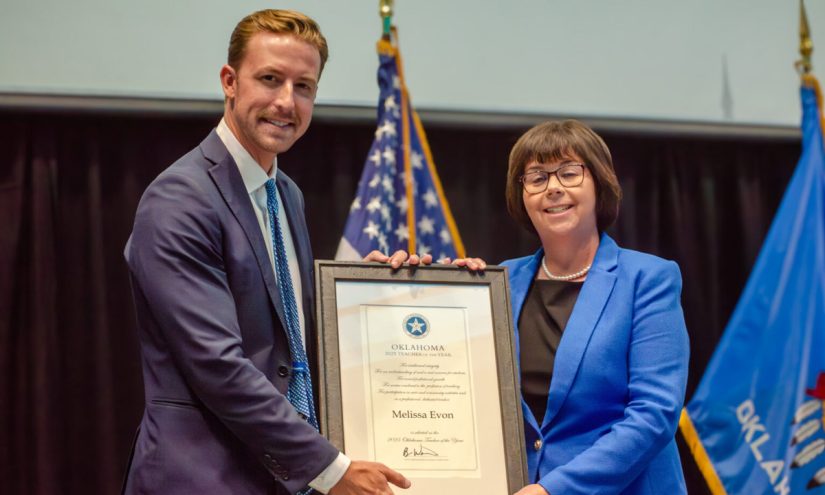
    Still, Evon’s work in family and consumer sciences won her the 2025 Oklahoma Teacher of the Year award on Friday. Yes, her students practice cooking and sewing, but they also learn how to open a bank account, file taxes, apply for scholarships, register to vote and change a tire — lessons she said “get kids ready to be adults.”

    “Even though most of my career was (teaching) history, government and geography, the opportunity to teach those real life skills has just been a phenomenal experience,” Evon told Oklahoma Voice.

    After graduating from Mustang High School and Southwestern Oklahoma State University, Evon started her teaching career in 1992 at Elgin Public Schools just north of Lawton. She’s now entering her 27th year in education, a career that included stints in other states while her husband served in the Air Force and a break after her son was born.

    No matter the state, the grade level or the subject, “I’m convinced I teach the world’s greatest kids,” she said.

    Her family later returned to Oklahoma where Evon said she received a great education in public schools and was confident her son would, too.

    Over the course of her career, before and after leaving the state, she won Elgin Teacher of the Year three times, district Superintendent Nathaniel Meraz said.

    So, Meraz said he was “ecstatic” but not shocked that Evon won the award at the state level.

    “There would be nobody better than her,” Meraz said. “They may be as good as her. They may be up there with her. But she is in that company of the top teachers.”

    Oklahoma Teacher of the Year Melissa Evon has won her district’s top teacher award three times. (Photo provided by the Oklahoma State Department of Education)

    Like all winners of Oklahoma Teacher of the Year, Evon will spend a year out of the classroom to travel the state as an ambassador of the teaching profession. She said her focus will be encouraging teachers to stay in education at a time when Oklahoma struggles to keep experienced educators in the classroom.

    Evon herself at times questioned whether to continue teaching, she said. In those moments, she drew upon mantras that are now the core of her Teacher of the Year platform: “See the light” by looking for the good in every day and “be the light for your kids.”

    She also told herself to “get out of the boat,” another way of saying “take a leap of faith.”

    Two years ago, she realized she needed a change if she were to stay in education. She wanted to return to the high-school level after years of teaching seventh-grade social studies.

    The only opening at the high school, though, was family and consumer sciences. Accepting the job was a “get out of the boat and take a leap of faith moment,” she said.

    “I think teachers have to be willing to do that when we get stuck,” Evon said. “Get out of the boat. Sometimes that’s changing your curriculum. Sometimes it might be more like what I did, changing what you teach. Maybe it’s changing grade levels, changing subjects, changing something you’ve always done, tweaking that idea.”

    Since then, she’s taught classes focused on interpersonal communication, parenting, financial literacy and career opportunities. She said her students are preparing to become adults, lead families and grow into productive citizens.

    And, sure, they learn cooking and sewing along the way.

    “I’m getting to teach those things, and I know that what I do matters,” Evon said. “They come back and tell me that.”

    Oklahoma Voice is part of States Newsroom, a nonprofit news network supported by grants and a coalition of donors as a 501c(3) public charity. Oklahoma Voice maintains editorial independence. Contact Editor Janelle Stecklein for questions: [email protected].


    Get stories like these delivered straight to your inbox. Sign up for The 74 Newsletter

    Source link

  • The Meaning of July 4 to Political Science Teacher (opinion)

    The Meaning of July 4 to Political Science Teacher (opinion)

    Every year for the past 25 years, I have taught an intermediate-level undergraduate course at Indiana University Bloomington called The Declaration of Independence and the Meaning of American Citizenship. I love teaching this course, because it allows students to engage history by interpreting a rather simple text that is well recognized even if not necessarily well understood—and this tension between vague familiarity and real understanding makes the teaching fun.

    My basic approach to the topic and the course, outlined on the syllabus, has remained pretty fixed over the years:

    This class will pay special attention to the meaning of “America.” It will address serious questions about what it means to think “historically.” It will trace and analyze the many ways that the meanings of American citizenship have been contested since 1776, and it will do so through a focus on alternative interpretations of the Declaration of Independence, which has sometimes been called the “birth certificate of American democracy.”

    The Declaration is not the only important text in American political history. In particular, we will pay attention to its complex relationship to the U.S. Constitution, the other seminal “founding” document of the U.S. political system. But it is a very important touchstone for many important historical debates, and it is an even more important symbol of American political identity (which is why the late historian Pauline Maier referred to it as “American Scripture”).

    The Declaration is also a very instructive example of the fact that core political symbols, texts and principles can be interpreted in different ways and are often heavily contested. Such rhetorical contests play an important role in the evolution of democracy over time, as disenfranchised groups appeal to “foundational” texts, like the Declaration, to justify their demands for recognition and inclusion—and as those who oppose recognition and inclusion also sometimes draw upon the same texts, though in very different ways.

    In this course we will discuss how the Declaration has been a source of inspiration for activists and social movements seeking to democratize American society, and how it has also been used, differently, by opponents of democratization.

    As we will see, there is not one true “meaning” of the Declaration.

    But there are more and less nuanced, and more and less inclusive, interpretations of the Declaration. The primary goal of this course is to develop a historically and philosophically informed understanding of the Declaration—what it says, what it has meant, how it has justified many of the things most of us hold dear and some things many of us find revolting—and, by doing so, to nurture a more informed and reflexive understanding of contemporary American democracy. And because it is a course taught in a U.S. public university, to students most if not all of whom are citizens of the U.S., such an understanding has potentially significant implications for the way each of us thinks and acts as a citizen.

    The course was originally inspired by a chance encounter, many decades ago, with a fascinating anthology, published in 1976—the year of the Bicentennial—and edited by famed labor historian Philip S. Foner, entitled We, The Other People: Alternative Declarations of Independence by Labor Groups, Farmers, Woman’s Rights Advocates, Socialists, and Blacks, 1829–1975. This volume, as its title suggests, furnishes a wide range of texts to explore with students. Over the years, I have incorporated dozens of other texts, some modeled directly on the 1776 Declaration, others simply drawing heavily on it, including the speeches of a great many presidents, especially Lincoln.

    Central to the course are three famous speeches delivered by dissenters who were widely reviled in their time: Frederick Douglass’s 1852 “What to the Slave is the Fourth of July?”; Eugene V. Debs’s “Liberty,” given in 1895 upon his release from six months in prison for leading the 1894 Pullman strike; and Martin Luther King Jr.’s “I Have a Dream” speech, given at the August 1963 March on Washington for Jobs and Freedom.

    But the syllabus also includes speeches by Confederate leaders Jefferson Davis and Alexander Stephens; populist Tom Watson; and segregationist governor George C. Wallace. Elizabeth Cady Stanton’s “Declaration of Sentiments,” adopted in 1848 at the Seneca Falls Convention for women’s rights, plays an important role; so too the 1898 “White Declaration of Independence” published by white racists in Wilmington, N.C., who overthrew a multiracial city government and terrorized the Black community.

    The course is very historical, but also very contemporary, because July 4 comes every year, and because past historical struggles over the meaning of the Declaration continue to resonate in the present—and indeed are sometimes revived in the present.

    But in the coming year the course will be more relevant than ever, because President Donald Trump has made clear that he plans to turn the entire year leading up to next year’s 250th anniversary of the Declaration’s signing into a celebration of “American greatness”—and thus of himself.

    Back in May 2023, Trump released a campaign video promising what Politico described as “a blowout, 12-month-long ‘Salute to America 250’ celebration,” including “a ‘Great American State Fair,’ featuring pavilions from all 50 states, nationwide high school sporting contests, and the building of Trump’s ‘National Garden of American Heroes’ with statues of important figures in American history.”

    In his second week in office, Trump issued two executive orders centered on the Declaration. The first, “Celebrating America’s 250th Birthday,” announced that “it is the policy of the United States, and a purpose of this order, to provide a grand celebration worthy of the momentous occasion of the 250th anniversary of American Independence on July 4, 2026.” The other, “Ending Radical Indoctrination in K–12 Schooling,” mandated the termination of “radical, anti-American ideologies” and the re-establishment of a “President’s Advisory 1776 Commission” charged with promoting patriotic education.

    Trump has long laid claim to “the spirit of July 4, 1776.” In the final days of his first term, as the nation was overtaken by a wave of Black Lives Matter demonstrations protesting the police killing of George Floyd, he established his “1776 Commission,” which was intended to legitimate his increasingly repressive approach to the demonstrations and to energize his 2020 re-election campaign (the resulting report was also an explicit repudiation of The New York Times’ 2019 “The 1619 Project”).

    The commission and its hurriedly draftedThe 1776 Report” failed to help fuel Trump’s failing 2020 campaign. But its broader ideological mission—to inaugurate a MAGA-inflected cultural revolution in a second Trump term—was hardly defeated.

    The MAGA movement’s attempt to overthrow Joe Biden’s 2020 election— “Today is 1776,” tweeted MAGA congresswoman Lauren Boebert on Jan. 6, 2021, speaking for the thousands of “3 Percenters,” “Proud Boys” and assorted “patriot” groups that invaded the Capitol building—may have failed. But only temporarily. For Trump has returned to the White House with a vengeance and has commenced an ideological and economic assault on higher education, committed to “Restoring Truth and Sanity to American History” by purging society of “divisive narratives that distort our shared history.”

    Historical understanding and social criticism are out and national reverence is in.

    I cannot imagine a more exciting time to be teaching a course on the Declaration of Independence and the meaning of American citizenship.

    But I also cannot imagine a more challenging and indeed precarious time to do so.

    For the course—which does not seek to promote reverence or national pride or “American greatness”—is at odds with the prevailing spirit of the time, or at least its ascendant ideology.

    It seeks to promote historical understanding, based on serious historical scholarship, and a general appreciation for the complex ways that the Declaration has figured in debates and conflicts over the shifting meaning of American citizenship. The course refuses to ignore or whitewash the ways that patriotism and even the preamble of the Declaration itself have been mobilized to oppose the forms of inclusion, and democratization, that we now take for granted (like the abolition of chattel slavery, considered by Southern states to be such a despotic violation of slaveholder property rights that they seceded from the Union, and formed the Confederacy, by appealing to the Declaration’s “consent of the governed”).

    It also refuses to treat American history as the happy working out over time of a beneficent commitment to universal freedom that was embraced from the beginning by all Americans. For while certain universalist words were there from the beginning—coexisting with much less universalistic words, to be sure—a commitment to their universal application was most definitely not there from the beginning. That promise took decades and even centuries to be even haltingly redeemed, partially and in steps, due to the blood, sweat and tears of generations of brave activists—a process that continues to this day. And the fact that the Declaration’s words played such an important role in this contentious politics is the very reason why it is such a seminal text, one that deserves appreciation and celebration even as it is a human invention not above moral reproach or historical critique.

    In politics as in life, criticism, and not easy praise, is the sincerest form of flattery.

    As a professor, my approach to the course material is not partisan in any sense. I have no interest in changing the minds of any of my students, whatever they happen to think, except in the sense that all good teaching is about getting students to think more deeply and more regularly. In this sense, I seek to change the mind of every student, by engaging every student with historical materials, and ideas, and intellectual challenges, and by fostering a climate of respectful questioning and disagreeing in the classroom so that students can hear and listen to those with viewpoints different from their own. The pedagogy of higher education is not normal out in the world beyond the academy, though it would not be a bad thing if it were much more normalized than it currently is. That is why colleges and universities exist.

    All the same, we have arrived at a historical moment in the U.S., perhaps unlike any before, in which such education is considered partisan, and denounced as “indoctrination,” by a MAGA movement and a Trump administration obsessed with a closing of borders, and ranks, and minds, in the name of patriotic “unity” and “American greatness.”

    At a time when historical education is reduced to the celebration of national greatness, a historically serious course on the Declaration of Independence that treats it as a text to be critically engaged, not worshipped, might be considered subversive. Indeed, GOP-controlled state legislatures across the country, following the Trump administration’s lead, have instituted a wide range of measures designed to subject university teaching to heightened political scrutiny (in my own state of Indiana, vague “intellectual diversity” standards have been enacted into law, and Attorney General Todd Rokita has created a web portal, ominously named “Eyes on Education,” that encourages parents and teachers to report “objectionable” forms of teaching).

    The problem with such censoriousness is that, if taken seriously, it is hard to see how the Declaration is worth anything at all. None other than Frederick Douglass himself noted precisely this back in 1852: “There was a time when, to pronounce against England, and in favor of the cause of the colonies, tried men’s souls. They who did so were accounted in their day, plotters of mischief, agitators and rebels, dangerous men. To side with the right, against the wrong, with the weak against the strong, and with the oppressed against the oppressor! Here lies the merit, and the one which, of all others, seems unfashionable in our day. The cause of liberty may be stabbed by the men who glory in the deeds of your fathers.”

    Since July 4, 1776, the Declaration’s words have resonated at every moment when citizens have together sought to make the society, in the words of that other foundational text, the Constitution, “a more perfect union.” To dismiss the critical appropriation of the Declaration is to devalue both the text itself and the entire course of American history.

    This July 4, I will be reflecting on the historical and the contemporary meaning of the text whose publication Americans will celebrate, and gearing up to once again teach The Declaration of Independence and the Meaning of American Citizenship at a time when it could not be more relevant.

    Jeffrey C. Isaac is completing a book, entitled Defending Democracy’s Declaration, that challenges the ways that the MAGA movement is poised to weaponize the 250th anniversary of the signing of the Declaration of Independence. The James H. Rudy Professor of Political Science at Indiana University Bloomington, Isaac writes regularly on current affairs at his blog, Democracy in Dark Times, and at his new Substack dedicated to the forthcoming book, also named Defending Democracy’s Declaration.


    Source link

  • Call for unis to ditch teacher education – Campus Review

    Call for unis to ditch teacher education – Campus Review

    A conservative research centre has recommended initial teacher education (ITE) courses be removed from universities and be once again set up through independent colleges.

    Please login below to view content or subscribe now.

    Membership Login

    Source link

  • The future for teacher diversity in a world of DEI scrutiny

    The future for teacher diversity in a world of DEI scrutiny

    This audio is auto-generated. Please let us know if you have feedback.

    With diversity, equity and inclusion efforts facing scrutiny under the Trump administration, school districts and states looking to diversify their teacher workforces are in a precarious situation. 

    Nearly a month into President Donald Trump’s second term, for instance, the U.S. Department of Education slashed $600 million in “divisive” teacher training grants — specifically through the Teacher Quality Partnership Program and the Supporting Effective Educator Development Grant Program. The department said in February that those cuts were made to grants that “included teacher and staff recruiting strategies implicitly and explicitly based on race.” Advocates for the federal grants said the decision particularly impacted funding for programs aiming to improve teacher diversity in classrooms. 

    For years, there’s been a push for more policies to support the recruitment and retention of teachers of color as the nation’s K-12 public school student population grows more racially diverse and as teacher shortages persist. Advocates often point to research that shows when schools hire teachers who look like their students — particularly students of color — student achievement improves and disciplinary rates go down.

    While research from the National Council on Teacher Quality found that teacher diversity slowly grew between 2014 and 2022, those findings also suggested that teachers of color are opting out of careers in education as teacher diversity lags behind the rate of the broader workforce.  

    But with the U.S. Supreme Court’s 2023 ruling that repealed race-conscious admissions in higher education and the Trump administration’s ongoing push against DEI, some experts advise districts and states to be cautious when approaching teacher diversity efforts moving forward. On the flip side, advocates say the need for these initiatives remain. 

    A ‘scary’ time for teacher diversity initiatives

    Before Modesto City Schools began its teacher workforce diversity partnership with California State University, Stanislaus, there was a “mismatch” in representation between students of color and teachers of color in its elementary schools, said Shannon Panfilio-Padden, an associate professor at the university’s college of education. 

    During the 2021-22 school year, elementary enrollment for students of color in Modesto City Schools could range from 60% in some buildings to as much as 98% in others. That’s compared to the range of 13% to 66% among elementary teachers of color in the district, said Panfilio-Padden, who helped oversee the partnership between the district and university. “What Modesto had been working on for years was diversifying their teacher workforce, but no matter what they tried, it wasn’t working.”

    By improving collaboration and identifying workforce barriers with Modesto City Schools, CalState Stanislaus — which has a majority Hispanic student population — was able to double the number of candidates who are teachers of color, from 6 to 16, who entered the district’s classrooms between the 2021-22 and 2023-24 school years, said Panfilio-Padden. 

    The partnership was spurred through CalState’s Center for Transformational Educator Preparation Programs, which aims to boost recruitment and retention of teachers of color to serve California’s diverse student population. 

    At a time when such initiatives are being targeted at the federal level, Panfilio-Padden said “it can be scary.” But, she said, she’s dedicated to supporting her students, who are aspiring teachers from diverse backgrounds. 

    “We need teachers so desperately in California, and we need highly qualified teachers,” she said. Panfilio-Padden said the university can’t predict the amount of federal aid or state grant money that will be available to aspiring teachers, but “at the same time, when they continue to come to us with an enthusiasm to teach elementary kids, it just puts everything into perspective.” 

    Meanwhile, on the other side of the country, Massachusetts enacted the Educator Diversity Act in November 2024 as part of the state’s economic development package. The legislation looks to address barriers to recruiting and retaining educators of color by allowing multiple pathways for teacher certification, creating a statewide dashboard for tracking educator workforce diversity at the district level, and increasing uniformity in hiring practices to support candidates from underrepresented backgrounds. 

    Source link