Texas teachers may be increasingly fed up with their job, but they’re still staying in school.
State data shows Texas public school educators continue to return to the classroom at somewhat similar rates as years past, despite multiple surveys showing the large majority of them have contemplated quitting the profession.
While teacher turnover has slightly increased over the past decade, state data show there hasn’t been a large exodus of experienced teachers. In fact, the average years of experience for Texas public school teachers hasn’t notably changed since 2014-15, nor has the share of first-year teachers hired by districts.
The numbers run counter to years of warnings that Texas teachers are primed to bolt en masse out of frustration with the job. At the same time, Texas does still face widespread issues with morale, as well as big challenges in finding certified teachers and filling several types of positions, including special education educators and bilingual teachers.
Steady hands in schools
While much has changed in Texas classrooms over the decade, students continue to be educated by mostly veteran teachers. The average tenure for Texas teachers has held steady during that stretch, ranging from 10.9 to 11.2 years of experience.
The state did see a slight dip in the share of first-year teachers — who, on average, have less positive impact on student achievement than other educators — during the late 2010s, then a slight uptick over the past few years. Still, novice teachers account for fewer than 1-in-10 Texas educators.
A small rise in turnover
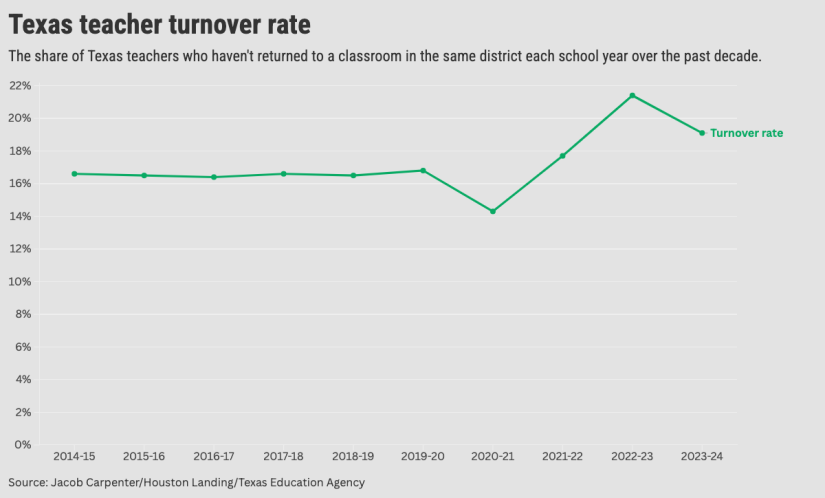
Teacher turnover, a measure of how many educators don’t return to teach in the same district each year, has ticked higher since the pandemic. While it once hovered near 16 percent, it’s reached roughly 20 percent over the past two years.
Ultimately, a 4 percentage point difference equates to about 15,000 more teachers who aren’t returning to a classroom in their district. However, state data shows teachers of all experience levels are leaving at similar rates.
Still stressed
Teachers might be sticking with their jobs, but that doesn’t mean they’re happy about it.
A 2024 poll of 1,100 Texas teachers by the Charles Butt Foundation, an Austin-based education advocacy nonprofit, found nearly four-fifths of educators surveyed had seriously considered quitting the profession in the past year. Pay, quality of campus leadership and a sense of feeling valued ranked among the biggest factors in whether teachers had considered quitting.
Texas education leaders also are worried about the state’s ability to retain teachers and hire tough-to-fill positions. A state panel convened by the Texas Education Agency examined the issues and made numerous recommendations in 2023, though few of its proposals have been put into action.
Ethical PD is a call to action for all involved in teacher professional development
Key questions that unleash powerful PLCs
GenAI and cultural competency: New priorities in teacher preparation
For more news on teacher PD, visit eSN’s Educational Leadership hub
Teachers are superheroes. Every day, they rise to the challenge, pouring their hearts into shaping the future. They stay late to grade papers, show up early to tutor struggling students, and spend their weekends planning lessons that inspire young minds. They do this because they believe in their mission–a mission to change lives, ignite passions, and build a better world.
More News from eSchool News
We are again in uncertain times. We again find ourselves dealing with sudden changes and uncertainty. We seem to be in a state of constant change and ambiguity.
In today’s evolving educational landscape, effective student assessment goes beyond multiple-choice tests and letter grades. According to a recent study, over 60 percent of educators believe traditional assessments fail to fully measure student understanding.
Holden, my 21-month-old, has fallen in love. His early morning snack and “couch time” includes a dose of “Tiger!” This is toddler for, “Mom, turn on Daniel Tiger’s Neighborhood.”
The COVID-19 pandemic left an indelible mark on K-12 education, placing immense pressure on teachers as they adapted, literally overnight, to new methods of instruction.
Spring brings not only showers and flowers, but it also brings the opportunity to interview for new education positions. Preparing for an interview involves several key steps that can significantly impact the outcome.
STEM careers are on the rise. According to the U.S. Bureau of Labor Statistics, employment in STEM occupations is expected to grow by 10.4 percent from 2023 to 2033, compared to just 3.6 percent for non-STEM occupations.
The U.S. Department of Education is giving state education agencies 10 days to certify that their schools do not engage in any practices that the administration believes illegally promote diversity, equity, and inclusion.
COVID had already killed thousands of people in other countries and was spreading in the United States when a top federal health official said schools should prepare to offer “internet-based teleschooling” in case they had to close for a period of time.
More than half of educators (62 percent) are already making use of AI at school, with more than one-quarter using it daily for work purposes, according to a Twinkl survey of more than 3,500 U.S. teachers.
Many math tasks involve reading, writing, speaking, and listening. These language demands can be particularly challenging for students whose primary language is not English.
In a 5-4 split, the U.S. Supreme Court on Friday granted the Trump administration’s emergency request to maintain a freeze on millions of dollars in federal teacher training grants.
The administration’s emergency application, filed on March 26, asked the justices to vacate a district court judge’s order requiring the U.S. Department of Education to reinstate some of Trump’s $600 million in slashed funding. The justices granted Acting Solicitor General Sarah Harris’ call for an immediate administrative stay, which pauses the March 10 order by Judge Myong Joun of the U.S. District Court for the District of Massachusetts while the case continues.
In an unsigned opinion, the Supreme Court majority wrote that the recipient programs wouldn’t suffer permanent damages if the funds were withheld while the case moves through the lower courts. The “respondents have not refuted the Government’s representation that it is unlikely to recover the grant funds once they are disbursed,” the opinion said.
The opinion also suggested the lower court may not have had the authority to issue its order.
In a dissenting opinion, Justice Ketanji Brown Jackson, joined by Justice Sonia Sotomayor, wrote that the notion that some grant recipients may seek to draw down funds that the Trump administration seeks to terminate was the “only hint of urgency that the Government offers to justify its unusual request for our intervention.”
“If true, that would be unfortunate, but worse things have happened,” Jackson wrote.
In a separate dissent, Justice Elena Kagan characterized the majority’s decision as a “mistake” that followed a “barebones briefing,” no argument and little time for reflection. Chief Justice John Roberts did not join either dissent but disagreed with the majority.
The move is the first time the Supreme Court has considered any challenges to President Donald Trump’s efforts to significantly scale back federal education programs — and ultimately dismantle the Education Department.
In the administration’s March 26 emergency request, Harris said the case is an example of a broader question the Supreme Court needs to answer: “‘Does a single district-court judge who likely lacks jurisdiction have the unchecked power to compel the Government of the United States to pay out (and probably lose forever)’ millions in taxpayer dollars?”
“Unless and until this Court addresses that question, federal district courts will continue exceeding their jurisdiction by ordering the Executive Branch to restore lawfully terminated grants across the government, keep paying for programs that the Executive Branch views as inconsistent with the interests of the United States, and send out the door taxpayer money that may never be clawed back,” Harris wrote.
The case in question concerns the Education Department’s February cancellation of over $600 million in what it called “divisive” federal teacher training grants funds. The canceled grants had been made under the Teacher Quality Partnership Program and the Supporting Effective Educator Development program.
In March, eight Democratic attorneys general sued the Trump administration to restore the awarded funds. In response, Joun granted a temporary restraining order for the department to reinstate those funds to the eight plaintiff states: California, Colorado, Illinois, Maryland, Massachusetts, New Jersey, New York and Wisconsin.
If the Supreme Court were to order the Trump administration to reinstate the grants to those eight states, the acting solicitor general said, the department would have to disburse up to $65 million in remaining funds.
On March 28, the eight states urged in a 44-page filing that the Supreme Court leave Joun’s order in place. The states said the Trump administration’s “real concern” appears to involve other cases “where courts are grappling with a raft of legal disputes arising out of recent actions by the Executive Branch.”
“Those concerns are properly litigated in the context of those other cases,” the states said. “They provide no basis for this Court to grant emergency relief here, where the district court appropriately granted a narrow and time-limited restraining order to preserve the status quo while it adjudicates the preliminary-injunction motion that was argued earlier today.”
Advocates for the teacher preparation programs have said the disruption to the grant programs is harming K-12 educator pipeline initiatives and will add to teacher shortages.
In the March 10 district court order, Joun said the department’s justification for terminating the grants — that they promote diversity, equity and inclusion initiatives among other reasons — “does not reach the level of a reasoned explanation; indeed it amounts to no explanation at all.”
The 1st U.S. Circuit Court of Appeals on March 21 denied the Trump administration’s motion for a stay while the government appealed Joun’s order.
This audio is auto-generated. Please let us know if you have feedback.
In a 5-4 split, the U.S. Supreme Court on Friday granted the Trump administration’s emergency request to maintain a freeze on millions of dollars in federal teacher training grants.
The administration’s emergency application, filed on March 26, asked the justices to vacate a district court judge’s order requiring the U.S. Department of Education to reinstate some of Trump’s $600 million in slashed funding. The justices granted Acting Solicitor General Sarah Harris’ call for an immediate administrative stay, which pauses the March 10 order by Judge Myong Joun of the U.S. District Court for the District of Massachusetts while the case continues.
In an unsigned opinion, the Supreme Court majority wrote that the recipient programs wouldn’t suffer permanent damages if the funds were withheld while the case moves through the lower courts. The “respondents have not refuted the Government’s representation that it is unlikely to recover the grant funds once they are disbursed,” the opinion said.
The opinion also suggested the lower court may not have had the authority to issue its order.
In a dissenting opinion, Justice Ketanji Brown Jackson, joined by Justice Sonia Sotomayor, wrote that the notion that some grant recipients may seek to draw down funds that the Trump administration seeks to terminate was the “only hint of urgency that the Government offers to justify its unusual request for our intervention.”
“If true, that would be unfortunate, but worse things have happened,” Jackson wrote.
In a separate dissent, Justice Elena Kagan characterized the majority’s decision as a “mistake” that followed a “barebones briefing,” no argument and little time for reflection. Chief Justice John Roberts did not join either dissent but disagreed with the majority.
The move is the first time the Supreme Court has considered any challenges to President Donald Trump’s efforts to significantly scale back federal education programs — and ultimately dismantle the Education Department.
In the administration’s March 26 emergency request, Harris said the case is an example of a broader question the Supreme Court needs to answer: “‘Does a single district-court judge who likely lacks jurisdiction have the unchecked power to compel the Government of the United States to pay out (and probably lose forever)’ millions in taxpayer dollars?”
“Unless and until this Court addresses that question, federal district courts will continue exceeding their jurisdiction by ordering the Executive Branch to restore lawfully terminated grants across the government, keep paying for programs that the Executive Branch views as inconsistent with the interests of the United States, and send out the door taxpayer money that may never be clawed back,” Harris wrote.
The case in question concerns the Education Department’s February cancellation of over $600 million in what it called “divisive” federal teacher training grants funds. The canceled grants had been made under the Teacher Quality Partnership Program and the Supporting Effective Educator Development program.
In March, eight Democratic attorneys general sued the Trump administration to restore the awarded funds. In response, Joun granted a temporary restraining order for the department to reinstate those funds to the eight plaintiff states: California, Colorado, Illinois, Maryland, Massachusetts, New Jersey, New York and Wisconsin.
If the Supreme Court were to order the Trump administration to reinstate the grants to those eight states, the acting solicitor general said, the department would have to disburse up to $65 million in remaining funds.
On March 28, the eight states urged in a 44-page filing that the Supreme Court leave Joun’s order in place. The states said the Trump administration’s “real concern” appears to involve other cases “where courts are grappling with a raft of legal disputes arising out of recent actions by the Executive Branch.”
“Those concerns are properly litigated in the context of those other cases,” the states said. “They provide no basis for this Court to grant emergency relief here, where the district court appropriately granted a narrow and time-limited restraining order to preserve the status quo while it adjudicates the preliminary-injunction motion that was argued earlier today.”
Advocates for the teacher preparation programs have said the disruption to the grant programs is harming K-12 educator pipeline initiatives and will add to teacher shortages.
In the March 10 district court order, Joun said the department’s justification for terminating the grants — that they promote diversity, equity and inclusion initiatives among other reasons — “does not reach the level of a reasoned explanation; indeed it amounts to no explanation at all.”
The 1st U.S. Circuit Court of Appeals on March 21 denied the Trump administration’s motion for a stay while the government appealed Joun’s order.
This audio is auto-generated. Please let us know if you have feedback.
Dive Brief:
A high school math teacher with post-traumatic stress disorder was entitled to a 15-minute break as a reasonable accommodation under the Americans with Disabilities Act even if she didn’t need one to perform her job’s essential functions, the 2nd U.S. Circuit Court of Appeals held March 25 in Tudor v. Whitehall Central School District.
The high school math teacher in New York sued her school district under the ADA for failing to accommodate her PTSD, according to court documents. She claimed the school district refused to guarantee her a 15-minute break every afternoon during the 2019-2020 school year. She said she used the breaks to compose herself away from the workplace, which tended to trigger her symptoms.
The teacher acknowledged that even without the breaks, she could perform her job’s essential functions, albeit “under great duress and harm.” On that basis, the district court found she had no failure-to-accommodate claim and granted summary judgment against her. The 2nd Circuit vacated the ruling and sent the case back for reconsideration.
Dive Insight:
Prohibited discrimination under the ADA includes, absent undue hardship to the employer, “not making reasonable accommodations to the known physical or mental limitations of an otherwise qualified individual with a disability,” the 2nd Circuit explained, quoting the statute.
In turn, the ADA defines a “qualified individual” as “an individual who, with or without reasonable accommodation, can perform the essential functions” of their job, the appeals court pointed out.
The district court, relying on this wording, incorrectly inferred that an employee who can perform the job’s essential functions without an accommodation does not, as a matter of law, have a claim for failure to accommodate, the panel said.
But “a straightforward reading of the ADA confirms that an employee may qualify for a reasonable accommodation even if she can perform the essential functions of her job” without an accommodation, the 2nd Circuit emphasized.
In other words, “accommodations that are not strictly necessary for an employee’s performance of essential functions may still be reasonable and therefore required by the ADA,” the court held.
The 2nd Circuit, which covers Connecticut, New York and Vermont, noted that most of the other federal circuit courts of appeal have made similar rulings.
Relevant to the teacher’s case, the ADA defines reasonable accommodation to include job restructuring or modifying an employee’s schedule, the 2nd Circuit said. A modified schedule may involve adjusting arrival or departure times or providing periodic breaks, according to a U.S. Equal Employment Opportunity Commission guidance.
For instance, the EEOC announced last week that a construction supply company agreed to pay $150,000 to settle allegations it failed to provide a diabetic worker with requested snack breaks throughout the day to regulate his blood sugar.
Reasonable accommodations also include allowing an employee to use accrued paid leave and providing unpaid leave, the EEOC guidance states.
However, the “reasonableness” of a requested accommodation is a fact-specific question, the 2nd Circuit explained.
On remand, the school district might demonstrate that the teacher’s request for a break while assigned to afternoon study hall was unreasonable and imposed an undue hardship, the court pointed out.
At the same time, the teacher’s long history of receiving her requested accommodation and the school district’s evolving policies indicated that her request may have been reasonable, notwithstanding that she performed her essential functions without it, the 2nd Circuit noted.
Court documents reflected that in 2008, the teacher sought and received permission to take one 15-minute break during each of her morning and afternoon “prep periods,” when she wasn’t responsible for overseeing students.
In 2016, the school district indicated she needed to submit additional documentation to support her request. Rather than doing so, the teacher took paid sick leave and then leave under the Family and Medical Leave Act, according to court records.
When she returned from FMLA leave in 2017, and throughout the 2018-2019 school year, she was allowed to take a morning and afternoon break when a school librarian could watch the students.
At issue here were the afternoon breaks the following year that she wasn’t guaranteed (but took anyway) when the librarian or another employee wasn’t to cover for her, court records reflected.
Specifically, the Education Department is enjoined from ending any grants provided through the three congressionally appropriated programs — the Supporting Effective Educator Development Grant Program, the Teacher Quality Partnership Program, and the Teacher and School Leader Incentive Program, according to the ruling from Judge Julie Rubin of the U.S. District Court for the District of Maryland.
In addition to the injunction, the three plaintiffs — teacher preparation groups that sued the Education Department for making cuts to over 70 of these federal grant programs in February — must have their grant awards reinstated within five business days of the March 17 order.
Rubin wrote that the cuts to the teacher training grant programs are “likely unlawful” under the Administrative Procedure Act.
The plaintiffs in the case are the American Association of Colleges for Teacher Education, National Center for Teacher Residencies, and Maryland Association of Colleges for Teacher Education.
The order means that grantees affiliated with the plaintiff organizations can soon “draw down funds without any restrictions,” AACTE said in a Monday statement.
“We are thrilled that the court has ruled in favor of preserving funding for TQP, SEED, and TSL grants, which have a transformative impact on our nation’s education system,” said AACTE President and CEO Cheryl Holcomb-McCoy.
“I commend the unwavering dedication that led to this decision and remain hopeful that institutions, nonprofits, and partners across America can continue to strengthen our educator workforce, and address critical shortages while ensuring that every child in our nation has access to exceptional educators and a high-quality educational experience.”
Last week, eight attorneys general had an initial victory in the U.S. District Court for the District of Massachusetts with a similar lawsuit over the Education Department’s cuts to millions of dollars in teacher training grants. That lawsuit only mentioned the SEED and TQP grants.
When announcing the cuts on Feb. 17, the Education Department said the $600 million in withdrawn funds had been allocated to “divisive” teacher training grants. The department did not initially name the specific grants it slashed, but it later confirmed to K-12 Dive that the cuts included SEED and TQP.
A federal judge in Maryland this week ordered the U.S. Department of Education to reinstate numerous grants that support teacher-preparation programs.
The department canceled the $600 million in grants last month as part of a wider effort to slash federal funding and eliminate programs that promote diversity, equity and inclusion. In response, the American Association of Colleges for Teacher Education, the National Center for Teacher Residencies and the Maryland Association of Colleges for Teacher Education challenged the cuts, arguing in a lawsuit that the grant terminations were illegal.
On Monday, U.S District Judge Julie Rubin ordered the department to restore funding for the Supporting Effective Educator Development program, the Teacher Quality Partnership program and the Teacher and School Leader incentive program within five business days. That order comes after a federal judge last week directed the department to reinstate canceled grants in eight states.
“We are thrilled that the court has ruled in favor of preserving funding for TQP, SEED, and TSL grants, which have a transformative impact on our nation’s education system,” AACTE president and CEO Cheryl Holcomb-McCoy said in a news release.
The order also blocks the department from terminating any other TQP, SEED or TSL grant awards “in a manner this court has determined is likely unlawful as violative of the Administrative Procedure Act,” which instructs courts to “hold unlawful and set aside final agency actions” deemed “arbitrary, capricious, an abuse of discretion, or otherwise not in accordance with law.”
The judge asked both the department and the plaintiffs to file a status report within seven business days showing compliance with the order.
This audio is auto-generated. Please let us know if you have feedback.
Dive Brief:
Democratic attorneys generals in eight states said the U.S. Department of Education “arbitrarily” and “improperly” terminated about $600 million in teacher training grants, according to a lawsuit filed Thursday in U.S. District Court in the District of Massachusetts
The complaint said the abrupt cancellation of the grants will “immediately disrupt teacher workforce pipelines, increase reliance on underqualified educators, and destabilize local school systems.” The lawsuit seeks preliminary and permanent injunctions to restore funding and access to these programs.
The suit is the second filed against the grants termination — the first one came three days earlier from three teacher preparation groups — and adds to mounting legal pushback to the Trump administration’s efforts to scrub programs associated with diversity, equity and inclusion initiatives.
Examples the agency provided in its Feb. 17 announcement included professional development workshops on dismantling racial bias and activities that required educators to take personal and institutional responsibility for systemic inequities.
Supporters of DEI rollbacks in education view the activities as illegal discrimination and wasteful spending of federal funds.
But those opposing the grant eliminations say the programs help address a severe lack of teachers and support students in underserved areas.
“Kids in rural and underserved communities deserve access to a quality education, and programs like SEED and TQP help bring qualified teachers to classrooms that desperately need it,” said New York Attorney General Letitia James, in a March 6 statement. “Slashing funding for these critical programs robs students of the opportunity to succeed and thrive.”
In New York, James said the cancellation of TQP programs at SUNY Buffalo, Buffalo Public Schools, Buffalo Academy of Science Charter, and REACH Academy Charter School alone would impact more than 120 teachers and about 13,000 students. Also affected by the elimination of SEED programs are 100 teachers and some 6,000 pre-K-12 students at SUNY Buffalo, Buffalo Public Schools, Amherst Central School District, and Kenmore Tonawanda Union-Free School District.
Joining James in the lawsuit were attorneys general from seven other states: California, Massachusetts, New Jersey, Colorado, Illinois, Maryland and Wisconsin.
Just days earlier, on March 3, the American Association of Colleges for Teacher Education, National Center for Teacher Residencies and Maryland Association of Colleges for Teacher Education also sued to overturn the program cuts. That challenge, filed in U.S. District Court for the District of Maryland, said the Education Department “failed to follow statute and Federal regulations in terminating the grants.”
Additionally, more than 100 national and state education organizations sent a letter to congressional leaders last week urging them to reverse the cancellations of SEED, TQP and the Teacher and School Leader Incentive Program grants.
Technology is an essential aspect of teaching and learning, and the integration of technology into early childhood education classrooms is reshaping childcare. And while many of today’s early childhood teachers are comfortable with technology, many are nervous to learn something new or do things differently.
That’s where teacher training can help. Let’s take a look at why your childcare center’s teachers must be trained to take advantage of education technology!
These parents expect real-time updates about what their child is doing in your daycare. Your teachers must be trained to send photos, videos, and notes throughout the day to keep families happy. Choose an app with family engagement capabilities that is easy to use and part of an all-in-one childcare software solution. Then sharing updates won’t require much training so your teachers can spend their time learning about other ways to use technology.
Plus, this transparency creates a supportive learning environment!
Access to a wealth of resources
If your teachers are not trained to use education technology, they will miss out on access to educational content from around the world and children will not reap the benefits either.
A study by the American Academy of Pediatrics found there is “emerging evidence to suggest that interactive apps may be useful and accessible tools for supporting early academic development.” Your teachers must be trained to take advantage of these apps, while understanding that screen time must be limited.
Online libraries, databases, and educational websites provide information on virtually any topic, allowing teachers to supplement their curriculum with up-to-date materials. This accessibility ensures that both teachers and young learners can expand their knowledge beyond traditional textbooks.
Education technology saves time
The 2024 Child Care Management Software Industry Trends Report from Procare Solutions found that about 30% of survey respondents said each teacher spends between three and five hours a week doing lesson planning, and a similar percentage noted their centers create their own curriculum.
So, beyond direct instruction, technology can significantly reduce the time teachers spend on these types of tasks, and on assessments and other paperwork. Childcare management software can streamline time-intensive processes, giving teachers more time to focus on what truly matters — the children in their care.
A strong digital curriculum that’s easy to use supports your teachers by handling lesson planning that takes time away from children. When childcare centers equip teachers with state-of-the-art online curriculum at their fingertips, teachers and young learners reap the benefits of education technology.
How to encourage your teachers to embrace education technology
To maximize the benefits of technology, ongoing professional development is essential. Employee retention rates rise by 30-50% when companies prioritize staff learning!
Workshops, webinars and websites that offer professional development and credentials can help teachers stay abreast of the latest technological advancements.
By investing in continuous training, your childcare center can ensure that teachers are confident and competent in integrating technology into their classrooms.
Halloween 2024 is a holiday that won’t be soon forgotten by Bernalillo High School teacher Lorilei Chavez. You see, October 31 was the day she was honored as the first Indigenous teacher named New Mexico Teacher of the Year.
Sixth period was going as usual for Lorilei and her social studies class. The group was in the middle of a lesson when BHS principal, Alyssa Sanchez-Padilla, and her secretary came to the door with an urgent request: Bring your students to the school’s black box theater to bump up attendance for a guest speaker.
“And so, you know, as a teacher, I’m like, ‘Oh no, we’re in the middle of a lesson,’” she related. “You know, I don’t want to lose valuable teaching time. But if the principal is asking you to take your students somewhere, you know, you get going.”
As she walked with her students to the theater and the seventh-period bell rang, her principal asked to detour to sign some tutoring paperwork. While walking, Chavez noticed a few extra student resource officers.
“Like I was getting kind of like an inclination that something was going on, you know?” she said, noting she was dressed in 1980s style for Halloween, with a side ponytail and an off-the-shoulder shirt.
Still thinking there was a guest speaker, Lorelei came to the theater and saw the “shimmer of cheerleading pompoms” and a huge cheer erupted as she entered the room. Assuming the cheer was for the “guest,” she got a bit spooked and started to back out of the room, she said.
“My principal was behind me and she just put her hands on my shoulders and softly nudged me forward,” she recalled. “I saw my mom and rushed over to her. Then she points up at the ceiling and there was this huge banner that says ‘Lorelei Chavez, Teacher of the Year.’”
“And that’s when it all just hit and took me over. And then it went from joy, like surprise to joy to like pure happy tears,” she said.
“It’s a life moment I’ll never forget.”
From Bernalillo and back
Lorilei describes herself as a “very proud product of Bernalillo Public Schools.” Beginning with kindergarten near home on the Kewa Pueblo (Santo Domingo Pueblo), she spent all but one year of her young life in the BPS system, beginning with Santo Domingo School and ending with graduation from Bernalillo High in 2008.
“It’s funny because I remember being in high school thinking, ‘Oh, I want to go as far as I can. Like, I want to go to school in California. I want to go to college in Washington, D.C. And I don’t want to come back to Bernalillo,’” she recalled with a chuckle. “And then six years later, I ended up (substitute teaching) while going to college. I’ve been there ever since.”
Beginning her college career at Central New Mexico Community College, Lorilei got her basics taken care of before transferring to the University of New Mexico. She graduated in 2018 with a degree in Native American Studies and a minor in History. Though she started as an education major and shifted away, her experiences as a substitute convinced her to go through CNM’s Alternative Licensure program, which she finished in 2020.
“When I started subbing as I was going to (UNM), I realized that I had a really deep ability to connect with students on a level that maybe some of my colleagues weren’t able to,” she said. “Because our district is 48% Indigenous, a lot of the students that I worked with didn’t really have Indigenous teachers or teacher aides or even substitutes that looked like them.”
Since the Bernalillo school system works with seven different tribes, Lorilei said she feels it’s important that Native students have Indigenous role models in the school setting. She used simple examples, like seeing her dressed in Native regalia or “big Native earrings” and beaded medallions to honor Native heritage.
“I think that’s what allowed me to see that I would be a good educator,” she said. “I would have an impact on students if I did a shift and got my teacher certification.
“And so that I think is my main drive even to today, is my ability to connect with students, uplift them, hear their voices, allow them to feel seen in the classroom, which I think creates the motivation to continue their goals and succeed in whatever they’re trying to accomplish.”
Serving her community
Lorilei said being named the first Indigenous teacher to win the statewide Teacher of the Year award was obviously an honor. But because “a core value of Pueblo people is the idea of service,” she said she feels that she is representing more than herself in accepting the award.
“As I serve my community, I wake up every day knowing that I’m going to serve my students, my future generations as I represent Santo Domingo Pueblo,” she said. “I wake up every day thinking, ‘What impact am I going to make on my community and what impact am I able to make today on the future generation?’ So, winning an award like this has been really hard for me to accept and value the honor. Because I feel it doesn’t just belong to me. It comes from a community of educators that has raised me and taught me.”
With her Native American Studies background, she said she strives to balance Indigenous culture and Western education in a school setting.
“The people, the past EAs, the language teachers, the teachers who’ve taught me that have poured into my education, I think is what brought me to today,” Lorilei said. “With this title and this beautiful award, I’m able to bring home not only Santo Domingo but to the Bernalillo Public Schools. I think the pressure of being the first Indigenous Teacher of the Year is making sure I’m honoring not only my school but my students and the community that I come from.”
‘Indigenizing’ the Education System
Lorilei said that as Teacher of the Year, she will emphasize “Indigenizing” education in New Mexico, as well as supporting teachers’ mental health. The desire to bring more Native experiences, stories, and perspectives into public education is something that grew from her time in the UNM Native Studies program.
“Going to (UNM’s) Native American studies program as a college student really opened my mind to this understanding of needing to know your culture, your history, the laws and the narrative that existed in Native community,” she said. “Things that weren’t necessarily told in the history books that I studied or in the papers that I wrote. Things not in the curriculum that I was offered as a public school student.”
“So graduating from UNM NAS instilled this understanding that going back into the public schools that I work at… I had no choice but an obligation to encourage our district and hold our district accountable when adopting curriculums and encouraging Native history in the core curriculum,” she concluded.
Lorilei said she and her fellow educators in the Bernalillo Public Schools “are blessed” to have a district leadership that understands the equity and value of bringing in Native languages and history as a core content.
She also said she feels very fortunate for the opportunity to work in a district that allows her the opportunity to build a curriculum that includes Indigenous history – subjects like the Pueblo Revolt, boarding schools, Native removal, sovereignty and decolonization, in a “school building that was not necessarily built for Indigenous education but built for Western education.”
“As the first Indigenous teacher of the year, I feel like that also is my obligation and duty, is to work to continue to advocate, to educate, so that we can uplift Native narrative, history, stories in curriculum,” she said. “Not just in high student of color populations, but in districts across the state.
“It is a passion of mine to Indigenize education and bring Indigenous perspective in Western curriculum. And so that’s something that I’m going to really push toward and be passionate about and continue to advocate for moving forward,” she related.
Prioritizing balance for teachers
Lorilei also said she is “super passionate” about state leadership and school districts starting a movement around prioritizing teacher mental health. She said she plans to “really pour some energy in as Teacher of the Year.” As a teacher working at the high school level, she said implementing teaching materials and testing guides, and “doing all the things that I need to do as a teacher to be the best teacher” leaves her drained at times.
“Balancing all of that with my life and my culture and everything that I am as a human being, an auntie, a sister, a cousin, is very difficult,” she said. “I really think as a state and as a nation, we really need to take a deeper look into how we are healing our teachers. How are we showing up for them in capacities that include mental wellness? And that includes body health and that includes spiritual strength in whatever capacity that they connect to.”
She concluded: “My goal and my hope is to really work with school districts, including mine, to have wellness days, wellness fairs, professional development days where teachers are paid to take time to take care of their mental health… because we’re so spread thin from the many, many things we have to do as educators.
“I’d really like to see us looking at an innovative way to address teacher wellness in ways that maybe the state and the nation haven’t before.”
The New Mexico Teacher of the Year program is sponsored by The New Mexico Oil and Gas Association. The award of $ 10,000 will go to Lorilei to help with professional development opportunities and support her travel needs.