Tag: Teachers

  • How Oklahoma’s Superintendent Set Off a Holy War in Classrooms

    How Oklahoma’s Superintendent Set Off a Holy War in Classrooms

    NORMAN, Okla. — Sometimes, Jakob Topper teaches his Christian faith to his 6-year-old daughter using children’s Bible stories illustrated with teddy bears. Other days, he might use her kid-friendly Bible featuring Precious Moments figures as characters. One thing he knows for sure: The King James version is not on the reading list, given some of its adult themes of sexual assault and incest. 

    As a parent and a Baptist pastor, Topper opposes Oklahoma’s state superintendent of public instruction’s mandate to put a King James Version Bible in every grade 5–12 classroom. The father of three is also not keen on the state’s newly proposed social studies standards that would require biblical lessons starting in first grade. 

    “I want the Bible taught to my daughter, and I want to be the one who chooses how that’s done,” said Topper, who also has a 1-year-old and a 3-year-old and is pastor of NorthHaven Church in Norman, a university town. “If we’re talking about parental choice, that’s my choice. I don’t want it to be farmed out to anyone else.”

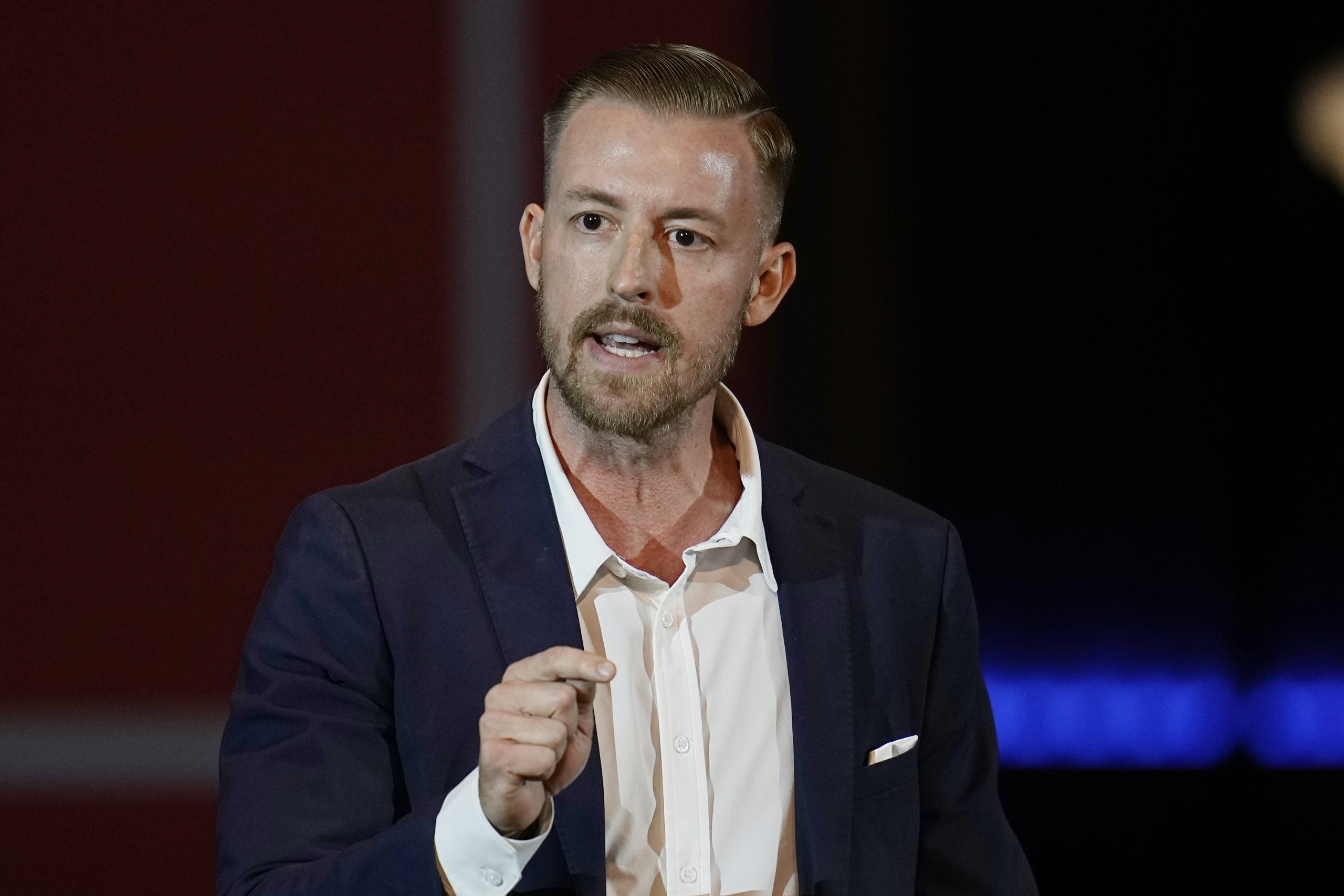
    Norman, a central Oklahoman city of about 130,000, is an epicenter of resistance to the Bible mandate that the state superintendent of public instruction, Ryan Walters, announced last June. Opposition here has come from pastors, religion professors, students, parents, teachers, school board members and the school district superintendent, among others. The prevailing philosophy among Norman residents, who are predominantly Christian, is that they do not want the state — and namely, Walters — mandating how children should be taught scriptures. They want their children to learn from holy books at home or in church. 

    Pastor Jakob Topper, of NorthHaven Church, says he prefers to teach his children about the Bible rather than placing that responsibility on teachers. Credit: Mike Simmons for The Hechinger Report

    Many residents see Walters’s pitch as a play for national attention, given his abundance of social media posts praising Donald Trump, who campaigned on returning prayer to schools and as president has established a White House Faith Office and a task force to root out “anti-Christian bias.” In September, Walters proposed spending $3 million to buy 55,000 copies of the Bible that has been endorsed by the president and for which he receives royalties. More recently, Walters — who in February clashed with his state’s governor for proposing that public schools track students’ immigration statuses — made media lists as a possible candidate for Trump’s education secretary. He was not picked. 

    But beyond Walter’s national aspirations, the Bible mandate also seems like an attempt at one-upmanship, with other states angling to infuse Christianity into public schools. Louisiana, for instance, is in a court battle over its push for Ten Commandments posters in schools. Texas fought off Democratic opposition to approve an optional Bible-infused curriculum and financial incentives for school districts that use the materials. A slew of states have passed or promoted similar measures, including ones allowing chaplains to act as counselors in schools. Unsurprisingly, Walters, too, has advocated for displaying the Ten Commandments in every classroom and also has backed the conversion of a private virtual Catholic school into a charter school; the Supreme Court plans to hear oral arguments on the case on April 30.  

    It goes without saying that Walters’s crusade is multifaceted. But fundamentally, all of his efforts amount to teaching the Bible “in inappropriate ways in public schools,” said Amanda Tyler, author of “How to End Christian Nationalism” and executive director of the Baptist Joint Committee for Religious Liberty, a Washington, DC–based organization of attorneys, ministers, and others who advocate for religious freedom. “He’s saying you can’t be a good American citizen if you don’t understand the Bible,” she added. “It’s this merger of American and Christian identities, the idea that only Christians are true Americans.” 

    On March 10, the Oklahoma Supreme Court dealt a blow to Walters’s plans: It issued a temporary stay prohibiting the state’s department of education from purchasing 55,000 Bibles with certain characteristics and from buying Bible-infused lessons and material for elementary schools. 

    The stay stems from a lawsuit led by Americans United for Separation of Church and State on behalf of 32 plaintiffs, including parents, clergy, students and teachers. The group, which is suing Walters, claims the Bible mandate violated the state’s prohibition against using state funds for religious purposes and the state’s own statutes allowing local district control over curriculum.

    As of now, until the court issues a final ruling, its decision marks a victory in Americans United’s attempt to stop Walters, said Alex Luchenitser, the organization’s associate legal director: “It protects the separation of church and state. It protects the religious freedom of students.” Speaking about the court’s stay, Walters, through spokeswoman Grace Kim, said in a statement: “The Bible has been a cornerstone of our nation’s history and education for generations. We will continue fighting to ensure students have access to this foundational text in the classroom.”

    Oklahoma Supreme Court, pictured in the state Capitol building, in March issued a stay that would prohibit the state education department from purchasing Bibles and Bible-infused lessons for elementary students. Credit: Sue Ogrocki/ Associated Press

    Meanwhile, Walters was also sued separately last summer by a parent in Locust Grove who contended the mandate violated the state and federal constitutions. The state education department has denied the claims of both suits and contended in legal briefs that using the Bible for its secular value does not violate the state’s constitution.

    Walters’s mandate has also sparked concern because of the proposed social studies standards that followed. The standards, which were initially released in December and would require legislative approval, mention the Bible and its historical impact more than 40 times. Several of the standards attempt to erroneously frame the Bible, and specifically the Ten Commandments, as the foundation of American law. Biblical scholars from the University of Oklahoma and elsewhere believe these standards promote the long-standing trope of Christian nationalism, which is premised in part on the false idea that the nation’s founding documents stemmed from the Bible. (The founders were Bible readers, but not necessarily fans of the same versions or holy texts in general. In fact, Thomas Jefferson cut up pages of the Bible to remove mention of miracles or the supernatural.)

    For example, Walters’s standards would require students in first grade to learn about David and Goliath, as well as Moses and the Ten Commandments, because the standards cite them as influences on the American colonists and others. Second graders would be asked to “identify stories from Christianity that influenced the American colonists, Founders, and culture, including the teachings of Jesus the Nazareth (e.g. the ‘Golden Rule,’ the Sermon on the Mount).” 

    Related: Inside the Christian legal campaign to return prayer to public schools

    “These new standards,” said a news release from the state department of education, “reflect what the people of Oklahoma — and all across America — have long been demanding of their public schools: a return to education curricula that upholds pro-family, pro-American values.” (Walters’s press office, despite repeated requests, did not make the state superintendent available for an interview.)

    Critics in Oklahoma and elsewhere see Walters’s Bible mandate as part of a broader Christian nationalist movement. “I think Oklahoma is the test case for the nation,” said Dawn Brockman, a Norman school board member.

    Walters, though, has been steadfast in his belief that the mandate is legal and critical for the education of Oklahomans. In the fall, after Americans United sued, Walters wrote on X: “The simple fact is that understanding how the Bible has impacted our nation, in its proper historical and literary context, was the norm in America until the 1960s and its removal has coincided with a precipitous decline in American schools.”

    But nothing is simple about the history of the Bible in America’s schools. When public schools started to open in the 1800s, some required regular Bible readings. From the beginning, that practice was controversial: Schools typically favored the King James Version, pitting Protestants against Catholics, and riots over school Bible readings broke out from the 1840s into the 1870s, said Mark Chancey, a professor of religious studies at Southern Methodist University in Dallas. By 1930, 36 states allowed Bible reading to be a requirement or an option, but another dozen banned such activities.

    A few decades later, a Pennsylvania family sued their school district for heeding the state’s 1949 law requiring the reading of 10 Bible verses and the recitation of prayers at the start of each school day. In 1963, just a year after a similar opinion, the Supreme Court ruled that requiring in-school Bible readings and prayers was unconstitutional. After those rulings, daily teaching from the Bible, for the most part, was halted, Chancey said, but backlash continued, with critics charging that removing prayer and Bible readings from schools had led to a decline in the morality of schoolchildren. 

    Related: Teachers struggle to teach the Holocaust without running afoul of new ‘divisive concepts’ laws

    In subsequent decades, the Supreme Court ruled against clergy-led prayer and prayer over the loudspeakers at football games in several school-related cases. But in a seeming reversal, in 2022, the high court ruled in favor of allowing a football coach to conduct midfield, postgame prayers, shifting the legal landscape. The majority’s opinion on the football coach’s prayer has prompted politicians and states to further test the limits of the separation of church and state. In February, lawmakers in Idaho and Texas even proposed measures to allow daily Bible readings in public schools again. 
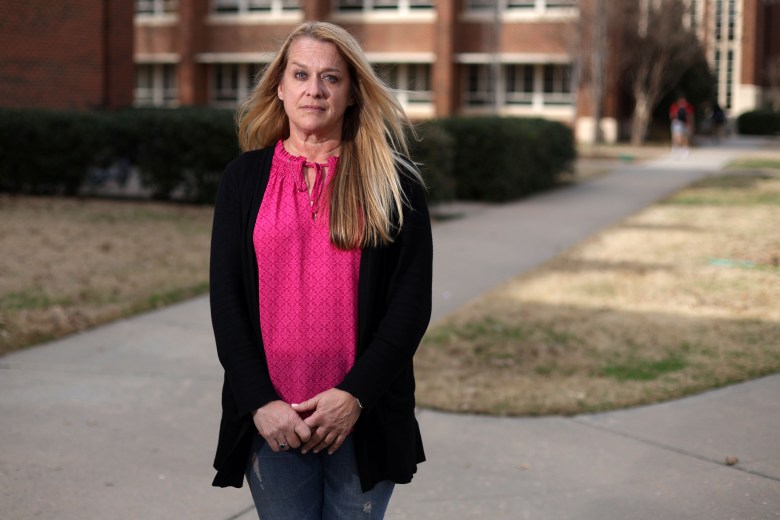
    Darcy Pippins, who teaches Spanish at Norman High School, said she doesn’t feel qualified to teach about the Bible. Credit: Mike Simmons for The Hechinger Report

    In Norman, many teachers reacted to news of the Bible mandate with concern and fear. Spanish teacher Darcy Pippins, who is in her 27th year at Norman High, said she sometimes teaches about Catholicism because it is the religion of the Spanish-speaking world. But putting a Bible in every classroom and teaching from it is different. “I just don’t feel comfortable,” said Pippins, also a parent. “I’m not qualified to teach and to incorporate the Bible into what I teach.’’ 

    Other teachers, said Brockman, the school board member, worried about professional repercussions were they not to follow the mandate, given that Walters had already targeted at least one Norman teacher in the past for objecting to bans on particular books. 

    Nick Migliorino, the public school system’s superintendent since 2017, was the first superintendent in the state to publicly oppose the Bible mandate. When asked about it in a July interview with a local paper, he responded: “I’m just going to cut to the chase on that. Norman Public Schools is not going to have Bibles in our classrooms, and we are not going to require our teachers to teach from the Bible.”

    Other superintendents followed, and by late July, at least 17 school district leaders said they had no plans to change curriculum in response to the Bible mandate, according to a report by StateImpact Oklahoma.

    In an interview at his district’s headquarters, Migliorino emphasized that his school system already teaches how different religions affect history. Bibles, he noted, are accessible to students through the library. Migliorino added that the state superintendent had no authority to make school districts follow the mandate and that it would result in pushing Christianity on students. 

    “It’s a captive audience, and that is not our role to push things onto kids,” he said. “Our role is to educate them and to create thinkers.”

    Oklahoma already has a 2010 measure allowing school districts to offer elective Bible classes and to give students the latitude to pick the biblical text they prefer to use. But unlike Walters’s mandate, it allows for different biblical perspectives, said Alan Levenson, chair of Judaic history at the University of Oklahoma and a biblical scholar. Even still, there has never been widespread interest in a Bible elective in Norman, said Jane Purcell, the school system’s social studies coordinator. Nor was there much interest in such a class when she taught in Florida. Since 2006, at least a dozen states have passed laws promoting elective Bible classes.

    This may be, in part, because educators worry about potential issues with teaching Bible courses, said Purcell: “It’s very easy for it to appear to be proselytizing.”

    Related: How one district has diversified its advanced math classes — without the controversy

    Walters, for his part, has not taken any of this pushback in stride. At a July 31 state board of education meeting, he lashed out against “rogue administrators” who opposed him, saying of the left: “They might be offended by it, but they cannot rewrite our history and lie to our kids.”

    After the public schools superintendent publicly rejected Walters’s mandate, community members and teachers in Norman expressed relief. Meg Moulton, a realtor and mother of three, came to a July board meeting to thank the superintendent in person. “I’m a Christian mama,” she said. “I love teaching my kids about God. I love going to church.” 

    But, she added, “Ryan Walters’s mandate makes it so that teachers and students who may not be Christians…[or] who may believe something different, are going to be essentially forced to learn something that they may not believe in.” 

    Students and others I met with at a popular Norman coffee shop said they were concerned about how Walters’s mandate could affect religious minorities, women, and members of the LGBTQ+ community. “What Ryan Walters is trying to push goes in line with a lot of trends of kind of pushing back against LGBTQ,” said Isandro Moreno, a 17-year-old senior at Norman High. 

    Phoebe Risch, a 17-year-old senior at Norman North, the town’s other public high school, said Walters’s mandate was part of what motivated her to restart her high school’s Young Democrats club and recruit roughly 30 members. Risch, already upset about her state’s readiness to ban abortion following the Supreme Court’s overturn of Roe v. Wade, fears that requiring Bible-based instruction could lead to the promotion of the idea that women are submissive. “As a young woman, the implications of implementing religion into our schools is a little scary,” she said, “especially because Oklahoma is already a very conservative state.”

    Among the half dozen teens attending a confirmation class in December at Oklahoma City Reform temple B’nai Israel, most opposed the mandate, except for one. She said she supported it as long as the classroom teacher was careful and encouraged critical thinking. 

    One teen recounted tearily how, during class the previous week, a friend had drawn a swastika on her paper as a taunt. “Stuff like that is so normalized,” she said. “It’s antisemitism. If that’s so normalized, normalizing Christianity further, it’s just worse.”

    Imad Enchassi, an imam who oversees an Oklahoma City mosque and also chairs the Islamic Studies department at Oklahoma City University, said he worries that Superintendent Ryan Walter’s policies will further isolate Muslim children. Credit: Mike Simmons for The Hechinger Report

    Imad Enchassi, an imam who oversees an Oklahoma City mosque and serves as chair of Islamic studies at Oklahoma City University, echoed similar fears for the Muslim community. “We’re already experiencing Islamophobia. Muslim kids who wear the headscarf already have been told they’re going to hell because they don’t believe in the Bible or they don’t believe in Jesus,” he said. “When curriculum mandates one religion over the other, that will further isolate our children.”

    Some Oklahomans, though, do support the mandate. And at one of the state board of education meetings where Walters touted it, three residents expressed support for the idea — during public comment — as did at least one board member. That board member said he thought biblical literacy was important, while other supporters see the Bible mandate as a way to instill morality in the public schools. Ann Jayne, a 62-year-old resident of Edmond, about 15 miles north of Oklahoma City, makes a point of letting Walters know on his Facebook page that she’s praying for him, because she believes public schools need to instill Christian values. “I think we need church in the state,” she said. “I don’t see a problem with God being back in the school. Nobody is forcing them to become a Christian.”

    Since last summer, Walters’s efforts to push Christianity have only become bolder. In mid-November, he announced the opening of the Office of Religious Liberty and Patriotism, which would, among other things, investigate alleged abuses against religious freedom and patriotic displays. Two days later, he announced that he was sending 500 Bibles to Advanced Placement government classes. He also emailed superintendents around the state with the order to show their students a one-minute-and-24-second video announcing the religious liberty office and praying for newly elected President Trump.

    At a Christmas parade in Norman in early December, some residents called the video embarrassing, with many superintendents, including Norman’s, having declined to show it. However, while many residents seem to abhor the Bible mandate, they do not agree on how religion should be handled in public life. Despite some religious diversity and some liberal leanings common in a university town, Norman skews religiously conservative. That dichotomy means many residents see the Bible as so sacrosanct that they don’t want it taught in schools, yet they see no problem with other Christian-oriented school activities.

    In some cases, residents like school board member Brockman, who is also a former teacher and lawyer with training on the First Amendment, have objected to school promotion of the religious aspects of Christmas. When she was a teacher at one of Norman’s two high schools, she asked to stop the playing of overtly religious Christmas songs in the halls during passing periods. She saw it as a “gentle reminder that the Supreme Court says we need to remain neutral on religion.” Her wish was granted. “They took it down with some consternation and played the Grinch in my honor.”

    Related: Teaching global warming in a charged political climate

    Residents have also quibbled over what to call the parade featuring Santa each December. Should it be called the Norman holiday or Christmas parade? It’s now known as the Norman Christmas Holiday Parade. In early December, the city’s mix of liberal and conservative influences shone through the glitz during the parade. The Knights of Columbus float had a sign that said “Merry CHRISTmas.” Norman’s Pride organization participated, with its human angels wearing wings lit up in rainbow colors.

    Tracey Langford, watching the parade from the back of her SUV, was dressed in a red stocking cap and a red sweatshirt that read “Santa, define good,” a jab at the fact that she is a lawyer who cares about legal definitions. To her, the Bible mandate is a clear violation of separation of church and state.“Every home here has a Bible…. We don’t need to spend a dollar to get a Bible in every classroom,” said Langford, a lawyer at the University of Oklahoma and a parent of a first grader in Norman schools and a 15-year-old in a private school. 

    Traci Jones, a parent of both a Norman sixth grader and fifth grader, likewise asked, “Who’s supposed to be teaching these kids the Bible? Is it just a random person? What if it’s an atheist or someone who has totally different beliefs than me?” As a nondenominational Christian, she added, “I think it’s wack to ask these poor teachers to teach that.”

    What happens next may ultimately be decided in a courtroom. There is no sign yet when final opinions may be issued in either lawsuit.

    State lawmakers at recent appropriation hearings said they were worried about the directive’s constitutionality, and in fact, in March, the Senate Appropriations’ Education Subcommittee  said it did not consider Walters’s $3 million request to purchase Bibles. The next day Walters announced he was launching a national campaign with a country singer to get Bibles donated to Oklahoma schools. (The legislature gets the final word on the Bible purchases, a line item in the education budget, and the standards, which the state board of education approved in late February.) Meanwhile, the fate of religion’s place in public schools on a national level likely will rest with the Supreme Court, with various lawsuits against state measures promoting Christianity making their way through the court system.  

    A Ten Commandments monument that sat on Oklahoma State Capitol grounds until the state Supreme Court ruled its presence violated the separation of church and state. It now is at the headquarters of a conservative lobbying group. Credit: Linda K. Wertheimer for The Hechinger Report

    In Norman, Jakob Topper, Kyle Tubbs and other Baptist pastors I met with at the headquarters of a statewide Baptist church organization were increasingly aghast at Walters’s mixing of religion and politics. Rick Anthony, pastor of Grace Fellowship, a Baptist church, centered his November 17 sermon on such concerns. “Almost comically, we’ve heard this week about a video made that was ordered to be shown to all children in the public schools and then sent to their parents,” he said. “Our question is…where are our voices as our political leaders cozy up to faith leaders, all the while destroying our faith institutions?” 

    Kaily Tubbs, Tubbs’s wife and a fifth grade teacher in Norman schools, said the mandate conflicts with her personal belief on how faith should be handled in schools. She spoke also as a mother of a kindergartener and a third grader, both in Norman schools. “Our faith is really important to us,” she said. “I don’t want it to be used as a prop in a classroom.”

    Topper said that at his church, the majority of his congregation believes in separation of church and state. He said he is aware of the religious diversity that exists in his town, too, and has both Muslim and Jewish neighbors. Like Anthony, he spoke with his congregation about Walters’s mandate, though in an informal weeknight meeting at his church, rather than as part of a formal sermon. “I wish,” he said, “that Jesus was left out of schools and left for the religious realm.”

    Contact editor Caroline Preston at 212-870-8965, via Signal at CarolineP.83 or on email at [email protected].

    This story about Bibles in schools was produced by The Hechinger Report, a nonprofit, independent news organization focused on inequality and innovation in education. Sign up for the Hechinger newsletter.


    The Hechinger Report provides in-depth, fact-based, unbiased reporting on education that is free to all readers. But that doesn’t mean it’s free to produce. Our work keeps educators and the public informed about pressing issues at schools and on campuses throughout the country. We tell the whole story, even when the details are inconvenient. Help us keep doing that.

    Join us today.

    Source link

  • A new era for teachers as AI disrupts instruction

    A new era for teachers as AI disrupts instruction

    This story originally appeared on the Christensen Institute’s blog, and is reposted with permission.

    Key points:

    Picture your favorite teacher from your childhood. He or she may have been great at explaining things, energetic, affirming, funny, or had other wonderful attributes. I remember Mrs. Rider. She was smart and pretty, and showed she really believed in me.

    With this picture in mind that highlights the many wonderful teachers who typify the “sage on the stage” teacher role, you may wonder why Guide School (full disclosure: I’m the founder) prepares teachers and other adults to become “guides” instead of sages. Why not spend our efforts developing more wonderful sages like Mrs. Rider?

    The printing press provides a helpful analogy to answer that question.

    Over time, Disruptive Innovations change how things are conventionally done

    Before the invention of the printing press, books and written materials were primarily produced as handwritten manuscripts. Scribes, often monks or other church officials, painstakingly copied texts by hand using quill pens and special inks to illuminate and decorate each parchment.

    The printing press, invented by Johannes Gutenberg in the 15th century, revolutionized the production and sharing of written knowledge. It allowed for the mass production of books at a much faster rate and lower cost. In short, texts became accessible to a greater number of people.

    But it also meant disrupting the profession of scribes, who suddenly found their work had shifted. Some scribes found new opportunities as proofreaders or editors within the emerging print industry. Others continued to provide handwritten services for personal letters and legal documents. Additionally, a market remained for beautifully handcrafted manuscripts among wealthy patrons who valued calligraphy.

    There’s a parallel between the stories of scribes and conventional teachers. Just as the best scribes produced unique artistry in rare, individually commissioned works, the best teachers create rare but enviable classrooms with well-behaved, deeply motivated, impressively thriving students. Unfortunately, however, many people are left out of these ideal scenarios. Without the printing press, millions of people would have languished without access to printed materials. Without transforming the conventional classroom, millions of students today will continue to suffer from want of effective instruction. That’s because while the conventional system could develop more wonderful, conventional teachers like Mrs. Rider, doing so requires an investment of resources often unavailable to every student in every school across the world. All too often, only those who are lucky or whose families can pay receive the benefits of those investments. 

    Happily, the printing press’s disruption of scribing proved to be an irrefutable boon for the education of humanity. The printing press facilitated the growth of literacy, numeracy, and scientific knowledge by enabling the widespread distribution of printed materials with dependable accuracy and lower costs. It played a crucial role in the Renaissance, Reformation, and Scientific Revolution, allowing for the mass sharing of ideas at unprecedented speed and scale. By the end of the 15th century, millions of copies of thousands of book titles had been printed, marking a dramatic shift in the accessibility of knowledge.

    AI and its potential to disrupt conventional teaching

    Similarly, the rise of AI-powered, online apps for instruction is disrupting the teaching profession. It’s giving rise to a new wave of global knowledge distribution with increasingly dependable accuracy and precision, allowing for mass learning at unprecedented speed and scale.

    When the printing press arrived, the scribe profession did not disappear, but scribes did have to adapt to new roles as their industry changed. Similarly, many conventional teachers will need to adapt to a new role as their role of sage becomes disrupted. 

    Fortunately, this pivot presents a remarkable opportunity for teachers and society at large. For years, experts have identified that students do best when they have personal, individual tutelage to help them learn. Top-down, whole-class, monolithic instruction isn’t working for most students–and observant teachers know that. The shift from sage on the stage to guide on the side of each student is a welcome relief for teachers who see that the conventional approach is broken in that it leaves behind too many students and want a model that allows them to have the individual impact they hoped for when they entered the teaching profession.

    AI frees up teachers’ time to give more individual attention and students’ time for more than foundational knowledge attainment. The Flex blended-learning model, which pairs AI-powered apps with group discussions, real-world projects, individual coaching from guides, and other student experiences, attracts teachers who see its value and want its benefits. Rather than feeling replaced by computer-based instruction, these teachers feel attracted to a clear opportunity to shift their time spent on lectures and embrace the facilitation of a more student-driven learning design for their students.

    Guide School prepares adults who feel called to this new role. The guide profession is different from the conventional teaching profession. It requires different mindsets, skills, and dispositions. But for those well-suited to and trained for the role, it’s a profession with unprecedented opportunities to help youth worldwide develop knowledge and talents to a higher level than ever before.

    Latest posts by eSchool Media Contributors (see all)

    Source link

  • Top Challenges Inside the Classroom for Drama Teachers

    Top Challenges Inside the Classroom for Drama Teachers

    Investing in Arts Education

    Often a department of one, drama teachers must work proactively to find support networks and community resources that enable them to provide the best education possible.

    In late spring, 2006, I was faced with a quandary: How do you teach drama? I had just been assigned my first drama classes at North Hollywood High School, where I’d been teaching for two years, and although I had many thoughts about shows I might direct that would be a good fit for our student population, I had no idea what to include in day-to-day classroom curriculum. 

    This conundrum was unfortunately not new to me. I had just earned my teacher certification in the state of California as an English teacher through LAUSD’s District Intern Program. Never mind that I had never taken an English class in college — I passed the state exam for English language arts and that was sufficient for entry to the program. As a result, I leaned heavily on the expertise of teachers in the English department at North Hollywood for guidance on what to teach. I asked those colleagues what they were teaching to get insight into what materials and activities were successful with our students. However, when it came to drama, I’d be on my own. Although elements of drama pedagogy were incorporated into various graduate courses I’d taken while a student in NYU Steinhardt’s Program in Educational Theatre, I lacked a scaffolded approach to learning how to create a curriculum and no set community of drama teachers to turn to for support. 

    Just as I had experienced in the English department at North Hollywood, most teachers have the luxury of working with colleagues who teach the same content. Consider the math department, the social studies department, or the science department. But how many schools have a drama department? Some lucky few might find themselves within an arts department, but how similar are visual art teaching, music teaching, dance teaching, and drama teaching? Consequently, it is incumbent upon drama teachers to get out of the isolation of being a department-of-one and find a support network of trusted peers to whom they can turn when faced with the all-too-common question: “What now?” 

    Community support for drama and theater teachers

    Professional organizations like the American Alliance for Theatre and Education (AATE) and the Educational Theatre Association (EDTA) host annual conferences that provide theater educators with needed professional development and networking which are necessary resources for supporting classroom teachers. However, membership in these organizations is not free, and registration and travel to attend these annual conferences requires investment from school and district leadership to support teachers in their professional development.  

    The support drama teachers get from these organizations is essential at this political moment. In the press, a lot of attention is given to book banning across the country, but less so to censorship and restrictions in the arts. For the last five years, Qui Nguyen’s play “She Kills Monsters” regularly appears in EDTA’s annual survey of the top ten plays performed in schools, and yet the work has been met with calls for censorship and cancellation due to the play’s content. Other popular plays have faced a similar fate — be it Lorraine Hansberry’s “A Raisin in the Sun,” Moisés Kaufman and members of Tectonic Theatre Project’s “The Laramie Project,” Bert V. Royal’s “Dog Sees God: Confessions of a Teenage Blockhead,” or even works by William Shakespeare. 

    Through partnership with organizations like AATE and EDTA, teachers learn about initiatives to actively oppose efforts to restrict the arts, such as the No Book Bans Coalition, which advocates against theater bans; Dramatists Guild Legal Defense Fund, which has published “Dramatic Changes: A Toolkit for Producing Stage Works on College Campuses in Turbulent Times,” and provide legal support for producing scripted plays; and the National Coalition Against Censorship, who have published “The Show Must Go On: A Toolkit for Organizing Against Theatre Censorship in Public Schools.”

    Through participation in national organizations like AATE and EDTA, drama teachers are able to develop support networks across the country. In community and solidarity, drama teachers are able to develop skills to meet the needs of an ever-diversifying student population, improve classroom instruction, promote deeper arts learning, and respond to classroom and community challenges in turbulent times.

    Source link

  • AI Support for Teachers

    AI Support for Teachers

    Collaborative Classroom, a leading nonprofit publisher of K–12 instructional materials, announces the publication of SIPPS, a systematic decoding program. Now in a new fifth edition, this research-based program accelerates mastery of vital foundational reading skills for both new and striving readers.

    Twenty-Five Years of Transforming Literacy Outcomes

    “As educators, we know the ability to read proficiently is one of the strongest predictors of academic and life success,” said Kelly Stuart, President and CEO of Collaborative Classroom. “Third-party studies have proven the power of SIPPS. This program has a 25-year track record of transforming literacy outcomes for students of all ages, whether they are kindergarteners learning to read or high schoolers struggling with persistent gaps in their foundational skills.

    “By accelerating students’ mastery of foundational skills and empowering teachers with the tools and learning to deliver effective, evidence-aligned instruction, SIPPS makes a lasting impact.”

    What Makes SIPPS Effective?

    Aligned with the science of reading, SIPPS provides explicit, systematic instruction in phonological awareness, spelling-sound correspondences, and high-frequency words. 

    Through differentiated small-group instruction tailored to students’ specific needs, SIPPS ensures every student receives the necessary targeted support—making the most of every instructional minute—to achieve grade-level reading success.

    SIPPS is uniquely effective because it accelerates foundational skills through its mastery-based and small-group targeted instructional design,” said Linda Diamond, author of the Teaching Reading Sourcebook. “Grounded in the research on explicit instruction, SIPPS provides ample practice, active engagement, and frequent response opportunities, all validated as essential for initial learning and retention of learning.”

    Personalized, AI-Powered Teacher Support

    Educators using SIPPS Fifth Edition have access to a brand-new feature: immediate, personalized responses to their implementation questions with CC AI Assistant, a generative AI-powered chatbot.

    Exclusively trained on Collaborative Classroom’s intellectual content and proprietary program data, CC AI Assistant provides accurate, reliable information for educators.

    Other Key Features of SIPPS, Fifth Edition

    • Tailored Placement and Progress Assessments: A quick, 3–8 minute placement assessment ensures each student starts exactly at their point of instructional need. Ongoing assessments help monitor progress, adjust pacing, and support grouping decisions.
    • Differentiated Small-Group Instruction: SIPPS maximizes instructional time by focusing on small groups of students with similar needs, ensuring targeted, effective teaching.
    • Supportive of Multilingual Learners: Best practices in multilingual learner (ML) instruction and English language development strategies are integrated into the design of SIPPS.
    • Engaging and Effective for Older Readers: SIPPS Plus and SIPPS Challenge Level are specifically designed for students in grades 4–12, offering age-appropriate texts and instruction to close lingering foundational skill gaps.
    • Multimodal Supports: Integrated visual, auditory, and kinesthetic-tactile strategies help all learners, including multilingual students.
    • Flexible, Adaptable, and Easy to Teach: Highly supportive for teachers, tutors, and other adults working in classrooms and expanded learning settings, SIPPS is easy to implement well. A wraparound system of professional learning support ensures success for every implementer.

    Accelerating Reading Success for Students of All Ages

    In small-group settings, students actively engage in routines that reinforce phonics and decoding strategies, practice with aligned texts, and receive immediate feedback—all of which contribute to measurable gains.

    “With SIPPS, students get the tools needed to read, write, and understand text that’s tailored to their specific abilities,” said Desiree Torres, ENL teacher and 6th Grade Team Lead at Dr. Richard Izquierdo Health and Science Charter School in New York. “The boost to their self-esteem when we conference about their exam results is priceless. Each and every student improves with the SIPPS program.” 

    Kevin Hogan
    Latest posts by Kevin Hogan (see all)

    Source link

  • Teachers’ union sues to block Trump admin’s DEI guidance

    Teachers’ union sues to block Trump admin’s DEI guidance

    Pete Kiehart/The Washington Post/Getty Images

    A coalition of educators and sociologists is challenging the Department of Education and its unprecedented Dear Colleague letter—which declared all race-conscious student programming illegal—in a lawsuit filed late Tuesday evening.

    The American Federation of Teachers and the American Sociological Association argue in the complaint, which was submitted to a Maryland federal court, that following the letter’s dictates “will do a disservice to students and ultimately the nation by weakening schools as portals to opportunity.”

    “This vague and clearly unconstitutional memo is a grave attack on students, our profession and knowledge itself … It would hamper efforts to extend access to education, and dash the promise of equal opportunity for all, a central tenet of the United States since its founding,” AFT president Randi Weingarten said in a statement. “It would upend campus life.”

    The expected legal challenge came just three days before a Feb. 28 compliance deadline. The four-page guidance document says that colleges and universities must rescind any race-based policies, activities and resources by the end of the day or risk investigation and the loss of federal funding.

    The department justifies its demands through a new interpretation of the Supreme Court’s 2023 ruling in Students for Fair Admissions v. Harvard, which banned the consideration of race in college admissions. Although the Supreme Court’s decision applied specifically to admissions, the Trump administration believes it extends to all race-conscious activities.

    On Friday, a judge from the same federal court in Maryland issued a temporary injunction in a separate lawsuit that blocked parts of President Trump’s antidiversity executive orders.

    But higher education legal experts say that the Dear Colleague letter and the executive orders, though similar, are independent levers, so the injunction doesn’t affect the department’s guidance. The Education Department has also said it is still moving forward with its interpretation of the law and the deadline stands.

    So now all eyes are on this most recent court case, as higher education leaders wait to see if the judge will issue a second injunction and block the guidance.

    “The Department of Education’s new policy, reflected in the February ‘Dear Colleague’ letter, seeks to undermine our nation’s educational institutions and is an unlawful attempt to impose this administration’s particular views,” said Skye Perryman, president of Democracy Forward, the legal group representing the plaintiffs. “We will continue to pursue every legal opportunity to oppose and stop harmful attacks on freedom of expression and on the values like inclusion, diversity and belonging that make us all and our nation stronger.”

    In the meantime, higher education advocacy groups are urging colleges and universities to stay calm and not overreact to the Dear Colleague letter.

    On Tuesday the American Council on Education sent a letter to Craig Trainor, the acting assistant secretary of civil rights, requesting that he “rescind the DCL” and work with higher education institutions to ensure a clearer understanding of the letter before setting a new compliance deadline.

    “Over the last two years, our colleges and universities have worked hard to assess and modify, as appropriate, policies and practices in light of the decision in the SFFA case and applicable civil rights laws,” ACE president Ted Mitchell wrote. “It is unreasonable for the department to require institutions to appropriately respond to this extremely broad reinterpretation of federal law in a mere two weeks and in the absence of necessary guidance.”

    Source link

  • 25 (Mostly AI) Sessions to Enjoy in 2025 – The 74

    25 (Mostly AI) Sessions to Enjoy in 2025 – The 74


    Get stories like this delivered straight to your inbox. Sign up for The 74 Newsletter

    South by Southwest Edu returns to Austin, Texas, running March 3-6. As always, it’ll offer a huge number of panels, discussions, film screenings, musical performances and workshops exploring education, innovation and the future of schooling.

    Keynote speakers this year include neuroscientist Anne-Laure Le Cunff, founder of Ness Labs, an online educational platform for knowledge workers; astronaut, author and TV host Emily Calandrelli, and Shamil Idriss, CEO of Search for Common Ground, an international non-profit. Idriss will speak about what it means to be strong in the face of opposition — and how to turn conflict into cooperation. Also featured: indy musical artist Jill Sobule, singing selections from her musical F*ck 7th Grade.

    As in 2024, artificial intelligence remains a major focus, with dozens of sessions exploring AI’s potential and pitfalls. But other topics are on tap as well, including sessions on playful learning, book bans and the benefits of prison journalism. 

    To help guide the way, we’ve scoured the schedule to highlight 25 of the most significant presenters, topics and panels: 

    Monday, March 3:

    11 a.m. — Ultimate Citizens Film Screening: A new independent film features a Seattle school counselor who builds a world-class Ultimate Frisbee team with a group of immigrant children at Hazel Wolf K-8 School. 

    11:30 a.m. — AI & the Skills-First Economy: Navigating Hype & Reality: Generative AI is accelerating the adoption of a skills-based economy, but many are skeptical about its value, impact and the pace of growth. Will AI spark meaningful change and a new economic order, or is it just another overhyped trend? Meena Naik of Jobs for the Future leads a discussion with Colorado Community College System Associate Vice Chancellor Michael Macklin, Nick Moore, an education advisor to Alabama Gov. Kay Ivey, and Best Buy’s Ryan Hanson.

    11:30 a.m. — Navigation & Guidance in the Age of AI: The Clayton Christensen Institute’s Julia Freeland Fisher headlines a panel that looks at how generative AI can help students access 24/7 help in navigating pathways to college. As new models take root, the panel will explore what entrepreneurs are learning about what students want from these systems. Will AI level the playing field or perpetuate inequality? 

    12:30 p.m. — Boosting Student Engagement Means Getting Serious About Play: New research shows students who are engaged in schoolwork not only do better in school but are happier and more confident in life. And educators say they’d be happier at work and less likely to leave the profession if students engaged more deeply. In this session, LEGO Education’s Bo Stjerne Thomsen will explore the science behind playful learning and how it can get students and teachers excited again.

    1:30 p.m. — The AI Sandbox: Building Your Own Future of Learning: Mike Yates of The Reinvention Lab at Teach for America leads an interactive session offering participants the chance to build their own AI tools to solve real problems they face at work, school or home. The session is for AI novices as well as those simply curious about how the technology works. Participants will get free access to Playlab.AI.

    2:30 p.m. — Journalism Training in Prison Teaches More Than Headlines: Join Charlotte West of Open Campus, Lawrence Bartley of The Marshall Project and Yukari Kane of the Prison Journalism Project to explore real-life stories from behind bars. Journalism training is transforming the lives of a few of the more than 1.9 million people incarcerated in the U.S., teaching skills from time management to communication and allowing inmates to feel connected to society while building job skills. 

    Tuesday, March 4:

    11:30 a.m. — Enough Talk! Let’s Play with AI: Amid the hand-wringing about what AI means for the future of education, there’s been little conversation about how a few smart educators are already employing it to shift possibilities for student engagement and classroom instruction. In this workshop, attendees will learn how to leverage promising practices emerging from research with real educators using AI in writing, creating their own chatbots and differentiating support plans. 

    12:30 p.m. — How Much is Too Much? Navigating AI Usage in the Classroom: AI-enabled tools can be helpful for students conducting research, outlining written work, or proofing and editing submissions. But there’s a fine line between using AI appropriately and taking advantage of it, leaving many students wondering, “How much AI is too much?” This session, led by Turnitin’s Annie Chechitelli, will discuss the rise of GenAI, its intersection with academia and academic integrity, and how to determine appropriate usage.  

    1 p.m. — AI & Edu: Sharing Real Classroom Successes & Challenges: Explore the real-world impact of AI in education during this interactive session hosted by Zhuo Chen, a text analysis instructor at the nonprofit education startup Constellate, and Dylan Ruediger of the research and consulting group Ithaka S+R. Chen and Ruediger will share successes and challenges in using AI to advance student learning, engagement and skills. 

    1 p.m. — Defending the Right to Read: Working Together: In 2025, authors face unprecedented challenges. This session, which features Scholastic editor and young adult novelist David Levithan, as well as Emily Kirkpatrick, executive director of the National Council of Teachers of English, will explore the battle for freedom of expression and the importance of defending reading in the face of censorship attempts and book bans.

    1 p.m. — Million Dollar Advice: Navigating the Workplace with Amy Poehler’s Top Execs: Kate Arend and Kim Lessing, the co-presidents of Amy Poehler’s production company Paper Kite Productions, will be live to record their workplace and career advice podcast “Million Dollar Advice.” The pair will tackle topics such as setting and maintaining boundaries, learning from Gen Z, dealing with complicated work dynamics, and more. They will also take live audience questions.

    4 p.m. — Community-Driven Approaches to Inclusive AI Education: With rising recognition of neurodivergent students, advocates say AI can revolutionize how schools support them by streamlining tasks, optimizing resources and enhancing personalized learning. In the process, schools can overcome challenges in mainstreaming students with learning differences. This panel features educators and advocates as well as Alex Kotran, co-founder and CEO of The AI Education Project.

    4 p.m. — How AI Makes Assessment More Actionable in Instruction: Assessments are often disruptive, cumbersome or disconnected from classroom learning. But a few advocates and developers say AI-powered assessment tools offer an easier, more streamlined way for students to demonstrate learning — and for educators to adapt instruction to meet their needs. This session, moderated by The 74’s Greg Toppo, features Khan Academy’s Kristen DiCerbo, Curriculum Associates’ Kristen Huff and Akisha Osei Sarfo, director of research at the Council of the Great City Schools.

    Wednesday, March 5:

    11 a.m. — Run, Hide, Fight: Growing Up Under the Gun Screening & Q&A: Gun violence is now the leading cause of death for American children and teens, according to the federal Centers for Disease Control and Prevention, yet coverage of gun violence’s impact on youth is usually reported by adults. Run, Hide, Fight: Growing Up Under the Gun is a 30-minute documentary by student journalists about how gun violence affects young Americans. Produced by PBS News Student Reporting Labs in collaboration with 14 student journalists in five cities, it centers the perspectives of young people who live their lives in the shadow of this threat. 

    11:30 a.m. — AI, Education & Real Classrooms: Educators are at the forefront of testing, using artificial intelligence and teaching their communities about it. In this interactive session, participants will hear from educators and ed tech specialists on the ground working to support the use of AI to improve learning. The session includes Stacie Johnson, director of professional learning at Khan Academy, and Dina Neyman, Khan Academy’s director of district success. 

    11:30 a.m. — The Future of Teaching in an Age of AI: As AI becomes increasingly present in the classroom, educators are understandably concerned about how it might disrupt their teaching. An expert panel featuring Jake Baskin, executive director of the Computer Science Teachers Association andKarim Meghji of Code.org, will look at how teaching will change in an age of AI, exploring frameworks for teaching AI skills and sharing best practices for integrating AI literacy across disciplines.

    2:30 p.m. — AI in Education: Preparing Gen A as the Creators of Tomorrow: Generation Alpha is the first to experience generative artificial intelligence from the start of their educational journeys. To thrive in a world featuring AI requires educators helping them tap into their natural creativity, navigating unique opportunities and challenges. In this session, a cross-industry panel of experts discuss strategies to integrate AI into learning, allowing critical thinking and curiosity to flourish while enabling early learners to become architects of AI, not just users.

    2:30 p.m. — The Ethical Use of AI in the Education of Black Children: Join a panel of educators, tech leaders and nonprofit officials as they discuss AI’s ethical complexities and its impact on the education of Black children. This panel will address historical disparities, biases in technology, and the critical need for ethical AI in education. It will also offer unique perspectives into the benefits and challenges of AI in Black children’s education, sharing best practices to promote the safe, ethical and legal use of AI in classrooms.

    2:30 p.m. — Exploring Teacher Morale State by State: Is teacher morale shaped by where teachers work? Find out as Education Week releases its annual State of Teaching survey. States and school districts drive how teachers are prepared, paid and promoted, and the findings will raise new questions about what leaders and policymakers should consider as they work to support an essential profession. The session features Holly Kurtz, director of EdWeek Research Center, Stephen Sawchuk, EdWeek assistant managing editor, and assistant editor Sarah D. Sparks.

    2:30 p.m. — From White Folks Who Teach in the Hood: Is This Conversation Against the Law Now? While most students in U.S. public schools are now young people of color, more than 80% of their teachers are white. How do white educators understand and address these dynamics? Join a live recording of a podcast that brings together white educators with Christopher Emdin and sam seidel, co-editors of From White Folks Who Teach in the Hood: Reflections on Race, Culture, and Identity (Beacon, 2024).

    3:30 p.m. — How Youth Use GenAI: Time to Rethink Plagiarism: Schools are locked in a battle with students over fears they’re using generative artificial intelligence to plagiarize existing work. In this session, join Elliott Hedman, a “customer obsession engineer” with mPath, who with colleagues and students co-designed a GenAI writing tool to reframe AI use. Hedman will share three strategies that not only prevent plagiarism but also teach students how to use GenAI more productively.  

    Thursday, March 6:

    10 a.m. — AI & the Future of Education: Join futurists Sinead Bovell and Natalie Monbiot for a fireside discussion about how we prepare kids for a future we cannot yet see but know will be radically transformed by technology. Bovell and Monbiot will discuss the impact of artificial intelligence on our world and the workforce, as well as its implications for education. 

    10 a.m. — Reimagining Everyday Places as Early Learning Hubs: Young children spend 80% of their time outside of school, but too many lack access to experiences that encourage learning through hands-on activities and play. While these opportunities exist in middle-class and upper-income neighborhoods, they’re often inaccessible to families in low-income communities. In this session, a panel of designers and educators featuring Sarah Lytle, who leads the Playful Learning Landscapes Action Network, will look at how communities are transforming overlooked spaces such as sidewalks, shelters and even jails into nurturing learning environments accessible to all kids.

    11 a.m. — Build-a-Bot Workshop: Make Your Own AI to Make Sense of AI: In this session, participants will build an AI chatbot alongside designers and engineers from Stanford University and Stanford’s d.school, getting to the core of how AI works. Participants will conceptualize, outline and create conversation flows for their own AI assistant and explore methods that technical teams use to infuse warmth and adaptability into interactions and develop reliable chatbots.  

    11:30 a.m. — Responsible AI: Balancing Innovation, Impact, & Ethics: In this session, participants will learn how educators, technologists and policymakers work to develop AI responsibly. Panelists include Isabelle Hau of the Stanford Accelerator for Learning, Amelia Kelly, chief technology officer of the Irish AI startup SoapBox Labs, and Latha Ramanan of the AI developer Merlyn Mind. They’ll talk about how policymakers and educators can work with developers to ensure transparency and accuracy of AI tools. 


    Get stories like these delivered straight to your inbox. Sign up for The 74 Newsletter

    Source link

  • Stephen Rohde: Federal court rejects lawsuit by Jewish parents and teachers that labelled an ethnic studies curriculum ‘anti-Semitic’ and ‘anti-Zionist’ – First Amendment News 452

    Stephen Rohde: Federal court rejects lawsuit by Jewish parents and teachers that labelled an ethnic studies curriculum ‘anti-Semitic’ and ‘anti-Zionist’ – First Amendment News 452

    From time to time, we here at FAN post op-eds on various timely issues. One such issue is who decides what is taught in public schools and what are the applicable constitutional restraints placed on attempts to restrict teachers’ educational objectives. A recent court ruling in Concerned Jewish Parents & Teachers of Los Angeles v. Liberated Ethnic Studies Model Curriculum Consortium, et al. (Cen. Dist., Nov. 30, 2024) places this issue in bold relief. 

    In the piece below, Stephen Rohdea First Amendment authority, analyzes the case and the First Amendment issues raised in it. 

    News items and the Supreme Court’s docket follow the op-ed. – rklc


    Stephen Rohde

    An important recent court ruling rejected attempts by Jewish parents and teachers in the Los Angeles Unified School District to remove an ethnic studies curriculum they labelled “anti-Semitic” and “anti-Zionist.” On Nov. 30, 2024, a federal judge reaffirmed that a system of education “which discovers truth out of a multitude of tongues” must allow teachers and their students “to explore difficult and conflicting ideas.” 

    In his 49-page ruling, U.S. District Judge Fernando M. Olguin wrote: “[W]e must be careful not to curb intellectual freedom by imposing dogmatic restrictions that chill teachers from adopting the pedagogical methods they believe are most effective.” Moreover, he stressed that “teachers must be sensitive to students’ personal beliefs and take care not to abuse their positions of authority,” but they “must also be given leeway to challenge students to foster critical thinking skills and develop their analytical abilities” (citing C.F. ex rel. Farnan v. Capistrano Unified Sch. Dist. (9th. Cir., 2019)).

    An international controversy

    The lawsuit (filed by Lori Lowenthal Marcus and Robert Patrick Sticht) came in the midst of a national — and indeed international — debate surrounding who controls the telling of the complicated history of Israel and the Palestinians and how criticism of Israel and its policies is being attacked with epithets such as “anti-Semitism” and “anti-Zionism.” It was an unprecedented attempt to convince a federal court to force the second largest public school system in the United States to adopt a single, one-sided interpretation of the hotly-contested political, religious, legal, military, and cultural histories of Judaism (spanning thousands of years), Zionism (which emerged in the late nineteenth century), and the State of Israel (founded in 1948). And all of this has been marked throughout the years by an endless variety of shifting perspectives by Jews and non-Jews alike.

    Lori Lowenthal Marcus

    Lori Lowenthal Marcus (Plaintiff’s counsel)

    Not incidentally, the ruling also represents a welcome rebuke to the efforts of Republican state legislators and conservative parent groups to restrict the teaching of comprehensive American and world history in public schools. This campaign includes attempts to ban books that examine racism, sexism, and LGBTQ issues as well as their efforts to eliminate programs that seek to ensure diversity, equity, and inclusion in American education.

    The LAUSD lawsuit is part of a well-financed, well-resourced campaign in the United States and around the world to impose an official, dogmatic pro-Israel narrative not only on Israel’s current war in Gaza and the West Bank, but on its entire 76-year history, and to silence any contrary or pro-Palestinian perspectives in the name of fighting “anti-Semitism.” 

    Ominous nature of lawsuit

    The ominous nature of the lawsuit can be seen in the breathtakingly overbroad injunction the plaintiffs had requested. Had it been granted, the injunction, as described in the plaintiffs’ own words, would have enlisted the powerful authority of a federal court to require the indoctrination of an entire school district, and all of its teachers and students, with false, misleading, highly-contested, and controversial claims, by prohibiting the following: 

    [A]ny language, in any teaching materials, asserting that Zionism is not a Jewish belief; denouncing the Jewish belief in the land of Israel as the land promised by God to the Jewish people, or the Jewish belief in Zionism, or asserting that the State of Israel, as the Nation-State of the Jewish people, is illegitimate, or asserting as a fact that the Jewish State is guilty of committing such horrific crimes against others as ethnic cleansing, land theft, apartheid or genocide, or that the Jewish people are not indigenous to the land of Israel or to the Middle East, or denying the State of Israel the right to self-defense; and/or denying the historical or religious connection between the Jewish people and the land of Israel.

    Had this handful of parents and teachers succeeded, more than 24,000 LAUSD teachers would have been forced by court order to teach more than 565,000 students the single dogma that Zionism, a movement that emerged a little over a hundred years ago, is “a Jewish belief,” when in fact there is a wide diversity of views among Jews on the issue of Zionism.

    In addition, if the injunction had been granted, all LAUSD teachers would have been banned by law from teaching or debating, for example, the fact that in Feb. 2022 Amnesty International issued a comprehensive 280-page investigative report entitled “Israel’s Apartheid Against Palestinians: Cruel System of Domination and Crime Against Humanity. As its title indicates, this report “analysed Israel’s intent to create and maintain a system of oppression and domination over Palestinians and examined its key components: territorial fragmentation; segregation and control; dispossession of land and property; and denial of economic and social rights.” The report then concluded that “Israel imposes a system of oppression and domination against Palestinians across all areas under its control: in Israel and the OPT [Occupied Palestinian Territory], and against Palestinian refugees, in order to benefit Jewish Israelis,” which “amounts to apartheid as prohibited in international law.”

    And if the plaintiffs had had their way, all LAUSD teachers would have been breaking the law if they taught that on Jan. 26, 2024, the United Nations International Court of Justice issued a detailed ruling, which found it “plausible” that Israel has committed “acts of genocide” that violated the Genocide Convention and ordered Israel to ensure that the IDF not commit any of the acts of genocide prohibited by the convention.

    And all those teachers would have been prohibited from teaching that on Nov. 21, 2024, the International Criminal Court issued arrest warrants against Israeli Prime Minister Benjamin Netanyahu and Yoav Gallant, former Minister of Defence of Israel, accusing them of being “responsible for the war crimes of starvation as a method of warfare and of intentionally directing an attack against the civilian population; and the crimes against humanity of murder, persecution, and other inhumane acts from at least 8 October 2023 until at least 20 May 2024.”

    The plaintiffs and their lawsuit

    In May 2022 a group calling itself “Concerned Jewish Parents and Teachers of Los Angeles,” comprised of what the lawsuit called “Jewish, Zionist” teachers in the LAUSD and “Jewish, Zionist” parents of students in the LAUSD, sued the school district, the United Teachers of Los Angeles, its president Cecily Myart-Cruz, the Liberated Ethnic Studies Model Curriculum Consortium, the Consortium’s secretary Theresa Montaño, and Guadalupe Carrasco, its co-founder. The defendants were represented by Mark Kleiman.

    As summarized by Judge Olguin, the plaintiffs claimed that the ethnic studies curriculum “denounces capitalism, the nuclear family, and the territorial integrity of the lower 48 states of the United States[,]” and is designed “to expunge the idea of Zionism, and the legitimacy of the existence of the State of Israel, from the public square[.]” They claimed that the challenged curriculum “seeks to make it unsafe and ultimately impossible for any person to express Zionist ideas or Zionist commitment in public in general and within LAUSD public schools in particular.”

    In addition to taking issue with the content of the challenged curriculum, the plaintiffs decried the individual defendants’ support for the challenged curriculum. According to the plaintiffs: “Defendants are injecting their views into the LAUSD curriculum” and “disseminating [the challenged curriculum] to teachers throughout Los Angeles” under the authority of the LAUSD, and “at times through stealth[.]” Plaintiffs also alleged that the defendants supported or participated in workshops that “led teachers to bring the [challenged curriculum] to their own classrooms.”

    It is noteworthy that the plaintiffs did acknowledge that the LAUSD “has the right to control the content of all Ethnic Studies classes taught in LAUSD schools” and specifically admitted that the LAUSD “has ultimate control over and responsibility for the use and public disclosure of any teaching materials in Los Angeles public schools other than those materials whose use is directed by the California State Board of Education.”

     Mark Kleiman

     Mark Kleiman (Defense counsel)

    The plaintiffs also conceded that the challenged curriculum had not been formally adopted by LAUSD, but nevertheless they claimed that they “are being harmed” and “will be harmed” by it. And they alleged that the challenged curriculum is being taught by at least two LAUSD teachers, one of whom is currently “using the LESMC including the discriminatory, hateful material on Israel at issue in this case.” Additionally, they alleged that defendant Cardona confirmed that “she is teaching from LESMC materials and would continue doing so in her LAUSD classroom.”

    As for their legal claims, the plaintiffs alleged that the challenged curriculum is “discriminatory” and violates their rights under the Equal Protection Clauses of the U.S. Constitution and California Constitution, the Free Exercise Clause of the U.S. Constitution, Title VI of the Civil Rights Act, and California Education Code.

    The court ruling

    At the outset of his decision, Judge Olguin called the lawsuit “confusing” and noted that the complaint is “difficult to understand and contains a morass of largely irrelevant — and sometimes contradictory — allegations, few of which state with any degree of clarity precisely what plaintiffs believe defendants have done or, more importantly, how plaintiffs have been harmed.” He pointed out that the lack of clarity was particularly troubling given that this was the plaintiffs’ fourth attempt to allege a valid complaint.

    The lack of standing issue

    Addressing threshold procedural issues, Judge Olguin found that the plaintiffs did not have standing to bring the lawsuit in the first place and that their claims were not ripe for adjudication. He observed that the “essence of plaintiffs’ alleged injuries appears to be that they are aware of the challenged curriculum, disagree with it, and fear it will be adopted or used in LAUSD classrooms.” But he found “it is far from clear that learning about Israel and Palestine or encountering teaching materials with which one disagrees constitutes an injury, citing long-standing Supreme Court and appellate precedents.” And he found that neither the parent-plaintiffs nor the teacher-plaintiffs identified “any personal injury suffered by them as a consequence of the alleged constitutional error.” Plaintiffs may not “sue merely because their legal objection is accompanied by a strong moral, ideological, or policy objection to a [purported] government action.” In other words, “the individual plaintiffs’ potential exposure to ideas with which they disagree is insufficient to support standing.”

    At its core, plaintiffs’ lawsuit sought to have the court “weigh in on whether instruction that may be critical of Zionism or Israel is antisemitic.” Judge Olguin recognized that courts do on occasion determine whether beliefs are religious in nature and whether they are sincerely held, but here, without a justiciable case or controversy that presented a cognizable, redressable injury, he could not — and would not — entertain “a generalized grievance.”

    Throughout his decision, Judge Olguin relied heavily on the Ninth Circuit appellate decision in Monteiro v. Tempe Union School District (1998). In that case, a parent sued a school district, on behalf of her daughter and other Black students, over the high-school curriculum’s inclusion of certain literary works, such as The Adventures of Huckleberry Finn and A Rose for Emily. The plaintiff in that case argued that because these works contain racially derogatory terms, their inclusion in the curriculum violated the Black students’ rights under the Equal Protection Clause. The Ninth Circuit rejected this argument and held that “objections to curriculum assignments cannot form the basis of a viable Equal Protection claim, because curriculum decisions must remain the province of school authorities.” Absent an allegation of an underlying racist policy, “plaintiffs cannot challenge the assignment of material deemed to have educational value by school authorities.” 

    In Monteiro, no underlying racist policy was found. Similarly, in the LAUSD case, Judge Olguin found that the plaintiffs “do not allege the existence of an underlying racist policy; instead, they challenge unspecified portions of a hypothetical curricular offering.” Although the plaintiffs asserted that they were targeting a curriculum “infected from top to bottom with racism and bias[,]” they did not direct the court to any allegations that supported their assertion. Nor were there any allegations to support an inference of a discriminatory policy. Thus, the lawsuit was a direct attack on curricula, and under Monteiro, “absent evidence of unlawful intentional discrimination, parents are not entitled to bring Equal Protection claims challenging curriculum content.”

    Failure to raise a free exercise claim

    Judge Olguin also found that the plaintiffs failed to allege a violation of their right to the free exercise of religion. According to the Supreme Court, “a plaintiff may carry the burden of proving a free exercise violation in various ways, including by showing that a government entity has burdened his sincere religious practice pursuant to a policy that is not neutral or generally applicable.” But the courts have also held that “offensive content” that “does not penalize, interfere with, or otherwise burden religious exercise does not violate Free Exercise rights,” even where such content contains material that plaintiffs may find “offensive to their religious beliefs.”

    In the LAUSD case, the plaintiffs did not allege that they “have somehow been prevented from practicing their faith, or that the parent-plaintiffs have been barred in any way from instructing their children at home.” In effect, the only hardship plaintiffs alleged was that the existence of the challenged curriculum — and its possible adoption — offended them. “But mere offense is insufficient to allege a burden on religious exercise,” stated Judge Olguin, citing court decisions holding that class materials offensive to Hindu or Muslim plaintiffs did not violate Free Exercise Clause. As Chief Judge Pierce Lively put it in a 1987 case: “[D]istinctions must be drawn between those governmental actions that actually interfere with the exercise of religion, and those that merely require or result in exposure to attitudes and outlooks at odds with perspective prompted by religion.”

    It is important to note that Judge Olguin could have simply found that the plaintiffs lacked standing to bring the lawsuit and dismissed it entirely. Instead, he went on to explain that even if the plaintiffs had established standing, they could not overcome the “significant First Amendment” obstacles their complaint presented. Because the non-LAUSD defendants are private parties, their speech and conduct are protected by the First Amendment. The court “cannot enjoin private parties from expressing their views on what an ethnic studies curriculum should or should not contain, let alone from using any ‘elements’ of the challenged curriculum, because doing so would violate the First Amendment.”

    Three First Amendment issues

    Judge Olguin then explained in detail the various First Amendment violations that the plaintiffs’ requests raised: 

    First, plaintiffs “take issue with the non-District defendants’ forms of discussion, expression, and petitioning in relation to the challenged curriculum,” such as “various UTLA and Consortium activities, including funding, supporting, promoting, and hosting of workshops and events that discuss Palestine and Israel.” The plaintiffs sought to have the court impose restrictions on the non-District defendants’ protected speech by requesting an injunction “prohibiting all Defendants from using the elements of the LESMC at issue in this case . . . in any training sessions funded by public funds, or for which salary points are awarded by LAUSD. 

    Judge Olguin made it clear, however, that “the non-District defendants have a right to express their views about the curriculum under the First Amendment and to petition for curricular changes.” And he went even further: “[E]ven if teaching the challenged curriculum were unlawful, and the non-District defendants encouraged the material to be taught, the non-District defendants’ activities would be protected, as plaintiffs have not alleged incitement to imminent lawlessness action.”

    Second, the plaintiffs had relied on the seminal 1969 Supreme Court decision in Brandenburg v. Ohio, arguing that the court may “prevent a speaker from counseling the commission of imminent lawless action [by LAUSD] when such counseling is likely to incite or produce such action.” But Judge Olguin found there were “no plausible allegations” in the complaint “to support such an assertion.” And in any event, “the assertion conflicts with plaintiffs’ contention that they, for example, ‘do not claim that UTLA is acting wrongfully by petitioning the government to include the challenged materials in the classroom, or to discuss with others what the curriculum should be or whether the law should be changed to allow Defendants to teach what they want.” Indeed, according to plaintiffs, “[t]here is no claim that it is illegal for UTLA to speak to teachers about Ethnic Studies and there is no request that this Court order UTLA to stop doing so.” Nor is there any claim “that the law is violated by Defendants’ conduct of seminars showing teachers how to teach [the challenged curriculum], and no relief is sought from the Court asking anyone to stop conducting such seminars.”

    Third, plaintiffs specifically targeted “classroom expression by public school teachers, on the clock and paid for with public money” and asked the court to enjoin LAUSD teachers from teaching the challenged curriculum.

    Judge Olguin held that “this request raises serious concerns about the First Amendment and principles of academic freedom.” Although high school teachers do not have freedom of speech to the full extent of the First Amendment, nonetheless according to Monteiro, there is no doubt that “allowing the judicial system to process complaints that seek to enjoin or attach civil liability to a school district’s assignment of” curricular material could have broader, potentially chilling effects on speech. In other words, “while teachers’ speech rights in the classroom may be reasonably abridged by their employers, such limitations are fundamentally different than speech restrictions imposed by a court at the behest of a group of private citizens.” 

    He added: “[S]tudents have a right to receive information and ‘lawsuits threatening to attach civil liability on the basis of the assignment of [curricular material] would severely restrict a student’s right to receive material that his school board or other educational authority determines to be of legitimate educational value,’” citing Monteiro.

    Judge Olguin recognized that “determining the content of curricula is a complicated, important matter, and it is for this reason that school boards generally retain broad discretion in doing so.” He stressed that “teachers must have some discretion and academic freedom in implementing and teaching the curriculum,” because “teachers and students must always remain free to inquire, to study and to evaluate, to gain new maturity and understanding.” He also warned that “it would be of great concern for the educational project and for academic freedom if every offended party could sue every time they did not like a curriculum or the way it was taught.”

    Teaching provocative and challenging ideas is painful but necessary

    Citing a 1949 Supreme Court decision that recognized that “[s]peech is often provocative and challenging,” Judge Olguin recognized that while the plaintiffs clearly considered the challenged curriculum to be “provocative and challenging,” nonetheless, “our legal tradition recognizes the importance of speech and other expressive activity even when — perhaps especially when — it is uncomfortable or inconvenient.”

    Consequently, Judge Olguin dismissed all of plaintiffs’ claims with prejudice, preventing them from filing a fifth amended complaint.

    No doubt the Jewish parents and teachers who brought this lawsuit were deeply concerned that their children and students would be exposed to sharply different and indeed highly negative perspectives about the State of Israel and the nature and history of Zionism — perspectives that conflict with what may have been taught at home. But when it comes to public education in America, no particular group of parents or teachers can restrict the curriculum designed for all students based on their personal views or because they are offended by some aspect of the curriculum.

    “At their best, public schools in the United States serve to produce a literate and informed citizenry imbued not only with knowledge but with a spirit of inquiry,” according to Jonathan Friedman, Director of Free Expression and Education at PEN America. “Diversity of thought has been the core of our pluralistic identity, and free expression — one of the central tenets of American democracy — is an essential value that ensures both the quality of our children’s education and the ability of our schools to prepare them to become engaged citizens in an increasingly complex world.”

    Friedman went on to explain that while there is no question that “parents have a central role in guiding, supporting, nurturing, and educating their children,” the so-called “parents’ rights” movement seeks to elevate “individual parents’ beliefs or preferences over the rights of all other parents.” He also noted that in many parts of the country, “individual parents are demanding the removal of books from schools they find unfavorable.” But in the United States, “it has been an abiding principle of our democracy to side with free speech over those who wish to restrict it. The freedom to learn, the freedom to read, and the freedom to think are inextricably bound.”

    “Preventing students from learning about the real world won’t protect them from it,” Friedman pointed out. Students “don’t deserve a chilled environment where teachers are unable to speak honestly for fear of upsetting any one parent.”

    Thirty-three years ago, the American Association of University Professors reiterated its long-held view that the “freedom of thought and expression” upon which education is based “often inspires vigorous debate on those social, economic, and political issues that arouse the strongest passions. In the process, views will be expressed that may seem to many wrong, distasteful, or offensive. Such is the nature of freedom to sift and winnow ideas.”

    The AAUP reminded us that on “a campus that is free and open, no idea can be banned or forbidden. No viewpoint or message may be deemed so hateful or disturbing that it may not be expressed.”

    The debate over Israel, Zionism, and the Palestinians, like all debates on serious issues, will not be resolved by convincing courts to mandate the views of one side or to silence the voices of the other side. The debate must be a free and open discussion informed by a rigorous and unflinching examination of history that respects the human rights and dignity of everyone.


    Sixth Circuit rules FCC lacked the authority to reinstate Net Neutrality rules

    A federal appeals court struck down the Federal Communications Commission’s landmark net neutrality rules on Thursday, ending a nearly two-decade effort to regulate broadband internet providers as utilities.

    The U.S. Court of Appeals for the Sixth Circuit, in Cincinnati, said the F.C.C. lacked the authority to reinstate rules that prevented broadband providers from slowing or blocking access to internet content. In its opinion, a three-judge panel pointed to a Supreme Court decision in June, known as Loper Bright, that overturned a 1984 legal precedent that gave deference to government agencies on regulations.

    “Applying Loper Bright means we can end the F.C.C.’s vacillations,” the court ruled.

    The court’s decision put an end to the Biden administration’s hallmark tech policy, which had drawn impassioned support from consumer groups and tech giants like Google and fierce protests from telecommunications giants like Comcast and AT&T.

    Levine and Schafer on ‘central meaning of the First Amendment’

    Last month, Carson Holloway argued in Law & Liberty’s forum on New York Times v. Sullivan that the Supreme Court “owes it to the nation” to reconsider and ultimately overrule this defining First Amendment case. He has made this argument in Law & Liberty before. He is mistaken.

    Sullivan declared that the First Amendment has a “central meaning”: that citizens in a democracy have a right to criticize government officials without fear of ruin. The Court made this principle a reality by establishing the “actual malice” requirement. Before enforcing a damages judgment or sending a citizen to jail, courts going forward were to require clear and convincing proof that the alleged defamer of a public official published the defamatory statement knowing it was false or with a high degree of awareness of its probable falsity.

    The rule has proven a potent protection for press freedom. But for Holloway, it is a modern invention that is not “based on the original understanding of the First Amendment.” We agree with Angel Eduardo that this argument is “at best . . . highly contested.” Having spent our careers defending press freedom (in the case of one of us, that includes two trips to the Supreme Court), we write to explain what exactly Holloway got wrong.

    Initially, Holloway’s originalism argument is a red herring. The defamation tort is a creature of state law and the First Amendment at the Founding only imposed limits on the federal government. (It is noteworthy, though, that Madison viewed his unsuccessful amendment that would have prohibited state infringements on liberty of the press as more valuable than the First Amendment.) So it should be expected that there is no evidence that the Founding generation understood the First Amendment as a limit on state libel law. (Even so, Jefferson, perhaps anticipating the Sedition Act of 1798, thought the First Amendment ought to impose limits on libel.)

    The TikTok case

    More in the News

    2024-2025 SCOTUS term: Free expression and related cases

    Cases decided

    • Villarreal v. Alaniz (Petition granted. Judgment vacated and case remanded for further consideration in light of Gonzalez v. Trevino, 602 U. S. ___ (2024) (per curiam))
    • Murphy v. Schmitt (“The petition for a writ of certiorari is granted. The judgment is vacated, and the case is remanded to the United States Court of Appeals for the Eighth Circuit for further consideration in light of Gonzalez v. Trevino, 602 U. S. ___ (2024) (per curiam).”)

    Review granted

    Pending petitions

    Petitions denied

    Last scheduled FAN

    FAN 451: “Media on the run: A sign of things to come in Trump times?

    This article is part of First Amendment News, an editorially independent publication edited by Ronald K. L. Collins and hosted by FIRE as part of our mission to educate the public about First Amendment issues. The opinions expressed are those of the article’s author(s) and may not reflect the opinions of FIRE or Mr. Collins.

    Source link

  • Universities and the Teachers Pension Scheme: the time for change is now

    Universities and the Teachers Pension Scheme: the time for change is now

    Welcome back. The HEPI blog is now up and running again on a daily basis, landing in your inbox at 6:30am. (The pieces we ran over the break are available here.) If you are not already subscribed, you can sign up at the bottom of this page.

    Spaces are still open for our in-person Symposium with CBDU on Thursday 16th January: you can register here.

    Today’s piece is by Jane Embley, Chief People Officer, Northumbria University and Professor Tom Lawson, Deputy Vice-Chancellor and Provost, Northumbria University.

    The end of the Universities Superannuation Scheme (USS) pensions dispute in the summer of 2023 was the source of much relief in the sector. University employees in the scheme saw both their pension benefits restored to the levels they had been before the USS valuation of 2017 and a reduction in their contributions (from January 2024) from 9.8% to 6.1%. Employers could reverse the significant liabilities that had previously been skewing their financial statements and their contributions to USS were reduced from 21.6% to 14.5%. The Financial Times declared that ‘the cost to UK universities of providing pensions for employees is poised to fall by hundreds of millions of pounds after the sector’s main retirement plan swung into surplus after more than a decade of being in deficit’.

    But for many institutions the great pensions crisis was not over: indeed it had only just begun. For at least 80 universities, USS is not their main pension scheme, because those that gained university status through the 1992 Higher Education Act are required to offer Teachers Pension Scheme (TPS) to their academic staff. This includes institutions like Northumbria University, which has significantly developed its research intensity over the last decade and seeks to compete with other research intensives. The disparity in the costs of TPS and USS means that competition is no longer on a level playing field.

    Northumbria has more than 200 staff who are members of USS, but all of those have joined the university as existing members of that scheme. All other academic colleagues must be enrolled in TPS and cannot, at present, voluntarily become members of USS. Indeed those who join as members of USS also retain a right to be enrolled in TPS if they wish. Around 50 modern institutions employ some members of USS however the underlying requirement to make TPS available to university-employed academic staff is the same.

    Since 2023 the cost of TPS to both employees and employers has significantly diverged from USS. While employers’ contributions to the two schemes tracked one another closely until October 2019, they then began to diverge radically when TPS employer contributions rose to 23.68% while USS was at 21.1%. But in April 2024 the gulf between the two schemes became a chasm – TPS contributions rose by 5% to 28.68% as USS employer contributions went down to 14.5%.

    The difference in percentage terms is stark. But when you start to think about the financial cost for institutions it is all the more so. The pension cost (to employers) for a typical academic salary of £57,500 is £8,300 per annum for USS. For a TPS employee, it is £16,500. At an institutional level that means that for every 1000 staff earning this salary in TPS, the annual cost is £8.2 million greater than if those same employees were members of USS. For a professor earning £85,000 the difference is as much as £12,000 per full-time colleague. As Northumbria’s experience shows, these are additional costs being carried in one part of the sector for essentially the same staff.

    The situation is compounded by the nature of TPS as a scheme. Unlike USS, employers have no say in how the TPS is run and have no levers to keep employer (and indeed employee) contributions down. This is simply a cost handed down to universities by the Treasury. But unlike schools, to which the Treasury through the Department for Education provides additional funding to cover TPS cost increases, universities receive no relief and simply have to absorb these costs into their already stretched budgets. And unlike schools in the independent sector, which were permitted to stop offering TPS to new staff, universities are obliged to continue to offer TPS – whatever alternatives they can develop for their staff.

    The impact of this is extraordinary. It essentially means that in one part of the sector, it costs employers the same amount in on-costs to employ 503 staff as it costs to employ 1000 staff elsewhere. Quite apart from the burden this places on institutions, it is deeply anti-competitive.

    What then is to be done? The path forward is beset by problems. Unless there is legislative change, modern universities will be required to continue to make TPS available to all academic colleagues and, it bears repeating, will continue to have no say at all in the running of the scheme.  

    Of course, one option is to do nothing, but the finances of the sector mean the status quo is extraordinarily difficult to justify. Doing nothing embeds an unfairness that makes the government’s stated priorities for university reform more difficult to achieve. To put it crudely, it costs more for some institutions than others to employ academic staff, and as that resource is derived (at least in part) from student fee income then those institutions will require more students to fund the salaries of staff. For every 1000 staff earning £57,500 it would require all of the fees from 859 additional UK undergraduate students just to fund the difference in employer pension contributions.

    Institutions can employ new colleagues via subsidiary companies in order to give themselves the freedom to offer more affordable pensions to new employees. But this approach has many potential pitfalls. It would not help to reduce the costs in relation to existing staff, so would be slow to have any impact, and in any case it remains unclear what the status of such employees is according to HESA – which could among other things impact the ability of individuals to make a contribution to future REF exercises with the attendant implications for future funding. Employment through a subsidiary, even with all terms and conditions being the same but being out of scope for recognition within the REF, is also likely to be a less attractive prospect for employees.

    It seems likely that until solutions are found, many institutions might find themselves having to rethink their ability to participate in national collective pay bargaining. With higher pension costs and higher National Insurance contributions, it may be necessary, for now at least, for institutions to take control of salary increases to contain the total costs of employment. This is not an attractive option, but it is hard to think of any others that would be as swift and effective in containing cost increases, although of course it would come with its own industrial relations challenges.  

    Ultimately all institutions value their academic staff immensely and we want to provide access to attractive pension schemes. However, the lack of institutional control over which pension scheme can be offered, and the high, fixed nature of the employer contribution to TPS (which is not directly linked to any improvement in benefits for the individual) cannot be sustained. The timing of the current challenge could also not be worse. Institutions are grappling with a whole range of financial pressures, and as a consequence dealing with TPS remains in the ‘too hard’ box for many, not least because we genuinely cannot find the solutions without some form of intervention. But as the sustainability of institutions becomes all the more scrutinised, and as the sector needs to find financial efficiencies to address the concerns expressed by the Secretary of State for Education earlier in 2024, we do urgently need to find a way forward.

    Obliging institutions to continue to offer TPS places greater financial constraints on precisely those universities that might do the most to widen access and give greater opportunity to those from disadvantaged backgrounds as per the government’s priorities. It is an obvious unfairness that some of students will go to institutions where it is substantially more expensive to employ staff than in other institutions that are more traditionally regarded as elite. The time is now to remove this inbuilt, and presumably unintended, unfairness and end the obligation upon modern universities to offer TPS. If that happens individual institutions and the sector as a whole can begin to chart a path to a more sustainable position in the future.

    Source link

  • 2025 Teacher of the Year is first Indigenous honoree

    2025 Teacher of the Year is first Indigenous honoree

    By Kenn Rodriguez
    For NMEducation.com

    Halloween 2024 is a holiday that won’t be soon forgotten by Bernalillo High School teacher Lorilei Chavez. You see, October 31 was the day she was honored as the first Indigenous teacher named New Mexico Teacher of the Year.

    Sixth period was going as usual for Lorilei and her social studies class. The group was in the middle of a lesson when BHS principal, Alyssa Sanchez-Padilla, and her secretary came to the door with an urgent request: Bring your students to the school’s black box theater to bump up attendance for a guest speaker.

    “And so, you know, as a teacher, I’m like, ‘Oh no, we’re in the middle of a lesson,’” she related. “You know, I don’t want to lose valuable teaching time. But if the principal is asking you to take your students somewhere, you know, you get going.”

    As she walked with her students to the theater and the seventh-period bell rang, her principal asked to detour to sign some tutoring paperwork. While walking, Chavez noticed a few extra student resource officers. 

    “Like I was getting kind of like an inclination that something was going on, you know?” she said, noting she was dressed in 1980s style for Halloween, with a side ponytail and an off-the-shoulder shirt.

    Still thinking there was a guest speaker, Lorelei came to the theater and saw the “shimmer of cheerleading pompoms” and a huge cheer erupted as she entered the room. Assuming the cheer was for the “guest,” she got a bit spooked and started to back out of the room, she said.

    “My principal was behind me and she just put her hands on my shoulders and softly nudged me forward,” she recalled. “I saw my mom and rushed over to her. Then she points up at the ceiling and there was this huge banner that says ‘Lorelei Chavez, Teacher of the Year.’”

    “And that’s when it all just hit and took me over. And then it went from joy, like surprise to joy to like pure happy tears,” she said. 

    “It’s a life moment I’ll never forget.”

    From Bernalillo and back

    Lorilei describes herself as a “very proud product of Bernalillo Public Schools.” Beginning with kindergarten near home on the Kewa Pueblo (Santo Domingo Pueblo), she spent all but one year of her young life in the BPS system, beginning with Santo Domingo School and ending with graduation from Bernalillo High in 2008.

    “It’s funny because I remember being in high school thinking, ‘Oh, I want to go as far as I can. Like, I want to go to school in California. I want to go to college in Washington, D.C. And I don’t want to come back to Bernalillo,’” she recalled with a chuckle. “And then six years later, I ended up (substitute teaching) while going to college. I’ve been there ever since.”

    Beginning her college career at Central New Mexico Community College, Lorilei got her basics taken care of before transferring to the University of New Mexico. She graduated in 2018 with a degree in Native American Studies and a minor in History. Though she started as an education major and shifted away, her experiences as a substitute convinced her to go through CNM’s Alternative Licensure program, which she finished in 2020.

    “When I started subbing as I was going to (UNM), I realized that I had a really deep ability to connect with students on a level that maybe some of my colleagues weren’t able to,” she said. “Because our district is 48% Indigenous, a lot of the students that I worked with didn’t really have Indigenous teachers or teacher aides or even substitutes that looked like them.”

    Since the Bernalillo school system works with seven different tribes, Lorilei said she feels it’s important that Native students have Indigenous role models in the school setting. She used simple examples, like seeing her dressed in Native regalia or “big Native earrings” and beaded medallions to honor Native heritage.

    “I think that’s what allowed me to see that I would be a good educator,” she said. “I would have an impact on students if I did a shift and got my teacher certification.

    “And so that I think is my main drive even to today, is my ability to connect with students, uplift them, hear their voices, allow them to feel seen in the classroom, which I think creates the motivation to continue their goals and succeed in whatever they’re trying to accomplish.”

    Serving her community 

    Lorilei said being named the first Indigenous teacher to win the statewide Teacher of the Year award was obviously an honor. But because “a core value of Pueblo people is the idea of service,” she said she feels that she is representing more than herself in accepting the award. 

    “As I serve my community, I wake up every day knowing that I’m going to serve my students, my future generations as I represent Santo Domingo Pueblo,” she said. “I wake up every day thinking, ‘What impact am I going to make on my community and what impact am I able to make today on the future generation?’ So, winning an award like this has been really hard for me to accept and value the honor. Because I feel it doesn’t just belong to me. It comes from a community of educators that has raised me and taught me.”

    With her Native American Studies background, she said she strives to balance Indigenous culture and Western education in a school setting.

    “The people, the past EAs, the language teachers, the teachers who’ve taught me that have poured into my education, I think is what brought me to today,” Lorilei said. “With this title and this beautiful award, I’m able to bring home not only Santo Domingo but to the Bernalillo Public Schools. I think the pressure of being the first Indigenous Teacher of the Year is making sure I’m honoring not only my school but my students and the community that I come from.”

    ‘Indigenizing’ the Education System

    Lorilei said that as Teacher of the Year, she will emphasize “Indigenizing” education in New Mexico, as well as supporting teachers’ mental health. The desire to bring more Native experiences, stories, and perspectives into public education is something that grew from her time in the UNM Native Studies program.

    “Going to (UNM’s) Native American studies program as a college student really opened my mind to this understanding of needing to know your culture, your history, the laws and the narrative that existed in Native community,” she said. “Things that weren’t necessarily told in the history books that I studied or in the papers that I wrote. Things not in the curriculum that I was offered as a public school student.”

    “So graduating from UNM NAS instilled this understanding that going back into the public schools that I work at… I had no choice but an obligation to encourage our district and hold our district accountable when adopting curriculums and encouraging Native history in the core curriculum,” she concluded.

    Lorilei said she and her fellow educators in the Bernalillo Public Schools “are blessed” to have a district leadership that understands the equity and value of bringing in Native languages and history as a core content. 

    She also said she feels very fortunate for the opportunity to work in a district that allows her the opportunity to build a curriculum that includes Indigenous history – subjects like the Pueblo Revolt, boarding schools, Native removal, sovereignty and decolonization, in a “school building that was not necessarily built for Indigenous education but built for Western education.”

    “As the first Indigenous teacher of the year, I feel like that also is my obligation and duty, is to work to continue to advocate, to educate, so that we can uplift Native narrative, history, stories in curriculum,” she said. “Not just in high student of color populations, but in districts across the state. 

    “It is a passion of mine to Indigenize education and bring Indigenous perspective in Western curriculum. And so that’s something that I’m going to really push toward and be passionate about and continue to advocate for moving forward,” she related.

    Prioritizing balance for teachers

    Lorilei also said she is “super passionate” about state leadership and school districts starting a movement around prioritizing teacher mental health. She said she plans to “really pour some energy in as Teacher of the Year.” As a teacher working at the high school level, she said implementing teaching materials and testing guides, and “doing all the things that I need to do as a teacher to be the best teacher” leaves her drained at times. 

    “Balancing all of that with my life and my culture and everything that I am as a human being, an auntie, a sister, a cousin, is very difficult,” she said. “I really think as a state and as a nation, we really need to take a deeper look into how we are healing our teachers. How are we showing up for them in capacities that include mental wellness? And that includes body health and that includes spiritual strength in whatever capacity that they connect to.”

    She concluded: “My goal and my hope is to really work with school districts, including mine, to have wellness days, wellness fairs, professional development days where teachers are paid to take time to take care of their mental health… because we’re so spread thin from the many, many things we have to do as educators. 

    “I’d really like to see us looking at an innovative way to address teacher wellness in ways that maybe the state and the nation haven’t before.”

    The New Mexico Teacher of the Year program is sponsored by The New Mexico Oil and Gas Association. The award of $ 10,000 will go to Lorilei to help with professional development opportunities and support her travel needs.

    Source link

  • What Early Education Teachers Need to Know About Technology 

    What Early Education Teachers Need to Know About Technology 

    Early childhood educators are responsible for the positive development, health, and well-being of many children, making critical the appropriate use of technology in those settings.

    Michelle Kang

    CEO, National Association for the Education of Young Children (NAEYC)

    Alissa Mwenelupembe

    Managing Director of Early Learning, NAEYC

    When we were children — and even when our own children were little — educational television shows like “Sesame Street,” “Mr. Rogers’ Neighborhood,” and “Reading Rainbow” provided time-limited relief for busy parents and an opportunity for children to learn.  

    Now, screens are ubiquitous as adults carry them in pockets and purses, and the content coming from those screens has changed considerably to become more interactive, brighter, and more likely to encourage continued engagement with the screen. It’s no longer as straightforward as turning off the corner television set. 

    The research on children and technology is ongoing, and the American Academy of Pediatrics has declined to set recommended screen time hours for children — not because unlimited screen time is good, but because not all screen time is equal. 

    For parents, this presents an individual challenge, but for early childhood educators, it is magnified across a whole program, where teachers are responsible for the positive development, health, and well-being of many young children at once. 

    What is appropriate? 

    A guiding rule is that the use of technology in an early childhood education setting, whether in a center, home, or school, should be in service to developmentally appropriate practices around learning. 

    That takes professional judgment by early educators who, through expertise and experience, can identify the value of incorporating active, hands-on technology into activities based on the readiness of the children and whether it will support their learning.  That also means early educators must have appropriate training, support, and digital literacy themselves. 

    Any technological engagement by children should support creativity and/or cognitive and social development. Special consideration should be given to how it can help create equity, particularly by using translation and assistive technology supports to engage with multi-language learners or children with identified disabilities. 

    One great example of technology use in a preschool classroom was from a teacher who shared a story with the National Association for the Education of Young Children (NAEYC) of assigning a classroom job of “journalist” to one of the preschoolers in her integrated special education classroom. The child would document the day by taking photos on a tablet, and then report on one of the pictures during the closing circle. It’s interactive, sparks conversation, inspires creativity, and is adaptable to different developmental levels. 

    What are some guidelines? 

    NAEYC and the Fred Rogers Center for Early Learning and Children’s Media issued a technology and interactive media position statement in 2012. While it is on the docket for a renewal and refresh, the fundamentals still hold even as technology has advanced. 

    Early childhood educators should:  

    • Select, use, integrate, and evaluate technology and interactive media tools in intentional and developmentally appropriate ways, giving careful attention to the appropriateness and the quality of the content, the child’s experience, and the opportunities for co-engagement. 
    • Provide a balance of activities in programs for young children, recognizing that technology and interactive media can be valuable tools when used intentionally with children to extend and support active, hands-on, creative, and authentic engagement with those around them and with their world. 
    • Prohibit the passive use of screens in early childhood programs for children younger than two, and discourage passive and non-interactive uses with children ages two through five. 
    • Limit any use of technology and interactive media in programs for children younger than two to those that appropriately support responsive interactions between caregivers and children and that strengthen adult-child relationships. 
    • Provide leadership in ensuring equitable access to technology and interactive media experiences for the children in their care and for parents and families. 

    There is no one-size-fits-all way to address technology in early education programs, even and especially as technology expands to include AI. However, well-prepared and supported educators using their professional judgment will remain the critical link between children and safe, effective engagement with technology.

    Source link