As artificial intelligence (AI) continues to reshape the educational landscape, teachers have a unique opportunity to model how to use it responsibly, creatively, and strategically.
Rather than viewing AI as a threat or distraction, we can reframe it as a tool for empowerment and efficiency–one that allows us to meet student needs in more personalized, inclusive, and imaginative ways. Whether you’re an AI beginner or already experimenting with generative tools, here are five ways to infuse AI into your classroom this school year:
1. Co-plan lessons with an AI assistant
AI platforms like ChatGPT, Eduaide.ai, and MagicSchool.ai can generate lesson frameworks aligned to standards, differentiate tasks for diverse learners, and offer fresh ideas for student engagement. Teachers can even co-create activities with students by prompting AI together in real time.
Try this: Ask your AI assistant to create a standards-aligned lesson that includes a formative check and a scaffold for ELLs–then adjust to your style and class needs.
2. Personalize feedback without the time drain
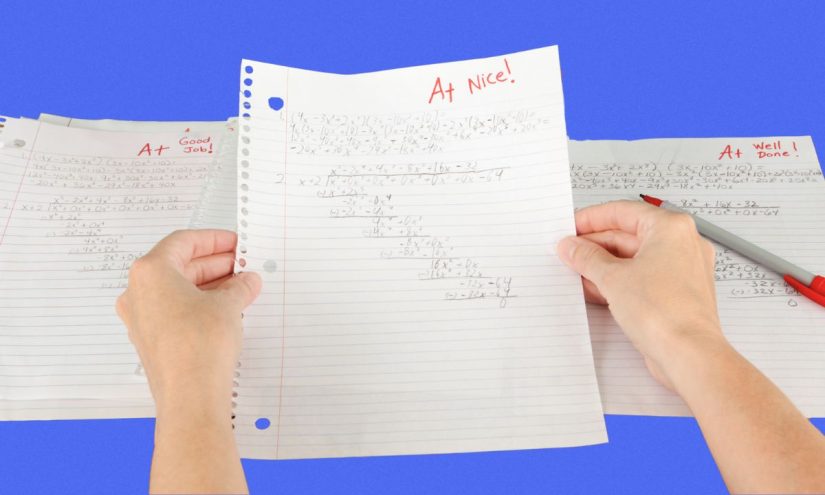
AI can streamline your feedback process by suggesting draft comments on student work based on rubrics you provide. This is particularly helpful for writing-intensive courses or project-based learning.
Ethical reminder: Always review and personalize AI-generated feedback to maintain professional judgment and student trust.
3. Support multilingual learners in real time
AI tools like Google Translate, Microsoft Immersive Reader, and Read&Write can help bridge language gaps by offering simplified texts, translated materials, and visual vocabulary support.
Even better: Teach students to use these tools independently to foster agency and access.
4. Teach AI literacy as a 21st-century skill
Students are already using AI–let’s teach them to use it well. Dedicate time to discuss how AI works, how to prompt effectively, and how to critically evaluate its outputs for bias, credibility, and accuracy.
Try this mini-lesson: “3 Prompts, 3 Results.” Have students input the same research question into three AI tools and compare the results for depth, accuracy, and tone.
5. Automate the tedious–refocus on relationships
From generating rubrics and newsletters to drafting permission slips and analyzing formative assessment data, AI can reduce the clerical load. This frees up your most valuable resource: time.
Pro tip: Use AI to pre-write behavior plans, follow-up emails, or even lesson exit ticket summaries.
The future of AI
AI won’t replace teachers–but teachers who learn how to use AI thoughtfully may find themselves with more energy, better tools, and deeper student engagement than ever before. As the school year begins, let’s lead by example and embrace AI not as a shortcut, but as a catalyst for growth.
Timothy Montalvo, Iona University
Timothy Montalvo is an educator passionate about leveraging technology to enhance student learning outcomes. With over a decade of experience in social studies education, he is dedicated to preparing students for active citizenship in the digital age. He currently serves as a Middle School Assistant Principal in Westchester, NY and an adjunct professor of education at Iona University in New York. He can be reached on Twitter/X @MrMontalvoEDU.
Latest posts by eSchool Media Contributors (see all)
As students returned to class earlier this month, Hawaiʻi schools reported the lowest number of teacher vacancies the state has seen in more than five years. As of last week, only 73 teacher positions were unfilled, compared to more than 1,000 in the aftermath of the Covid-19 pandemic.
But schools are employing a growing number of unlicensed teachers, also known as emergency hires, to fill those vacancies. Last August, Hawaiʻi schools started the year with 670 emergency hires, an 80% increase from four years ago.
Emergency hires can work in schools for up to three years but must make progress toward earning their licenses.
The recent increase in emergency hires partly stems from state efforts to put more teachers in classrooms, including increasing pay for unlicensed educators in 2023. But while research shows that emergency hires tend to have higher retention rates, they may also be less effective than licensed teachers, who typically have more training and classroom experience.
While the Hawaiʻi teacher licensing board tracks emergency hires in schools, it doesn’t publish regular data on how many of these teachers go on to earn their teacher licenses and continue working in public schools here.
Even so, principals and researchers say hiring unlicensed teachers is better than leaving positions vacant, which can leave schools scrambling for substitutes. The state has also explored other options to recruit and retain educators, like raising teacher pay and bringing in workers from the Philippines, but some solutions may only be temporary.
“There’s a united front to attract qualified educators that are already certified,” said Chris Sanita, principal at Hāna High and Elementary. “I think it’s a larger state issue on housing and affordability.”
A Growing Population
In 2018, Brandon Galarita began teaching at Ke’elikōlani Middle School as an emergency hire, hoping to build on his experience as a substitute teacher and use his college degree in English. While the pay was low, Galarita said, working full-time as an emergency hire allowed him to earn a living while also completing the requirements for a teacher license.
“At least it starts building a teacher if they want to go into education,” said Galarita, who earned his license from the University of Hawaiʻi Mānoa in 2020. “I would hope that the influx of emergency hires will result in more teachers that are staying in the profession.”
University of Hawaiʻi Mānoa’s College of Education offers a program that helps cover the costs of tuition and fees for residents pursuing their teacher’s license. (Kevin Fujii/Civil Beat/2024)
Osa Tui Jr., president of the state teachers’ union, said he attributes the big jump in emergency hires to the pay raise they received two years ago. Currently, emergency hires earn about $50,300 a year, compared to $38,500 previously.
“These numbers reflect exactly what we were hoping to accomplish,” Tui said.
The state has encouraged prospective educators, including emergency hires, to earn their licenses through the Grow Our Own initiative at UH Mānoa, which helps cover the costs of tuition for teacher preparation programs. Teachers who complete the program and earn their licenses must work in public schools for at least three years.
Emergency hire numbers don’t always reflect teachers’ progress toward earning their licenses, said Waiʻanae Intermediate School Principal John Wataoka. While he has around 11 emergency hires on staff this year, only one of the teachers has yet to complete a teacher preparation program.
The rest have finished their training but are waiting to take a licensing exam or haven’t received the results of their final tests yet, Wataoka said.
“Right now, it’s just a waiting game,” he said.
But a recent study of emergency hires entering Massachusetts schools during the pandemic suggests that unlicensed teachers may be less effective than other educators. Students taught by emergency hires tended to have lower math and science test scores compared to their peers, according to research from the National Center for Analysis of Longitudinal Data in Education Research.
Jonathon Medeiros, a teacher at Kauaʻi High School and vice president of the Hawaiʻi Education Association, said he understands parents’ possible concerns about emergency hires and the quality of education students are receiving. But it’s still preferable to have an emergency hire in a classroom than a substitute — or nobody at all.
In the past, Medeiros said, students were occasionally sent to the library or cafeteria for study hall when there weren’t enough educators to teach every class and the state faced a shortage of substitute teachers.
Unlike emergency hires, DOE doesn’t require substitute teachers to have a college degree.
“We all want skilled, caring, talented teachers who are from the community and committed to their schools,” Medeiros said. “How do we make sure we get those people in every single classroom is the key question.”
Expanding The Pool
While the boost in emergency hire pay has attracted more teachers to public schools, the state is still searching for other solutions to increase the hiring pool.
At Waiʻanae Intermediate, Wataoka said he’s hired seven international teachers to fill staff positions over the past two years. The J-1 visa program, which DOE has participated in since 2019, allows teachers from other countries, primarily the Philippines, to teach in the state for up to five years.
This year, the department hired around 100 new teachers through the visa program, Superintendent Keith Hayashi said in a Board of Education meeting earlier this month. International teachers’ interest in working in Hawaiʻi is comparable to past years, he said, despite concerns that participation could drop after Immigration Customs and Enforcement agents raided the shared Maui home of teachers from the Philippines last spring.
On Maui, Sanita said he’s also seeing the impact of the bonuses introduced for teachers in hard-to-fill positions five years ago. While it’s difficult to attract people to Hāna — a town with limited housing and no stop signs – the $8,000 bonus for remote schools helps retain teachers who would otherwise struggle with the high cost of living, Sanita said.
“The differentials have really helped people, our teachers in Hana, not to have five different side hustles,” Sanita said. “They can actually teach and make ends meet.”
The bonuses have also incentivized teachers to remain at Waiʻanae Intermediate even when they face long commutes from other parts of the island, Wataoka said. While the Leeward Coast has the greatest concentration of new teachers in the state, the $8,000 bonus has helped experienced teachers cover the cost of gas to West Oʻahu and remain at Waiʻanae Intermediate.
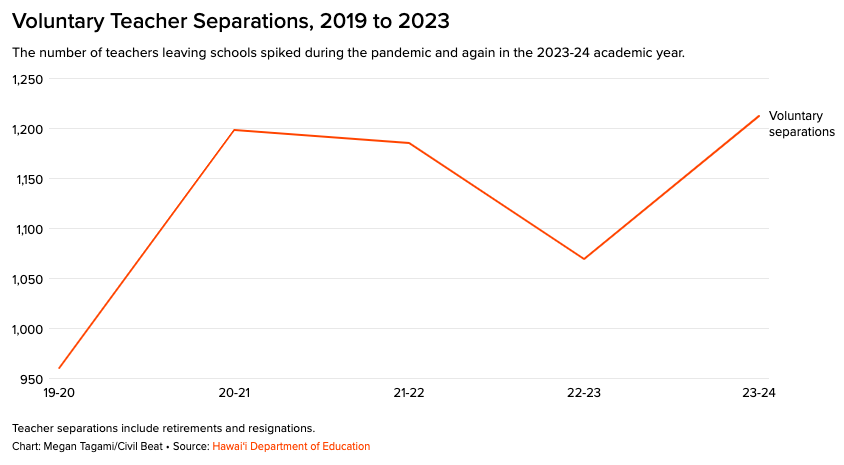
But despite more retention measures in place, the department saw a jump in the number of teachers leaving schools last year. Over 1,200 teachers voluntarily resigned or retired from DOE in the 2023-24 school year, compared to roughly 1,000 the year before.
Tui said there’s no single answer as to why the number of teachers leaving schools jumped. In some cases, teachers may have felt more comfortable changing jobs after the pandemic as they faced less uncertainty in the job market, he said.
This year, educators continuing to work in public schools will receive a 3% pay raise, with some veteran teachers receiving a larger raise of around 7%. While the pay increase will encourage teachers to stay in schools longer, Tui said, it’s possible the state will see a wave of educators retiring after three years as they qualify for higher state pensions.
For teachers hired before 2012, the state uses their three highest years of pay to determine their pensions.
“We have to make sure that we can get people into the profession that we can recruit to handle a drop off like that,” Tui said.
Civil Beat’s education reporting is supported by a grant from Chamberlin Family Philanthropy.
As a “pink-collar profession” — a nickname given to women-dominated occupations — teaching has historically paid less than comparable fields requiring a higher education degree, and in Philadelphia, the push to close the wage gap could lead to a strike by the end of the month.
Salaries for Philly teachers — roughly 70 percent of whom are women — begin at $54,146. That’s far below the median earnings of Pennsylvania college graduates. Now, concern over pay has become a sticking point between the Philadelphia Federation of Teachers (PFT) and the School District of Philadelphia as they negotiate a new contract, with the current collective bargaining agreement expiring August 31.
The PFT in June voted to authorize its executive board to initiate a strike if the union and the district don’t agree on a new contract by then. With the deadline imminent and no deal in sight, schools may open on August 25 only for teachers to appear on picket lines within days. A strike could leave working parents in a lurch, scrambling for childcare — a task moms usually have to complete. Many Philly teachers, however, are also parents and demanding higher salaries to better provide for their families.
PFT President Arthur Steinberg pointed out that even suburban teachers with less education often out-earn Philadelphia’s top-performing educators by up to $22,000.
Amid ongoing negotiations, Steinberg appeared with School District of Philadelphia Superintendent Tony Watlington at a welcome event for new teachers on Wednesday.
“We are optimistic about a successful conclusion by the end-of-the-month deadline, and it’s important to us that all of our employees feel seen, valued and heard,” said Watlington, who called Steinberg a “tough negotiator.”
To reach an agreement, Steinberg said, “There’s significant work that has to be done, but it’s doable.”
“Our schools are not safe, they’re not healthy for anybody to work in or go to school in,” chemistry teacher Kate Sundeen told local news station ABC 6. “We have a hard time with teacher retention and a hard time attracting new talent.”
On Friday, the national bus tour of the American Federation of Labor and Congress of Industrial Organizations (AFL-CIO) will arrive in West Philadelphia to support the PFT ahead of a possible strike. The event will be the last of six strike preparation events that have taken place before the teachers head back to work on Monday, a week before the first day of school.
A district court judge has temporarily blocked a Trump administration ban on collective bargaining by two teachers unions in Department of Defense schools.
Judge Paul Friedman issued a preliminary injunction in a lawsuit filed this spring by the Federal Education Association and Antilles Consolidated Education Association, which represent more than 5,500 teachers, librarians and counselors in the 161 schools under the Department of Defense Education Activity. The agency educates 67,000 children on military bases worldwide.
The union sued the Trump administration over a March executive order that stripped collective bargaining rights from two-thirds of federal service workers. The order impacted the Departments of Justice, Defense, Veteran Affairs, Treasury, and Health and Human Services, as well as the Centers for Disease Control and Prevention and the Environmental Protection Agency.
The Federal Education Association has been negotiating teachers contracts with the Department of Defense since 1970, while the Antilles Consolidated Education Association has bargained on behalf of Puerto Rico educators since 1976, according to the lawsuit. The current collective bargaining agreements for both unions were approved in 2023 and are set to expire in summer 2028.
But since the order was issued, the lawsuit says, the Department of Defense Education Activity has discontinued negotiations, stopped participation in grievance proceedings and prohibited union representation during educator disciplinary meetings. Members are also no longer allowed to conduct union work during the school day. Requests from educators to access a union sick leave bank with 13,000 donated hours have also been ignored, according to the suit.
“These actions, taken together, essentially terminate the respective collective bargaining agreements and thus cause irreparable harm,” Friedman said in his decision.
A 1978 federal statute allows collective bargaining in the civil service sector. The suit argued that while presidents have the authority to exclude an agency if its primary function involves intelligence, investigation or national security work, “Many, if not most, of the agencies and agency subdivisions swept up in the executive order’s dragnet do little to no national security work, much less do they have a primary function [of] intelligence, counterintelligence, investigative [work].”
The agency declined to comment on ongoing legal proceedings. In a reply to the unions’ lawsuit, Trump administration attorneys said the executive order was within the law and that reversing it would be costly.
“Rather than maintaining the status quo, it would force [the Department of Defense] to undo actions it has already taken to implement the executive order, causing significant disruption and resource expenditures,” the lawyers wrote.
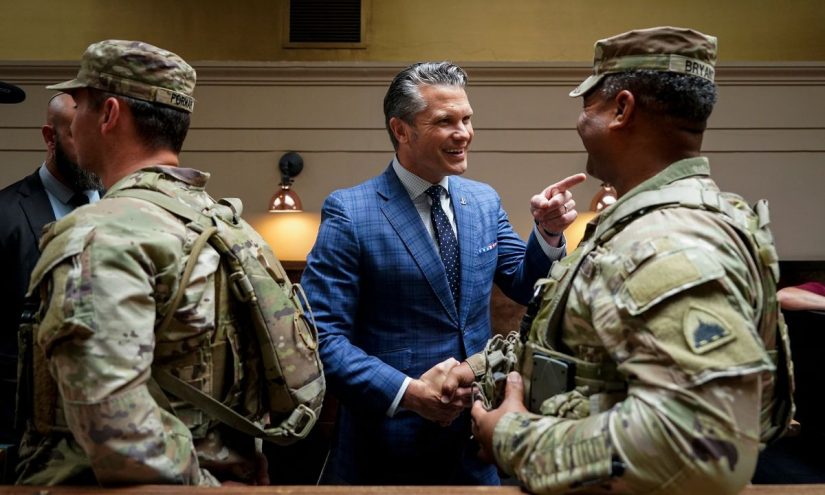
In April, Defense Secretary Pete Hegseth authorized a few exemptions for agencies related to the Air Force and Army, but not the teachers unions — despite a push from 45 lawmakers to exclude the school system.
“Ensuring that DoDEA educators and personnel retain collective bargaining protections will ensure that DoDEA can continue to recruit and retain the best staff in support of its mission,” the congressional members wrote in a letter. “Collective bargaining safeguards the public interest, and its history in DoDEA has demonstrated better outcomes for mission readiness, and stronger connections between military-connected families and those who serve them.”
An appeal from the Trump administration is pending. A similar lawsuit from six unions, including the American Federation of Government Employees, resulted in an injunction, but a federal appeals court reversed it in August.
This podcast, Sold a Story, was produced by APM Reports and reprinted with permission.
There’s an idea about how children learn to read that’s held sway in schools for more than a generation – even though it was proven wrong by cognitive scientists decades ago. Teaching methods based on this idea can make it harder for children to learn how to read. In this new American Public Media podcast, host Emily Hanford investigates the influential authors who promote this idea and the company that sells their work. It’s an exposé of how educators came to believe in something that isn’t true and are now reckoning with the consequences – children harmed, money wasted, an education system upended.
Episode 14: The Cuts
Education research is at a turning point in the United States. The Trump administration is slashing government funding for science and dismantling the Department of Education. We look at what the cuts mean for the science of reading — and the effort to get that science into schools.
This podcast, Sold a Story, was produced by APM Reports and reprinted with permission.
The Hechinger Report provides in-depth, fact-based, unbiased reporting on education that is free to all readers. But that doesn’t mean it’s free to produce. Our work keeps educators and the public informed about pressing issues at schools and on campuses throughout the country. We tell the whole story, even when the details are inconvenient. Help us keep doing that.
In 2020, around 3,500 incoming New York City kindergartners were deemed eligible for a public school gifted-and-talented program. In 2021, that number spiked up to over 10,000.
What happened to nearly triple the number of identified “gifted” students in NYC in a single year?
But in 2021, the process was changed. Now, instead of a test, students in public school pre-K programs qualify based on evaluations by their teachers, and there is no differentiation between those eligible for “accelerated” or “enriched” programs.
In 2022, the last year for which figures are available, 9,227 students were deemed qualified to enter the gifted-and-talented placement lottery. But for the last decade there have only been about 2,500 spots citywide. Over 6,700 “gifted” students weren’t offered a seat.
That’s a shame, because, based on their overwhelming responses to the city’s G&T recommendation questionnaires, NYC teachers believe the vast majority of their young students – a statistically impressive 85% – would thrive doing work beyond what is offered in a regular classroom.
When evaluating students for a G&T recommendation, teachers are asked, among other things, whether the child:
Is curious about new experiences, information, activities, and/or people;
Asks questions and communicates about the environment, people, events and/or everyday experiences in and out of the classroom;
Explores books alone and/or with other children;
Plays with objects and manipulatives via hands-on exploration in and outside of the classroom setting;
Engages in pretend/imaginary play;
Engages in artistic expression, e.g. music, dance, drawing, painting, cutting, and/or creating
Enjoys playing alone (enjoys own company) as well as with other children.
This video illustrates how such “gifted” characteristics can be applied to … anybody.
The Pygmalion Effect has demonstrated that when teachers are told their students are “gifted,” they treat them differently — and by the end of the year, those children are performing at a “gifted” level.
Extrapolating that 85% of incoming kindergartners to the 70,000 or so kids enrolled at every grade level in NYC, that would mean there are 59,500 “gifted” students in each academic year, for a whopping total of 773,500 “gifted” K-12 students in the New York City public school system.
And extending those calculations to the whole of the United States, then 85% of 74 million — i.e. 62,900,000 — 5- through 18-year-olds are capable of doing work above grade level. With that in mind, academic expectations could be raised across the board, and teachers would implement the new, higher standards filled with confidence that the majority of their students would rise to the occasion. NYC teachers have already said as much on their evaluations.
What would happen if NYC were to provide a G&T seat to every student whom its own teachers deemed qualified? If it were subsequently confirmed that over 773,500 students in a 930,000-plus student school system are capable of doing “advanced” work, can parents, activists and everyone invested in making education the best it can possibly be for all expect to see such higher-level curriculum extended to all students — in NYC and, eventually, across America?
As for the minority who weren’t recommended for “advanced” instruction, the combination of Pygmalion Effect and the benefits of mixed-ability classrooms should raise their proficiency, as well.
In education, we often talk about “meeting the moment.” Our current moment presents us with both a challenge and an opportunity: How can we best prepare and support our teachers as they navigate increasingly complex classrooms while also dealing with unprecedented burnout and shortages within the profession?
One answer could lie in the thoughtful integration of artificial intelligence to help share feedback with educators during training. Timely, actionable feedback can support teacher development and self-efficacy, which is an educator’s belief that they will make a positive impact on student learning. Research shows that self-efficacy, in turn, reduces burnout, increases job satisfaction, and supports student achievement.
As someone who has spent nearly two decades supporting new teachers, I’ve witnessed firsthand how practical feedback delivered quickly and efficiently can transform teaching practice, improve self-efficacy, and support teacher retention and student learning.
AI gives us the chance to deliver this feedback faster and at scale.
A crisis demanding new solutions
Teacher shortages continue to reach critical levels across the country, with burnout cited as a primary factor. A recent University of Missouri study found that 78 percent of public school teachers have considered quitting their profession since the pandemic.
Many educators feel overwhelmed and under-supported, particularly in their formative years. This crisis demands innovative solutions that address both the quality and sustainability of teaching careers.
What’s often missing in teacher development and training programs is the same element that drives improvement in other high-performance fields: immediate, data-driven feedback. While surgeons review recordings of procedures and athletes get to analyze game footage, teachers often receive subjective observations weeks after teaching a lesson, if they receive feedback at all. Giving teachers the ability to efficiently reflect on AI-generated feedback–instead of examining hours of footage–will save time and potentially help reduce burnout.
The transformative potential of AI-enhanced feedback
Recently, Relay Graduate School of Education completed a pilot program with TeachFX using AI-powered feedback tools that showed remarkable promise for our teacher prep work. Our cohort of first- and second-year teachers more than doubled student response opportunities, improved their use of wait time, and asked more open-ended questions. Relay also gained access to objective data on student and teacher talk time, which enhanced our faculty’s coaching sessions.
Program participants described the experience as “transformative,” and most importantly, they found the tools both accessible and effective.
Here are four ways AI can support teacher preparation through effective feedback:
1. Improving student engagement through real-time feedback
Research reveals that teachers typically dominate classroom discourse, speaking for 70-80 percent of class time. This imbalance leaves little room for student voices and engagement. AI tools can track metrics such as student-versus-teacher talk time in real time, helping educators identify patterns and adjust their instruction to create more interactive, student-centered classrooms.
One participant in the TeachFX pilot said, “I was surprised to learn that I engage my students more than I thought. The data helped me build on what was working and identify opportunities for deeper student discourse.”
2. Freeing up faculty to focus on high-impact coaching
AI can generate detailed transcripts and visualize classroom interactions, allowing teachers to reflect independently on their practice. This continuous feedback loop accelerates growth without adding to workloads.
For faculty, the impact is equally powerful. In our recent pilot with TeachFX, grading time on formative observation assignments dropped by 60 percent, saving up to 30 hours per term. This reclaimed time was redirected to what matters most: meaningful mentoring and modeling of best practices with aspiring teachers.
With AI handling routine analysis, faculty could consider full class sessions rather than brief segments, identifying strategic moments throughout lessons for targeted coaching.
The human touch remains essential, but AI amplifies its reach and impact.
3. Scaling high-quality feedback across programs
What began as a small experiment has grown to include nearly 800 aspiring teachers. This scalability can more quickly reduce equity issues in teacher preparation.
Whether a teaching candidate is placed in a rural school or urban district, AI can ensure consistent access to meaningful, personalized feedback. This scalable approach helps reduce the geographic disparities that often plague teacher development programs.
Although AI output must be checked so that any potential biases that come through from the underlying datasets can be removed, AI tools also show promise for reducing bias when used thoughtfully. For example, AI can provide concrete analysis of classroom dynamics based on observable actions such as talk time, wait time, and types of questions asked. While human review and interpretation remains essential–to spot check for AI hallucinations or other inaccuracies and interpret patterns in context–purpose-built tools with appropriate guardrails can help deliver more equitable support.
4. Helping teachers recognize and build on their strengths
Harvard researchers found that while AI tools excel at using supportive language to appreciate classroom projects–and recognize the work that goes into each project–students who self-reported high levels of stress or low levels of enjoyment said the feedback was often unhelpful or insensitive. We must be thoughtful and intentional about the AI-powered feedback we share with students.
AI can also help teachers see what they themselves are doing well, which is something many educators struggle with. This strength-based approach builds confidence and resilience. As one TeachFX pilot participant noted, “I was surprised at the focus on my strengths as well and how to improve on them. I think it did a good job of getting good details on my conversation and the intent behind it. ”
I often tell new teachers: “You’ll never see me teach a perfect lesson because perfect lessons don’t exist. I strive to improve each time I teach, and those incremental gains add up for students.” AI helps teachers embrace this growth mindset by making improvement tangible and achievable.
The moment is now
The current teacher shortage is a crisis, but it’s also an opportunity to reimagine how we support teachers.
Every student deserves a teacher who knows how to meaningfully engage them. And every teacher deserves timely, actionable feedback. The moment to shape AI’s role in teacher preparation is now. Let’s leverage these tools to help develop confident, effective teachers who will inspire the next generation of learners.
Dr. Alice Waldron, Relay Graduate School of Education
Dr. Alice Waldron leads Relay’s collective efforts to accelerate progress toward our mission and vision through meaningful innovation. With a focus on impact, values, and financial sustainability, she creates and leads processes to test and scale innovation initiatives to meet the evolving needs of schools and educators. Prior to this role, Dr. Waldron was the founding Dean of Relay’s Online Campus as well as Relay’s national Dean of Clinical Experience.
Latest posts by eSchool Media Contributors (see all)
After graduating from Knox College in Illinois with a bachelor’s degree, Stephanie Martinez-Calderon’s plans were upended by the pandemic. She hadn’t planned on becoming a teacher but found an opportunity to tutor remotely for the year after college.
Tutoring helped her build confidence and develop instructional skills, and today she’s a middle school teacher in the Washoe County School District in Nevada.
Tutoring can be a powerful training ground for future educators, providing hands-on experience, confidence and a bridge into the classroom. And what might begin as a temporary opportunity can become a career path at a time when teachers are needed more than ever: A recent report noted that nearlyone in five K-12 teachers plan to leave teaching or are unsure if they’ll stay.
Turnover remains a crisis in many districts, one that can be solved by a ready-made pipeline of young future educators with instructional experience and relationship-building skills they’ve gained from tutoring.
How school districts think about tutoring should evolve. Rather than seeing it as a short-term response to pandemic-interrupted learning, they should view it as part of the fabric of school design and future educator development. This requires including tutoring in strategic plans, forming community partnerships and creating a structure to sustain programs that cultivate tutors for careers in education. To fund these programs and pay tutors, districts can redirect Title I funds, use federal work-study and create apprenticeship programs.
Starting as a tutor allows aspiring educators to build core teaching skills in a supportive, lower-stakes environment. Tutors learn to navigate student relationships and adapt lessons to individual needs. Without having to manage an entire classroom, they can practice asking questions that get students thinking and selecting problems to help students learn. This early practice eases the transition into teaching.
Tutors from Generation Z, born between 1996 and 2012, often bring fresh energy to the profession. As digital natives, they are reimagining how to engage and inspire students, leverage technology and foster creativity and new approaches to learning.
They are alsothe most ethnically and racially diverse generation yet: Many come from backgrounds historically underrepresented in the teaching force; over half of undergraduates identify as first-generation college students. Their engagement broadens the prospects for a more diverse teacher pipeline.
Gen Z’s emphasis on flexibility and remote opportunities is one of the most significant workforce changes since the pandemic. They value mental health, stability and mission-driven work. Part-time, hybrid and wellness benefits help recruit young talent.
At our nonprofit, recruiters hear from education candidates that Gen Z appreciates the chance to try out industries, and that tutoring provides them with a window into the world of teaching.
Public schools could better meet the evolving needs of young professionals entering education by reimagining tutor roles to include hybrid options, mental health supports and collaborative teaching pathways for professional growth. For instance, a tutor might start off working in a part-time online tutoring role, but after interacting with students virtually and gaining more experience, they may be more excited to take on a full-time teaching role on-site.
For school districts, tutoring programs can serve as effective recruitment pipelines. By offering recent graduates a low-barrier entry point into education — one that doesn’t require immediate certification — districts can spark interest in teaching among candidates who may not have previously considered it.
When tutors step into teaching roles, they bring valuable continuity — familiarity with the students and insight into progress and school culture. This seamless transition supports both student learning and district staffing needs.
The idea that tutoring should be built into future educator pipelines is spreading. For example, since the launch of its Ignite Fellowship in 2020, Teach for America says that 550 of its former tutors have become full-time teachers. The program has proven to be especially effective at drawing in nontraditional candidates — those who may not have initially envisioned themselves in the classroom. In Washington, D.C., the school district launched a tutor-to-teacher apprenticeship program after success with high-impact tutoring. In Texas, teacher residents are required to work as tutors and in other support roles while co-teaching with a mentor.
By offering flexible, purpose-driven opportunities, districts can attract Gen Z professionals and give them a meaningful entry point into teaching. And tutoring programs can become more than academic support — they can serve as strategic talent pipelines that strengthen the future of the teaching workforce.
Alan Safran is co-founder, CEO and chair of the board ofSaga Education; Halley Bowman is senior director of academics.
This story about tutoring was produced byThe Hechinger Report, a nonprofit, independent news organization focused on inequality and innovation in education. Sign up for Hechinger’s weekly newsletter.
The Hechinger Report provides in-depth, fact-based, unbiased reporting on education that is free to all readers. But that doesn’t mean it’s free to produce. Our work keeps educators and the public informed about pressing issues at schools and on campuses throughout the country. We tell the whole story, even when the details are inconvenient. Help us keep doing that.
Paul T. Corrigan teaches at The University of Tampa. He is currently writing a book on teaching literature. He has published on teaching and learning in TheAtlantic.com, The Chronicle of Higher Education, Inside Higher Ed, College Teaching, Pedagogy, Reader, The Teaching Professor, International Journal for the Scholarship of Teaching and Learning, and other venues. He has a PhD from the University of South Florida and a MA from North Carolina State University. More at paultcorrigan.com. Follow on Twitter at @teachingcollege.
A colleague of ours recently attended an AI training where the opening slide featured a list of all the ways AI can revolutionize our classrooms. Grading was listed at the top. Sure, AI can grade papers in mere seconds, but should it?
As one of our students, Jane, stated: “It has a rubric and can quantify it. It has benchmarks. But that is not what actually goes into writing.” Our students recognize that AI cannot replace the empathy and deep understanding that recognizes the growth, effort, and development of their voice. What concerns us most about grading our students’ written work with AI is the transformation of their audience from human to robot.
If we teach our students throughout their writing lives that what the grading robot says matters most, then we are teaching them that their audience doesn’t matter. As Wyatt, another student, put it: “If you can use AI to grade me, I can use AI to write.” NCTE, in its position statements for Generative AI, reminds us that writing is a human act, not a mechanical one. Reducing it to automated scores undermines its value and teaches students, like Wyatt and Jane, that the only time we write is for a grade. That is a future of teaching writing we hope to never see.
We need to pause when tech companies tout AI as the grader of student writing. This isn’t a question of capability. AI can score essays. It can be calibrated to rubrics. It can, as Jane
said, provide students with encouragement and feedback specific to their developing skills. And we have no doubt it has the potential to make a teacher’s grading life easier. But just because we can outsource some educational functions to technology doesn’t mean we should.
It is bad enough how many students already see their teacher as their only audience. Or worse, when students are writing for teachers who see their written work strictly through the lens of a rubric, their audience is limited to the rubric. Even those options are better than writing for a bot. Instead, let’s question how often our students write to a broader audience of their peers, parents, community, or a panel of judges for a writing contest. We need to reengage with writing as a process and implement AI as a guide or aide rather than a judge with the last word on an essay score.
Our best foot forward is to put AI in its place. The use of AI in the writing process is better served in the developing stages of writing. AI is excellent as a guide for brainstorming. It can help in a variety of ways when a student is struggling and looking for five alternatives to their current ending or an idea for a metaphor. And if you or your students like AI’s grading feature, they can paste their work into a bot for feedback prior to handing it in as a final draft.
We need to recognize that there are grave consequences if we let a bot do all the grading. As teachers, we should recognize bot grading for what it is: automated education. We can and should leave the promises of hundreds of essays graded in an hour for the standardized test providers. Our classrooms are alive with people who have stories to tell, arguments to make, and research to conduct. We see our students beyond the raw data of their work. We recognize that the poem our student has written for their sick grandparent might be a little flawed, but it matters a whole lot to the person writing it and to the person they are writing it for. We see the excitement or determination in our students’ eyes when they’ve chosen a research topic that is important to them. They want their cause to be known and understood by others, not processed and graded by a bot.
The adoption of AI into education should be conducted with caution. Many educators are experimenting with using AI tools in thoughtful and student-centered ways. In a recent article, David Cutler describes his experience using an AI-assisted platform to provide feedback on his students’ essays. While Cutler found the tool surprisingly accurate and helpful, the true value lies in the feedback being used as part of the revision process. As this article reinforces, the role of a teacher is not just to grade, but to support and guide learning. When used intentionally (and we emphasize, as in-process feedback) AI can enhance that learning, but the final word, and the relationship behind it, must still come from a human being.
When we hand over grading to AI, we risk handing over something much bigger–our students’ belief that their words matter and deserve an audience. Our students don’t write to impress a rubric, they write to be heard. And when we replace the reader with a robot, we risk teaching our students that their voices only matter to the machine. We need to let AI support the writing process, not define the product. Let it offer ideas, not deliver grades. When we use it at the right moments and for the right reasons, it can make us better teachers and help our students grow. But let’s never confuse efficiency with empathy. Or algorithms with understanding.
Dennis Magliozzi & Kristina Peterson, University of New Hampshire’s Writers Academy
Kristina Peterson and Dennis Magliozzi have been teaching English since 2008. Kristina has a master’s degree in teaching and over a decade of experience mentoring teachers. Dennis holds an MFA in poetry and a PhD from the University of New Hampshire. Together, they co-teach in the University of New Hampshire’s Writers Academy and Learning Through Teaching program. Their work on generative AI’s impact in the classroom is highlighted on Heinemann’s blog, and in their forthcoming book, AI in the Writing Workshop: Finding the Write Balance.
Latest posts by eSchool Media Contributors (see all)