A torrent of controversy has erupted over the Trump administration’s decision to shutter the federal Department of Education. Critics howl that it will destroy public education in America. Supporters insist it will somehow make things better.
The only thing that’s clear is that our public education system is broken. It’s time for politicians to stop using education as a political football, with blue and red teams competing for control rather than sharing the responsibility to prepare our children for their futures.
The resulting chaos and confusion and rigid policies choke the joy out of learning and of working in our schools. Insufficient attention by leaders to education culture can result in fear and distrust, turf wars and a tendency to blame and make excuses for a lack of progress.
Such behaviors produce a toxicity that disables learning and disempowers leadership. Instead of increasing our nation’s economic prosperity, we’re deepening inequality, limiting opportunity and sadly wasting the potential of many children, on whose ability to thrive our country depends.
Poor work conditions, insufficient support, inadequate pay and limited career opportunities are among some of the reasons teachers are leaving and schools are struggling to attract top talent. Reductions in funding from the Great Recession through the present render our facilities dangerous in some instances and unwelcoming in others. Would you buy a house with barbed wire fencing and unkempt grounds that make you wonder whether the aim is to keep something out or in?
What should we do to change what is going on inside our schools?
We must first of all start working together to make our public schools great places to teach and learn.
Great places to work and learn are places that are well led, fueled by purpose and guided by shared, positive behaviors that advance learning goals and serve as “rules of the road” for how employees and students are expected to behave.
In great schools, employees, students and families are respected and valued. Leaders in great schools inspire their employees — all of them — to do more than they think they can. Employees align behind the purpose of enabling learning, which creates momentum and camaraderie for what they are working to attain together.
In great schools, leaders inspire their communities to join them in cheering for and supporting kids’ future successes. Families, no matter their socioeconomic status, feel a sense of belonging.
Problems are perceived as opportunities to get better, not sources of indiscriminate blame. Solutions are found by looking in the mirror first. External threats to learning, such as poverty or parents’ underemployment, are acknowledged and addressed. Schools don’t dodge their responsibility to educate all kids.
In great schools, kids are known by caring employees; they feel seen and heard and are deeply engaged and invested in their learning.
Every employee working in a great school district feels responsible for achieving the district’s mission, no matter whether they work inside or outside of the classroom.
When kids return after being absent, employees welcome them back, tell them they were missed and focus on catching them up. They do not judge the constraints of their families’ lives or mete out punishment as though missing school is a crime.
Great places to learn must also be great places to work. We must reframe our concept of schools as not just places where kids learn. Great places to work care about the needs of all the human beings in their care, including and especially their employees.
“To win in the marketplace, you must first win in the workplace,” Douglas R. Conant, former Campbell Soup Company CEO famously said. He knew what is becoming clearer within our public school systems — that unhappy, unfulfilled employees lead to high turnover, disengagement by students and staff and disaffected families turning to alternative educational offerings.
It is no secret that attracting and retaining top talent to work in our schools is increasingly difficult as employees seek more stability. Attracting younger workers is even more difficult.
Many of those who currently work in schools, especially teachers, are stressed, burned out and dissatisfied. Being stressed and burned out is not a normative experience; it’s a symptom of a weak culture, and an organizational problem to be solved. And employee turnover is no longer limited to teachers. There are increasing vacancies among principals, bus drivers and food service and facilities staff.
The quality of the experiences of employees working in our schools must be higher. Every point along the employee experience continuum, from applying for a job to choosing to leave, is an opportunity to deepen employee engagement and commitment to being a high performer.
We can fix what we have broken. Thinking differently about making our public schools great places to work and learn is a good place to start. No policy changes are required to demonstrate concern for the human beings the system employs and seeks to educate.
Etienne R. LeGrand is a thought leader, writer and culture-shaping strategist and adviser at Vivify Performance.
This story about school culture was produced by The Hechinger Report, a nonprofit, independent news organization focused on inequality and innovation in education. Sign up for Hechinger’s weekly newsletter.
The Hechinger Report provides in-depth, fact-based, unbiased reporting on education that is free to all readers. But that doesn’t mean it’s free to produce. Our work keeps educators and the public informed about pressing issues at schools and on campuses throughout the country. We tell the whole story, even when the details are inconvenient. Help us keep doing that.
FIRE helped secure a victory this week for two educators in Oregon when the U.S. Court of Appeals for the Ninth Circuit sent Damiano v. Grants Pass School District back down to the federal district court, as FIRE had asked it to in our amicus brief.
When their school district passed a policy requiring teachers to address transgender students by their preferred names and pronouns, the plaintiffs, Oregon assistant principal Rachel Sager and teacher Katie Medart, started the grassroots campaign “I Resolve” to voice their opposition to the policy. Following complaints by students, parents, and community members, their local school district fired the teachers but later reinstated them to different roles.
The teachers sued. But the lower court ruled the school district was entitled to fire the teachers and granted summary judgment, meaning it did not see a need to go to trial.
FIRE saw things differently. And now, so has the appellate court. Our brief to the Ninth Circuit argued that Sager and Medart’s speech on a matter of public concern — as speech on the debate around gender issues undoubtedly is — must be properly balanced against the school district’s interest in providing services to the public. FIRE wrote:
Almost twenty years ago, this Court held “it is well-settled that a teacher’s public employment cannot be conditioned on her refraining from speaking out on school matters.” … Yet the district court here held that, under Pickering, Grants Pass School District could do exactly that. The court incorrectly concluded that the district did not violate the First Amendment by firing an assistant principal (Rachel Sager, née Damiano) and teacher (Katie Medart) for speaking out against the District’s gender identity policy … because their actions—namely, publishing an alternative model gender-identity education policy and accompanying video called “I Resolve”—allegedly caused significant community disruption.
The lower court put too much weight on the discomfort and controversy the teachers caused with their advocacy, and too little weight on their First Amendment right to speak as private citizens on a matter of public concern.
On top of that, the court found a genuine dispute to be resolved over whether the teachers’ advocacy actually disrupted the school’s operation. As such, the Ninth Circuit reversed the lower court’s opinion — meaning the educators’ First Amendment claim can now proceed to trial.
With its ruling, the Ninth Circuit has sent a pointed reminder that public employees don’t surrender their constitutional rights just because they work for the government.
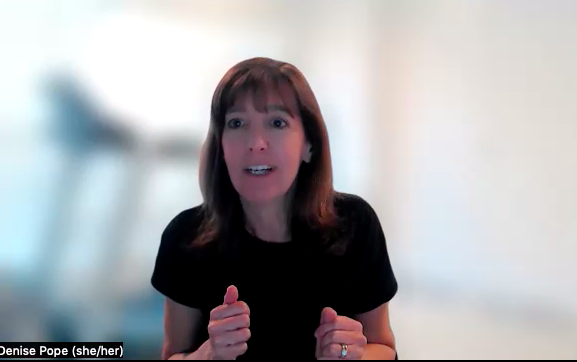
Tired of talking about AI? That’s too bad. The technology remains the most impactful force in education. The challenge becomes avoiding all the Claptrap. Thankfully, that’s where Denise Pope, Co-Founder of Challenge Success at the Stanford Graduate School of Education, comes in.
I had the chance to explore the current AI state-of-play from her perspective. One striking disparity I haven’t heard talked about: While AI usage among students has skyrocketed—from 25% to 60% at the middle school level and 45% to 75% at the high school level over just two school years—only 32% of teachers report using AI for academic purposes.
This gap has created what Denise describes as an educational “La La Land,” where students are experimenting with AI tools while many schools lack clear policies or guidance. The absence of structured approaches is breeding anxiety among both educators and students, who are left wondering when and how AI should appropriately be used in academic settings.
Click through to hear how Denise believes this issue can be addressed:
Kevin is a forward-thinking media executive with more than 25 years of experience building brands and audiences online, in print, and face to face. He is an acclaimed writer, editor, and commentator covering the intersection of society and technology, especially education technology. You can reach Kevin at [email protected]
America’s K-12 educators are more stressed than ever, with many considering leaving the profession altogether, according to new survey data from Prodigy Education.
The Teacher Stress Survey, which polled more than 800 K-12 educators across the U.S., found that nearly half of teachers (45 percent) view the 2024-25 school year as the most stressful of their careers. The surveyed educators were also three times more likely to say that the 2024-25 school year has been the hardest compared to 2020, when they had to teach during the height of the COVID-19 pandemic.
Student behavior challenges (58 percent), low compensation (44 percent), and administrative demands (28 percent) are driving teacher burnout and turnover at alarming rates. Public school teachers were more likely to report stress from unrealistic workloads, large class sizes, school safety concerns, and student behavior issues than their private school counterparts.
“The fact that stress levels for so many teachers have exceeded those of the pandemic era should be a wake-up call,” said Dr. Josh Prieur, director of education enablement at Prodigy Education and former assistant principal in the U.S. public school system. “Teachers need tangible, meaningful, and sustained support … every week of the year.”
Additional key findings include:
The vast majority of teachers (95 percent) are experiencing some level of stress, with more than two-thirds (68 percent) reporting moderate to very high stress. K-5 teachers were the most likely to feel extremely/very stressed (33 percent). Sixty-three percent of teachers report that their current stress levels are higher than when they first started teaching.
Nearly one in 10 teachers surveyed (9 percent) are planning to leave the profession this year, while nearly one in four (23 percent) are actively thinking about it. One-third of teachers do not expect to be teaching three years from now, likely because nearly half (48 percent) of teachers don’t feel appreciated for the work that they do.
Teachers are finding ways to prioritize their well-being, but time limits and job pressures often get in the way. Seventy-eight percent of teachers say they actively make time for self-care, but nearly half (43 percent) feel guilty for spending time on self-care and 78 percent have skipped self-care due to work demands. Implementing school-provided self-care perks and mandatory self-care breaks would appeal to teachers, with 85 percent and 76 percent taking advantage of each benefit, respectively.
Top solutions that would reduce teachers’ stress include a higher salary (59 percent), a four-day school week (33 percent), stronger classroom discipline policies (32 percent), and smaller class sizes (25 percent). Public school teachers were more likely to prefer a shorter week, while private school educators opted for higher pay.
“Teacher Appreciation Week should serve as the starting point for building systems that show we value teachers’ time, talent, and well-being,” said Dr. Prieur. “Districts can do this by investing in tools that reduce the burden on teachers, prioritizing time for self-care and implementing policies that reinforce teachers’ value as an ongoing commitment to bettering the profession.”
Laura Ascione is the Editorial Director at eSchool Media. She is a graduate of the University of Maryland’s prestigious Philip Merrill College of Journalism.
CINNAMINSON, N.J. — Terri Joyce believed that her son belonged in a kindergarten classroom that included students with and without disabilities.
The year before, as a 4-year-old, he happily spent afternoons in a child care program filled with typically developing children, without any extra support. Like other kids his age, her son, who has Down syndrome, was learning about shapes and loved sitting on the rug listening to the teacher read books aloud. His speech delay didn’t prevent him from making friends and playing with children of differing abilities and, during the summer, he attended the same program for full days and would greet her with big smiles at pick up time.
But when Joyce met with school district administrators ahead of her son’s kindergarten year, they told her that he would need to spend all day in a classroom that was only for students with significant disabilities.
“They absolutely refused to even consider it,” Joyce said. “They told us, ‘We move so fast in kindergarten, he needs specialized instruction, he’ll get frustrated.’”
It was the separate classroom that left him frustrated.
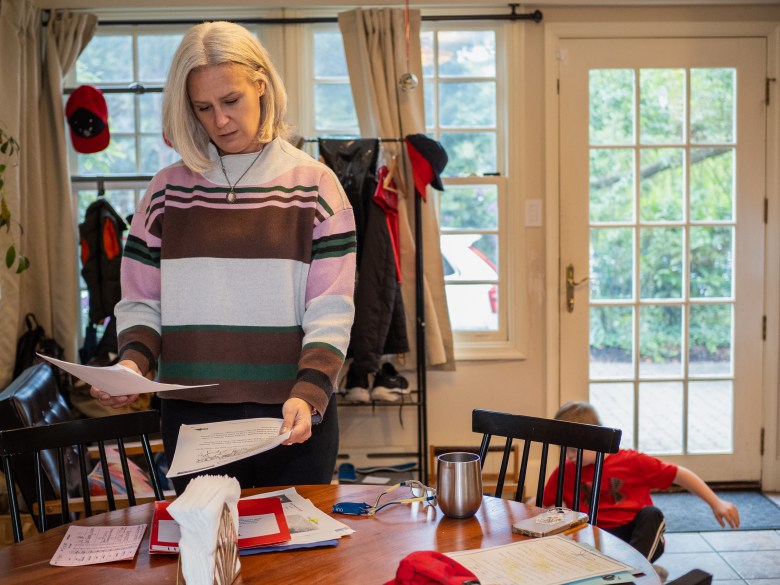
Terri Joyce said her son, who has Down syndrome, has thrived after she fought for him to be included in a general education classroom. Credit: Yunuen Bonaparte for The Hechinger Report
Under federal law, students with disabilities — who once faced widespread outright exclusion from public schools — have a right to learn alongside peers without disabilities “to the maximum extent” possible. That includes the right to get accommodations and help, like aides, to allow them to stay in the general education classroom. Schools must report crucial benchmarks, including how many students with disabilities are learning in the general education classroom over 80 percent of the time.
More than anywhere else in the country, New Jersey students with disabilities fail to reach this threshold, according to federal data. Instead, they spend significant portions of the school day in separate classrooms where parents say they have little to no access to the general curriculum — a practice that can violate their civil rights under federal law.
Just 49 percent of 6- and 7-year-olds with disabilities in the state spend the vast majority of their day in a general education classroom, compared with nearly three-quarters nationally. In some New Jersey districts, it was as low as 10 percent for young learners. Only 45 percent of students with disabilities of all ages are predominantly in a general education classroom, compared to 68 percent nationwide.
For over three decades, the state has faced lawsuits and federal monitoring for its continued pattern of unnecessarily segregating students with disabilities and regularly fails to meet the targets it sets for improving inclusion.
Surrounded mostly by children who had trouble communicating, Terri Joyce’s son’s speech development stalled. He wasn’t exposed to what his peers in the general education classroom were learning — like science and social studies.
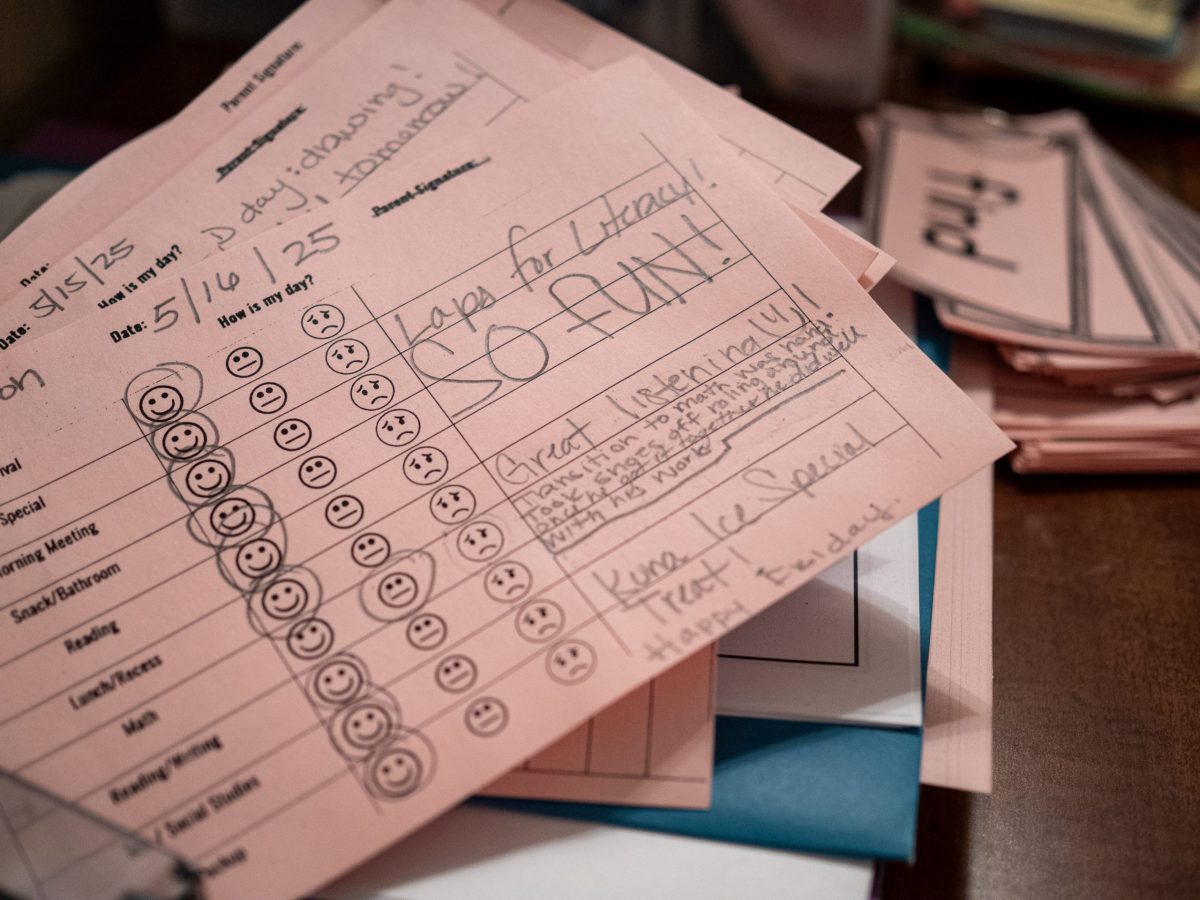
For Terri Joyce, getting her son included in a general education classroom “was a part-time job” and meant staying on top of, and documenting, his academic and social progress. Credit: Yunuen Bonaparte for The Hechinger Report
Joyce tried mediation with the Cinnaminson district but they refused to budge. In the end, she hired a lawyer, filed a due process claim with the state and succeeded in having her son placed in a classroom that included students with and without disabilities the next year, repeating kindergarten to see if he could regain the skills he had lost. The process cost her family thousands of dollars.
Related: Become a lifelong learner. Subscribe to our freeweekly newsletter featuring the most important stories in education.
The Hechinger Report spoke with more than 80 parents, researchers, lawyers, advocates and school officials across the state who described a widespread failure to devote resources to integrating students with disabilities — and a decentralized system that gives enormous power to district leaders, who have long been able to refuse to prioritize inclusion without facing consequences from the state or federal government.
New Jersey is known nationally as a leader in public education, but the state’s governance system has led to inclusion rates that vary dramatically between districts. As a result, a child who is placed in a separate classroom for the entire day in one district could be included all day in a general education classroom in a neighboring one.
“Mindset is the biggest barrier,” said Michele Gardner, executive director of All In for Inclusive Education and previously an administrator for 15 years in the Berkeley Heights district. “There are educators, parents, administrators and physicians who truly believe that separate is better for children with and without disabilities. With more than 600 districts, local control makes change harder.”
Experts say integrating students with disabilities in general education should be easiest, and can be the most beneficial, in the early years. Researchers have found students with and without disabilities — particularly the youngest learners — can benefit when inclusion is done with enough staffing and commitment. Young children also learn from watching each other, and parents worry denying students with disabilities this chance can have lasting damage on them academically and emotionally. Worldwide, inclusion is considered a human right helping all children develop empathy and prepare for society after graduation.
Too often, New Jersey parents say, young learners are placed right away in separate classrooms based on a diagnosis — as Joyce’s son was — rather than an assessment of what support they actually need.
Just over a decade ago, New Jersey settled a class-action lawsuit filed by parents and advocacy groups over student placement, which required years of state monitoring, a new stakeholder committee, and training and technical assistance for districts with the lowest rates of inclusion.
But since then, the proportion of young students in the general education classroom the vast majority of the day actually decreased by about 5 percentage points, from 54 percent in the 2013-14 school year. Nationwide, there was no such drop.
“We are certainly seeing a trend that, even at younger ages, students are being shuttled into segregated schooling and never really starting in inclusive experiences,” Syracuse University inclusive special education professor Christine Ashby said of New Jersey and other states.
Ashby, who also runs the university’s Center on Disability and Inclusion, said students then tend to stay in separate — commonly called self-contained — classrooms, where they may receive individualized instruction alongside peers with disabilities but may be less prepared for life after high school.
For Terri Joyce, the opportunity she fought for her son to have proved worth it. It took him time to adjust, but with the help of an aide, he settled in and, now in first grade, is thriving alongside his general education peers once again.
“It was like night and day,” said Joyce. “His speech improved. He loves school. He has friends. He gets invited to birthday parties.”
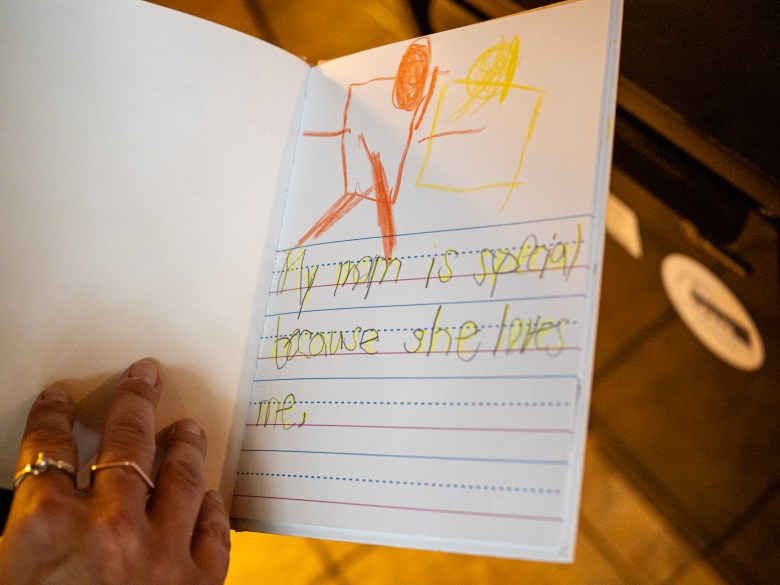
Terri Joyce is happy with how her son’s writing skills have developed in first grade while learning in a general education classroom. Credit: Yunuen Bonaparte for The Hechinger Report
New Jersey Department of Education officials declined a request for an interview, but said in a statement that the agency is working with schools statewide to improve how often students with disabilities are placed in general education classrooms through training, technical assistance and programs promoting inclusion. A new website provides a detailed look at each district’s data, broken down by grade and type of disability.
“All placement decisions must be made on an individual basis and there is no one-size-fits all standard or outcome that should be applied to every district, school or student,” Laura Fredrick, the department’s communication director, said in the emailed statement.
Fredrick said districts that fail to meet state goals for increasing inclusion may face more intensive monitoring, but there are no direct financial penalties or automatic consequences for failing to improve. She also noted that the state pays for voluntary trainingto increase inclusion in K-12 schools.
That program has helped in some districts, but a limited number of schools have participated so far and space is limited — some that have applied for the training have been turned away.
In Cinnaminson, district officials said they could not comment on specific students but that school officials and parents work together on placement decisions.
“To the fullest extent possible, we strive to place students in general education classrooms for the most inclusive educational experience,” Superintendent Stephen Cappello said in a statement.
Some experts said the data suggests that, unlike other states, New Jersey districts do a good job providing individualized services that students need. Autism New Jersey clinical director Joe Novak said in contrast, “There are certain districts, or states, where the default may simply be to place the child in general education and say, ‘Well, best of luck.’”
Indeed a frequent complaint from some parents is the lack of specialized services in general education classrooms, especially because of staffing shortages or lack of expertise. In those cases a student may be counted as included in a general education classroom but without the support they need, which advocates on both sides of the debate say can be harmful.
“New Jersey is probably doing a lot of things right, because it means we’re probably really customizing what makes sense for the individual,” Novak said
Yet others say the state can improve inclusion rates that are sharply lower than the nation’s.
The federal government doesn’t say how many students should be included or for how much of the school day. States set targets for inclusion rates but typically don’t fine or sanction districts for not meeting them. States can also take other steps like requiring training or administrative changes for districts. Advocates say New Jersey districts have little to lose for repeatedly falling below the state’s own targets for including children with disabilities.
Left out
New Jersey has the nation’s lowest inclusion rates for students with disabilities. The Hechinger Report investigated why — and visited places that show how it doesn’t need to be that way.
Do you have experiences with special education you’d like to share with our journalists?
Oversight from the federal government could also diminish going forward. Although the Trump administration pledges to continue funding special education, advocates warn the planned dismantling of the Department of Education, including its civil rights enforcement arm, will harm students with disabilities.
“It’s sort of petrifying, from my end, for these families,” said Jessica Weinberg, a former New Jersey school district attorney who now runs a special education law firm.
“It could be completely disbanded,” she said of the Education Department. “The uncertainty is really unsettling.”
Federal law says students should be placed in separate classrooms “only if” they can’t learn in the general education classroom with services detailed in IEPs, or individualized education programs — the document that outlines a student’s needs, the services they should receive and where they’ll receive them. Teachers, school officials and parents sit on their child’s IEP team, which is supposed to review placement decisions each year.
And parents across New Jersey say it takes time and money to fight for access to general education classrooms — which means whether a child is included can reflect existing racial disparities and whether families can afford lawyers and advocates. Parents say when a school argues their child must be taught separately, their best way of fighting that decision is lawyers and experts — if they can afford it.
Districts with less poverty and a larger share of white students tend to have higher inclusion rates and test scores, according to The Hechinger Report’s analysis of state data. Overall, just 37 percent of Black students in kindergarten, first or second grade in New Jersey are included in the general education classroom for the vast majority of the school day, compared to half of white students.
It’s challenging to get special education services in urban and lower-income districts in the first place, said Nicole Whitfield, a mother of a child with a disability who founded an advocacy group in Trenton for families fighting for special education services.
Urban “districts are so overloaded with so many kids, they don’t do a good job in managing it,” she said.
In all districts, arguments against including more students often hinge on money. Administrators may say they can’t afford all the services every child needs, like an aide assigned to work with one child, and some parents worry providing comprehensive services could strain budgets or cut services for students without disabilities. As special education costs rise, the federal government has long failed to provide as much special education funding as it pledged.
The way New Jersey funds schools doesn’t consider how many students have disabilities. The governor’s proposed budget for the upcoming school year would take that into account and increase overall special education spending by about $400 million — though some districts will lose money. Lawmakers are debating the governor’s proposal, which has some support from the chair of the state Senate Education Committee, Sen. Vin Gopal.
Yet districts spend hundreds of millions of dollars a year to pay tuition at private schools ($784 million last year statewide) and fight legal battles — money advocates say could boost public special education.
It cost Washington Township school district about $90,000 to send Nicole Lannutti’s daughter, who is non-verbal and has a developmental delay, to a private preschool for a year rather than educate her in one of its schools.
“If you can come up with the money for lawsuits, why can’t you put it into the district right now?” Lannutti said. “That makes no sense.”
Washington Township school district did not respond requests for comment.
Whittier Elementary School in Teaneck, New Jersey, rearranged its classrooms to improve how many students with disabilities are included in classes with their peers. Credit: Meredith Kolodner/The Hechinger Report
In some districts, officials say inclusion doesn’t cost more in the long run, even if there are upfront costs. Administrators in Sparta Township, for example, said improving inclusion rates didn’t require more spending. Its schools got help from the New Jersey Inclusion Project — the state-funded training program that helps districts provide students with the least restrictive learning environment appropriate for them.
“[It] has really changed the way we educate our students,” said Adrienne Castorina, Sparta’s director of special services. Teachers found that they were able to provide specialized instruction in reading inside a general education classroom, for example, instead of pulling children out and teaching them in separate rooms.
In 2024, a special education parent advisory committee in Bernards Township School District asked administrators to apply to the New Jersey Inclusion Project. Parents thought the program would be a no-cost, collaborative path forward.
District officials refused.
Many parents in the wealthy district say Bernards’ classroom staff are committed and skilled, but they also say there’s an unwritten policy of separating children based on their diagnosis — close to three-quarters of children with autism, for example, spend the vast majority of their day without contact with their general education peers.
For years, Trish Sumida pleaded with staff at her daughter’s elementary school in Bernards to allow her to have contact with her non-disabled peers. But every day, starting in kindergarten, she learned only alongside other children with autism. Most years, she was the only girl in the room, and she longed for someone to play with who shared her interests.
“Those early years are so important,” said Sumida, whose daughter is now in fifth grade and still spends most of her time in a separate classroom. “I feel like we’ve missed our window.”
Many Bernards parents are particularly frustrated by the refusal to set up co-taught classrooms, a nationally used approach where a general education and special education teacher work together to educate students with and without disabilities.
Jean O’Connell, Bernards’ director of special services, rejected the idea of co-taught classes in elementary school, saying they made it harder to support individual students, particularly in reading. “We had this model in place for many years and found it ineffective,” she said in an email.
Research suggests even students with significant disabilities can learn alongside general education peers with help from co-teachers or paraprofessionals. And a large body of evidence suggests inclusion doesn’t harm learners with or without disabilities.
Some scholars say inclusion research is flawed because students who appear to benefit may need less support and have fewer academic struggles. Such experts point out that a separate classroom may be the appropriate setting for some children, who could languish without intensive support in a general education classroom. And schools with high inclusion rates on paper may place students with disabilities in general education without needed aides and accommodations — which federal data does not capture.
Even a prominent researcher who has questioned the benefits of inclusion, however, said most children don’t need to be taught separately all day.
“Most students with disabilities do not need very intensive forms of instruction,” said Vanderbilt University special education professor Douglas Fuchs.
O’Connell did not respond to questions about why Bernards refused to participate in the New Jersey Inclusion Project and said only that the district has participated in inclusion workshops. She added that the district has no “blanket district-wide policy on inclusion” and involves parents in all placement decisions.
Yet several Bernards parents said they met intense resistance from administrators. One mom said her child who has autism that requires limited support was in an inclusion classroom for pre-K without any problems, but Bernards administrators insisted he be placed in a self-contained classroom for kindergarten.
“He would cry to me every morning and say he didn’t want to go to school,” said the mom, who asked not to be named, afraid her child could experience discrimination because of his disability if identified. “I just felt heartbroken every day.”
She tried repeatedly to have him moved, eventually turning to mediation and filing a complaint with the state. Ultimately, she felt her child couldn’t wait for a resolution. She moved to another district last fall, where he learns alongside his general education peers all day. She said her child is now happy and doing well academically and socially.
Other districts that have struggled with low levels of inclusion have embraced outside help — including from the Inclusion Project. The program helped Whittier Elementary School in Teaneck create its first co-taught classrooms two years ago. Teachers there said the shift requires a lot of planning and they wish they had more staff to provide support, but they’ve seen their students develop academically and socially.
“When you think about the conversations that kids have — turn to your partner, talk to your table, those opportunities aren’t there in self-contained,” said Janine Lawler, who has been a special education teacher for 18 years, mostly in self-contained classrooms, and is now co-teaching in a first-grade class.
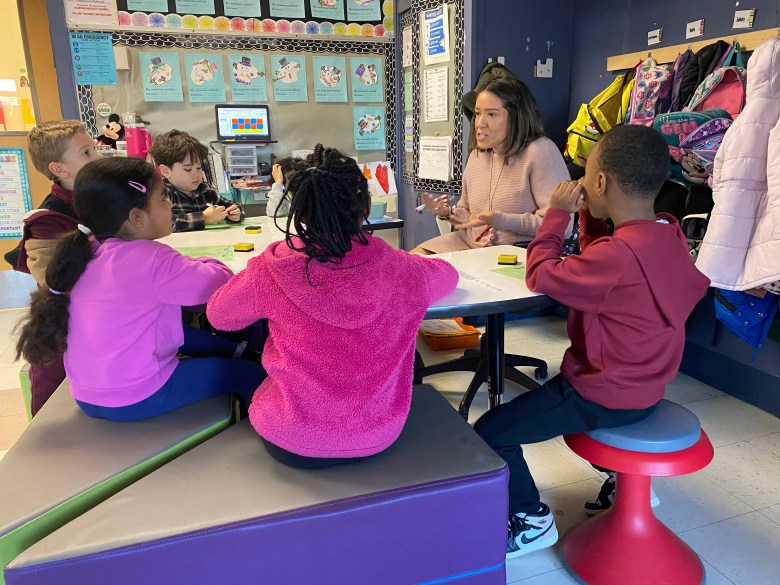
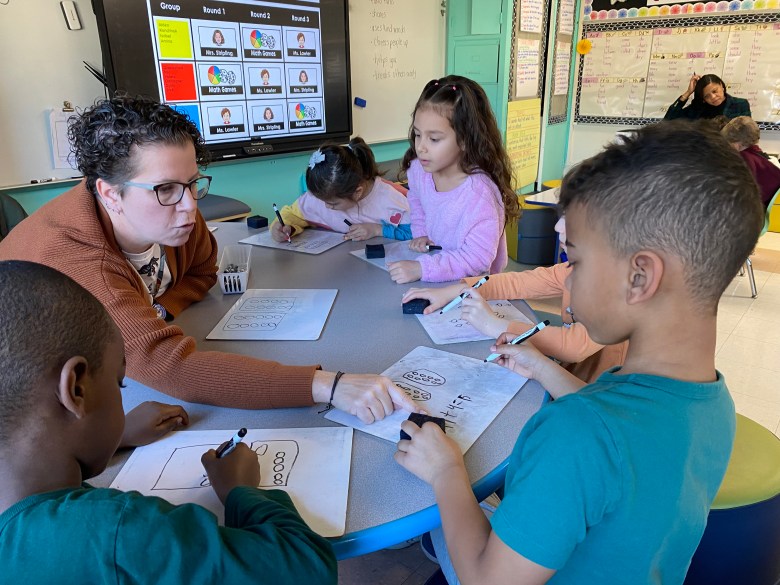
Janine Lawler teaches math to a group of first graders in Teaneck, New Jersey. Her classroom includes students with and without disabilities. Credit: Meredith Kolodner/The Hechinger Report
Educators say they can provide intensive instruction without having to separate children for large portions of the day.
“Do we have to isolate young people to give them a service, or can we include them and provide the same service or greater service?” said André Spencer, superintendent of Teaneck Public Schools. “We believe we can include them.”
For decades, New Jersey education officials have failed to support or pressure districts to improve their inclusion rates. A 2004 report found a lack of consequences — such as financial penalties — for New Jersey districts who repeatedly failed to increase inclusion of students with disabilities despite years of promises to improve.
“There’s a culture in New Jersey, which is that you teach kids with impairments in segregated classes,” said Carol Fleres, a long-time special education administrator in New Jersey who is now a special education professor and department co-chair at New Jersey City University.
A 2018 report by the National Council on Disability, an independent federal agency, found “serious contradictions” in New Jersey’s regulations that lay out how schools have to provide special education services. For example: The state categorizes students as having mild, moderate or severe disabilities and says that students with similar behavioral or academic needs should be grouped together.
Those issues make it easy for New Jersey schools to lump students with disabilities together in violation of federal requirements, according to the report.
A spokesman for New Jersey’s education department defended the regulations as doing the opposite. “This arrangement helps ensure that students who require more individualized instruction, especially those whose needs cannot be met in a general education setting, even with supplementary aids and services, are educated in smaller, more supportive environments,” Michael Yaple said in an email.
Despite settlements and scrutiny, advocates want more accountability: New Jersey’s State Special Education Advisory Council, which advises the state Education Department on special education issues, recommended required training for districts with low inclusion rates.
Special education parent and advocate Amanda Villamar, who works with families throughout New Jersey, said education officials try to educate the state’s over 600 school districts — but those efforts only go so far.
“We have a lot of districts that just say: ‘Well, it’s guidance. We don’t have to do it,’” Villamar said. “They literally just don’t even give it the time of day. Then you have other districts that put a lot of work and thought and effort into it.”
Lawyers representing families said young children with behavioral challenges or intellectual disabilities often wind up in separate classrooms for years, even if behaviors improve. Promises of inclusion in gym class or at lunch don’t always happen, they said.
Many parents said they felt forced to agree to separate classrooms, with the promise of inclusion, eventually. That day never came.
“Once you start restricting them, how are you going to get them back and get them increasingly more time within the classroom?” said Elizabeth Alves, a member of the State Special Education Advisory Council.
For Terri Joyce’s son, learning in the co-taught classroom meant accessing the general education curriculum, including social studies. The lessons on civil rights inspired him.
“He became obsessed with Martin Luther King,” she said. “He still will sit for hours and watch YouTube videos of his speeches.”
Like other students with disabilities, her son’s IEP is subject to an annual review, which means that inclusion in the general education classroom isn’t guaranteed in the years to come. Joyce says that means constant vigilance in a process that feels like a part-time job.
But her efforts to have her son included are about more than academics. He’s on the flag football team. He rides the school bus. Other kids recognize him and say hello in the grocery store.
“It’s much bigger than just his education and being included in the classroom,” she said. “Being included in school means he’s more included in life, and he’s more included in our community, and he’s more valued.”
The Hechinger Report provides in-depth, fact-based, unbiased reporting on education that is free to all readers. But that doesn’t mean it’s free to produce. Our work keeps educators and the public informed about pressing issues at schools and on campuses throughout the country. We tell the whole story, even when the details are inconvenient. Help us keep doing that.
Math anxiety isn’t just about feeling nervous before a math test. It’s been well-known for decades that students who are anxious about math tend to do worse on math tests and in math classes.
But recently, some of us who research math anxiety have started to realize that we may have overlooked a simple yet important reason why students who are anxious about math underperform: They don’t like doing math, and as a result, they don’t do enough of it.
We wanted to get a better idea of just what kind of impact math anxiety could have on academic choices and academic success throughout college. In one of our studies, we measured math anxiety levels right when students started their postsecondary education. We then followed them throughout their college career, tracking what classes they took and how well they did in them.
We found that highly math-anxious students went on to perform worse not just in math classes, but also in STEM classes more broadly. This means that math anxiety is not something that only math teachers need to care about — science, technology and engineering educators need to have math anxiety on their radar, too.
We also found that students who were anxious about math tended to avoid taking STEM classes altogether if they could. They would get their math and science general education credits out of the way early on in college and never look at another STEM class again. So not only is math anxiety affecting how well students do when they step into a STEM classroom, it makes it less likely that they’ll step into that classroom in the first place.
This means that math anxiety is causing many students to self-sort out of the STEM career pipeline early, closing off career paths that would likely be fulfilling (and lucrative).
Our study’s third major finding was the most surprising. When it came to predicting how well students would do in STEM classes, math anxiety mattered even more than math ability. Our results showed that if you were a freshman in college and you wanted to do well in your STEM classes, you would likely be better off reducing your math anxiety than improving your math ability.
We wondered: How could that be? How could math anxiety — how you feel about math — matter more for your academic performance than how good you are at it? Our best guess: avoidance.
If something makes you anxious, you tend to avoid doing it if you can. Both in our research and in that of other researchers, there’s been a growing understanding that in addition to its other effects, math anxiety means that you’ll do your very best to engage with math as little as possible in situations where you can’t avoid it entirely.
In some of our other work, we found that math-anxious students were less interested in doing everyday activities precisely to the degree that they thought those activities involved math. The more a math-anxious student thought an activity involved math, the less they wanted to do it.
If math anxiety is causing students to consistently avoid spending time and effort on their classes that involve math, this would explain why their STEM grades suffer.
What does all of this mean for educators? Teachers need to be aware that students who are anxious about math are less likely to engage with math during class, and they’re less likely to put in the effort to study effectively. All of this avoidance means missed opportunities for practice, and that may be the key reason why many math-anxious students struggle not only in math class, but also in science and engineering classes that require some math.
Math anxiety researchers are at the very beginning of our journey to understand ways to make students who are anxious about math stop avoiding it but have already made some promising suggestions for how teachers can help. One study showed that a direct focus on study skills could help math-anxious students.
Giving students clear structure on how they should be studying (trying lots of practice problems) and how often they should be studying (spaced out over multiple days, not just the night before a test) was effective at helping students overcome their math anxiety and perform better.
Especially heartening was the fact that the effects seen during the study persisted in semesters beyond the intervention; these students tended to make use of the new skills into the future.
Math anxiety researchers will continue to explore new ways to help math-anxious students fight their math-avoidant proclivities. In the meantime, educators should do what they can to help their students struggling with math anxiety overcome this avoidance tendency — it could be one of the most powerful ways a math teacher can help shape their students’ futures.
Rich Daker is a researcher and founder of Pinpoint Learning, an education company that makes research-backed tools to help educators identify why their students make mistakes. Ian Lyons is an associate professor in Georgetown University’s Department of Psychology and principal investigator for the Math Brain Lab.
The Hechinger Report provides in-depth, fact-based, unbiased reporting on education that is free to all readers. But that doesn’t mean it’s free to produce. Our work keeps educators and the public informed about pressing issues at schools and on campuses throughout the country. We tell the whole story, even when the details are inconvenient. Help us keep doing that.
For the last four years, school and public libraries have been drawn into a culture war that seeks to censor, limit and discredit diverse perspectives.
Yet time and time again, as librarians have been encouraged or even directed to remove books that include LGBTQ+, Black, Latino and Indigenous characters or themes or history from their collections, they have said no.
When librarians said no, policy changes were submitted and laws were proposed — all in the name of controlling the library collection.
Some librarians lost their jobs. Some had their lives threatened. Legislators proposed bills that attempt to remove librarians’ legal protections, strive to prevent them from participating in their national professional associations, seek to limit some materials to “adults only” areas in public libraries and threaten the way library work has been done for decades.
Here’s why this is wrong. For generations, libraries have been hubs of information and expertise in their communities. Librarians and library workers aid in workforce development, support seniors, provide resources for veterans, aid literacy efforts, buttress homeschool families —among many other community-enriching services. Your public library, the library in your school and at your college, even those in hospitals and law firms, are centers of knowledge. Restrictions such as book bans impede their efforts to provide information.
Related: Become a lifelong learner. Subscribe to our free weekly newsletter featuring the most important stories in education.
Professional librarians study the First Amendment and understand what it means to protect the right to read. We provide opportunities for feedback from our users so that they have a voice in decision-making. We follow a code of ethics and guidelines to make the best selections for our communities.
It is illegal for a library to purchase pornographic or obscene material; we follow the law established by the Supreme Court (Miller v. California, 1973). That decision has three prongs to determine if material meets the qualifications for obscenity. If the material meets all three, it is considered obscene and does not have First Amendment protection.
But our procedures have been co-opted, abused and flagrantly ignored by a small and vocal minority attempting to control what type of information can be accessed by all citizens. Their argument, that books are not banned if they are available for purchase, is false.
When a book or resource is removed from a collection based on a discriminatory point of view, that is a book ban.
Librarians follow a careful process of criteria to ensure that our personal biases do not intervene in our professional work. Librarians have always been paying attention. In 1939, a group of visionary librarians crafted the Library Bill of Rights to counter “growing intolerance, suppression of free speech and censorship affecting the rights of minorities and individuals.” In 1953, librarians once again came together and created the Freedom to Read Statement, in response to McCarthyism.
You may see a similar censorship trend today — but with the advent of the internet and social media, the speed at which censorship is occurring is unparalleled.
Much of the battle has focused on fears that schoolchildren might discover books depicting families with two dads or two moms, or that high school level books are available at elementary schools. (Spoiler alert: they are not.)
The strategy of this censorship is similar in many localities: One person comes to the podium at a county or school board meeting and reads a passage out of context. The selection of the passage is deliberate — it is meant to sound salacious. Clips of this reading are then shared and re-shared, with comments that are meant to frighten people.
After misinformation has been unleashed, it’s a real challenge to control its spread. Is some subject matter that is taught in schools difficult? Yes, that is why it is taught as a whole, and not in passages out of context, because context is everything in education.
Librarians are trained professionals. Librarians have been entrusted with tax dollars and know how to be excellent stewards of them. They know what meets the criteria for obscenity and what doesn’t. They have a commitment to provide something for everyone in their collections. The old adage “a good library has something in it to offend everyone” is still true.
Thankfully, there are people across the country using their voices to fight back against censorship. The new documentary “Banned Together,” for example, shows the real-world impact of book banning and curriculum censorship in public schools. The film follows three students and their adult allies as they fight to reinstate 97 books pulled from school libraries.
Ultimately, an attempt to control information is an attempt to control people. It’s an attempt to control access, and for one group of people to pass a value judgment on others for simply living their lives.
Libraries focus on the free expression of ideas and access to those ideas. All the people in our communities have a right to read, to learn something new no matter what their age.
Lisa R. Varga is the associate executive director, public policy and advocacy, at the American Library Association.
This story about book bans was produced byThe Hechinger Report, a nonprofit, independent news organization focused on inequality and innovation in education. Sign up for Hechinger’s weekly newsletter.
The Hechinger Report provides in-depth, fact-based, unbiased reporting on education that is free to all readers. But that doesn’t mean it’s free to produce. Our work keeps educators and the public informed about pressing issues at schools and on campuses throughout the country. We tell the whole story, even when the details are inconvenient. Help us keep doing that.
Here’s a true story from North Carolina. Two elementary school children under the age of 10 waited for their parents to come home. We know they cleaned the dishes; the house was immaculate when someone finally came.
The children did not attend school for a number of days. After three days, someone from their school reached out to a community member with concern for their well-being.
While they were home alone instead of in school, the children made their own food and drank water. Their parents, who had been detained by ICE, had nurtured these skills of independence, so the children were not yet hungry or thirsty when someone finally came.
Similar scenes are likely happening across the U.S. as President Trump aggressively steps up efforts to deport undocumented immigrants. The new policies sweeping the nation deeply affect and harm our children.
Teachers: This is the moment when we need to rise to the occasion, because children are being wronged in uncountable ways. Protections that allow them to express their gender identities are under threat. Their rights to learn their diverse histories and understand the value of their communities are being chipped away bit by bit.
These threats, one at a time, layer after layer, amount to profound harm. So let us be especially vigilant.
The responsibility to challenge these threats cannot fall solely on the shoulders of individual teachers. We must have systems in place that allow us to swiftly raise concerns about student well-being.
Schools, districts, and states must provide resources and structures — like wellness checks, counseling and communication with community services — that allow us to act swiftly when the safety of our students is at risk.
As public servants, we must live out our charge to protect and advocate for the children we serve by taking immediate action to ensure their safety in whatever ways we are able. That means actively noticing when students are missing and when they are struggling.
Public education has long wrestled with the role of politics in schools. No matter how we answer questions about political content, educators have been unified in the goal of nurturing children’s thinking and flourishing.
Our state constitution and many others’ declare that all children are entitled to a “sound basic education,” and our professional responsibilities extend to their safety. In North Carolina, the first category of thecode of ethics for educators pertains to professional ethical commitments to students.
To uphold these professional commitments, the educator “protects students from conditions within the educator’s control that circumvent learning or are detrimental to the health and safety of students.”
This protection must be more than theoretical. When our students are at risk, we have our constitutional guarantees and ethical commitments.
The brutal example of the children whose parents were taken away is one of many. We cannot fathom all that the children needed to know in order to survive those harrowing few days alone in their home. We do know they were ready.
We can assume that perhaps they read their favorite books or calculated measurements while cooking themselves dinner, utilizing skills they learned in our classrooms. What we do know is that the knowledge taught to them by their families and community ensured their safety.
The community member who ultimately went to check in on the missing students used a “safe word” — one that the children had been taught to listen for before ever opening their door to a stranger.
The children did not open the door until that word was spoken. Hearing that word, they reportedly asked: “Are Mommy and Daddy OK? ICE?”
These are the lessons young children are living by today. Safe words to protect themselves from adults who prey on their families. Skills of survival to hide at home, cooking and caring for themselves without seeking help from others if they find themselves alone.
A protective silence now envelops all the children in the community where those parents were seized. An example has been made and now those in their community are hiding in fear or fleeing. The idea that this example is a model to be followed is a transgression of our ethical compact to care for these children, who are no longer in school, due to their fear, hiding with family members.
Recognizing, acting on and speaking back to this injustice is precisely the sort of resistance and professionalism that binds our practice as educators. It is what we write of today.
The children were ready. Educators need to be as well.
We must use our voices to illuminate the harm being done to the children we know, honor and teach. Let us replace silences with spoken truths about their power and ours to survive and to resist; let us live out the expectation that public service must be enacted with humanity.
We have a professional responsibility to not look away. This is not just a moral argument. We are their teachers, and we must ask: How will the students in my classroom survive? And how can we help them?
Simona Goldin is a research professor in the Department of Public Policy at the University of North Carolina. Debi Khasnabis is a clinical professor at the University of Michigan’s Marsal School of Education.
The Hechinger Report provides in-depth, fact-based, unbiased reporting on education that is free to all readers. But that doesn’t mean it’s free to produce. Our work keeps educators and the public informed about pressing issues at schools and on campuses throughout the country. We tell the whole story, even when the details are inconvenient. Help us keep doing that.
Early this month, the U.S. Department of Education issued an ultimatum to K-12 public schools and state education agencies: Certify that you are not engaging in discrimination under the banner of diversity, equity and inclusion, or risk losing federal funding — including billions in support for low-income students.
The backlash was immediate. Some states with Democratic governors refused to comply, arguing that the directive lacks legal basis, fails to clearly define what constitutes “illegal DEI practices,” and threatens vital equity-based initiatives in their schools.
After lawsuits from the National Education Association teachers union and the American Civil Liberties Union, the Department of Education agreed to delay enforcement until after April 24.
But states across the country, both liberal- and conservative-led, are worried about losing other aid: the pandemic-era money that in some cases they’ve already spent or committed to spending.
The Department of Education has long played a critical role in distributing federal funds to states for K-12 education, including Title I grants to boost staffing in schools with high percentages of low-income students, and emergency relief like that provided during the COVID-19 pandemic.
Conservative-led states — particularly Mississippi, South Dakota and Arkansas — rely the most heavily on these funds to sustain services in high-need districts.
The 15 states with the highest percentage of their K-12 budget coming from federal funding in fiscal year 2022 — the latest year with data available from the National Center for Education Statistics — voted for Trump in the 2024 presidential election. Similarly, 10 of the 15 states receiving the highest amounts of Title I funding in fiscal year 2024 also voted for Trump.
Mississippi and Kentucky have sent letters to the Department of Education expressing concern over halted pandemic aid.
The clash over federal funding comes even as the future of the Department of Education is murky, given President Donald Trump’s pledge to dismantle the department.
DEI-related cuts
In letters to the Department of Education, state officials and superintendents in Illinois, New York and Wisconsin pushed back against the DEI directive.
New York officials said they would not provide additional certification beyond what the state already has done, asserting that there “are no federal or State laws prohibiting the principles of DEI.” Illinois Superintendent Tony Sanders wrote that he was concerned that the Department of Education was changing the conditions of federal funding without a formal administrative process. Wisconsin Superintendent Jill Underly questioned the legality of the order.
New York State Department of Education Counsel and Deputy Commissioner Daniel Morton-Bentley noted that the federal department’s current stance on DEI starkly contrasts with its position during Trump’s first term, when then-Education Secretary Betsy DeVos supported such efforts.
Colorado and California also confirmed they would not comply with the Department of Education’s order.
While some states with liberal leaders are gearing up for legal battles and possible revocation of funding, conservative-led states such as Florida have embraced the federal directive as part of a broader push to reshape public education.
In March, the Department of Education abruptly rescinded previously approved extensions of pandemic-era aid, ending access to funds months ahead of the original March 2026 deadline.
When the Massachusetts governor’s office voiced concern over that decision, the federal department’s reply on social media was blunt: “COVID is over.”
Sixteen mostly Democratic-led states and the District of Columbia filed a federal lawsuit against the Department of Education and Secretary Linda McMahon, challenging the abrupt rescission of previously approved extensions for spending COVID-19 education relief funds.
But backlash against abrupt federal cuts to education has not been limited to blue states.
Mississippi’s Department of Education warned the cuts would jeopardize more than $137 million in already obligated funds, slated for literacy initiatives, mental health services and infrastructure repairs. “The impact of this sudden reversal is detrimental to Mississippi students,” state Superintendent Lance Evans wrote in a letter to McMahon.
The letter also outlines the state’s repeated — but unsuccessful — efforts to draw down millions in approved funds since February.
Shanderia Minor, a spokesperson for the Mississippi education department, told Stateline the agency is awaiting next steps and direction about the funds and federal directives.
In Kentucky, state Education Commissioner Robbie Fletcher told districts — which stand to lose tens of millions in pandemic aid — that abrupt federal changes leave them “in a difficult position,” with schools already having committed funds to teacher training and facility upgrades.
According to Kentucky Department of Education spokesperson Jennifer Ginn, the state has about $18 million in unspent pandemic aid funds left to distribute to districts. And districts have about $38 million in unspent funds, for a total $56 million that could be lost.
Lauren Farrow, a former Florida public school teacher, told Stateline that schools that receive Title I money are already underfunded — and the federal threat only widens the gap.
“Florida is pouring billions into education — but where is it going? Because we’re not seeing it in schools, especially not in Title I schools,” said Farrow. “I taught five minutes away from a wealthier school, and we didn’t even have pencils. Teachers were buying shoes for students. Why is that still happening?”
Effects in the classroom
Tafshier Cosby, senior director of the Center for Organizing and Partnerships at the National Parents Union, a parents advocacy group, told Stateline that while most families don’t fully understand the various school funding systems, they feel the impact of cuts in the classroom.
Cosby said parents are worried about the loss of support services for students with disabilities, Title I impacts, and how debates about DEI may deflect from more urgent needs like literacy and teacher support.
“We’ve been clear: DEI isn’t the federal government’s role — it’s up to states,” she said. “But the confusion is real. And the impact could be devastating.”
Today, as a consultant working with teachers across Florida’s Orange County Public Schools — one of the largest districts in the country — Farrow says many educators are fearful and confused about how to support their students under changing DEI laws.
“Teachers are asking, ‘Does this mean I can’t seat a student with glasses at the front of the room anymore?’ There’s so much fear around what we’re allowed to do now.”
“There’s no one giving teachers guidance or even basic acknowledgment. We’re just left wondering what we’re allowed to say or do — and that’s dangerous.”
Amanda Hernández contributed to this report. Stateline reporter Robbie Sequeira can be reached at [email protected].
Stateline is part of States Newsroom, a nonprofit news network supported by grants and a coalition of donors as a 501c(3) public charity. Stateline maintains editorial independence. Contact Editor Scott S. Greenberger for questions: [email protected].