Tag: Teaching

  • How we designed a space where our students connect, collaborate, and flourish

    How we designed a space where our students connect, collaborate, and flourish

    Key points:

    Our charter school, Westbrook Academy, has been serving middle and high school students in the South Los Angeles area for the past six years and stands as a beacon of opportunity for our community. With a student body comprising nearly 99 percent Black and Latinx individuals hailing from historically under-resourced communities, we confront the realities of poverty and the accompanying insecurities head-on.

    Despite the odds, our 400 students consistently demonstrate remarkable resilience and a profound capacity for excellence. Our institution is supported by generous donors and funding sources. Operated and managed by the education nonprofit LA Promise Fund, which provides students with academic and enrichment opportunities that support our mission to spark passion, empower leadership, and prepare them for their chosen college and career paths.

    At one point, our high school students were learning in a church because we didn’t have a traditional classroom set-up. We also lacked the equipment that a traditional high school might have. This changed when we moved into our forever home in South Gate, where an on-campus Empowerment Center serves as a modern, welcoming “student hub.”

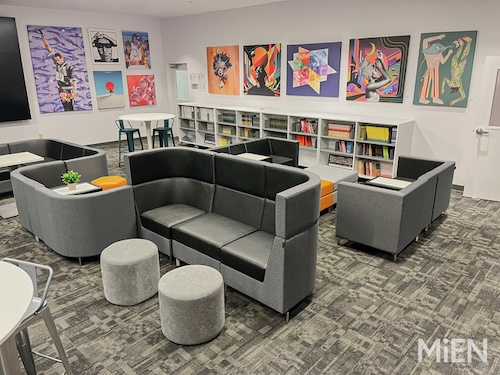
    Designed and outfitted by MiEN and Meteor Education, the Empowerment Center is where kids go to hang out, collaborate, and/or participate in school club activities. The hub is also set up with two wellness rooms where students can go to debrief and disconnect from a long day or just the stresses of being a student. It’s there for the students’ use.

    Here are the steps we took to create a space that consistently makes jaws drop and impresses parents who never thought their children would have access to such a warm, welcoming communal space on campus:

    • Add some flexibility into the process. Our original goal was to open the Empowerment Center’s doors in time for the 2023-24 school year, but getting it done the right way would require a bit more time. Our partners were willing to listen to us in terms of what we wanted to create, but within the realistic timelines. That was really cool.
    • Acknowledge the financial limitations. We largely relied on fundraising for this project and knew that some things just weren’t going to be realistic. To other schools in similar situations, I’d recommend staying flexible enough to hit the timelines and get all of the bases covered while keeping student needs in mind. We can have all the bells and whistles, but at the end of the day, if the car runs, the car runs. We know we can always add a new paint job later.
    • Get the right partners onboard early. As we went through the steps of designing the Empowerment Center, we learned a lot about architecture, planning, and construction. Through it all, having the right partners in its corner helped the school achieve its goals within budget and on time. It was really great to have our design and furniture partners sharing their best practices and other insights with us. We knew what we wanted to do, and a lot of the ideas came from our families and students. We just needed them to show us how we could get those ideas as close to reality as possible.
    • Make it personal. Special features we wanted in our Empowerment Center included a huge, interactive flatscreen TV that students, teachers, and guest speakers use to interact and work together. There’s also a large selection of donated books, the latest technology tools, and artwork that was personally selected by an art curation team. They were able to secure artists from the LA community to create and share visuals that our students are really familiar with. For example, some of the artwork spotlights female empowerment (i.e., with photos of authors like Octavia Butler) and the importance of acknowledging indigenous people. Everything in the hub is meant to spark curiosity. 
    • Brace yourself for some jaw-dropping moments. At our ribbon-cutting ceremony last year, our parents’ jaws were on the floor. They just never thought these resources would be available to their kids. A lot of them grew with us being in the church and a co-located space, and then we asked them to trust us to deliver on our promise, and now we’re able to show that as the reward for supporting us. We feel really proud that our parents were just over the moon about it.

    Hitting it out of the park

    Reflecting on the process we put in place to get our modern student hub designed, built, and open for business, I can say that the end result is an engaging, collaborative space that can be used for hanging out, structured learning, or a little of both. I think we really hit the ball out of the park with this innovative space.

    Student, teacher, and family feedback on the Empowerment Center has been extremely positive. Everyone loves it, and students are always excited to come and spend time in the modern, comfortable space that’s equipped with the technology and tools they need to be able to learn and engage.

    Latest posts by eSchool Media Contributors (see all)

    Source link

  • Teaching Students Practical Life Skills

    Teaching Students Practical Life Skills

    Higher education is designed to prepare students for their future lives and careers by imparting technical and soft skills, but what about practical, hands-on tasks, like managing a home or vehicle?

    A 2023 survey found that young adults lack practical life skills, with two-thirds (68 percent) of millennials and Gen Z unable to change their car oil, nearly half (48 percent) unable to change a tire and 46 percent unable to tie a tie. Eighty percent of Gen Z respondents said they do not feel like they have figured out adulting.

    A workshop series at George Mason University in Virginia, titled Now What?, helps build students’ practical knowledge and well-being by giving them life advice and skills, such as how to change a tire.

    In this episode of Voices of Student Success, host Ashley Mowreader spoke with Ethan Carter, associate director of programs, well-being and assessment, and graduate student assistant Dianna Philipps, to learn more about the program offerings and how it supports student success.

    An edited version of the podcast appears below.

    Inside Higher Ed: I wonder if we can just start by talking about the inspiration for this program. Where did the idea come from?

    Ethan Carter: I came up with the idea, because as a [student activities] programmer, it is difficult to replicate things. When I thought a lot about being a college student—which was several years ago—I was like, “Man, what were the things that I wish I had known back then?” And so I kind of tried to think about something catchy, and I said, “Well, there were lots of things— I would do something, and then I’d be like, ‘So now what?’’ And so I was like, “Oh, that would be a really good little catchy phrase.”

    Also, from a programming standpoint, it is very adaptable to what we want to do. I don’t have to replicate my programs, but we can have the theme of Now What?, and seeking what students would want to know more about in their lives. Not that what I wanted to learn was bad. It was just, things change.

    Inside Higher Ed: When you address that question of Now What?, what are some of the themes you all have talked about? What has programming looked like practically?

    Dianna Philipps: One of our main ones would be the “how to change a tire” one. I feel like most people on campus have a car, [but] they don’t really think of the things that come with having a car.

    So when you see the tire-changing [workshop], you’re like, “Oh, what if I do get a flat tire? Like, maybe I should learn how to handle that if I’m on my own on the road or something.” I feel like things like that really stand out to students when they see it.

    Inside Higher Ed: Something I thought was cool is that your roles focus on well-being and recreation and this program is an interesting intersection of those two ideas. I wonder if you can talk about how this contributes to students’ well-being and thriving on campus.

    Carter: When you work on a college campus, and the big theme behind the campus is about well-being, you try and find out, where do you fit? And for us, it wasn’t just in the fitness realm. We wanted to think about something that was what we would consider our niche.

    I settled on practical well-being because it is adaptable and relatable. Recreation is usually seen as something that does provide movement, but I wanted to capitalize on that and build off of the aspect of, just, living in general can be tough. It also opens the door for us to be able to partner, because a lot of our programs within themselves are not things that we run, and it’s not our expertise, but it is a place where we can be a hub and connect individuals, which kind of ties in with the well-being aspect, like, you need to find your own well-being.

    Inside Higher Ed: Who are those partners across campus, and how do they participate in this?

    Carter: Anyone and everyone is actually who we get to partner with. The [change a] tire one is done with our facilities group and specifically the auto shop—they help us with any vehicle-based activities that we have going on.

    We’ve also connected with Student Health Services for ones that are related to health insurance, with anything about self-care. And then we did another [event] with academics for a little bit, talking about preparing for exams and test-taking and things like that.

    One of my other favorite [events] is intercollaboration within a department. So like, how to do a hike, how to change a flat tire on a bike.

    I think we had one more connection, oh, with dining. Dining teaches us how to cook, and so we’ve done a Super Bowl one where we made a special dip and some other little fun delicacies.

    Inside Higher Ed: What have you learned from students and their feedback as you’ve done the events over the past year or so? What did they enjoy about it?

    Philipps: I would say the main feedback is that it was very helpful for them. I think most of the people who have come to one event, they’re the ones who continue going to each of the events. I think it just helps them learn the things that they don’t know, because they’re like, you don’t know what you don’t know until you, I guess, go to the event. So that kind of helps them a lot.

    Inside Higher Ed: There are knowledge gaps for all students as they come on college campuses—whether that’s academic preparedness or just life skills that you might not know. If you’ve never owned a car before, you might not know how to jump your car or change a tire, or if you’ve never had a full-size kitchen before, you might not know how to cook a Super Bowl dish. So I think it’s really cool that you all give them the opportunity to identify what they don’t know, but then also just close those gaps and help them feel like they’re not left behind or unsure of what they do next.

    Carter: I would also add that they’ve enjoyed putting their hands on the tools that help them.

    We do one [workshop] on how to use hand tools, and sometimes the power drill is the [tool] that we get to play around with. Other times it’s a hammer and nail. Sometimes we play around with a tape measure. And I’ve appreciated the vulnerability of the students and admitting like, “Hey, this is what I don’t know,” and it provides an opportunity for me to talk more about like, “Hey, this is what I was feeling when I was a college student.”

    When you are thinking about all the resources that are available to you on campus, it’s important that you’re able to admit that you don’t know how to do something, and then go out and ask someone, because most of the time, most of those tools are readily available for you on campus. You just have to be pointed in the right direction, and people can’t give you what they don’t know you need. So that would be something else that I would say has been a great benefit for me in connecting with other campus partners and connecting with those students.

    Inside Higher Ed: I remember when I was a college student, I was really afraid of the makers’ studio, where the VR lab and the 3-D printing are. It just felt so intimidating to go in and actually try things out. But once you have an experience like this, where it’s a little more hands-on and assisted, you feel like you have the skills to do it.

    I bet there’s also an element of introduction to staff on campus. Maybe students have never met a facilities manager before, and now, after changing a tire with them, they can ask for help in other ways. Or if you’ve never talked to the Student Health Center, now you feel more comfortable talking about health insurance or other things like that.

    If you had to give advice or insight to another college or university that was looking to replicate your idea, what would you say you’ve learned? Or what are some best practices for people to know?

    Carter: First one is, what I actually tell the students all the time, is to be yourself within your organization. You maybe have a limited budget, and you only have certain resources available to you, so it’s important for you to not try and go and do what everybody else is doing. It’s important for you to do what you’re able to do, and then to connect with your students and allow them to be part of the construction of what your program is going to be.

    It may start out as just being something where you’re looking at budgets, and then another student comes in—because you are making this for the students. So if you don’t have the student audience that is available for what you’re providing, like, it isn’t super helpful.

    So do that, and then the adaptability aspect: Be OK with something not working. Because when you hear “no” or no one comes, that is good information; you know not to do that anymore. A lot of people get offended by that and are like, “Oh, I’m a horrible programmer” or whatnot.

    It could be that you’re doing it at the wrong time, or it’s just that students are not available for that. Why would we do something that’s related to budget and all the students that need to do the budget stuff are in class in the a.m., so maybe I should try it in the evening. Things of that nature. So be OK not always having everything get hit out of the ballpark. And then if you do find something, you try and make it better as you go.

    Inside Higher Ed: You mentioned that this is a different sort of programming and something that you all can adapt to reflect student needs. I’ve heard a lot from people who work on college campuses that post-COVID, it’s just been harder to get students to show up for things or feel like you’re being responsive to their needs. Have you felt like this has accomplished that goal in being adaptable, but also engaging students?

    Carter: I would say it depends, and it really depends on what’s going on and what the particular group you’re working with is all about. So, Dianna, if you don’t mind sharing some of your ideas to try and help us get some people coming.

    Philipps: One of the main ones would be changing locations. Especially if you’re on a bigger campus, trying to make it more central so it can target different types of people, either coming from class or coming from the dining hall or things like that.

    Just back to what Ethan had said about being creative with it, and if something doesn’t work, look at what did work, keep that and then change what didn’t work. You can learn from that. See what things people are actually going to, what they actually need help with. So, again, being adaptable to things.

    Inside Higher Ed: You mentioned earlier that students who come to one event might come to multiple—like, they really appreciate the skills that they’re building. Have you seen that that’s true of a handful of students or more?

    Carter: It makes you feel good when you see somebody that you’ve seen before; it kind of increases your self-esteem. You’re like, “Oh, I did something, right?”

    I think the bonus is that they invite their friends and they make them aware. I think that a lot of times, even as an adjunct professor, I’ve had to change my perspective of it isn’t what the student looks like, because most of the time when I’ve talked to my students, they look like they don’t care about my class. But then I mentioned that to them, and they’re like, “No, you’re one of the coolest professors that I’ve ever had.” I’m like, “I can’t tell from looking at your face.”

    So when we’re doing our programming, it may not be that the students don’t like it, they just may not be aware, which is why we’ve tried really, really hard to go to the students to make the things available—not just putting a flier in front of their face, but providing them an opportunity where they can go and do something.

    I would say we’ve gotten the greatest number of students coming to things when we went to another class with content that was in line with what we were doing; we were complimenting what an instructor was teaching. And then the students are like, “We had no idea that this was going on; what other programming do you have available?”

    So I would say that that has been super, super helpful, going to the students and just becoming more and more visible, shaking hands and getting to know people, which, again, it seems like it’s common sense, but you do have to become visible in a way that is helpful and not harmful.

    Inside Higher Ed: You mentioned working with other staff on campus; have faculty been a partner in this work as well?

    Carter: We have gotten to work with them. And like I said, when we invite ourselves to their class, it doesn’t work out so well. When we are paying attention to what it is that they’re teaching and ask them, “Hey, this is something that we’re offering. Is there, maybe, 15 or 20 minutes that we can come and complement some of the stuff that you’re teaching?” That actually ends up being a two-way thing, because usually that instructor is willing to come over to our workshops and provide some informational knowledge, and so that has been super, super helpful with that. So having a crossover is good.

    Inside Higher Ed: This series is all about helping Gen Z prepare for unknown futures and navigate their world after college. When we talk about the role of higher education, I think we talk a lot about careers, about students building life skills like critical thinking and things like that. But there’s also this idea of helping students just be people, having that practical wellness. I wonder if you can tie this all together—why this is important for colleges and universities to do, and how this is foundational to not only the students’ success, but also just being responsive to their needs?

    Carter: We have a saying in our well-being practices—our goal is to help students to live just as they breathe.

    When you think about well-being and the holistic aspect of it, it’s important that people realize that eating well can be tied into you, just coming and sitting in a facility, being around people. It can also be exercise. It can also be yoga. It can also be about you being able to get the job done, or even going through a bout of anxiety and finding out you know how to be resilient in that space, or how to ask for help.

    When it comes to our programming, we want to do what’s going to help people to be the best version of themselves. And that’s a journey that students have to take, and we’re on that journey with them.

    We want to walk alongside the student and provide the things that they need, to help them to feel like, “Hey, you know, I feel like I’m a better adult,” and at the end of the day, want to come back and give to other students. So being a human being is what we’re all about, and we want to support that in the best way possible, through our programming. And if we don’t have the programming, we can point them to other services and other individuals on a college campus, because that’s what universities are here for.

    In higher education, the more that we acknowledge the humanity of others, I think the better off that we’ll be, as opposed to trying to figure out things in a box. We’re not people built in boxes; we’re people with unique qualities and differences.

    Philipps: I would add that these events also teach us how to ask for help. Because I feel like that’s a big thing, especially when we’ll have actual careers and stuff, you don’t know everything as much as you may think you do. So just having that skill of asking for help, or just even getting assistance collaborating with others, is really important, and I think we get that from these events.

    Get more content like this directly to your inbox. Subscribe here.

    Source link

  • AI compels us to re-evaluate the purpose of teaching – Episode 169 – Campus Review

    AI compels us to re-evaluate the purpose of teaching – Episode 169 – Campus Review

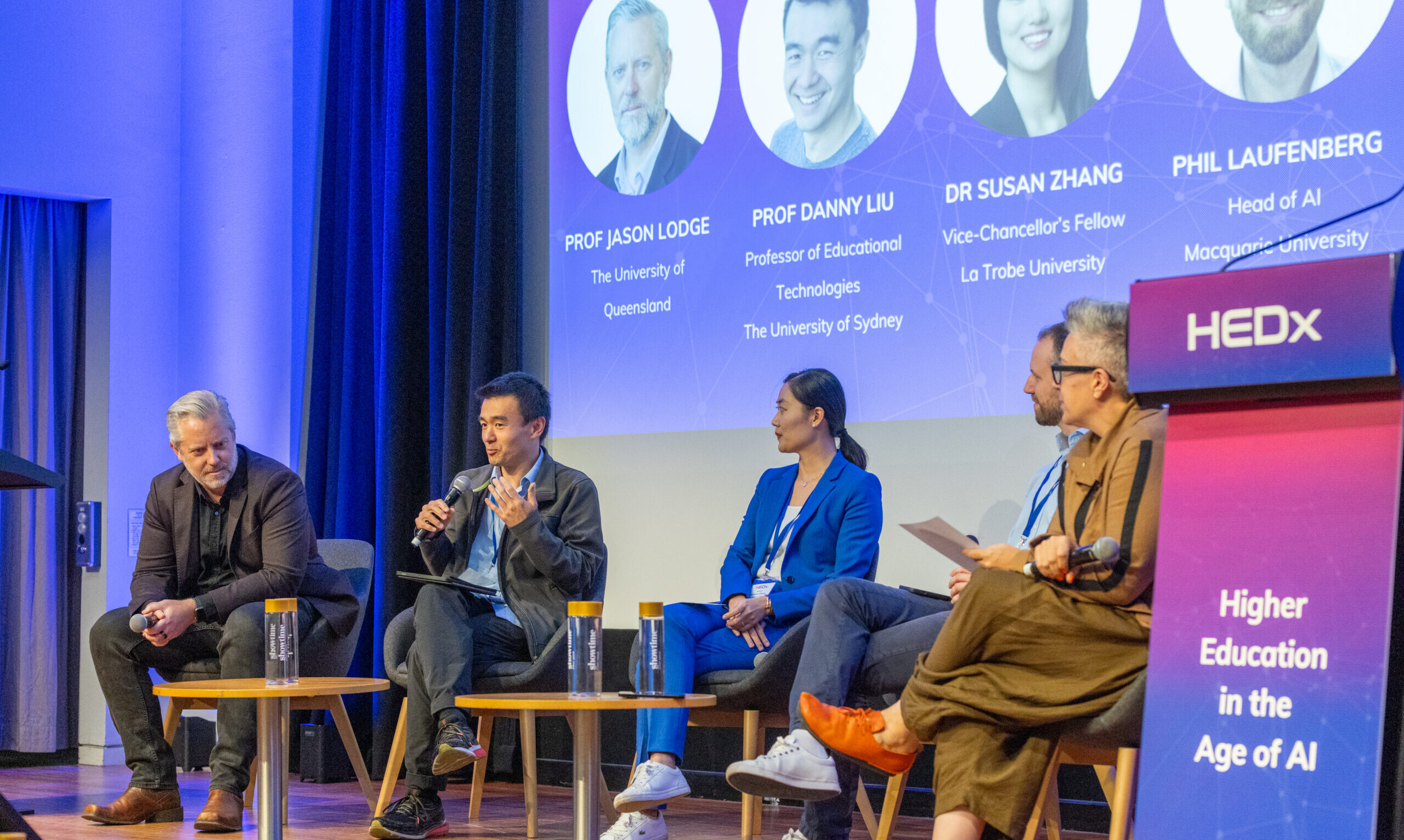
    Danny Liu from the University of Sydney posited that artificial intelligence compelled us to re-evaluate not just the methodology, but the very purpose of our teaching practices.

    Please login below to view content or subscribe now.

    Membership Login

    Source link

  • New (old) models of teaching and assessment

    New (old) models of teaching and assessment

    On the face of it, saying that if we stopped teaching we would not need examinations sounds crazy.

    But it is not so hard to think of examples of rigorous assessment that do not entail examinations in the sense of written responses to a set of predetermined questions.

    For example, institutions regularly award PhDs to candidates who successfully demonstrate their grasp of a subject and associated skills, without requiring them to sit a written examination paper. The difference of course is that PhD students are not taught a fixed syllabus.

    The point of a PhD thesis is to demonstrate a unique contribution to knowledge of some kind. And as it is unique then it is not possible to set examination questions in advance to test it.

    What are we trying to assess?

    If written examinations are inappropriate for PhDs, then why are they the default mode of assessment for undergraduate and taught postgraduate students? The clue, of course, is in the word “taught”. If the primary intended learning outcomes of a course of study require all students to acquire the same body of knowledge and skills, as taught in the course, to the same level, then written examinations are a logical and efficient institutional response.

    But surely what we want as students, teachers, employers, professional bodies and funding bodies is graduates who are not just able to reproduce old knowledge and select solutions to a problem from a repertoire of previously learned responses? So why does so much undergraduate and postgraduate education emphasise teaching examinable knowledge and skills rather than developing more autonomous learners capable of constructing their own knowledge?

    It is not true that learners lack the motivation and ability to be autodidacts – the evidence of my young grandchildren acquiring complex cognitive skills (spoken language) and of motor abilities (walking and running) suggests we have all done it in the past. And the comprehensive knowledge of team players and team histories exhibited by football fans, and the ease and confidence with which some teenagers can strip down and reassemble a motorcycle engine suggest that autodidacticism is not confined to our early years.

    An example from design

    Is it feasible, practical or economic to run courses that offer undergraduates an educational framework within which to pursue and develop personal learning goals, akin to a PhD, but at a less advanced level? In this case, my own experience suggests we can. I studied at undergraduate level for four years, at the end of which I was awarded an honours degree. During the entire four years there were no written examinations.

    I was just one of many art and design students following programmes of study regulated and approved at a national level in the UK by the Council for National Academic Awards (CNAA).

    According to the QAA Art and Design subject benchmark statement:

    Learning in art and design stimulates the development of an enquiring, analytical and creative approach, and develops entrepreneurial capabilities. It also encourages the acquisition of independent judgement and critical self-awareness. Commencing with the acquisition of an understanding of underlying principles and appropriate knowledge and skills, students normally pursue a course of staged development progressing to increasingly independent learning.

    Of course some of the “appropriate knowledge and skills” referred to are subject specific, for example sewing techniques, material properties and history of fashion for creating fashion designs; properties of materials, industrial design history and machining techniques for product design; digital image production and historic stylistic trends in illustration and advertising for graphic design, and so on.

    Each subject has its own set of techniques and knowledge, but a lot of what students learn is determined by lines of enquiry selected by students themselves in response to design briefs set by course tutors. To be successful in their study they must learn to operate with a high degree of independence and self-direction, in many ways similar to PhD students.

    Lessons without teaching

    This high degree of independence and self-direction as learners has traditionally been fostered through an approach that differs crucially from the way most other undergraduate courses are taught.

    Art and design courses are organised around a series of questions or provocations called design briefs that must be answered, rather than around a series of answers or topics that must be learned. The learning that takes place is a consequence of activities undertaken by students to answer the design brief. Answers to briefs generated by art and design students still have to be assessed of course, but because the formal taught components (machining techniques, material properties, design history, etc.) are only incidental to the core intended learning outcomes (creativity, exploration, problem solving) then written examinations on these topics would be only marginally relevant.

    What is more important on these courses is what students have learned rather than what they have been taught, and a lot of what they have learned has been self-taught, albeit through carefully contrived learning activities and responsive guidance from tutors to scaffold the learning. Art and design students learn how to present their work for assessment through presentation of the designed artefact (ie. “the answer”), supported by verbal, written and illustrated explanations of the rationale for the final design and the development process that produced it, often shared with their peers in a discussion known as a “crit” (critique). Unlike written examinations, this assessment process is an authentic model of how students’ work will be judged in their future professional practice. It thus helps to develop important workplace skills.

    Could it work for other subjects?

    The approach to art and design education described here has been employed globally since the mid-twentieth century. However, aspects of the approach are evident in other subject domains, variously called “problem based learning”, “project based learning” and “guided discovery learning”. It has been successfully deployed in medical education but also in veterinary sciences, engineering, nursing , mathematics, geography and others. So why are traditional examinations still the de facto approach to assessment across most higher education disciplines and institutions?

    One significant barrier to adoption is the high cost of studio-based teaching at a time when institutions are under pressure to increase numbers while reducing costs. The diversity of enquiries initiated by art and design students responding to the same design brief requires high levels of personalised learning support, varied resources and diversity of staff expertise.

    Is now the time?

    As with other subjects, art and design education has been under attack from the combined forces of politics and market economics . In the face of such trends it might be considered naive to suggest that such an approach should be adopted more widely rather than less. But although these pressures to reduce costs and increase conformity will likely continue and accelerate in the future, there is another significant force at play now in the form of generative AI tools.

    These have the ability to write essays, but they can also suggest template ideas, solve maths problems, and generate original images from a text prompt, all in a matter of seconds. It is possible now to enter an examination question into one of several widely available online generative AIs and to receive a rapid response that is detailed, knowledgeable and plausible (if not always entirely accurate). If anyone is in any doubt about the ability of the current generation of AIs to generate successful examination question answers then the record of examinations passed by ChatGPT will be sobering reading.

    It is possible that a shift from asking questions, (answers to which the questioner already knows), to presenting learners with authentic problems that assess ability to present, explain, and justify their responses – is a way through the concerns that AI generated responses to other assessment forms present.

    Source link

  • Quality Teaching in Practice is returning in 2025 – Campus Review

    Quality Teaching in Practice is returning in 2025 – Campus Review

    Quality Teaching in Practice returns for its fourth consecutive year, as one of the leading educational research and practice conference for teachers, school leaders and policymakers.

    Please login below to view content or subscribe now.

    Membership Login

    Source link

  • Launch of the Commission on Students in Higher Education: Unpicking the connections between teaching, funding and student outcomes

    Launch of the Commission on Students in Higher Education: Unpicking the connections between teaching, funding and student outcomes

    • The APPG for Students has launched the Commission on Students in Higher Education as a means of feeding into the Department for Education’s HE Review through a student-centred lens. A call for evidence has now opened, until May 1st, where colleagues from across the sector are encouraged to input.
    • Alex Stanley is Vice President Higher Education of the National Union of Students (NUS).
    • Saranya Thambirajah is Vice President Liberation and Equality of the NUS.

    The debates over the financial sustainability of the higher education sector, effective interventions in access and participation, and the quality of teaching will not be new to HEPI readers. Amongst the column inches and radio waves, however, students and the academic community are living these tensions every single day.

    It’s no secret that students are working long hours during term time, living pay cheque to pay cheque to cover their rent and bills – plugging the gap created by real-terms cuts to maintenance support. The NUS’s own research shows that of those who work during their studies, over 60% are working over 20 hours per week. While we feel from the stories that students tell us that there must be a link between inadequate maintenance funding, working long hours and students’ eventual attainment and outcomes, we lack an evidence base on the impact of working hours or lack of financial support on students’ attainment.

    Similarly, we are all aware that teaching standards and the concept of good degrees have spent the past fourteen years under the microscope, with innovative practice sometimes denounced as dumbing down in the press – and students told their course choice is leaving them with ‘low value degrees’, or that their hard work leading to higher grades is down to grade inflation.

    At NUS, we firmly believe the way to cut through the noise is by focusing on the real-life, current experience of students – and that the best way to do that is to bring them into the rooms where decisions are made. We are proud to hold the APPG on Students, for which NUS UK serves as Secretariat, as a space which connects student leaders to Westminster decision makers. We’ve been using this to bring student voice to the Houses of Parliament for over a decade, from launching the landmark research on the Black Attainment Gap, providing space for students to grill Sir Philip Augar immediately after his report launched, to most recently shaping the Renters’ Reform and then Renters’ Rights Bills, with interventions from current students the genesis of now-passed amendments on limiting rent up front and controlling the student lettings cycle. There is no question that bringing students and young people into the room on issues that impact them makes policy decisions better and enriches the debate.

    In this vein, we are proud to launch the Commission on Students in Higher Education, designed to place students at the heart of the current debates on funding, teaching and attainment.

    The Commission will tackle the big issues of the current funding debate: teaching standards, maintenance funding and student outcomes, drawing on the expertise of a cross-party group of Commissioners and higher education specialists, all working to provide meaningful recommendations which should influence and complement the Department for Education’s HE Review and the Comprehensive Spending Review.

    We will begin with an in-person event on Maintenance Funding tomorrow, Wednesday 23 April, when we will hear from proposers of four different ways of funding a more generous student maintenance offer, who will then be questioned by students and Parliamentarians.

    We will take in written evidence on the core areas of the Commission: maintenance funding, students and work, widening participation & student outcomes and teaching quality.

    We welcome submissions from colleagues across students’ unions, the academic community and sector practitioners who, like us, are keen to see the HE Review and Spending Review succeed in solving some of the existential problems we are facing across the sector.

    If you have any questions, please email [email protected]

    Source link

  • 5 High-Presence Teaching Tactics for Active Online Learning – Faculty Focus

    5 High-Presence Teaching Tactics for Active Online Learning – Faculty Focus

    Source link

  • 5 High-Presence Teaching Tactics for Active Online Learning – Faculty Focus

    5 High-Presence Teaching Tactics for Active Online Learning – Faculty Focus

    Source link

  • 6 ways to make math more accessible for multilingual learners

    6 ways to make math more accessible for multilingual learners

    Key points:

    Math isn’t just about numbers. It’s about language, too.

    Many math tasks involve reading, writing, speaking, and listening. These language demands can be particularly challenging for students whose primary language is not English.

    There are many ways teachers can bridge language barriers for multilingual learners (MLs) while also making math more accessible and engaging for all learners. Here are a few:

    1. Introduce and reinforce academic language

    Like many disciplines, math has its own language. It has specialized terms–such as numerator, divisor, polynomial, and coefficient–that students may not encounter outside of class. Math also includes everyday words with multiple meanings, such as product, plane, odd, even, square, degree, and mean.

    One way to help students build the vocabulary needed for each lesson is to identify and highlight key terms that might be new to them. Write the terms on a whiteboard. Post the terms on math walls. Ask students to record them in math vocabulary notebooks they can reference throughout the year. Conduct a hands-on activity that provides a context for the vocabulary students are learning. Reinforce the terms by asking students to draw pictures of them in their notebooks or use them in conversations during group work.

    Helping students learn to speak math proficiently today will pay dividends (another word with multiple meanings!) for years to come.

    2. Incorporate visual aids

    Visuals and multimedia improve MLs’ English language acquisition and engagement. Picture cards, for example, are a helpful tool for building students’ vocabulary skills in group, paired, or independent work. Many digital platforms include ready-made online cards as well as resources for creating picture cards and worksheets.

    Visual aids also help MLs comprehend and remember content. Aids such as photographs, videos, animations, drawings, diagrams, charts, and graphs help make abstract ideas concrete. They connect concepts to the everyday world and students’ experiences and prior knowledge, which helps foster understanding.

    Even physical actions such as hand gestures, modeling the use of a tool, or displaying work samples alongside verbal explanations and instructions can give students the clarity needed to tackle math tasks.

    3. Utilize digital tools

    A key benefit of digital math tools is that they make math feel approachable. Many MLs may feel more comfortable with digital math platforms because they can practice independently without worrying about taking extra time or giving the wrong answer in front of their peers.

    Digital platforms also offer embedded language supports and accessibility features for diverse learners. Features like text-to-speech, adjustable speaking rates, digital glossaries, and closed captioning improve math comprehension and strengthen literacy skills.

    4. Encourage hands-on learning

    Hands-on learning makes math come alive. Math manipulatives allow MLs to “touch” math, deepening their understanding. Both physical and digital manipulatives–such as pattern blocks, dice, spinners, base ten blocks, and algebra tiles–enable students to explore and interact with mathematical ideas and discover the wonders of math in the world around them.

    Many lesson models, inquiry-based investigations, hands-on explorations and activities, and simulations also help students connect abstract concepts and real-life scenarios.

    PhET sims, for example, create a game-like environment where students learn math through exploration and discovery. In addition to addressing math concepts and applications, these free simulations offer language translations and inclusive features such as voicing and interactive descriptions.

    Whether students do math by manipulating materials in their hands or on their devices, hands-on explorations encourage students to experiment, make predictions, and find solutions through trial and error. This not only fosters critical thinking but also helps build confidence and perseverance.

    5. Use students’ home language as a support

    Research suggests that students’ home languages can also be educational resources

    In U.S. public schools, Spanish is the most commonly reported home language of students learning English. More than 75 percent of English learners speak Spanish at home. To help schools incorporate students’ home language in the classroom, some digital platforms offer curriculum content and supports in both English and Spanish. Some even provide the option to toggle from English to Spanish with the click of a button.

    In addition, artificial intelligence and online translation tools can translate lesson materials into multiple languages.

    6. Create verbal scaffolds

    To respond to math questions, MLs have to figure out the answers and how to phrase their responses in English. Verbal scaffolds such as sentence frames and sentence stems can lighten the cognitive load by giving students a starting point for answering questions or expressing their ideas. This way, students can focus on the lesson content rather than having to spend extra mental energy figuring out how to word their answers.

    Sentence frames are often helpful for students with a beginning level of English proficiency.

    • A square has            sides.  
    • An isosceles triangle has at least             equal angles.

    Sentence stems (a.k.a. sentence starters) help students get their thoughts going so they can give an answer or participate in a discussion. 

    • The pattern I noticed was                               .               
    • My answer is                               . I figured it out by                               .

    Whether online or on paper, these fill-in-the-blank phrases and sentences help students explain their thinking orally or in writing. These scaffolds also support academic language development by showing key terms in context and providing opportunities to use new vocabulary words.

    Making math welcoming for all

    All students are math language learners. Regardless of their home language, every student should feel like their math classroom is a place to learn, participate, contribute, and grow. With the right strategies and tools, teachers can effectively support MLs while maintaining the rigor of grade-level content and making math more accessible and engaging for all.

    Source link

  • Thirty ways for DfE to deliver the manifesto and raise the standards of teaching

    Thirty ways for DfE to deliver the manifesto and raise the standards of teaching

    At some point we might get some actual higher education policy out of the Department for Education (DfE), rather then endless crackdowns on the “long tail” of the market.

    There’s rumours of a (next) TEF delay which we might assume ministers will take an interest in, and a signature manifesto commitment on “raising the standards of teaching” to deliver.

    It all raises the question – what should Labour’s agenda on teaching be? How might it realise it? What levers will it pull?

    Of course it’s the case that whatever the agenda, there’s a need for the right funding systems (for both students and providers) and regulatory architecture – and those will always dominate the discussion.

    But you’d like to think there were other things, too.

    Reinstate the QAA as the Designated Quality Body for England

    A nice and easy start – DfE should issue ministerial guidance directing the Office for Students (OfS) to re-designate the QAA as the primary quality assurance body. The QAA has long maintained international credibility and alignment with European standards – something England has steadily drifted away from since Brexit.

    It’s not just a technical concern – it threatens the international recognition of English qualifications at precisely the moment when global educational mobility is increasing. OfS has tried to go it alone on quality – the experiment has failed. No shame in admitting it.

    Re-establish periodic review and enhancement expectations

    DfE should direct OfS to develop requirements for periodic review through regulatory guidance, with funding for QAA to develop a new enhancement framework appropriate for England’s context.

    One of the quietest casualties of England’s regulatory experiment has been the loss of enhancement culture. Where periodic review encouraged reflection and improvement, the pendulum has swung decisively toward compliance and risk-management. England now lags behind Scotland, Wales, and Northern Ireland, where enhancement remains central to quality regimes. We now have a sector where teaching innovation happens despite, not because of, the regulatory framework. It could be different.

    Scrap the current TEF and implement subject-level TEF based solely on metrics

    First, abolish continuation as a metric that somehow represents “teaching quality”. We’re so good at it internationally that it’s starting to look like kidnapping, and seriously harms the sort of flexibility envisaged in the LLE or required from our breathtaking levels of decision regret.

    Then DfE should issue guidance to OfS to develop a revised, metrics-based TEF framework operating at subject level. As currently constituted, the TEF neither drives genuine improvement nor provides meaningful information to prospective students. A subject-level TEF grounded in robust metrics would offer more granular insights while slashing the cost and reducing the burden of institutional storytelling that has become the hallmark of the current approach.

    And it would prevent what is likely to be a key “misleading practice” issue under the DMCC act – a “TEF Gold” banner appearing over the door of a faculty whose metrics would suggest a requires improvement rating.

    Regulation for the struggling, enhancement for the thriving

    A simple distinction should be made in the approach to quality. For provision failing to meet minimum standards (below B3 thresholds), robust regulatory intervention through OfS remains appropriate. More boots on the ground if anything. However, for provision meeting or exceeding these standards, we need to shift from compliance-checking to enhancement-driven approaches led by the QAA.

    In other words, let OfS carry on its inspections against minimums when its thresholds aren’t met at subject, provider or subcontractual status level, and let quality assurance and enhancement via the QAA sit alongside it for everyone and everything else. Neat.

    Require publication of external examiner reports

    External examining is one of the oldest, most trusted mechanisms for maintaining academic standards in the UK and causing collaboration between universities – but it has become increasingly invisible. Reports are buried in back-office systems, rarely seen by students, and seldom discussed publicly.

    DfE should ask OfS to require the publication of external examiner reports, ideally with departmental responses. Visibility would encourage honest, critical engagement with standards, and bring students into the conversation about academic quality. After all, if someone outside the course is checking the quality, why shouldn’t those taking it see what they say?

    Establish targets and metrics for staff teaching training

    Universities are packed with subject experts, but expertise in a field doesn’t automatically translate to expertise in teaching it. The uneven distribution of pedagogical training and teaching qualifications means students experience wildly different teaching quality depending on their course, their institution, and sometimes just luck of the draw.

    OfS should be asked to introduce and publish metrics on staff development, making it clear which institutions invest in teaching capacity. Yes – an input measure! One that students actually want.

    Require compulsory module evaluations with visible results for loan-funded modules

    Every module of credit that accrues a loan charge should be accompanied by a compulsory evaluation, with results that students can see – including action taken in response to previous feedback. A “comply-or-explain” expectation would transform the granularity of information available to students making module choices under the Lifelong Loan Entitlement, and improve teaching. DfE should ask OfS to apply one.

    If students are paying for it (and increasingly borrowing for it), they deserve to know what they’re getting. Student reps can then work with the data and work with departments on problem-solving instead of being asked to supply feedback themselves.

    Reduce the number of subject benchmark statements

    The current proliferation of subject benchmark statements has created a rigid and prescriptive framework that stifles innovation and interdisciplinarity. If they were reduced and broadened, there would be more space for flexible curriculum design that responds to emerging fields and changing student needs. That’s about defining quality and standards in ways that encourage creativity and adaptation – rather than compliance and conformity. The EU is hurtling in this direction anyway – would be nice to… align at least. That should go in the ministerial direction letter too.

    Convene a partnership between NUS and SUs for national student-led teaching awards

    Student-led teaching awards have become an important feature at most universities, celebrating innovative and impactful teaching practice. But their impact remains localised, with limited opportunities to identify and share learning across the sector.

    A national event via a DfE-convened partnership would elevate the student voice in defining teaching excellence, create powerful incentives for innovation, be a good PR opportunity for the sector and the department, and offer a rich source of data on what works for students. It could even be held in 20 Great Smith St to drive down the cost.

    Direct OfS to mine NSS free text responses for insights

    The quantitative metrics of the National Student Survey tell only part of the story, and OfS is sat on a couple of decades of hidden intel – free text comments contain rich insights into student experiences that are currently underutilised.

    With appropriate anonymisation and ethical safeguards, comments could identify emerging concerns, highlight innovative practice, and provide a more nuanced understanding on good teaching that numbers alone cannot capture. Another one for the letter.

    Establish a clear definition of learning gain

    Despite extensive discussion about “learning gain,” there’s no clear consensus on how to define, measure, or evaluate it. The ambiguity undermines meaningful comparison and improvement – so establishing a clear, shared definition, focused not just on knowledge acquisition but on skill development, mindset shifts, and capability building means we’ll get a meaningful framework for universities to then further define for assessing educational value and building degree transcripts. “Dear Susan and Edward, we expect…”

    Establish a regulatory domain focused on “learning environment”

    Currently, various aspects of the learning environment – mental health support, physical spaces, digital infrastructure, library resources – are regulated through bafflingly disconnected processes. The fragmentation creates bureaucratic burden – despite this stuff being essential underpinners of good teaching and learning.

    Asking OfS to establish “learning environment” as a distinct integrated regulatory domain (like it is in most other countries in Europe) would mean a rounded approach – recognising how these elements interact to shape student experiences and outcomes, and clocking that a lot of good learning is self-directed. It would also allow for more proportionate, context-sensitive regulation while maintaining a focus on student needs and concerns.

    Establish a TASO equivalent for teaching enhancement

    England needs its own equivalent to Scotland’s Quality Enhancement Framework – a body akin to TASO (Transforming Access and Student Outcomes) that can convene national conversations, fund pilots, and broker communities of practice around teaching improvement.

    Maybe QAA gets to do it, maybe Advance HE. Maybe someone else. But it’s needed nationally, probably at subject level, and should involve students drawn from academic societies. Can’t DfE convene something? It should CETL for nothing less.

    Push for associate membership of European University Alliances

    Brexit has left UK higher education increasingly isolated from European teaching networks, particularly the European Universities Initiative. They are building the future of cross-border education – shared degrees, joint quality standards, collaborative innovation – while England watches from the sidelines. DfE should push for associate membership of these initiatives to ensure English universities (and their student leaders) are plugged into the networks where the most exciting teaching innovations are emerging.

    Implement DfE approval for franchising arrangements based on qualitative criteria

    DfE should establish a dedicated unit with oversight powers for franchising approvals, with clear guidance on acceptable quality thresholds – as friends in FE somewhere in Great Smith St do. The proliferation of “business/cities” subcontracted provision has created regulatory blind spots where quality can quietly deteriorate – so DfE should hold approval rights for these arrangements based on demonstrable need, track record and quality assurance, not just market opportunity.

    Apply the OfS fairness condition universally across the sector

    DfE should instruct OfS to implement its proposed new fairness condition without exemptions through clear ministerial guidance, requiring equal application regardless of provider type or history. If we’re not careful, we’ll focus regulatory attention on newer providers while established institutions escape scrutiny.

    If a student at Oxford experiences the same poor practice as one at a small private provider, shouldn’t they have the same protections? Fairness cannot be conditional based on institutional prestige or history – either students have rights to good teaching, or they don’t. They do.

    Establish university-level ombuds and a duty to learn from complaints

    DfE should fund a pilot programme for university-level ombuds, followed by regulatory requirements through OfS. The duty to learn from complaints would be implemented through revised regulatory conditions requiring public reporting of complaint outcomes and resulting changes. University-level ombuds – independent officers with investigatory powers and public reporting requirements – could transform how institutions respond to student concerns.

    Rather than treating complaints as irritants to be managed, they would become valuable sources of insight for improvement. OfS should also establish a duty for universities to publicly report on what they’ve learned from complaints and appeals (both uphelds and others), and how practice has changed as a result.

    Require OfS to respond to the National Student Survey each year

    DfE should issue ministerial guidance requiring OfS to produce an annual NSS response document with clear action points – identifying trends, highlighting innovative approaches, and using the data to inform regulatory priorities. Students take the time to respond to the NSS. It’s time the regulator did too. As if students score assessment and feedback badly every year and nothing is done!

    Strengthening student rights and voice

    For all the rhetoric about students as partners, their voice in institutional decision-making remains precarious. The regulatory framework mentions consultation more than it meaningfully embeds representation. Many still treat student engagement as a box-ticking exercise rather than a fundamental right.

    OfS should be told to enshrine stronger rights for students to influence decisions, the curriculum, know their rights, seek redress, and access minimum support for their representative bodies. And every provider should be required to support effective independent student organising (ie SUs) and support for students – not as an optional extra, but as a core expectation given students’ textbook vulnerability.

    Establish “access to the loan book” criteria to drive credit transfer

    England’s student finance system remains one of the major obstacles to student mobility. If you switch institutions, change course, or build credits in non-traditional settings like the workplace, transferring that credit remains difficult and under-rewarded.

    Tying access to student loan funding to a provider’s willingness to recognise credit means DfE could incentivise the sector towards a more flexible future where students have genuine mobility between institutions and learning contexts. Yeah, I know Oxford and Cambridge and a slice of the Russell Group would object. They can probably afford to go exempt.

    Task OfS with monitoring subject/module availability and facilitating collaboration

    The regulator should be asked to monitor subject and module availability – not just full course provision – and be given a duty to drive collaboration across the sector where gaps emerge. Medr has by its minister already. When competition constricts provision, regulation must enable collaboration.

    This might mean funding shared provision between institutions, brokering inter-university module access, or investing in digital platforms that let students study beyond the borders of their enrolled provider. Quality needs choice, and choice has to be protected in the architecture of the system.

    Enshrine the right to build credit across multiple institutions

    What if we enshrined the right for students to accrue credit across multiple higher education institutions? And a domestic mobility scheme – akin to Erasmus, but within the UK – could support students spending terms or modules at other universities, either physically or virtually, learning lessons about excellent teaching along the way. Jacqui would have to have a conversation with Heidi Alexander over the train fares, but it would be great – and we’ve seen it work in several European countries now.

    Allow students to accrue credit through employment and service learning

    Not all “teaching” is done by “teachers”. All students – undergraduate and postgraduate – should have the right to accrue up to 10 ECTS credits per year in recognised learning outside their main subject area, via employment or service learning. For postgraduates, this could extend to 15 ECTS. Whether working in a hospital, mentoring in a school, or delivering a community project, students should gain formal credit for skills developed through real-world application.

    That would reframe how we think about employability – not just as abstract skills development, but as validation of the meaningful, real-world work many students already juggle alongside their studies. It would also encourage universities to connect more deeply with their communities, valuing not just what students learn in the university, but what they contribute through it. The LLE should really be focussed on delivering flexibility in what’s there now, not spending hours figuring out how to stop fraud over single modules.

    Require credit-bearing student induction and transition support

    Every institution should be told to offer structured, credit-bearing induction and transition support – developing core competencies in academic integrity, independent study, and navigating support systems – to ensure that all students, regardless of their educational background, have the tools they need to succeed.

    And while graduate attributes are mapped in fine detail, the early-stage student journey is largely ignored. An embedded framework that builds progressively – with assessment points and optional modules on civic leadership, digital fluency, and self-directed learning – would connect coherently to broader goals around credit mobility and skills development.

    Introduce credit-bearing interdisciplinary “civic lab” modules

    DfE should establish a dedicated civic engagement fund with partners in DCMS to support development and implementation, alongside regulatory expectations for civic engagement through the curriculum. Credit-bearing, interdisciplinary “civic lab” modules across all degree programmes would allow students to apply their disciplinary knowledge to real-world problems while developing transferable skills.

    Develop competency-based academic transcripts

    Revisit Burgess and announce the end of the UK degree classification system. It’s harmful twaddle. A competency-based academic transcript would provide a more helpful picture of graduate capabilities, detailing specific skills, contributions, and attributes developed through their studies.

    It would offer employers and postgraduate admissions tutors a more granular view of student achievement, and would encourage universities to think more broadly about the skills and attributes they’re developing through their teaching. The degree should be about what’s interesting about that graduate, not whether they’re in one of four impossibly broad categories. Just announce it. See what happens.

    Embed inquiry-based learning into teaching quality expectations

    DfE should direct OfS and QAA to develop clear guidance on inquiry-based approaches in teaching, backed by targeted enhancement funding for curriculum development and staff training.

    At its heart, that’s about moving beyond compliance-driven education to something more transformative. We should embed inquiry-based learning into teaching quality expectations, requiring that all students, in all disciplines, experience modules built around active investigation rather than passive content delivery. Module evaluations should track the extent to which learning creates independence, reflection, and curiosity – not just satisfaction scores.

    Communicate NSS standards to students from the outset

    Currently, the National Student Survey functions primarily as a retrospective judgment tool – students reflect on their experiences only after they’ve happened. But the questions within the NSS implicitly define standards for good teaching, assessment, and support.

    If these were made explicit from the outset, students could work collaboratively with academics throughout their courses to realise these standards, rather than just offering critiques after the fact. Doing so would transform the NSS from a retrospective satisfaction measure to a developmental framework that drives ongoing improvement through partnership between students and staff, and empower students to articulate their expectations clearly and engage in constructive dialogue throughout their studies. Pop it in the letter.

    Extend the National Student Survey to postgraduate students

    The experiences of postgraduate students remain considerably less visible than those of undergraduates. Yet these students make up a significant proportion of the higher education population and face distinct challenges around supervision, research support, and career development.

    Extending the NSS to postgraduate taught and research students – with questions appropriately tailored to their contexts – would shine a light on these experiences and drive improvement in areas that are currently under-scrutinised.

    Implement an all-applicant entry survey via UCAS

    Universities currently receive minimal information about their incoming cohorts’ learning needs, preferences, and educational backgrounds – and without that, how can the teaching ever be excellent? It makes it difficult to tailor provision effectively or identify potential support needs early. A universal entry survey, administered through UCAS, would provide invaluable data on learning styles, academic concerns, skills gaps, and support requirements.

    With appropriate data protection safeguards, this information could be shared with providers to inform course planning, induction programmes, and support services. It would also allow for more personalised approaches to teaching and learning, so students receive the support they need from day one rather than waiting for problems to emerge.

    Source link