Is it possible for someone you’ve never met to be a mentor?
I don’t know how else to describe Ken Bain, author of What the Best College Teachers Do, a book that transformed not just my teaching, but my entire life.
Ken Bain passed away on Oct. 10. I first learned this news on LinkedIn from Jim Lang, who did know and was directly mentored by Ken Bain and, like the several dozen folks who offered comments on his passing—and also me—whose life and work were profoundly affected by Ken Bain’s work.
I read an advance copy of What The Best College Teachers Do sometime in early 2004 in a period where I was starting to question the folklore of teaching I had absorbed as a student and graduate assistant, and it immediately changed how I thought about my own work, kicking off a process of consideration and experimentation around teaching writing that continues to this day.
What the Best College Teachers Do reflects more than a decade of study and is entirely based in observations of teaching, teaching materials, student responses and reflections, interviews and other sources, filtered through various lenses (history, literary analysis, sociology, ethnography, investigative journalism) to draw both big conclusions about not just what teachers do, but how they think, how they relate to students, how they view their work and how they evolve their approaches.
The method is relentlessly qualitative rather than quantitative, and it can be straightforwardly adapted to one’s own work.
At least that’s how I used the book. Looking through some of the text for the first time in years, I can see significant strands of What the Best College Teachers Do DNA in my writing about the writer’s practice. The lens of “doing” as the central feature of any work has been part of my personal framework for so long that I almost lost its origin, but there it is.
The book is more than 20 years old, but its framing questions are evergreen and even more relevant in this AI age. The book asks and answers the following questions:
What do the best teachers know and understand?
How do they prepare to teach?
What do they expect of their students?
What do they do when they teach?
How do they treat students?
How do they check their progress and evaluate their efforts?
The book helpfully encapsulates the study’s findings under these categories, and as bullet points of good teaching practice they are spot-on. But I am also here to testify that they are not a substitute for the full experience of reading What the Best College Teachers Do, because the act of reading the specific illustrations and examples that gave rise to these findings allows for the individual to reflect on their own practices relative to others.
The first thing I did after reading and absorbing What the Best College Teachers Do was change my attendance policy to no longer punish students based on a maximum number of absences. I’d engaged in this practice because it had been handed down as conventional wisdom: If you don’t police student attendance, they won’t show up. Bain’s best teachers challenged this conventional wisdom.
The positive effects were immediate. I stepped up my game in terms of making sure class was viewed by students as productive and necessary. My mood improved, as I no longer stewed over students who were pushing their luck in terms of absences, daring me to dock their overall semester grade.
Attendance went up! I asked students about this, and they said that when a class says you “get four absences” they were treating that as a kind of permission (or even encouragement) to go ahead and miss four classes. Student agency and self-responsibility increased. If they missed a class, they knew what they had to do, and it didn’t involve me.
The experiments continued, leading ultimately to the writer’s practice and my embrace of alternative assessment, developments that made me a much more effective instructor and now, improbably, someone invited to colleges and universities to share his expertise on these subjects.
It would not have happened without the work and mentorship of Ken Bain, mentorship I experienced entirely through reading his book.
I worry that mentorship is going to be further eroded by AI, particularly if entry-level jobs with their apprenticeship tasks are now completed through automation, rather than by working with other, more experienced humans. The enthusiasm for letting large language models compress texts into summaries rather than reading the full work of another unique intelligence is also a threat.
My conviction that our way forward through the challenge of AI is rooted in deeply examining the experiences of learning and fostering those experiences for students only grows stronger by the day. What the Best College Teachers Do is experiences all the way down, a book of observations conveyed in such a way that allows us to make use of them, literally, in what we do.
A great man. A great mentor. Ken Bain’s work will live on through the many pedagogues he’s inspired.
As we round down our time in the PKMastery workshop, I’m now presented with a topic that is both familiar, yet still incredibly challenging for me: systems thinking. One of the best books I read in my MA was The Fifth Discipline: The Art & Practice of the Learning Organization. I discovered that I didn’t have a digital copy (where I like to keep highlights) and was fortunate to find it on sale for $1.99, plus a digital credit that made it “free”.
Systems thinking: He describes here how rain happens, with a bunch of different events that happen across distance, time, and space, yet: “… they are all connected within the same pattern. Each has an influence on the rest, an influence that is usually hidden from view. You can only understand the system of a rainstorm by contemplating the whole, not any individual part of the pattern.” We use systems thinking to be more effective at seeing the full picture and associated patterns, as well as to find ways to facilitate change.
Personal mastery: Senge distinguishes the multiple meanings of the word mastery. Yes, it can mean dominance over another, yet can also have to do with proficiency. He defines personal mastery as, “…the discipline of continually clarifying and deepening our personal vision, of focusing our energies, of developing patience, and of seeing reality objectively.”
Mental models: These baked in assumptions, over-generalized beliefs impact how we understand and explain what happens and the actions we take as a result of those paradigms.
Building shared vision: Organizations that achieve great things do so through leadership capacity at developing a shared perspective on where the organization is headed. Senge describes: “When there is a genuine vision (as opposed to the all-too-familiar “vision statement”), people excel and learn, not because they are told to, but because they want to.”
Team learning: Senge encourages us to look to the Greeks’ practice of dialog vs discussion. When we are in dialog, our ideas are free-flowing and we can build a capacity to suspend our assumptions and actually think together. In contrast, the word discussion has ties with word like “percussion” and “concussion” and the idea of competitive ideation can take place.
Senge describes how the fifth discipline is systems thinking, because it weaves together the other disciplines toward intentional transformation. When we can visualize something better, we can understand it more effectively, as Jarche illustrates in a story about when NASA first released a picture of the earth, taken from space. He writes how:
There are many ways to use visualization to understand data better. The real value of big data is using it to ask better questions. Visualization can be a conversation accelerator.
Taking existing systems and using visualization to surface the ways the various parts of the system shape the other parts is vital in increasing our individual and collective abilities to learn.
What Holds Us Back From Being a Learning Organization
In chapter two, Senge writes about what he calls organizational learning disabilities. I’m not sure he communicates in such a way to support more of an asset-based framework for disability that many of us have become familiar with today. But I still want to list and describe them here, as this was my biggest takeaway from the book, reading it more than twenty years ago.
“I am my position”
“When asked what they do for a living, most people describe the tasks they perform every day, not the purpose of the greater enterprise in which they take part. Most see themselves within a system over which they have little or no influence. They do their job, put in their time, and try to cope with the forces outside of their control. Consequently, they tend to see their responsibilities as limited to the boundaries of their position.”
“The enemy is out there”
“When we focus only on our position, we do not see how our own actions extend beyond the boundary of that position. When those actions have consequences that come back to hurt us, we misperceive these new problems as externally caused. Like the person being chased by his own shadow, we cannot seem to shake them.”
The illusion of taking charge
“All too often, proactiveness is reactiveness in disguise… True proactiveness comes from seeing how we contribute to our own problems. It is a. product of our way of thinking, not our emotional state.”
The fixation on events
Senge describes how we evolved out of societies where people had to be focused on events to survive, like watching for the saber-toothed tiger to show up and be able to respond immediately.
“Generative learning cannot be sustained in an organization if people’s thinking is dominated by short-term events. If we focus on events, the best we can ever do is predict an event before it happens so that we can react optimally. But we cannot learn to create.”
The parable of the boiled frog
“Learning to see slow, gradual processes requires slowing down our frenetic pace and paying attention to the subtle as well as the dramatic… The problem is our minds are so locked in one frequency, it’s as if we can only see at 78 rpm; we can’t see anything at 33-1/3. We will not avoid the fate of the frog until we learn to slow down and see the gradual processes that often pose the greatest threats.”
Remember that this is meant to be a metaphor to help us explain this phenomenon. No frogs were harmed in sharing this boiling frog apologue.
The delusion of learning from experience
“Herein lies the core learning dilemma that confronts organizations: we learn best from experience but we never directly experience the consequences of many of our most important decisions. The most critical decisions made in organizations have systemwide consequences that stretch over years or decades.”
The myth of the management team
“All too often, teams in business tend to spend their time fighting for turf, avoiding anything that will make them look bad personally, and pretending that everyone is behind the team’s collective strategy—maintaining the appearance of a cohesive team. To keep up the image, they seek to squelch disagreement; people with serious reservations avoid stating them publicly, and joint decisions are watered-down compromises reflecting what everyone can live with, or else reflecting one person’s view foisted on the group. If there is disagreement, it’s usually expressed in a manner that lays blame, polarizes opinion, and fails to reveal the underlying differences in assumptions and experience in a way that the team as a whole could learn from.”
The cartoon character Michigan J Frog would only dance and sing when the man who found him was alone. Any time that someone else entered the picture, the frog just sat there, making normal frog noises. Here’s a look at his antics:
Looks to me like skilled incompetence and also some seriously skilled frog theatrics (but only when no one is looking).
What Comes Next
The next part of The Fifth Discipline is something Senge calls “the beer game.” It is a memorable look at what happens when we are unable to see the entire system, but only one part of it. Let’s just say there’s a supposed shortage of beer, and then lots and lots of beer. But you should read it, as I’m nowhere capturing the marvelous metaphor that is the beer game.
Readers are also instructed how to map systems in this book, though it is a practice that I never mastered. Jarche links to Tools for Systems Thinkers: Systems Mapping, by Leyia Acaroglu. which gives a great introduction and series of maps to use to explore complex ideas. Acaroglu illustrates their value by describing:
As a practicing creative change-maker, I use systems mapping tools like this all the time when I want to identify the divergent parts of the problem set and find unique areas in which to develop interventions. I also use them to gain clarity in complexity, and find it especially useful when working in teams or collaborating because it puts everyone on the same page.
I pretty much want to take every class that Levia and her team have available on the Unschool of Disruptive Design site. I’m also thinking I had better settle myself down a bit and wrap up this PKMastery course before biting off anything more. That, plus a couple of big conferences coming up I still need to prepare for…
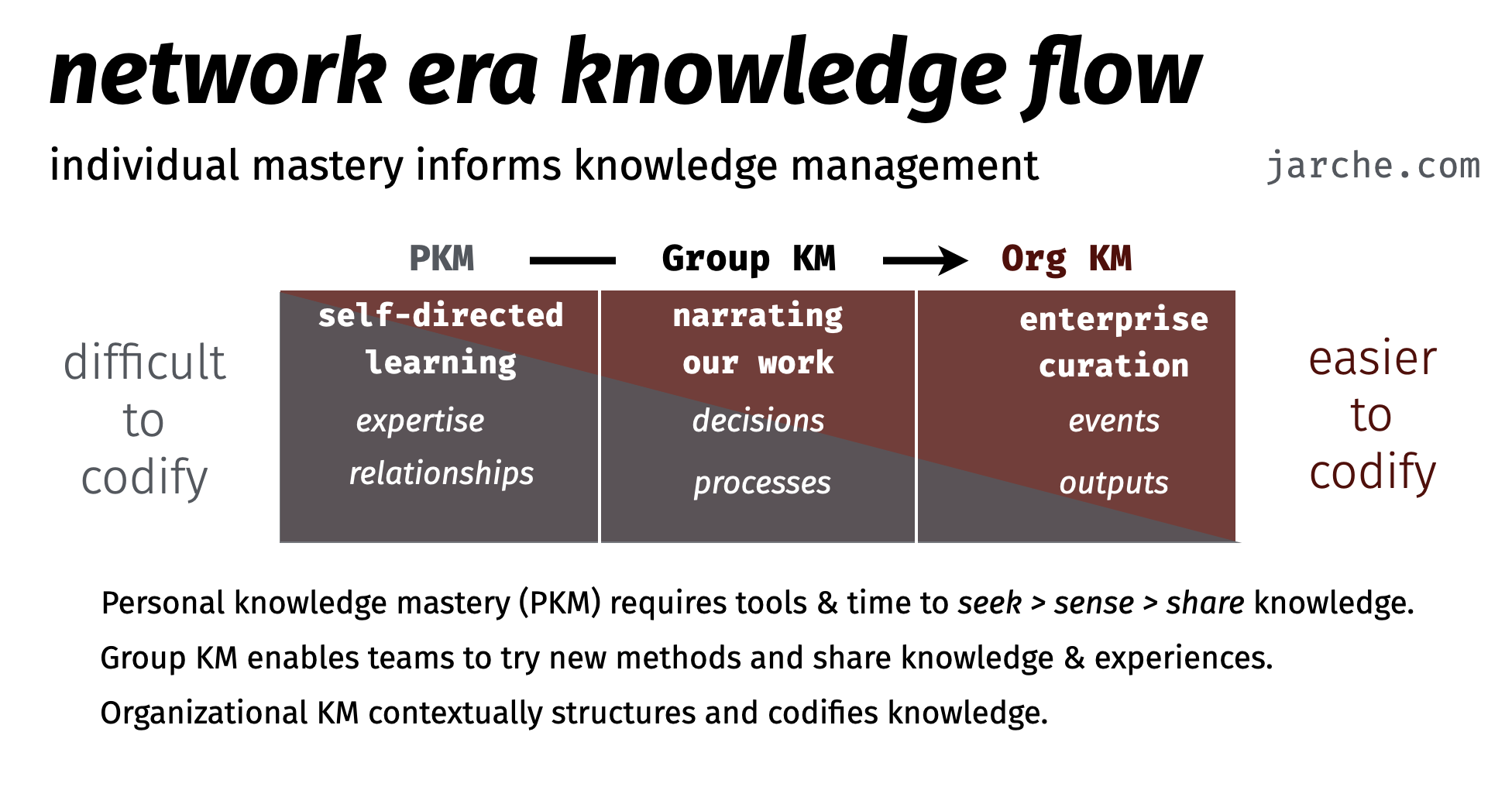
Jarche informs us that when we narrate our work, we don’t experience knowledge transfer, but what we do get is greater understanding. Our individual, self-directed learning is difficult to codify, he explains, and is more focused on relationships and expertise. When we narrate our work, focusing on decisions and processes, we make that work more visible to others. This means we can experiment and share knowledge, learning together in real time. The results of this thinking together results in enterprise curation, where we can more easily codify knowledge and experience the results of our earlier efforts.
The value of social bookmarks are hard to see, at first. However, over time, especially when combined with the use of feed aggregators and readers, we eventually get to witness the power of PKM as a discipline. I’ve been using Raindrop.io bookmarks for years, now, and enjoy having shareable bookmarks (which I can surface, when a situation encourages that practice), yet most of my collections are private. One that is now public is my growing collection of AI articles, in both an RSS feed and just a browsable page.
I do find myself cringing a bit as I save items there, knowing that I certainly don’t endorse each link I save and the topic of AI is so controversial and polarizing. I’ve got everything up there from the world as we know it is crumbling to its core to fun hacks to use AI to build you a rocket ship to the moon (or load your dishwasher) or some such thing.
Jarche states that our emphasis when we narrate our work should be on making our thinking accessible, but to avoid disrupting people with what we choose to share. He writes:
The key is to narrate your work so it is shareable, but to use discernment in sharing with others. Also, to be good at narrating your work, you have to practice.
One practice Jarche mentions under his tips and links section is to keep a journal. While I’ve not been good at this practice since my teenage years long ago, I did find many of these 6 Ways Keeping a Journal Can Help Your Career compelling. In Episode 425 of Teaching in Higher Ed, I share Viji Sathy’s and Kelly Hogan’s suggestion to keep a “Starfish” folder. There are variations of the beloved story of the starfish, including this Tale of the Starfish page from the Starfish Foundation with a powerful video describing the power in making a difference for a single starfish, even if we can’t rescue them all.
I have kept up with digital encouragement folders for years now, both on my email accounts, as well as in my file directories (across my personal and professional domains). While not a journal, exactly, these stories and words can bring me encouragement during difficult times.
I’ve been paying for the Day One Journal App for years now, though entirely languish in my practice of journaling. I would switch over to Obsidian, which has the benefit of future proofing any notes I take using Obsidian, since they are just text files sitting wherever I want them to be (as in if the app went away, the text files are still there and readable).
However, Day One brings together all the TV and movies that I’ve watched, all my social media posts and images, and all the videos I’ve favorited on YouTube. I use Sequel to track what I want to watch, which then optionally integrates with the free Trakt service, which allows for an IFTTT rule to add an entry to Day One each time I mark something as watched in Sequel. In case you’re wondering about how I accomplish this, I found these two automations on IFTTT and never had to change a thing.
Perhaps someday I’ll go down a rabbit trail of trying to figure out a longer-term, non-subscription based model for collecting all those memories across all those different services and not locking myself into DayOne. For now, I’m enjoying revisiting this glimpse of these two upside down kind of people from 2017….
…and then having this song from Jack Johnson start playing on the soundtrack of my mind for what I’m sure will last at least a few hours.
Sometimes we think we need experts, sure. But we shouldn’t dismiss the power of finding fellow seekers. There are times when an expert might help us, but also times they leave us behind or otherwise are unable to contribute to our growth. They may not have sufficient beginner’s mind or childlike curiosity. We may need the empathy and lack of judgement that can be possible with someone who is still wrestling through these same ideas, themselves.
I’ve often tried to coach students in showing them the ways that they can help their professors, when they often think their only possible role is as one being the receiver of help. Similarly, when we are in a seeking role, we aren’t able to see the ways we can add value to the learning process for ourselves and others. We can wrestle with trying to give the appearance of competence versus staying in the seeker’s mindset and focusing on curiosity and wonder. This hesitance at potentially looking foolish to others in our incompetence can not only hold us back from learning, but also cause us to feel alone. It is vital to connect with other seekers and experience the benefits of those roles within our networks.
Jarche writes:
Your fellow seekers can help you on a journey to become a Knowledge Catalyst, which takes parts of the Expert and the Connector and combines them to be a highly contributing node in a knowledge network. We can become knowledge catalysts — filtering, curating, thinking, and doing — in conjunction with others. Only in collaboration with others will we understand complex issues and create new ways of addressing them. As expertise is getting eroded in many fields, innovation across disciplines is increasing. We need to reach across these disciplines.
Compare yourself to yourself yesterday, not to younger people who aren’t you. Everyone progresses at a different rate, so don’t let anyone else make you feel behind. You probably don’t even know where exactly you’re going, so feeling behind doesn’t help. Instead… start planning experiments.
The Value of Experiments
What are experiments? Epstein describes them by introducing physicist Andre Geim and his “Friday night experiments” (FNEs). It was through these endeavors that Geim won not a fancy Nobel Prize, but an Ig Nobel (which Geim shares with collaborator M V Berry via their Of Flying Frogs and Levitrons piece, available through the Internet Wayback Machine). The Ig Nobel is bestowed on those who at first seem like they’re doing something ridiculous. From Wikipedia:
The Ig Nobel Prize (/ˌɪɡ noʊˈbɛl/) is a satirical prize awarded annually since 1991 to promote public engagement with scientific research. Its aim is to “honor achievements that first make people laugh, and then make them think.” The name of the award is a pun on the Nobel Prize, which it parodies, and on the word “ignoble”.
A serious researcher, Geim is (as of 2025) the only person to both win a Nobel and an Ig Nobel prize. Those who are in line to potentially win an Ig Nobel are first informed, such that they can determine if the satirical nature of the designation might be detrimental to their research careers. For his FNEs, Geim was experimenting with levitating frogs with magnets and was awarded the satirical prize for that less “serious” work. Through another FNE, Geim wound up developing “gecko tape,” which was based on the properties of geckos’ feet. These less serious experiments contributed to his more “serious” research, which ultimately led to his prestigious receipt of a Nobel Prize.
This 2010 image of a lump of graphite, a graphene transistor, and a tape dispenser, items that were given to the Nobel Museum by researchers Andrew Geim and Konstantin Novoselov to reflect their Nobel research. Before their discoveries, it was believed to be impossible to create material that could conduct electricity in such thin layers as graphene is now able to, which has opened up even more possibilities in both material science and electronics.
In his first-person narrative from his 2010 Nobel Prize, he describes how his Russian literature tutor critiqued his writing for trying too hard to parrot experts vs trusting his own intuition. Geim writes:
My tutor said that what I was writing was good but it was clear from my essays that I tried to recall and repeat the thoughts of famous writers and literature critics, not trusting my own judgement, afraid that my own thoughts were not interesting, important or correct enough. Her advice was to try and explain my own opinions and ideas and to use those authoritative phrases only occasionally, to support and strengthen my writing. This simple advice was crucial for me – it changed the way I wrote. Years later I noticed that I was better at explaining my thoughts in writing than my fellow students.
I once was able to interview a recipient of the Ig Nobel for Teaching in Higher Ed: Episode 591 – Rethinking Student Attendance Policies for Deeper Engagement and Learning with Simon Cullen and Danny Oppenheimer. Danny is the one of these two collaborators with this great honor. Take a look at the incredible title of the piece that won him the Ig Nobel: Consequences of Erudite Vernacular Utilized Irrespective of Necessity: Problems with Using Long Words Needlessly, by Daniel M. Oppenheimer Imagine how bummed I was that despite me being so excited to ask him more about it, my nerves got the best of me and I entirely forgot to ever mention it during our conversation for the podcast.
Researching Versus Searching
Epstein describes in Range the ways in which the novice mindset gets weaved together with the expert mindset in such transformative ways. He reveals how us being willing to be vulnerable in our not knowing and early experimentation through an art historian’s description of how Geim is emblematic of this willingness to stay in the not knowing longer. Epstein tells how:
Art historian Sarah Lewis studies creative achievement, and described Geim’s mindset as representative of the “deliberate amateur.” The word “amateur,” she pointed out, did not originate as an insult, but comes from the Latin word for a person who adores a particular endeavor. “A paradox of innovation and mastery is that breakthroughs often occur when you start down a road, but wander off for a ways and pretend as if you have just begun,” Lewis wrote.
My friend, Naomi, and I always joke with each other about our “rabbit trail” emails back and forth to each other. I often wish there were a better expression that more precisely evokes the delight that can come from a diversion. Two years before he won the Nobel, Geim was asked to explain his research process. He described how instead of always going deep, he likes to stay in the shallow and move around. He described:
I don’t want to carry on studying the same thing from cradle to grave. Sometimes I joke that I am not interested in doing re-search, only search.
Seeking as Doing
Jarche illustrates how when trust is low that doers, connectors, and catalysts can address the limitations of credibility that exist in the roles of professors, stewards, and experts. He asserts: We Need Less Professing and More Doing. He describes how someone like Zeynep Tukekci can be not a medical professional herself, but so gifted at weaving “knowledge from many disciplines into a coherent narrative.”
Jarche stressing the doing part made me think of Mike Caulfield, who says that novice fact checkers need not to solely focus on critical thinking, but he would rather we all get far better at teaching critical doing skills. I’ve been having a blast following Mike’s own critical doing skills as he documents his experiments with in what ways AI may be able to help with critical thinking/doing. He is in the process of learning out loud, as he identifies the less helpful approaches for trying to use AI for fact checking and where he sees promise for achieving better results than most people would be able to come up with, themselves.
The secret to designing growth loops is not better knowledge or skills, but your ability to think about your own thinking, question your automatic responses, and know your mind.
Sounds a lot like PKM to me… Until next time. For now, it is dinnertime around here and we ordered Cheesecake Factory. It’s good to be back home. In the meantime, here’s for our individual and collective ability to see clearly now, as we practice PKM together.
I’ve been traveling this week, so got a bit behind on my reflections on Harold Jarche’s Personal Knowledge Mastery (PKM) workshop. The other thing that is a bit frustrating, is that I haven’t been disciplined about my typical sensemaking habits and practices and seem to have lost the notes I took on a video he shared about something new to me: network weaving. At some point, maybe my reflections will resurface (my digital inboxes are overflowing, at the moment, and search seems no use to me if I can’t even find the haystack that the needle may be hiding in with those notes). That’s all just to say, I’m all over the place right now.
Network Weaving
I stubbornly don’t want to rewatch the video at this exact moment. I’m sitting in an airport, next to an outlet with all my devices happily charging until it is time to get on my first of two flights for the day. To say that I am a person with battery anxiety is an understatement. Here’s what I remember about watching Networks: Weaving People, Ideas and Projects, though, mixed with the connections I found with other ideas I’ve encountered in the past.
June Holley describes network weaving as connecting people, ideas, and projects. Hearing her describe the generosity and intentionality involved in network weaving had me reflecting on Coaching for Leaders Episode 279 with Tom Henschel: How to Grow Your Professional Network. Prior to listening to that conversation between Dave and Tom, I had thought about networking more as something I was never very good at, but tolerated, since I knew it was necessary in most professions.
Tom described different types of networking and it was then that I realized I actually loved it and did it all the time; just that I hadn’t thought of what I enjoy doing falling under the category of networking. I enjoy meeting someone new and then identifying who else I know that is into the same stuff that they’re into. I think what Tom was describing is a lot like June Holley’s description of network weaving. Jarche shares this short Network Weaving 101 article from Valdis Krebs, which describes how this process is all about “closing triangles.” Krebs writes:
A triangle exists between three people in a social network. An “open triangle” exists where one person knows two other people who are not yet connected to each other — X knows Y and X knows Z, but Y and Z do not know each other. A network weaver (X) may see an opportunity or possibility from making a connection between two currently unconnected people (Y and Z). A “closed triangle” exists when all three people know each other: X-Y, X-Z, Y-Z.
This makes so much sense to me, instantly. Some of the other content that Jarche has shared has been challenging for me to take in (which I appreciate, as he’s stretching me and helping me grow). But this one, I feel like I get on a more instinctive level. Like I’ve been doing something for much of my life, without having a word for it, yet experiencing such joy each time it happens.
Imposter Syndrome
I’m also realizing that one of the ways I try to calm my nerves when preparing to do a keynote or workshop may very well be embodied by the idea of network weaving. The lizard part of my brain starts to tell myself that I have nothing to offer (this gets exasperated by being in a hotel room in an unfamiliar city, after sitting too long on airplanes all day). One of the best listener emails I ever received came from Itamar Kastner in Scotland. He said that he knows I’m a fan of music and thought I might enjoy Grace Petrie, and English Folk singer-song writer “in the protest singer tradition of Billy Bragg and Woody Guthrie,” he explained over email. Yes, indeed, Itamar was spot on in recommending Grace Petrie’s Nobody Knows That I’m a Fraud:
To thwart the less sophisticated parts of my brain that make me wonder what I’m doing in a hotel room, preparing for the next day’s adventures, I work to shift my focus away from how I am feeling and what I might like people to experience in the session with me. I even try to shrink it down more than a bunch of nameless faces and think about a single person and where they may be struggling and potentially feeling alone or like a failure in some way. What sorts of imposter syndrome symptoms might otherwise be relieved through my vulnerability in not having everything figured out, yet learning out loud, anyway? How might that posture provide fertile ground for others to do the same?
The second half of how I can calm my nerves is to remember that my job isn’t to talk about what I do in my own teaching, necessarily. Rather, I get to share these incredible stories and point people back to the source of inspiration that I’ve found through the podcast across all these years. This feels very much like what I now understand to be a form of collective network weaving (as in connecting many people to new ideas, people, and projects. The last eleven and a half years, I’ve been fortunate to get to talk to people from all over the world who love teaching and learning (just like me). The stories within those conversations are limitless sources of hope, practice, and feelings of solidarity.
Jackie Shay offers the final piece of the puzzle for unraveling those feelings of insecurity that can be present for so many of us, by the way. I realize that last sentence mixed at least two metaphors at once, but give me a break. I’m sitting in an airport, remember? 😂 On Episode 571: Overcoming Imposter Syndrome Through Joyful Curiosity, Jackie asks:
Why can’t we recognize that these different types of intelligences have just as much value as intellectual intelligence?
I’m not supposed to ever be even close to the smartest person in the room. Not even close. But curiosity and connection? Those are two pursuits I’ve enjoyed my whole life and are forms of intelligence to be valued and cultivated in ourselves and others. As we prepare to share our sensemaking process with others, how about we stop trying to out-perform the imaginary room of intelligent people we’ll be talking at and start working on creating conversations that spark imagination?
Jackie Shay is tremendously good at getting people curious and engaged. I remember so vividly talking to Jackie about my memories of camping with my family in Joshua Tree as a little girl and getting swept away in all the specifics that flooded into my mind. Then, I felt like I should pull back and joked about revealing a bigger focus on capitalism than I had hoped for a conversation about nature/science. My brother and I used to have a whole economy we had built out of the various elements in the desert back then, like the quartz crystals and different types of plants.
Jackie laughed with me, but also let me know that sorting and categorizing things (as we had done with the different elements there in the desert) was actually a big part of science. We were doing science, even though I didn’t have a word for that at the time (and clearly didn’t in my embarrassment feeling like no one wanted to hear about my childhood memories until she pointed out to me that we had been doing science, without realizing it). I recalled Alexis Pierce Caudell recommending Categories We Live By: How We Classify Everyone and Everything, by Gregory L. Murphy on Episode 527. While I wish I had finished reading it by now, but it sits in the virtual pile of books I’ve started but have yet to complete. It’s not a science book, though, well… except maybe the varieties related to library science and information technology. I obviously need to read the book before I should be commenting on what it is and isn’t. Sigh.
I don’t think at all that this picture of my brother and I was actually taken in Joshua Tree. I’m going to have to see if I can find one in the photo albums I haven’t quite gotten to scanning yet. But it reminds me of our imaginative life that we had when our family would take trips together.
Closing Triangles
As Valdis Krebs described, network weaving is all about closing triangles. At the keynote I gave for the ETOM conference today, I didn’t exactly close a triangle. However, I got to spend some time with a couple of past Teaching in Higher Ed podcast guests. Christina Moore discussed Inclusive Practices Through Digital Accessibility on Episode 293 and Mobile-Mindful Teaching and Learning on Episode 456. VaNessa Thompson helped us discover How to Engage on Social Media on Episode 416.
VaNessa and Christina already know each other and I know them. Still, this memory we now share tightens the bond between us and now creates a triangular relationship between the three of us. Again, not necessarily closing triangles here. But certainly doing something new with going from one-on-one relationships and now having this shared triangle to remember and potentially strengthen in the future.
PS. My talk was aligned with the conference theme (innovation). I had some fun with alliteration and divided the talk into: 1) innovation 2) imagination and 3) imitation (which was kinda like curation, but I just couldn’t break the alliteration streak I was on there). In my reading for the topic of connectors, I just saw a quick reference in Beth Kanter’s piece that Jarche shared about how helpful network weaving can be when we’re “stumbling through the fog of innovation.” I like that phrase “fog of innovation” and only wish I had come across it before today’s keynote. 🤦♀️🫠
What if the AI tools we are trying to limit and caution against were actually essential (or beneficial) to enhancing the critical thinking skills we are afraid of losing? Since the 2023 proliferation of generative AI, faculty have been inundated with warnings that human intelligence is being eroded by AI. As a result, some faculty have adopted policies banning or severely limiting AI use driven by concerns of academic integrity and the fear of students bypassing essential learning.
However, banning AI will not prevent students from using it, whether for nefarious or appropriate purposes. Instead, it may deny students a chance to practice and engage with AI in an educational setting where they and faculty can explore its full potential collaboratively. This kind of restrictive thinking is based on two flawed assumptions: that AI cannot support student thinking and that students will only use AI to cheat. The challenge is not to police every use, but to reframe our approach from one of prohibition to one of collaborative partnership.
This shift in perspective allows faculty to systematically integrate AI into courses in a developmentally appropriate manner. By centering policies on learning, we can encourage students to take an active, self-regulated approach to their education. This reframes the focus from dishonesty to autonomous learning, emphasizing academic values while scaffolding meaningful assignments that challenge student thinking.
Integrating AI into the curriculum requires a developmental approach, much like teaching toddlers. Expecting a first-year student to rely on AI for essential skills development is like asking a toddler to color within the lines—it’s developmentally inappropriate. Instead, our policies should align with a student’s progression. In lower-level courses, the focus must be on foundational skill-building including learning how to use AI. For upper-level and graduate students, we can empower them to autonomously evaluate AI’s role in their learning and whether or not AI is developing or replacing learning. Meanwhile, mid-level courses can provide a scaffolded transition, with specific instructions on how and when to use AI.
It is important to consider students’ prior knowledge of AI as well. While many are comfortable using technology and AI, they may lack metacognitive awareness of how their use affects learning. Understanding students’ technology usage is crucial when designing courses. Ultimately, use your best judgment—some graduate courses may require a cautious approach, while entry-level courses might benefit from a more permissive policy, especially since students within the same course can have a wide range of AI abilities.
How to Integrate AI Developmentally into Your Courses
Lower-Level Courses: Focus on building foundational skills, which includes guided instruction on how to use AI responsibly. This moves the strategy beyond mere prohibition.
Mid-Level Courses: Use AI as a scaffold where faculty provide specific guidelines on when and how to use the tool, preparing students for greater independence.
Upper-Level/Graduate Courses: Empower students to evaluate AI’s role in their learning. This enables them to become self-regulated learners who make informed decisions about their tools.
Balanced Approach: Make decisions about AI use based on the content being learned and students’ developmental needs.
Now that you have a framework for how to conceptualize including AI into your courses here are a few ideas on scaffolding AI to allow students to practice using technology and develop cognitive skills.
To introduce AI into your course, create a prompt that asks students to have a conversation with an AI about a concept you will be discussing. This anticipatory set can prime student thinking and encourage them to use AI in a conversational manner, moving beyond simply asking for answers. You can then discuss the AI’s responses—exploring bias, hallucinations, and the depth of its answers—which naturally leads to a conversation about crafting better prompts. This simple, ungraded exercise allows all students to participate, provides valuable practice, and serves a clear learning purpose.
Another example of a nongraded, purposeful use of AI is for providing feedback on learning. When students are writing papers, you can create custom AI agents to provide feedback on different parts of the writing process, from idea development to final submission. These agents can be designed to follow assignment criteria without writing any portion of the work. If students choose to use the agent, you can ask them to share their feedback conversations to assess the quality of the feedback and to write about how they incorporated it to develop their ideas—adding a crucial element of metacognition.
This method is also ideal for reinforcing and mastering skill development. For example, in a counseling course, students can practice articulating confidentiality and its limits to a fictional client created by AI. Once this foundational skill is mastered, the agent can be instructed to demonstrate signs of self-harm, allowing the student to practice assessing client safety and deciding whether to break confidentiality. As with the other examples, you can ask students to share their conversations for your feedback, have them critique their own performance, and provide a rationale for their approach. The agent itself can even provide feedback at the end of the session.
Finally, a higher level of AI integration is to have students create their own custom learning AI agent. By this point, students will have had multiple chances to improve their prompt writing, practice using AI for learning (not bypassing skills), and evaluate how AI supports their development. Creating a personalized study agent would be an ideal way for students to be active in their learning and assess the areas they need to develop. Faculty could provide guidelines and ask students to share how they are using AI positively.
How to Scaffold AI into Your Courses
Start with low-stakes, ungraded activities.
Then use AI to provide meaningful, real-time feedback.
Create opportunities for skill reinforcement and mastery.
Finally, empower students to become creators, not just users.
To truly prepare students for life after graduation, institutions and faculty must be willing to provide training on new technologies with a lens of learning. Faculty must move beyond fear and prohibition and engage directly with these tools. By exploring AI’s potential faculty can transform their teaching from a place of restriction to one of collaborative partnership.
By taking a development and scaffolded approach to AI implementation students can benefit from its potential. If this approach is embraced, the question is no longer “Should we allow AI in the classroom?” The more productive question becomes “How can we teach our students to become discerning and effective creators of a world shaped by AI?”
Michael Kiener, PhD, CRC, is a professor at Maryville University of St. Louis in their Clinical Mental Health Counseling program. For the past 10 years he has coordinated their Scholarship of Teaching and Learning Program, where faculty participate in a yearlong program with a goal of improved student learning. In 2012 and 2024 he received the Outstanding Faculty Award for faculty who best demonstrate excellence in the integration of teaching, scholarship and/or service. He has over thirty publications including a co-authored book on strength-based counseling and journal articles on career decision making, action research, counseling pedagogy, and active and dynamic learning strategies.
UK universities are under mounting financial pressure. Join HEPI and King’s College London Policy Institute on 11 November 2025 at 1pm for a webinar on how universities balance relatively stable but underfunded income streams against higher-margin but volatile sources. Register now. We look forward to seeing you there.
This blog was kindly authored by Estefania Gamarra, Postdoctoral Research Fellow, and Marion Heron Associate Professor in Educational Linguistics, both from the University of Surrey Institute of Education. It was also authored by Harriet R. Tenenbaum Professor in Developmental and Social Psychology and Lewis Baker Senior Lecturer in Chemical and Process Engineering – Foundation Year, both from the University of Surrey.
Today’s higher education sector faces a need to increase student progression and improve retention. This goal is especially necessary for Foundation Year programmes. A proposed solution is active learning. Yet amid the push to make lectures more interactive, one approach stands out – dialogue.
Dialogue transforms students from passive listeners into active participants. But while universities increasingly encourage discussion in classrooms and put students in pairs, they often overlook a crucial question: do students know how to talk to each other in academic contexts?
For years, the emphasis has been on teaching students how to write academically, while teaching them how to engage in academic talk – how to reason aloud, build on others’ ideas, and disagree respectfully – has been largely ignored. Academic dialogue is not a natural skill: it is a learnt one. For many students, particularly those from ethnic minoritised or first-generation backgrounds, the language of higher education can feel like a second language. Expecting them to navigate complex, often implicit norms of discussion without support risks reproducing the very inequalities universities seek to address.
What we mean by educational dialogue
Educational dialogue refers to purposeful, structured talk that supports reasoning, collaboration, and shared understanding. It differs from casual conversation because it asks participants to listen actively, build connections between ideas, and make their thinking explicit. In this way, dialogue makes learning visible – students co-construct understanding through talk.
Despite a growing body of research in schools showing the benefits of educational dialogue for reasoning, collaboration, and attainment, there has been little work examining how this plays out in higher education. Our project, funded by the Nuffield Foundation, aimed to fill that gap by exploring how Foundation Year students across six UK universities talk to one another when given structured opportunities for dialogue – and whether a targeted intervention could enhance the quality of these interactions.
What we found
We observed clear disciplinary differences in the ways students engaged in dialogue. Psychology students, for instance, tended to make more connections to topics beyond the classroom, while Engineering students often built on one another’s ideas in a collaborative effort to solve the problems presented. Recognising these differences is crucial: subject cultures shape how students learn to talk, and this understanding can help educators design more inclusive, discipline-sensitive approaches to active learning. At the same time, if our goal is to prepare students for an increasingly interdisciplinary world, we must also help them become aware of how other disciplines talk and encourage them to develop the flexibility to communicate across disciplinary boundaries.
The intervention itself had a tangible effect. Discussion time increased, and we observed a higher frequency of dialogic moves such as connecting ideas and making reasoning explicit. In simple terms, students were not just talking more; they were engaging in higher-quality dialogue.
Both students and teachers noticed the change. Students reported greater confidence in contributing to class discussions and felt more comfortable expressing disagreement respectfully. Teachers in the intervention group described classroom talk as ‘more professional’ and ‘more purposeful’, noting that students participated more readily and that discussions felt more structured.
Why this matters for policy
These findings underscore a simple yet powerful message: if universities want students to collaborate effectively and communicate professionally, they must teach them how to talk.
This is not merely a matter of classroom technique but of educational equity. All students are expected to adopt the norms of academic discourse without being taught what these norms are. By treating dialogue as a teachable skill – much like academic writing – universities can make participation more equitable and support a sense of belonging for all learners.
Embedding educational dialogue within curricula also has broader policy implications. It aligns directly with the sector’s commitments to widening participation, student engagement, and the development of graduate attributes. In an increasingly interdisciplinary world, helping students learn how to communicate across disciplinary and cultural boundaries is not an optional extra – it is essential preparation for both professional and civic life.
A call to action
Universities already invest heavily in teaching academic writing. It is time to afford talk the same status. Embedding structured opportunities for educational dialogue – and explicitly teaching the skills that underpin it – can help create classrooms where every student, regardless of background, can find and use their voice.
If higher education is serious about inclusion, engagement, and progression, it must teach students not just what to say, but how to say it.
These are dangerous times. Never have so many people had access to so much knowledge, and yet been so resistant to learning anything.
In today’s post, I want to think less about the societal and educational concerns I have about the death of expertise and more about how I might continue to attempt to inculcate habits that can keep me from dying that same death, myself. Part of that practice involves finding and curating many experts to help shape my thinking, over time.
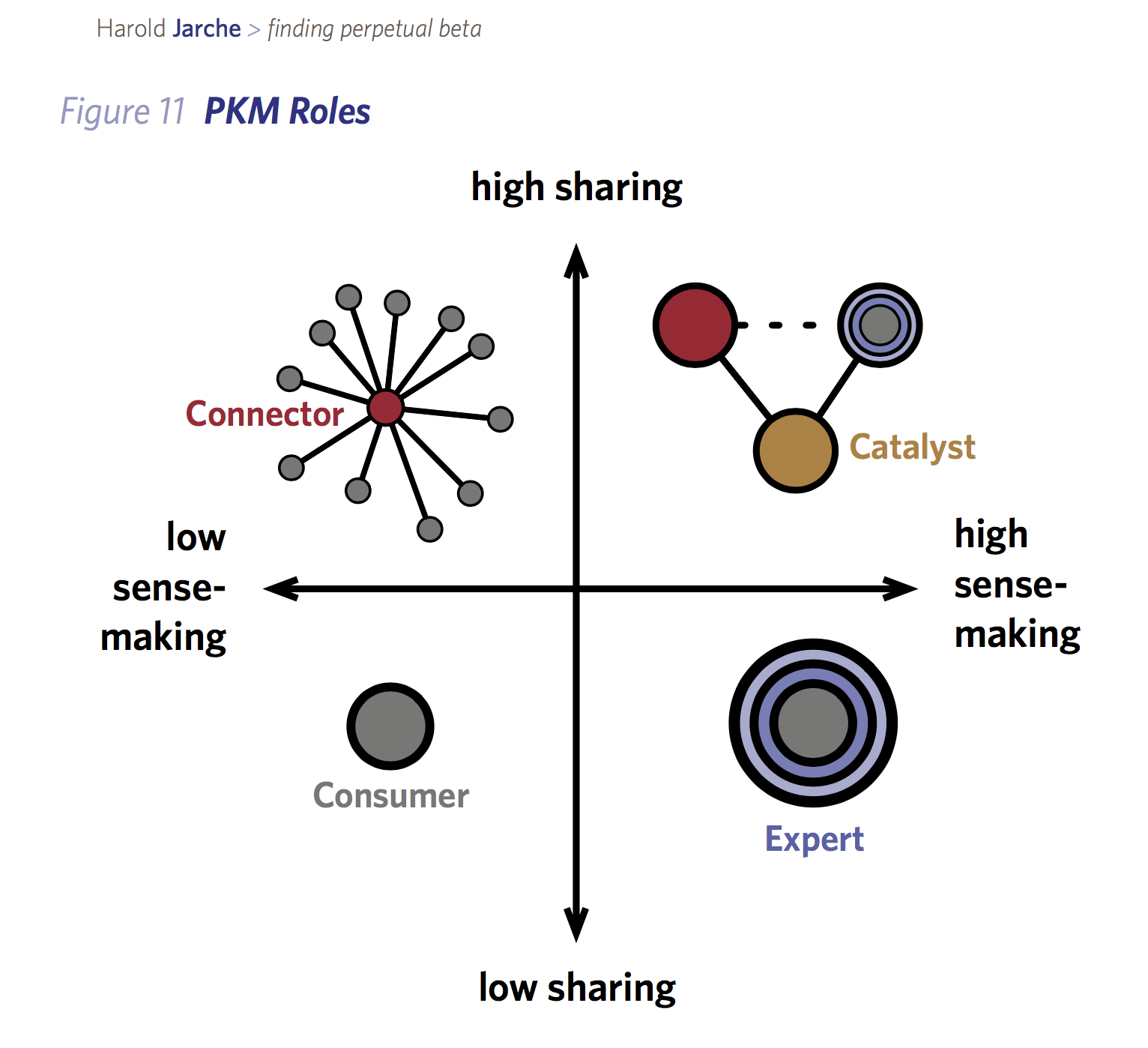
On the Y axis, we can sort ourselves into doing high or low amounts of sharing. As I wrote previously, my likelihood of sharing is in direct relation to the topic I’m exploring. However, as Jarche recommended social bookmarking as one way of sharing, perhaps I was selling myself short when I categorized myself as not likely to share anything overly controversial. I have over 35 thousand digital bookmarks on Raindrop.io and add around 10-20 daily. However, I’m more likely to be categorized as highly visible sharing in terms of the Teaching in Higher Ed podcast and the topics I write about on the Teaching in Higher Ed blog.
On the X axis, our activities are plotted on a continuum more toward high or low sense-making. A prior workshop participant of Jarche’s wrote:
We must make SENSE of everything we find, and that includes prioritising–recognising what is useful now, what will be useful later, and what may not be useful.
Given my propensity for saving gazillions of bookmarks and carefully tagging them for future use, combined with my streak of weekly podcast episodes airing since June of 2014, when it comes to teaching and learning, I’m doing a lot of sense-making on the regular.
These are the (NEW) Experts in My Neighborhood
Taking inspiration from Sesame Street’s People in Your Neighborhood and from Jarche’s activity related to experts, I offer the following notes on experts. When I searched for people within teaching and learning on Mastodon, I found that I was already following a lot of them. I decided to then look at who people I already follow are following:
Ethan Zuckerman – UMass Amherst, Global Voices, Berkman Klein Center. Formerly MIT Media Lab, Geekcorps, Tripod.com
Sarah T. Roberts, Ph.D. – Professor, researcher, writer, teacher. I care about content moderation, digital labor, the state of the world. I like animals and synthesizers and games. On the internet since 1993. Mac user since they came out. I like old computers and OSes. I love cooking. Siouxsie is my queen.
I was intrigued by her having written a content moderation book called Behind the Screen. I know enough about content moderation to know that I know pretty much nothing about content moderation.
She hasn’t posted in a long while, so I’m not sure how much I’ll regularly have ongoing opportunities to see what she’s currently exploring or otherwise working on
Other Things I Noticed
As I was exploring who people I follow are connected with on Mastodon, I noticed that you can have multiple pinned posts, unlike other social media I’ve used. Many people have an introduction post pinned to the top of their posts, yet also have other things they want to have front and center. One big advantage to Bluesky to me has been the prevalence of starter packs. The main Mastodon account mentioned an upcoming feature involving “packs” around twenty days ago, but said that they’re not sure what they’ll call the feature.
Sometimes, scrolling through social media can be depressing. I decided that the next time I’m getting down on Mastodon, I should just check out what’s happening on the compostodon hashtag. It may be the most hopeful hashtag ever.
As I was winding down my time doing some sensemaking related to experts, I came across a video from Westenberg that was eerily similar to what Jarche has been stressing about us making PKM a practice. I can’t retrace my steps for how I came across Joan’s video on Mastodon, but a video thumbnail quickly caught my eye. Why You Should Write Every Day (Even if You’re Not a Writer) captured my imagination immediately, as I started watching. In addition to the video, there’s a written article of the same title posted, as well.
As I continue to pursue learning through the PKM workshop, I’m blogging more frequently than I may ever have (at least in the last decade for sure). Reading through Joan’s reactions to the excuses we make when we don’t commit to writing resonate hard. We think we don’t have time. How about realizing we’re not writing War and Peace, Joan teases, gently. Too many of us get the stinking thinking that we don’t have anything good to say or that this comes naturally to people who are more talented and articulate than we are. Joan writes:
Writing every day is less about becoming someone who writes, and more about becoming someone who thinks.
Before I conclude this post, I want to be sure to stress the importance I’m gleaning of not thinking of individual experts as the way to practice PKM. Rather, it is through engaging with a community of experts that we will experience the deepest learning. A.J. Jacobs stresses that we should heed his advice:
Thou shalt pay heed to experts (plural) but be skeptical of any one expert (singular)
By cultivating many experts whose potential disagreements may help us cultivate a more nuanced perspective on complex topics. When we seek to learn in the complex domain, the importance of intentionality, intellectual humility, and curiosity becomes even more crucial. Having access to a network of experts helps us navigate complexity more effectively.
As with the prior column, this week’s thesis evolves out of the Zoom keynote to the Rethink AI Conference, sponsored in part by the International Academy of Science, Technology, Engineering and Management and hosted by the ICLED Business School in Lagos, Nigeria. Thanks again to the chair of the International Professors Project, Sriprya Sarathy, and the conference committee for making my presentation possible.
Virtually all aspects and positions at universities will be touched by the transformation. The changes will come more rapidly than many of us in higher education are accustomed to or with which we are comfortable. In large part, the speed will be demanded by employers of our learners and by competition among universities. Change will also strike directly at the nature of what and how we teach.
It is not that we have seen no change in teaching over the years. Notably, delivery systems, methods and modes of assessment, and related areas have been subject to significant changes. Anthony Piña, Illinois State University’s chief online learning officer, notes that online learners surpassed 50 percent in 2022 and continue to rise. However, deeper changes in the nature of what we teach have progressed as technology has influenced what employers are seeking.
Most Popular
Building knowledge has been the mantra in higher education for many centuries. The role of the university has been to build knowledge in learners to make them “knowledgeable.” Oxford Languages and Google define knowledge most concisely as “facts, information, and skills acquired by a person through experience or education; the theoretical or practical understanding of a subject.”
The emphasis on facts and information has taken a somewhat changed role with the advent of technologies over recent decades. Notably, the World Wide Web with the advent of the first browser, Mosaic, in 1993 provided instant access to unprecedented volumes of information. While familiarity with key facts and information remains paramount, the recall and synthesis of facts and information via the web can be performed nearly as quickly and more thoroughly than the human brain in most instances. In a sense the internet has become our extended, rapid-access, personal memory. Annual global web traffic exceeded a zetabyte for the first time in 2015. A zetabyte is 1,000 exabytes, one billion terabytes or one trillion gigabytes. This year, it’s expected to hit 175 ZB.
More recently, we have seen a surge in professional certificates offered by higher education. As Modern Campus reports,
“Every professional needs upskilling in order to maintain a competitive edge in the workforce. Keeping ahead of the latest skills and knowledge has become more crucial than ever in order to align with evolving market demands. Although traditional degree programs have long been the standard solution, certificate programs have gained popularity due to their ability to offer targeted, accelerated skill development.”
However, agentic AI is just now emerging. It is different than the prompt to answer generative AI in that agentic AI can include many workforce skills in its array of tools. In fact, working and collaborating with agentic AI will require an advanced, integrated skill set, as described by the Global Skills Development Council:
“In the fast-paced, digitally driven world, agentic AI is at the forefront of demanding new human competencies. While intelligent agents retain a place in daily life and work, individuals should transition to acquire agentic AI skills to thrive in the new age. These skills include, but are not limited to, working with technology, thinking critically, applying ethical reasoning, and adaptive collaboration with agentic AI systems. Such agentic AI skills empower one to consciously engage in guiding and shaping AI behaviors and outcomes rather than passively receiving and adapting to them. If one has agentic AI skills, they can successfully lead businesses, education, and creative industries in applying agents for innovation and impact. As such, re-dedicating ourselves to lifelong learning and responsible use of AI may prove vital in retaining humanity at the core of intelligent decision-making and progress. Without such competencies, professionals risk being bypassed by technologies they cannot control or understand. A passive attitude creates dependency on AI outcomes without the skill to query or improve them. Adopting agentic AI competencies equips individuals with the power to drive innovation and ensure responsible AI integration in the workplace.”
The higher-level skills humans will need as described by the Global Skills Development Council are different from many of the career-specific skills that universities now provide in short-form certificates and certification programs. Rather, I suggest that these broad, deep skills are ones that we might best describe as wisdom skills. They are not vocational but instead are deeper skills related to overall maturity and sophistication in leadership, vision and insight. They include thinking critically, thinking creatively, applying ethical reasoning and collaborating adaptively with both humans and agentic AI.
Agentic AI can be trained for the front-line skills of many positions. However, the deeper, more advanced and more cerebral skills that integrate human contexts and leadership vision are often reflective of what we would describe as wisdom rather than mere working skills. These, I would suggest, are the nature of what we will be called upon to emphasize in our classes, certificates and degrees.
Some of these skills and practices are currently taught at universities, often through case studies at the graduate level. Integrating them into the breadth of the degree curriculum as well as certificates may be a challenge, but it is one we must accomplish in higher education. Part of the process of fully embracing and integrating AI into our society will be for we humans to upgrade our own skills to maintain our relevance and leadership in the workplace.
Has your university begun to tackle the topics related to how the institution can best provide relevant skills in a world where embodied, agentic AI is working shoulder to shoulder with your graduates and certificate holders? How might you initiate discussion of such topics to ensure that the university continues to lead in a forward-thinking way?
A growing share of colleges and universities are embedding artificial intelligence tools and AI literacy into the curriculum with the intent of aiding student success. A 2025 Inside Higher Ed survey of college provosts found that nearly 30 percent of respondents have reviewed curriculum to ensure that it will prepare students for AI in the workplace, and an additional 63 percent say they have plans to review curriculum for this purpose.
In the latest episode of Voices of Student Success, host Ashley Mowreader speaks with Shlomo Argamon, associate provost for artificial intelligence at Touro, to discuss the university policy for AI in the classroom, the need for faculty and staff development around AI, and the risks of gamification of education.
An edited version of the podcast appears below.
Q: How are you all at Touro thinking about AI? Where is AI integrated into your campus?
Shlomo Argamon, associate provost for artificial intelligence at Touro University
A: When we talk about the campus of Touro, we actually have 18 or 19 different campuses around the country and a couple even internationally. So we’re a very large and very diverse organization, which does affect how we think about AI and how we think about issues of the governance and development of our programs.
That said, we think about AI primarily as a new kind of interactive technology, which is best seen as assistive to human endeavors. We want to teach our students both how to use AI effectively in what they do, how to understand and properly mitigate and deal with the risks of using AI improperly, but above all, to always think about AI in a human context.
When we think about integrating AI for projects, initiatives, organizations, what have you, we need to first think about the human processes that are going to be supported by AI and then how AI can best support those processes while mitigating the inevitable risks. That’s really our guiding philosophy, and that’s true in all the ways we’re teaching students about AI, whether we’re teaching students specifically, deeply technical [subjects], preparing them for AI-centric careers or preparing them to use AI in whatever other careers they may pursue.
Q: When it comes to teaching about AI, what is the commitment you all make to students? Is it something you see as a competency that all students need to gain or something that is decided by the faculty?
A: We are implementing a combination—a top-down and a bottom-up approach.
One thing that is very clear is that every discipline, and in fact, every course and faculty member, will have different needs and different constraints, as well as competencies around AI that are relevant to that particular field, to that particular topic. We also believe there’s nobody that knows the right way to teach about AI, or to implement AI, or to develop AI competencies in your students.
We need to encourage and incentivize all our faculty to be as creative as possible in thinking about the right ways to teach their students about AI, how to use it, how not to use it, etc.
So No. 1 is, we’re encouraging all of our faculty at all levels to be thinking and developing their own ideas about how to do this. That said, we also believe very firmly that all students, all of our graduates, need to have certain fundamental competencies in the area of AI. And the way that we’re doing this is by integrating AI throughout our general education curriculum for undergraduates.
Ultimately, we believe that most, if not all, of our general education courses will include some sort of module about AI, teaching students specifically about the AI-relevant competencies that are relevant to those particular topics that they’re learning, whether it’s writing, reading skills, presentations, math, science, history, the different kinds of cognition and skills that you learn in different fields. What are the AI competencies that are relevant to that, and to have them learning that.
So No. 1, they’re learning it not all at once. And also, very importantly, it’s not isolated from the topics, from the disciplines that they’re learning, but it’s integrated within them so that they see it as … part of writing is knowing how to use AI in writing and also knowing how not to. Part of learning history is knowing how to use AI for historical research and reasoning and knowing how not to use it, etc. So we’re integrating that within our general education curriculum.
Beyond that, we also have specific courses in various AI skills, both at the undergraduate [and] at the graduate level, many of which are designed for nontechnical students to help them learn the skills that they need.
Q: Because Touro is such a large university and it’s got graduate programs, online programs, undergraduate programs, I was really surprised that there is an institutional AI policy.
A lot of colleges and universities have really grappled with, how do we institutionalize our approach to AI? And some leaders have kind of opted out of the conversation and said, “We’re going to leave it to the faculty.” I wonder if we could talk about the AI policy development and what role you played in that process, and how that’s the overarching, guiding vision when it comes to thinking about students using and engaging with AI?
A: That’s a question that we have struggled with, as all academic leaders, as you mentioned, struggle with this very question.
Our approach is to create policy at the institutional level that provides only the necessary guardrails and guidance that then enables each of our schools, departments and individual faculty members to implement the correct solutions for them in their particular areas, within this guidance and these guardrails so that it’s done safely and so that we know that it’s going, over all, in a positive and also institutionally consistent direction to some extent.
In addition, one of the main functions of my office is to provide support to the schools, departments and especially the faculty members to make this transition and to develop what they need.
It’s an enormous burden on faculty members to shift, not just to add AI content to their classes, if they do so, but to shift the way that we teach, the way that we do assessments. The way that we relate to our students, even, has to shift, to change, and it creates a burden on them.
It’s a process to develop resources, to develop ways of doing this. I and the people that work in our office, we have regular office hours to talk to faculty, to work with them. One of the most important things that we do, and we spend a lot of time and effort on this, is training for our faculty, for our staff on AI, on using AI, on teaching about AI, on the risks of AI, on mitigating those risks, how to think about AI—all of these things. It all comes down to making sure that our faculty and staff, they are the university, and they’re the ones who are going to make all of this a success, and it’s up to us to give them the tools that they need to make this a success.
I would say that while in many questions, there are no right or wrong answers, there are different perspectives and different opinions. I think that there is one right answer to “What does a university need to do institutionally to ensure success at dealing with the challenge of AI?” It’s to support and train the faculty and staff, who are the ones who are going to make whatever the university does a success or a failure.
Q: Speaking of faculty, there was a university faculty innovation grant program that sponsored faculty to take on projects using AI in the classroom. Can you talk a little bit about that and how that’s been working on campus?
A: We have an external donor who donated funds so that we were able to award nearly 100 faculty innovation challenge grants for developing methods of integrating AI into teaching.
Faculty members applied and did development work over the summer, and they’re now implementing in their fall courses right now. We’re right now going through the initial set of faculty reports on their projects, and we have projects from all over the university in all different disciplines and many different approaches to looking at how to use AI.
At the beginning of next spring, we’re going to have a conference workshop to bring everybody together so we can share all of the different ways that people try to do this. Some experiments, I’m sure, will not have worked, but that’s also incredibly important information, because what we’re seeking to do [is], we’re seeking to help our students, but we’re also seeking to learn what works, what doesn’t work and how to move forward.
Again, this goes back to our philosophy that we want to unleash the expertise, intelligence, creativity of our faculty—not top down to say, “We have an AI initiatives. This is what you need to be doing”—but, instead, “Here’s something new. We’ll give you the tools, we’ll give you the support. We’ll give you the funding to make something happen, make interesting things happen, make good things for your students happen, and then let’s talk about it and see how it worked, and keep learning and keep growing.”
Q: I was looking at the list of faculty innovation grants, and I saw that there were a few other simulations. There was one for educators helping with classroom simulations. There was one with patient interactions for medical training. It seems like there’s a lot of different AI simulations happening in different courses. I wonder if we can talk about the use of AI for experiential learning and why that’s such a benefit to students.
A: Ever since there’s been education, there’s been this kind of distinction between book learning and real-world learning, experiential learning and so forth. There have always been those who have questioned the value of a college education because you’re just learning what’s in the books and you don’t really know how things really work, and that criticism has some validity.
But what we’re trying to do and what AI allows us to do [is], it allows us and our students to have more and more varied experiences of the kinds of things they’re trying to learn and to practice what they’re doing, and then to get feedback on a much broader level than we could do before. Certainly, whenever you had a course in say, public speaking, students would get up, do some public speaking, get feedback and proceed. Now with AI, students can practice in their dorm rooms over and over and over again and get direct feedback; that feedback and those experiences can be made available then to the faculty member, who can then give the students more direct and more human or concentrated or expert feedback on their performance based on this, and it just scales.
In the medical field, this is where it’s hugely, hugely important. There’s a long-standing institution in medical education called the standardized patient. Traditionally it’s a human actor who learns to act as a patient, and they’re given the profile of what disorders they’re supposed to have and how they’re supposed to act, and then students can practice, whether they’re diagnostic skills, whether they’re questions of student care and bedside manner, and then get expert feedback.
We now have, to a large extent, AI systems that can do this, whether it’s interactive in a text-based simulation, voice-based simulation. We also have robotic mannequins that the students can work with that are AI-powered with AI doing conversation. Then they can be doing physical exams on the mannequins that are simulating different kinds of conditions, and again, this gives the possibility of really just scaling up this kind of experiential learning. Another kind of AI that has been found useful in a number of our programs, particularly in our business program, are AI systems that watch people give presentations and can give you real-time feedback, and that works quite well.
Q: These are interesting initiatives, because it cuts out the middleman of needing a third party or maybe a peer to help the student practice the experience. But in some ways, does it gamify it too much? Is it too much like video games for students? How have you found that these are realistic enough to prepare students?
A: That is indeed a risk, and one that we need to watch. As in nearly everything that we’re doing, there are risks that need to be managed and cannot be solved. We need to be constantly alert and watching for these risks and ensuring that we don’t overstep one boundary or another.
When you talk about the gamification, or the video game nature of this, the artificial nature of it, there are really two pieces to it. One piece is the fact that there is no mannequin that exists, at least today, that can really simulate what it’s like to examine a human being and how the human being might react.
AI chatbots, as good as they are, will not now and in the near, foreseeable future, at least, be able to simulate human interactions quite accurately. So there’s always going to be a gap. What we need to do, as with other kinds of education, you read a book, the book is not going to be perfect. Your understanding of the book is not going to be perfect. There has to be an iterative process of learning. We have to have more realistic simulations, different kinds of simulations, so the students can, in a sense, mentally triangulate their different experiences to learn to do things better. That’s one piece of it.
The other piece, when you say gamification, there’s the risk that it turns into “I’m trying to do something to stimulate getting the reward or the response here or there.” And there’s a small but, I think, growing research literature on gamification of education, where if you gamify a little bit too much, it becomes more like a slot machine, and you’re learning to maneuver the machine to give you the dopamine hits or whatever, rather than really learning the content of what you’re doing. The only solution to that is for us to always be aware of what we’re doing and how it’s affecting our students and to adjust what we’re doing to avoid this risk.
This goes back to one of the key points: Our whole philosophy of this is to always look at the technology and the tools, whether AI or anything else, as embedded within a larger human context. The key here is understanding when we implement some educational experience for students, whether it involves AI or technology or not, it’s always creating incentives for the students to behave in a certain way. What are those incentives, and are those incentives aligned with the educational objectives that we have for the students? That’s the question that we always need to be asking ourselves and also observing, because with AI, we don’t entirely know what those incentives are until we see what happens. So we’re constantly learning and trying to figure this out as we go.
If I could just comment on that peer-to-peer simulation: Medical students poking each other or social work students interviewing each other for a social work kind of exam has another important learning component, because the student that is being operated upon is learning what it’s like to be in the other shoes, what it’s like to be the patient, what it’s like to be the object of investigation by the professional. And empathy is an incredibly important thing, and understanding what it’s like for them helps the students to learn, if done properly, to do it better and to have the appropriate sort of relationship with their patients.
Q: You also mentioned these simulations give the faculty insight into how the student is performing. I wonder if we can talk about that; how is that real-time feedback helpful, not only for the student but for the professor?
A: Now, one thing that needs to be said is that it’s very difficult, often, to understand where all of your students are in the learning process, what specifically they need. We can be deluged by data, if we so choose, that may confuse more than enlighten.
That said, the data that come out of these systems can definitely be quite useful. One example is there are some writing assistance programs, Grammarly and their ilk, that can provide the exact provenance of writing assignments to the faculty, so it can show the faculty exactly how something was composed. Which parts did they write first? Which parts did they write second? Maybe they outlined it, then they revised this and they changed this, and then they cut and pasted it from somewhere else and then edited.
All of those kinds of things that gives the faculty member much more detailed information about the student’s process, which can enable the faculty to give the students much more precise and useful feedback on their own learning. What do they perhaps need to be doing differently? What are they doing well? And so forth. Because then you’re not just looking at a final paper or even at a couple of drafts and trying to infer what the student was doing so that you can give them feedback, but you can actually see that more or less in real time.
That’s the sort of thing where the data can be very useful. And again, I apologize if I sound like a broken record. It all goes back to the human aspect of this, and to use data that helps the faculty member to see the individual student with their own individual ways of thinking, ways of behaving, ways of incorporating knowledge, to be able to relate to them more as an individual.
Briefly and parenthetically, one of the great hopes that we have for integrating AI into the educational process is that AI can help to take away many of the bureaucratic and other burdens that faculty are burdened with, and free them and enable them in different ways to enhance their human relationship with their students, so that we can get back to the core of education. Which really, I believe, is the transfer of knowledge and understanding through a human relationship between teacher and student.
It’s not what might be termed the “jug metaphor” for education, where I, the faculty member, have a jug full of knowledge, and I’m going to pour it into your brain, but rather, I’m going to develop a relationship with you, and through this relationship, you are going to be transformed, in some sense.
Q: This could be a whole other podcast topic, but I want to touch on this briefly. There is a risk sometimes when students are using AI-powered tools and faculty are using AI-powered tools that it is the AI engaging with itself and not necessarily the faculty with the students. When you talk about allowing AI to lift administrative burdens or ensure that faculty can connect with students, how can we make sure that it’s not robot to robot but really person to person?
A: That’s a huge and a very important topic, and one which I wish that I had a straightforward and direct and simple answer for. This is one of those risks that has to be mitigated and managed actively and continually.
One of the things that we emphasize in all our trainings for faculty and staff and all our educational modules for students about AI is the importance of the AI assisting you, rather than you assisting the AI. If the AI produces some content for you, it has to be within a process in which you’re not just reviewing it for correctness, but you’re producing the content where it’s helping you to do so in some sense.
That’s a little bit vague, because it plays out differently in different situations, and that’s the case for faculty members who are producing a syllabus or using AI to produce other content for the courses to make sure that it’s content that they are producing with AI. Same thing for the students using AI.
For example, our institutional AI policy having to do with academic honesty and integrity, is, I believe, groundbreaking in the sense that our default policy for courses that don’t have a specific policy regarding the use of AI in that course—by next spring, all courses must have a specific policy—is that AI is allowed to be used by students for a very wide variety of tasks on their assignments.
You can’t use AI to simply do your assignment for you. That is forbidden. The key is the work has to be the work of the student, but AI can be used to assist. Through establishing this as a default policy—which faculty, department chairs, deans have wide latitude to define more or less restrictive policies with specific carve-outs, simply because every field is different and the needs are different—the default and the basic attitude is, AI is a tool. You need to learn to use it well and responsibly, whatever you do.
Q: I wanted to talk about the future of AI at the university. Are there any new initiatives you should tell our listeners about? How are you all thinking about continuing to develop AI as a teaching and learning tool?
A: It’s hard for me to talk about specific initiatives, because what we’re doing is we believe that it’s AI within higher education particularly, but I think in general as well, it’s fundamentally a start-up economy in the sense that nobody, and I mean nobody, knows what to do with it, how to deal with it, how does it work? How does it not work?
Therefore, our attitude is that we want to have it run as many experiments as we can, to try as many different things as we can, different ways of teaching students, different ways of using AI to teach. Whether it’s through simulations, content creation, some sort of AI teaching assistants working with faculty members, whether it’s faculty members coming up with very creative assignments for students that enable them to learn the subject matter more deeply by AI assisting them to do very difficult tasks, perhaps, or tasks that require great creativity, or something like that.
The sky is the limit, and we want all of our faculty to experiment and develop. We’re seeking to create that within the institution. Touro is a wonderful institution for that, because we already have the basic institutional culture for this, to have an entrepreneurial culture within the university. So the university as a whole is an entrepreneurial ecosystem for experimenting and developing ways of teaching about and with and through AI.