Some professors resist using teamwork in their classes because they mistakenly believe that team projects are too difficult to grade. One issue is that, as educators, we often only evaluate the team presentation, project or paper with a grade based on how well the team has met our learning objectives.
However, a single project evaluation at the end allows some members to potentially free ride on harder-working teammates, or enables one aggressive or dominating member to take over the entire project to ensure the team gets an A. If we simply grade team projects at the end, it is too late for our student teams to adapt or adjust and learn how to be better at working in teams, a key skill that employers look for in our graduates.
The key to effectively grading teamwork is to set up the grading process systematically at the start of the project. In this article, we offer four ways that you can grade team projects effectively to meet your learning objectives and help students become better team members.
Share your grading rubric at the start of the assignment. Students need to know at the outset of the team project how they will be graded. Many good students tell us they hate team projects because they know they will have to deal with “social loafers” who rely on one or two others to do the work. However, by sharing a rubric that highlights the expectations for each team member and how you will be combining individual and team grading, you can help students make more intentional decisions regarding how they distribute the assignment’s requirements. We not only distribute the rubric at the start of the project, but we post it on our course management system and frequently review it with the class so our expectations are clear.
Include peer evaluation as a part of the evaluation process. Students are sometimes asked to rate their fellow team members, but they are seldom taught how to do it well. As a result, they tend to only give positive feedback to avoid conflict or hurting another student’s feelings. Teaching peer feedback takes only a little class time, as few as 15 minutes. It starts with clarifying your expectations about how you will use peer feedback. You can use or create a form that allows students to provide quantitative and qualitative feedback, and then you should use this same form multiple times during the project. The first time you collect peer feedback should be a low-stakes or practice situation early during the project so that students have a psychologically safe opportunity to learn how to use it. Your students should begin with self-evaluation and then evaluate their peers. Next, you need to summarize the peer feedback and give results to individual students so they know how they are doing. Finally, have groups reflect on how well the group is doing without naming or shaming others. There are times when students will have to give feedback to a person who is free riding or loafing. When they do, make sure they know to first ask that person for permission before they give feedback, then praise in public, and finally provide any negative feedback in private. Finally, we have a YouTube video that instructors can show during class to help students learn about how to give and receive feedback.
Incorporate ongoing feedback from the instructor. We know of faculty who give out a team assignment and never mention it again until the week before the project is due. This is setting up the student teams for failure. Faculty need to check in frequently with their teams to be sure they are making progress on their work and any questions or concerns are answered. Taking just five minutes at the end of class for teams to meet can pay great dividends in a better project product. This instructor feedback can include a way to hold individual team members accountable for the work they are doing. For example, we have set up a separate Google folder for each team with instructor access. Each team member needed to post their contributions to the team project weekly. In this way, we could keep an eye on any social loafers, and provide feedback to those who were working independently instead of with the team. Instructors can also schedule a brief time to sit in on team meetings so that they get a more comprehensive update about the project and who is working toward each of the outcomes.
Carefully consider the weight you give to each phase of the project. It is essential to incorporate peer assessments and the instructor evaluation about how well the project met the learning objectives into any final grade; both are important. However, the weight of these different evaluations tells students the importance of each. More weight on the individual peer assessments stresses the individual work, while more weight on the instructor grade of the project shows the team efforts are more important. At a minimum, use the 80/20 rule: At least 20 percent of the student’s grade should be based on each. Also, be sure to check the peer evaluations to verify that they result from real behaviors rather than personal biases. We accomplish this by looking for consistency across the times of evaluation, across team members and between peer and self-evaluations. In most cases, we find that the evaluations show consistency in all three areas (though self-evaluations are often inflated). In the rare cases when they don’t align, we always refer to supporting documentation, such as agendas, meeting minutes and information that resulted from our ongoing check-ins to help make sense of the reasons underlying any inconsistencies.
Grading a team project may seem like a daunting challenge, but grading is by no means a reason to avoid giving students the experience of working with a team. By following these four principles for evaluating teamwork, instructors can account for the team’s achievement of the learning objectives as well as provide students with valuable teamwork experiences that they can take to future classes, internships, co-ops and employment.
Lauren Vicker is a communications professor emeritus, and Tim Franz is a professor of psychology, both at St. John Fisher University. They are the authors of Making Team Projects Work: A College Instructor’s Guide to Successful Student Groupwork (Taylor & Francis, 2024).
Most students expect to see one professor at the front of the classroom throughout the semester. But for those attending Harvey Mudd College, a STEM-focused institution in California, it’s not unusual to have four or more faculty members teaching one course.
At Harvey Mudd, team teaching has been a distinguishing facet of the student experience for decades; most general education STEM courses for incoming students are taught by two or more professors.
“It’s the water we swim in,” said Kathy Van Heuvelen, associate dean of faculty. “It’s so embedded in our culture.”
Implementing team teaching as standard practice has helped the college train early-career faculty, establish more holistic courses and ensure students are aware of the various resources and experts available to them on campus.
What is team teaching? Also called collaborative teaching or co-teaching, team teaching involves multiple instructors leading a course, each with their own responsibilities.
Often, team teaching involves faculty of different disciplines covering a topic or issue from multiple perspectives. At Harvey Mudd, for example, a group of faculty taught a course on California wildfires, and the content included the history of forestry, atmospheric chemistry and air pollution, as well as the social implications of fires. Sometimes that means two professors teaching side by side, but often faculty split up lessons and take turns delivering content to students.
Team teaching is less common than solo teaching, in part because it requires more time to implement. Faculty sometimes face logistical barriers, such as aligning schedules and co-creating materials, as well as personal differences in assessment or classroom management. But when done well, the format can equip students with greater critical thinking skills and a richer understanding of content.
Prepped for success: To help professors navigate team teaching, Harvey Mudd offers them a variety of resources. New instructors participate in a weekly lunch led by college administrators where they gather, eat and engage in professional development, Van Heuvelen said. “Our sessions have included team-teaching strategies for communicating with your team and navigating this mode of teaching.”
Van Heuvelen also provides a team-teaching checklist for faculty each semester to help them prepare for the upcoming term, which includes items such as communication, timeline for developing materials, classroom management and other course policies.
“It has a list of questions for the team to discuss ahead of time to try to help teams get out In front of any challenges and establish their team norms,” she said.
The college is part of the Claremont Consortium—a group of seven higher education institutions in Claremont, Calif.—which has a Consortium Center for Teaching and Learning and provides workshops on team teaching, as well.
Most team-taught courses are designed to feature a junior and senior faculty member, allowing the early-career professional to learn from a more experienced instructor, Van Heuvelen said.
“For an early-career hire who maybe does not have extensive teaching experience, it is like attending a master class,” Van Heuvelen said. “There is tremendous mentoring that can go on there.”
Newer instructors also bring fresh perspectives and ideas to the classroom, which ensures content does not get stale over time.
Supporting student success: One of the benefits of the model is that students have a group of instructors to engage with and call on if they need academic support, Van Heuvelen said.
“For example, when we have a team that’s teaching, we all hold common office hours, so students can go to any office hours,” Van Heuvelen said.
Past research shows that students are often unaware of the full range of supports available to them on campus, but engaging with many professors can get students more plugged in to institutional services, or at least provide more touch points, Van Heuvelen said.
Working as a successful team member remains one of the most important skills that employers report that they want when hiring college graduates. This means that when professors create well-executed and high-quality team projects, they can help their students succeed in a challenging job market. However, there are times when professors fail to help students to develop the necessary teamwork skills that our students will need, such as helping them learn how to manage team conflict.
We surveyed college professors a few years ago to better understand the problems they face when running team projects, even learning about why some choose to avoid team projects altogether. Many reported that they struggle because of the issues that students face when working in a team, such as one student taking over the project, figuring out how to grade a team project, motivating social loafers, and including dealing with team conflict.
The reality is that conflict will inevitably occur during team projects. We can help our students work better in teams by teaching them how to manage the conflict that they will face.
Many students think that there is something wrong when conflict occurs on their team. However, conflict can be a positive force for team decision-making when it’s focused on the task, provides new perspectives on the issues, and shows how the team can improve. On the other hand, there are types of conflict that can be destructive, such as when it gets emotional and focuses on people and personal grievances, rather than the work that the team is doing.
In this article, we recommend six easy strategies to help your students try to avoid the destructive emotional conflict and better manage the substantive conflict in their team when it does occur.
1. Focus on Team Goals
It’s important to start your team project by emphasizing the importance of the team project to their work in your class. This requires more than discussing how the project paper or presentation relates to their grade. Instead, help your teams to understand the skills that they will gain from working on the project you’ve assigned. When team members see the value in your team project, they are more likely to work together on it.
2. Create a Team Charter
Start your teams off right by having them create a team charter. This should include at least three components: when and how long they will meet each week, how to contact one another, and a list of behavioral and attitudinal obligations that they have to one another. These obligations may include things like how soon to respond to messages, how responsibilities are assigned, and even how they will resolve disagreements as they work together.
3. Use Frequent Check-ins
Monitoring how well your teams are working together can help you to identify a minor conflict before it becomes a major problem. These check-ins can be accomplished through ongoing peer evaluations, when you attend their team meetings, and/or through team updates they can provide, often as an assignment on your LMS. Once you learn about a potential conflict, you can make some suggestions for how they might move forward. We have often made Google Drive folders for each team with instructor access, and we require students to write their contributions to the instructor each week as one way to keep an eye on potential issues that might derail their projects. We’ve even had these project updates impact a small portion of the final grade of the project.
4. Focus the Team on Their Task
Keep your teams focused on the team task. You can help them to accomplish this by breaking down your project into components and setting intermediary deadlines. Scaffolding a team project this way can help keep your teams moving forward rather than spiraling or stalling. You can also regularly remind them about the main goal of the assignment. Finally, make sure to explain how any conflict that occurs needs to focus on issues with substance (e.g., how to collect data, what recommendations should we give, etc.) because these are important parts of the discussions that will help their team to create a better project. Similarly, remind them that they should not be spending time hurling angry accusations at each other or talking to team members behind others’ backs. We like to use the following quote to help our students with this:
Conflict is inevitable. Anger is a choice. And almost always the wrong choice. — Seth R. Silver
This way, they begin to understand that their conflict is not a problem until it starts to boil over into frustration, anger, and even resentment that derails them.
5. Address Conflict Resolution Strategies in Class
There are many great conflict resolution strategies that you can use to help your students recover when they do in fact face some conflict. One of our favorites is a team-based Start-Stop-Continue exercise. In it, the team discusses what they should start doing (e.g., setting deadlines for completing action items), stop doing (e.g. showing up late to team meetings), and continue doing (e.g. keeping the other team members informed about their work) in order to be successful. Remind students that this is a team discussion, which means that they should use team talk (“we can start setting deadlines”) and it should not include any ‘naming or shaming’ that calls out any one team member by name.
6. Get Involved When Necessary
If you’re following the first five steps, your teams will usually work through most conflicts. But, there are times where you might need to get involved – this should be a last resort and often only when you are asked to intervene. When you get such a request, you should meet with the team outside of class time. Your main role will be listening to their issues and asking open-ended questions. This will help them to find (or maybe even gently guide them towards) a solution on their own, because your students will be more committed to a solution that they help to create. You want to avoid dictating a solution unless the team is ready to self-destruct and it is truly the only way forward.
By incorporating these six strategies into your team project, your students will be more likely to:
Have a better team experience in your class;
Learn important skills that will help them in future teams;
Be more likely to successfully work in teams in other classes; and
Have a compelling story that they can share with potential employers about how well they worked in a team.
In addition, it will improve your own experience with team projects (and make them easier for you to grade, too)!
Tim Franz is Professor of Psychology and Lauren Vicker is Communications Professor Emeritus, both at St. John Fisher University. We started working together to team-teach a course in group dynamics beginning in 2004, coming from the fields of psychology and communications. We have presented, written, and published on teamwork and team projects, with our latest effort being Making Team Projects Work: A College Instructor’s Guide to Successful Student Groupwork, published by Routledge/Taylor & Francis, 2025. Approaching the issue from two different perspectives and teaching beyond our own home disciplines in business, pharmacy, criminology, etc. has given us a broad perspective into the issue.
Top Hat’s engineering team is gaining a valuable new voice with the addition of Alec Kretch, whose work and experience sits at the intersection of technical innovation and learning science. As the founder of OpenClass—an AI-powered platform that helps educators design meaningful, mastery-based assignments—Kretch is a strong advocate for using assessment as a tool for learning rather than simple measurement. The acquisition of OpenClass’s intellectual property, along with Kretch’s appointment to Top Hat’s engineering team, will support Top Hat’s continued investment in discipline-specific solutions and in expanding the company’s capabilities around authentic assessment. These efforts align with a growing institutional focus on career readiness and helping students build practical skills they can carry into life after graduation
“Alec has shown how technology can help educators create richer, more effective learning experiences through relevant, real-world application,” said Maggie Leen CEO of Top Hat. “His work with OpenClass aligns closely with our focus on supporting instructors with tools that encourage deeper thinking and meaningful student engagement.”
OpenClass was originally developed to help computer science instructors create authentic assignments, where students solve in-browser coding problems and receive immediate, actionable feedback. While built with programming in mind, the underlying approach is broadly applicable across disciplines. Authentic assessment encourages students to apply what they’ve learned in practical contexts, fostering critical thinking, creativity, and lasting understanding in ways traditional assignments often fall short. This kind of learning experience is especially vital as students increasingly look to higher education to build the skills they’ll need to succeed in their future careers.
Over the past few years Top Hat has expanded innovation across many disciplines. Aktiv Chemistry, for example, which the company acquired in 2022, offers interactive tools designed to meet the unique needs of chemistry educators and learners. Offering personalized, authentic assessments that reflect the real-world scenarios students will face in their careers supports Top Hat’s mission to spark better teaching and more meaningful learning.
“Top Hat is the gold standard for evidence-based learning platforms,” said Kretch. “We share a vision for the future of higher education—one that’s equitable, personalized, and focused on helping students develop real skills. I’m excited to help bring the best of OpenClass to more instructors and learners.”
On the eve of the 4th of July holiday, when they probably hoped no one was paying attention, the Trump Department of Education issued an Interpretive Rule that will make it easier for for-profit colleges to evade regulations aimed at protecting students, and especially student veterans and military service members, from low-quality schools.
The Department’s 90-10 rule, created by Congress, requires for-profit colleges to obtain at least ten percent of their revenue from sources other than taxpayer-funded federal student grants and loans, or else — if they flunk two years in a row — lose eligibility for federal aid. The purpose is to remove from federal aid those schools of such poor quality that few students, employers, or scholarship programs would put their own money into them.
For decades, low quality schools have been able to avoid accountability through a giant loophole: only Department of Education funding counted on the federal side of the 90-10 ledger, while other government funding, including GI Bill money from the VA, and tuition assistance for active duty troops and their families from the Pentagon, counted as non-federal. That situation was particularly bad because it motivated low-quality predatory schools, worried about their 90-10 ratios, to aggressively target U.S. veterans and service members for recruitment.
After years of efforts by veterans organizations and other advocates to close the loophole, Congress in 2021 passed, on a bipartisan basis, and President Biden signed, legislation that appropriately put all federal education aid, including VA and Defense Department money, on the federal side of the ledger.
The Department was required by the new law to issue regulations specifying in detail how this realignment would work, and the Department under the Biden administration did so in 2022, after engaging in a legally-mandated negotiated rulemaking that brought together representatives of relevant stakeholders. In an unusual development, that rulemaking actually achieved consensus among the groups at the table, from veterans organizations to the for-profit schools themselves, on what the final revised 90-10 rule should be.
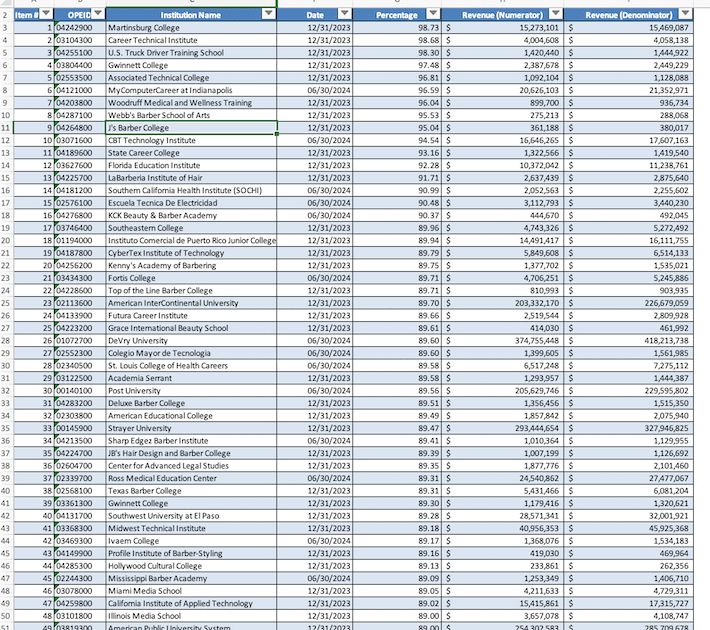
The new rule took effect in 2023, and when the Department released the latest 90-10 calculations, for the 2023-24 academic year, sixteen for-profit colleges had flunked, compared with just five the previous year. These were mostly smaller schools, led by West Virginia’s Martinsburg College, which got 98.73 percent of its revenue from federal taxpayer dollars, and Washington DC’s Career Technical Institute, which reported 98.68 percent. Another 36 schools, including major institutions such as DeVry University, Strayer University, and American Public University, came perilously close to the line, at 89 percent or higher.
The education department last week altered the calculation by effectively restoring an old loophole that allowed for-profit colleges to use revenue from programs that are ineligible for federal aid to count on the non-federal side. That loophole was expressly addressed, via a compromise agreement, after Department officials discussed the details with representatives of for-profit colleges, during the 2022 negotiated rulemaking meetings.
All the flunking or near-flunking schools can now get a new, potentially more favorable, calculation of their 90-10 ratio under the Trump administration’s re-interpretation of the rule.
In the lawless fashion of the Trump regime, the Department has now undermined a provision of its own regulation without going through the required negotiated rulemaking process. (The Department’s notice last week included a labored argument about why its action was lawful.)
As it has done multiple times over its first six months, the Trump Department of Education, under Secretary Linda McMahon, has again taken a step that allows poor-quality predatory for-profit colleges to rip off students and taxpayers.
You’re under increased pressure to make better, data-informed decisions. However, most colleges and universities don’t have the budget to build the kind of data team that drives strategic progress. And even if you can hire, you’re competing with other industries that pay top dollar, making it hard, if not impossible, to find the right data resource with all the skills to move your operation forward. Don’t let hiring roadblocks make you settle for siloed insights and stagnant dashboards.
How to Build a High-Impact Data Team Without the Full-Time Headcount Thursday, June 26 2:00 pm ET / 1:00 pm CT
In this webinar, Jeff Certain, VP of Solution Development and Go-to-Market, and Dan Antonson, AVP of Data and Analytics, break down how a managed services model can help you create a high-impact data team at a fraction of the cost and give you access to a robust bench of highly specialized data talent. They will also share some real-world examples of nimble, high-impact data teams in action.
You’ll walk away knowing:
Which data roles are needed for success and scale in higher ed
How to rapidly scale data operations without adding FTEs
Why managed services are a smarter investment than full-time hires
Ways to tap into cross-functional expertise on demand
How to build a future-ready data infrastructure without ballooning your org chart
Whether you’re starting from scratch or trying to scale a lean team, this session will offer practical, flexible strategies to get there faster — and more cost-effectively.
Who Should Attend:
If you are a data-minded decision-maker in higher ed or a cabinet-level leader being asked to do more with less, this webinar is for you.
Presidents and provosts
CFOs and COOs
Enrollment and marketing leaders
Expert Speakers
Jeff Certain
VP of Solution Development and Go-to-Market
Collegis Education
Dan Antonson
AVP of Data and Analytics
Collegis Education
It’s time to move past the piecemeal approach and start driving real outcomes with your data. Complete the form to reserve your spot! We look forward to seeing you on Thursday,June 26.
State legislators from both parties want to expand family child care — the home-based sector of licensed child care, which has shrunk by more than a third since 2018. Both the House and Senate budget proposals include pilots to open new programs to meet the needs of families and employers.
For the past two years, a team from the nonprofit Southwestern Child Development Commission (SWCDC) has done just that, creating North Carolina’s first statewide system of support for family child care. In the past year, the organization has helped launch 27 new family child care programs, 20 of which are open, creating at least 160 new slots for children. Two are the first family child care programs in their counties.
Since September 2023, the team has awarded start-up grants to another 26 programs and business sustainability grants to 38 programs. It has created the first statewide family child care mentorship program, regional communities of practice, and a marketing campaign that has garnered interest from more than 200 prospective providers since April.
As state leaders ask how to improve child care access and affordability, the project’s lessons should carry forward, said Daniel Bates, the statewide project’s manager.
“I just really felt like we’ve done something here, and I hope that, no matter what, it still continues, because family child care is so incredibly important,” Bates said. “And they are part of early childhood education.”
‘People that will be around for a while’
Expanding family child care takes one-on-one support for new providers who often bring a passion for children but little knowledge of the complex regulations and business challenges that come with starting and operating a program, the project leaders said. It also requires funding.
In 2024, SWCDC, a nonprofit focused on early care and education based in western North Carolina, was awarded $525,000 from the Division of Child Development and Early Education (DCDEE) from legislative pilot funding to expand access to family child care. The project’s expected output was to help 18 programs get started. Instead, it has helped launch 27 programs by awarding grants to cover start-up costs.
The grants ranged from $5,000 to $20,000 depending on the providers’ needs and the strategic goals of the project. The average grant was about $13,000.
Providers also spent their own money to open their programs outside of the grants. A survey of some of the providers found that most had spent between $1,000 and $5,000 before receiving grants to prepare their homes and buy materials.
The new providers are in 19 counties. In Alleghany and Montgomery counties, grant recipients will be the only family child care providers in their counties. Two providers speak Spanish fluently, according to the project leaders. At least 18 have college degrees. Four of the new providers were under 30 years old. Six were in their 30s; 10 were in their 40s.
“These are people that will be around for a while,” said Vickie Ansley, SWCDC’s Child Care Resource & Referral (CCR&R) regional programs manager and family child care in-home program activity coordinator.
Danielle Dixon wakes up students from nap time at Helen Cole’s Day Care. (Liz Bell/EducationNC)
That grant funding was layered onto a larger statewide family child care project the organization has been leading since February 2023 through a separate $3 million contract with DCDEE from the CCDF, the federal funding stream that helps states raise the quality of child care and helps working families afford it.
The statewide project had many components, including start-up grants of up to $10,000 and business grants of up to $5,000 for access to business training, software, or devices to manage programs. It provided 64 professional development workshops to providers on a range of issues. It also created a framework for family child care substitute pools and a database of zoning contacts and information.
Hands-on support from regional consultants
The crux of the project, however, was all about hands-on support and community building, the project leaders said. The project funded 17 family child care consultants who reached 477 providers in 73 counties with coaching and consultation.
The consultants, trained in the specifics of owning and operating a family child care program, were embedded in the 14 regional CCR&R hubs covering all 100 counties.
“We’re talking about people located in those communities,” Ansley said. “They know the (providers), or they know somebody who knows them.”
Helen Cole, a family child care provider in Taylortown, says the grants she received from Southwestern Child Development Commission helped her buy high-quality materials. (Liz Bell/EducationNC)
The PDG contract is in process but will be awarded to Acelero Charitable Foundation “in collaboration with multiple agencies that support family child care.” It will focus on increasing quality and family engagement, the spokesperson said.
DCDEE employs licensing consultants who meet with all types of potential child care owners to begin the licensure process. The licensing consultants began recommending reaching out to the regional family child care consultants to new providers.
The family child care consultants then could provide knowledge specific to family child care, dedicate time and energy to decipher the complexities of starting and sustaining a business, and offer support that was independent from regulatory oversight and compliance. Some of the consultants were former family child care providers themselves.
“Prior to that, if an agency had capacity, then they provided support,” Bates said. “The services were somewhat limited, whereas this was full 100% dedication for family child care.”
The regional consultants received business training to advise providers on budget planning, financial reports, marketing, and recruiting and retaining staff.
Kathleen Hoffler, a regional consultant at the Partnership for Children of Cumberland County who once owned a family child care home, described the role as her “dream job.”
Hoffler said she has helped providers take better care of their businesses, their children, and themselves. She encouraged providers to take time off and to reach out for help.
“If you’re having issues with enrollment, if you’re having issues with collecting payments from parents, if you’re having behavior issues with kids or you’re worried that one of your kids might need some developmental screening, and you don’t have anybody to talk that out with, it’s real easy to get discouraged and possibly decide it’s not for you and you’re going to close your program,” Hoffler said.
The family child care consultants connected providers to the pilot grant opportunities and helped them budget what they needed and how they should spend the funding.
Since the consultants were embedded in CCR&R agencies, they could connect providers with a variety of professional development opportunities and resources.
And they connected providers to mentors — seasoned family child care providers who provided a listening ear and advice on overcoming obstacles — and to communities of practice, regional teams that met to share ideas and support one another.
Annette Anderson-Samuels, owner of Phenomenal Kids Child Care Services, a family child care home in Kings Mountain, was one of those mentors. She said her advice to two new providers on how to advertise their programs kept them from closing. She recently helped a provider navigate a tough conversation with parents who were not following her policies.
“It’s to help each other become better at what we do as child care providers,” Anderson-Samuels said.
There were 22 mentors and 44 mentees across the state. In his decades working in early childhood, Bates said the group has been a standout.
“They’ve crossed county lines to go help each other in person,” he said. “The interest and the willingness, wanting to improve themselves, is really out there if they have the opportunity to do that.”
‘The lost segment of early childhood education’
The number of family child care programs, child care businesses within a residence, has fallen by about 36% since 2018, compared with an overall 15% decline in all types of licensed child care.
As a generation of providers age out of the work, a lack of awareness, funding, and support — along with increased regulation — has kept new providers from entering the field, project leaders said.
The team was intentional about listening to providers’ experiences and needs before developing a system of support.
Helen Cole said her family child care home has better equipment and provides higher-quality care because of the support she received from the Southwestern Child Development Commission’s family child care projects. (Liz Bell/EducationNC)
Many brought up the low rates that family child care providers receive per child to participate in the state’s subsidy program. These rates, the state has found, do not cover the full cost of providing child care in any setting. Home-based programs receive lower amounts per child than centers. And providers in rural and low-income areas often receive lower rates than those in higher-income counties.
In rural areas where market rates are lower, “even though we need family child care in those communities desperately, market rates are a hindrance,” said Lori Jones-Ruff, SWCDC’s regional programs manager.
Jones-Ruff also sits on Gov. Josh Stein’s Task Force on Child Care and Early Education, where members have discussed the need for higher subsidy rates and a statewide floor rate that would level the playing field among counties. Research has shown the geographic disparities are wider than place-based differences in cost.
“That’s not just a center issue,” she said. “It’s for family child care as well.”
Low funding from public sources and private tuition leads to low compensation for family child care professionals. The median wage for home-based providers in 2023 was $10.20.
The team also heard about obstacles due to HOA rules and zoning regulations. They found that local ordinances were putting up barriers to new programs in some places. Septic tank requirements were among the most common and most expensive problems.
“(Providers) have recognized, ‘I don’t really need to run to Raleigh; some of the challenges I have are really just in my own backyard, and I just need to talk to my town or county,’” Bates said.
The team heard about the isolation many providers feel, being alone in their homes all day without a network to air ideas or lean on when challenges arise. Providers said they did not feel respected or supported by the state.
“Historically, there was a huge emphasis put on center-based care in North Carolina,” Jones-Ruff said. “Homes did not feel that they were as valued and as supported as center-based. And so there was a period of time where they really felt like they were kind of the lost segment of early childhood education in North Carolina.”
So the team built a strategy based on both funding and relationships.
‘Like a prayer answered’
For Helen Cole, that assistance and funding was key to opening her family child care home in Taylortown in Moore County.
“I just feel like this wouldn’t have been possible without the support and the funds,” said Cole, who recently earned her four-star license to care for children from infancy to 12 years old at Helen Cole’s Day Care.
She received more than $17,000 to start her program from the legislative pilot funding. She bought new outside equipment, furniture, dramatic play sets, age-appropriate toys and books, a new kitchen faucet, a state-approved curriculum, and a new laptop.
Cole heard about the potential grant funding for start-up costs from the state licensing consultant. She was also connected with Hoffler.
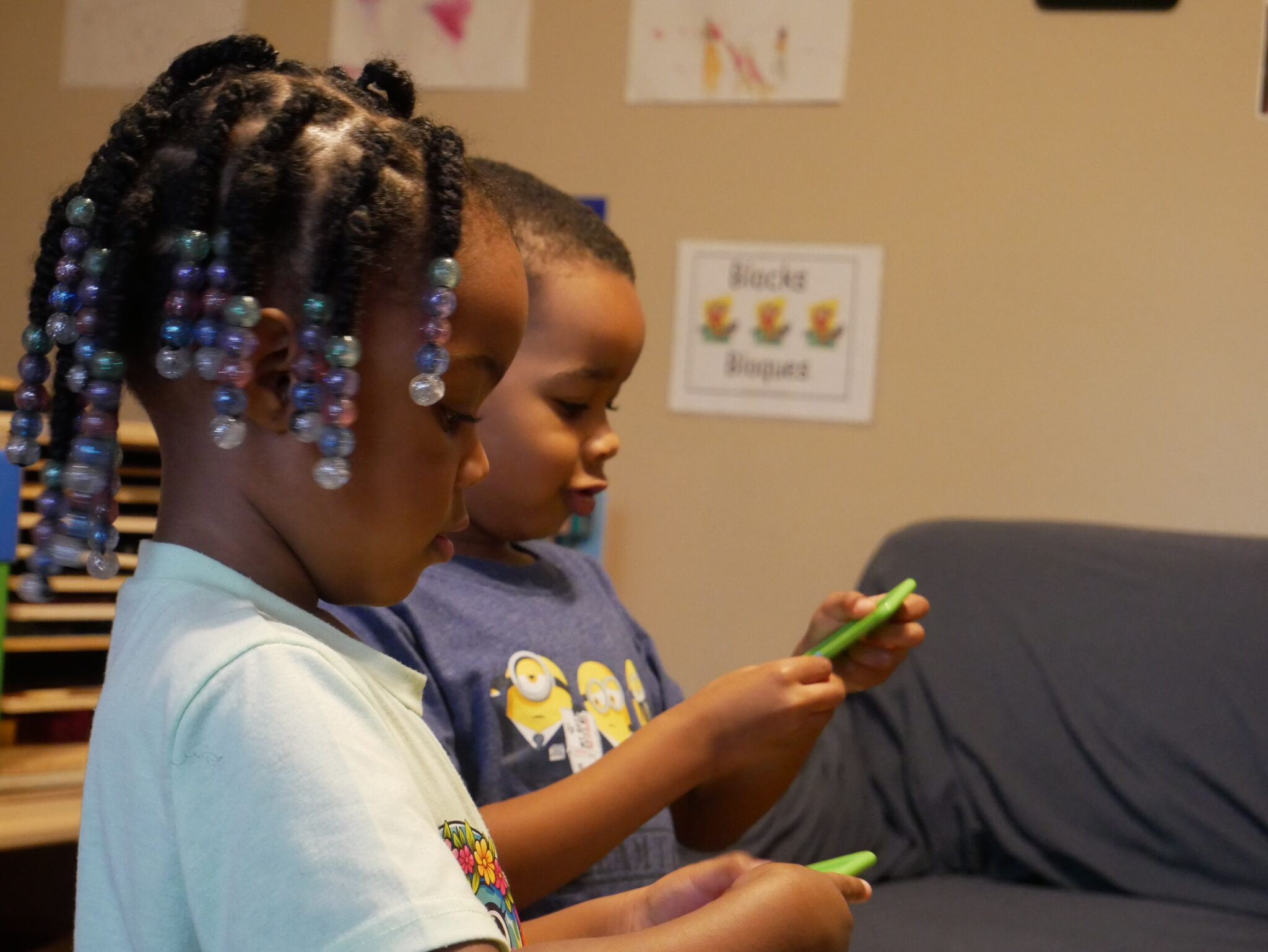
Students at Helen Cole’s program work on their counting skills. (Liz Bell/EducationNC)
Cole was excited to open after hearing about a local demand for second-shift care. After retiring as a substitute teacher in her local school district, she needed more income and was eager to fill a community need.
But after her initial meeting with a licensing consultant, she received a long checklist of everything she had to do. She said she felt overwhelmed.
“It was just so much information,” she said. “There are things on the website, but how do you adjust it for your day care?”
Plus, Cole had experience helping in her sister’s child care program, but she did not know the ins and outs of operating a small business. Even with a background in accounting, she knew the role would be challenging. So she reached out to Hoffler for an in-person meeting.
“It was like a prayer answered,” Cole said. “She broke it down for me.”
Hoffler helped Cole navigate the tough decisions that come with operating a business from your home, such as how much living space she was willing to sacrifice and what renovations were needed. And she helped Cole create a budget to apply for grant funding through the legislative pilot. She gave her ideas on high-quality and age-appropriate materials.
She also connected Cole with a mentor, helped her with business skills, and connected her with other resources through the Smart Start partnership.
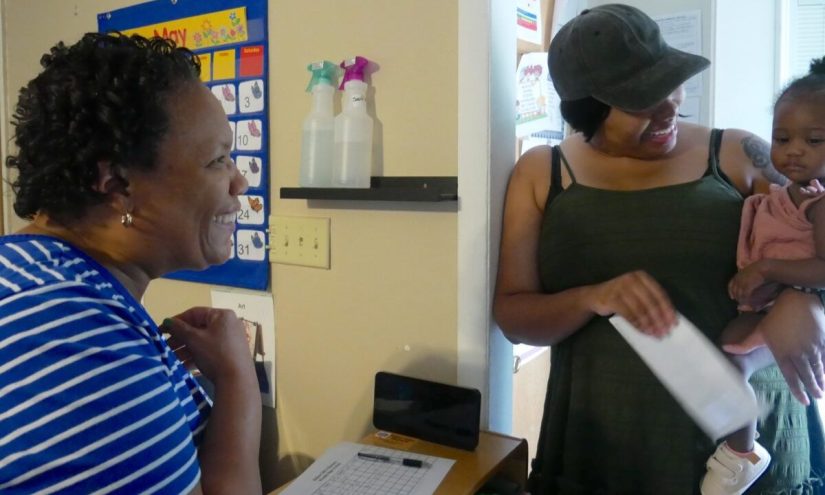
Hoffler has helped her advertise her program and hold on through the ups and downs of enrollment, Cole said. Because she needed to hire another teacher, her niece Danielle Dixon, Cole said she is breaking even but has not started making a profit or been able to pay herself. She said she has been advised that it can take nine months to a year.
She said low subsidy rates and parents’ inability to afford her private rates have also been financially challenging. She serves one student whose parents are both working, making too much to qualify for a subsidy, but cannot afford her private rate of $200 per week. She only charges that family $85 per week.
Danielle Dixon, a teacher at Helen Cole’s Day Care, has worked in child care for 11 years. (Liz Bell/EducationNC)
Dixon, who has been working in child care professionally for 11 years but informally since she was 16 years old, has both of her children enrolled at the program. Dixon said her grandmother and mother, as well as three of her aunts, have worked in child care. She decided to partner with her aunt, Cole, to return to working with young children in a creative, exploratory environment after working in public schools.
Helen Cole’s Day Care opened in December in the home she was raised in, and where her mother used to take care of children whose parents were at risk of losing custody.
“All of our lives, we’ve had other children here,” Cole said.
Both Dixon and Hoffler have helped Cole strengthen her understanding and practice of early childhood care and education. Her program’s philosophy is based on relationships, exploration, and emotional and social development. Then academic foundations are added.
“It’s that give and take between you and this child,” Hoffler said. “They’re going to learn more from you if you are actively engaging with them and talking to them throughout the day, than they’ll ever learn if you give them a coloring sheet and try to teach them how to stay in the lines. There are no lines in early childhood.”
“That was a wow moment,” Cole said. “I understand that we have to have a curriculum, and we do, but the biggest thing is for them to develop on their own.”
It is this one-on-one attention and intimate environment that make family child care appeal to so many parents. Rural children, low-income children, and children of color are more likely to access home-based care than center-based, according to national advocacy and research group Home Grown. It is often more affordable, more convenient and flexible for nontraditional working hours, and more culturally and linguistically relevant to diverse families.
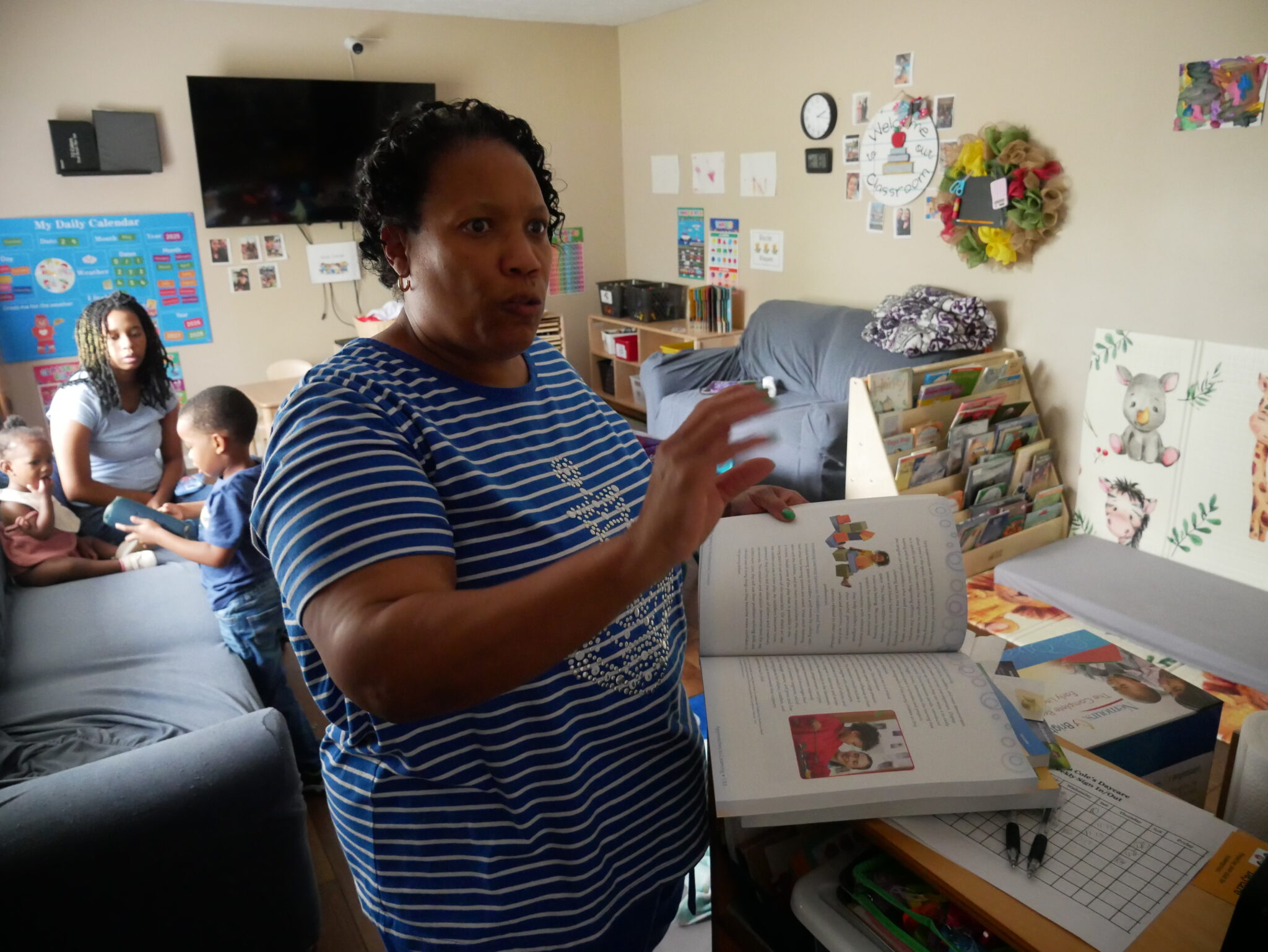
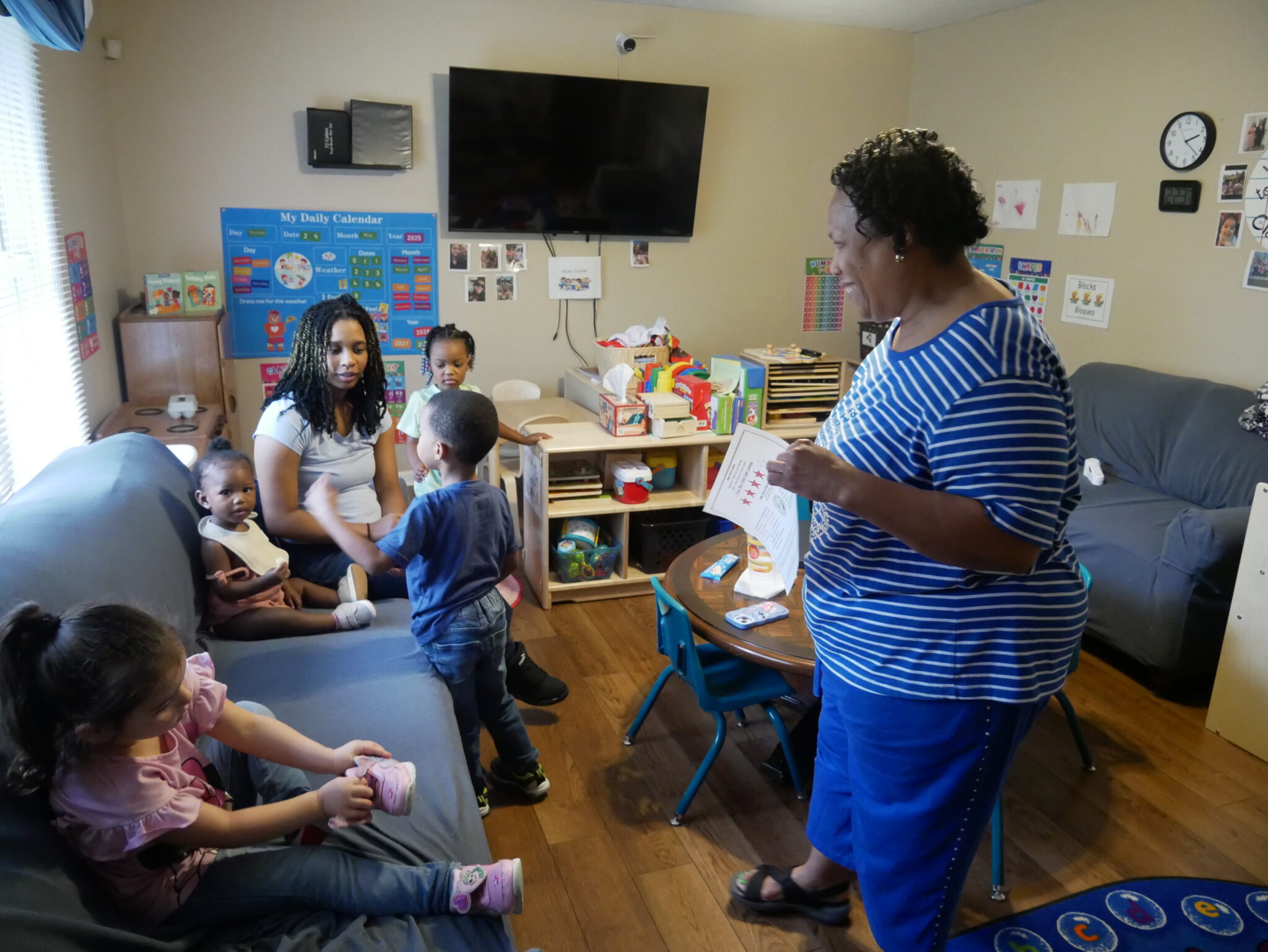
Inside Helen Cole’s child care program. (Liz Bell/EducationNC)
Kailyn Green, whose daughter has been at the program for a month, said she toured other programs with open spots but they “didn’t feel right.” Then she visited Cole’s program and did a walk-through.
“I was like, ‘I’m sold. I’m good,’” Green said.
A licensed clinical social worker, Green said she has been able to return to work without worrying. She receives texts and videos of her daughter’s days and has been impressed by how much she has progressed, especially with eating more consistently.
“I love that she truly gets the attention,” she said. “She’s been able to form a relationship with her. It’s been great.”
Hoffler said she was excited to hear about Cole’s recent accomplishment: earning four out of five stars on the state’s quality rating scale.
“I’m just so proud of her,” she said. “She handled it like a pro.”
What’s next?
There are multiple efforts to build different kinds of supports for family child care. DCDEE said the project with SWCDC taught them that “Family Child Care Homes (FCCHs) would benefit from additional funding, continued community engagement, and professional development to improve quality,” according to a DCDEE spokesperson.
“FCCHs are a vital part of our state’s early care and learning network, and DCDEE is committed to continuing our support for these small businesses,” the spokesperson said in an emailed statement.
Though the contract for the statewide project ends on June 30, the spokesperson said the division will continue using CCDF funds and federal funds from the Preschool Development Grant (PDG) Birth through Five to provide business technical assistance and other services to family child care programs.
The PDG contract is in process but will be awarded to Acelero Charitable Foundation “in collaboration with multiple agencies that support family child care.” It will focus on increasing quality and family engagement, the spokesperson said.
DCDEE is also contracting with Frank Porter Graham Child Development Institute at UNC-Chapel Hill to provide evaluation and coordination of the PDG Elevate FCCH project, which will provide extra subsidy funding to family child care programs to increase wages for providers.
The House and Senate budget proposals direct DCDEE to use CCDF funds to expand family child care capacity. The House would allocate $7 million over two years for a pilot in three localities, and the Senate would allocate $6 million for a pilot in Alamance, Harnett, and Johnston counties. The funding would go to councils of governments in each of those counties to select a third-party vendor. Both proposals have specific requirements for the chosen vendor, including experience in establishing family child care homes in at least three other states and rural areas, experience in operating a substitute pool in another state, and technology that connects families with providers and includes billing and coaching functions.
Meanwhile, Jones-Ruff said SWCDC will continue supporting family child care by retaining a statewide team with organizational funding — and will seek outside funding to continue other aspects of the project. Some of the family child care consultants will continue their work through local CCR&R or Smart Start funding.
“I can see just the monumental amount of work and the progress that has happened in such a short amount of time,” she said. “We’re not going away.”
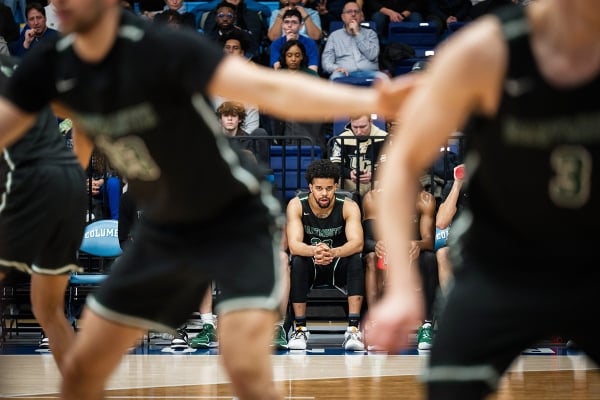
The Dartmouth College men’s basketball team is dropping its historic bid to form a union, months after voting to do so.
The decision, announced Tuesday, comes as Republicans are poised to take control of the National Labor Relations Board, which could affect who is allowed to unionize on college campuses. A regional office of the board cleared the way earlier this year for the players to vote on the petition, ruling that the student-athletes were employees and thus allowed to unionize.
Dartmouth disagreed with that opinion and refused to bargain with the team until the five-member NLRB ruled on the issue. Currently, the five-member panel has two vacancies, so incoming President Donald Trump could quickly reshape the board. In withdrawing the petition, the Service Employees International Union, Local 560, which represents the players, decided not to gamble with the new board and potentially risk a negative opinion.
“By filing a request to withdraw our petition today, we seek to preserve the precedent set by this exceptional group of young people on the men’s varsity basketball team,” local president Chris Peck said in a statement to the Associated Press. “They have pushed the conversation on employment and collective bargaining in college sports forward and made history by being classified as employees, winning their union election 13-2, and becoming the first certified bargaining unit of college athletes in the country.”
The Dartmouth team union threatened to upend college sports and added more urgency to the National Collegiate Athletic Association’s efforts to settle the question of whether student athletes are employees who can collectively bargain. The NCAA has lobbied Congress to pass a law affirming that college athletes aren’t employees. The incoming Congress seems likely to grant that request.
I am thrilled to share my heartfelt gratitude to the University of Liverpool for offering the Diploma for Go Higher Programme – a remarkable initiative designed to open doors and beacon of hope for those who, due to various reasons, have been unable to pursue their educational goals and have had to suppress their ambitions.
My name is Gary Singh, and I want to share my journey with you, a journey that has been filled with challenges, resilience, and hope. In 2004, my plans to become a solicitor were shattered by the sudden passing of my father. I had to start working, and unfortunately, I faced exploitation by corrupt politicians in India, making it nearly impossible to chase my dreams. Every attempt to resume my education was met with rejection due to the gap in my studies. After seeking asylum in the UK, I reached out to the University of Liverpool, hoping to enroll in a degree program because of the plenty of time available to me. Unfortunately, again, I was told that the gap in my education prevented direct entry into a degree course. However, Go Higher Team introduced me to the Go Higher Diploma program, a pathway that would enable me to pursue a degree. This news reignited my optimism and belief that I could achieve my dream of becoming a solicitor to serve society, just as I had hoped for as a teenager.
I was fortunate enough to receive scholarships from the University of Liverpool, which were specifically designed for destitute students like myself, as I am not permitted to work as an asylum seeker. Even as a mature student, I found the friendly, multicultural atmosphere at the University of Liverpool very welcoming. My classmates, both younger and older, were incredibly supportive. Despite English being my second language and the initial challenge of understanding new accents, I can comprehend about 80% of my tutor’s lectures and make up the rest by utilizing lecture slides and class recordings available on the Canvas site. I started my first assignment with marks well above passing, and with unimaginable support from my tutors, I received an A grade on my last assignment. The dedication of my mentors—James Bainbridge, David Ellis, Barbara Milne, Julia, Sharon Connor, Darryn Nyatanga, Claire Jones, Stephen Kearns, Debbie Hart, and Matthew—along with additional English classes by Will, has been invaluable.
I have encountered challenges on the path to success, but determination and hard work have allowed me to conquer every obstacle. On the day of the Go Higher celebration, something incredible occurred. I was honored with a personal achievement award, which came as a pleasant surprise. Furthermore, I was accepted into the Law with Business program at the University of Liverpool. This achievement has filled me with excitement and hope as I strive to complete my degree and make a positive impact on society. My aspiration is to become so capable and competent that I can assist those in need.
Go Higher education means more to me than just personal advancement; it’s a way to think critically for the betterment of society and individuals. Through my Go higher studies, I learned to see society from a different perspective and took the first step toward progress in civilized society. My message to everyone is this: Don’t let your ambitions die in your heart. Give it a try! If your intentions are good, you will find many opportunities, mentors, and friends who are ready to help you. Believe in yourself and take the first step. The journey may be challenging, but the rewards are immeasurable.





![How to Build a High-Impact Data Team Without the Full-Time Headcount [Webinar]](https://blog.college-counseling.com/wp-content/uploads/2025/06/How-to-Build-a-High-Impact-Data-Team-Without-the-Full-Time.jpg)