Tag: Tennessee

  • Penny Schwinn Drops Out of the Running for Ed Department’s Deputy Role – The 74

    Penny Schwinn Drops Out of the Running for Ed Department’s Deputy Role – The 74

    Updated

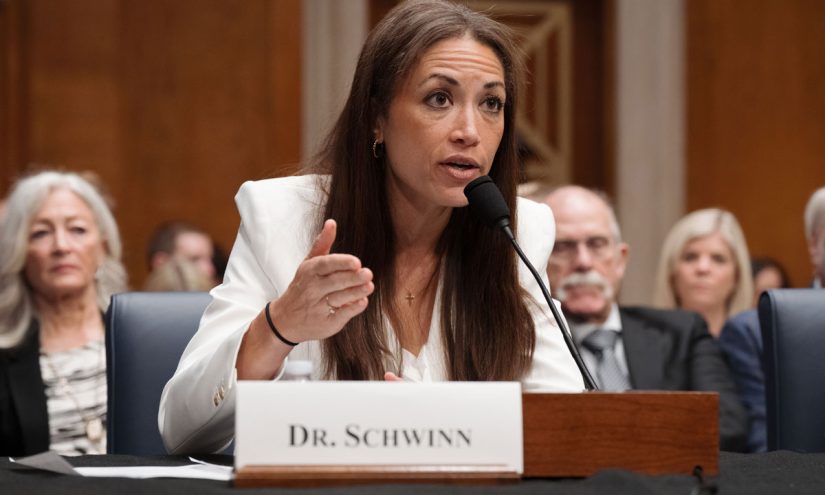
    Penny Schwinn, in line to serve as second in command of the U.S. Department of Education, has withdrawn from the nomination, Education Secretary Linda McMahon announced Thursday.

    Instead, the former Tennessee education commissioner will take on a different role for the department.

    “I am grateful to Dr. Schwinn for her commitment to serving students, families, and educators across the nation,” McMahon said in a statement. “Penny is a brilliant education mind and I look forward to continuing working with her as my chief strategist to make education great again.”

    Schwinn, in a statement, said she gave the decision “thoughtful consideration” and said she will  “remain committed to protecting kids, raising achievement and expanding opportunity  —  my lifelong mission and north star.”

    Considered a champion for improving reading outcomes and high-dosage tutoring, Schwinn was among President Donald Trump’s early picks for department posts. Many perceived her as a more bipartisan choice than others joining the administration, but among Tennessee conservatives, many who felt she was too liberal, opposition to her nomination was strong.

    The timing of Schwinn’s withdrawal couldn’t be worse, according to some conservatives. 

    “Her decision to remove herself from consideration to become deputy secretary hurts students, educators, and the Trump administration,” said Jim Blew, co-founder of the Defense of Freedom Institute, a think tank. “Secretary McMahon has been charged by Congress and the president with huge tasks under the One Big Beautiful Bill and several urgent executive orders.”

    As head of the Education Department, McMahon is striving to turn more authority over education to the states. It’s now unclear who will step into the deputy position and take the lead on the state’s requests for more flexibility over education funding. At least two states, Iowa and Oklahoma, have already submitted requests for block grants, and Indiana is currently gathering comments from the public in preparation for a similar proposal. Kirsten Baesler, North Dakota’s long-time education chief, is currently awaiting confirmation to be assistant secretary for elementary and secondary education at the department. In February, she joined 11 other GOP chiefs in asking McMahon for greater freedom to direct education funds toward state-level needs.

    Controversies and questions over Schwinn’s conservative qualifications have followed her for years. Far-right groups, including Moms for Liberty, said her past support for equity initiatives, like hiring more teachers of color, was evidence that she was not a good fit for an administration determined to eliminate such programs. Others remained angry over Schwinn’s pandemic-era plan to conduct “well-being” home visits. Even though she scrapped the plan, parents and members of the legislature considered it an example of government overreach.

    More recently, Steve Gill, a conservative commentator in Tennessee, reported that while she was deputy superintendent of the Texas Education Agency, Schwinn recommended individuals who advocate for comprehensive sex education, including abortion rights, to advise the state on health curriculum. 

    Gill told The 74 he shared his TriStar Daily article about her stance on these issues with Tennessee Sens. Marsha Blackburn and Bill Hagerty, as well as the state’s congressional delegation. Blackburn, who is expected to run for governor next year, was considered a possible no vote for Schwinn.

    According to Gill, Blackburn’s office “has been working tirelessly behind the scenes with the White House, Secretary Linda McMahon and Majority Leader [John] Thune to block the confirmation.”

    But Madi Biedermann, spokeswoman for the department, said the agency “strongly disagrees with that characterization.”

    Republican Sen. Marsha Blackburn from Tennessee was expected to vote no on Penny Schwinn’s confirmation. (Anna Moneymaker/Getty Images)

    Blew said it’s unfortunate that politics got in the way, noting that Schwinn’s experience in both blue and red states would have brought valuable expertise to the Ed Department role. In addition to her jobs in Tennessee and Texas, Schwinn founded a charter school in Sacramento and also served in the Delaware Department of Education.

    “It’s sad that a handful of demagogues are standing in the way of giving Secretary McMahon the team she needs to succeed,” he said.

    Others praised Schwinn’s record of prioritizing the science of reading in Tennessee schools and directing COVID relief funds toward tutoring.

    “This is a setback for all who want to see Washington slashing red tape, advancing literacy and fighting for common sense values,” said Rick Hess, director of education policy studies at the conservative American Enterprise Institute.

    For some critics, Schwinn’s business ventures since leaving the top spot in Tennessee two years ago raised questions as she waited to appear before the Senate education committee. 

    In June, a day ahead of her joint hearing with three other nominees, The 74 reported that shortly after Trump tapped her for the job, she registered a new education consulting business in Florida, New Horizon BluePrint Group, with a longtime colleague. Before Schwinn filed ethics paperwork with the federal government, her sister replaced her as a manager on the business. 

    When a reporter from The 74 asked questions about the new project, Donald Fennoy, her colleague and a former superintendent of the Palm Beach County School District, dissolved the business.

    Ethics experts say candidates for an administration post often distance themselves from new business entanglements to avoid any appearance of a conflict, but Schwinn has faced accusations of poor judgment before.

    While she was in Texas, the state agency signed a $4.4 million no-bid contract in 2017 with a software company where she had a “professional relationship” with a subcontractor, according to a state audit. And in Tennessee, the education agency made an $8 million deal in 2021 with TNTP, a teacher training organization where her husband Paul Schwinn was employed at the time. Lawmakers considered the deal a “huge conflict.

    “Ethics was a crucial concern,” said J.C. Bowman, executive director and CEO of Professional Educators of Tennessee, a non-union organization. He was among those who sent letters to the Senate, asking them to remove her from consideration. “Her personal business interests and possible conflicts could potentially influence educational decisions in ways that many found difficult to overlook.”

    Clarification: An earlier version of this story mischaracterized the role Penny Schwinn will take on in lieu of serving as the deputy education secretary. Schwinn will be taking on an advisory role at the Education Department.


    Get stories like these delivered straight to your inbox. Sign up for The 74 Newsletter

    Source link

  • Tennessee launches direct admissions pilot with student aid component

    Tennessee launches direct admissions pilot with student aid component

    Dive Brief: 

    • Tennessee is joining the ranks of states with direct admissions programs by launching a pilot this fall that will automatically offer certain high school students spots at the state’s two- and four-year colleges based on their academic records. 
    • The program, led by the Tennessee Higher Education Commission, will pair admissions offers with financial aid information for about half the high school students to test whether that boosts their chances of enrolling
    • In a statement Wednesday, THEC Executive Director Steven Gentile cast the initiative as a way to simplify the path to college. “For the first time in the nation, we are pairing direct admissions with personalized financial aid information, so students not only know where they’ve been accepted — they’ll also know how they can afford to go.”

    Dive Insight: 

    The TN Direct Admissions pilot is to launch in November, when roughly 41,000 students from more than 230 randomly selected high schools in the state will receive letters listing which participating colleges have automatically accepted them. Around half of those students will also get information about available state and institutional financial aid tailored to them based on their GPA, test scores or other criteria. 

    To participate, students will need to complete an application for the Tennessee Promise program by Nov. 1.

    Researchers will use the information from the pilot to study how providing this information influences college-going behavior. 

    They aim to find out whether high school students who receive both financial aid information and direct admissions bids are more likely to attend college than those who just get automatic admissions offers. They will also compare the data against that for students who don’t receive direct admissions letters at all. 

    “Through this study, we will learn not only about the impact of direct admissions and financial aid on students’ college enrollment, but how students feel about their direct admission experience,” Trisha Ross Anderson, a Harvard University researcher working on the project, said in a Wednesday statement. 

    The financial aid component — which THEC said in a Wednesday statement is the first of its kind for a direct admissions program — will inform students of their eligibility for institutional grants and scholarships, as well as for state programs such as the Tennessee Promise. That program covers remaining tuition and fees for students at state community or technical colleges after all other grant aid has been applied.  

    Overall, 53 colleges are participating in the fall pilot. That includes all 13 of the state’s community colleges and its 23 technical colleges, as well as 17 public and private universities. 

    Tennessee joins several other states that have recently launched direct admissions programs. Earlier this year, Illinois Gov. JB Pritzker signed a bill into law to send high school and community college students direct admissions offers to the state’s universities depending on their academic performance. 

    And last October, New York launched an effort to guarantee fall 2025 spots to at least one of its public universities for high school students graduating in the top 10% of their class. The nine initial participating colleges included the state’s two flagships, University at Buffalo and Stony Brook University.

    Source link

  • Tennessee and SFFA sue over funding for Hispanic-serving institutions

    Tennessee and SFFA sue over funding for Hispanic-serving institutions

    This audio is auto-generated. Please let us know if you have feedback.

    Dive Brief:

    • The state of Tennessee and Students for Fair Admissions sued the U.S. Department of Education Wednesday over allegations the agency’s decades-long practice of designating federal grant funding for Hispanic-serving institutions is unconstitutional.
    • The plaintiffs argued that the department’s eligibility requirements for HSI grants are discriminatory and undercut opportunities for all students, including those who are Hispanic and attend colleges that aren’t HSIs. To qualify as an HSI, a college must be nonprofit and enroll a full-time undergraduate student body that is at least 25% Hispanic.
    • Asserting that all colleges serve Hispanic students, Tennessee and SFFA are asking the federal court to strike down the HSI grant program’s ethnicity-based requirements and allow all institutions to apply for the grants “regardless of their ability to hit arbitrary ethnic targets.”

    Dive Insight:

    Edward Blum, president of SFFA, said the advocacy organization is suing to ensure equal opportunity for all, not “denying opportunity to any racial or ethnic group.” SFFA successfully challenged race-conscious admissions before the U.S. Supreme Court, getting the practice banned in 2023.

    “This lawsuit challenges a federal policy that conditions the receipt of taxpayer-funded grants on the racial composition of a student body,” Blum said in a statement Wednesday. “No student or institution should be denied opportunity because they fall on the wrong side of an ethnic quota.”

    HSI is a designation first established in 1992 as part of the Higher Education Act, and the federal government began distributing funds to qualifying institutions three years later.

    The Education Department’s HSI division exists to distribute grant funding to “expand the educational opportunities for Hispanic Americans and other underrepresented populations,” according to its website.

    Though a majority of states have at least one HSI, the institutions are clustered in areas with higher Hispanic populations.

    Seven states — California, Texas, New York, Illinois, Florida, New Mexico and New Jersey — and Puerto Rico are home to 81% of HSIs, according to an analysis of federal data by the Hispanic Association of Colleges and Universities.

    The Hispanic and Latino population is one of the fastest-growing minority groups in the country. In 2023, 65.2 million Hispanic and Latino people lived in the U.S., accounting for nearly a fifth of the population. The Hispanic population is expected to grow to roughly a quarter of the U.S. population by 2060, according to federal data.

    In Tennessee, Hispanic students made up just over 8% of undergraduates in the 2023-24 academic year, according to HACU. The state has just one HSI — Southern Adventist University, a private nonprofit

    No public Tennessee college qualifies for HSI funding, despite all serving some population of Hispanic students, state officials said in Wednesday’s lawsuit. This puts public college students at a disadvantage and harms the institutions, they argued.  

    Tennessee Attorney General Jonathan Skrmetti alleged that the HSI grant system “openly discriminates against students based on ethnicity.”

    “The HSI program perversely deprives even needy Hispanic students of the benefits of this funding if they attend institutions that don’t meet the government’s arbitrary quota,” he said in a Wednesday statement.

    Both Skrmetti and Blum invoked the 2023 Supreme Court ruling on race-conscious college admissions in their statements. Blum argued the court “made clear” that federal funding practices like the HSI grant program are “patently unconstitutional.”

    That interpretation of diversity-focused federal funding has yet to be tested judicially. The high court’s 2023 decision only addressed admissions practices. But since then, conservative policymakers and those opposed to diversity initiatives have sought to apply it to a wide range of college affairs, including scholarships and diversity programs for students.

    Now, they are turning their attention to a long-standing federal program through this lawsuit, filed in U.S. District Court in Tennessee.

    The Education Department did not immediately respond to a request for comment Thursday. 

    However, the department under Trump has already sought to apply the Supreme Court’s 2023 ruling against Harvard University and the University of North Carolina to diversity, equity and inclusion efforts at federally funded institutions. In February, the agency threatened to pull all funding from colleges and K-12 schools that considered race in their programs and policies. 

    The department quickly faced lawsuits over the guidance, and it issued a Q&A “to provide clarity” the following month. The document softened the agency’s initial stance, though officials still struck a strident tone. Regardless, a federal judge in April blocked the Education Department from enforcing either document.

    On the first day of his second term, President Donald Trump issued an executive order repealing a Biden-era initiative aimed at boosting educational access via Hispanic-serving institutions. Among several goals, that program sought to expand the educational capacity of Hispanic-serving institutions through federal support. 

    Trump’s order — which revoked dozens of Biden-era executive actions — described the repealed policies as a move to “restore common sense” in the federal government.

    Source link

  • Tennessee Sues to End HSI Requirements

    Tennessee Sues to End HSI Requirements

    The state of Tennessee filed a lawsuit against the U.S. Department of Education on Wednesday seeking to nix traditional requirements for Hispanic-serving institutions’ federal designation and grant funding. The state is joined by Students for Fair Admissions, the advocacy group whose lawsuits against Harvard and the University of North Carolina at Chapel Hill resulted in the U.S. Supreme Court ruling against affirmative action in college admissions.

    The plaintiffs argue it’s unconstitutional and discriminatory for the Education Department to designate grants for Hispanic-serving institutions, defined as colleges and universities where at least a quarter of students are Hispanic. Today, about 600 colleges and universities meet the criteria for the federal designation, established by Congress in the 1990s.

    The lawsuit laments that Tennessee higher ed institutions serve Hispanic and low-income students but don’t receive grants intended for HSIs because they don’t meet the enrollment threshold. As a result, the plaintiffs argue, Tennessee institutions find themselves in an “unconstitutional dilemma”—they want to enroll more Hispanic students to earn HSI status, but using race as a factor in admissions would be illegal.

    “Funds should help needy students regardless of their immutable traits, and the denial of those funds harms students of all races,” the lawsuit reads.

    The plaintiffs seek “a declaratory judgment that the HSI program’s ethnicity-based requirements are unconstitutional” and “a permanent injunction prohibiting the [Education] Secretary from enforcing or applying the HSI program’s ethnicity-based requirements when making decisions whether to award or maintain grants to Tennessee’s institutions of higher education.”

    Source link

  • ‘Economically Reckless’ Businesses Slam Bill to Bar Immigrant Kids From School – The 74

    ‘Economically Reckless’ Businesses Slam Bill to Bar Immigrant Kids From School – The 74


    Get stories like this delivered straight to your inbox. Sign up for The 74 Newsletter

    More than two dozen Chattanooga business owners are condemning a bill to require student immigration background checks in Tennessee’s public schools as “economically reckless.”

    The Tennessee Small Business Alliance represents restaurants, real estate firms, retail stores and other local employers operating within the district represented by Sen. Bo Watson.

    Watson, a Republican, is cosponsoring the legislation to require proof of legal residence to enroll in public K-12 and charter schools.  The bill would also give public schools the option of charging tuition to the families of children unable to prove they legally reside in the United States – or to deny them the right to a public education altogether.

    House Leader William Lamberth of Gallatin is a co-sponsor of the bill, which has drawn significant — but not unanimous — support from fellow Tennessee Republicans. Lamberth’s version of the bill differs from Watson’s in that it would make it optional — rather than mandatory — to check students’ immigration status in all of Tennessee’s more than 1700 public schools.

    The bill, one of the most controversial being considered during the 2025 Legislative session, has significant momentum as the Legislature winds down for the year even as it has drawn raucous protests at times.  The legislation will next be debated on Monday in a House committee.

    A statement released by the business alliance described the legislation as a “political stunt that’s cruel, economically reckless, and completely out of step with local values.”

    Citing estimates compiled by the nonprofit advocacy organization, American Immigration Council, the statement noted that more than 430,000 immigrants in Tennessee paid $4.4 billion in taxes – more than $10,000 per immigrant.

    Watson, in an emailed statement from Chattanooga public relations firm Waterhouse Public Relations, said his bill “raises important questions about the financial responsibility of educating undocumented students in Tennessee—questions that have long gone unaddressed.”

    The statement said the Supreme Court’s 1982 decision in Plyler v. Doe, which established the right to a public school education for all children regardless of immigration status, has “never been re-examined in the context of today’s challenges.” The statement said Watson is committed to a “transparent, fact-driven discussion about how Tennessee allocates its educational resources and how federal mandates impact our state’s budget and priorities.”

    Watson has previously also said the legislation was prompted, in part, by the rising costs of English-language instruction in the state’s public schools.

    Democrats have criticized that argument as based on inaccurate assumptions that English language learners lack legal immigration status.

    Kelly Fitzgerald, founder of a Chattanooga co-working business and one of 27 employers that signed onto the statement of condemnation, criticized lawmakers.

    “Do our representatives believe that undocumented children — who had no say in their immigration status — should be denied a public education, even though their families already pay taxes that fund our schools?” said Fitzgerald, whose own children attend Hamilton County Public schools

    “My children are receiving a great education in our public schools, and I want every child to have the same rights and opportunities as mine do,” she said.

    “In my opinion, this is not something our legislators should be spending their resources on when there are much larger issues at hand in the current environment,” she said. “We should leave children out of the conversation.”

    Tennessee Lookout is part of States Newsroom, a nonprofit news network supported by grants and a coalition of donors as a 501c(3) public charity. Tennessee Lookout maintains editorial independence. Contact Editor Holly McCall for questions: [email protected].


    Get stories like these delivered straight to your inbox. Sign up for The 74 Newsletter

    Source link

  • Federal Cuts Deepen Tennessee State U’s Budget Woes

    Federal Cuts Deepen Tennessee State U’s Budget Woes

    President Trump’s assault on federal grants is making Tennessee State University’s ongoing financial troubles even worse.

    The Tennessean reported last week that the chronically underfunded historically Black university in Nashville is preparing to lose $14.4 million, the remainder of an $18 million grant it received from the National Institute of Food and Agriculture. It’s one of hundreds of colleges and universities across the country facing financial uncertainty as the Trump administration moves to cut trillions of dollars from the federal budget.

    “This is going to impact our people,” Jim Grady, TSU’s chief financial officer, said at a finance committee meeting Wednesday evening. “We’ll continue to evaluate the volatility … and the potential impact to employees, students and university operations.”

    Grady said nothing would change for at least 90 days after receiving notice of the grant cancellation, and it’s not yet clear how many jobs will be eliminated as a result. And that’s not the only federal grant in question, according to The Tennessean.

    In February, the U.S. Department of Agriculture—which includes the National Institute of Food and Agriculture—canceled $45 million in federal grants to the cash-strapped university, which eliminated 114 positions last fall amid a looming budget shortfall.

    Earlier this month, the USDA restored about $23 million of those grants, though another $115 million could be suspended or frozen. TSU’s federal grants fully fund 62 employees and partially fund another 112.

    In the midst of the financial uncertainty, TSU has suspended its search for a permanent president, WKRN reported.

    Source link

  • LAWSUIT: Tennessee town cites woman for using skeletons in holiday decorations

    LAWSUIT: Tennessee town cites woman for using skeletons in holiday decorations

    GERMANTOWN, Tenn., Feb. 12, 2025 — Christmas in Germantown, Tennessee, might be merry and bright, but be careful if your decorations give a fright: you might get dragged into court and fined.

    Today, the Foundation for Individual Rights and Expression filed a federal lawsuit seeking to strike down on First Amendment grounds the Memphis suburb’s ordinance dictating to residents how and when they’re allowed to display holiday decorations. On Thursday, FIRE will also defend Alexis Luttrell before a municipal court, after the Germantown resident was cited for celebrating Christmas with decorative skeletons.

    “There is simply no good reason for the government to care how and when a resident celebrates a holiday in their own front yard,” said FIRE attorney Colin McDonell. “When government officials try to stop that resident from expressing their holiday spirit to others, that violates the First Amendment.”

    In October, Alexis set up a decorative skeleton and skeleton dog in her front yard to celebrate Halloween. Then for Election Day, she used the same skeletons to hold political signs. But in December, a Germantown code officer left a notice that she was in violation of Ordinance 11-33, which decrees that home and yard holiday decorations “shall not be installed or placed more than 45 days before the date of the holiday” and must be removed within “30 days, following the date of the holiday.”

    So Alexis updated her skeletons for Christmas, dressing them up for the holiday alongside her inflatable tree and Santa Claus.

    But Germantown still had (ahem) a bone to pick. On Jan. 6, she received a citation from the city saying she was still in violation and that she would have to appear before a judge on Feb. 13. If found guilty, she could be subject to fines, a court order prohibiting skeletons in her holiday displays, and even city officials entering her property and forcibly removing the skeletons. 

    “You don’t have to like my decorations, but that doesn’t mean Germantown has the right to force me to take them down,” said Alexis. “This is America. Even our local government has to respect our rights.”

    COURTESY PHOTOS OF ALEXIS AND HER HOLIDAY DISPLAYS

    Germantown’s ordinance violates the First Amendment, no bones about it. To start, it targets residents’ displays based on their message — specifically, whether they celebrate a holiday. It’s perfectly legal to have miniature deer figurines in your yard year-round, for example . . . unless there’s nine of them and one of them has a red nose. The Supreme Court has long held that speech restrictions based on content are unconstitutional unless they are narrowly tailored to serve a compelling government interest.

    “City governments can impose reasonable restrictions on yard displays that address concerns like safety, noise, or light pollution, but Alexis’s decorations aren’t harming anyone,” said McDonell. “Germantown is simply targeting protected expression.”

    The ordinance is also unconstitutional viewpoint discrimination because it allows government officials to enforce their own subjective views on what decorations may celebrate a particular holiday. By refusing to permit Alexis’s skeletons as an acceptable Christmas display, Germantown is telling residents they have to celebrate Christmas the government-approved “right” way, even if they have a macabre sense of humor or just enjoy “The Nightmare Before Christmas.”

    How one celebrates a holiday should be dictated by their personal taste, not government officials. And many religions and cultures have different ideas of when a holiday falls or how it should be celebrated that defy Germantown’s narrow view:

    • A Filipino living in Germantown might want to put up Christmas decorations as early as September.
    • An Orthodox Christian wouldn’t celebrate Christmas until Jan. 7, and a Hispanic resident might intend their nativity scene to encompass both Christmas and Día de Los Reyes on Jan. 6.
    • A Chinese resident would only have until Jan. 31 to keep up a “Happy New Year!” sign, even though his traditional New Year started Jan. 30.

    Lastly, Germantown’s ordinance is unconstitutionally vague. Regulations have to be clear enough for the average person to know if they’re breaking the law or not, but the ordinance offers no guidance on what decorations are “intended” to celebrate a particular “holiday.” As a result, Germantown residents are constantly in the dark about which holidays their city will enforce, when they officially begin, and which decorations qualify for that holiday — and which are forbidden.

    Alexis’s skeletons are currently dressed, for example, in a “Love is Love” theme. St. Valentine’s Day isn’t an official government holiday — but then neither is Halloween, and Germantown officials targeted her skeletons nonetheless. Her rainbow-colored decorations are intended as a Valentine’s Day message — but it’s also imagery about LGBT acceptance that many people display year-round. Alexis can only guess at whether her display meets the city’s definition.

    With FIRE on her side, Alexis is fighting this unconstitutional ordinance. Once Valentine’s Day has passed, she has plans to put her skeletons in costumes for St. Patrick’s Day, Easter, Pride Month and other holidays this year and for years to come.

    “Perhaps for President’s Day, I’ll dress the skeleton like a Founding Father and give him a copy of the Constitution,” said Alexis. “Maybe a visual display will make it finally sink in when they ask me to tear it down.”


    The Foundation for Individual Rights and Expression (FIRE) is a nonpartisan, nonprofit organization dedicated to defending and sustaining the individual rights of all Americans to free speech and free thought — the most essential qualities of liberty. FIRE educates Americans about the importance of these inalienable rights, promotes a culture of respect for these rights, and provides the means to preserve them.

    CONTACT:

    Alex Griswold, Communications Campaign Manager, FIRE: 215-717-3473; [email protected]

    Source link

  • Tennessee State University could run out of cash this spring without help

    Tennessee State University could run out of cash this spring without help

    Dive Brief:

    • Tennessee State University is looking for help from state lawmakers as it tries both to stay afloat and to revamp its operations and finances for the long term.
    • The public historically Black institution is on pace to run out of cash by April or May, Interim President Dwayne Tucker said Tuesday at a meeting hosted by Black Caucus members in the state Legislature. 
    • TSU intends to present a five-year turnaround plan to the Legislature. Operations through the first year of the plan could be financed by removing restrictions on roughly $150 million out of $250 million the state previously set aside for university infrastructure, Tucker noted.

    Dive Insight:

    TSU’s financial troubles are steep and immediate. An FAQ page on the university’s website acknowledges that the financial condition has reached crisis levels stemming from missed enrollment targets and operating deficits. This fall, the university posted a projected deficit of $46 million by the end of the fiscal year. 

    The university identified inefficient processes in financial aid, advising and enrollment systems, that contributed to its woes. It also said those problems were exacerbated by 2024’s messy federal rollout of the Free Application for Federal Student Aid. 

    Additionally, and perhaps most damaging, the university launched a full scholarship program for some students without a plan to fund it throughout students’ journey to graduation. It paid $37 million toward the scholarship in fiscal 2022 using federal pandemic emergency funds. When that money ran dry, TSU had to issue tens of millions of dollars in institutional financial aid, causing it to heavily discount its tuition. 

    The scholarship helped attract students, with fall enrollment hitting 8,198 students in 2023, compared to 7,774 in 2018. But the university couldn’t ultimately afford to maintain those aid levels.

    Taking aim at the university’s management, Tennessee lawmakers last March passed a Republican-led bill to replace all of the university’s trustees and restructure its board, over the objection of Democrats. 

    Emergency state funding last fall kept the institution operating, but Tucker said TSU will need more to not just turn around — but to stay open. 

    “It’s a fact that we can’t pay our bills,” Tucker said, noting also that the university would likely not be open today without state help. 

    But Tennessee also owes TSU money, according to a federal assessment. 

    In a letter to Tennessee Gov. Bill Lee in 2023, then-U.S. Education Secretary Miguel Cardona and U.S. Agriculture Secretary Tom Vilsack said the institution had been hurt by “longstanding and ongoing underinvestment” as a public land-grant HBCU. By their estimate, inequitable funding gaps led Tennessee State to miss out on $2.1 billion over 30 years. 

    Tucker dismissed the idea of suing the state for the $2.1 billion, arguing that the legal process could take years — while the university’s financial needs are immediate. Legal action could also potentially anger the legislators whose support TSU needs to help provide funding. Moreover, the institution could lose a legal challenge, he added. 

    Tucker — the university’s second interim president in less than a year — argued for focusing instead on the state funding gap identified by the Legislature in 2021. That gap amounts to over $540 million

    Since identifying the amount, Tennessee lawmakers lined up a one-time $250 million sum for the university to invest in infrastructure. Tucker said the university could use a portion of those funds to keep it afloat through the first year of a five-year plan. 

    Along with state help, TSU and its board are considering financial exigency, a restructuring process that allows an institution experiencing budgetary distress to lay off tenured faculty and shut down academic programs. 

    In a special meeting of TSU’s board on Jan. 31, a consultant with the National Association of College and University Business Officers presented a detailed workshop on how exigency works.

    Tucker said Tuesday that officials were considering exigency but that it wasn’t in the university’s immediate plans. 

    Source link