DENTON, Texas, Aug. 28, 2025 — The University of North Texas system confirmed that it has lifted its “pause” on drag performances across its campuses, in response to a demand letter from civil liberties organizations informing the school that it was violating its students’ First Amendment rights.
On March 28, UNT System Chancellor Michael Williams issued a system-wide directive announcing an immediate “pause” on drag performances on campus. Williams’ directive came days after a similar drag ban from the Texas A&M University System was blocked by a federal judge following a lawsuit from the Foundation for Individual Rights and Expression.
On Aug. 14, FIRE and the American Civil Liberties Union (ACLU) of Texas sent a letter informing Williams that his “pause” violated the Constitution for the same reasons.
“UNT cannot justify banning an entire class of protected expression from campus performance venues on the basis that such expression might cause offense,” the letter read. “In the same way that some people may not appreciate UNT allowing students, staff, or visitors to engage in prayer on campus or wear t-shirts supporting rival universities, the fear that such speech may be ‘offensive’ to some is not a constitutionally permissible reason to ban it.”
Yesterday, the UNT Office of General Counsel responded to the FIRE/ACLU-TX letter and announced that in light of a recent decision from the U.S. Court of Appeals for the Fifth Circuit blocking yet another drag ban in Texas — this time at West Texas A&M University — “the UNT System’s temporary pause on drag performances has ended.”
“If campus officials can silence expression simply because some find it ‘offensive,’ no one’s speech will be safe,” said FIRE Strategic Campaigns Counsel Amanda Nordstrom “Today it’s drag shows, but tomorrow it could be political rallies, art exhibits, or even bake sales. From West Texas to North Texas and any direction you look, the message is clear: drag is protected expression, and the show must go on.”
“UNT repealed its drag ban following public backlash and legal pressure,” said ACLU of Texas Attorney Chloe Kempf. “As we and the courts have repeatedly made clear, banning drag is plainly unconstitutional. Drag is a cherished source of joy and liberation for the LGBTQIA+ community — and this reversal ensures students can once again freely express and celebrate their identities on campus.”
The Foundation for Individual Rights and Expression (FIRE) is a nonpartisan, nonprofit organization dedicated to defending and sustaining the individual rights of all Americans to free speech and free thought—the most essential qualities of liberty. FIRE recognizes that colleges and universities play a vital role in preserving free thought within a free society. To this end, we place a special emphasis on defending the individual rights of students and faculty members on our nation’s campuses, including freedom of speech, freedom of association, due process, legal equality, religious liberty, and sanctity of conscience.
CONTACT:
Alex Griswold, Communications Campaign Manager, FIRE: 215-717-3473; [email protected]
La joven de 18 años de Houston iba a comenzar clases este otoño en la Universidad de Texas en Tyler, donde le habían concedido una beca de 10.000 dólares al año. Esperaba que eso le permitiera alcanzar su sueño: un doctorado en Química, seguido de una carrera como profesora o investigadora.
“Y entonces se produjo el cambio en la matrícula estatal, y fue entonces cuando supe con certeza que tenía que dar un giro”, dijo Ximena. (The Hechinger Report se refiere a ella solo por su nombre de pila porque ella teme represalias por su situación migratoria).
Aunque Ximena pasó sus primeros años en el norte de México, la mayoría de sus recuerdos son de después de mudarse a Estados Unidos con su padre. Ha asistido a escuelas en Estados Unidos desde el jardín de infancia y, para ella, el 12.º grado consistió principalmente en explicar conceptos avanzados de química a sus compañeros de clase y dirigir laboratorios como asistente de enseñanza.
Pero en junio, los sueños de Ximena se vieron truncados cuando la oficina del fiscal general de Texas y la administración Trump colaboraron para poner fin a las disposiciones de una ley estatal que ofrecía a miles de estudiantes indocumentados como ella tasas de matrícula más bajas en las universidades públicas de Texas. Los funcionarios estatales y federales argumentaron con éxito ante los tribunales que la política vigente desde hacía mucho tiempo discriminaba a los ciudadanos estadounidenses de otros estados que pagaban una tasa más alta. Ese razonamiento se ha replicado ahora en demandas similares contra Kentucky, Oklahoma y Minnesota, como parte de una ofensiva más amplia contra el acceso de los inmigrantes a la educación pública.
En la UT Tyler, la matrícula y las tasas estatales para el próximo año académico ascienden a un total de 9.736 dólares, frente a los más de 25.000 dólares que pagan los estudiantes de fuera del estado. Ximena y su familia no podían permitirse el elevado coste de la matrícula, por lo que la joven se retiró. En su lugar, se matriculó en el Houston Community College, donde los costos para los estudiantes de fuera del estado son de 227 dólares por hora semestral, casi tres veces más que la tarifa para los residentes en el distrito. La escuela solo ofrece clases básicas de química de nivel universitario, por lo que, para prepararse para un doctorado o para trabajar en investigaciones especializadas, Ximena seguirá necesitando encontrar la manera de pagar una universidad de cuatro años en el futuro.
Su difícil situación es precisamente lo que los legisladores estatales de ambos partidos políticos esperaban evitar cuando aprobaron la Texas Dream Act o Ley de Sueños de Texas, una ley de 2001 que no solo abrió las puertas de la educación superior a los estudiantes indocumentados, sino que también tenía por objeto reforzar la economía y la mano de obra de Texas a largo plazo. Con esa ley, Texas se convirtió en el primero de más de dos docenas de estados en aplicar la matrícula estatal a los estudiantes indocumentados, y durante casi 24 años, esta política histórica se mantuvo intacta. Los legisladores conservadores propusieron repetidamente su derogación, pero a pesar de los años de control de un solo partido en la legislatura estatal, no hubo suficientes republicanos que apoyaran la derogación, incluso esta primavera, días antes de que la oficina del fiscal general de Texas y el Departamento de Justicia federal decidieran ponerle fin.
Ahora, a medida que se acerca el semestre de otoño, los estudiantes inmigrantes están sopesando si darse de baja de sus cursos o esperar a que se aclare cómo les afecta el acuerdo de consentimiento firmado por el estado y el Departamento de Justicia. Los defensores de los inmigrantes temen que las universidades de Texas estén excluyendo a posibles alumnos que se encuentran en situación legal y siguen reuniendo los requisitos para pagar la matrícula estatal a pesar de la sentencia judicial, incluidos los beneficiarios del programa de Acción Diferida para los Llegados en la Infancia (DACA), los solicitantes de asilo y los que tienen Estatus de Protección Temporal o TPS, porque el personal de la universidad carece de conocimientos sobre inmigración y no ha recibido directrices claras sobre quién debe pagar exactamente la matrícula más alta.
En el Austin Community College, que presta servicio a un área tan grande como el estado de Connecticut, los miembros del consejo de administración no están seguros de cómo aplicar correctamente la sentencia judicial. Mientras esperan respuestas, hasta ahora han decidido no enviar cartas a sus estudiantes solicitándoles información confidencial para determinar las tasas de matrícula.
Una valla publicitaria que promociona el Austin Community College en español se encuentra en una autopista que conduce a Lockhart, Texas. Credit: Sergio Flores for The Hechinger Report
“Esta confusión perjudicará inevitablemente a los estudiantes, porque lo que vemos es que, ante la falta de información y la presencia del miedo y la ansiedad, los estudiantes optarán por no continuar con la educación superior o se esconderán en las sombras y se sentirán como miembros marginados de la comunidad”, afirmó Manuel González, vicepresidente del consejo de administración del ACC.
Por su parte, los expertos en políticas públicas advierten de que la mano de obra de Texas podría verse afectada, ya que los jóvenes con talento, muchos de los cuales han cursado toda su educación en el sistema de escuelas públicas del estado, ya no podrán permitirse los títulos de asociado y licenciatura que les permitirían seguir carreras que ayudarían a impulsar sus economías locales. En virtud de la Ley Texas Dream, los beneficiarios estaban obligados a comprometerse a solicitar la residencia permanente legal lo antes posible, lo que les daba la oportunidad de mantener puestos de trabajo relacionados con sus títulos. Sin la condición de residentes, es probable que sigan trabajando, pero en empleos peor remunerados y menos visibles.
Relacionado: ¿Te interesa recibir más noticias sobre universidades? Suscríbete a nuestro boletín quincenal gratuito deeducación superior.
“Es una visión muy cortoplacista en lo que respecta al bienestar del estado de Texas”, afirmó Barbara Hines, antigua profesora de Derecho que ayudó a los legisladores a redactar la Ley Texas Dream.
A principios de siglo, casi dos décadas después de que los niños indocumentados obtuvieran el derecho a asistir a la escuela pública en Estados Unidos, los estudiantes inmigrantes y sus defensores seguían frustrados porque la universidad seguía estando fuera de su alcance.
Para el mayor general retirado de la Guardia Nacional del Ejército Rick Noriega, un demócrata que en ese momento formaba parte de la Legislatura de Texas, esa realidad le tocó de cerca cuando se enteró de que un joven trabajador de su distrito quería matricularse en el community college local para estudiar mecánica aeronáutica, pero no podía permitirse pagar la matrícula fuera del estado.
Noriega llamó a la oficina del rector de la escuela, que pudo proporcionar fondos para que el estudiante se inscribiera. Pero esa experiencia le llevó a preguntarse: ¿cuántos niños más de su distrito se enfrentaban a las mismas barreras para acceder a la educación superior?
Así que colaboró con un sociólogo para encuestar a los estudiantes de las escuelas secundarias locales sobre el problema, que resultó ser muy frecuente. Y el distrito de Noriega no era una excepción. En un estado que durante mucho tiempo ha tenido una de las mayores poblaciones de inmigrantes no autorizados del país, los políticos de todos los partidos conocían a electores, amigos o familiares afectados y querían ayudar. Una vez que Noriega decidió proponer la legislación, un republicano, Fred Hill, pidió ser coautor del proyecto de ley.
Para los defensores de la Ley Texas Dream, el mejor argumento a favor de la matrícula estatal para los estudiantes indocumentados era de carácter económico. Después de que el estado ya hubiera invertido en estos estudiantes durante la educación pública K-12, tenía sentido seguir desarrollándolos para que, con el tiempo, pudieran ayudar a satisfacer las necesidades de mano de obra de Texas.
“Habíamos gastado todo ese dinero en estos jóvenes, y ellos habían hecho todo lo que les pedimos —en muchos casos, eran superestrellas, los mejores de su promoción y cosas por el estilo— y luego se topaban con este obstáculo, que era la educación superior, cuyo costo era prohibitivo”, dijo Noriega.
La legislación fue aprobada fácilmente por la Cámara de Representantes de Texas, que en ese momento estaba controlada por los demócratas, pero el Senado, liderado por los republicanos, se mostró menos complaciente.
“Ni siquiera pude conseguir una audiencia. Me dijeron rotundamente: “No, esto no va a salir adelante””, afirmó Leticia Van de Putte, la entonces senadora estatal que patrocinó la legislación en su cámara.
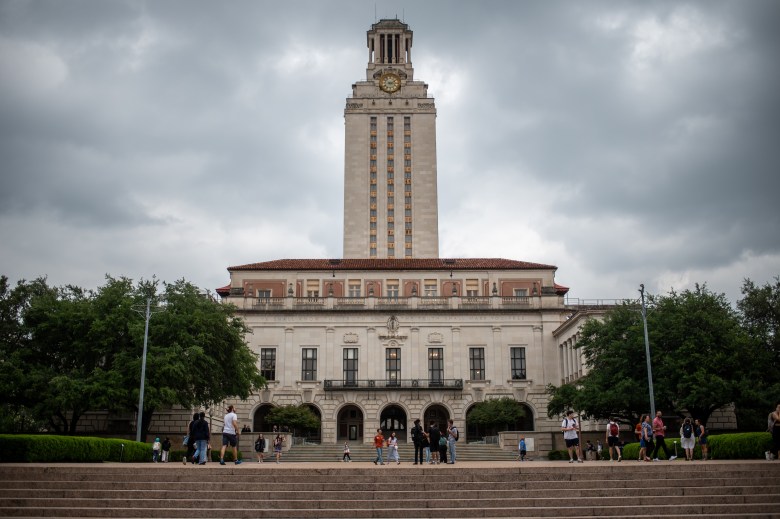
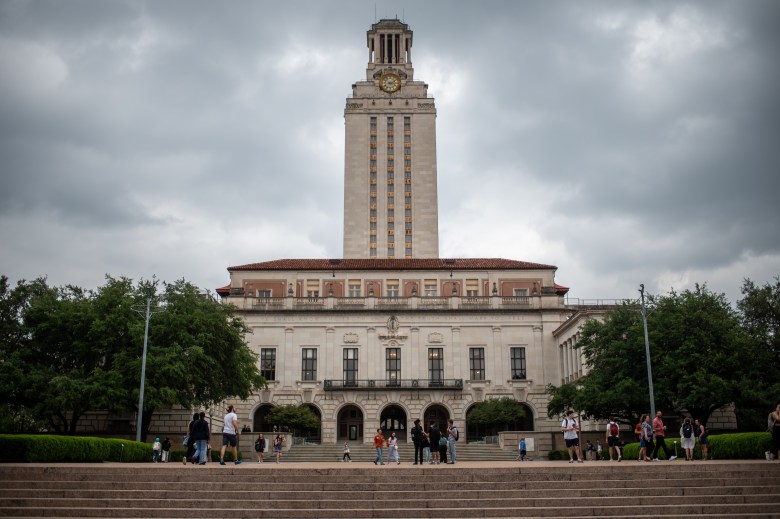
Las nubes cubren el cielo detrás de la torre de la Universidad de Texas en Austin. Credit: Sergio Flores for The Washington Post via Getty Images
Para persuadir a sus colegas republicanos, añadió varias restricciones, entre ellas la de exigir a los estudiantes indocumentados que vivieran en Texas durante tres años antes de terminar la escuela secundaria o recibir un GED. (Se estimó que tres años era el tiempo medio que tardaría una familia en pagar suficientes impuestos estatales para compensar la diferencia entre la matrícula estatal y la matrícula fuera del estado). También incluyó la cláusula que obligaba a los estudiantes indocumentados que accedían a la matrícula estatal a firmar una declaración jurada en la que se comprometían a solicitar la tarjeta de residencia tan pronto como pudieran.
Van de Putte también recurrió a los grupos empresariales de Texas para insistir en los argumentos económicos a favor del proyecto de ley. Y convenció a la comunidad empresarial para que pagara los autobuses que llevarían a pastores evangélicos conservadores latinos de Dallas, San Antonio, Houston y otras zonas del estado a Austin, para que pudieran llamar a las puertas en apoyo de la legislación y rezar con los senadores republicanos y su personal.
Después de eso, la Ley Texas Dream fue aprobada por abrumadora mayoría en el Senado estatal en mayo de 2001, y el entonces gobernador Rick Perry, republicano, la promulgó como ley al mes siguiente.
Sin embargo, en 2007, incluso cuando los defensores de los derechos de los inmigrantes, los grupos religiosos y las asociaciones empresariales formaron una coalición para defender a los inmigrantes contra las políticas estatales perjudiciales, la legislatura de Texas comenzó a presentar una serie de propuestas generalmente contrarias a los inmigrantes. En 2010, las encuestas sugerían que los tejanos se oponían de manera abrumadora a que los estudiantes indocumentados pagaran las tasas de matrícula estatales.
En 2012, un nuevo grupo de políticos de derecha fue elegido para ocupar cargos públicos, muchos de ellos opuestos filosóficamente a la ley y muy críticos al respecto. La defensa de la política por parte de Perry se volvió en su contra durante las primarias presidenciales republicanas de 2012, cuando su campaña fue objeto de críticas después de que, durante un debate, dijera a los oponentes de la igualdad en las matrículas: “No creo que tengan corazón”.
Aún así, ninguno de los muchos proyectos de ley presentados a lo largo de los años para derogar la Ley Texas Dream tuvo éxito. E incluso el gobernador Greg Abbott, un republicano partidario de la línea dura en materia de inmigración, se mostró en ocasiones ambiguo sobre la política, y su portavoz afirmó en 2013 que Abbott creía que “el objetivo” de la matrícula estatal independientemente del estatus migratorio era “noble”.
Los observadores legislativos afirman que algunos republicanos del estado siguen apoyando la política. “Es una cuestión bipartidista. Hay republicanos que apoyan la matrícula estatal”, afirmó Luis Figueroa, director de asuntos legislativos de la organización sin fines de lucro Every Texan, dedicada a la investigación y la defensa de políticas públicas. “Pero no pueden decirlo públicamente”.
Mientras tanto, a medida que el tema se volvía más controvertido políticamente en Texas, la Texas Dream Act acabó amplificando un debate más amplio que finalmente condujo a la creación del DACA, el programa de la era Obama que ha dado a algunos inmigrantes indocumentados acceso a protecciones contra la deportación y permisos de trabajo.
Incluso antes del DACA, muchos inmigrantes trabajaban, y los que siguen sin papeles a menudo siguen haciéndolo, ya sea como contratistas independientes para empleadores que hacen la vista gorda ante su estatus migratorio o creando sus propios negocios. Un estudio de mayo de 2020 reveló que los residentes no autorizados constituyen el 8,2 % de la población activa del estado y que, por cada dólar gastado en servicios públicos para ellos, el estado de Texas recuperaba 1,21 dólares en ingresos.
Pero sin el permiso legal inmediato para trabajar, los graduados universitarios indocumentados que se habían beneficiado de la Ley Dream de Texas se vieron limitados a pesar de sus títulos. A medida que la lucha por la equidad en las matrículas se extendía a otros estados, también lo hacía la lucha por una solución legal que apoyara a los estudiantes beneficiados.
Cuando estos jóvenes, cariñosamente apodados “soñadores o dreamers”, pasaron a primer plano para defenderse más públicamente, su difícil situación despertó simpatía. En 2017, el mismo año en que Trump comenzó su primer mandato, las encuestas dieron un giro y mostraron que la mayoría de los tejanos apoyaba las matrículas estatales para los estudiantes indocumentados. Más recientemente, las investigaciones han indicado una y otra vez que los estadounidenses apoyan una vía para que los residentes indocumentados traídos a Estados Unidos cuando eran niños obtengan la residencia legal.
Pero los argumentos en contra de la matrícula estatal, independientemente del estatus migratorio, también ganaron popularidad: los críticos sostenían que la política es injusta para los ciudadanos estadounidenses de otros estados que tienen que pagar tasas más altas, o que los estudiantes indocumentados están ocupando plazas en escuelas competitivas que podrían ser ocupadas por estadounidenses.
El Departamento de Justicia se apoyó en una retórica similar en la demanda que acabó con la igualdad en las matrículas en Texas, alegando que la ley estatal queda invalidada por la legislación federal de 1996 que prohíbe a los inmigrantes indocumentados acceder a la matrícula estatal basada en la residencia. Ese argumento se ha convertido en un modelo, ya que la administración Trump ha presentado demandas para desmantelar las políticas de matrícula estatal de otros estados para los residentes indocumentados.
En Kentucky, el fiscal general del estado, el republicano Russell Coleman, ha seguido los pasos de Texas y ha recomendado que el consejo estatal que supervisa la educación superior retire su normativa que permite el acceso a la matrícula estatal en lugar de luchar por defenderla en los tribunales.
Al mismo tiempo, la administración Trump ha encontrado otras formas de recortar las oportunidades de educación superior para los estudiantes indocumentados, revocando una política que les había ayudado a participar en programas de formación profesional, técnica y para adultos, e investigando a las universidades por ofrecerles becas.
En Texas, el repentino cambio de política con respecto a las matrículas estatales está causando caos. Las dos universidades más grandes del estado, Texas A&M y la Universidad de Texas, están utilizando diferentes directrices para decidir qué estudiantes deben pagar las tasas fuera del estado.
“Creo que las universidades son las que se encuentran en esta situación realmente difícil”, dijo Figueroa. “No son expertos en inmigración. Han recibido muy poca orientación sobre cómo interpretar el decreto de consentimiento”.
En medio de tanta confusión, Figueroa predijo que es probable que surjan futuras demandas. Los estudiantes y organizaciones afectados ya han presentado mociones ante los tribunales para defender tardíamente la Ley Texas Dream contra el Departamento de Justicia.
Mientras tanto, los jóvenes estudiantes se enfrentan a decisiones difíciles. Una estudiante, que pidió permanecer en el anonimato debido a su condición de inmigrante indocumentada, estaba leyendo las noticias en su teléfono antes de acostarse cuando vio un titular sobre el resultado del caso judicial del Departamento de Justicia.
“Me eché a llorar porque, como alguien que ha luchado por salir adelante en sus estudios, ahora que estoy en la educación superior, ha sido una bendición”, dijo. “Así que lo primero que pensé fue: “¿Qué voy a hacer ahora? ¿Hacia dónde va mi futuro? ¿Los planes que tenía para mí tendrán que detenerse por completo?””.
La joven, que vive en San Antonio desde que tenía 9 meses, se había matriculado en seis cursos para el otoño en la Universidad Texas A&M-San Antonio y no estaba segura de si abandonarlos. Sería su último semestre antes de obtener sus títulos en psicología y sociología, pero no podía imaginar pagar la matrícula fuera del estado.
“Estoy en el limbo”, dijo, como “muchos estudiantes en este momento”.
Comunícate con la editora Caroline Preston al 212-870-8965 o [email protected].
The Hechinger Report provides in-depth, fact-based, unbiased reporting on education that is free to all readers. But that doesn’t mean it’s free to produce. Our work keeps educators and the public informed about pressing issues at schools and on campuses throughout the country. We tell the whole story, even when the details are inconvenient. Help us keep doing that.
From the start, Na’Siah Martin and H’Sanii Blankenship’s July trip to Washington, D.C., was destined to be a riveting stop on the teenagers’ passage to adulthood. There were the scheduled meetings with lawmakers, the monuments, the reflecting pool near where Martin Luther King Jr. broadcast his dream for racial equality 62 summers ago.
For years, the pair have been involved in the Boys and Girls Clubs of the Austin Area, the revered summer and after-school program that was now making it possible for the two blossoming leaders to meet with Texans in Congress and present their game plan for tackling mental health challenges among student-athletes, a struggle both were deeply familiar with.
But two weeks before their arrival on Capitol Hill, President Donald Trump’s administration threw one of many curveballs lobbed during the first months of his second term. The U.S. Department of Education notified state education officials on the last day of June that it would pause the disbursement of nearly $7 billion in funds for teacher development, support for students learning English, and before- and after-school programs predominantly serving low-income families, pending a review of how schools had put the money to use. That notice went out a day before states expected to begin receiving the money.
For Texas, it meant a potential loss of nearly $670 million. For Martin and Blankenship, it potentially meant losing the Boys and Girls Club, a space that has aided their growth as both leaders and individuals. Martin, 18, graduated from Navarro Early College High School in June and has participated in the club since elementary school. Blankenship, a 17-year-old incoming senior at the same school, has participated in the club for about as long as Martin.
The focus of their trip immediately broadened: They now wanted to convince federal lawmakers that cutting the funds would harm Texas kids.
“These programs aren’t just for fun,” Blankenship said. “They actually give us resources, help us grow into adults instead of just coming here and just goofing around and stuff like that. These programs, they help us cope with things we need to cope with.”
The education funding freeze was typical of the Trump administration. In recent months, it has also cut billions of dollars in food assistance and health care for families in poverty; frozenbillions in grants and contracts financially supporting universities; canceled billions for foreign aid and public broadcasting stations; laid off thousands of employees working in critical federal agencies; and sought to overhaul the U.S. immigration landscape through actions like attempting to end birthright citizenship.
Those cuts and changes have often been sweeping and abrupt, disrupting federally funded services and programs serving large swaths of people of color, people with disabilities, low-income families, LGBTQ+ Americans and immigrants. And they have come at the same time the administration has moved to lower taxes for some of America’s wealthiest households.
“We can’t look at just the cuts to education in isolation,” said Weadé James, senior director of K-12 education policy at the Center for American Progress. “I think what we’re witnessing is really the undoing of a lot of progress, and also actions that are really going to keep a lot of families trapped in cyclical and generational poverty.”
Boys and Girls Club director Jacob Hernandez watches club members play spades at Navarro Early College High School. Credit: Montinique Monroe for The Texas Tribune
Ongoing changes to the country’s educational landscape are only one part of Trump’s larger goals to eliminate what the second-term president has deemed “wasteful” spending and crack down on anything he views as diversity, equity and inclusion initiatives. A large piece of his efforts involve closing the Department of Education and sending “education back to the states,” though most decisions about education and public school funding already happen at the state and local levels.
“Teachers will be unshackled from burdensome regulations and paperwork, empowering them to get back to teaching basic subjects. Taxpayers will no longer be burdened with tens of billions of dollars of waste on progressive social experiments and obsolete programs,” Trump Secretary of Education Linda McMahon said in a statement earlier this year. “K-12 and college students will be relieved of the drudgery caused by administrative burdens—and positioned to achieve success in a future career they love.”
The disarray has resulted in profound consequences for Texas, one of the largest and most diverse states in the nation, home to more than 9,000 school campuses and 5.5 million students — the majority of whom live in low-income households and come from Hispanic and Black families. Public schools serve as a safety net for many of them. They are one of the few places where some children have consistent access to meals, where working-class parents know their kids will be taken care of.
The prospect of federal cuts to school programs triggered a wave of concern across the state. For 44-year-old Clarissa Mendez, it jeopardized the after-school program her two daughters attend while she works as a nurse in Laredo.
“I’m on shaky grounds right now because I don’t know what I’m going to do,” Mendez said last month. “I understand there has to be cuts. I understand the government needs to find out how to save money. But why does it have to affect us and our kids?”
For Gay Hibbitts, a 57-year-old trying to become a certified teacher in rural Throckmorton, the worries began months earlier.
Earlier this year, the federal government cut roughly $400 million from a program that helps teaching candidates like her pay for their education as they gain hands-on classroom experience. That left participating rural districts with one of two options: cover the costs at a time when schools are financially struggling to make ends meet, or get rid of their preparation programs during a teacher shortage.
In both scenarios, Hibbitts said, children would pay the price.
“They’re the main ones that are going to suffer,” she said.
For as long as Martin and Blankenship can remember, they have each helped raise their younger siblings, a responsibility that has been rewarding but stressful. On the one hand, Martin said, her siblings look up to her, and her academic success has motivated them to do well in school. On the other hand, Blankenship said, taking on adult responsibilities at an early age meant missing out on the type of exhilarating childhood experiences many kids desire.
Since joining the Boys and Girls Club, the program has provided them the space to be kids.
They receive tutoring and time to finish homework. They go to live sporting events, watch movies and listen to music — SZA some days, Lauryn Hill on others. They play sports, cards and board games. They can earn scholarships. They find mentorship.
“We’re the future adults, so I feel like if you help us now with programs like this, that make us happy, that give us stress relief, that let us be kids, because we can’t be kids at home, I feel like that’ll equate to happier adults,” Martin said.
Na’Siah Martin, left, and H’Sanii Blankenship traveled to Washington, D.C., in July and had a chance to discuss with lawmakers the Trump administration’s pause on roughly $7 billion in federal funding, which threatened to shutter the Boys and Girls Club. Credit: Montinique Monroe for The Texas Tribune
Neither Martin nor Blankenship enjoys public speaking. Martin actually fears it. But with the Austin Boys and Girls Club’s future in jeopardy, they decided to lean into the discomfort and use the face time with lawmakers and their staffers to make a case for the after-school program.
The pair and several other clubmates sat down with the staff of Texas Republican Sens. John Cornyn and Ted Cruz. They also met with Rep. Greg Casar, an Austin Democrat. The kids wore blue polo shirts with the words “America Needs Club Kids” etched in white. Martin, rocking a black one-button blazer, led the way.
“I gotta let these people know,” she thought.
Erica Peña is responsible for taking care of about 400 kids as she coordinates Hebbronville Elementary’s summer and after-school programs. Working with an assistant and about 25 paid volunteers, the 37-year-old often stays after hours — sometimes as late as 7 p.m. — depending on when parents can leave work to get there.
Peña breaks the after-school schedule into blocks. The first hour is for tutorials and worksheets, the later hours are usually for more fun activities like arts and crafts, kickball and cooking.
But shortly after the federal education funds were paused, the district notified Peña that it could no longer afford to keep her or the program.
“I cried, to be honest,” Peña said. “I was very upset, because I love my job, I love my students, and a lot of it is about them.”
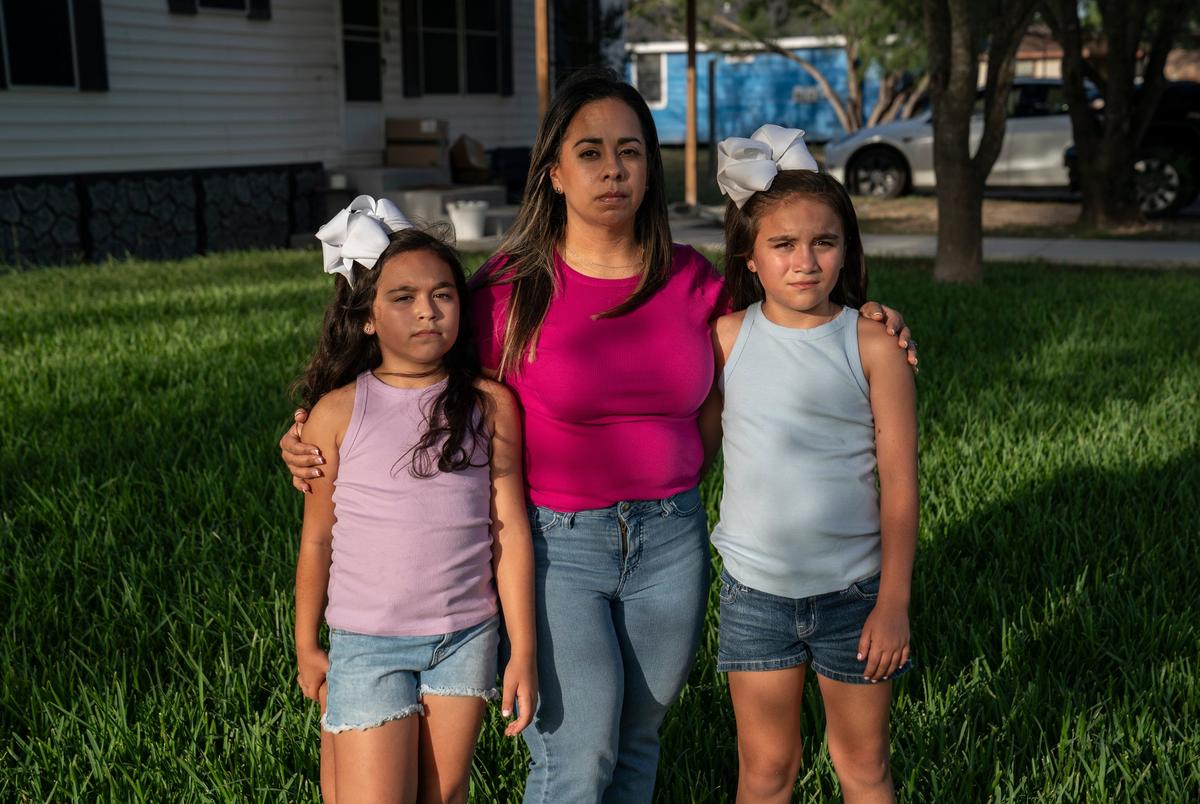
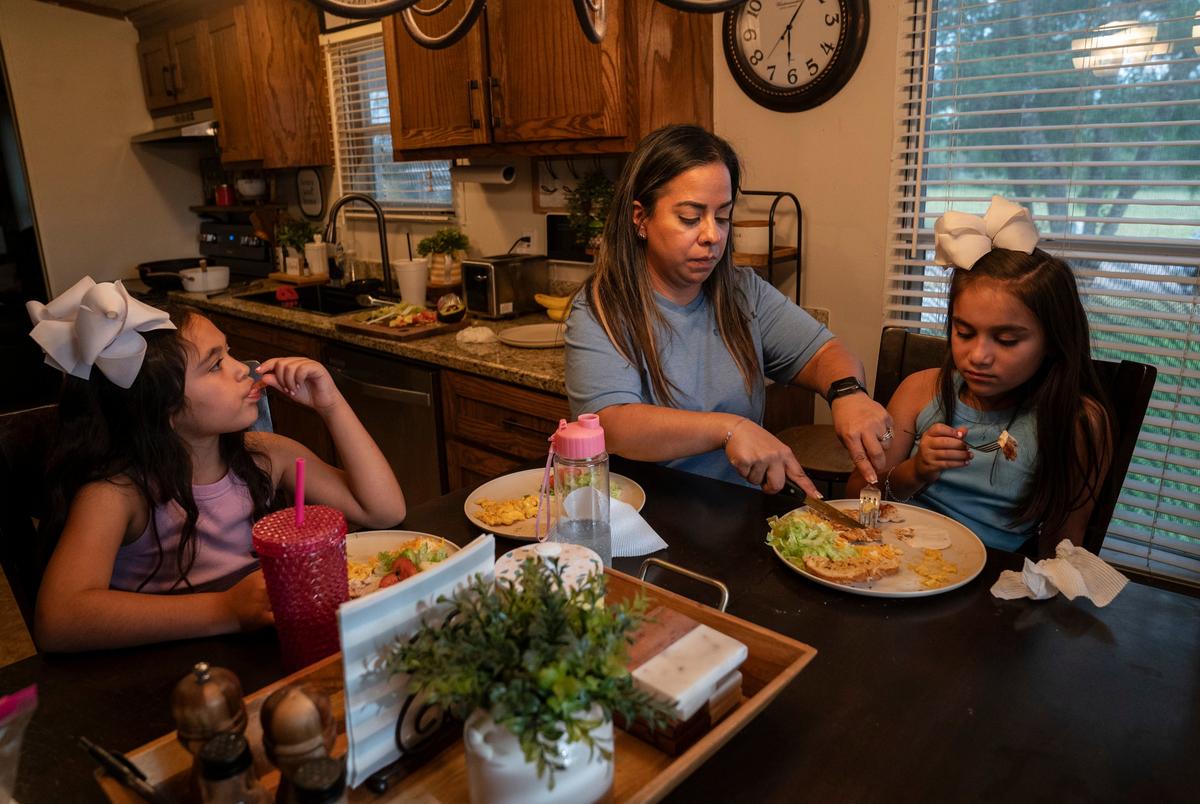
Clarissa Mendez and her daughters Catiana Ester Mendez, left, and Catalaya Avaneh Mendez pose for a photo at their home in Hebbronville on July 30, 2025. Credit: Gabriel V. Cárdenas for The Texas Tribune
Hebbronville, in far South Texas, is home to about 4,300 mostly Hispanic Texans, one-third of whom live below the poverty line. The town has no H-E-B or Walmart. The local health clinic is often busy. The town has a few day care centers, but they can get pricey.
For the average Texas family, child care is financially out of reach. The median annual cost sits at $10,706 a year — or $892 each month. That’s more than one-fourth of the average cost for in-state tuition at a four-year public college, according to the Economic Policy Institute. Access to no-cost options, like the Hebbronville after-school program, has positive effects on student attendance, behavior and learning, multiplestudies have found over the years. Such programs also keep families from having to choose between leaving their children unattended or taking time off work to stay home.
“That has a direct impact on future economic prospects for that entire family,” said Jenna Courtney, CEO of the Texas Partnership for Out of School Time, a youth advocacy organization.
Mendez, the 44-year-old Hebbronville mother with two daughters, commutes about an hour to and from Laredo every weekday to make it to her job as a nurse. She goes in at 9 a.m. and gets out at 5 p.m. Her husband operates heavy equipment and has an unpredictable work schedule.
After picking up her daughters, Mendez cooks for them and spends some time with them before she starts working from home for an additional three to four hours. The after-school program Mendez’s daughters attend allows her to save some money on daycare costs. Credit: Gabriel V. Cárdenas for The Texas Tribune
The after-school program “gives me enough time to get to town to pick them up,” she said. But with the district planning to shutter operations, Mendez needed to find care providers who could look after her children until 6-6:30 p.m., when she gets home. She pays about $1,000 a month for that service during the summer when the school program is out of session. It would likely cost her another $800 per month during the academic year.
“That’s a big chunk of our money,” Mendez said.
Without the program, she would need to find a second job.
“We’ll do what we gotta do,” she added. “But I don’t understand.”
Catalaya Avaneh Mendez plays with her sister Catiana Ester Mendez as their mother watches them at her home. The Trump administration recently froze funding that benefits after-school programs, placing financial stress on parents such as the Mendez. They would have to find and pay for daycare for their children if those programs ended. Credit: Gabriel V. Cárdenas for The Texas Tribune
Hibbitts, the 57-year-old from Throckmorton, recently joined a federally funded program that would allow her to support students in her rural hometown between Abilene and Wichita Falls. It places aspiring full-time teachers in classrooms under the supervision of more seasoned teachers and provides financial assistance for their education and living expenses.
In exchange, the district gets to retain educators familiar with the community and eager to teach.
Based on her own experience as a Throckmorton student in the 1970s, Hibbitts knows the monumental role teachers can play in a child’s life.
“They were almost like your second mother,” she said.
Texas has the largest rural population of any state in the country. Of its roughly 5.5 million students, 13% attend class on a rural campus. Those schools often have to educate their students with less: Less access to the internet and technology, less staffing, and less money to pay and retain teachers.
Educator Gay Hibbitts, left, speaks with her mentor, Amy Dick, a secondary social studies teacher, inside a classroom at Throckmorton Collegiate ISD on July 29, 2025. Hibbitts was part of a federally funded educator preparation program serving about 30 participants across 11 rural Texas districts. Credit: Desiree Rios for The Texas Tribune
Texas lawmakers have acknowledged that rural teachers often do not make as much as their urban and suburban counterparts, and that many have left the profession because of a lack of support. Public schools over time have also grown more reliant on hiring unlicensed educators, a trend playing out more profoundly in the rural parts of Texas.
In response, state officials recently passed laws aimed at raising teacher pay, particularly in rural schools, and enhancing teacher preparation programs.
During her first year in the Throckmorton program, Hibbitts learned how to incorporate state learning standards into lesson plans. She learned how to keep students engaged. She helped a child who struggled academically and acted out at the beginning of the school year become a “model student” who thrived in reading by the year’s end.
Then, one Sunday afternoon in April, her superintendent called her.
The Trump administration had abruptly cut the federal dollars that helped schools fund educator preparation initiatives like the one she was participating in. It would affect about 30 people across 11 rural districts in Texas.
Hibbitts was one of them.
Hibbitts participates in a safety training at Throckmorton Collegiate ISD. The funding for Hibbitts’ educator preparation program, which covered her two years of college and training costs, was cut on April 25 under the Trump administration, leaving her uncertain about her future. Credit: Desiree Rios for The Texas Tribune
In Hebbronville, Mendez and Peña each had to confront their own harsh realities. Mendez would have to search for child care in a community with few affordable options. Peña, the after-school program coordinator, would have to find a new job.
In Austin, Martin and Blankenship had trouble picturing life without the Boys and Girls Club.
Club leaders began preparing a memo to notify parents about the funding uncertainty and what it could mean for their kids. Nothing had come of the Republican, Democratic and legal efforts seeking the release of the frozen funds. The Texas kids who spoke with congressional lawmakers and staff at the U.S. Capitol hadn’t heard anything either. When the administration would make a decision about the funds was anyone’s guess.
When Blankenship got the news, he sprinted out of his room in excitement and told his mom. The moment was just as surreal for Martin.
“Knowing that it could have been me, my story, or any other club kids’ story,” Martin said, “it made me happy. But it was like, ‘Dang. I was a part — we were a part of that.’”
Peña, the Hebbronville Elementary program coordinator, was relieved. The mood in her group chat with people from the district’s after-school programs was “pretty ecstatic.” They all cried. Getting the funds meant they no longer had to look for new jobs, and parents like Mendez wouldn’t have to go searching for a place to take care of their kids after school.
Hibbitts is pursuing a bachelor’s degree in general studies with an emphasis in education and a minor in psychology at West Texas A&M. Credit: Desiree Rios for The Texas Tribune
Hibbitts, meanwhile, wasn’t immediately able to bask in the good news, as it did not restore the federal funds for her district’s teacher preparation program. But in early August, her supervisor notified her that the program was officially back up and running for the 2025-26 school year. The news cleared the way for the 57-year-old to graduate at the end of the year and to start teaching full time by the next.
“This has been life changing for somebody of my age, to be able to step up and to step into the world of education,” Hibbitts said. “I’m finishing my dream. And as my kids like to say, ‘Mom, you’re going to be 58 years old walking the stage.’”
Still, she recognizes that so much uncertainty around federal funding means there is no guarantee others will get the same chance.
Uncertainty is what Peña also keeps coming back to.
“It just gets me upset with the administration, because, why? What was the purpose of the freeze? Why did you do that? You’re hurting people, not just adults, but children,” Peña said. “It’s like in a divorce, you don’t want to put the children in the middle. If something were to happen between parents, you never put children in the middle. And by doing that, you put children in the middle.”
This article originally appeared in The Texas Tribune, a member-supported, nonpartisan newsroom informing and engaging Texans on state politics and policy. Learn more at texastribune.org.
The 18-year-old from Houston was going to start college in the fall at the University of Texas at Tyler, where she had been awarded $10,000 a year in scholarships. That, she hoped, would set her up for her dream: a Ph.D. in chemistry, followed by a career as a professor or researcher.
“And then the change to in-state tuition happened, and that’s when I knew for sure that I had to pivot,” said Ximena, who was born in Mexico but attended schools stateside since kindergarten. (The Hechinger Report is referring to her by only her first name because she fears retaliation for her immigration status.)
In June, the Texas attorney general’s office and the Trump administration worked together to end the provisions in a state law that had offered thousands of undocumented students like her lower in-state tuition rates at Texas public colleges. State and federal officials successfully argued in court that the long-standing policy discriminated against U.S. citizens from other states who paid a higher rate. That rationale has now been replicated in similar lawsuits against Kentucky, Oklahoma and Minnesota — part of a broader offensive against immigrants’ access to public education.
At UT Tyler, in-state tuition and fees for the upcoming academic year total $9,736, compared to more than $25,000 for out-of-state students. Ximena and her family couldn’t afford the higher tuition bill, so she withdrew. Instead, she enrolled at Houston Community College, where out-of-state costs are $227 per semester hour, nearly three times the in-district rate. The school offers only basic college-level chemistry classes, so to set herself up for a doctorate or original research, Ximena will still need to find a way to pay for a four-year university down the line.
Her predicament is exactly what state lawmakers from both political parties had hoped to avoid when they passed the Texas Dream Act, 2001 legislation that not only opened doors to higher education for undocumented students but was also meant to bolster Texas’s economy and its workforce long-term. With that law, Texas became the first of more than two dozen states to implement in-state tuition for undocumented students, and for nearly 24 years, the landmark policy remained intact. Conservative lawmakers repeatedly proposed to repeal it, but despite years of single-party control in the state legislature, not enough Republicans embraced repeal even as recently as this spring, days before the Texas attorney general’s office and the federal Department of Justice moved to end it.
Now, as the fall semester approaches, immigrant students are weighing whether to disenroll from their courses or await clarity on how the consent agreement entered into by the state and DOJ affects them.
Immigration advocates are worried that Texas colleges and universities are boxing out potential attendees who are lawfully present and still qualify for in-state tuition despite the court ruling — including recipients of the Deferred Action for Childhood Arrivals program, asylum applicants and Temporary Protected Status holders — because university personnel lack immigration expertise and haven’t been given clear guidelines on exactly who needs to pay the higher tuition rate.
At Austin Community College, which serves an area as large as Connecticut, members of the board of trustees are unsure how to accurately implement the ruling. As they await answers, they’ve so far decided against sending letters asking their students for sensitive information in order to determine tuition rates.
“This confusion will inevitably harm students because what we find is that in the absence of information and in the presence of fear and anxiety, students will opt to not continue higher education,” said Manuel Gonzalez, vice chair of the ACC board of trustees.
A billboard promoting Austin Community College in Spanish sits on a highway that leads to Lockhart, Texas. Credit: Sergio Flores for The Hechinger Report
Policy experts, meanwhile, warn that Texas’s workforce could suffer as talented young people, many of whom have spent their entire education in the state’s public school system, will no longer be able to afford the associate’s and bachelor’s degrees that would allow them to pursue careers that would help propel their local economies. Under the Texas Dream Act, beneficiaries were required to commit to applying for lawful permanent residence as soon as possible, giving them the opportunity to hold down jobs related to their degrees. Without resident status, it’s likely they’ll still work — just more in lower-paying, under-the-radar jobs.
“It’s so short-sighted in terms of the welfare of the state of Texas,”said Barbara Hines, a former law school professor who helped legislators craft the Texas Dream Act.
Related: Become a lifelong learner. Subscribe to our free weekly newsletter featuring the most important stories in education.
For retired Army National Guard Maj. Gen. Rick Noriega, a Democrat who served in the Texas Legislature at the time, that reality hit close to home when he learned of a young yard worker in his district who wanted to enroll at the local community college for aviation mechanics but couldn’t afford out-of-state tuition.
Noriega called the school chancellor’s office, which was able to provide funding for the student to attend. But that experience led him to wonder: How many more kids in his district were running up against the same barriers to higher education?
So he worked with a sociologist to poll students at local high schools about the problem, which turned out to be widespread. And Noriega’s district wasn’t an outlier. In a state that has long had one of the nation’s largest unauthorized immigrant populations, politicians across the partisan divide knew affected constituents, friends or family members and wanted to help. Once Noriega decided to propose legislation, a Republican, Fred Hill, asked to serve as a joint author on the bill.
To proponents of the Texas Dream Act, the best argument in support of in-state tuition for undocumented students was an economic one. After the state had already invested in these students during K-12 public schooling, it made sense to continue developing them so they could eventually help meet Texas’ workforce needs.
“We’d spent all this money on these kids, and they’d done everything that we asked them to do — in many instances superstars and valedictorians and the like — and then they hit this wall, which was higher education that was cost prohibitive,” said Noriega.
The legislation easily passed the Texas House of Representatives, which was Democratic-controlled at the time, but the Republican-led Senate was less accommodating.
“I couldn’t even get a hearing,’” said Leticia Van de Putte, the then-state senator who sponsored the legislation in her chamber.
To persuade her Republican colleagues, she added several restrictions, including requiring undocumented students to live in Texas for three years before finishing high school or receiving a GED. (Three years was estimated as the average time it would take a family to pay enough in state taxes to make up the difference between in-state and out-of-state tuition.) She also included the clause mandating that undocumented students who accessed in-state tuition sign an affidavit pledging to pursue green cards as soon as they were able.
Van de Putte also turned to Texas business groups to hammer home the economic case for the bill. And she convinced the business community to pay for buses to bring Latino evangelical conservative pastors from Dallas, San Antonio, Houston and other areas of the state to Austin, so they could knock on doors in support of the legislation and pray with Republican senators and their staff.
After that, the Texas Dream Act overwhelmingly passed the state Senate in May 2001, and then-Gov. Rick Perry, a Republican, signed it into law the following month.
Yet by 2007, even as immigrant rights advocates, faith-based groups and business associations formed a coalition to defend immigrants against harmful state policies, the Texas legislature was starting to introduce a wave of generally anti-immigrant proposals. In 2010, polling suggested Texans overwhelmingly opposed allowing undocumented students to pay in-state tuition rates.
By 2012, a new slew of right-wing politicians was elected to office, many philosophically opposed to the law — and loud about it. Perry’s defense of the policy had come back to haunt him during the 2012 Republican presidential primary, when his campaign was dogged by criticism after he told opponents of tuition equity during a debate, “I don’t think you have a heart.”
Still, none of the many bills introduced over the years to repeal the Texas Dream Act were successful. And even Texas Gov. Greg Abbott, a Republican border hawk, at times equivocated on the policy, with his spokesperson saying in 2013 that Abbott believed “the objective” of in-state tuition regardless of immigration status was “noble.”
Legislative observers say that some Republicans in the state continue to support the policy. “It’s a bipartisan issue. There are Republicans in support of in-state tuition,” said Luis Figueroa, senior director of legislative affairs at the public policy research and advocacy nonprofit Every Texan. “They cannot publicly state it.”
Meanwhile, as the topic became more politically charged in Texas, the Texas Dream Act ended up amplifying a larger conversation that eventually led to the creation of DACA, the Obama-era program that has given some undocumented immigrants access to deportation protections and work permits.
Even before DACA, many immigrants worked, and those who remain undocumented often still do, either as independent contractors for employers that turn a blind eye to their immigration status or by starting their own businesses. A study from May 2020 found that unauthorized residents make up 8.2 percent of the state’s workforce, and for every dollar spent toward public services for them, the state of Texas recouped $1.21 in revenue.
But without the immediate legal permission to work, undocumented college graduates who had benefited from the Texas Dream Act found themselves limited despite their degrees. As the fight for tuition equity spread to other states, so did the fight for a legal solution to support the students it benefited.
When these young people — affectionately dubbed Dreamers — took center stage to more publicly advocate for themselves, their plight proved sympathetic. By 2017, the same year Trump began his first term, polling had flipped to show a plurality of Texans in support of in-state tuition for undocumented students. More recently, research has indicated time and time again that Americans support a pathway to legal status for undocumented residents brought to the U.S. as children.
But arguments against in-state tuition regardless of immigration status also grew in popularity: Critics contended that the policy is unfair to U.S. citizens from other states who have to pay higher rates, or that undocumented students are taking spots at competitive schools that could be filled by documented Americans.
The DOJ leaned on similar rhetoric in the lawsuit that killed tuition equity in Texas, saying the state law is superseded by 1996 federal legislation banning undocumented immigrants from getting in-state tuition based on residency. That argument has become a template as the Trump administration has sued to dismantle other states’ in-state tuition policies for undocumented residents.
In Kentucky, state Attorney General Russell Coleman, a Republican, has followed in Texas’ footsteps, recommending that the state council overseeing higher education withdraw its regulation allowing for access to in-state tuition instead of fighting to defend it in court.
At the same time, the Trump administration has found other ways to cut back on higher education opportunities for undocumented students, rescinding a policy that had helped them participate in career, technical and adult education programs and investigating universities for offering them scholarships.
Back in Texas, the sudden policy change regarding in-state tuition is causing chaos. Even the state’s two largest universities, Texas A&M and the University of Texas, are using different guidelines to decide which students must pay out-of-state rates.
Clouds fill the sky behind the tower at the University of Texas. Credit: Sergio Flores for The Washington Post via Getty Images
“Universities, I think, are the ones that are put in this really difficult position,” Figueroa said. “They are not immigration experts. They’ve received very little guidance about how to interpret the consent decree.”
Amid so much confusion, Figueroa predicted, future lawsuits will likely crop up. Already, affected students and organizations have filed motions in court seeking to belatedly defend the Texas Dream Act against the DOJ.
In the meantime, young scholars are facing difficult choices. One student, who asked to remain anonymous because of her undocumented immigration status, was scrolling through the news on her phone before bed when she saw a headline about the outcome of the DOJ court case.
“I burst in tears because, you know, as someone who’s been fighting to get ahead in their education, right now that I’m in higher education, it’s been a complete blessing,” she said. “So the first thing that I just thought of is ‘What am I going to do now? Where is my future heading?’ The plans that I have had going for me, are they going to have to come to a complete halt?’”
The young woman, who has lived in San Antonio since she was 9 months old, had enrolled in six courses for the fall at Texas A&M-San Antonio and wasn’t sure whether to drop them. It would be her final semester before earning her psychology and sociology degrees, but she couldn’t fathom paying for out-of-state tuition.
“I’m in the unknown,” she said, like “many students in this moment.”
Contact editor Caroline Preston at 212-870-8965, via Signal at CarolineP.83 or on email at [email protected].
The Hechinger Report provides in-depth, fact-based, unbiased reporting on education that is free to all readers. But that doesn’t mean it’s free to produce. Our work keeps educators and the public informed about pressing issues at schools and on campuses throughout the country. We tell the whole story, even when the details are inconvenient. Help us keep doing that.
Johns was supposed to begin teaching at Texas A&M University this fall.
Texas A&M University professor Russell Taylor Johns was arrested by university police last Wednesday following an allegation that he exposed himself at the University of Texas at Austin earlier this year, KBTX reported.
Johns, who hadn’t yet begun teaching but was hired to join Texas A&M’s Harold Vance Department of Petroleum Engineering this fall, worked at UT Austin from 1995 to 2010 and was invited back to campus in April by its department of petroleum and geosciences. Court documents obtained by KBTX allege that Johns exposed his genitals and touched himself inappropriately at the UT Austin student center on April 29. A staff member told police that she saw Johns masturbate while looking at two female students sitting across from him.
Johns previously taught in the Department of Energy and Mineral Engineering at Pennsylvania State University.
Johns was booked at the Brazos County Detention Center and released on a $7,000 bond. His bond conditions require that he not contact the alleged victims or their families, refrain from committing additional offenses, and submit to random drug testing. In Texas, indecent exposure is a Class B misdemeanor and punishable by up to 180 days in jail and a $2,000 fine.
Texas A&M did not return Inside Higher Ed’s request for comment Tuesday.A university spokesperson told KSAT that the university was not aware of the allegation when Johns was hired and that he is currently suspended.
NEW ORLEANS, Aug. 18, 2025 — In a victory for student expression on campus, the U.S. Court of Appeals for the Fifth Circuit today overruled a lower court to halt an unconstitutional ban on student drag performances at West Texas A&M University.
In March 2023, West Texas A&M President Walter Wendler announced that he was unilaterally canceling a planned campus drag show hosted by LGBTQ+ organization Spectrum WT to raise money for suicide prevention. In a campus-wide email, Wendler said that he was canceling the event because he believes it offends and demeans women.
As a public official at a state university, the First Amendment bars Wendler from censoring a performance based on nothing more than his personal disapproval. But astonishingly, Wendler admitted he was canceling the show even though “the law of the land appears to require” him to allow it.
The Foundation for Individual Rights and Expression quickly jumped into action, filing a lawsuit against Wendler and West Texas A&M on behalf of Spectrum WT, its president Bear Bright, and vice president Marcus Stovall. FIRE’s lawsuit seeks to halt Wendler’s unlawful censorship and obtain damages for violating the students’ clearly established First Amendment rights.
In September 2023, the district court denied FIRE’s motion for a preliminary injunction. While the case made its way through the courts, Wendler canceled a second drag show planned by Spectrum WT in March 2024.
Today’s ruling from the Fifth Circuit overturns the district court’s ruling and places a temporary hold on Wendler’s enforcement of his illegal directive, allowing Spectrum WT and any other student organization to put on drag shows while litigation continues.
The majorityopinion from Judge Leslie H. Southwick found a substantial likelihood that Spectrum WT’s First Amendment claims would prevail on the merits.
“Because theatrical performances plainly involve expressive conduct within the protection of the First Amendment, and because we find the plaintiffs’ drag show is protected expression,” the Fifth Circuit held Wendler’s censorship failed to pass constitutional muster.
“FIRE is pleased that the Fifth Circuit has halted President Wendler’s unconstitutional censorship and restored the First Amendment at West Texas A&M,” said FIRE Supervising Senior Attorney JT Morris. “This is a victory not just for Spectrum WT, but for any public university students at risk of being silenced by campus censors.”
The Foundation for Individual Rights and Expression (FIRE) is a nonpartisan, nonprofit organization dedicated to defending and sustaining the individual rights of all Americans to free speech and free thought — the most essential qualities of liberty. FIRE educates Americans about the importance of these inalienable rights, promotes a culture of respect for these rights, and provides the means to preserve them.
CONTACT:
Alex Griswold, Communications Campaign Manager, FIRE: 215-717-3473; [email protected]
This audio is auto-generated. Please let us know if you have feedback.
Though it’s expected that teacher turnover will decrease over the next few years, it’s estimated that there were at least 49,000 vacant teaching positions and 400,000 underqualified educators instructing in classrooms nationwide during the 2024-25 school year, according to a project led by researchers from the University of Missouri and the University of Pittsburgh.
Texas has one of the highest teacher underqualification rates in the country, according to the University of Missouri-University of Pittsburgh research project.
Between the 2019-20 and 2024-25 school years, the total number of uncertified teachers in Texas jumped from 12,900 to 42,100, the Texas Education Agency found. That means 12% of the state’s total teachers were uncertified by 2024-25 compared to 3.8% before the pandemic.
On top of that, 34% of the nearly 49,200 newly hired teachers in the 2023-24 school year had no Texas teaching certifications, according to TEA data.
Texas makes a change
Texas’ growing reliance on uncertified teachers stems from the District of Innovation policy enacted by the state legislature in 2015.
Some 986 Texas school districts participate in the program, which essentially automatically allows them to waive teacher certifications even though it was initially intended just for career and technical education teachers, said Jacob Kirksey, an assistant professor of education policy at Texas Tech University. Kirksey is also the associate director of the university’s Center for Innovative Research in Change, Leadership and Education.
Since the pandemic, however, there has been a “dramatic spike” in districts using the District of Innovation program to help with hiring uncertified teachers for foundational subject areas, Kirksey said.
According to Kirksey’s research, Texas’ use of uncertified teachers with no classroom experience led to major learning losses for students. Those taught by new uncertified educators lost 4 months in reading and 3 months in math compared to their peers taught by certified instructors.
But a major shift is underway: HB2, a new state law enacted in June, will phase out all uncertified teachers in foundational content areas by the 2029-30 school year.
Now in Texas, Kirksey said, “we’ve seen the extent of the damage. I think our legislature realized, ‘OK, we created this hole, and now we need to put in the work to fix it.’”
HB2 also incentivizes districts to hire high-quality teachers, he said. Under the new law, districts can receive $1,000 bonuses for every teacher they certify who previously lacked necessary credentials. Other larger bonuses can be earned from the state for mentoring and training teachers.
South Carolina embraces uncertified teachers
On the flip side, some states are implementing laws that would allow more uncertified teachers to enter classrooms.
In South Carolina, for instance, a law enacted in May launched a five-year pilot program that will allow public school districts to hire uncertified teachers — capped at 10% of a district’s instructional staff.
These teachers must have a bachelor’s or master’s degree with at least five years of relevant work experience in the subject area they are hired to instruct. Uncertified teachers must also enroll in an educator preparation program within their first three years of instruction.
The new law comes as South Carolina’s school districts reported over 1,000 teacher vacancies at the beginning of the 2024-25 school year — 600 fewer vacancies, or a 35% decrease, from the previous year, according to a November 2024 analysis by the Center for Educator Recruitment, Retention, and Advancement.
Dena Crews, president of the South Carolina Education Association, said she’s concerned that the law doesn’t require uncertified teachers to take any foundational training before they can instruct students. “The business world and the education world are not the same,” she said.
Uncertified teachers also don’t have any incentive to stay in schools and won’t face any consequences if they quit in the middle of their contract, Crews said. For instance, if one of these teachers doesn’t know anything about classroom management and they can’t get students’ attention for days on end, they may not want to come back and teach.
“So those kids are left at a deficit,” Crews said. “That didn’t help with the shortage. It helped with the shortage for a couple of days and really didn’t do anything, because those kids didn’t learn anything.”
Overall, Crews said she hopes South Carolina’s uncertified teacher pilot program “will not become the norm” for states and school districts nationwide.
Texas has watched its uncertified teacher policies play out longer than other states, Kirksey said. Some lessons learned from watching this trend, he said, are that states facing educator shortages should avoid the easiest option, which is to “deregulate everything” for teaching regulations like in South Carolina. Instead, states should look for ways to prioritize training people to become high-quality educators.
“I do think it’s just a matter of time before folks realize that if we choose to de-incentivize quality, then it’s going to impact kids,” Kirksey said.
Kirksey said he doesn’t believe there’s a lack of qualified adults who can teach. Rather, there’s “a lack of educators who are willing to be in the classroom, who are well-prepared.”
That’s why states and districts ultimately need to address issues with teacher pay, burnout and job satisfaction, Kirksey said. In Texas, he said, “I feel like, as a state, we finally recognize that.”
Kurt Micklo lost interest in academics after he failed to make the basketball team as a sophomore at Chapin High School. Soon after, he fathered a son and began to work full time, which put him further behind in his studies.
A counselor finally advised him during his junior year that he should withdraw and try to earn a GED. He dropped out and – through hard work – found professional success as a general manager of a subcontracting logistics company. However, the lack of a high school diploma haunted him. He wants one to give his family – especially his mother – another reason to be proud of him.
A busy work and family schedule have kept him from returning to school, but the flexibility of a new state program aimed at people aged 18 and older without a high school diploma will allow him to earn a diploma and a college career and technical education, or CTE, credential for programs such as health care, welding or computer science at the same time.
The concept of Opportunity High School Diploma was part of House Bill 8, which the state Legislature passed in 2023. The state funneled about $2 million into this program to help the approximately 4.3 million Texans as of 2023, including about 30,000 adult El Pasoans, without a diploma to earn the academic credits most of them will need to acquire higher-paying jobs. The program is scheduled to launch in spring 2026.
“If I could juggle it, I’d be pretty interested” in the program, said 34-year-old Micklo, a father of three ages 15, 10 and 5. He is the general manager of three warehouses, two in El Paso and one in Laredo, Texas, as well as four sites near the international ports of entry with Mexico in El Paso, Tornillo and Santa Teresa, New Mexico, were commodities are offloaded.. “It would make my stepfather (a retired educator) and my mother happy if I earned my high school diploma.”
El Paso Community College is one of five community college districts in the state selected for the design and implementation phases of this program. The other institutions in the design phase are Alamo Colleges District, Austin Community College, Dallas College and San Jacinto College near Houston.
They work under the direction of the Texas Higher Education Coordinating Board. The board will review the instructional outcomes and performance expectations that the college collaborators created during an October meeting. Once finalized, the college faculty will begin to work with school districts to design the curriculum.
The program is flexible for students who probably work full time and have family obligations. Courses would have suggested timelines, but students would turn in assignments as their schedule allowed through the end of the term.
Micklo, a Northeast resident, said the promised flexibility is the only reason he might consider the program. As for his credential, he said he would need to review EPCC’s career and technical education options. The college offers more than 100 career programs such as HVAC, or heating, ventilation and air conditioning, and electrical, automotive or diesel technologies.
Students will be co-enrolled in competency-based high school curriculum such as math, civics, sciences and communication, and a career and technical workforce program. Competency based courses are focused more on a students’ mastery of a skill or subject than the amount of time spent in a classroom.
Isela Castañón Williams
Isela Castañón Williams, professor and coordinator of EPCC’s teacher preparation programs, is in charge of the college’s 13-member team. She called the project a “monumental task” because of its scope and uniqueness. She said her team, and its counterparts, played a critical role in the design phase.
“Faculty at EPCC are very innovative,” she said. “I think that my colleagues have approached this process with a great deal of enthusiasm. We’re always looking to provide better services and educational experiences to the community we serve.”
EPCC faculty advocated for the program to be designed to accommodate English Second Language and English Language Learner populations, a THECB spokesman said in a July 1 statement. He said last year that the board selected EPCC for the project’s design phase because of its border insights, and because its CTE degrees and credentials are in line with the program.
While the state wants to attract students aged 18 and older, EPCC officials will aim for people 25 and older so as to not compete with K-12 school districts that have their own dropout recovery programs. EPCC, which will offer the program at its five campuses, expects some of the program’s younger students to come from rural areas outside El Paso.
Steven E. Smith
Steven E. Smith, vice president of Instruction and Workforce Education at EPCC, said the state will provide funds to the colleges to cover tuition for initial cohorts. He expects the first groups will range from 30 to 50 students and scale up from there.
“We think this is a big market in El Paso, and I think once the word starts to get out, that will grow tremendously,” Smith said.
The administrator said that he would work on ways to market the program later this month with the college’s External Relations, Communication & Development Division. He said the college would work with school district partners to build lists of potential OHSD students.
“As you might imagine, that is a pretty difficult population to identify and reach out to because they are not in the system anymore,” Smith said.
School (in)Security is our biweekly briefing on the latest school safety news, vetted by Mark Keierleber. Subscribe here.
As far-right political operative David Barton leads a Christian nationalist crusade, he’s traveled to state capitols across the country this year to support dozens of bills requiring Ten Commandments displays in classrooms.
My latest story digs into a well-coordinated and deep-pocketed campaign to inject Protestant Christianity into public schools that could carry broader implications for students’ First Amendment rights. Through a data analysis of 28 bills that have cropped up across 18 states this year, I show how Barton’s role runs far deeper than just being their primary pitchman.
The analysis reveals how the language, structure and requirements of these bills nationwide are inherently identical. Time and again, state legislation took language verbatim from a Barton-led lobbying blitz to reshape the nation’s laws around claims — routinely debunked — about Christianity’s role in the country’s founding and its early public education system.
Three new state laws in Louisiana, Arkansas and Texas mandating Ten Commandments posters in public schools are designed to challenge a 1980 Supreme Court ruling against such government-required displays in classrooms. GOP state lawmakers embracing these laws have expressed support for eradicating the separation of church and state — a pursuit critics fear will coerce students and take away their own religious freedom.
In the news
Updates to Trump’s immigration crackdown: Immigration and Customs Enforcement has released from custody a 6-year-old boy with leukemia more than a month after he and his family were sent to a rural Texas detention center. | Slate
As the Department of Homeland Security conducts what it calls wellness checks on unaccompanied minors, the young people who migrated to the U.S. without their parents “are just terrified.” | Bloomberg
‘It looks barbaric’: Video footage purportedly shows some two dozen children in federal immigration custody handcuffed and shackled in a Los Angeles parking garage. | Santa Cruz Sentinel
The Department of Homeland Security is investigating surveillance camera footage purportedly showing federal immigration officers urinating on the grounds of a Pico Rivera, California, high school in broad daylight. | CBS News
California sued the Trump administration after it withheld some $121 million in education funds for a program designed to help the children of migrant farmworkers catch up academically. | EdSource
Undocumented children will be banned from enrolling in federally funded Head Start preschools, the Trump administration announced. | The Washington Post
Legal pushback: Parents, Head Start providers challenge new rule barring undocumented families. | The 74
Getty Images
The executive director of Camp Mystic in Texas didn’t begin evacuations for more than an hour after he received a severe flood warning from the National Weather Service. The ensuing tragedy killed 27 counselors and campers. | The Washington Post
The day after the Supreme Court allowed the Education Department’s dismantling, Secretary Linda McMahon went ahead with plans to move key programs. | The 74
Now, with fewer staff, the Office for Civil Rights is pursuing a smaller caseload. During a three-month period between March and June, the agency dismissed 3,424 civil rights complaints. | Politico
Sign-up for the School (in)Security newsletter.
Get the most critical news and information about students’ rights, safety and well-being delivered straight to your inbox.
Massachusetts legislation seeks to ban anyone under the age of 18 from working in the state’s seafood processing facilities after an investigation exposed the factories routinely employed migrant youth in unsafe conditions. | The Public’s Radio
An end to a deadly trend: School shootings decreased 22% during the 2024-25 school year compared to a year earlier after reaching all-time highs for three years in a row. | K-12 Dive
Florida is the first state to require all high school student athletes to undergo electrocardiograms in a bid to detect heart conditions. | WUSF
The Senate dropped rules from Trump’s “big, beautiful” tax-and-spending bill that would have prevented states from regulating artificial intelligence tools, including those used in schools. | The Verge
Food stamps are another matter: The federal SNAP program will be cut by about a fifth over the next decade, taking away at least some nutrition benefits from at least 800,000 low-income children. | The 74
Texas state representative Brian Harrison has asked the U.S. Department of Health and Human Services to investigate his alma mater, Texas A&M University, for allegedly engaging in “discriminatory” student recruiting practices,The Dallas Express reported.
“In the state of Texas, government entities … should not be treating people differently based on anything other than merit,” Harrison told the outlet. “We have got to bring back a focus on meritocracy. And the president of Texas A&M brags about the fact that he’s doing it.”
According to a May letter to HHS acting general counsel Brian Keveney that Harrison posted on X, Texas A&M president Mark Welsh had sent him a letter “admitting @TAMU is still engaged in DEI courses and discriminatory ‘targeted recruiting’ practices.”
Welsh’s letter, which Harrison also included, criticizes the lawmaker for posting a video and other content online accusing the TAMU president of flouting the law.
“Your comments accompanying the video imply that the university is doing something illegal by engaging in ‘targeted’ student recruitment efforts,” Welsh’s letter says. “You’ve also posted about student groups and academic courses, which, like recruiting activities, are specifically exempted in the bill. Since you voted in favor of the law, you must also be aware of those exemptions.”
In his letter to Keveney, Harrison called Welsh’s defense—that Texas law does not explicitly ban targeted recruiting—“preposterous.” He asked HHS to “take any action[s] you or President Trump’s Task Force deem appropriate to ensure that Texas universities receiving federal funds are complying with the U.S. Constitution.”
Harrison told The Dallas Express that HHS had received his letter and is “taking it and handling it appropriately.”