Tag: theyre

  • The R&D buckets are here to stay – what matters now is how they’re used

    The R&D buckets are here to stay – what matters now is how they’re used

    The Budget and the introduction of DSIT’s new bucket framework mark a shift in how government wants to think and talk about research and innovation. With growth now central to the government’s agenda, it is a clear attempt to answer Treasury’s perennial question: what does the public get for its money?

    At the centre of this shift sits the idea of R&D “buckets”: a four-part categorisation of public R&D funding into curiosity-driven research, government priorities, innovation support and cross-cutting infrastructure.

    The logic behind the buckets is easy to understand. The UK system is complex, with budget lines stretching across a maze of research councils, departments, institutes, academies and government labs. Even seasoned insiders need a cup of coffee before attempting to decipher the charts on one of UKRI’s much-valued budget explainers.

    From the Treasury’s perspective, the lack of clarity is a barrier to the value of government investment. DSIT’s response is the bucket model: a clearer way of presenting public investment that moves the conversation away from budget lines and towards outcomes that matter to citizens. If this helps build broader support for R&D across departments and with the public, as CaSE’s latest research suggests is needed, it could be hugely valuable.

    The outcomes challenge

    One consequence of an outcomes-driven model, however, is that different types of research will find it easier or harder to demonstrate their value. Basic and curiosity-driven research can be difficult to evidence through simple KPIs or narrow ROI measures.

    In contrast, some forms of applied R&D lend themselves more easily to straightforward metrics. The Higher Education Innovation Fund (HEIF) is a good example. It can demonstrate a return on investment of £14.80 to £1 in ways that are simple to communicate and easy for officials to interpret. In a system that places a premium on measurable outcomes, this kind of clarity is powerful.

    If outcomes become the dominant organising logic, there is a risk that bucket one, which covers curiosity-driven research, could appear on paper to be the least “investable” – especially under a future minister who is less supportive of blue-skies research. The danger is not deliberate neglect, but an unintended shift in perception, whereby discovery research is viewed as separate from, rather than essential to, mission-led or innovation-focused work.

    The challenge becomes even clearer when we look at quality-related research funding (QR). Few funding mechanisms are as versatile or as important to the health of the research ecosystem. QR supports discovery research, helps universities leverage private investment, underpins mission- and place-based activity, and fills the gaps left by research council and charity grants. It is the flexible connective tissue that keeps the system functioning.

    Trying to code QR neatly into a single bucket, as bucket one, doesn’t reflect reality. It may make the diagrams tidier, but it also risks narrowing Whitehall’s understanding of how QR actually works. Worse, it could make QR more vulnerable at fiscal events if bucket one is cast as the “future problem” bucket, the category that can be trimmed without immediately visible consequences.

    The trap of over-simplification

    That brings us to a wider point about the buckets themselves. The intention with buckets is to draw a much more explicit line between priorities, investment and impact. This is a reasonable goal. But the risk is that it invites interpretations that are too neat. Most research does not sit cleanly in any one category. The system is interdependent, porous and overlapping. Innovation depends on discovery research. Regional growth depends on long-term capability. And capability only exists if the UK continues to invest in talent, infrastructure and basic research.

    Rather than accepting a model that implies hard boundaries, it may be more helpful to embrace, and actively communicate, this interdependence. A Venn diagram might be a more honest reflection than three or four boxes with solid walls.

    The aim is not to relabel the buckets, but to strengthen the narrative around how the types of research we fund reinforce each other, rather than competing for space in a zero-sum system. This kind of framing could also help government understand why certain funding streams look costly on paper, but yield value across a wide range of outcomes over time.

    One argument is that by identifying curiosity-driven research as a distinct bucket, it will be harder for future governments to cut it without doing so publicly. There is some truth in this. Transparency can raise the political cost of reducing support for basic research. But the counterargument is also important. Once bucket one becomes a visible and discrete line of spend, it could also become more vulnerable during fiscal consolidations. Ministers looking to free up resources for missions or innovation-focused interventions may see it as an easier place to make adjustments, especially if the definition of “impact” narrows over time.

    Shovel ready

    This is why the narrative around the buckets matters as much as the buckets themselves. If they are understood as three separate spaces competing for limited resources, the system loses coherence. Discovery becomes something distant from growth, rather than the engine that drives it. Missions appear disconnected from the long-term capability required to achieve them. Innovation emerges as a standalone activity rather than as part of a pipeline that begins with public investment in fundamental science.

    The bucket framework is not going away. It will shape how government talks about R&D for years to come. This makes the next phase critical: there is an opportunity now to influence how the buckets are interpreted, how they are used in practice and how the narrative around them is constructed.

    If treated as rigid boundaries, the buckets risk weakening the case for long-term investment in capability. But if used as a way of telling a more coherent story about the interdependence of discovery, missions and innovation, they could help build stronger cross-government support for R&D. The challenge is to make sure the latter happens.

    Source link

  • Students don’t think anything will change. They’re probably right

    Students don’t think anything will change. They’re probably right

    The standout quote for me from new Office for Students (OfS) commissioned research on student consumer rights comes from a 21-year-old undergrad in a focus group:

    If you were unhappy with your course, I don’t know how you’d actually say to them, ‘I want my money back, this was rubbish,’ basically. I don’t think that they would actually do that. It would just be a long, drawn-out process and they could just probably just argue for their own sake that your experience was your experience, other students didn’t agree, for example, on your course.

    There’s a lot going on in there. It captures the power imbalance between students and institutions, predicts institutional defensiveness, anticipates bureaucratic obstacles, and reveals a kind of learned helplessness – this student hasn’t even tried to complain, and has already concluded it’s futile.

    It’s partly about dissatisfaction with what’s being delivered, and a lack of clarity about their rights. But it’s also about students who don’t believe that raising concerns will achieve anything meaningful.

    Earlier this year, the regulator asked Public First to examine students’ perceptions of their consumer rights, and here we have the results of a nationally representative poll of 2,001 students at providers in England, alongside two focus groups.

    On the surface, things look pretty healthy – 83 per cent of students believe the information they received before enrolment was upfront, clear, timely, accurate, accessible and comprehensive, and the same proportion say their learning experience aligns with what they were promised.

    But scratch a bit and we find a student body that struggles to distinguish between promises and expectations, that has limited awareness of their rights, that doesn’t trust complaints processes to achieve anything meaningful, and that is largely unaware of the external bodies that exist to protect them.

    Whether you see this as a problem of comms, regulatory effectiveness, or student engagement probably depends on where you sit – but it’s hard to argue it represents a protection regime that’s working as intended.

    Learning to be helpless

    Research on complaints tends towards five interlocking barriers that prevent people from holding institutions and service providers to account – and each of them can be found in this data.

    There’s opportunity costs (complaining takes time and energy), conflict aversion (people fear confrontation), confidence and capital (people doubt they have standing to complain), ignorance (people don’t know their rights), and fear of retribution (people worry about consequences). In this research, they combine to create an environment in which students who experience problems just put up with them.

    When they were asked about the biggest barrier to making a complaint, the top answer was doubt that it would make a difference – cited by 36 per cent of respondents. The polling also found that 26 per cent of students said they have “no faith” that something would change if they raised a complaint, and around one in six students (17 per cent) disagreed with the statement “at my university, students have a meaningful say in decisions that affect their education.”

    One postgrad described the experience of repeatedly raising concerns about poor organisation:

    People also just don’t think anything’s going to happen if they make a complaint, like I don’t think it would. With my masters’, it was so badly organised at the start, like we kept turning up for lectures and people just wouldn’t turn up and things like that […] We had this group chat and we were all like, ‘What’s going on? We’re paying so much money for this,’ and […] it just seemed like no one knew what was going on, but we raised it to the rep to raise it to like one of the lecturers and then […] it would just still happen. So it’s like they’re not going to change it.

    That’s someone who tried to work the system, followed the proper channels, raised concerns through the designated representative – and concluded it was futile.

    The second most common barrier captures the opportunity costs thing – lack of time or energy to go through the process, cited by 35 per cent. Combined with doubting it would make a difference, we end up with a decent proportion of students who have cost-benefit analysed complaining and decided it’s not worth the effort. Domestic students were particularly likely to cite futility as a barrier – 41 per cent versus 25 per cent of international students.

    They’ve learned helplessness – and only change their ways when failures impact their marks, only to find that “you should should have complained earlier” is the key response they’ll get when the academic appeal goes in.

    Fear of retribution is also in there. About a quarter of students cited concern that complaining might affect their grades or relationships with staff (25-26 per cent) or said they felt intimidated or worried about possible consequences (23-26 per cent). A postgraduate put it bluntly:

    I think people are scared of getting struck off their course.

    Another student imagined what would happen if they tried to escalate to an external body:

    I think [going to the OIA] would have to be a pretty serious thing to do, and I think that because it’s external to the university, I’d feel a little bit like a snitch. I would have to have a lot of evidence to back up what I’m saying, and I think that it would be a really long, drawn-out process, that I ultimately wouldn’t really trust would get resolved. And so I just wouldn’t really see it as worth it to make that complaint.

    That’s the way it is

    What are students accepting as just how things are? The two things students were most likely to identify as promises from their university were a well-equipped campus, facilities and accommodation (79 per cent) and high quality teaching and resources (78 per cent).

    Over three-quarters of students said the promises made by their university had not been fully met – 59 per cent said they had been mostly met, 14 per cent partially met and 1 per cent not met at all, leaving just 24 per cent who thought promises had been fully met.

    Yet fewer than half of respondents said these were “clear and consistent parts of their university experiences” – 42 per cent for physical resources and just 37 per cent for teaching and resources. In other words, the things students most clearly remember being promised are precisely the things that, for a large minority, show up as patchy, unreliable features of day-to-day university life rather than dependable fixtures.

    There’s also a 41 percentage point gap between what students believe they were promised on teaching quality and what they report actually experiencing – 78 per cent say high quality teaching and resources were promised, but only 37 per cent say that kind of provision is a clear and consistent part of their experience. Public First note that “high quality” wasn’t explicitly defined in the polling, so these are students’ own judgements rather than a technical standard – but the size of the mismatch is still striking.

    About a quarter of students (23 per cent) reported receiving lower quality teaching than expected, rising to 26 per cent among undergraduates. Twenty-two per cent experienced fewer contact hours and more online or hybrid teaching than expected, and twenty-one per cent reported limited access to academic staff.

    One undergraduate described being taught by someone who made clear he didn’t want to be there:

    One of our lecturers, he wasn’t actually a sports journalism lecturer, he’s just off the normal journalism course, and he made it pretty clear that he didn’t like any of us and he didn’t want to be there when he was teaching us. And we basically got told that we had to go and get on with it, pretty much. So there wasn’t any sort of solution of, ‘We’ll change lecturers,’ or anything, it’s just, ‘You’ll get in more trouble if you don’t go, so just get on with it and finish it.

    When presented with a list of possible disruptions and asked which they’d experienced, 70 per cent identified at least one type. The most common was cancellation or postponement of in-person teaching, reported by 35 per cent of undergraduates. Industrial action affecting teaching or marking hit 20 per cent of students overall, and 16 per cent said it had significantly impacted their academic experience.

    Limited support from academic staff affected 20 per cent overall, rising to one in four postgraduate students – and this was the disruption that students were most likely to say had significantly impacted their experience (23 per cent overall, climbing to 32 per cent among international students).

    Telling is how dissatisfied students were with institutional responses to disruptions. Forty-two per cent said they were not that satisfied or not at all satisfied with their institution’s response to cancelled or postponed teaching – 45 per cent said the same about the response to strikes or industrial action. In other words, students experienced disruption, they weren’t happy with how it was handled, and yet most didn’t complain, because (again) they didn’t think it would achieve anything.

    Informal v informant

    Unsurprisingly, most students (65 per cent) had never lodged a formal complaint against their institution. On its face, that could look like satisfaction – if students aren’t complaining, perhaps things are generally fine. But when you dig into the reasons students give for not complaining, about one in four students (24 per cent) who hadn’t complained said they weren’t confident they’d know how to go about it – that’s the ignorance barrier.

    And the bigger obstacles weren’t procedural – they were about believing it was pointless or fearing consequences.

    When students did complain, they were at least twice as likely to have done so through informal channels (such as course representatives or conversations, 23 per cent) than through formal procedures (11 per cent). That’s your conflict aversion in action – you try the informal route first, see if you can get something fixed quietly without escalating to a formal process that might create confrontation.

    But it also means the formal complaints processes that are supposed to provide accountability and redress (and documented institutional learning) are being bypassed by students who’ve concluded they’re not worth engaging with.

    Among those who did complain formally, around half (54 per cent) felt satisfied with their institution’s handling of it – which means nearly half didn’t. So if you’re a student considering whether to raise a complaint, and you believe there’s roughly a 50-50 chance it won’t be handled satisfactorily, if you’ve already concluded there’s a strong likelihood it won’t change anything anyway, why would you bother?

    Especially when you add in the other barriers – concern it might affect grades or relationships with staff, feeling intimidated or worried about consequences, lack of trust in the university to handle it fairly.

    The focus groups reinforce the picture of systematic dismissal. One undergraduate explained the calculation:

    If you were unhappy with your course, I don’t know how you’d actually say to them, ‘I want my money back, this was rubbish,’ basically. I don’t think that they would actually do that. It would just be a long, drawn-out process and they could just probably just argue for their own sake that your experience was your experience, other students didn’t agree, for example, on your course.

    That’s someone that has already mapped out in their head exactly how the institution would respond – they’d argue it’s subjective, other students were happy, your experience doesn’t represent a breach of contract. And, of course, they’re probably right.

    An entitled generation

    If students don’t believe complaining will achieve anything, part of the reason is that they don’t really understand what they’re entitled to expect in the first place. The research found that only 50 per cent of students said they understood and could describe their rights and entitlements as a student – which very much undermines the whole premise of students as empowered consumers able to hold institutions to account.

    When asked how well informed they felt about various rights, the results were even worse. Only 32 per cent of students felt well informed about their right to fair and transparent assessment – the highest figure for any right listed. More than half (52 per cent) said they felt not that well informed or not at all informed about their right to receive compensation. You can’t assert rights you don’t know you have.

    The focus groups then show just how fuzzy students’ understanding of “promises” really is. Participants found it difficult to identify what had been explicitly promised to them, with received ideas about higher education playing a significant role in shaping student expectations.

    They could articulate areas where their experiences fell short – reduced contact hours, poor teaching quality, limited access to careers support – but struggled to identify where these amounted to broken promises.

    One undergraduate captured this confusion as follows:

    I personally think I do get what I was promised when I applied to university. Not like I’m an easy-going person or anything, but I do get what I need in the university, yes.

    Notice the subtle shift from “promised” to “need” – the student can’t quite articulate what was promised, so they fall back on whether they’re getting what they need, which is a much vaguer and more subjective standard.

    This matters a lot, because if you don’t know what you were promised, you can’t confidently assert that a promise has been broken. You might feel disappointed, you might think things should be better, but you can’t point to a specific commitment and say “you told me X and you’ve given me Y.”

    Which means that even when students want to complain, they’re starting from a position of uncertainty about whether they have grounds to do so. It’s the perfect recipe for learned helplessness – you’re dissatisfied, but you’re not sure if you’re entitled to be dissatisfied, so you conclude it’s safer to just accept it.

    The one clear exception? Doctoral students, who were confident they’d been promised the support of a supervisor:

    When I was applying for a PhD, I applied to several universities, so I was selected and accepted in [Institution A] and [Institution B], but I decided to come to [Institution A] for the supervisor – he interviewed me, he sent me the acceptance letter.

    Getting on the escalator

    If the picture so far suggests a system where students lack confidence in internal complaints processes, the findings on external avenues for redress make sense. Only 8 per cent of all students had heard of the Office of the Independent Adjudicator (OIAHE), and the focus groups confirm there was “little to no awareness of external organisations or avenues of redress for students”.

    More broadly, more than a third (35 per cent) of students said they were unaware of any of the external organisations or routes listed through which students in England can raise complaints about their university – rising to 41 per cent among undergraduates and 38 per cent among domestic students. The list they were shown included the OIA, the OfS, Citizens Advice, solicitors, local MPs, the QAA, and trade unions or SUs like NUS. More than a third couldn’t identify a single one of these as somewhere you might go with a concern about your university.

    As for OfS itself, just 18 per cent of students overall had heard of it, falling to 14 per cent among undergraduates. Let’s go ahead and assume that they’ve not read Condition B2.

    When asked where they would go for information about their rights, the most common answer was the university website (53 per cent) or just searching online (51 per cent). About 42 per cent said they’d look to their SU for information about rights. That’s positive – SUs are meant to provide independent advice and advocacy for students. But the fact that only 42 per cent think to go there, versus 53 per cent who’d go to the university website, suggests SUs aren’t being seen as the first port of call.

    Among postgraduates in the focus groups, there was “limited interest in the use of these avenues for redress”, with the implicit sense that if intra-institutional channels of redress seemed drawn-out, daunting and potentially fruitless, it was unlikely that “resorting to extra-institutional channels would make the situation better”. If students have concluded that internal processes are bureaucratic and ineffective, they’re not going to invest additional time and energy in external ones – especially when they don’t know those external routes exist in the first place.

    Explorations

    It’s an odd little bit of research in many ways. It’s hard to tell if recommendations have been deleted, or just weren’t asked for – either way, they’re missing. It’s also frustratingly divorced from OfS’ wider work on “treating students fairly” – I know from my own work over the decades that students tend initially to be overconfident about their rights knowledge, only to realise they’ve over or undercooked when you give them crunchier statements like these “prohibited behaviours” (which of course only seem to be “prohibited”, for the time being, in providers that will join the register in the future).

    More curious is the extent to which OfS knows all of this already. Six years ago this board paper made clear that consumer protection arrangements were failing students on multiple fronts. It knew that information available to support student choice was inadequate – insufficiently detailed about matters that actually concern students and poorly structured for meaningful comparisons between providers and courses, with disadvantaged students and mature learners particularly affected by lack of accessible support and guidance.

    It knew that the contractual relationship between students and providers remains fundamentally unequal, with ongoing cases of unclear or unfair terms that leave students uncertain about what they’re actually purchasing in terms of quality, contact time, support and costs, while terms systematically favoured providers.

    It also knew that its existing tools weren’t allowing intervention even when it saw evidence that regulatory objectives were being delivered, and questioned whether a model requiring individual students to challenge providers for breaches was realistic or desirable.

    So many things would help – recognition of the role of student advocacy, closer adjudication, better coordination between OfS and the OIA, banning NDAs for more than sexual misconduct are four that spring to mind, all of which should be underpinned by a proper theory of change that assumes that not all power over English HE is held in Westward House in Bristol.

    If students have concluded that complaining is futile, there are really three possible responses. One would be to figure that the promises being made raise expectations too high. But there are so many actors specifically dedicated to not talking down a particular university or the sector in general as to render “tell them reality” fairly futile.

    Another is to try to convince them they’re wrong – better communications about rights, clearer signposting of redress routes, more prominent information about successful complaints. You obviously can’t give that job to universities.

    The third would be to ask what would need to change for complaining to actually be worthwhile. That would require processes that are genuinely quick and accessible, institutional cultures where raising concerns is welcomed rather than seen as troublemaking, meaningful remedies when things go wrong, and external oversight bodies that can intervene quickly and effectively.

    But there’s no sign of any of that. A cynic might conclude that a regulator under pressure to help providers manage their finances might need to keep busy and look the other way while modules are slashed and facilities cut.

    Why this matters more than it might seem

    Over the years, people have asserted to me that students-as-consumers, or even the whole idea of student rights, is antithetical to the partnership between students and educators required to create learning and its outcomes.

    “It’s like going to the gym”, they’ll say. “You don’t get fit just by joining”. Sure. But if the toilets are out of order or the equipment is broken, you’re not a partner then. The odd one will try it on. But most of them are perfectly capable of keeping two analogies in their head at the same time.

    In reality, it’s not rights but resignation, when it becomes systematic, that corrodes the basis on which the student-university relationship is supposed to work. If students don’t believe they can hold institutions to account, then all the partnership talk in the world becomes hollow.

    National bodies can write ever more detailed conditions about complaint processes, information provision, and student engagement. Universities can publish ever more comprehensive policies about policies and redress mechanisms. None of it matters if students have concluded that actually using those mechanisms is futile.

    There’s something profoundly upsetting about a system where three-quarters of students believe promises haven’t been kept, but most conclude there’s no point complaining because nothing will change. It speaks to a deeper breakdown than just poor communications or inadequate complaints processes.

    It’s precisely because students aren’t just consumers purchasing a service that we should worry. They’re participants in an institution that’s supposed to be about more than transactions. Universities ask students to trust them with years of their lives, substantial amounts of money (whether paid upfront by international students or through future loan repayments by domestic students), and significant life decisions about career paths and personal development.

    In return, students are supposed to be able to trust that universities will deliver what they promise, listen when things go wrong, and be held accountable when they fail to meet their end of the deal.

    The parallels with broader social contract failures are hard to miss. Just as students don’t believe complaining will change anything at their university, many young people don’t believe political engagement will change anything in society more broadly. Just as students have concluded that formal institutional processes are unlikely to deliver meaningful redress, many citizens have concluded that formal democratic processes are unlikely to deliver meaningful change.

    The learned helplessness this research documents in higher education mirrors learned helplessness – which later turns to extremism – in civic life.

    I don’t think I’ve ever heard of any uni willing to reimburse or cover if they’ve done a poor job of teaching. That’s never come to me.

    They’re right.

    Source link

  • Many students decide they’re not a ‘math person’ by the end of elementary school, new study shows

    Many students decide they’re not a ‘math person’ by the end of elementary school, new study shows

    This story was originally published by Chalkbeat. Sign up for their newsletters at ckbe.at/newsletters.

    Roughly half of middle and high schoolers report losing interest in math class at least half the time, and 1 in 10 lack interest nearly all the time during class, a new study shows.

    In addition, the students who felt the most disengaged in math class said they wanted fewer online activities and more real-world applications in their math classes.

    Those and other findings published Tuesday from the research corporation RAND highlight several ongoing challenges for instruction in math, where nationwide student achievement has yet to return to pre-pandemic levels and the gap between the highest and lowest-performing students in math has continued to grow.

    Feeling bored in math class from time to time is not an unusual experience, and feeling “math anxiety” is common. However, the RAND study notes that routine boredom is associated with lower school performance, reduced motivation, reduced effort, and increased rates of dropping out of school.

    Perhaps unsurprisingly, the study found that the students who are the most likely to maintain their interest in math comprehend math, feel supported in math, are confident in their ability to do well in math, enjoy math, believe in the need to learn math, and see themselves as a “math person.”

    Dr. Heather Schwartz, a RAND researcher and the primary investigator of the study, noted that the middle and high school years are when students end up on advanced or regular math tracks. Schwartz said that for young students determining their own sense of math ability, “Tracking programs can be a form of external messaging.”

    Nearly all the students who said they identified as a “math person” came to that conclusion before they reached high school, the RAND survey results show. A majority of those students identified that way as early as elementary school. In contrast, nearly a third of students surveyed said they never identified that way.

    “Math ability is malleable way past middle school,” Schwartz said. Yet, she noted that the survey indicates students’ perception of their own capabilities often remains static.

    The RAND study drew on data from their newly established American Youth Panel, a nationally representative survey of students ages 12-21. It used survey responses of 434 students in grades 5-12. Because this was the first survey sent to members of the panel, there is no comparable data on student math interest prior to the pandemic, so it doesn’t measure any change in student interest.

    The RAND study found that 26% percent of students in middle and high school reported losing interest during a majority of their math lessons. On the other end of the spectrum, a quarter of students said they never or almost never lost interest in math class.

    There weren’t major differences in the findings across key demographic groups: Students in middle and high school, boys and girls, and students of different races and ethnicities reported feeling bored during a majority of math class at similar rates.

    Dr. Janine Remillard, a professor at the University of Pennsylvania Graduate School of Education and expert in mathematics curriculum, said that in many math classes, “It’s usually four or five students answering all the questions, and then the kids who either don’t understand or are less interested or just take a little bit more time — they just zone out.”

    Over 50% of students who lost interest in almost all of their math classes asked for fewer online activities and more real-world problems, the RAND study shows. Schwartz hypothesizes that some online math programs represent a “modern worksheet” and emphasize solo work and repetition. Students who are bored in class instead crave face-to-face activities that focus on application, she said.

    During Remillard’s math teacher training classes, she puts students in her math teacher training class into groups to solve math problems. But she doesn’t tell them what strategy to use.

    The students are forced to work together in order to understand the process of finding an answer rather than simply repeating a given formula. All of her students typically say that if they had learned math this way, they would think of themselves as a math person, according to Remillard, who was not involved in the RAND study.

    Chalkbeat is a nonprofit news site covering educational change in public schools.

    For more news on STEM learning, visit eSN’s STEM & STEAM hub.

    Latest posts by eSchool Media Contributors (see all)

    Source link

  • Americans worry about AI in politics — but they’re more worried about government censorship

    Americans worry about AI in politics — but they’re more worried about government censorship

    As artificial intelligence technologies make their way into political ads and campaigning, Americans are expressing growing concern. But they’re not just worried about deepfakes and deceptive content’s impact on elections —  they also fear how the government might use the fight against misinformation to restrict free speech.

    In a recently released FIRE poll of registered American voters, conducted by Morning Consult, one concern stood out: government regulation itself. Nearly half of respondents (45%) said they are “extremely” or “very” concerned that government regulation of election-related AI content could be abused to suppress criticism of elected officials. That’s a powerful signal that while Americans see the risks posed by AI, they don’t trust government regulators to police political expression fairly.

    When asked to choose between protecting free speech in politics or stopping deceptive content, a plurality (47%) said protecting free speech in politics is more important, even if that means allowing some deceptive content. Just 37% prioritized stopping deceptive content, even at the expense of limiting speech that would otherwise be protected by the First Amendment. These sentiments are held across the political spectrum, but are stronger among Independents and Republicans, than among Democrats.

    This isn’t just a preference — it’s a principled stand in favor of the core freedoms the First Amendment exists to protect. Political speech lies at the heart of those freedoms, and Americans clearly recognize that any government attempts to police what can or can’t be said pose a far greater threat to democracy than free speech itself.

    Regulation threatens participation

    The chilling effects are already measurable. About 28% of voters said they’d be less likely to share content on social media if the government began regulating AI-generated or AI-altered content. (That’s right: All content, not just AI-generated or AI-altered content.) That may not sound dramatic at first glance, but that’s more than the average voter turnout during the last midterm primaries. As our political culture is increasingly shaped online, discouraging speech — even unintentionally — can have real consequences for public discourse.

    These findings suggest a troubling trajectory: Government regulations justified in the name of protecting the public from AI could end up silencing the public instead. 

    While some polls show that a similar percentage of voters (41%) say it’s important to protect people from misinformation, that concern cannot be used to justify censorship. About 39% said that preserving freedom of speech should be the government’s top priority when crafting AI laws. Only 12% said that view doesn’t describe them at all. In other words, most Americans believe that protecting speech isn’t just one goal among many — it’s the central concern.

    And they’re right to think so. The First Amendment doesn’t permit the government to restrict speech simply because it believes the public might be misled. The solution to bad speech is more speech, not less.

    These results should serve as a warning to policymakers: The public views efforts to regulate AI in political campaigns as a risk to free expression. FIRE has been actively engaged in legislative advocacy to safeguard First Amendment rights, including vague and overbroad bans or disclosure requirements imposed on AI content. 

    If voters already believe regulation will be abused — and are already pulling back from political expression using AI — that’s not just a theoretical harm. It’s a chilling effect in action.

    Instead of rushing to regulate, elected officials should reaffirm their commitment to protecting political speech, no matter the medium. The technology may be new, but the principle is not: In a free society, the government doesn’t get to decide which ideas are too dangerous to be heard.


    The poll was conducted May 13-15, 2025, among a sample of registered voters in the US. A total of 2,005 interviews were conducted online across the US for a margin of error of plus or minus 2 percentage points. Frequency counts may not sum to 2,005 due to weighting and rounding. Topline results are available here.

    Source link

  • Federal agency reportedly texts survey to professors asking if they’re Jewish or Israeli

    Federal agency reportedly texts survey to professors asking if they’re Jewish or Israeli

    This audio is auto-generated. Please let us know if you have feedback.

    Dive Brief:

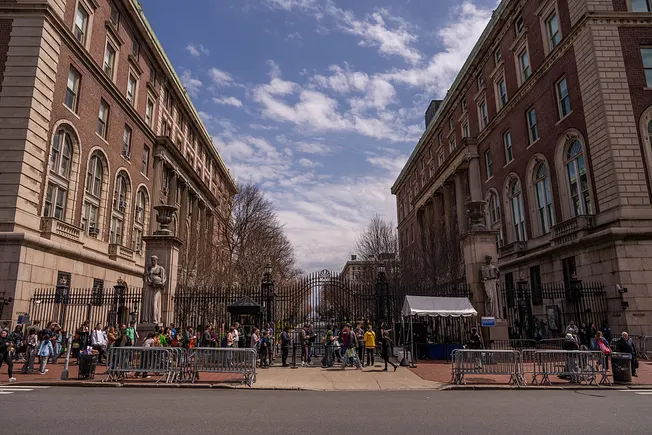
    • Faculty members of Columbia University and Columbia-affiliated Barnard College received text messages from the U.S. Equal Employment Opportunity Commission asking them to complete a survey inquiring about whether they are Jewish or Israeli, multiple news outlets reported April 23.
    • According to a screenshot of a message posted by CNN, EEOC said responses to the survey would be kept confidential “to the extent allowed by law.” The screenshot said EEOC was conducting an inquiry into Barnard College and that, should the agency find that the college violated laws enforced by EEOC, some of the information of respondents may be disclosed.
    • In an email to HR Dive, EEOC declined to confirm that it had sent the messages. Columbia, in a separate email, declined to confirm that employees had received messages from EEOC.

    Dive Insight:

    Federal officials have scrutinized Columbia following a series of on-campus protests in 2024. In August of that year, Rep. Virginia Foxx, R-N.C., and former chairwoman of the House Committee on Education and the Workforce, issued several subpoenas to Columbia leaders as part of an investigation into antisemitism at the university and whether the protests had created a hostile environment in violation of the 1964 Civil Rights Act.

    Last month, EEOC Acting Chair Andrea Lucas issued a statement in which she pledged to hold universities and colleges accountable for workplace antisemitism. Lucas’ statement did not name any specific institutions, but it did cite “disruptive and violent protests in violation of campus policies” as an example of severe or pervasive antisemitic conduct that could violate Title VII of the Civil Rights Act.

    “Under the guise of promoting free speech, many universities have actually become a haven for antisemitic conduct, often in violation of the universities’ own time, place, and manner policies, as well as civil rights law,” Lucas said in the March 5 statement.

    EEOC did not confirm whether messages sent to Columbia and Barnard faculty were part of an ongoing investigation into either institution. “Per federal law, we cannot comment on investigations, nor can we confirm or deny the existence of an investigation,” the agency said.

    Similarly, Columbia declined to comment on a pending investigation, but a university official said Columbia had told staff that it gave “affected employees notice that the University was required to provide certain information in compliance with a subpoena. The University did not provide the information voluntarily.”

    Columbia did not respond to a request for comment on whether it had advised staff not to respond to EEOC’s messages.

    News of the inquiry drew criticism from one of EEOC’s administrative judges, Karen Ortiz, who sent an all-staff email directed to EEOC Acting Chair Andrea Lucas.

    Ortiz wrote that Lucas should consider resigning; in an interview with HR Dive, she said the email was in response to news of the text messages and other recent agency actions, including its decision to abandon gender-identity discrimination litigation and halting some claims processing. She said the survey arguably was not within Lucas’ authority to send and could be understood as an attempt to intimidate Columbia and Barnard.

    “It’s a complete overreach,” Ortiz said of the survey.

    Source link

  • Apprenticeships are not an “alternative” to uni, they’re alt-uni

    Apprenticeships are not an “alternative” to uni, they’re alt-uni

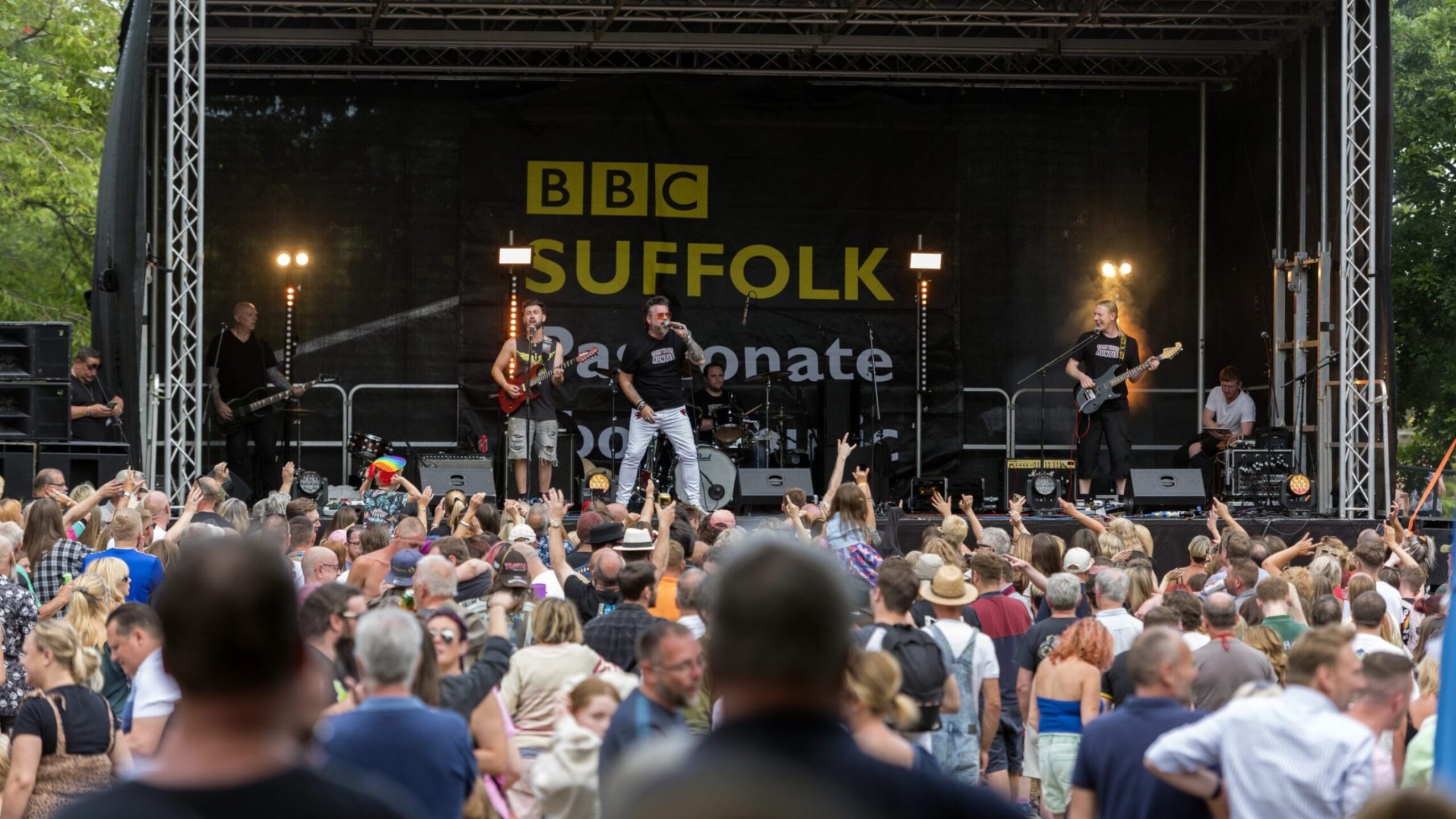
    On the first Sunday in July, Ipswich runs a free music festival at Christchurch Park.

    It’s a great experience for Ipswich – it’s one of few times in a year where the town is full and busy.

    Anyone from an Ipswich secondary school will likely have fond memories – meeting their friends on Hippie Hill – seeing multiple people you know all at once, getting into mosh pits, going on the Booster. The list goes on.

    But despite my advocacy for Ipswich, I once found myself anxious to attend. Earlier in my apprenticeship, I had difficult experiences at work with a frequent performer at this festival.

    This is something which, nearly six years after the ordeal ended, I am still coming to terms with.

    Something which has helped me a great deal is the idea of exposure therapy. This is the act of revisiting certain ideas and places from a new reference point.

    The intent is that it neutralises any bad associations with an idea or place by creating new associations. Over time, more neutral or even good experiences will outnumber the bad ones.

    It’s like treating grief as a ball in a jar, where the jar grows around the ball over time. The pain is still there when the ball hits the jar, though the ball is much less likely to hit the expanding insides of the jar.

    Along these lines, I approached the 2024 Ipswich Music Day with a fresh perspective. Seeing the band in the programme made me reflect on the rhetoric around being an apprentice and how it’s positioned alongside other options.

    No alternative

    I would argue that apprenticeships are not an alternative to university, at least not in all cases. Whilst it is a clear-cut alternative in some cases, such as advanced apprenticeships, it is more complex for Higher and Degree apprenticeships.

    In these cases, it is debatable – on the one hand, these apprentices can attain qualifications at the equivalent level of a degree without attending a university.

    In others, such as in my own personal experience, going to university was a core part of my experience – my qualification was a degree accredited by a university.

    Gaining an academic education is what drew me to my degree apprenticeship, along with the opportunity to meet other students and experience (and create) a stimulating academic environment with them.

    The difference in my case was that I wanted to apply what I had learned much more immediately and meaningfully – doing this would allow the knowledge to be retained more easily for me.

    Maybe my experience is not universal – I can’t claim to know what other students’ experience has been like.

    Nevertheless, I did my best to gain a fulfilling student experience, which was easier to achieve when I lived locally.

    Whilst I did attend the university Film Society and meet up with friends, I did not have the “full” experience – I wasn’t living away from home, and I didn’t have as much free time to study and discover my interests. This is because much of the free time was consumed by a full-time job.

    On paper, it does appear to be mostly work with some study release thrown in. This only accounts for the official contact hours, respectively from the employer and the university. To do well as a degree apprentice, you need to be willing to invest time in serious, self-paced academic study outside of the allotted contact hours. From my experience, this was as much as the time I spent at work.

    If people who have chosen these options with the express intention of not going to university realise that they have to go to one, then they’re going to dislike the experience or drop out altogether.

    Therefore, a contradiction presents itself:

    Why is an option promoted as an “alternative to university” when half of it involves going to university?

    The common resolution to this contradiction for policymakers and marketers is to just diminish or hide the role of the university as much as possible.

    Then, the purpose of the apprenticeship is perceived as solely a means of gaining employment, rather than for its educational merit – university, within this paradigm, is viewed as a distraction or an obstacle to be traversed in order to accomplish solely career-focussed success

    But the problem with the approach is disengagement, both socially and academically.

    Making the most of it

    For me, making the most of the educational aspects of the apprenticeship is as important as making the most of the position of employment.

    The goal of an apprenticeship is to start from nothing and to gain experience in a given domain – my own experience shows that the creation of a virtuous cycle of learning is essential in gaining this experience:

    The root of the contradiction is a separation between the experience of studying for a degree and the other aspects of university education. These other aspects are often overlooked, of which I have some first-hand experience.

    When I have made genuine efforts to engage with every aspect of the experience, I am told that I should have gone to university full-time or that I am spending too much time focussed on academics at the expense of my professional work.

    Seeing the band in the Ipswich Music Day programme made me reflect on an approach to resolve the contradiction of promoting degree apprenticeships to people who don’t want to go to university. This solution arguably comes from a change in definitions.

    The band defines itself on their website as being “alt-rock”. Alternative rock is a broad genre of rock defined by the fact it is influenced from a diversity of independent music genres.

    It is defined as an alternative to forms of rock that were becoming mainstream, such as arena rock – it is a different approach to the common genre of rock. Alt rock is not an alternative to rock as a whole – jazz and classical music are not considered “Alt Rock” for this reason.

    We can see that alt-rock doesn’t describe a genre separate from rock. Its approach is different, with alt-rock defining a range of heterophonic subgenres.

    Likewise, it can be argued that we should consider arguing for “alt-uni”. This terminology would reflect the fact that degree apprenticeships are alternative to the mainstream of full-time university education, but are not an alternative to university as a whole.

    It’s still uni

    Arguably, degree apprentices bring a range of learning approaches and knowledge to universities, such as through their professional training.

    When I have previously suggested this idea, some argued that “alt-degree” would be a better term, as it focuses on the approach to the degree rather than the university.

    But I believe the approach to a degree should be the same for all students, and this expectation contributes to the challenges of completing a degree apprenticeship.

    The definition of what this alternative approach would constitute may vary amongst apprentices. Some debate is definitely due, though I would say that the following are important to the definition of alt-uni:

    • Every second of university experience matters – an apprenticeship is finite, and we have less time than full-time students. This means careful evaluation of the experience to get the best outcome, academically and socially
    • We can immediately and meaningfully apply both academic and professional work to improve the world
    • There is the need to establish new precedents over accommodation, socialisation and engagement with university [youth] culture
    • We can provide positive role models for studentship unencumbered by student debt, as a means of encouraging the reduction of student debt to ensure that the best options are available for all types of student
    • We approach university similarly to students on scholarship. We have effectively been given a scholarship that covers our full loans. I would argue that apprenticeships should seek scholars across the university to inspire each other
    • We cannot socialise as much as other students, but socialisation with them is valuable. This is especially true for apprentices of school-leaver age

    Degree apprenticeships are not an alternative to university when a university education is involved.

    Instead, just as alt-rock is not an alternative to rock, they should be conceived as an alternative approach to university (“alt-uni”).

    This approach necessarily requires intentionality, balancing a university life with professional work. Done right, it will create a more inclusive, experience-rich education that values both theory and practice.

    Source link

  • ‘It’s different when they’re in their office’: the disconnect in student perceptions of academic meetings

    ‘It’s different when they’re in their office’: the disconnect in student perceptions of academic meetings

    by Stacey Mottershaw and Anna Viragos

    As we approach the five-year anniversary of the closure of UK university campuses for the Covid-19 pandemic, we thought it might be interesting and timely to reflect on the way that the sector adapted to educational delivery, and which innovations remain as part of our new normal.

    One key aspect of educational delivery which has remained to varying extents across the sector is the move to online student meetings. This includes meetings for academic personal tutorials, dissertation supervisions and other one-to-one meetings between students and staff. The Covid-19 lockdowns necessitated the use of online meetings as the only available option during this time. However, even post-lockdown, students and staff have continued to request online meetings, for reasons such as flexibility, privacy and sustainability.

    To explore this further, we conducted a small mixed-methods study with students from Leeds University Business School to consider their preferences for online or in-person meetings, utilising a faculty-wide survey for breadth and short semi-structured interviews for depth.

    We designed a questionnaire including questions on demographic (eg gender, home/international, whether they have caring responsibilities) and situational questions regarding their preference for face-to-face only, hybrid, or online meetings. We also included some questions around the ‘Big Five’ personality traits, to better understand factors that influence preferences.  We then distributed this online questionnaire, using the Qualtrics questionnaire software.

    Based on our findings, 15% of respondents preferred face-to-face only, 31% online only, with the remaining 54% preferring to have the option of either face-to-face or online.

    We also found that international students had a stronger preference for online meetings compared to non-international students. Whilst we had a relatively small sample of students on the Plus Programme (our institutional programme targeted to under-represented students); they had a stronger preference for in-person meetings. In terms of the Big Five traits, this student sample was highest on agreeableness and conscientiousness, and lowest on extroversion.

    In addition to the questionnaire, we ran seven one-to-one interviews with students from a mix of second year, the year in industry and final year, who had all experienced a mix of both online and face-to-face meetings throughout their studies.

    In reviewing the data, we identified five core themes of student preferences around meeting modes:

    • Connection and communication: Participants felt that the type of meeting affected connection and communication, with in-person meetings feeling more authentic.
    • Privacy/space: Participants felt that the type of meeting was influenced by factors including their access to private space, either at home or on campus.
    • Confidence: Some participants felt that the type of meeting could affect how confident they would feel in interactions with staff, with online meetings in their own environment feeling more comfortable than in spaces on campus.
    • Time: Participants discussed the amount of time that they had for each type of meeting, with online meetings deemed to be more efficient, due to the absence of travel time.
    • Flexibility: Participants demonstrated a strong preference for flexibility, in that they value having a choice over how to meet, rather than a meeting mode being imposed upon them.

    Through cross-examination of the core themes, we also identified something akin to a meta-theme, that is a ‘theme which acquire[s] meaning through the systematic co-occurrence of two or more other themes’ (Armborst, 2017 p1). We termed this meta-theme ‘The Disconnect’, as across each of the core themes there seemed to be a disconnect between student expectations of APT and what is typically provided, which ties in with existing literature (Calabrese et al, 2022).

    For example, one participant suggested that:

    It’s different when they’re in their office like popping there and asking a question for the lecture or even like the tutorials rather than having to e-mail or like go on a call [which] feels more formal.

    Whilst this comment seems to lean more towards other types of academic teaching (eg module leadership, lecture delivery or seminar facilitation), it can also translate to availability of staff more broadly. The comment suggests that students might expect staff to be available to them, on site, as and when they are needed. Yet in reality, it is unlikely that outside of set office hours academic staff will be available to answer ad hoc questions given their other commitments and particularly given the increased proportion of staff regularly working from home since the pandemic. This perspective also seems to contradict the perception that staff are much more available now than ever before, due to the prevalence of communications administered via email and online chat and meeting tools such as MS Teams. Staff may feel that they are more available as online communication methods increase in availability and use, but if students do not want ‘formal’ online options or prefer ad hoc on-site provision, then there may be a disconnect between student expectations and delivery, with all stakeholders feeling short-changed by the reality.

    Another disconnect between expectations and reality became apparent when another participant commented:

    […] online it was more rushed because you have the 30 minutes and you see the time going down and in the Zoom you will see like you have 4 minutes left to talk and then you’re rushing it over to finish it.

    Whilst this clearly relates to the core theme of time, it also seemed to be correlated with participant understanding of staff roles. It is difficult to understand how the time limitation for online and in-person meetings is different when the meetings are of the same duration, except that in the case of in-person meetings the student may be less aware of timings, due to not having the time physically visible on the screen in front of them. This might be reflected in the student-staff dynamic, where managing online meetings might be seen to be a joint and equal endeavour, with the responsibility for managing in-person meetings being skewed towards the staff member. Whilst it can be argued that staff should take responsibility for managing the meeting, in a time of increased narratives around student-led tutoring, it may be worth exploring the possible knock-on effects of students passively allowing the meeting to happen, rather than actively owning the meeting.

    Final thoughts

    A limitation of this study was the low response rate. At the point of dissemination, there were approximately 2,000 students in our faculty. However, we received just 198 survey responses (9.9%), and only seven people took part in the interviews, despite repeated calls for participants and generous incentives. Although this was a smaller sample than we had hoped for, we are confident that our study makes a timely and relevant contribution to discussions around delivery of APT, both within our faculty and beyond.

    As a starting point, future research could seek to generate responses from a broader pool of participants, through both a quantitative survey and qualitative methods. Based on our findings, there may also be scope for further research exploring student expectations of staff roles, and how these match to institutional offerings across the sector. Ultimately, universities need to do more to investigate and understand student preferences for educational delivery, balancing this alongside pedagogical justifications and staff circumstances.

    Stacey Mottershaw is an Associate Professor (Teaching and Scholarship) at Leeds University Business School and an EdD candidate at the University of Sheffield. Her research predominantly seeks to understand the needs of marginalised groups in higher education, with a particular focus on equitable and socially just career development. 

    Dr Anna Viragos is an Associate Professor in Organizational Psychology at Leeds University Business School, and a Chartered Psychologist of the BPS. Her research focuses on a variety of topics such as stress and wellbeing, creativity, and job design.

    Author: SRHE News Blog

    An international learned society, concerned with supporting research and researchers into Higher Education

    Source link

  • Snitch hotlines for ‘offensive’ speech were a nightmare on campus — and now they’re coming to a neighborhood near you

    Snitch hotlines for ‘offensive’ speech were a nightmare on campus — and now they’re coming to a neighborhood near you

    We know the term “Orwellian” gets thrown around a lot these days. But if a government entity dedicated to investigating and even reeducating Americans for protected speech doesn’t deserve the label, nothing does.

    This step towards the Stasi isn’t hypothetical, either. It’s real. The governing bodies in question are called bias reporting systems, and the odds are they’re already chilling free expression on a campus near you. What’s worse, they aren’t staying there — now municipalities and states are using them, too.

    In this explainer, we’ll break down what bias reporting systems are, how they’ve spread beyond campus, and why they’re a threat to free speech.

    What are bias reporting systems?

    If you’ve been on campus in the last decade, you’ve likely heard of bias reporting systems — or, as they’re sometimes called, bias response teams. Their structure and terminology vary, but FIRE defines a campus bias reporting system as any system that provides:

    1. a formal or explicit process for or solicitation of
    2. reports from students, faculty, staff, or the community
    3. concerning offensive conduct or speech that is protected by the First Amendment or principles of expressive or academic freedom.

    Bias reporting systems generally solicit reports of bias against identity characteristics widely found in anti-discrimination laws. Western Washington University, for example, defines a “bias incident” as “language or an action that demonstrates bias against an individual or group of people based on actual or perceived race, color, creed, religion, national origin, sex, gender identity or expression, disability, sexual orientation, age, or veteran status.” Some systems also invite reports of bias against traits like “intellectual perspective,” “political expression,” and “political belief,” or have a catch-all provision for any other allegedly biased speech.

    Many colleges have bias response teams that consist not only of administrators but law enforcement. They often investigate complaints and summon accused students and faculty to meetings.

    The ability to speak freely is core to our democracy. Any system or protocol that stifles or inhibits free expression is antithetical to the principles and ideals of our institutions of higher education and our republic. 

    You might be wondering, “Don’t civil rights laws already cover this sort of thing?” Well, not quite. Bias reporting systems cover way more expressive ground than civil rights laws do, which puts these systems at odds with First Amendment protections. They generally define “bias” in such broad or vague terms that it could be applied to basically anything the complainant doesn’t like, including protected speech. This is doubly so when a school includes that vague and subjective word “hate” as another form of language or behavior worth reporting.

    That’s a problem at public colleges, which are bound by the First Amendment, and also at private colleges that voluntarily adopt First Amendment-like standards. Bias reporting systems completely ignore the fact that “hate speech” has no legal definition, and that unless a given expression clearly falls into one of the clearly-defined categories of unprotected speech, like true threats or incitement to immediate violence, it is almost certainly protected by the First Amendment. This remains so regardless of how anyone might feel about the speech itself.

    Bias Response Team Report 2017

    Reports

    The posture taken by many Bias Response Teams is likely to create profound risks to freedom of expression and academic freedom on campus.


    Read More

    These initiatives incentivize and in many cases encourage people to report each other for disfavored expression. As you can imagine, these systems often lead to unconstitutional infringements on protected student and faculty speech and chill expression on campus.

    For example, after the University of California, San Diego received bias incident reports about a student humor publication that satirized “safe spaces,” administrators asked the university’s lawyer to “think creatively” about how to address the newspaper, which they felt “crosse[d] the ‘free speech’ line.” And at Connecticut College, pro-Palestinian students were reported for flyers mimicking Israeli eviction notices to Palestinians, prompting an investigation by a dean.

    These are just a couple of instances where bias reporting systems have crossed the line. Sadly, there are plenty more, spanning FIRE’s research and commentary going back as far as 2016 — and none of them are good news.

    Sound Orwellian enough for you yet? Wait until you hear how bias reporting systems work off campus.

    Bias reporting systems have graduated from campus into everyday life

    Exporting campus bias reporting systems to wider society is a disastrous idea. No state should be employing de facto speech police. But of course, that hasn’t stopped state and city governments from trying.

    Bias reporting systems have been popping up in one form or another across more than a dozen state and city municipalities in the last four years, usually consisting of an online portal or telephone number where citizens are encouraged to submit reports.

    If you’re thinking this is just like the hate crime hotlines that many states have had for years, there is one important difference: namely, the word “crime.” While the new bias reporting systems will similarly accept reports of criminal acts, they also actively solicit reports of speech and behavior that are not only not crimes, but also First Amendment-protected expression.

    They know this, too.

    Vermont state police protocol, for instance, describes the information it compiles as being on “biased but protected speech.” This raises the obvious question of why the police are concerning themselves with Americans lawfully exercising their fundamental rights, and opens the door to police responses that violate those rights.

    Wherever they’ve popped up, these bias reporting systems have been bad news. Washington Free Beacon journalist Aaron Sibarium’s research has turned up a number of alarming examples. In Oregon, citizens can report “offensive ‘jokes’” and “imitating someone’s cultural norm or practice.”

    Meanwhile, in Maryland, the attorney general’s office states on its website that “people who engage in bias incidents may eventually escalate into criminal behavior,” which is why “Maryland law enforcement agencies are required by law to record and report data on both hate crimes and bias incidents.” But these speculative concerns do not justify the chilling effect bias reporting systems create. Not only do these systems solicit complaints about protected speech, they also cast an alarmingly wide net. It’s hard to believe, for instance, that many “offensive jokes” are reliable signs of future criminal activity.

    At this point you’d be forgiven for thinking that “Orwellian” is an understatement.

    But that’s not the worst of it. In Philadelphia — home of FIRE, the Liberty Bell, and the Constitution — authorities fielding “hate incidents” can now ask for exact addresses and various identifying details about the alleged offending party, including their names. According to Sibarium, city officials will in some cases “contact those accused of bias and request that they attend sensitivity training.”

    You heard that right. If you’re reported for a “non-criminal bias incident” in the city of Philadelphia, the city may request that you take a course meant to teach you the error of your ways. “If it is not a crime, we sometimes contact the offending party and try to do training so that it doesn’t happen again,” Saterria Kersey, a spokeswoman for the Philadelphia Commission on Human Relations, told Sibarium.

    The training is voluntary, but it reflects an unsettling level of government interference in the thoughts and opinions of the public.

    At this point you’d be forgiven for thinking that “Orwellian” is an understatement.

    Bias reporting systems are a threat to free speech on and off campus

    Thankfully, there has been some considerable pushback on bias reporting systems — though not entirely successful. Washington, for example, introduced a bill to create a statewide bias reporting system, but it failed to advance out of the Senate Ways and Means committee. However, a new version of the bill passed in March of 2024, and Washington is now set to establish a bias reporting system this year.

    The threat remains real, and the consequences of these speech-chilling initiatives are further-reaching than it might seem at first glance.

    On campus, the mere existence of bias reporting systems threatens one of the purposes of higher education, if not the purpose: the free exchange of ideas. Some courts have recognized that bias reporting systems may chill protected speech to such a degree that they violate the First Amendment.

    Bias reporting systems fundamentally undermine the First Amendment rights of not just students and faculty, but also ordinary citizens.

    The state-level reporting systems raise similar First Amendment issues — especially when law enforcement is involved. Like their campus counterparts, the state systems use expansive definitions of “bias” and “hate” that could encompass a vast range of protected expression, including speech on social or political issues.

    However, unconstitutionality isn’t the only concern. Even a bias reporting system that stays within constitutional bounds can deter people from freely expressing their thoughts and opinions. If they are afraid that the state will investigate them or place them in a government database just for saying something that offended another person, people will understandably hold their tongues and suppress their own voices. Moreover, the lack of clarity around what some states actually do with the reports they collect is itself chilling.

    The ability to speak freely is core to our democracy. Any system or protocol that stifles or inhibits free expression is antithetical to the principles and ideals of our institutions of higher education and our republic. In both word and deed, bias reporting systems fundamentally undermine these principles — and now seriously threaten the First Amendment rights of not just students and faculty, but also ordinary citizens.

    Source link

  • California and other states are rushing to regulate AI. This is what they’re missing

    California and other states are rushing to regulate AI. This is what they’re missing

    This article was originally published in December 2024 in the opinion page of The Los Angeles Times and is republished here with permission.


    The Constitution shouldn’t be rewritten for every new communications technology. The Supreme Court reaffirmed this long-standing principle during its most recent term in applying the 1st Amendment to social media. The late Justice Antonin Scalia articulated it persuasively in 2011, noting that “whatever the challenges of applying the Constitution to ever-advancing technology, the basic principles of freedom of speech and the press … do not vary.”

    These principles should be front of mind for congressional Republicans and David Sacks, Trump’s recently chosen artificial intelligence czar, as they make policy on that emerging technology. The 1st Amendment standards that apply to older communications technologies must also apply to artificial intelligence, particularly as it stands to play an increasingly significant role in human expression and learning.

    But revolutionary technological change breeds uncertainty and fear. And where there is uncertainty and fear, unconstitutional regulation inevitably follows. According to the National Conference of State Legislatures, lawmakers in at least 45 states have introduced bills to regulate AI this year, and 31 states adopted laws or resolutions on the technology. Congress is also considering AI legislation.

    Many of these proposals respond to concerns that AI will supercharge the spread of misinformation. While the worry is understandable, misinformation is not subject to any categorical exemption from 1st Amendment protections. And with good reason: As Supreme Court Justice Robert Jackson observed in 1945, the Constitution’s framers “did not trust any government to separate the true from the false for us,” and therefore “every person must be his own watchman for truth.”

    California nevertheless enacted a law in September targeting “deceptive,” digitally modified content about political candidates. The law was motivated partly by an AI-altered video parodying Vice President Kamala Harris’ candidacy that went viral earlier in the summer.

    Two weeks after the law went into effect, a judge blocked it, writing that the “principles safeguarding the people’s right to criticize government … apply even in the new technological age” and that penalties for such criticism “have no place in our system of governance.”

    Ultimately, we don’t need new laws regulating most uses of AI; existing laws will do just fine. Defamation, fraud, false light and forgery laws already address the potential of deceptive expression to cause real harm. And they apply regardless of whether the deception is enabled by a radio broadcast or artificial intelligence technology. The Constitution should protect novel communications technology not just so we can share AI-enhanced political memes. We should also be able to freely harness AI in pursuit of another core 1st Amendment concern: knowledge production.

    When we think of free expression guarantees, we often think of the right to speak. But the 1st Amendment goes beyond that. As the Supreme Court held in 1969, “The Constitution protects the right to receive information and ideas.”

    Information is the foundation of progress. The more we have, the more we can propose and test hypotheses and produce knowledge.

    The internet, like the printing press, was a knowledge-accelerating innovation. But Congress almost hobbled development of the internet in the 1990s because of concerns that it would enable minors to access “indecent” content. Fortunately, the Supreme Court stood in its way by striking down much of the Communications Decency Act.

    Indeed, the Supreme Court’s application of the 1st Amendment to that new technology was so complete that it left Electronic Frontier Foundation attorney Mike Godwin wondering “whether I ought to retire from civil liberties work, my job being mostly done.” Godwin would go on to serve as general counsel for the Wikimedia Foundation, the nonprofit behind Wikipedia — which, he wrote, “couldn’t exist without the work that cyberlibertarians had done in the 1990s to guarantee freedom of expression and broader access to the internet.”

    Today humanity is developing a technology with even more knowledge-generating potential than the internet. No longer is knowledge production limited by the number of humans available to propose and test hypotheses. We can now enlist machines to augment our efforts.

    We are already starting to see the results: A researcher at the Massachusetts Institute of Technology recently reported that AI enabled a lab studying new materials to discover 44% more compounds. Dario Amodei, the chief executive of the AI company Anthropic, predicts that “AI-enabled biology and medicine will allow us to compress the progress that human biologists would have achieved over the next 50-100 years into 5-10 years.”

    This promise can be realized only if America continues to view the tools of knowledge production as legally inseparable from the knowledge itself. Yes, the printing press led to a surge of “misinformation.” But it also enabled the Enlightenment.

    The 1st Amendment is America’s great facilitator: Because of it, the government can no more regulate the printing press than it can the words printed on a page. We must extend that standard to artificial intelligence, the arena where the next great fight for free speech will be fought.

    Source link