Tag: Thinking

  • Preserving critical thinking amid AI adoption

    Preserving critical thinking amid AI adoption

    Key points:

    AI is now at the center of almost every conversation in education technology. It is reshaping how we create content, build assessments, and support learners. The opportunities are enormous. But one quiet risk keeps growing in the background: losing our habit of critical thinking.

    I see this risk not as a theory but as something I have felt myself.

    The moment I almost outsourced my judgment

    A few months ago, I was working on a complex proposal for a client. Pressed for time, I asked an AI tool to draft an analysis of their competitive landscape. The output looked polished and convincing. It was tempting to accept it and move on.

    Then I forced myself to pause. I began questioning the sources behind the statements and found a key market shift the model had missed entirely. If I had skipped that short pause, the proposal would have gone out with a blind spot that mattered to the client.

    That moment reminded me that AI is fast and useful, but the responsibility for real thinking is still mine. It also showed me how easily convenience can chip away at judgment.

    AI as a thinking partner

    The most powerful way to use AI is to treat it as a partner that widens the field of ideas while leaving the final call to us. AI can collect data in seconds, sketch multiple paths forward, and expose us to perspectives we might never consider on our own.

    In my own work at Magic EdTech, for example, our teams have used AI to quickly analyze thousands of pages of curriculum to flag accessibility issues. The model surfaces patterns and anomalies that would take a human team weeks to find. Yet the real insight comes when we bring educators and designers together to ask why those patterns matter and how they affect real classrooms. AI sets the table, but we still cook the meal.

    There is a subtle but critical difference between using AI to replace thinking and using it to stretch thinking. Replacement narrows our skills over time. Stretching builds new mental flexibility. The partner model forces us to ask better questions, weigh trade-offs, and make calls that only human judgment can resolve.

    Habits to keep your edge

    Protecting critical thinking is not about avoiding AI. It is about building habits that keep our minds active when AI is everywhere.

    Here are three I find valuable:

    1. Name the fragile assumption
    Each time you receive AI output, ask: What is one assumption here that could be wrong? Spend a few minutes digging into that. It forces you to reenter the problem space instead of just editing machine text.

    2. Run the reverse test
    Before you adopt an AI-generated idea, imagine the opposite. If the model suggests that adaptive learning is the key to engagement, ask: What if it is not? Exploring the counter-argument often reveals gaps and deeper insights.

    3. Slow the first draft
    It is tempting to let AI draft emails, reports, or code and just sign off. Instead, start with a rough human outline first. Even if it is just bullet points, you anchor the work in your own reasoning and use the model to enrich–not originate–your thinking.

    These small practices keep the human at the center of the process and turn AI into a gym for the mind rather than a crutch.

    Why this matters for education

    For those of us in education technology, the stakes are unusually high. The tools we build help shape how students learn and how teachers teach. If we let critical thinking atrophy inside our companies, we risk passing that weakness to the very people we serve.

    Students will increasingly use AI for research, writing, and even tutoring. If the adults designing their digital classrooms accept machine answers without question, we send the message that surface-level synthesis is enough. We would be teaching efficiency at the cost of depth.

    By contrast, if we model careful reasoning and thoughtful use of AI, we can help the next generation see these tools for what they are: accelerators of understanding, not replacements for it. AI can help us scale accessibility, personalize instruction, and analyze learning data in ways that were impossible before. But its highest value appears only when it meets human curiosity and judgment.

    Building a culture of shared judgment

    This is not just an individual challenge. Teams need to build rituals that honor slow thinking in a fast AI environment. Another practice is rotating the role of “critical friend” in meetings. One person’s task is to challenge the group’s AI-assisted conclusions and ask what could go wrong. This simple habit trains everyone to keep their reasoning sharp.

    Next time you lean on AI for a key piece of work, pause before you accept the answer. Write down two decisions in that task that only a human can make. It might be about context, ethics, or simple gut judgment. Then share those reflections with your team. Over time this will create a culture where AI supports wisdom rather than diluting it.

    The real promise of AI is not that it will think for us, but that it will free us to think at a higher level.

    The danger is that we may forget to climb.

    The future of education and the integrity of our own work depend on remaining climbers. Let the machines speed the climb, but never let them choose the summit.


    Laura Ascione
    Latest posts by Laura Ascione (see all)

    Source link

  • How tutors can support student thinking

    How tutors can support student thinking

    Key points:

    Consider the work of a personal trainer. They can explain and model a workout perfectly, but if the athlete isn’t the one doing the lifting, their muscles won’t grow. The same is true for student learning. If students only copy notes or nod along, their cognitive muscles won’t develop. Cognitive lift is the mental work students do to understand, apply, and explain academic content. It’s not about giving students harder problems or letting them struggle alone. It’s about creating space for them to reason and stretch their thinking.

    Research consistently shows that students learn more when they are actively engaged with the material, rather than passively observe. Learners often forget what they’ve “learned” if they only hear an explanation. That’s why great tutors don’t just explain material clearly–they get students to explain it clearly. 

    Tutoring, with its small group format, is the ideal space to encourage students’ cognitive lift. While direct instruction and clear explanations are essential at the right times in the learning process, tutorials offer a powerful opportunity for students to engage deeply and productively practice with support.

    The unique power of tutorials

    Small-group tutorials create conditions that are harder to foster in a full classroom. Having just a few students, tutors can track individual student thinking and adjust support quickly. Students gain more chances to voice reasoning, test ideas, and build confidence. Tutorials rely on strong relationships, and when students trust their tutor, they’re more willing to take risks, share half-formed thoughts, and learn from mistakes. 

    It’s easier to build space for every student to participate and shine in a tutorial than in a full class. Tutors can pivot when they notice students aren’t actively thinking. They may notice they’re overexplaining and can step back, shifting the cognitive responsibility back to the students. This environment gives each learner the opportunity to thrive through cognitive lift.

    What does cognitive lift look like?

    What does cognitive lift look like in practice? Picture two tutorials where students solve equations like they did in class. In the first, the tutor explains every step, pausing only to ask quick calculations like, “What’s 5 + 3?” The student might answer correctly, but solving isolated computations doesn’t mean they’re engaged with solving the equation.

    Now imagine a second tutorial. The tutor begins with, “Based on what you saw in class, where could we start?” The student tries a strategy, gets stuck, and the tutor follows up: “Why didn’t that work? What else could you try?” The student explains their reasoning, reflects on mistakes, and revises. Here, they do the mental heavy lifting–reaching a solution and building confidence in their ability to reason through challenges.

    The difference is the heart of cognitive lift. When tutors focus on students applying knowledge and explaining thinking, they foster longer-term learning. 

    Small shifts, big impact

    Building cognitive lift doesn’t require a complete overhaul. It comes from small shifts tutors can make in every session. The most powerful is moving from explaining to asking. Instead of “Let me show you,” tutors can try “How might we approach this?” or “What do you notice?” Tutoring using questions over explanations causes students to do more work and learn more.

    Scaffolds–temporary supports that help students access new learning–can support student thinking without taking over. Sentence stems and visuals guide thinking while keeping responsibility with the student. Simple moves like pausing for several seconds after questions (which tutors can count in their heads) and letting students discuss with a partner also create space for reasoning. 

    This can feel uncomfortable for tutors–resisting the urge to “rescue ” students too quickly can be emotionally challenging. But allowing students to wrestle with ideas while still feeling supported is where great learning happens and is the essence of cognitive lift.

    The goal of tutoring

    Tutors aren’t there to make learning easy–they’re there to create opportunities for students to think and build confidence in facing new challenges. Just like a personal trainer doesn’t lift the weights, tutors shouldn’t do the mental work for students. As athletes progress, they add weight and complete harder workouts. Their muscles strengthen as their trainer encourages them to persist through the effort. In the same way, as the academic work becomes more complex, students strengthen their abilities by wrestling with the challenge while tutors coach, encourage, and cheer.

    Success in a tutorial isn’t measured by quick answers, but by the thinking students practice. Cognitive lift builds independence, deepens understanding, and boosts persistence. It’s also a skill tutors develop, and with the right structures, even novices can foster it. Imagine tutorials where every learner has space to reason, take risks, and grow. When we let students do the thinking, we not only strengthen their skills, we show them we believe in their potential.

    Latest posts by eSchool Media Contributors (see all)

    Source link

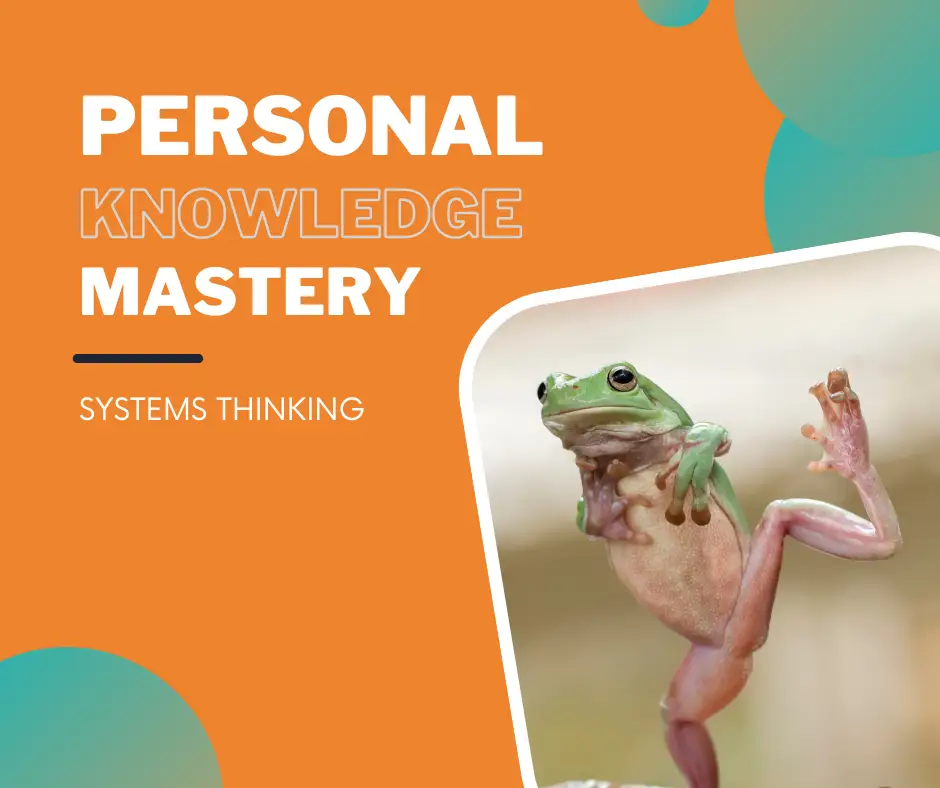
  • No Frogs Were Actually Harmed in Describing Systems Thinking – Teaching in Higher Ed

    No Frogs Were Actually Harmed in Describing Systems Thinking – Teaching in Higher Ed

    This post is one of many, related to my participation in  Harold Jarche’s Personal Knowledge Mastery workshop.

    As we round down our time in the PKMastery workshop, I’m now presented with a topic that is both familiar, yet still incredibly challenging for me: systems thinking. One of the best books I read in my MA was The Fifth Discipline: The Art & Practice of the Learning Organization. I discovered that I didn’t have a digital copy (where I like to keep highlights) and was fortunate to find it on sale for $1.99, plus a digital credit that made it “free”.

    The key dimensions of the disciplines of the learning organization are listed by Senge in the introduction:

    • Systems thinking: He describes here how rain happens, with a bunch of different events that happen across distance, time, and space, yet: “… they are all connected within the same pattern. Each has an influence on the rest, an influence that is usually hidden from view. You can only understand the system of a rainstorm by contemplating the whole, not any individual part of the pattern.” We use systems thinking to be more effective at seeing the full picture and associated patterns, as well as to find ways to facilitate change.
    • Personal mastery: Senge distinguishes the multiple meanings of the word mastery. Yes, it can mean dominance over another, yet can also have to do with proficiency. He defines personal mastery as, “…the discipline of continually clarifying and deepening our personal vision, of focusing our energies, of developing patience, and of seeing reality objectively.”
    • Mental models: These baked in assumptions, over-generalized beliefs impact how we understand and explain what happens and the actions we take as a result of those paradigms.
    • Building shared vision: Organizations that achieve great things do so through leadership capacity at developing a shared perspective on where the organization is headed. Senge describes: “When there is a genuine vision (as opposed to the all-too-familiar “vision statement”), people excel and learn, not because they are told to, but because they want to.”
    • Team learning: Senge encourages us to look to the Greeks’ practice of dialog vs discussion. When we are in dialog, our ideas are free-flowing and we can build a capacity to suspend our assumptions and actually think together. In contrast, the word discussion has ties with word like “percussion” and “concussion” and the idea of competitive ideation can take place.

    Senge describes how the fifth discipline is systems thinking, because it weaves together the other disciplines toward intentional transformation. When we can visualize something better, we can understand it more effectively, as Jarche illustrates in a story about when NASA first released a picture of the earth, taken from space. He writes how:

    There are many ways to use visualization to understand data better. The real value of big data is using it to ask better questions. Visualization can be a conversation accelerator.

    Taking existing systems and using visualization to surface the ways the various parts of the system shape the other parts is vital in increasing our individual and collective abilities to learn.

    What Holds Us Back From Being a Learning Organization

    In chapter two, Senge writes about what he calls organizational learning disabilities. I’m not sure he communicates in such a way to support more of an asset-based framework for disability that many of us have become familiar with today. But I still want to list and describe them here, as this was my biggest takeaway from the book, reading it more than twenty years ago.

    1. “I am my position”

    “When asked what they do for a living, most people describe the tasks they perform every day, not the purpose of the greater enterprise in which they take part. Most see themselves within a system over which they have little or no influence. They do their job, put in their time, and try to cope with the forces outside of their control. Consequently, they tend to see their responsibilities as limited to the boundaries of their position.”

    1. “The enemy is out there”

    “When we focus only on our position, we do not see how our own actions extend beyond the boundary of that position. When those actions have consequences that come back to hurt us, we misperceive these new problems as externally caused. Like the person being chased by his own shadow, we cannot seem to shake them.”

    1. The illusion of taking charge

    “All too often, proactiveness is reactiveness in disguise… True proactiveness comes from seeing how we contribute to our own problems. It is a. product of our way of thinking, not our emotional state.”

    1. The fixation on events

    Senge describes how we evolved out of societies where people had to be focused on events to survive, like watching for the saber-toothed tiger to show up and be able to respond immediately.

    “Generative learning cannot be sustained in an organization if people’s thinking is dominated by short-term events. If we focus on events, the best we can ever do is predict an event before it happens so that we can react optimally. But we cannot learn to create.”

    1. The parable of the boiled frog

    “Learning to see slow, gradual processes requires slowing down our frenetic pace and paying attention to the subtle as well as the dramatic… The problem is our minds are so locked in one frequency, it’s as if we can only see at 78 rpm; we can’t see anything at 33-1/3. We will not avoid the fate of the frog until we learn to slow down and see the gradual processes that often pose the greatest threats.”

    Remember that this is meant to be a metaphor to help us explain this phenomenon. No frogs were harmed in sharing this boiling frog apologue.

    1. The delusion of learning from experience

    “Herein lies the core learning dilemma that confronts organizations: we learn best from experience but we never directly experience the consequences of many of our most important decisions. The most critical decisions made in organizations have systemwide consequences that stretch over years or decades.”

    1. The myth of the management team

    “All too often, teams in business tend to spend their time fighting for turf, avoiding anything that will make them look bad personally, and pretending that everyone is behind the team’s collective strategy—maintaining the appearance of a cohesive team. To keep up the image, they seek to squelch disagreement; people with serious reservations avoid stating them publicly, and joint decisions are watered-down compromises reflecting what everyone can live with, or else reflecting one person’s view foisted on the group. If there is disagreement, it’s usually expressed in a manner that lays blame, polarizes opinion, and fails to reveal the underlying differences in assumptions and experience in a way that the team as a whole could learn from.”

    Senge goes on to describe what Chris Argyris from Harvard calls “skilled incompetence” (gift, non-paywalled article from HBR)- groups of individuals who get super good at making sure to prevent themselves from actually learning. Since we’re talking frogs a lot in this series of PKM posts, I can’t help but bring up another illustrative story having to do with skilled incompetence.

    The cartoon character Michigan J Frog would only dance and sing when the man who found him was alone. Any time that someone else entered the picture, the frog just sat there, making normal frog noises. Here’s a look at his antics:

    Looks to me like skilled incompetence and also some seriously skilled frog theatrics (but only when no one is looking).

    What Comes Next

    The next part of The Fifth Discipline is something Senge calls “the beer game.” It is a memorable look at what happens when we are unable to see the entire system, but only one part of it. Let’s just say there’s a supposed shortage of beer, and then lots and lots of beer. But you should read it, as I’m nowhere capturing the marvelous metaphor that is the beer game.

    Readers are also instructed how to map systems in this book, though it is a practice that I never mastered. Jarche links to Tools for Systems Thinkers: Systems Mapping, by Leyia Acaroglu. which gives a great introduction and series of maps to use to explore complex ideas. Acaroglu illustrates their value by describing:

    As a practicing creative change-maker, I use systems mapping tools like this all the time when I want to identify the divergent parts of the problem set and find unique areas in which to develop interventions. I also use them to gain clarity in complexity, and find it especially useful when working in teams or collaborating because it puts everyone on the same page.

    I pretty much want to take every class that Levia and her team have available on the Unschool of Disruptive Design site. I’m also thinking I had better settle myself down a bit and wrap up this PKMastery course before biting off anything more. That, plus a couple of big conferences coming up I still need to prepare for…

    Source link

  • Teaching with AI: From Prohibition to Partnership for Critical Thinking – Faculty Focus

    Teaching with AI: From Prohibition to Partnership for Critical Thinking – Faculty Focus

    Source link

  • UOW offers new ‘critical thinking’ major – Campus Review

    UOW offers new ‘critical thinking’ major – Campus Review

    The University of Wollongong will offer a new Liberal Arts Major to all students from 2026 to foster critical thinking in an age of Humanities course cuts and evolving AI.

    Please login below to view content or subscribe now.

    Membership Login

    Source link

  • Only radical thinking will deliver the integrated tertiary system the country needs

    Only radical thinking will deliver the integrated tertiary system the country needs

    The post-16 white paper was an opportunity to radically enable an education and skills ecosystem that is built around the industrial strategy, and that has real resonance with place.

    The idea that skills exist in an entirely different space to education is just wrongheaded. The opportunity comes, however, when we can see a real connection, both in principle and in practice, between further and higher education: a tertiary system that can serve students, employers and society.

    Significant foundations are already in place with the Lifelong Learning Entitlement providing sharp focus within the higher education sector and apprenticeships, now well established, and well regarded across both HE and FE. Yet we still have the clear problem that schools, FE, teaching in HE, research and knowledge transfer are fragmented across the DfE and other associated sector bodies.

    Sum of the parts

    The policy framework needs to be supported by a major and radical rethink of how the parts fit together so we can truly unlock the combined transformational power of education and innovation to raise aspirations, opportunity, attainment, and ultimately, living standards. This could require a tertiary commission of the likes of Diamond and Hazelkorn in the Welsh system in the mid-2010’s.

    Such a commission could produce bold thinking on the scale of the academies movement in schools over the last 25 years. The encouragement to bring groups of schools together has resulted in challenge, but also significant opportunity. We have seen the creation of some excellent FE college groups following an area-based review around a decade ago. The first major coming together of HE institutions is in train with Greenwich and Kent. We have seen limited pilot FE/HE mergers. Now feels like the right time for blue sky thinking that enables the best of all of those activities in a structured and purposeful way that is primarily focused on the benefits to learning and national productivity rather than simply financial necessity.

    Creating opportunities for HE, FE and schools to come together not only in partnerships, but in structural ways will enable the innovation that will create tangible change in local and regional communities. All parts of the education ecosystem face ever-increasing financial challenge. If an FE college and a university wished to offer shared services, then there would need to be competitive tender for the purposes of best value. This sounds sensible except the cost of running such a process is high. If those institutions are part of the same group, then it can be done so much more efficiently.

    FE colleges are embedded in their place and even more connected to local communities. The ability to reach into more disadvantaged communities and to take the HE classroom from the traditional university setting, is a distinct benefit. The growth in private, for-profit HE provision is often because it has a great ability to reach into specific communities. The power of FE/HE collaboration into those same communities would bring both choice and exciting possibility.

    While in theory FE and HE can merge through a section 28 application to the Secretary of State, the reality is that any activity to this point has been marginal and driven by motivation other than enhanced skills provision. If the DfE were to enable, and indeed drive, such collaboration they could create both financial efficiencies and a much greater and more coordinated offer to employers and learners.

    The industrial strategy and the growth in devolved responsibility for skills create interesting new opportunities but we must find ways that avoid a new decade of confusion for employers and learners. The announcement of new vocational qualifications, Technical Excellence Colleges and the like are to be welcomed but must be more than headlines. Learners and employers alike need to be able to see pathways and support for their lifelong skills and learning needs.

    Path to integration

    The full integration of FE and HE could create powerful regional and place-based education and skills offers. Adding in schools and creating education trusts that straddle all levels means that employers could benefit from integrated offers, less bureaucracy and clear, accelerated pathways.

    So now is the moment to develop Integrated Skills and Education Trusts (ISET): entities that sit within broad groups and benefit from the efficiencies of scale but maintaining local provision. Taking the best of FE, understanding skills and local needs and the best of HE and actively enabling them to come together.

    Our experience at Coventry, working closely and collaboratively with several FE partners, is that the barriers thrown up within the DfE are in stark and clear contrast to the policy statements of ministers and, indeed, of the Prime Minister. The post-16 white paper will only lead to real change if the policy and the “plumbing” align. The call has to be to think with ambition and to encourage and enable action that serves learners, employers and communities with an education and skills offer that is fit for the next generation.

    Source link

  • A joined up post-16 system requires system-level thinking combined with local action

    A joined up post-16 system requires system-level thinking combined with local action

    There have been so many conversations and speculations and recommendations aired about the forthcoming post-16 skills and education white paper that you’d be forgiven for thinking it already had been published months ago.

    But no, it’s expected this week some time – possibly as early as Monday – and so for everyone’s sanity it’s worth rehearsing some of the framing drivers and intentions behind it, clearing the deck before the thing finally arrives and we start digesting the policy detail.

    The policy ambition is clear: a coherent and coordinated post-16 “tertiary” sector in England, that offers viable pathways to young people and adult learners through the various levels of education and into employment, contributing to economic growth through providing the skilled individuals the country needs.

    The political challenge is also real: with Reform snapping at Labour’s heels, the belief that the UK can “grow its own” skills, and offer opportunity and the prospect of economic security to its young people across the country must become embedded in the national psyche if the government is to see off the threat.

    The politics and policy combine in the Prime Minister’s announcement at Labour Party Conference of an eye-catching new target for two thirds of young people to participate in some form of higher-level learning. That positions next week’s white paper as a longer term systemic shift rather than, say, a strategy for tackling youth unemployment in this parliament – though it’s clear there is also an ambition for the two to go hand in hand, with skills policy now sitting across both DfE and DWP.

    Insert tab a into slot b

    The aspiration to achieve a more joined up and functioning system is laudable – in the best of all possible worlds steering a middle course between the worst excesses and predatory behaviours of the free market, and an overly controlling hand from Whitehall. But the more you try to unpick what’s happening right now, the more you see how fragmented the current “system” is, with incentives and accountabilities all over the place. That’s why you can have brilliant FE and HE institutions delivering life-changing education opportunities, at the same time as the system as a whole seems to be grinding its gears.

    Last week, a report from the Association of Colleges and Universities UK Delivering a joined-up post-16 skills system showcased some of the really great regional collaborations already in place between FE colleges and universities, and also set out some of the barriers to collaboration including financial pressures causing different providers to chase the same students in the same subjects rather than strategically differentiating their offer; and different regulatory and student finance systems for different kinds of learners and qualifications creating complexity in the system.

    But it’s not only about the willingness and capability of different kinds of provider to coordinate with each other. It’s about the perennial urge of policymakers to tinker with qualifications and set up new kinds of provider creating additional complexity – and the complicating role of private training and HE provision operating “close to market” which can have a distorting effect on what “public” institutions are able to offer. It’s about the lack of join-up even within government departments, never mind across them. It’s also about the pervasiveness of the cultural dichotomy (and hierarchy) between perceptions of white-collar/professional and blue-collar/manual work, and the ill-informed class distinctions and capability-based assumptions underpinning them.

    Some of this fragmentation can be addressed through system-wide harmonisation – such as the intent through the Lifelong Learning Entitlement (LLE) to implement one system of funding for all level 4–6 courses, and bringing all courses in that group under the regulatory purview of the Office for Students. AoC and UUK have also identified a number of areas where potential overlaps could be resolved through system-wide coordination: between OfS, Skills England, and mayoral strategic authorities; between the LLE and the Growth and Skills Levy; and between local skills improvement plans and the (national) industrial strategy. It would be odd indeed if the white paper did not make provision for this kind of coordination.

    But even with efforts to coordinate and harmonise, in any system there is naturally occurring variation – in how employers in different industries are thinking about, reporting, and investing in skills, and at what levels, in the expectations and tolerance of different prospective students for study load, learning environment, scale of the costs of learning, and support needs, and in the relationship between a place, its economy and its people. The implications of those variations are best understood by the people who are closest to the problem.

    The future is emergent

    Complex systems have emergent properties, ie the stuff that happens because lots of actors responded to the world as they saw it but that could not necessarily have been predicted. Policy is always generating unforeseen outcomes. And it doesn’t matter how many data wonks and uber-brains you have in the Civil Service, they’ll still not be able to plot every possible outcome as any given policy intervention works its way through the system.

    So for a system to work you need good quality feedback loops in which insight arrives in a timely way on the desks of responsible actors who have the capability, opportunity and motivation to adapt in light of them. In the post-16 system that’s about education and civic leaders being really good at listening to their students, their communities and to employers – and investing in quality in civic leadership (and identifying and ejecting bad apples) should be one of the ways that a post-16 skills system can be made to work.

    But good leaders need to be afforded the opportunity to decide what their response will be to the specifics of the needs they have identified and be trusted, to some degree, to act in the public interest. So from a Whitehall perspective the question the white paper needs to answer is not only how the different bits of the system ought to join up, but whether the people who are instrumental in making it work themselves have the skills, information and flexibility to take action when it inevitably doesn’t.

    Source link

  • Are we outsourcing our thinking to AI?

    Are we outsourcing our thinking to AI?

    Key points:

    I’ll admit that I use AI. I’ve asked it to help me figure out challenging Excel formulas that otherwise would have taken me 45 minutes and a few tutorials to troubleshoot. I’ve used it to help me analyze or organize massive amounts of information. I’ve even asked it to help me devise a running training program aligning with my goals and fitting within my schedule. AI is a fantastic tool–and that’s the point. It’s a tool, not a replacement for thinking.

    As AI tools become more capable, more intuitive, and more integrated into our daily lives, I’ve found myself wondering: Are we growing too dependent on AI to do our thinking for us?

    This question isn’t just philosophical. It has real consequences, especially for students and young learners. A recent study published in the journal Societies reports that people who used AI tools consistently showed a decline in critical thinking performance. In fact, “whether someone used AI tools was a bigger predictor of a person’s thinking skills than any other factor, including educational attainment.” That’s a staggering finding because it suggests that using AI might not just be a shortcut. It could be a cognitive detour.

    The atrophy of the mind

    The term “digital dementia” has been used to describe the deterioration of cognitive abilities as a result of over-reliance on digital devices. It’s a phrase originally associated with excessive screen time and memory decline, but it’s found new relevance in the era of generative AI. When we depend on a machine to generate our thoughts, answer our questions, or write our essays, what happens to the neural pathways that govern our own critical thinking? And will the upcoming era of agentic AI expedite this decline?

    Cognitive function, like physical fitness, follows the rule of “use it or lose it.” Just as muscles weaken without regular use, the brain’s ability to evaluate, synthesize, and critique information can atrophy when not exercised. This is especially concerning in the context of education, where young learners are still building those critical neural pathways.

    In short: Students need to learn how to think before they delegate that thinking to a machine.

    Can you still think critically with AI?

    Yes, but only if you’re intentional about it.

    AI doesn’t relieve you of the responsibility to think–in many cases, it demands even more critical thinking. AI produces hallucinations, falsifies claims, and can be misleading. If you blindly accept AI’s output, you’re not saving time, you’re surrendering clarity.

    Using AI effectively requires discernment. You need to know what you’re asking, evaluate what you’re given, and verify the accuracy of the result. In other words, you need to think before, during, and after using AI.

    The “source, please” problem

    One of the simplest ways to teach critical thinking is also the most annoying–just ask my teenage daughter. When she presents a fact or claim that she saw online, I respond with some version of: “What’s your source?” It drives her crazy, but it forces her to dig deeper, check assumptions, and distinguish between fact and fiction. It’s an essential habit of mind.

    But here’s the thing: AI doesn’t always give you the source. And when it does, sometimes it’s wrong, or the source isn’t reputable. Sometimes it requires a deeper dive (and a few more prompts) to find answers, especially to complicated topics. AI often provides quick, confident answers that fall apart under scrutiny.

    So why do we keep relying on it? Why are AI responses allowed to settle arguments, or serve as “truth” for students when the answers may be anything but?

    The lure of speed and simplicity

    It’s easier. It’s faster. And let’s face it: It feels like thinking. But there’s a difference between getting an answer and understanding it. AI gives us answers. It doesn’t teach us how to ask better questions or how to judge when an answer is incomplete or misleading.

    This process of cognitive offloading (where we shift mental effort to a device) can be incredibly efficient. But if we offload too much, too early, we risk weakening the mental muscles needed for sustained critical thinking.

    Implications for educators

    So, what does this mean for the classroom?

    First, educators must be discerning about how they use AI tools. These technologies aren’t going away, and banning them outright is neither realistic nor wise. But they must be introduced with guardrails. Students need explicit instruction on how to think alongside AI, not instead of it.

    Second, teachers should emphasize the importance of original thought, iterative questioning, and evidence-based reasoning. Instead of asking students to simply generate answers, ask them to critique AI-generated ones. Challenge them to fact-check, source, revise, and reflect. In doing so, we keep their cognitive skills active and growing.

    And finally, for young learners, we may need to draw a harder line. Students who haven’t yet formed the foundational skills of analysis, synthesis, and evaluation shouldn’t be skipping those steps. Just like you wouldn’t hand a calculator to a child who hasn’t yet learned to add, we shouldn’t hand over generative AI tools to students who haven’t learned how to write, question, or reason.

    A tool, not a crutch

    AI is here to stay. It’s powerful, transformative, and, when used well, can enhance our work and learning. But we must remember that it’s a tool, not a replacement for human thought. The moment we let it think for us is the moment we start to lose the capacity to think for ourselves.

    If we want the next generation to be capable, curious, and critically-minded, we must protect and nurture those skills. And that means using AI thoughtfully, sparingly, and always with a healthy dose of skepticism. AI is certainly proving it has staying power, so it’s in all our best interests to learn to adapt. However, let’s adapt with intentionality, and without sacrificing our critical thinking skills or succumbing to any form of digital dementia.

    Latest posts by eSchool Media Contributors (see all)

    Source link

  • Fuel Innovation at Your Institution with the Design Thinking Workbook [Download]

    Fuel Innovation at Your Institution with the Design Thinking Workbook [Download]

    In a time when institutions are being asked to do more with less, reimagining how teams solve problems is critical. That’s where design thinking comes in.

    This workbook introduces a proven framework for creative problem-solving that centers empathy, collaboration, and experimentation. Whether you’re launching a new program, reworking a process, or building cross-functional alignment, design thinking can help your institution move faster and smarter.

    What’s Inside?

    • A breakdown of each phase of the design thinking process
    • Guided activities to structure collaborative work sessions
    • Prompts to help teams challenge assumptions and generate solutions
    • Space to capture insights and action steps in real time
    • Tips for applying design thinking to institutional challenges

    It’s built for higher ed professionals looking to drive innovation without overcomplicating the process.

    Complete the form on the right to download your free copy and start unlocking smarter solutions, faster.

    Source link

  • Thinking About AI’s Threat to the Writing Process

    Thinking About AI’s Threat to the Writing Process

    I will never forget the student who—upon being given 15 minutes at the end of class to get rolling on the writing assignment I’d just given—whipped out their phone and starting furiously typing away.

    At first, I thought this was an act of defiance, a deliberate wasting of time I’d been generous enough to provide following a carefully constructed discussion activity that was meant to give students sufficient kindling to get the flames of the first draft flickering to life.

    I said something about maybe texting people later and the student said that they were working on their draft, that they, in fact, first wrote everything on their phone. Not wanting to make a fuss in the moment, I shut up about it, but a week or so later in an individual conference I asked the student about their method, and they showed me the reams and reams of text in their phone’s Notes app.

    The phone itself was a fright, the screen cracked, a particularly dense web of fractures at the bottom, but when I asked the student to show me how they used the app for writing, it became clear that they could type at a speed comparable or better to the average student on a computer keyboard.

    I’d been teaching the writing process for my entire career, talking students through the steps and sequence to producing a satisfactory piece of work—prewriting, drafting, revision, editing, proofreading—with more detailed dives into each of those stages, but until that incident I didn’t fully appreciate that I shouldn’t be teaching the writing process per se, I should be giving students the kinds of challenges that allowed them to develop their own writing processes.

    As I considered this distinction, I realized how truly idiosyncratic my own process is and how different it can be depending on the occasion and situation. An outside observer looking at how I put together a column or book or proposal would see all manner of inefficiency and declare my method … madness.

    But the key thing about my method is that it’s mine, and I think I have sufficient proof that it works. It may continue to evolve over time, which I suppose we could equate with improvement, but it’s really just different.

    My student’s strategy was rooted in resource constraints, both time and money. Typing on the phone had started as a way to get stuff done during brief in-between times when working as a bicycle delivery person for one of the downtown-Charleston sandwich shops. They’d capture a draft on the phone on the fly and then transfer it to a computer for further development. The phone text had notes like “put thing from that thing here” as place markers for sources or evidence.

    I realized that this method required the student to fundamentally work from a place of their own thoughts and ideas, something that was actually at odds with some of their first-year writing classmates who had been conditioned to defer to their readings, seeing their job as students to prove that they’d read and (generally) understood the content, rather than building on that content with ideas of their own, as I’d been asking them to do.

    At the time of the conference, the student didn’t even have a computer, having had theirs stolen and not having sufficient funds at the time to immediately replace it. The student had been using the terminals in the library computer lab for the nonphone work.

    This conference also revealed the reason for the rather up-and-down nature of this student’s work that semester. This was a clearly curious and driven person who had a number of extra challenges at simply completing the work of college. The assignment we were working on at the time, an alternate history analysis where students had to take a past event, change some aspect of it and imagine a different future, was probably the most challenging experience of the semester, but according to my archives at least, it proved to be this student’s best work.

    Writing the initial draft untethered from any sources or even being able to easily move between information online and the text on the screen required the student to think creatively and analytically in ways that unlocked interesting insights into their choice of subject. Because of fate and circumstance, and without me really planning it, this student was getting a high-level experience in how to harness their own mind.

    I started thinking more deeply about the intersection between the affordances of the tools and the writing process. One of the biggest shifts in my method over the years was when I acquired an external monitor that allowed me to see two full pages of text simultaneously on screen. This was something I’d longed for for years but resisted because I’m cheap. I now have a hard time working without it.

    This incident happened as I was also experimenting with approaches to alternative grading, so it became a natural fit to start asking students to reflect more purposefully on the literal mechanics of their writing process so they could identify missing needs that they might be able to fulfill.

    At the time I hadn’t yet come up with my framework of the writer’s practice, but now I can see how integral asking students to be this mindful about their own process can be to the development of a practice.

    It’s also a good route for introducing mindfulness into the choices they may make when it comes to using generative AI tools. If they understand their labor and its meaning, they will have the capacity to assess how using the tool may enhance or—what I think is more likely—distort their process. It is also a reminder to us to design challenges that encourage the kind of labor we want students to be doing.

    Before we retreat to old technology that dodges these challenges, like blue books, I think we could do a lot of good by really leaning in to helping students see writing as an experience that will differ based on their unique intelligences, and that if they pay attention, if what they are doing matters, they can come to know themselves a bit better.

    Source link