Tag: Thousands

  • The Shutdown Is Over, But Thousands of Kids Are Still Locked Out of Head Start – The 74

    The Shutdown Is Over, But Thousands of Kids Are Still Locked Out of Head Start – The 74


    Get stories like this delivered straight to your inbox. Sign up for The 74 Newsletter

    Nearly 9,000 children across 16 states and Puerto Rico remained locked out of Head Start programming as of Friday evening, according to the National Head Start Association, despite the federal government’s reopening on Wednesday night.

    For some programs, the promise of incoming funding will be enough to restart operations. But many won’t be able to open their doors until they receive their federal dollars, which could take up to two weeks, said Tommy Sheridan, deputy director at the NHSA. 

    Sheridan said the Trump administration understands the urgency and is “moving as fast as they possibly can.”

    That said, this interruption had an opportunity cost, and it’s led to instability for families and providers, he said, adding that the shutdown caused staff to focus on issues they “should not be worried about,” such as fundraising and contingency planning.

    Some providers fear greater delays since the Trump administration shuttered half of the Head Start regional offices earlier this year. 

    “They’re going to be working as hard as they can, but they’re going to be doing it with half the capacity,” said Katie Hamm, former deputy assistant secretary for early childhood development under President Joe Biden.

    And even once the funding comes through, closed centers will need to go through a series of logistical hurdles, including reaching out to families who may have found alternative child care arrangements and calling back furloughed staff, some of whom have found employment elsewhere. 

    “Head Start is not a light switch,” Hamm said. “You can’t just turn it back on.”

    This interruption has also further eroded trust between grantees and the federal government that was already shaky, she added.

    The Administration for Children and Families did not respond to a request for comment on when programs can anticipate communication from the office or their funding.

    Since Nov. 1, approximately 65,000 kids and their families — close to 10% of all of those served by Head Start — have been at risk of losing their seats because their programs had not received their awarded funding during the longest government shutdown in history. The early care and education program delivers a range of resources to low-income families including medical screenings, parenting courses and connections to community resources for job, food and housing assistance. 

    At the peak of the Head Start closures, roughly 10,000 kids across 22 programs lost access to services, according to Sheridan. A number of the remaining programs were able to stay open through private donations, loans, alternative funding streams and staff’s willingness to go without pay.

    Valerie Williams, who runs a Head Start program with two facilities in Appalachian Ohio, was excited to tell parents that classrooms would be reopening soon. Her centers have been closed since Nov. 3, impacting 177 kids and 45 staff, many of whom already live paycheck to paycheck, she said.

    Valerie Williams runs two Head Start centers in Appalachian Ohio, serving 177 kids. (Valerie Williams)

    A number of families were doubly impacted, losing access to Head Start’s resources as well as the Supplemental Nutrition Assistance Program, also known as SNAP, simultaneously. In the days leading up to the closure, Williams and her staff prepared families as best they could, sharing information about resources for food, assistance for utilities and heating and guidance on child care options. 

    On Thursday, Williams wrote to parents via an online portal that she hopes to restart the normal school schedule sometime next week. The post was quickly flooded with comments. 

    “This is super exciting!!” wrote one parent. “Best news in a long time. Carter has been asking every day. Hope to see u guys very soon.”

    “Yayyy,” wrote another. “The kids miss you guys so much!”
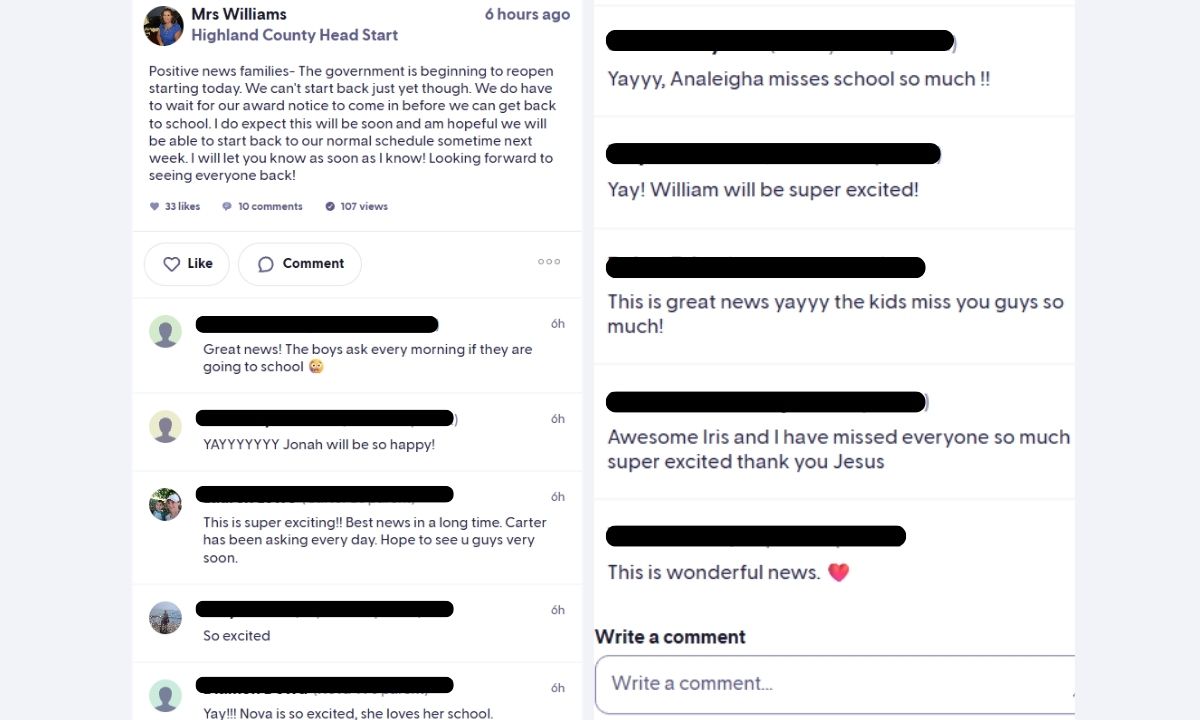
    Valerie Williams, who runs a Head Start program in Appalachian Ohio, was excited to tell parents that classrooms would be reopening soon. (Valerie Williams)

    Still, Williams knows reopening won’t be seamless. Along with program leaders across the country, she’ll need to call back furloughed staff, place food orders and handle a number of other operational challenges.

    And despite the excitement, the transition back may also prove tricky for some kids.

    “I do think that it will feel like starting school again for a lot of our classrooms,” Williams said. “They’ve been out for two weeks … You’re going to work on separation anxiety issues, you’re going to have to get into that routine again and the structure of a classroom environment. So I think that will be a big issue for a lot of our teachers.” 

    As of Friday afternoon, Williams was still awaiting communication from the federal Office of Head Start with information about the anticipated timeline for next steps. 

    “As soon as we get that notice of award, [I want to] start our staff and kids back immediately,” she said. “The very next day.”

    Now that the shutdown has ended, what’s next for Head Start?

    Funding for Head Start is complex. Some 80% comes from federal grants that are released to local providers on a staggered schedule throughout the year. This year, grant recipients with funding deadlines on the first of October and November were left scrambling, as the federal shutdown dragged on.

    The government began to resume operations late Wednesday night after President Donald Trump signed a bill, funding most federal agencies through Jan. 30 and allowing programs that didn’t receive their funding on time, including Head Start, to use forthcoming dollars to backpay expenses incurred over the past month and a half.

    Here’s what Hamm predicts will happen next: The Office of Head Start will recall all staff to resume, including those who were furloughed during the shutdown. The employees will review grant applications, a process which now requires them to flag any language that might be reflective of diversity, equity and inclusion practices. Next, money will be sent along to the remaining regional offices, and eventually dispersed to individual grantees. The NHSA is hopeful that this process will be completed by Thanksgiving for all grantees.

    There are two things the federal government can do to help centers open faster, according to Hamm. First, they could waive a typical protocol that leads to a period of seven days between when a member of Congress is notified that their state will be receiving funding and when the funding actually goes out, Hamm explained. 

    Officials could also notify grantees, in writing, about how much money they’ll get and when it’s expected to come through, so they can begin planning. 

    Unlike SNAP, which received guaranteed funding through the budget year, money for Head Start remains uncertain beyond Jan. 30. While the fear of another shutdown has caused “quite a bit of worry” among the Head Start community, Sheridan said it would likely lead to fewer program disruptions, since it wouldn’t fall at the start of the fiscal year.
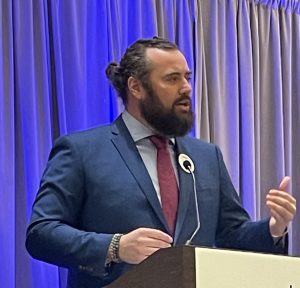
    Tommy Sheridan, deputy director of the National Head Start Association. (Tommy Sheridan)

    To prevent similar chaos moving forward, Democratic Sen. Tammy Baldwin of Wisconsin introduced a bill in the final days of the shutdown that would guarantee uninterrupted service for fiscal year 2026. 

    “The 750,000 children and their families who use Head Start shouldn’t pay the price for Washington dysfunction,” Baldwin, the ranking member of the Senate Appropriations Subcommittee for Labor, Health and Human Services, Education, and Related Agencies, wrote in a statement to The 74.

    Multiple funding threats and deep staffing cuts by the Trump administration over the past year have plunged programs across the country into uncertainty. In the wake of that recent upheaval, a leadership change is also underway. The acting director of the Office of Head Start, Tala Hooban, accepted a new role within the Office of Administration for Children and Families and will be replaced by political appointee Laurie Todd-Smith, according to an email statement from ACF. Todd-Smith currently leads the Office of Early Childhood Development, which oversees the Office of Head Start. 

    Sheridan described this move as anticipated and not particularly concerning, though others were less sure. Joel Ryan, the executive director of the Washington State Association of Head Start, noted that Hooban was a longtime civil servant and strong supporter of the Head Start program. Without her, he fears “there’s nobody internally with any kind of power that will push back,” on future threats to the program.

    Another worry plaguing providers: current funding for Head Start has remained stagnant since the end of 2024, meaning that through at least Jan. 30, programs will be operating under the same budget amid rising costs across the board.

    In previous years, the program’s grant recipients typically got a cost-of-living adjustment, such as the 2.35% bump ($275 million) for fiscal year 2024. In May, a group of almost 200 members of Congress signed a letter to a House Appropriations subcommittee, requesting an adjustment of 3.2% for 2026. A recent statement from NHSA suggested that instead, the proposed Senate bill for next year includes a jump of just 0.6%, or $77 million.

    “If we don’t see a funding increase in line with inflation, that means that Head Start will be facing a cut of that degree,” said Sheridan. “It’s just kind of a quiet cut, or a silent cut.”

    “I think what will end up happening,” said Ryan, “is you’ll end up seeing a massive reduction in the number of kids being served.”


    Did you use this article in your work?

    We’d love to hear how The 74’s reporting is helping educators, researchers, and policymakers. Tell us how
    Source link

  • Thousands of Qualified Community College Students Failing to Transfer to CSU, New Report Finds

    Thousands of Qualified Community College Students Failing to Transfer to CSU, New Report Finds

    More than 32,000 California community college students who earned transfer degrees never applied to California State University despite guaranteed admission, according to a new report that highlights critical gaps in the state’s higher education pipeline.

    Marisol Cuellar MejiaThe Public Policy Institute of California study reveals that 21 percent of Associate Degree for Transfer recipients between 2018-19 and 2022-23 failed to apply to CSU. Most concerning, more than half of these students — 32,500 individuals — appear to have abandoned their pursuit of a bachelor’s degree altogether.

    The findings come as California races to meet an ambitious goal of 40 percent baccalaureate completion among working-age residents by 2030, a target that depends heavily on improving transfer rates from community colleges. 

    “When the transfer pathway works, it works,” said Marisol Cuellar Mejia, co-author of the report. “The challenge lies in ensuring that more California community college students are able to get to the point of applying.”

    The report identifies another significant loss point: nearly 63,000 students who were admitted to CSU but chose not to enroll never appeared at any four-year institution. This group represents what researchers call “the most immediate opportunity for enrollment gains” at the state university system.

    Despite these gaps, the study found high success rates for students who complete the transfer process. Among community college applicants to CSU, 92 percent are eventually admitted to at least one campus, and 76 percent of fall 2020 transfer students graduated by spring 2024. Transfer applications and enrollment remain below pre-pandemic levels.  Fall 2024 saw 50,259 new transfer students enroll at CSU, a 6 percent increase from the prior year but still 17 percent below the 2020 peak of 60,529 students. Applications are down 16.4 percent from 2020 levels.

    The decline has not affected campuses equally. San Diego State, Cal State Los Angeles, and San Francisco State continued enrollment drops through fall 2024, with the latter two campuses seeing transfer enrollment more than 30 percent below 2020 peaks. 

    Meanwhile, five campuses — Fresno State, Fullerton, Sonoma State, Monterey Bay, and Chico State — have surpassed their 2020 transfer enrollment numbers. The report notes that CSU is the leading destination for California community college transfers, receiving about 58 percent of students who successfully transfer to four-year institutions. Another 17 percent transfer to University of California campuses, while 25 percent go to private or out-of-state schools.

    The study found that the typical CSU applicant spends nine terms enrolled in the community college system before applying. However, students who reach key academic milestones during their first year can apply sooner. Three in ten applicants apply in more than one term, and almost half of these students had all applications denied initially but were admitted later. Among admitted students, 69 percent chose to enroll at CSU.

    The California Community Colleges system serves more than 2.1 million students, with most expressing intent to transfer. However, only one in five actually transfers within four years of initial enrollment, meaning even modest improvements could substantially boost four-year college enrollment statewide.

    CSU recently committed to increasing transfer enrollment by 15 percent over the next three years as part of its systemwide strategic plan. The move comes as high school graduate numbers are expected to plateau or decline, limiting the pool of first-time freshmen and making community college transfers increasingly important for maintaining enrollment.

    Source link

  • How Oversight Failures in VA-Approved Education Programs Put Thousands at Risk (Michael S. Hainline)

    How Oversight Failures in VA-Approved Education Programs Put Thousands at Risk (Michael S. Hainline)

    I know this all too well. As a former military police officer who trained as a truck driver in 2016 under a VA-approved program, I was exposed to dangerous, poorly maintained equipment that ultimately caused me to lose the use of my right arm for over a year, a disability I will carry for life. 

    Despite repeated complaints to the program staff and the assigned State Approving Agency (SAA), the official body responsible for oversight, my concerns were dismissed, and no corrective action was taken until years later — and only after significant evidence surfaced.

    Unsafe Equipment Ignored

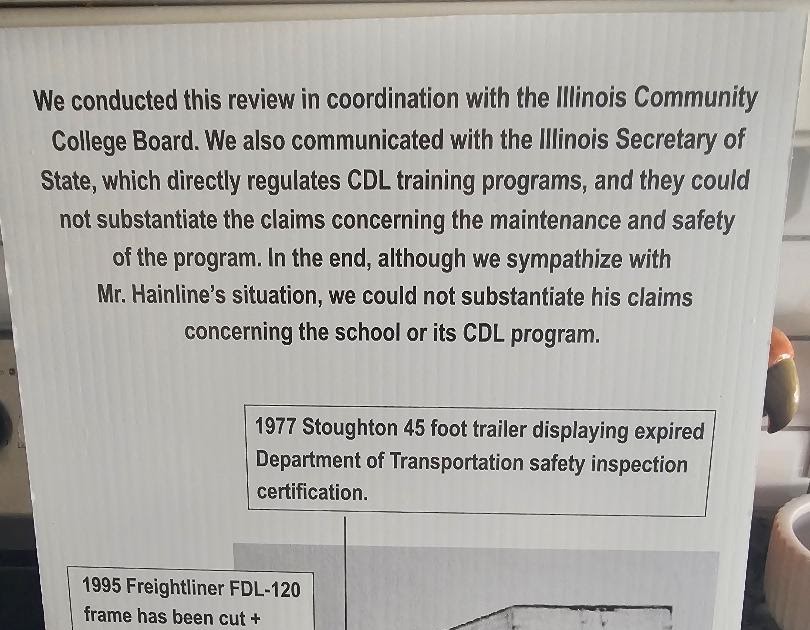
    During my class, veteran student Mike and I, and non-veteran students Dustin & Richard, discovered that the landing gear on the 1977 Stoughton trailer assigned for training was missing an axle and four wheels. I reported this to the staff, who admitted the equipment was faulty but took no timely corrective action. A veteran student later informed me that the school replaced the landing gear on a similar 1987 Great Dane trailer sometime after our class ended, contradicting official reports submitted to the VA and state approving agencies that claimed no issues existed.

    To confirm these claims, I located the trailer used in program advertising and compared photos taken during and after our training. The landing gear had indeed been replaced—freshly painted and altered, as confirmed by Great Dane Trailers’ manufacturer. 

    The trucks used for training showed similar problems. According to Vehicle Identification Numbers, three trucks had modifications—such as frame cutting between tandem axles—that Daimler Trucks North America (the manufacturer) neither recommended nor approved. Federal Motor Carrier Safety Administration guidelines were not followed, creating additional safety concerns, per conversations with the Federal Motor Carrier Safety Administration. 

    Systemic Oversight Failures

    These issues highlight a broader problem: the State Approving Agencies, under contract with the VA, are failing to provide adequate oversight and ensure program quality. The VA Office of Inspector General’s 2018 report (OIG Report #16-00862-179) found that 86% of SAAs did not sufficiently oversee educational programs to ensure only eligible, high-quality programs were approved. The report estimated that without reforms, the VA could improperly pay out $2.3 billion over five years to subpar or fraudulent institutions.

    Alarmingly, the VA Veterans Benefits Administration (VBA) is restricted in its ability to question or audit the reports submitted by SAAs. There is no mechanism for veterans to challenge or appeal SAA findings, effectively leaving veterans powerless within a system that is supposed to protect them.

    Veteran Service Organizations’ Silence

    I sought help from veteran service organizations but found little interest in addressing these critical problems. The American Legion initially responded to my outreach in 2017, engaging in conversations and phone calls. However, within months, communication ceased without explanation. Attempts to meet with American Legion leadership and their legislative contacts, including Dr. Joe Wescott—an influential consultant on veterans’ education—were unsuccessful. Dr. Wescott dismissed concerns about the integrity of the SAA’s targeted risk-based reviews, citing that schools typically fix problems before SAAs visit, and failed to investigate conflicts of interest between report authors and SAA officials.

    At the 2024 American Legion convention, a planned meeting between a fellow veteran and Legion leadership was abruptly canceled. Meanwhile, other veteran groups such as Veterans of Foreign Wars (VFW), Disabled American Veterans (DAV), and Veterans Education Success (VES) showed engagement, but the American Legion and Student Veterans of America remained unresponsive.

    The American Legion’s own 2016 Resolution #304 warned of the exact issues I and countless other veterans have endured: deceptive practices by some education providers, poor accreditation standards, and underfunded and understaffed SAAs unable to enforce proper oversight.

    A Cycle of Scandal

    Congressional staff admitted privately that veterans’ education legislation rarely progresses without support from key players like Dr. Wescott and the National Association of State Approving Agencies (NASAA), whose leaders have repeatedly declined to meet with veterans raising concerns. These complex relationships between SAAs, VA officials, veteran groups, and legislators perpetuate a “cycle of scandal” that leaves veterans vulnerable and taxpayers footing the bill.

    In 2023, a combat veteran attending the same program I did reported similar frustrations: only one of three trucks was roadworthy, severely limiting practical training time for a full class of students. Despite numerous documented complaints, the NASAA president refused to meet or discuss these issues.

    The Human Cost

    Beyond financial waste and bureaucratic failures, real human harm occurs. My injury, caused by training on unsafe equipment, robbed me of a year of mobility and continues to affect my life. Thousands of veterans have lost their G.I. Bill benefits, incurred debt for worthless or limited degrees, or been misled about their job prospects after completing programs approved by the very agencies meant to protect them.

    The internet is rife with investigative reports exposing waste, fraud, and abuse in VA-approved programs. Headlines like “School Scammers Are Robbing Veterans and the Government Blind” and “For-Profit Colleges Exploit Veterans’ G.I. Bill Benefits” are far too common.

    A Call for Reform

    Despite these glaring failures, meaningful reform remains elusive. The VA OIG report and numerous investigations call for increased accountability, transparency, and cooperation between the VBA, SAAs, veteran service organizations, and Congress. Veterans deserve a system that genuinely safeguards their education and wellbeing.

    My fellow former veteran students and I have organized online and turned to media outlets to break the silence. It’s time for the public and policymakers to hear our stories—not just slogans and “catchy” legislative titles that fail to restore lost benefits or improve program quality.

    We veterans demand change—because we have earned more than empty promises and a broken system that leaves us behind.


    Michael S. Hainline is a veteran and advocate living in Pensacola, Florida. He served in active duty and reserve military components and now works to expose the failures of oversight in VA-approved education and job training programs. He can be reached at [email protected].

    Source link

  • Hundreds Waitlisted for Pre-K in South Carolina Despite Thousands of Open Seats – The 74

    Hundreds Waitlisted for Pre-K in South Carolina Despite Thousands of Open Seats – The 74


    Get stories like this delivered straight to your inbox. Sign up for The 74 Newsletter

    COLUMBIA — Hundreds of 4-year-olds across South Carolina are on waitlists to access state-funded preschool programs, even though there are thousands of open seats, according to a report presented Monday to the state Education Oversight Committee.

    The state funds a dual system of full-day kindergarten for 4-year-olds deemed “at risk.” Students are eligible under state law if they qualify for Medicaid or free or reduced-price meals, or if they are homeless, in foster care or show developmental delays. Many public school districts use local property tax dollars to expand that eligibility.

    The state Department of Education oversees programs in public schools, while First Steps, a separate state agency, oversees state-funded classes in approved private schools and child care centers.

    As of November, 400 4-year-olds were waiting for spots to open up to enroll at their local public school. At the same time, First Steps 4K reported more than 2,300 open seats, often in the same counties as the districts with the longest waitlists, according to the report.

    “It’s just a matter of finding an open seat for a child on a waitlist or finding an eligible child for the open seat,” said Jenny May, a committee researcher who presented the report.

    Because 4K is a one-year program, students who are on the waitlist are unlikely to end up in a preschool program before starting kindergarten. Children need at least 120 days of preschool to prepare, so even if a slot happens to open up toward the end of the school year, they will start kindergarten less ready than other 5-year-olds, according to the study.

    It’s not clear why some 4-year-olds are on a waiting list for a public school when vacancies exist in private programs, May said.

    In some cases, the issue could be that another preschool program isn’t available nearby. The four counties with the longest waitlists — Lexington, Anderson, Berkeley and Newberry — all have at least one First Steps 4K program with availability, according to the report. However, that doesn’t account for potential cross-county drives.

    Other parents may not know that other options are available, May said. Having a person designated to help direct parents to other preschool options, such as the nearest First Steps 4K program with open seats, could help reduce that waitlist, May said.

    “It’s likely that if we had a more efficient process, we could serve most of the 400 kids on a waitlist on one of the First Steps seats,” May said.

    The state already has several websites meant to help parents figure out what programs they’re eligible for and how to enroll. Palmetto Pre-K, launched in 2020, tells parents whether they’re eligible for state-funded preschool programs. First Five SC does the same but includes all early childhood programs with federal or state funding.

    But having a person parents can call, or who can reach out to families with children on waitlists, could help reach some parents who might not know about the websites or have other concerns, the study suggests. That person, who the committee dubbed a 4K navigator, could then talk parents through the differences in programs, find available seats and answer any other questions parents might have, researchers said.

    First Steps 4K has a similar program, in which applicants are directed to a central phone line or website that helps parents find the right fit for their child. That has helped prevent First Steps from having its own waitlist, May said. The 4K navigators, who the study suggested trying out in areas with the largest waitlists first, would have a broader knowledge of pre-K programs, the report said.

    If a school district has a persistent waitlist of more than 20 students, that suggests the population has risen in that area, and state officials should consider giving the district more funding to create enough slots for those students, the report suggested.

    The waitlisted students represent less than 1% of students who are eligible for the program but not enrolled. More than 18,000 4-year-olds, or about 55% of all eligible, are living in poverty but not enrolled in a 4K program, according to the report.

    That’s a decrease from the 2022-2024 school year, when 60% of eligible students were not enrolled in districts. Still, it’s not enough, May said.

    Even if every student on a waitlist enrolled in one of the available spots, programs would have space left over to take on at least 1,900 more students, according to the report. That suggests there are barriers other than program space keeping parents from enrolling their students in state-funded preschool, May said.

    In many cases, the problem might be that parents don’t know about 4K programs or their benefits, May said. The state should put more funding and effort into outreach to help those students, the report suggests.

    Data shows preschool programs are highly beneficial, helping students learn skills in reading, math and socialization, studies have found. According to the report, at-risk students who attended a state-funded pre-K program were more likely to be prepared for school than their counterparts who didn’t, according to the report.

    “So, we want those students who are eligible and not served to be able to access it, and we definitely want those students who are on a waitlist to be able to access the program,” said Dana Yow, executive director of the committee.

    SC Daily Gazette is part of States Newsroom, a nonprofit news network supported by grants and a coalition of donors as a 501c(3) public charity. SC Daily Gazette maintains editorial independence. Contact Editor Seanna Adcox for questions: [email protected].


    Get stories like these delivered straight to your inbox. Sign up for The 74 Newsletter

    Source link