Tag: time

  • 5 Ways to Monitor Your Child’s Time with Technology

    5 Ways to Monitor Your Child’s Time with Technology

    Early Childhood Education

    Photo: Courtesy of Kelly Sikkema

    Technology and the internet have created countless new opportunities for teaching and learning. Students can now read about virtually any subject from anywhere and connect with people and places around the world. Teachers are harnessing this power to bring curriculum alive, and modify instruction to meet the unique needs of every child.

    Digital learning gives students the skills they need to succeed, in school and their chosen careers. And while having a bounty of information at our fingertips has many benefits, it also comes with risks and potential pitfalls.

    As we tell kids to look both ways before crossing the street and teach them to practice good behavior, it is just as important to talk to them about being responsible and safe in the increasingly digital world, and show them that the rules of life also apply online.

    As we guide the next generation of digital citizens, here are five ways families can help children make smarter decisions online and when using technology:

    1. Limit screen time

    Be assertive about when your child can use his or her phone or tablet. For instance, if your 8-year-old is using a tablet for playing app games and accessing learning tools for homework, set aside a certain number of hours after school and over the weekend to do this. If you are giving your 15-year-old permission to take a smartphone to school, collect the phone when he or she returns home (and for dinner and bedtime). Establish an “online” and “offline” schedule to create balance between the real world and cyber world.

    2. Activate privacy settings

    You can enable or install a variety of features, depending on how your child uses their device, such as location tracking, parental control for internet content and mobile usage monitoring apps. This will keep your child safe and protect his or her privacy. It is also important to talk to your child about smart usernames and passwords and what information is and isn’t appropriate to share online.

    3. Address health precautions and other risks

    Teach your child about the potential risks of overusing smartphones and other digital devices. For teens, it is critical to stress no texting and driving. You also should talk to your kids about not getting caught up in negative conversations that could lead to cyberbullying.

    4. Monitor and model your technology use

    Review your personal example in teaching your child good digital habits, like not bringing your phone to the dinner table, never driving and texting or turning off all devices and storing them in a common area well before bedtime. Kids follow what adults do, and they benefit greatly when expectations and good digital habits are modeled for them.

    5. Make a contract with your child or teen

    Find 20 minutes to invest in your family’s online well-being by creating a personalized family plan to guide your technology use. Online resources and apps are available to help you have an open dialogue about online behaviors and agree on healthy limits. You can then create an official family contract to post in your home as a reminder.

    It is important that families have open, ongoing conversations about devices and technology use. It will help children build good digital habits and ensure they have the skills they need to be responsible.

    Source link

  • How do care-experienced students view their time in higher education?

    How do care-experienced students view their time in higher education?

    Last Thursday 6th March, TASO shared its report on Pathways into and through higher education for young people with experience of children’s social care. It found that young people with experience of care are four times less likely to attend higher education by age 22 and more than twice as likely to drop out as their peers without experience of care.

    It builds on a growing body of literature in this area, including analysis by the Unite Foundation and evaluations of its own scholarships with Jisc.

    Through the annual Student Academic Experience Survey (SAES), HEPI and Advance HE collect data on the experiences and attitudes of care-experienced students. We are in a constant process of iterating and improving the SAES, and in 2024, a close reading of our data from previous years suggested a higher number of respondents than expected were saying they had experience of care. To make sure we were capturing the right students, we refined the question as follows:

    Have you been in care? Select yes if you’ve ever lived in public care or as a looked-after child, including:

    • with foster carers under local authority care
    • in a residential children’s home
    • being ‘looked after at home’ under a supervision order
    • living with friends or relatives in kinship care

    Note: This does not refer to time spent in boarding schools, working in a care or healthcare setting, or if you are a carer yourself.

    In 2024, nearly 900 of the roughly 10,300 respondents to the SAES – still quite a high number, but significantly fewer than the previous year – said they had experience of care. What do the data say about their experiences in higher education? (Note that the margin of error for any subset will be higher than the margin for the whole survey sample, which is around 1%.)

    On subject choices, care-experienced students in the SAES were somewhat more likely to be studying Medicine and Dentistry and subjects allied to Medicine, which is consistent with sector-level data. They were also more likely to be studying Engineering and less likely to be studying Business, Social Studies and creative subjects.

    In addition to the challenges faced by having experienced care, these students were also less likely to come from the highest quintiles of participation in higher education (POLAR) than other students and more likely to have a disability (45%, compared to 30% of other students) but less often described themselves as first in family (25%, compared to 32% of other students).

    This probably informs many of their responses throughout the survey. For example, like other students taking courses like these, care-experienced students have more contact hours and do more hours of independent work (a total of 41.5 hours) than students without experience of care (36 hours on average). Likewise, more than half of care-experienced students use AI at least once a week, compared with less than a third (30%) of other students. This is as expected, given that saving time is a primary reason students use AI tools.

    Perhaps surprisingly, care-experienced students report higher scores on wellbeing measures, like happiness and life satisfaction. (For example, they average 7.08 out of 10 for whether the things they do are worthwhile, compared to 6.74 for other students.) However, they also report higher rates of anxiety and loneliness than students without experience of care, averaging 5.29 out of 10 for feeling anxious compared with 4.48 for other students.

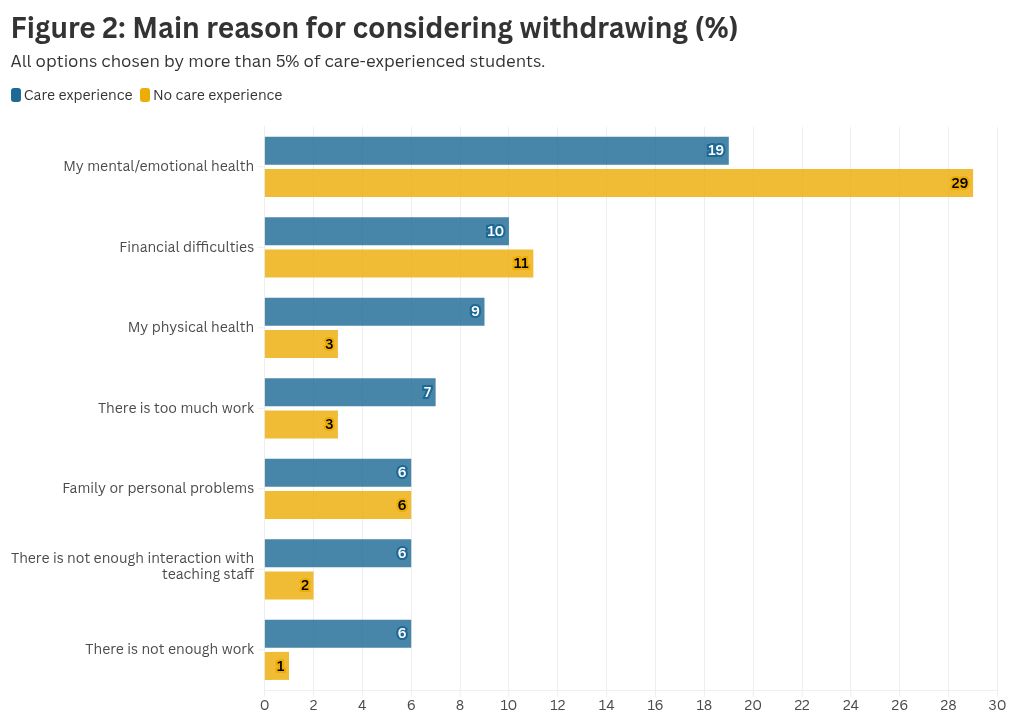
    Care-experienced students are more likely to have considered withdrawing: 38% compared with 24% of all students. When asked for their main reason why, they cite mental health as the primary challenge, but at a lower rate than students without experience of care. Instead, they were more likely to mention workload – either a higher or lower volume than expected – or their physical health.

    chart visualization

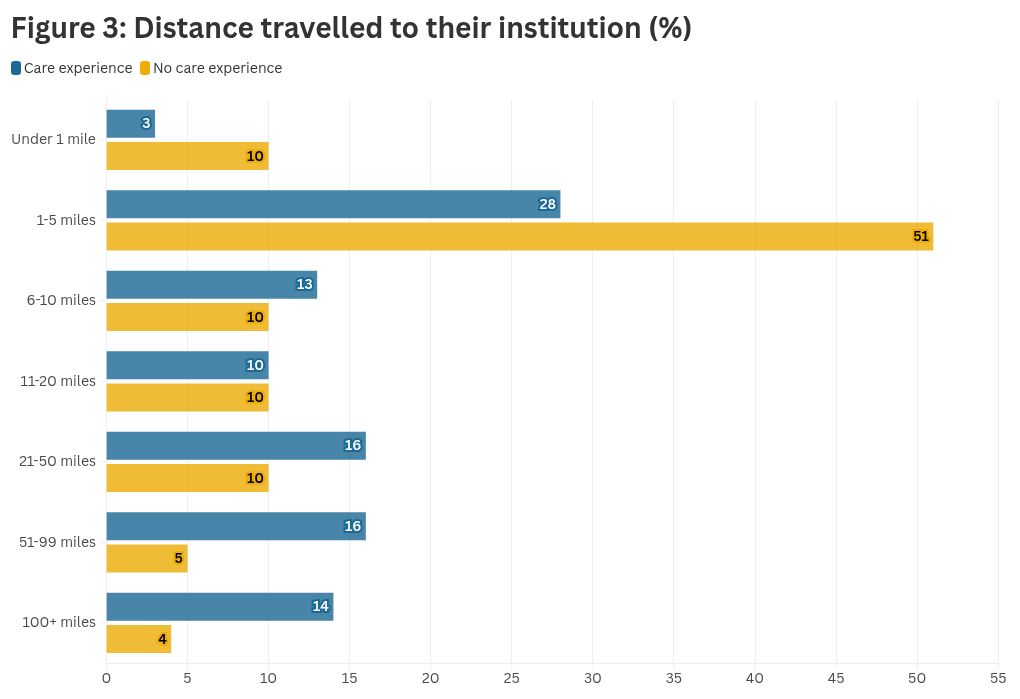
    These data also suggest that care-experienced students face an altogether more challenging context. Some 58% of care-experienced students say they travel 10 miles or more to get to university, compared with only 31% without experience of care travelling the same distance. This may be because the benefits some care-experienced students get can be contingent on living within a particular local authority. Care-experienced students reported living alone or with family at higher rates than other students.

    chart visualization

    Additionally, care-experienced students may need to remain at home to provide for family members at higher rates. Almost all care-experienced students (80%) do some paid work during term-time, compared with 55% of other students. This is most often to supplement their income. But more than one-third of care-experienced students (35%) work to support friends or family financially.

    A third (33%) say the cost-of-living crisis has affected them ‘a lot’, compared with 27% of other students. Care-experienced students are also nearly twice as likely to depend on scholarships or bursaries to cover their costs, which could also show that such funds are being effectively targeted towards students who need them.

    In summary, care-experienced students are more likely to take certain Health and Science subjects, live further from their institution, are more likely to be working to support their families and are affected more by cost-of-living difficulties. These challenging findings help to explain why care-experienced students withdraw from higher education at higher rates.

    Clearly there is more that institutions and government can do to support this group of students. The TASO report recommends, for example, working closely with local authorities to ensure care-experienced students have reliable access to accommodation, both during and outside of term-time. And as Paige Mackenzie wrote for us in 2022, the holidays can be a ‘really lonely time’ for care-experienced and estranged students and it helps when staff reach out.

    Source link

  • The best and most rewarding study time possible

    The best and most rewarding study time possible

    About a decade ago now, there was a problem at the University of Wisconsin-Madison.

    Across a collection of STEM courses, there was a significant “achievement” (attainment/awarding) gap between marginalised groups (all religious minorities and non-White students) and privileged students (caucasian, non-Hispanic participants who were either Christian or had no religion).

    Psychology prof Markus Brauer had an idea. He’d previously undertaken research on social norms messaging – communicating to people that most of their peers hold certain pro-social attitudes or tend to engage in certain pro-social behaviours.

    He knew that communications shape people’s perceptions of what is common and socially acceptable, which in turn influences their own attitudes and behaviours.

    So he thought he’d try some on new students.

    He started by trying out posters in waiting rooms and teaching spaces, and then tried showing two groups of students a video – one saw an off-the-shelf explanation of bias and micro-aggressions, and another where lots of voxpopped students described the day to day benefits of diversity.

    Long story short? The latter “social norms” video had a strong, significant, positive effect on inclusive climate scores for students from marginalised backgrounds.

    They reported that their peers behaved more inclusively and treated them with more respect, and the effect was stronger for marginalised students than for privileged students.

    Then he tried it again. One group got to see the social norms video in their first scheduled class, and those students also got an email from the university’s Deputy Vice Chancellor for Diversity and Inclusion in week 7 of the semester, which reported positive findings from the university’s most recent climate survey and encouraged students to continue working toward an inclusive social climate.

    The other group had a short “pro-diversity” statement added to the syllabus that was distributed in paper format during the first class. That pro-diversity statement briefly mentioned the university’s commitment to diversity and inclusive excellence. Students in this group did not receive an email.

    As well as a whole bunch of perception effects, by the end of the semester the marginalised students in the latter group had significantly lower grades than privileged students. But in the norms video group, the achievement gap was completely eliminated – through better social cohesion.

    What goes on tour

    I was thinking about that little tale on both days of our brief study tour to Stockholm last month, where 20 or so UK student leaders (and the staff that support them) criss-crossed the city to meet with multiple student groups and associations to discuss their work.

    Just below the surface, on the trips there’s an endless search for the secret sauce. What makes this work? Why is this successful?

    Across our encounters in Stockholm, one of the big themes was “culture”. Gerry Johnson and Kevan Scholes’ Cultural Web isn’t a bad place to start.

    • Stories and symbols were everywhere in Stockholm – Uppsala and Lund’s student nations tell a story of deep-rooted student self-governance, while patches on student boilersuits mark both affiliation and achievement.
    • Rituals and routines were on offer too. Valborg (Walpurgis Eve) celebrations in Sweden bring students together in citywide festivities, and the routine of structured student influence meetings – where student representatives actively participate in decision-making – ensures that engagement isn’t just performative but institutionalised.
    • Organisational structures help too. A student ombuds system that provides legal advice and advocacy, sends the signal that rights – mine and yours – are as important as responsibilities. Students’ role in housing cooperatives demonstrate how deeply embedded student influence is too – giving students a tangible stake in their own living conditions. And plenty of structures that include circa 2k students feels “just right” in terms of self-governing student communities.
    • Control systems and power structures define the boundaries of student influence and how authority is distributed. Visibly giving student groups the job of welcome and induction – not “res life” professionals, “student engagement” teams or “events managers” – seems to matter. Causing student groups to lead on careers work – with professional staff behind the scenes, rather than front and centre – matters too.

    In conversation, culture came up in multiple ways. One of the things that lots of the groups and their offshoots mentioned was that they played a role in introducing students to Swedish student culture – for international students, home students who were first in family, or just new students in general who needed to know how things worked.

    It came up in both an academic context and a social context. In the former, the focus was on independent study and the relative lack of contact hours in the Swedish system – in the latter, through traditions like “spex” (comedic part-improv theatrical performances created and performed by students), students wearing boiler suits with patches, or “Gasques”, where where students dress up, sing traditional songs, and enjoy multiple courses of food alongside speeches and entertainment.

    But it also came up as a kind of excuse. As well as cracking out the XE app to work out how much better off students in Sweden tend to be, when we got vague answers to our questions interrogating the high, almost jaw-dropping levels of engagement in extracurricular responsibilities, both them and us were often putting it down to “the culture”.

    “It’s fun”, “it’s what we do here”, “we want to help people” were much more likely to be the answers on offer than the things our end expected – CV boosting, academic credit or remuneration.

    “Excuse” is a bit unfair – partly because one of the things that’s happened off the back of previous study tours is that delegates have brought home project ideas or new structures and plonked them into their university, the resultant failures often put down to a difference in culture.

    Maybe that’s reasonable, maybe not. But we can change culture, surely?

    Depth and breadth

    Whatever’s going on, the depth and breadth of student engagement in activity outside of the formal scope of their course in Sweden is breathtaking.

    At Stockholm’s School of Economics, the student association’s VP for Education told us that of the circa 1800 students enrolled, about 96 per cent are SU members – and 700 of them are “active”. I think I thought he meant “pitching up to stuff semi-regularly”, but on the next slide he meant ”have a position of responsibility”.

    At the KTH Royal Institute of Technology, the volunteers we met from Datasektion – the “chapter” for students studying data science courses – had similar stats, nestled in a much bigger university. We met them in their “chapter room” – something that felt like it was theirs rather than a page from a furniture catalogue. As they presented their slides, I started surfing around their website to count the roles. I soon gave up. There’s even a whole committee for keeping the chapter room clean – it’s their home, after all.

    Chatting to the tiny crew of staff at Stockholm University’s SU was a humbling experience. Every time we thought we’d got a grip on their structures, another set unfurled – councils, forums, sports groups, societies, project groups and hundreds of university-level reps shouldn’t be sustainable in a university of 30,000 students – but it is.

    Even at Södertörn University just south of the city – a former Högskola (university college) that’s as close as Sweden gets to a post-92, the numbers are wild. There’s reps for departments, reps for subjects, reps for university boards and working groups, reps that run the careers fair, and reps for the SU’s work environment, archives, finance and administration, graphic design, sustainability, communication, project management and student influence and impact.

    There’s even 30 odd students that run the pub – without a “grown up” in sight.

    It was probably the Doctoral chapter back at KTH that really did it for me. I don’t think it’s unfair to suggest that extracurricular activity and student representation for PhD students in the UK is fairly thin on the ground – in Sweden, not only is there a vision for PGR student life beyond the research and the survival, there are formal time compensation arrangements that support it.

    Maybe that’s why there’s branches, projects, EDI initiatives, careers support, international student events, ombudspeople, awards nights, trips, handbooks, student support and highly sophisticated research and lobbying. Actually, maybe that’s why Swedish PhD students are salaried at a level approaching those that supervise them – while our “New Deal” says nothing on student life or representation, and frames stipends equivalent to the minimum wage as an achievement.

    There’s many a student leader that’s returned to the UK and decided that they need an elected officer for every faculty, or to create a PGR “officer” or whatever, only to find that the culture in said university or faculty gives that student nothing to work with and little to organise.

    One of our new Swedish friends described that as “painting a branch a different colour – the tree will still be brown when the tree grows and the branch falls off”, as she impressively explained the way that students were recruited first to help, then later to take charge, building their confidence and skills along the way.

    Causes and effects

    Back in the UK, the sector often talks of how students have changed – as if their desires, preferences, activities or attitudes are outside of the gift of educational institutions – something to be marketed to rather than inculcated with.

    But every student I’ve ever met wants to fit in – to know the rules of the games, to know how things work around here, to know how to fit in. Maybe how they’re inducted and supported – and who does that induction and support – matters.

    Maybe it’s about age – students enrol into higher education later in Sweden. Maybe it’s about pace – in the standard three years, only about 40 per cent of bachelor’s students complete – add on three years, and “drop out” is as low as in the UK.

    Maybe it’s about a wider culture of associative activity – the UK always has been useless at sustaining mutuals, and our participation rates in them are near the bottom of the European tables.

    Maybe it’s the legislation – law that has given students the formal right to influence their own education and a panoply of associated rights without the tiresome discourse of consumerism or “what do they know” since the 1970s.

    Maybe it’s about trust. You soon spot when you visit a country how much its people are trusted when you jump on a train – “it must be because it’s so cheap” is what we tend to think, but maybe that lack of barriers and inspectors is about something else.

    Less than 4 in 10 staff in Swedish Universities are non-academic, far less than in the UK. Maybe we do so much for students in the UK because they need the help. Maybe we’ve convinced ourselves – both in universities and SUs – that they can’t or won’t do it on their own – or that if they did, they’d mess it up, or at least mess the metrics or the marketing up.

    In that endless search for the secret sauce, the research doesn’t help. In theses like this, the most common reasons for student volunteering in Sweden are improving things/helping people, meeting new people/making friends, developing skills, and gaining work experience/developing their CV. Like they are everywhere.

    International students, particularly those studying away from their home country, are more likely to volunteer as a way to make new social connections. Younger students tend to volunteer more frequently than older ones. And universities could encourage volunteering by increasing awareness, linking it to academic subjects, and offering rewards or networking opportunities​. We knew that already.

    But actually, maybe there’s something we didn’t know:

    Swedish students tend to volunteer because it is seen as normal rather than something extraordinary.

    And that takes us back to Wisconsin.

    Normal for Norfolk

    In this terrific podcast, Markus Brauer urges anyone in a university trying to “change the culture” to focus on the evidence. He says that traditional student culture change initiatives lack rigorous evaluation, rely on flawed assumptions, provoke resistance, and raise awareness without changing behaviour.

    He critiques approaches that focus on individual attitudes rather than systemic barriers, stressing that context and social norms – not just personal beliefs – shape behaviour. Negative, deficit-based framing alienates. And it’s positive, evidence-based, and systematic strategies – structural reforms, visible institutional commitments and peer modelling that really drive the change.

    Maybe that’s why each and every student leader we met had an engagement origin story that was about belonging.

    When I asked the International Officer at the Stockholm Student Law Association what would happen if a new student didn’t know how to approach an assignment, he was unequivocal – one of the “Fadder” students running the group social mentoring scheme would do the hard yards on the hidden curriculum.

    When I asked the Doctoral President at KTH how she first got involved, it was because someone had asked her to help out. The Education VP at the School of Economics? He went to an event, and figured it would be fun to help run it next time because he’d get to hang out with those that had run it for him. Now he runs a student-led study skills programme and gets alumni involved in helping students to succeed. Maybe it’s that. School plays sell out.

    Belonging has become quite important in HE in recent years. The human need to feel connected, valued, and part of something greater than ourselves has correlations with all sorts of things that are good. Belonging shapes students’ identities, impacts their well-being, enables them to take risks and overcome challenges with resilience.

    But since we’ve been putting out our research, something bad has been happening. Back in the UK, I keep coming across posters and social media graphics that say to students “you belong here”

    And that’s a problem, because something else we know is that when a student doesn’t feel like that and when there’s no scaffolding or investment to stimulate it, it can make students feel worse. Because the other thing we’ve noticed about how others in Europe do it is that it’s about doing things.

    Doing belonging

    The first aspect of that is that when students work together on something it allows us to value and hope for the success of others beyond their individual concerns. They want the project to succeed. We want the event to go well. They smile for the photos in a group.

    The second is that when they work in a group and they connect and contribute they’re suddenly not in competition, and so less likely to lose. When they’re proofing someone’s essay or planning a route for a treasure hunt, they’re not performing for their success – they’re performing for others.

    But the third is that they start to see themselves differently. Suddenly they’re not characterised by their characteristics, judged by their accent or ranked by their background. They start to transcend the labels and become the artist, the coach, the consultant or the cook.

    The folklore benefits of HE participation are well understood and hugely valuable to society. They’re about health, wellbeing, confidence, community mindedness and a respect for equality and diversity.

    In every country in the process of massifying, the debate about whether they’re imbued via the signalling of those that go (rather than those that don’t), or whether they’re imbued via the graduate attributes framework variously crowbarred into modules, or imbued simply via friendship or via the social mixing that seems so scarce in modern HE rages on.

    My guess is that it’s partly about having the time to do things – we make student life more and more efficient at our peril. It’s partly about giving things back to students that we’ve pretty much professionalised the belonging out of. It’s partly about scaffolding – finding structures that counterintuitively run against the centralisation rampant in the management of institutions and causing students to organise their communities in groups of the right size.

    Maybe it’s all of that, or some of it. Maybe some good social norming videos would help.

    But my best guess is not that higher education should show new students a manipulative video tricking them into the social proof that helping others is fun. It’s that seeing other students do things for them – and then asking them to get involved themselves – is both the only way to build belonging and community, and the only way to ensure that the benefits of participation extend beyond the transactional.

    When students witness peers actively shaping their environment, supporting each other, and making tangible contributions to their communities, they don’t just internalise the value of participation – they embody it. Creating the conditions where reciprocity feels natural, expected and rewarding is about making it natural, expected, and rewarding.

    The more HE massifies, the more the questions will come over the individual benefits to salary, the more the pressure will come on outcomes, and the more that some will see skills as something that’s cheaper to do outside of the sector than in it.

    If mass HE is to survive, its signature contribution in an ever-more divided world ought to be belonging, community and social cohesion. However hard it looks, that will mean weaning off engineering individual engagement from the top down – and starting to enable community engagement from the ground up.

    Source link

  • After Heated Oval Office Exchange, Trump Ends Pivotal Meeting With Zelensky Early (Time)

    After Heated Oval Office Exchange, Trump Ends Pivotal Meeting With Zelensky Early (Time)

    Ukraine President Volodymyr Zelensky wouldn’t concede the point. A tense Oval Office meeting Friday that was supposed to end in Ukraine agreeing to share mining resources with the U.S. devolved into a heated argument as President Donald Trump and Vice President J.D. Vance insisted Ukraine should express more gratitude for U.S. support and agree to a ceasefire with Russia, even without clear security guarantees from the U.S.
    “You don’t have the cards right now,” Trump told Zelensky, as the two interrupted each other during a forceful exchange in front of TV cameras.

    Source link

  • It’s Time for Higher Education Leadership to Embrace ‘Good Trouble’

    It’s Time for Higher Education Leadership to Embrace ‘Good Trouble’

    Dr. Detris AdelabuOn the day of his death in 2020, an op-ed appeared in the New York Times, pre-written by Congressman John Lewis, urging Americans to stand up for justice and what he called “good trouble, necessary trouble.  Even in his death, Congressman Lewis fought for a more equitable America, where every individual recognizes their moral obligation to persist in the struggle for a more just nation.

    The recent Supreme Court decision striking down race-conscious admissions policies, followed by anti-equity legislation across more than 40 states and at the highest level of government, erodes decades of collective efforts to rectify a history of gross social and structural inequities. In higher education, these legislative attacks have led to a decline in Black and Latino student enrollment at selective colleges and universities and have prompted institutions to abandon their commitment to equity.  Universities such as Harvard, Rutgers, Northeastern, the University of Texas, and Louisiana State University are scrubbing their website of all references to diversity, equity, and inclusion, shuttering DEI offices and laying off staff, and scrutinizing the curriculum for any references to DEI.  If ever there was a time for “good trouble” in higher education, that time is now.  But can higher education leadership muster the political will to stand firm for equity?

    Institutional Responsibility and Moral Leadership

    Legislative setbacks to equity beckon colleges and universities to take bold and creative strategies to reaffirm their commitment to equitable access to resources and opportunities in education. Institutions can, for example, place greater emphasis on partnering with under-resourced high schools and expand outreach to marginalized communities to signal their commitment to equity. While such measures are imperfect, they signal a refusal to yield to a regressive interpretation of equity and justice.

    Higher education institutions can leverage their platforms to articulate their mission and commitment to equity beyond their campuses by working together to:

    1. Form Multi-Institutional Alliances to Challenge Anti-DEI Legislation: Colleges and universities can form alliances on a national scale to amplify their collective advocacy against policies that restrict access to resources and opportunities. Sharing strategies and best practices can strengthen collective efforts to promote equity. Dr. Felicity CrawfordDr. Felicity Crawford
    2. Invest in Community Partnerships: By deepening relationships with K-12 schools, particularly those in strategically under-resourced areas, institutions can create robust pathways for diverse talent. Mentorship programs, financial support, and academic preparation initiatives can help bridge gaps in access and opportunity.
    3. Prioritize Transparency and Accountability: By publishing detailed reports on their equity and diversity metrics, institutions can enhance accountability and demonstrate their progress towards equity.

    Upholding the Educational Mission of Higher Education

    The mission of higher education extends beyond the transmission of knowledge. It encompasses the cultivation of informed, engaged, and socially responsible citizens. Failing to prioritize equity undermines this mission, leaving graduates ill-equipped to navigate the complexities of a global society. Institutions that acquiesce to the erosion of equity risk not only their reputations but also their relevance in a rapidly changing world.

    Resisting harmful laws and policies that oppose equity is not without risks. Institutions may face political backlash, reduced funding, or legal challenges. However, the cost of inaction—both in terms of societal impact and institutional integrity—is far greater. By taking a principled stand, colleges and universities can position themselves on the right side of history, inspiring future generations to do the same. Equity, when implemented with fidelity, fosters diversity.

    The current sociopolitical landscape presents a defining moment for higher education. Gross social and structural inequities will not resolve themselves. Left unattended, they will continue to generate detrimental social and economic consequences for American society, with effects that can span generations. By developing innovative strategies, advocating for systemic change, and upholding their educational missions, institutions can resist attacks on progress and continue to serve as beacons of opportunity and justice. In doing so, they not only honor their moral and societal obligations but also preserve the transformative power of education for generations to come.Dr. Linda Banks-SantilliDr. Linda Banks-Santilli

    This moment calls for moral leadership in higher education that not only resists the immediate consequences of anti-DEI legislation but also envisions a more just and inclusive future. This moment calls for good trouble. To echo the words of Dr. Martin Luther King, Jr.:

    “In this unfolding conundrum of life and history, there is such a thing as being too late. This is no time for apathy or complacency. This is a time for vigorous and positive action.”

    Dr. Detris Honora Adelabu is a Clinical Professor at the Boston University Wheelock College of Education and Human Development

    Dr. Felicity A. Crawford is a Clinical Associate Professor at the Boston University Wheelock College of Education and Human Development

    Dr. Linda Banks-Santilli is a Clinical Associate Professor at the Boston University Wheelock College of Education and Human Development

    Source link

  • Research supervision in the context of REF – time for a step change?

    Research supervision in the context of REF – time for a step change?

    At a time when resources within research organisations are stretched, the PGR experience, and the role doctoral supervisors play in supporting that experience, needs closer attention.

    The release of the pilot indicators for the REF People Culture and Environment (PCE) has promoted a flurry of conversations across UK universities as to what ‘counts’. For the first time, institutions may evidence that “infrastructure, processes and mechanisms in place to support the training and supervision of research students are working effectively” and are invited to consider the inclusion of “pre and post training assessments” for supervisors.

    This signals to institutions that research supervision needs to be taken seriously– both in terms of quality and consistency of PGR experience, as well as the support and recognition for supervisors themselves. In doing so it validates the contribution of doctoral research to the research ecosystem.

    Accelerated prioritisation of research supervision shouldn’t come as a complete surprise. This lack of consistency in PGR experience was recognised less than a year ago in the UKRI New Deal for Postgraduate Research, which stated that “All PGR students should have access to high quality supervision and Research Organisations should ensure that everyone in the supervisory team is well supported, including through induction for new supervisors and Continuous Professional Development (CPD)”. That messaging has been repeated in the UKRI Revised Statement of Expectations for Doctoral Training (2024), alongside a call to research organisations to build supervisor awareness of PGR mental health, wellbeing, bullying and harassment, and equality, diversity and inclusion issues.”

    So, what do we know about research supervision?

    Data from the UK Research Supervision Survey 2024 (UKRSS) confirms that, overwhelmingly, research supervision is considered valuable, rewarding and enjoyable by those who undertake it. Supervision also positively impacts upon their own research. However, a third of respondents reported feeling anxious about supervision and reported their main challenge was fostering student confidence and focus, followed by offering compassionate support to students facing difficult issues ranging from mental health and wellbeing, to finances and funding.

    Lack of time continues to be a barrier to high quality supervision practice, and rising supervisor-to-candidate ratios complicate this further. While early career supervisors were likely to be allocated one to two candidates, those later in their career could be supervising five to ten– only 30 per cent of UKRSS respondents reported that their institution had a policy on maximum candidate numbers. Respondents also made it clear that doctoral research supervision is not being adequately calculated into workload allocations, with a typically described workload model allocating 42 hours per candidate, per year, but supervisors reporting investing an average of 62 hours.

    Time constraints like these contribute greatly to the ability of supervisors to participate in CPD opportunities. This itself is a barrier to good supervision practice, as the UKRSS revealed that supervisors who engage in regular, mandatory CPD reported higher levels of confidence in all areas of supervisory practice. A staggering 91 per cent of respondents who had experienced mandatory induction reported they felt able to enact their institutions’ procedures around supervision– compared to 66 per cent of those for whom induction was not mandatory and 55 per cent who reported no mandatory requirements..

    The data illustrates that supervisors care about and take satisfaction from supporting the next generation of researchers, but they are getting a raw deal from their institutions in terms of time, reward, recognition and opportunities to develop and enhance their own practice. Underscoring this point, just 56 per cent of supervisors reported feeling valued by their institution, compared to 90 per cent who felt valued by their students. Until now this has gone under the radar, making the inclusion of the PCE indicators a welcome sign for those of us working to make changes within the sector.

    Engaging supervisors with high quality Continuing Professional Development

    Focus groups conducted with supervisors at five UK universities as part of the Research England funded Next Generation Research SuperVision Project (RSVP), have provided insight into what CPD is considered useful, meaningful and relevant. Supervisors were well aware of the need to develop and improve their practice, with one participant reflecting “… there isn’t sufficient training for supervision, you have a huge responsibility to another person’s career. So I think the idea that we ‘wing it’ perhaps shouldn’t be acceptable.”

    An overwhelming majority of participants reported that the most important aspects of their supervision practice and development come from interactions with, and support from, their peers and more experienced colleagues. The idea that supervision practice is best developed by watching other supervisors on the job and through communities of practice was repeated by participants across experience levels, genders, disciplines, and institutions– with some even claiming this to be the only way to become a truly good supervisor.

    Far from being reluctant to engage in professional development, many supervisors welcomed the idea of having the space and time to reflect on their practice. What they were less keen on was anything perceived as a ‘tick-box’ exercise– examples given included short courses without time for discussion, and self-directed online modules. There was a recognition by some that these approaches can be useful, but should form part of a more varied approach to CPD.

    Generally speaking, supervisors with less experience were more likely to engage in facilitated workshops and other interventions that help them understand their role and the doctoral journey. Those with more experience expressed a strong preference for discussion-based CPD, including peer reading groups, opportunities for facilitated reflection and mentoring.

    Recognising supervision as part of research culture

    Whatever the final version of the PCE metrics look like, there is now a growing body of empirical evidence to suggest that a revision in the way we manage, reward and recognise research supervision is needed. When government enabled universities to introduce fees for undergraduates the issue of quality assurance quickly surfaced. It was recognised that students should be taught by properly trained staff with a knowledge and understanding of pedagogy and approaches to learning and teaching. Arguably that moment has now come for research supervision.

    If the UK HE sector wishes to attract capable, committed, creative doctoral candidates from a range of backgrounds then those supervising them need to be treated, and trained, as professional practitioners. This means creating the time and space to enable supervisors at all levels of experience to engage in meaningful exchanges about their practice and to refresh their knowledge of policies and new areas as they arise.

    Quick wins?

    For institutions looking for ways to bolster their supervision support there are some empirically grounded ways to improve practice

    Firstly, tap into existing levers for change. The Concordat to Support the Career Development of Researchers outlines the need for PIs (many of whom are supervisors) to engage in professional development. Postdoctoral researchers are also required to engage in “10 days of professional development.” Since postdoctoral researchers are often informally involved in doctoral supervision (15% of the UKRSS respondents identified themselves as ‘early career researchers’) their engagement in CPD could also be counted. Actively recognising and celebrating the diversity of doctoral researchers and their supervisors also aligns with Athena Swan.

    Secondly, increase the visibility of provision. Many supervisors in the UKRSS and focus groups didn’t know what CPD was available in their institution. Very few knew about routes to recognition of supervisory practice (e.g.through the UKCGE Research Supervision Recognition Programme). There is little to be lost in an institution showcasing themselves to prospective researchers and funders as one which takes the quality of supervision seriously and actively invests, rewards and recognises supervisors.

    Thirdly, actively enable conversations about supervision. Aside from the formal training it is the time spent together which is often valuable. This may include offering simple opportunities for new and experienced supervisors to come together to talk about their experiences on topics that matter to them. It may mean enlisting a few champions who will speak about their experience. If there is already a mentoring scheme research supervision could be added to the list of topics that can be discussed as part of that relationship. It is also helpful to encourage supervisors to engage with the UKCGE Supervisor’s Network which offers cross-disciplinary and national level value as a community of practice.

    Finally, use existing PGR and supervisor networks and expert spaces to find out what works well and where the gaps are. Including working with RSVP which is designing, with 58 partners, CPD interventions for new and more experienced supervisors around the topics identified above. Following pilots and evaluation these will be made freely available to the sector. Specific resources to support supervisors to engender a *neurodiversity-affirmative culture will be available later this year. Webpages to support mentoring will be available very soon. Join the RSVP mailing list to be kept up to date.


    *with thanks to Professor Debi Riby at the centre for Neurodiversity & Development at Durham University

    Source link

  • Higher education institutions have invested time, effort and money in level 7 apprenticeships

    Higher education institutions have invested time, effort and money in level 7 apprenticeships

    Many readers might have had an experience along the following lines. You’re on a call, in a meeting, at an event – and someone just happens to let slip that they are doing a postgraduate apprenticeship through their work.

    Questions bubble up: isn’t this person someone in a position to fund their own studies? Or perhaps: don’t they already have a master’s degree? You might even be thinking: your manager really lets you duck out of work for training so often?

    Now this is pure anecdote – and forgive me if it’s not quite as frequent as I’m assuming – but it’s proved to be a pretty powerful one as debates over apprenticeships have percolated in the press and in the back of policymakers’ minds for the last few years. Allied with controversies over supposed “MBA apprenticeships” (or more recently, MBA top-ups and management training for senior executives), it’s led fairly directly to where we are now.

    The government has announced that “a significant number” of level 7 apprenticeships will be removed from levy eligibility in England. The accompanying enjoinder for employers to fund them by other means (if they so choose) is likely the death knell for most of the affected courses, given that without the incentive of levy spending they will largely look like ungainly, over-regulated and rather long bits of exec ed.

    Now we still don’t know exactly what decision the government is going to take. And Labour’s moves here do have other motivations – the policy intention is to stop employers spending their allowances on (older, already qualified) existing staff, and therefore give them a free hand to take on younger apprentices at lower levels, including with so-called “foundation apprenticeships”, though there is zero detail on how this shift in employer training priorities is expected to come about.

    But still – if this was the only priority, money could have come from elsewhere. The fact remains that level 7 apprenticeships have various black marks hanging over them, whether or not justified, which have made them a safe target to go after. Is it really a good use of taxpayers’ money to fund long and expensive courses of what is overwhelmingly in-work training?

    Whose fund is it anyway?

    A big part of the issue, however, is this sense that the levy is really “taxpayers’ money”. It isn’t – it’s half a per cent of an employer’s annual pay bill, assuming said pay bill is £3m or more. Alison Wolf’s recent report for the Social Market Foundation vividly spells out the issue here – employers have become hyper-aware of what they “owe” and are incentivised to spend it as fast as they can, a perverse incentive of the current system which has made level 7 programmes more attractive than policymakers assumed.

    Much of Labour’s current skills policies have their genesis in a period when employers were not successfully deploying their own levy contributions, and there was a question of how better to direct underspends. This is very much not where we are now. And there are many employers who are not well set-up to pivot to entry-level apprenticeships (think solicitors, for example), or who are stressing their own workforce’s need for higher-level upskilling and pursuing productivity gains rather than a larger headcount.

    It could be that the non-apprenticeship part of the growth and skills levy will help square this circle – employers will be able to invest in shorter, possibly more useful workforce training this way, rather than running headlong towards level 7 programmes as the only game in town. The problem is that the government has gone very quiet about this, and we have no sense of what kind of courses will be in scope here.

    And much like with the employer national insurance rise, it doesn’t seem to have been thought through how publicly-funded bodies are meant to respond here – NHS trusts and local councils being big users of the apprenticeship levy, by dint of their size. If the government doesn’t want them spending their levy funds on this type of provision, is it asking them to spend cash from elsewhere in their budgets?

    Caught in the middle

    Stuck between employers’ wishes and government’s aims (or the imagined taxpayer investment) are those education and training providers who have poured resources into making higher-level apprenticeships work. And when we’re talking about level 7 qualifications, it’s universities that have done a lot of the running.

    If you had said a decade ago that many if not most universities would be founding and scaling up teams dedicated to reaching out to employers, thinking about training needs, even coordinating levy transfers across partners and supply chains (as the Edge Foundation’s recent research found) – well, it would have sounded like something dreamed up by a think tank, a laudable ambition unlikely to ever come true. And yet, here we are.

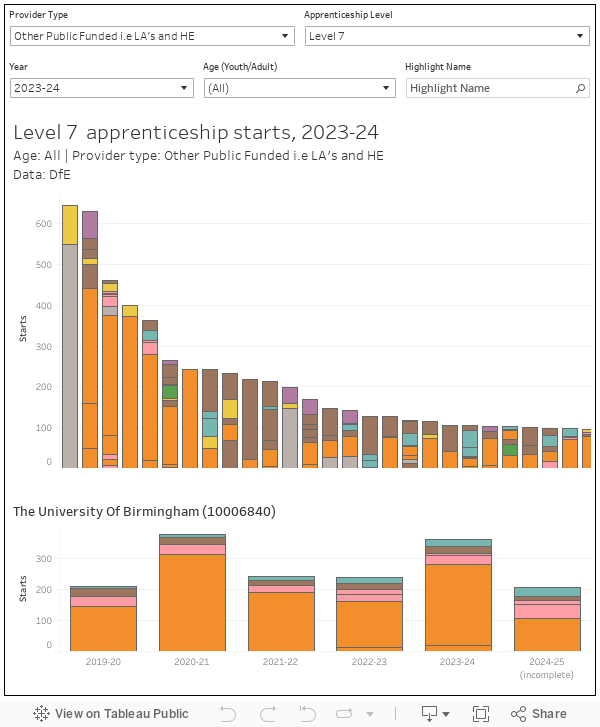
    The Department for Education and Skills England may decide to limit only a couple of standards – as the chart below shows, simply scrapping the Accountancy and Taxation Professional and Senior Leader standards would dramatically change the landscape (though we’d likely be back in the same position in a few years having a similar conversation about the Senior People Professional and Systems Thinking Practitioner ones).

    But once the government starts taking a pick-and-mix approach to standards (as opposed to letting a properly independent arms-length body do so), it opens the door to it happening again and again. If there is a substantial defunding of level 7 apprenticeship standards, expect the next few years to see targets on the back of others, even at level 6 – and an accompanying disincentive for universities to keep pressing ahead seeking out partnerships with employers.

    The removal from levy eligibility of standards that currently have a high uptake will have an immediate impact on those providers invested in them. Below, DK has charted apprenticeship starts by higher education institution (and a few other public bodies as they are lumped together in the DfE data, though as you may have noticed above some for-profit universities appear in the private sector category instead).

    The default view in this chart shows level 7 starts in 2023–24, broken down by standards, so that you can plumb the impact on different providers of different approaches to defunding. And if you’re getting nervous about what else Skills England might fancy doing once it’s finally got the level 7 announcement out of the way, you can look at provision at other levels too.

    Source link

  • ‘Father of Environmental Justice’ Robert Bullard on the Work Behind a Movement (Time)

    ‘Father of Environmental Justice’ Robert Bullard on the Work Behind a Movement (Time)


    Higher Education Inquirer : ‘Father of Environmental Justice’ Robert Bullard on the Work Behind a Movement (Time)


    ‘Father of Environmental Justice’ Robert Bullard on the Work Behind a Movement (Time)


    “This
    isn’t happenstance,” remarked
    Gloria Walton, former TIME Earth Award
    honoree, on the environmental justice movement being recognized as a
    powerful force.

    “It is a reality created by the energy and love of frontline communities
    and grassroots organizations who have worked for decades,” Walton said,
    as she presented an Earth Award to the man known as the “Father of
    Environmental Justice,” Robert Bullard.

    Bullard, who was appointed to the White House Environmental Justice
    Advisory Council in 2021, spoke of the long fight he’s waged for
    environmental justice in his acceptance speech. He discussed the
    challenges that he faced in 1979, when he conducted a study in support
    of the landmark case Bean v. Southwestern Waste Management Corps.— the
    first lawsuit to challenge environmental racism in the United States.

    “I am a sociologist and my sociology has taught me that it is not enough
    to gather the data, do the science and write the books,” he said. “In
    order for us to solve this kind of crisis, we must do our science, we
    must gather our data, we must collect our facts, and we must marry those
    facts with action.”


    Source link

  • Rachel Reeves and the Oxford-Cambridge Arc: Right time. Right place. Long live the Growth Corridor!

    Rachel Reeves and the Oxford-Cambridge Arc: Right time. Right place. Long live the Growth Corridor!

    The idea of a growth corridor between Oxford and Cambridge announced today is not new. Our region was fortunate with the announcements today: being ready, and in the right place at the right time armed with a good piece of policy background from Public First and Rachel Wolf.   

    While it has had many changes of name and cast, the idea of connecting this region has been around for at least 25 years. The idea has waxed and waned as it has acted as the poster child for Coalition, Tory and now Labour governments. It is estimated the Corridor could boost the economic contribution of the region by up to £78 billion, so has formed the centrepiece of the speech on growth given by Chancellor, Rachel Reeves. The Chancellor is going for growth in the Oxford-to-Cambridge Growth Corridor (formerly known as the Corridor, Arc, Region and now Corridor) with the ingredients of world-class companies with world-class talent and research and development.  

    It may even feel as if the Arc Universities Group – ‘working together towards inclusive and sustainable economic growth in an area of designated national economic significance’ – was formed in 2018 in anticipation of such a moment. This is a very long-term project which promises to bear fruit in 30-to-50 years. Universities are able to understand and span such timeframes. My own involvement, for a mere seven years, is transitory and many others have come and gone.  

    The universities in our region, and the relationships that they enjoy with industry and others, have played a pivotal role. There are several reasons for this, including:  

    1. We have been able to act as the honest broker and use our convening power to bring together people and conversations.  
    2. There has been a lot to learn as we face adaptive and existential challenges and these are the stock of universities.  
    3. We are largely independent in our actions, able to tell it how it is, free from the pressures of the electoral cycle or the vicissitudes of policy change. 
    4. Our universities have maturity of governance and stability of leadership, with vice-chancellors serving for at least five years, whereas Secretaries of State sometimes last only a few weeks. 
    5. The region, like many others, hosts a great diversity of institutions. The missions of our members are complementary  in their offering.  
    6. There is significant scale and influence with universities often being the biggest employers. With the benefit of money from the Higher Education Innovation Fund (HEIF), we have been able to act quickly and take risks that others have not and we have been able to hold the space while other processes catch up. 
    7. We have developed a great interface with industry and the private sector. 
    8. Partnerships: Perhaps the most valuable outcome of working in the wings for so many years is the alliances that have been formed between actors. We have formed a strategic alliance with East West Rail, with the private sector and with the sub-regional transport body, as well as the pan-regional partnership.  
    9. More recently we have cemented the relationship between universities and the private sector, in the formation of the Supercluster Board. 

    As our Chair, Alistair Fitt, the Vice-Chancellor of Oxford Brookes University and Chair of the Arc Universities Group, has reflected: 

    This region hosts a great diversity and scale of universities. Together we offer a wide range of key contributions: globally renowned research brilliance, the powerhouse of skills provision provided by cutting edge teaching, world-class knowledge transfer and commercialisation. Our universities, working in close partnership, in alliance with others – particular the private sector – are organised into the Arc Universities Group. We stand ready for the challenge. We welcome the oversight and experience that the leadership of Sir Patrick Vallance brings to the region, and we look forward to helping deliver the Chancellor’s aspirations for growth.

    The Supercluster Board (SCB) has been formed to ensure the UK can achieve its ambition to become a science and technology superpower. The SCB comprises a group of globally recognised scientific enterprises, investors and world-leading universities alongside the local enterprise partnerships, all of which have a vested interest in the region and will seek to work constructively with a wide range of stakeholders, including the UK Government, to deliver on the ambition for the Oxford-Cambridge Growth Corridor. 

    There is significant representation on this new group, with four university representatives on the main board, including Alistair Fitt, and with an expert panel comprising all the vice-chancellors or their near proxy. It is the private sector voice that has succeeded in landing the message about the region’s potential with Rachel Reeves.  

    I’m grateful to the many colleagues who have kept the faith. It is not always been easy, especially given the recent financial constraints, but the future looks promising and we can be greatly encouraged by the Chancellor’s recognition of the potential. The next challenge will be to see how we all deliver under the sudden power of the spotlight that will inevitably follow the announcements.  

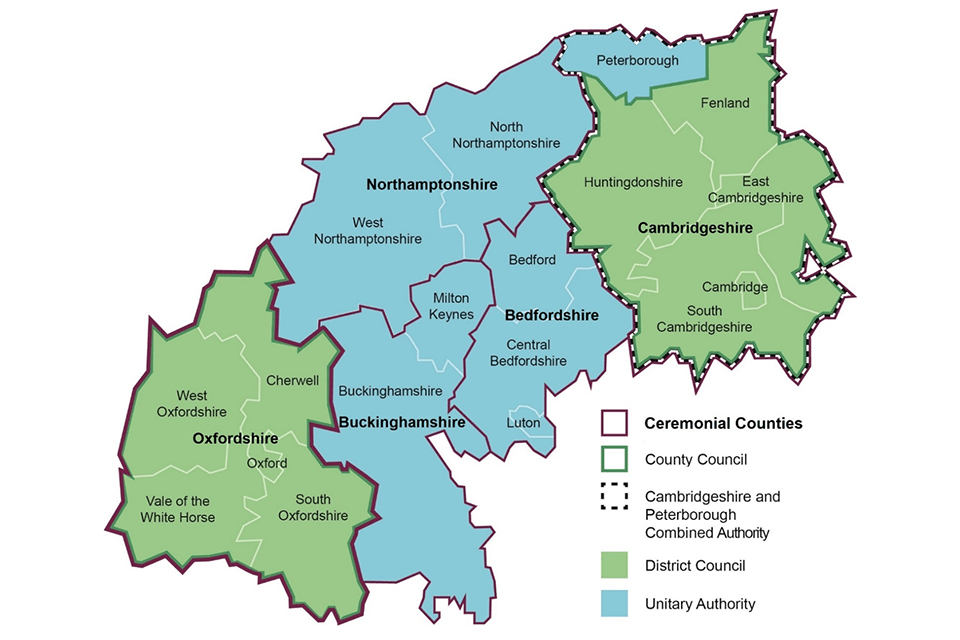
    The photo accompanying this blog on the HEPI website is taken from https://www.gov.uk/government/publications/oxford-cambridge-arc/oxford-cambridge-arc

    Source link

  • Crafting technology-driven IEPs

    Crafting technology-driven IEPs

    Key points:

    Individualized Education Plans (IEP) have been the foundation of special education for decades, and the process in which these documents are written has evolved over the years.

    As technology has evolved, writing documents has also evolved. Before programs existed to streamline the IEP writing process, creating IEPs was once a daunting task of paper and pencil. Not only has the process of writing the IEP evolved, but IEPs are becoming technology-driven.

    Enhancing IEP goal progress with data-driven insights using technology: There are a variety of learning platforms that can monitor a student’s performance in real-time, tailoring to their individual needs and intervening areas for improvement. Data from these programs can be used to create students’ annual IEP goals. This study mentions that the ReadWorks program, used for progress monitoring IEP goals, has 1.2 million teachers and 17 million students using its resources, which provide content, curricular support, and digital tools. ReadWorks is free and provides all its resources free of charge and has both printed and digital versions of the material available to teachers and students (Education Technology Nonprofit, 2021).

    Student engagement and involvement with technology-driven IEPs: Technology-driven IEPs can also empower students to take an active role in their education plan. According to this study, research shows that special education students benefit from educational technology, especially in concept teaching and in practice-feedback type instructional activities (Carter & Center, 2005; Hall, Hughes & Filbert, 2000; Hasselbring & Glaser, 2000). It is vital for students to take ownership in their learning. When students on an IEP reach a certain age, it is important for them to be the active lead in their plan. Digital tools that are used for technology-driven IEPs can provide students with visual representations of their progress, such as dashboards or graphs. When students are given a visual representation of their progress, their engagement and motivation increases.

    Technology-driven IEPs make learning fun: This study discusses technology-enhanced and game based learning for children with special needs. Gamified programs, virtual reality (VR), and augmented reality (AR) change the learning experience from traditional to transformative. Gamified programs are intended to motivate students with rewards, personalized feedback, and competition with leaderboards and challenges to make learning feel like play. Virtual reality gives students an immersive experience that they would otherwise only be able to experience outside of the classroom. It allows for deep engagement and experiential learning via virtual field trips and simulations, without the risk of visiting dangerous places or costly field trip fees that not all districts or students can afford. Augmented reality allows students to visualize abstract concepts such as anatomy or 3D shapes in context. All these technologies align with technology-driven IEPs by providing personalized, accessible, and measurable learning experiences that address diverse needs. These technologies can adapt to a student’s individual skill level, pace, and goals, supporting their IEP.

    Challenges with technology-driven IEPs: Although there are many benefits to
    technology-driven IEPs, it is important to address the potential challenges to ensure equity across school districts. Access to technology in underfunded school districts can be challenging without proper investment in infrastructures, devices, and network connection. Student privacy and data must also be properly addressed. With the use of technologies for technology-driven IEPs, school districts must take into consideration laws such as the Family Educational Rights and Privacy Act (FERPA).

    The integration of technology into the IEP process to create technology-driven IEPs represents a shift from a traditional process to a transformative process. Technology-driven IEPs create more student-centered learning experiences by implementing digital tools, enhancing collaboration, and personalized learning experiences. These learning experiences will enhance student engagement and motivation and allow students to take control of their own learning, making them leaders in their IEP process. However, as technology continues to evolve, it is important to address the equity gap that may arise in underfunded school districts.

    Latest posts by eSchool Media Contributors (see all)

    Source link