In particular, reports demonstrate that stress and burnout is higher in university staff than in the general population, reflecting systemic factors such as high workloads and insecure contracts.
There has been a greater focus on this issue in recent years and staff wellbeing is acknowledged within the University Mental Health Charter. However, as the sector is squeezed financially, staff are being placed under even greater pressure to do more with less, further placing staff wellbeing at risk.
Such issues are likely to disproportionately impact those with protected characteristics – including disabled staff. However, nowhere is the need for staff support more apparent than in relation to equality and diversity, where the focus on student experience typically leaves a void for staff: For example, Universities UK notes:
We believe that anyone who would benefit from a university education should have access to one. But more than that, we want to support our members in creating inclusive environments where all students enjoy their experience and achieve their study and career goals.” (emphasis added)
But what about disabled staff?
Data from Advance HE reveal that 6.8 per cent of staff in higher education have disclosed a disability, with the Higher Education Statistics Agency (HESA) reporting this as 15,155 academic staff and 16,320 staff in non-academic roles (though the latter figure represents only those providers that complete this, optional part of the underlying HESA submission). Given that 24 per cent of working age adults have a disability and 17.3 per cent of students declare a disability, disabled staff are vastly under-represented in higher education. Representation is especially problematic for academics, as declarations are consistently higher among professional and support staff. It is likely that the rates of disabled staff are impacted by a range of factors including a reluctance to disclose, with sharing a disability likened to “coming out”.
Disabled staff face a number of barriers to inclusion. For example, line management support is inconsistent and disabled staff experience glass partitions and ceilings that limit both horizontal and vertical movement. It should, however, be emphasised that disabled staff are not a homogenous group.
Staff with a range of impairments are included within available data, including those disclosing specific learning differences and longstanding illness or health conditions. Further, some staff disclose multiple disabilities, impairments and conditions. Care should be taken to understand the experiences of staff with specific conditions or condition types and to acknowledge the extent to which experiences differ both across and within categories of disability.
Staff are legally protected by the Equality Act (2010) which requires workplaces to make reasonable adjustments for impairments. Negotiating this process can, however, be exhausting for staff who have to advocate for themselves and make a case for how the employer should operationalise the weasel word “reasonable”. Staff can be encouraged to disclose disabilities though an improved commitment to support, for example by universities being flexible in their application of accommodations and line managers being given training to appreciate that staff may have fluctuating conditions and that the same impairment can impact staff differently.
Wider support is also welcomed through government initiatives such as Access to Work, though accessing timely support is challenging in the UK context where reported wait times for assessment have increased significantly.
Disabled Staff Networks can be a core part of the support for workers with impairments; these can offer a place for social connection, an empathic ear, and a place where staff can share experiences and strategies to respond to workplace challenges. In addition, the National Association of Disabled Staff Networks (NADSN) connects and represents disabled staff networks; here members share resources, promote events and work together to bring about change. NADSN has been supporting disabled staff networks to drive real policy change within higher education institutions (HEIs) and, over the past decade, has responded to national consultations and contributed to policy development thus amplifying the voices of all disabled staff and providing challenge to colleagues leading equality, diversity and inclusion (EDI); there are excellent resources on their website for anyone wanting to learn more.
While NADSN’s work has been powerful for disabled staff, there is a lack of wider support from influential organisations to drive equality and diversity in relation to disability in universities. Important progress is being made in highlighting key issues relating to race and gender; in particular the Race Equality Charter and Athena Swan are pressing for transformative change. Although these schemes have not been without criticism, they have increased visibility of equality issues and championed a cultural shift. It is also important to recognise that intersectionality is highlighted within these charters, pertinent to staff who face more than one form of discrimination, such as disabled women in academia who benefit from support with progression. Nonetheless, a disability charter has been conspicuous by its absence.
Work to improve disability inclusion for staff in universities is taking place, for example Evans and Zhu’s (2022) Disability Inclusion Institutional Framework stresses an integrated approach to disability inclusion, and places equal emphasis on staff and student disability inclusion. They argue that if disability inclusion is to improve for students we need to start with staff. There are also excellent examples of work such as podcasts sharing experiences of disability in HE; these increase visibility of disability, help to connect the community, and promote learning from each other. Within research, disability is being addressedand there is greater focus in both policy and practice on the development of anti-ableist research cultures that enable disabled researchers and professional services colleagues. Also pressing for change is the University Mental Health Charter where wellbeing of staff is acknowledged within domain 3 and inclusivity noted as an enabling theme; the charter describes the challenges that staff have to navigate such as issues with adjustments, social barriers, and the impact of the built environment.
What’s next?
More focus and commitment is needed to respond to disability initiatives and drive impactful change. In 2022 colleagues who had met via NADSN began discussing how to respond to this need. Rather than creating a charter like the examples above, we set out to develop a mechanism to encourage universities to share best practice relating to the inclusion of disabled staff. RIDE Higher, standing for “Realising the Inclusion of Disabled Employees” in Higher Education, was born and today it is a core initiative of NADSN.
RIDE Higher is chaired by Melanie Best of the University of Wolverhampton, and run by and for disabled staff working in higher education; our steering group includes staff from HE institutions across the UK (Please connect with us through NADSN’s news page and social media channels). Its mission is to change the HE landscape and ensure that disabled employees are seen, valued, and can thrive.
RIDE Higher is committed to a research-informed approach to driving disability inclusion across the sector. Central to this initiative, is the need for better understanding the lived experience of disabled staff working in higher education. This is why RIDE higher is launched the first National Disabled Staff Survey (NDSS) during Disability History Month, which fittingly, focussed on “livelihood and employment” this year.
Acknowledgements: As authors we would like to thank those who provided peer feedback during the development of this article including the RIDE Higher steering group (Melanie Best, Hamied Haroon, Dan Goodley, Elisabeth Griffiths, Meredith Wilkinson, Gayle Brewer, and Anica Zeyen).
A preliminary analysis of UK university websites finds gaps in the practical information on how postgraduate part-time study actually works, combined with inconsistent acknowledgement of the challenges faced by these learners. Ewan Fairweather, Postgraduate Student Recruitment Manager at The University of Edinburgh asks: ‘Should we really be surprised that many universities find it challenging to recruit part-time postgraduate students?’
‘New Year, New You’. It’s January, the month when ambitions and aspirations take shape. Right now, those of us working in university marketing and recruitment are capitalising on this self-improvement trend, targeting potential postgraduate learners and helping them navigate the labyrinth of course choice, affordability and time commitments.
With more than 13,000 part-time Master’s options listed on Findamasters.com, learners are spoiled for choice; there’s a strong chance they’ll find something relevant out there. But can they afford postgraduate study? And crucially, can they find the time to do it?
Busy lives
For those fortunate enough to be able to fund a part-time Master’s, it will require the considerable investment of another increasingly scarce commodity: time. And this is particularly the case among the largest segment of potential domestic postgraduate students, those aged 30+. This mature audience of prospective learners inevitably carries more personal and professional baggage – careers, relationships, families, caring responsibilities, community and volunteering roles, mortgages and loans.
That is why they are more likely to be considering part-time postgraduate study and so need to work out in very practical terms how to balance learning and living; to picture precisely what it will actually mean.
Drilling down into the detail
I know that universities do so much behind the scenes to address the needs of all types of learners, but sadly this does not come across in the following statements, the likes of which I frequently encountered when searching for part-time postgraduate course details online:
As the School timetable changes from year to year and is not finalised until August, we are unable to confirm this information in advance.
Part-time students are strongly advised to wait until the timetable is available before finalising their other commitments.
Classes can be timetabled Monday-Friday between 9am-6pm. We cannot give timetables in advance of enrolment unfortunately.
With such logistical and chronological vagueness, is it realistic to expect busy people to make life-changing decisions? Certainly timetabling is complicated but we need a clearer answer to the question, ‘So I can plan my life, can you give me an idea of what my timetable will look like?’
Postgraduate part-time learning may not generate the short-term financial boost that the sector needs right now, but we have to plan for today and tomorrow, especially if there is, ‘a need for more people with postgraduate skills in the workforce’. And if the largest segment of domestic students is older, we can assume that many will be looking at part-time in all its glorious forms (online, blended, block, burst, evenings, distance) as their preferred study mode. We have to up our game; timetabling challenges may pose us major headaches, but for prospective students, they are less relevant.
What I did
With a view to improving the information and guidance online for prospective part-time postgraduate students considering the University of Edinburgh, I carried out some exploratory analysis. I sought to understand how UK universities articulated the benefits and practicalities of part-time postgraduate study during the traditional core search period of early January. Typing ‘part time masters’ followed by the institution name into Google, I clicked on the most appropriate results, then evaluated these pages according to two categories:
Coverage: Whether part-time study was included, or contextualised, on the page and the extent to which this was done with empathy and understanding.
Specifics: The level of deeper detail provided (the ‘how, where, who and when’ of part-time delivery).
Pockets of best practice
I gathered the information to improve the content on my own institution’s website with a focus on these busy learners who are looking to successfully juggle high-level study with busy lives. It’s clear that collectively we must do better to address their requirements but there are nonetheless pockets of best practice I believe we can learn from:
Leeds: offers a blueprint for the provision of specific timetable information for each part-time course. It may not look beautiful but when you eventually get there, you find the details you need, combined with a helpful disclaimer
Bedfordshire: From a dedicated part-time page, you navigate to a list of what’s available part-time. From here, you find a course schedule and timetable of exactly when and where the units take place presented in a user-friendly format.
Birkbeck, RVC and Brighton provide extensive details of when and where teaching takes place so you can better manage your time.
Birmingham City University, scores strong on empathy, thinking deeply about the profile and specific needs of their prospective part-time learners
The Open University lives and breathes part-time. The ‘how’ section is fabulous, but I was expecting more on the ‘when and how do I study/attend classes?’
Some institutions promise innovative delivery models designed to support part-time learners’ needs, including De Montfort (‘Block Teaching’) and the RCA (‘Burst Mode’)
Kent is launching a new curriculum and a progressive approach to timetabling this year, designed to help busy people manage their lives better.
Universities with high or medium part-time learning coverage and/or specifics on their website
My recommendations
In concluding, here are some (relatively) easy-to-implement recommendations that will give postgraduate part-time students a clearer idea of the time they need to commit to their studies:
Publish sample timetables: definitive times and locations may not be possible, but is there a way of providing a sample timetable or sharing last year’s timetables?
Consolidate information on part-time study: consider bringing together all information on part-time learning into an easily findable resource or section
Provide bespoke part-time course structure details: interrogate the curriculum from a part-time learner’s perspective, then re-write and update
Show that we care: acknowledge that part-time learners have specific needs. Ideally, do this in a warm and welcoming tone.
It is complicated, but let’s aim to do part-time better – we owe it to our learners!
On our way to developing a curriculum for implementable real-world projects in professional classrooms, an interesting thing happened: Generative AI became ubiquitous. This provided a new perspective on the ideas we established in our previous article, Why Can’t Your Real-World Project Live in the Real World? (Faculty Focus, March 2022.)
In that article, we made a case for enabling real-world clients as partner educators. We tested this theory by working with a client, Artists Alliance Incorporated, a non-profit arts organization in New York City, who needed to rebuild its web presence. While we successfully redesigned the client’s website, we learned during this experience that the 15-week course structure presents a challenge for the production of an implementable project that has real-world impact. Why? Because there’s limited time for the students to gain the professional knowledge needed to generate recommendations that are implementable, and because of the limited capacity of the partner to consistently engage in answering questions about the project for the students. So, in trying to resolve these issues, we wondered, “Could we use generative AI to ‘hack time?’”
Where to begin hacking
The time-intensive elements we believe need to be “hacked” to help students develop the skills necessary to effectively respond to the client’s needs are:
Bringing the students up to speed on content knowledge so they can provide a viable scope to the client
Providing the students feedback on their thinking and recommendations without overloading the client
With the introduction of AI, we wondered if it could be used to augment the access students have to the teacher and the client. For example, could AI be harnessed to help students understand the core concepts of the course and increase their foundational knowledge? Could it also give on-demand feedback based on the client’s stated needs? Both are time-intensive, yet essential, components for implementing a real-world project.
To test our thinking, we developed two generative AI bots and introduced them to our students in a course we were teaching. One was a “Subject Knowledge Bot” (SKB), trained on introductory course content, and the other was a “Project Knowledge Bot” (PKB), trained on transcripts from a client interview detailing their business goals. The SKB provided students with timely knowledge to support the development of their ideas and solutions, while the PKB reduced demands on the client’s time by offering students project-specific insights.
So, how did the bots do?
We piloted the two bots in a Strategic Communications course taught at the NYU School of Professional Studies, Division of Programs in Business, during the spring 2024 semester. During the course, students were asked to redesign a monthly newsletter sent out by the administration to internal stakeholders. To start, the students were given previous newsletters to better assess their quality and efficacy based on the foundational concepts of internal communications being taught in the course. The students submitted their personal assessments and course examples to the SKB, requesting the bot’s feedback. Based on the bot’s response, the students developed a set of recommendations for how the administration could improve the newsletter. The purpose of this exercise was to strengthen the student’s knowledge of internal communications and fill in any gaps students may have had in their understanding. The bot streamlined the time required to build and enhance the students’ knowledge base, enabling students to respond more swiftly to the client’s needs.
After faculty review, the students shared their recommendations with the PKB, which had been trained on a transcript of an interview we conducted with the client. In the interview, the client discussed and assessed their newsletter, focusing on layout, design needs, and the suitability of the content for the target audience. Using the bot’s feedback, the students reevaluated their recommendations and prepared a revised response. The students then developed a final presentation outlining what they considered to be their top recommendations based on their conversations with the PKB. The project concluded with the client selecting the most viable ideas, which were then used to produce a year-end newsletter presented as “for-students, by-students.”
What comes next?
When we began this effort, we assumed that AI could provide a way to strengthen the student-client relationship by giving the students unrestricted access to:
the skills and strategies taught in the course using a bot trained on the course content and
the client using a bot trained on the project requirements and needs.
Based on what we had previously discovered (Is Your Real-World Experience Real Enough?Faculty Focus, March 2020), our thinking was that deepening the linkages between the learner and the client could foster a collaboration that would lead to an implementable project.
Overall, the bots were successful because they helped the students achieve several outcomes in a shorter period of time. The students became better versed in basic strategies for stakeholder communications, and the bots provided immediate feedback on their communication recommendations. These aspects had previously been challenging due to the constraints of the course schedule and the impracticality of expecting clients to address the high volume of student inquiries.
While we were pleased with the experience and the students were able to produce recommendations that were implemented by the client, we believe it is still too early to determine how effective this approach would be in applied classrooms on a broader scale. For example, some issues that still need to be addressed include:
Access to Generative AI tools: For this pilot, students had to have access to paid ChatGPT accounts to use the bots we designed, and those who did not had to use untrained, free-tier generative AI tools.
Strengthening student AI skills: Unfortunately, many of the students resorted to using the bots to simply write their recommendations, not recognizing the bot as a conversational and collaborative partner.
However, despite limitations, we believe there is real potential for AI to “hack time,” i.e., respond to some of the real challenges we, as teachers, have faced in working within a 15-week timeframe to produce implementable projects in professional, applied classrooms. We intend to continue utilizing AI in this manner while refining our approach based on our findings. This includes enhancing the bots’ knowledge base, improving equitable access to the bots, and developing clearer norms and guidelines for their use.
Dr. Paul Acquaro is a lecturer at FOM University of Applied Science for Economics and Management in Berlin and an adjunct assistant professor teaching online with New York University’s School of Professional Studies. He teaches undergraduate and graduate courses in database development, web technologies, IT management, business communication, and project development. Acquaro has over 20 years of experience in information technology, communications, and curriculum development and teaching, and earned a doctorate in education, focusing on instructional technology from Teachers College, Columbia University. Among his many interests is exploring how to combine the possibilities of online learning and the power of problem-based pedagogy.
Dr. Steven Goss, Ed.D., is a clinical faculty member and chair of the Management and Technology program in the Division of Business Programs at NYU School of Professional Studies (NYU SPS). He joined NYU SPS after serving as the Dean of the School of Professional Studies at Manhattan University. Before Manhattan, he led several successful online initiatives at Teachers College, Columbia University, Bank Street College of Education, and New York University, including The Center for Faculty Innovations in Teaching and Learning at NYU Tandon School of Engineering. He has taught diverse student audiences, including K-12, undergraduate, and graduate students. His courses closely relate to his academic interests, including online education, technology innovation, and experiential learning. He has received awards from The Association for the Advancement of Education in Computing (AACE) and the Online Learning Consortium (OLC) for his research on learner-centered online education. Dr. Goss received his Ed.D. in Instructional Technology and Media from Teachers College, Columbia University. He has published a book on practices for transformative online teaching through Teachers College Press, titled Transforming Online Teaching in Higher Education, Essential Practices in Engagement, Inquiry, and Equity, with co-authors Dr. Robin Hummel and Laura Zadoff.
Universities and academics working towards racial justice and inclusion education focus their efforts on closing ethnicity awarding gaps, a measure of systematic inequality in student outcomes.
While addressing these inequalities are essential, the concept of the awarding gap itself — particularly when it relates to race — carries problematic assumptions that undermine the broader efforts to address systemic inequities.
Before going forward, It is important to acknowledge that decolonisation is a controversial concept in its own right. I write from the perspective of UK HE, where decolonisation is a commonly used term. My perspective is therefore through the lens of the coloniser, not the colonised, and informed primarily by the legacy of historical British colonial activity. The issues may differ in the context of colonial expansion by other European powers.
Many contemporary global conflicts are colonial in nature, so I also recognised that for many these issues represent lived experience and ongoing trauma. However, the language of decolonisation is widespread in contemporary HE, so I use this term while acknowledging its limitations and tensions.
The awarding gap explained
The awarding gap measures the disparity in first class and upper second class degree outcomes, typically expressed as the percentage difference between the groups. For example, if 75 per cent of white students and only 60 per cent of Asian students earn a first or a 2:1, the Asian awarding gap is 15 per cent. In the UK the global majority awarding gap is widespread and stubbornly persistent. At sector level, there is a 18.5 per cent Black awarding gap and 5.7 per cent Asian awarding gap, and progress on the issue is notoriously slow.
The awarding gap can have a significant impact on student futures. If employers require at least a 2:1 then there will be an inevitable bias against Black and Asian graduates in the workplace. Inequity in undergraduate degree outcomes also restricts access to postgraduate education, reinforcing the loss of global majority talent. Addressing the awarding gap is therefore essential not only for equity of student outcomes, but also for increasing diversity within HE and the graduate workforce.
The colonial origins of awarding gap language
While the awarding gap metric is crucial for highlighting disparities, it is also fraught with issues. The terminology used to describe racial disparities in HE, such as “BAME” (Black, Asian, and minority ethnic), is highly contested. The UK government has abandoned “BAME” in favour of more nuanced categories, and HE should do the same. I prefer the term “global majority students,” following Rosemary Campbell-Stephens, but acknowledge that even this term may be problematic.
The racial categories used in HE such as “Black” and “Asian,” also have deeply problematic origins that many may be unaware of. These can be traced back to the groundbreaking work on biological classification of Carl Linneas, who as well as classifying plants and animals proposed “scientific” groupings of humans along racial lines. His 1735 work ‘Systema naturae’ classified humans into Europaeus albus (European white), Americanus rubescens (American reddish), Asiaticus fuscus (Asian tawny) and Africanus niger (African black). These were placed into a racial hierarchy, with “Africanus niger” at the bottom.
These groupings were accompanied with highly offensive descriptions; Africanus niger was described as “lazy … sly, sluggish,” while Asiaticus fucus were considered “stern, haughty, greedy.” These categories, based on pseudoscientific ideas of race, underpinned centuries of discrimination and oppression. Although modern genetics has debunked the notion of biological races, HE institutions continue to use similar categories, perpetuating a colonial mindset.
Contemporary issues with the awarding gap
The contemporary use of these terms also creates significant issues both practically and philosophically. For instance, the term “Asian” in the UK awarding gap context as defined by the Office for Students refers to UK-born or educated students of Asian heritage, not international students from Asia. This exclusion of international students from the awarding gap is justified by linking the metric to home undergraduate tuition fees, but it also reflects a colonial mindset where non-UK students’ outcomes are disregarded, despite their financial contributions.
Within home student data, crude categorisation also causes issues. For instance, Chinese students have higher outcomes than Pakistani and Bangladeshi students, yet they are all grouped under “Asian” in many HE metrics (although some institutions have started to disaggregate this data). Similarly, the term “white” encompasses diverse groups, including Gypsy, Roma, and Traveller communities, who are among the most excluded from education in the UK but are aggregated into “white”. These administrative categories erase the nuances and intersections of race, culture, and socio-economic background, which may compromise the effectiveness of interventions.
The grouping inherent in the awarding gap model often reinforces deficit thinking, where students from underrepresented racial groups are viewed as lacking in some way. The assumption is that global majority students are underperforming, but we should also question whether it is white students that are systematically over-rewarded by HE institutions. While the language shift from “attainment gap” to “awarding gap” is a step towards acknowledging institutional bias, much more needs to be done.
A 2021 analysis of UK Access and Participation Plans found that most interventions focused on student finance or study skills support, rather than examining institutional processes like assessment and grading. This approach perpetuates the idea that the problem lies with the students, not the institutions.
Decolonising the awarding gap
To address these issues, I propose six strategies for decolonising the awarding gap:
Be critical of the metric itself: We need to question the construction of the awarding gap metric, particularly its use of crude categories and hierarchical assumptions. The current framework oversimplifies the complexities of race and ethnicity, leading to ineffective solutions.
Disaggregate data: Institutions should disaggregate ethnicity data into the most nuanced categories possible while maintaining statistical validity. Intersectional analysis should be incorporated to capture the full scope of students’ experiences and identities.
Move beyond “gap gazing”: Simply identifying the gap is not enough. We need a qualitative understanding of why these gaps exist, grounded in the lived experiences of students. And more importantly to act with urgency, not to wait for more data.
Avoid deficit models: Interventions should focus on changing university processes, pedagogies, and assessment methods to be more inclusive for all students, rather than assuming that certain groups are inherently deficient.
Involve students: Students must be integral to efforts to address the awarding gap. Institutions should work “with” students, not “for” them, ensuring that their voices are central in both understanding the gap and designing solutions.
Engage senior leaders: Institutional leaders must take an active role in addressing the awarding gap. This work cannot be seen as a box-ticking exercise; it requires a deep understanding of the issues and a commitment to systemic change.
The awarding gap, as currently constructed, is a flawed and crude tool for addressing racial disparities in HE. Its colonial underpinnings and reliance on outdated racial categories reinforce the very inequalities we aim to dismantle. To make meaningful progress towards racial justice in education, we must critically engage with the metrics we use and adopt more nuanced, inclusive approaches.
Only by decolonising the awarding gap can we begin to address the deep-seated inequities in HE and create a more just educational system for all.
Welcome back. The HEPI blog is now up and running again on a daily basis, landing in your inbox at 6:30am. (The pieces we ran over the break are available here.) If you are not already subscribed, you can sign up at the bottom of this page.
Spaces are still open for our in-person Symposium with CBDU on Thursday 16th January: you can register here.
Today’s piece is by Jane Embley, Chief People Officer, Northumbria University and Professor Tom Lawson, Deputy Vice-Chancellor and Provost, Northumbria University.
The end of the Universities Superannuation Scheme (USS) pensions dispute in the summer of 2023 was the source of much relief in the sector. University employees in the scheme saw both their pension benefits restored to the levels they had been before the USS valuation of 2017 and a reduction in their contributions (from January 2024) from 9.8% to 6.1%. Employers could reverse the significant liabilities that had previously been skewing their financial statements and their contributions to USS were reduced from 21.6% to 14.5%. The Financial Times declared that ‘the cost to UK universities of providing pensions for employees is poised to fall by hundreds of millions of pounds after the sector’s main retirement plan swung into surplus after more than a decade of being in deficit’.
But for many institutions the great pensions crisis was not over: indeed it had only just begun. For at least 80 universities, USS is not their main pension scheme, because those that gained university status through the 1992 Higher Education Act are required to offer Teachers Pension Scheme (TPS) to their academic staff. This includes institutions like Northumbria University, which has significantly developed its research intensity over the last decade and seeks to compete with other research intensives. The disparity in the costs of TPS and USS means that competition is no longer on a level playing field.
Northumbria has more than 200 staff who are members of USS, but all of those have joined the university as existing members of that scheme. All other academic colleagues must be enrolled in TPS and cannot, at present, voluntarily become members of USS. Indeed those who join as members of USS also retain a right to be enrolled in TPS if they wish. Around 50 modern institutions employ some members of USS however the underlying requirement to make TPS available to university-employed academic staff is the same.
Since 2023 the cost of TPS to both employees and employers has significantly diverged from USS. While employers’ contributions to the two schemes tracked one another closely until October 2019, they then began to diverge radically when TPS employer contributions rose to 23.68% while USS was at 21.1%. But in April 2024 the gulf between the two schemes became a chasm – TPS contributions rose by 5% to 28.68% as USS employer contributions went down to 14.5%.
The difference in percentage terms is stark. But when you start to think about the financial cost for institutions it is all the more so. The pension cost (to employers) for a typical academic salary of £57,500 is £8,300 per annum for USS. For a TPS employee, it is £16,500. At an institutional level that means that for every 1000 staff earning this salary in TPS, the annual cost is £8.2 million greater than if those same employees were members of USS. For a professor earning £85,000 the difference is as much as £12,000 per full-time colleague. As Northumbria’s experience shows, these are additional costs being carried in one part of the sector for essentially the same staff.
The situation is compounded by the nature of TPS as a scheme. Unlike USS, employers have no say in how the TPS is run and have no levers to keep employer (and indeed employee) contributions down. This is simply a cost handed down to universities by the Treasury. But unlike schools, to which the Treasury through the Department for Education provides additional funding to cover TPS cost increases, universities receive no relief and simply have to absorb these costs into their already stretched budgets. And unlike schools in the independent sector, which were permitted to stop offering TPS to new staff, universities are obliged to continue to offer TPS – whatever alternatives they can develop for their staff.
The impact of this is extraordinary. It essentially means that in one part of the sector, it costs employers the same amount in on-costs to employ 503 staff as it costs to employ 1000 staff elsewhere. Quite apart from the burden this places on institutions, it is deeply anti-competitive.
What then is to be done? The path forward is beset by problems. Unless there is legislative change, modern universities will be required to continue to make TPS available to all academic colleagues and, it bears repeating, will continue to have no say at all in the running of the scheme.
Of course, one option is to do nothing, but the finances of the sector mean the status quo is extraordinarily difficult to justify. Doing nothing embeds an unfairness that makes the government’s stated priorities for university reform more difficult to achieve. To put it crudely, it costs more for some institutions than others to employ academic staff, and as that resource is derived (at least in part) from student fee income then those institutions will require more students to fund the salaries of staff. For every 1000 staff earning £57,500 it would require all of the fees from 859 additional UK undergraduate students just to fund the difference in employer pension contributions.
Institutions can employ new colleagues via subsidiary companies in order to give themselves the freedom to offer more affordable pensions to new employees. But this approach has many potential pitfalls. It would not help to reduce the costs in relation to existing staff, so would be slow to have any impact, and in any case it remains unclear what the status of such employees is according to HESA – which could among other things impact the ability of individuals to make a contribution to future REF exercises with the attendant implications for future funding. Employment through a subsidiary, even with all terms and conditions being the same but being out of scope for recognition within the REF, is also likely to be a less attractive prospect for employees.
It seems likely that until solutions are found, many institutions might find themselves having to rethink their ability to participate in national collective pay bargaining. With higher pension costs and higher National Insurance contributions, it may be necessary, for now at least, for institutions to take control of salary increases to contain the total costs of employment. This is not an attractive option, but it is hard to think of any others that would be as swift and effective in containing cost increases, although of course it would come with its own industrial relations challenges.
Ultimately all institutions value their academic staff immensely and we want to provide access to attractive pension schemes. However, the lack of institutional control over which pension scheme can be offered, and the high, fixed nature of the employer contribution to TPS (which is not directly linked to any improvement in benefits for the individual) cannot be sustained. The timing of the current challenge could also not be worse. Institutions are grappling with a whole range of financial pressures, and as a consequence dealing with TPS remains in the ‘too hard’ box for many, not least because we genuinely cannot find the solutions without some form of intervention. But as the sustainability of institutions becomes all the more scrutinised, and as the sector needs to find financial efficiencies to address the concerns expressed by the Secretary of State for Education earlier in 2024, we do urgently need to find a way forward.
Obliging institutions to continue to offer TPS places greater financial constraints on precisely those universities that might do the most to widen access and give greater opportunity to those from disadvantaged backgrounds as per the government’s priorities. It is an obvious unfairness that some of students will go to institutions where it is substantially more expensive to employ staff than in other institutions that are more traditionally regarded as elite. The time is now to remove this inbuilt, and presumably unintended, unfairness and end the obligation upon modern universities to offer TPS. If that happens individual institutions and the sector as a whole can begin to chart a path to a more sustainable position in the future.
The last episode from HEDx’s Future Solutions conference features interim pro-vice-chancellor of teaching and learning at the University of Queensland Professor Kelly Mathews.
She joins Martin Betts to discuss a survey of over 8000 university students about how they use artificial intelligence.
She is followed by a panel that included deputy vice-chancellor (education and students) at the University of Technology Sydney Kylie Readman, deputy vice-chancellor (academic) at Deakin University Professor Lix Johnson, vice-chancellor of Western Sydney University George Williams, president of Torrens University Linda Brown of Torrens, and industry executive of higher education at Microsoft Katie Ford.
They call on universities to partner with students and the tech company eco-system. Is HE brave enough to get out of its lane?
The cost of college has been a hot topic for a while now, and even though some studies suggest the net cost of college has been falling post-COVID, it’s clear that sticker prices have not been.
And because the overwhelming majority of college and university students in the US attend public institutions, that’s a good place to start the discussion.
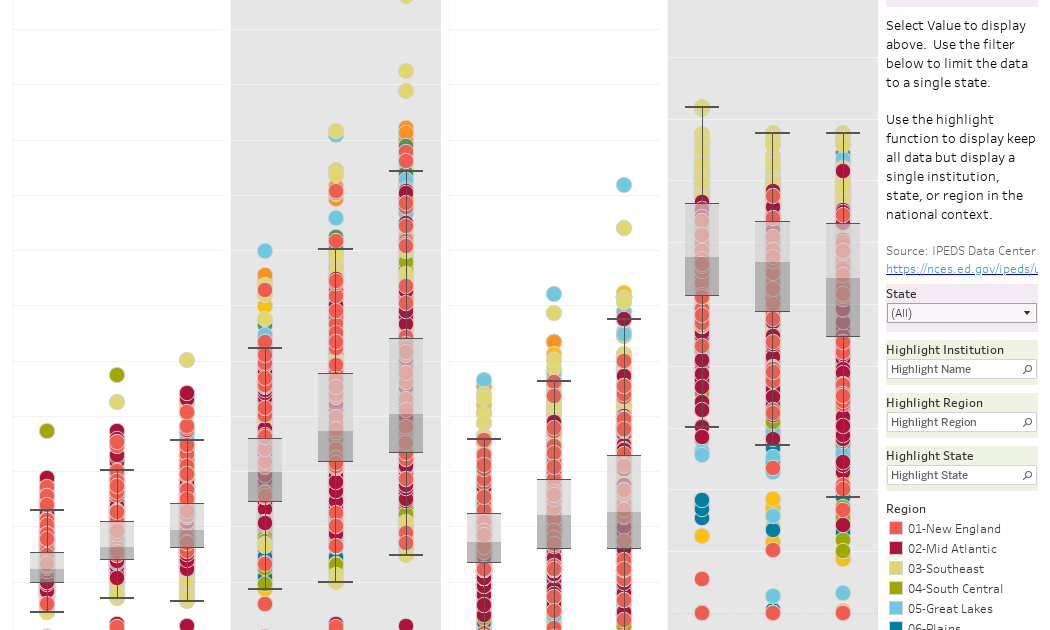
This is data from IPEDS, showing published cost about 530 public, four-year institutions that award the bachelor’s degree, excluding community colleges that have been creeping into that category over time. Each dot represents an institution, and the data are from 2009, 2016, and 2023 to show long-term trends. The dots are colored by geographic region.
The data are displayed four ways, from left to right and default to published Tuition and Fees: Resident, Nonresident, the premium nonresidents pay (in dollars), and the premium not residents pay (as a percentage of what residents pay.) You can change this to show just tuition or just fees by using the control at the top right.
You can also filter to a single state, if you wish, to get a sense of how that state things about tuition.
The green-shaded Highlight boxes at right will allow you to make either one institution, one region, or one state standout, without filtering the other data.
The data are displayed in a box-and-whisker format: The shaded boxes cover the middle 50% of the range, with the dividing line the 50th percentile. The rest of the data are mostly contained within the boundary created by the top bar and bottom bar, with outliers being shown above or below it. These are not enrollment weighted.
As always, I happy to hear what you got out of this. Leave a comment below or send me an email.
Dr. Martha Kenney knows your time is precious. She cares deeply about employee engagement, burnout prevention, work-life balance and career development amongst professional women. That’s why she works with women in medicine and beyond find work-life alignment. She helps women gain clarity on who you are, what you want in life, and what truly matters to you.
She’s also an Assistant Professor who researches mechanisms of chronic pain in young adults who are living with sickle cell disease. I’m delighted to share this conversation with Dr. Martha Kenney in this featured interview on The Social Academic.
Introducing Dr. Martha Kenney, time management expert, professor, coach, and mom
Jennifer: Hi everyone. Welcome back to The Social Academic, where I talk all about online presence for professors, researchers, and other people who have PhDs. I’m so excited to introduce you to my guest today, Dr. Martha Kenney. Martha, would you mind introducing yourself and letting people know a little bit about yourself?
Martha: Sure. Thank you so much for having me, Jennifer. It’s really a pleasure to be here.
I’m Martha. I’m a pediatric anesthesiologist, clinically by training. But, I spend the majority of my time doing research. My research is focused on understanding the mechanisms of chronic pain in young adults who are living with sickle cell disease. I also do research in other pain disparities area as well.
In addition to that, (as if that’s not enough), personally, I’m married with two young kids. So, I’m a really busy mom as well. I’m also a certified coach. I’m a certified executive career coach. I coach women primarily in academia around challenges related to work-life balance, time management, burnout management in general. Read Martha’s bio.
I’m also a behavior design consultant. I got some training in a certification through the Tiny Habits Academy, of which somebody hasn’t read that book by BJ Fogg, they should definitely check it out.
I work a lot with behavior management. How do we change our habits? How do we rewire our routines in a way that sets us up for success so we can be able to execute the goals that we actually have.
Jennifer: Ooh, that is so interesting. It sounds like you do it all.
How did you get into coaching? How did you decide that research, even though it was something that you love, that you wanted to do more than that? You wanted to work with people one-on-one as a coach as well.
Martha: That’s a great question. I got into coaching because of my experience in academia. I’m a physician scientist, clinically I did a very long training path. I finished everything in the fall of 2018 and took on my first position.
“Like most people who go into academia…I don’t wanna say we don’t put in thought into our first position, but I feel like we don’t know the questions we need to ask.
We’re not really prepared to take on our first position. Nobody actually sits you down and says, ‘These are the things you need to ask. These are the red flags that you need to look for.’”
Honestly, when you’ve been through a long training, whether it’s a PhD or an MD track, you’re just happy to have a job when you’re done. Like, yay, I have a job! You’re excited about that. All of this to say that the place that I started was not a good fit. It was not a good fit for many reasons.
Jennifer: Yeah.
Dr. Kenney’s success story with coaching as a former burnt-out academic
Martha: I had clarity on what I wanted to do, where I wanted my career to go.
The problem is that if you’re in an organization where there’s a values misalignment, no matter what you do, you can’t change the values and the mission of that organization.
And no matter what you do, you can’t. Unless you change your identity, which you can’t / which is hard to do, right? Because you are wired the way that you are, and you’re passionate about the things that you’re passionate about, so you can’t really change yourself also.
So what ends up happening is I see a lot of people kind of dwell in this organization.
There’s constant push and shove where there’s just misalignment between what you value, what’s important to you, and what the organization or the department considers to be important. That’s the situation I found myself in.
One of the ways to navigate around that is that someone recommended that I get a coach. I’m so grateful that I got a coach back in 2018 before coaching was sexy and hot. Right?
Jennifer: Right.
Martha: Through that experience, what I learned is that, so this is the way I kind of often explain it to women who approach me about working with me.
Let’s say you’re on this academic journey and you’re walking your path and you encounter a huge block. Imagine a huge boulder block that’s right on your path.
You feel stuck. Not only stuck, for some people, they can feel overwhelmed. It can even contribute to burnout in so many ways. And you don’t know how to navigate it.
There’s two options. One option is you’re like, “Okay, this is okay. This is not the best situation, but I’m just gonna work really hard. And you know, eventually this roadblock, whether it’s an individual, whether it’s a systematic thing, will get out of my way eventually ‘cause my hard work is gonna pay off.”
The reality is, your hard work is just chipping a few pieces off of that rock. So, what ends up happening is that you yourself are gonna suffer for it.
What coaching does is it opens your eyes into the alternative possibilities. It doesn’t take you away from your destination first. A coach can guide you to make sure that that is the right destination, that is the right path.
Perhaps your path is a different path that doesn’t have that roadblock. And that’s really not the path you’re supposed, you really should pursue.
In addition to that, you get clarity that that’s truly the path you need to navigate, then a coach acts as a bridge. And also almost like a flashlight and a lack of a better analogy to say, “Hey, have you noticed that corner is not being blocked?” You know, “How do you feel about going around this corner? It’ll get you to your destination. It might be a little bit windy, but it’ll get you there.” A coach acts like as a bridge between where you are now and where you wanna be in the future.
A good coach will help you realize that there are so many things within your control. You can’t control the boulder block, but you can definitely find the things you can control that helps you navigate around it so you can ultimately achieve your goal. That’s what my coach did for me. I was like, “Oh my gosh, this is like, amazing.”
One of my passions is really helping other people feel great about themselves and help them be successful in their endeavors. I’m like, “I wanna be a coach too!” I wanna give individuals the same feeling that I had cause without my coach I would’ve left academia to be honest.
Jennifer: Yeah
Martha: Through the help of my coach, I stayed the path. I learned to navigate around the path and really create a career that’s authentic to me. And also, find an institution that is aligned with my values and my goals as well.
Dr. Kenney’s coaching at Time Matters Today – Her take on work-life balance
Jennifer: Oh gosh. Thank you for being so open about that, because I feel like the vulnerability with which you shared that story, people are really gonna feel that, that people are gonna recognize themselves in a similar place or needing the kind of support that you received. So tell me about like, your coaching. How does it differ from like, the coaching that you had when you needed it?
Martha: So my coaching is really focused on work life balance, and I use that term because that’s what we’re familiar with. But I actually don’t believe in work-life balance.
Jennifer: Ooh.
Martha: To me it’s something that’s like, nonexistent, right?
Jennifer: Interesting.
Martha: ‘Cause the reality is life is an evolving process and there’s never gonna be a period where like you’re 50% work and 50% life.
And then also work is a compartment of the bigger compartment that is your identity in your life, right? It’s a bucket in your life. And so work should be a full expression of your identity and not like that this is life. This is you and this is work. You’re the same person in both spheres.
Work should really contribute to your personal fulfillment. And so really what I work with. The reality is I use that term ’cause that’s what people are familiar with.
Really what I do is help women really attain better work life alignment. And what does that mean? It means is that really gaining clarity on who you are, what you want in life, what truly matters to you.
Because oftentimes people come to me because they’re overcommitted, they’re overextended, they’re having challenges with time management.
People call me ‘a time management guru.’ I lead workshops. I can tell you all the steps you need to take. I can tell you how to plan your week. I can tell you what priority system you should use and so many things.
But the reality is if you don’t have clarity on what truly matters? If you think of your life as like a bucket, it’s gonna be filled with really meaningless things because you’re constantly going to pile things on without really passing through the judgment value. “Is this really important to me? Is it really worth my time?”
I help people really to, you know, get clarity on who they are, what truly matters to them, and then also who the people that they wanna serve. The people you wanna serve might be the people in your home. It might be the people in the work setting. And then really create goals and execute those goals around that. I believe that what my clients can tell you is that as a result, they have better clarity, more confidence in themselves. They’re able to really draw boundaries around their time and their energy.
People hear me say often over and over again: your time and your energy are finite resources. You can do anything, but you cannot do everything. And so you really have to take the cautious approach of really determining what is important to you and commit into that.
They find I don’t discover more time for them because I’m not God. There’s always gonna be 24 hours in a day. But what I do discover, what I help them do is with the 24 hours that they have, really being able to dedicate themselves to the things that truly matters. Giving them the boldness to say no to the things that don’t matter, and be released from the guilt that comes with that, especially for women in academia. And then also really develop tiny habits or behavioral steps that, okay, we’ve decided that this is the goal.
I can lead a time management workshop and talk about planning your week all you want. Then I’ll encounter people like, “Oh, I tried it, it worked really well for the first and second week, but then I’ve kind of slipped right back into my pattern.” Of course you did, because your pattern is a routine and it’s a habit. It’s an automated behavior. So how do we unwire that and really insert a more intentional and productive habit so that eventually it becomes automated? Eventually planning your week every Friday, at the end of the workday, or Monday morning, or whatever day or Sunday, becomes a routine habit that you do on a regular basis.
That’s my long-winded way of saying I help people manage their time. And feel good about how they use their time and their energy. And also modify their behaviors to be more intentional towards their goals.
Jennifer: That sounds so cool. Oh, you know, a question came up while you were chatting, when you were talking about tiny habits and behavior change. I’m curious, what is something that, like you had maybe a bad habit about that you have worked to improve using your methods?
Becoming more productive and finding a solution for bad habits
Martha: No, I mean, a great example is, so if we go back to my story, I started off of a 100% clinical position.
Jennifer: Mm.
Martha: I was in an environment where despite having a very clear plan, and even going into meetings with my leadership, with, you know, PowerPoint slides printed out and PDFs of my plan and what my research plan was, and having great collaborators who were really interested in me working with them, there’s still nobody wanted to invest in that. I was given literally no protected time.
One of the things that I realized was extremely important in all of us, this is common sense, is I needed to develop an automatic writing habit. The position I am in right now, I have protected nonclinical time dedicated to research. My research time at that time, the first three years of my career, was just free time. You know, when I’m not clinical. So it was my personal time, but I had two young kids. So I also wasn’t gonna try to kill myself to do this.
I developed a writing habit that allowed me to write, eventually write about 25 minutes every single day. And that 25 minutes was, regardless of whether I would go, I was going to the OR that particular day, or if it was a weekend. If it was a weekend, I woke up an hour earlier than my kids, would write for 25 minutes, they’re awake and I’m done.
And I kid you not, Jennifer, in six months on a full clinical load, I published three papers.
Jennifer: Wow!
Martha: Yeah. In the six month period, you know, one was a review paper, but two of them were original research papers.
Jennifer: Amazing!
Martha: Using retrospective data. This is with no protected time. And so I think oftentimes I say this and nobody really believes me. You actually don’t need as much time as you think to accomplish something.
Jennifer: Hmm.
Martha: Oftentimes the problem is our habits. Because the reality is even if I did not have that particular habit and had not developed it in that time period, right now I have 75% protected time, I could have this protected time and be very unproductive. Submit a paper, two papers in one year, despite having 75% protected time.
A lot of it has to do with our maladaptive habits and our not being intentional about building important habits. And so how I started this particular writing habit is I realized that whenever I would get up in the morning and get dressed before I would go to work, I would go downstairs to my office, and then I would actually end up, you know, checking my email before I would go to work. Well, no, there’s no ever any urgent email that I need to actually respond to.
So I created a tiny habit recipe. Any habit you want to develop, you wanna create a, an anchor moment, which is basically inserting that habit into a routine that you have. And my routine was I would turn on my computer in the morning.
And so what I said is that after I turn on my computer in the morning, and then here comes a tiny habit, I would write two sentences in a manuscript and I would have the particular manuscript that I’m working on. And then you also then wanna insert a celebration, which is, I think where BJ’s research really stands above some of the other habit books, because a lot of the habit books will teach you that you wanna give yourself a reward, but anything that you’re trying to wire in your brain, it needs to be instant gratification. And so he, you know, these emotions that create actually that desire to repeat a behavior and over and over again, behaviors guided by our emotions, right?
As soon as I would complete that, those two sentences, I’m a very affirming person. And what makes me feel good is to, you know, state positive affirmation statements. So I would say to myself, “I am an NIH funded researcher.” I was not, I was not close.
Jennifer: But you said it.
Martha: But I said it and it made me feel good!
Jennifer: I love that. So you got your two sentences, and then you’d have your positive affirmation.
Martha: Yes. Yes. It’s like an affirmation and a proclamation at the same time. Yeah. And so I said that it made me feel good. And eventually the two sentences like increased, you know, the two sentences would take me like less than five minutes, then it would increase to more.
Then I could crank out like a paragraph in 25 minutes. And I just kept doing that. Cause imagine this, you are writing in a paragraph in 25 minutes and writing 25 minutes a day. How long is it gonna take me to finish that manuscript?
Jennifer: Hmm. So you really created a recipe that ensured that you got your writing in at the start of the day, like kind of when you already had this habit of checking your email and you just switched that to writing the two sentences?
Jennifer: That’s so cool. That’s really interesting. One of the things that it seems like you are intentional about is who you work with, and that’s women. Is that, is that correct?
Martha: Yes.
Jennifer: Tell me a little bit about that decision and why you enjoyed working with women?
Martha: I got into coaching because of my personal experience. And as I started, before I became a coach, I started sharing my story. I was invited to different institutions to talk about, ’cause I, I did a lot of work around time management to folks talk about time management and career development for early career faculty at school, different universities.
And so, as I was telling, you know, given these workshops and given these talks, have all these conversations with women afterwards, and one of the things I realized was that my experience was not unique. Yes, it was unique to me, but there were so many women who had that same shared experience. And oftentimes when we’re going through some of these experiences, I haven’t really dived into some of the nitty gritty, you know, the gaslighting, the discrimination, all of the stuff that’s like in there, you know, the misogyny that kind of fueled a lot of this, right?
You think you’re alone and you suffer alone. And so as I started sharing my story, I realized that, “Oh gosh, there’s so many women that are experiencing this.”
And for me personally, I’m in a place where I love my academic career. I love being in academia, and I love being in academia because my mind is not wired to align with the traditional academic culture.
Jennifer: Hmm.
Martha: And by unwiring my mind and rethinking in a different way, it has helped me thrive. And it has helped me be successful in my career, and personally. And so, like, I really want other women to experience that joy because we’re seeing women leave medicine and academia at higher rates than men. And so, and for me, that’s extremely concerning.
Even though there’s more women in medical school, on the PhD path than ever before, we have such a leaky pipeline, extremely leaky. And so that’s why you see only 25% of full professors at schools of medicine across the country are females. You know, 25%, which is like utterly ridiculous. We make half. We’re 50% of the population. So, yeah. So, so I think that all of that is, is challenging. And I think that helping, that’s, you know, helping other women who have gone through the journey.
And I feel like when I speak to people or when I coach people, they feel there’s that level of trust because they feel like I’ve gone through that same experience as them. And I can offer, if anything, just a listening ear. And definitely as they open up to coaching, help them really transform their thinking and also their lives at the same time.
Recognizing burnout
Jennifer: One of the things that you mentioned was that after these workshops, women would come up to you and they, they’d have conversations about the things that they were experiencing, maybe how similar it was to what you talked about. What are some of the ways that women, academics especially, can recognize their burnout, recognize when maybe a change does need to happen?
Martha: Oh, that’s, that’s a great question.
Mental, physical exhaustion are like common signs of it. Disengagement from the workplace and from the things like your responsibilities and the things that even previously may have brought you some enjoyment no longer become like very enjoyable at all. Going to work with a sense of dread. You know, all of those things. And also like how your inter- how this, all of this feeds into your interactions with your family.
If you’re not happy at work, because as I mentioned, work should be a component of bringing you personal and professional fulfillment. And so if work is, if you’re not happy there, it really feeds into your personal fulfillment. It’s harder for you to be happy elsewhere. And it becomes obvious in what your kids may say, what your significant other may say as well.
I think that if people are experiencing this just exhaustion, this dread, this lack, this disengagement from work, even anxiety that’s attached to all of it, I think those are all signs that they really should reach out for help. There’s nothing wrong with asking for help. There’s absolutely nothing wrong with it. It makes you stronger, from my opinion.
Jennifer: I love that. So it sounds like the first step, if you’re listening to this and you are experiencing some of these feelings of burnout and exhaustion, your first step is to reach out for help. Can I ask, who, who do you recommend people reach out to? Is it a mental health professional? Is it a coach like yourself? What’s a good direction for someone to go?
Martha: Well, I think like the, probably the first most non-intimidating thing to do is to speak to a, a trusted peer or a colleague, right? Because oftentimes when people feel that overwhelmed like me in that situation, I, you know, I didn’t wanna speak to a stranger. I don’t even wanna speak to a mentor or have them judge me.
And so I reached out to a trusted friend. You know, I spoke to one of my, some of my physician colleagues, but also reaching out to like my personal friends outside of medicine who knew me really well was extremely helpful for them to act as a sounding board. And I think, I think as you begin to talk about your feelings, it will become obvious whether you need to also speak to a mental health provider.
Right now most universities also have free access to mental health providers for faculty members. And I would say take advantage of that. I absolutely did when I was at my lowest. It was just like one session and it was like a breath of fresh air. So definitely take advantage of that.
And then, you know, from there, I think coaching is really incredible guide that can really help you. And coaching obviously definitely can be paired with therapy because therapy is very different from coaching. If you need therapy to address underlying psychological or mental health issues, definitely pursue that. And then coaching can also kind of help really was like kind of the action steps.
Jennifer: So helpful. That’s great. I really appreciate you sharing those different options. And I like the one about talking with friends and people outside of academia too, how that can be helpful. So I appreciate that.
Jennifer: Now, this is a podcast that’s about online presence. And you’re a researcher, you’re a coach, you do, oh gosh, there’s one other thing you did that was recent. I can’t remember what it was. But with all of these things, how, how do you communicate? I mean, I imagine that your online presence has something to do with it, but tell me a little bit about what makes up your online presence and how you feel about it?
Martha: I feel like I’m in a more comfortable and great position with my online presence now. I think when I started, I just wanted to get, even, this was even before I had a coaching business.
Jennifer: Yeah.
Martha: I wanted to get my ideas out there. I’m somebody that I love to write, I love to journal. I’m very conceptual and very theory based, which is why I have a conceptual framework for my coaching. ’cause that is because I’m like that. I wanted to just get my ideas out there. And so I started off with just a blog and even I, I stopped writing my blog now, but like, I started off with a blog. It was great. Okay. I got my ideas out there. ’cause I felt like I had all this stuff inside. I’m like, I need to, I need to get it out.
Jennifer: I love that.
Martha: And I also then started exploring different social media platforms to just share my ideas. And I think for me, that was a search because, you know, my sister, who’s much, much younger than me, told me to go on Instagram because that’s her generation’s social media platform.
And I tried Instagram for about like, maybe six months or so. But I hated it. And there’s nothing wrong with Instagram. I would say as people are thinking about getting your ideas out there through social media, find the platform that is authentic to your personality.
Jennifer: Yes. I love that. Wait, wait. Before you go on, can I ask like, what helped you know that Instagram was definitely not for you? Because other people are listening to this being like, wait, I wanna delete my Instagram. So how did you know?
Martha: So no. Okay. So what I knew was like, when my sister was like, okay, you gotta create Reels, right? And you gotta figure out like what’s trending and et cetera. And I did a reel based on something that was trending and I put the video up for like, maybe two days and then I promptly deleted it because I watched a video and I was like, this is not you. Like this is just not you.
Jennifer: Yeah, yeah.
Martha: Like, this is so fake and it’s not you in any form.
Jennifer: Mm.
Martha: And I have to lean on my strengths and I need to find a platform that values good writing.
Jennifer: Yeah.
Martha: ‘Cause that is where I’m strong
Jennifer: I like that. I like that. So what platform did you end up really liking ‘cause of the writing component?
Martha: LinkedIn
Jennifer: LinkedIn
Martha: Yes. And so like, yeah, I mean, LinkedIn has been, I have, I, I think it’s been almost a year since I went all in on LinkedIn.
Jennifer: Yeah.
Martha: And, you know, I used to share posts like five days a week, but now I moved, I decreased it to three days a week just because I started a newsletter. And I wanna nurture my newsletter audience as well.
But what I love about LinkedIn is, I mean, sometimes I just put a selfie pick of myself. Like, a picture of me, like, sitting in front of my desk. That is my picture, you know, for like, my inter-LinkedIn. I think in the year that I’ve been on LinkedIn, I have done maybe two videos. I don’t have to do video. I’ve been able to really garner a, a nice engaged community without putting forward video content. ‘Cause I just don’t, that’s not where I lean and I don’t have that time also, or that capacity takes too much time as well. I find writing to be therapeutic for me.
And so whatever you do from a social media perspective, it has to be enjoyable. I enjoy writing these pieces, and so I find it to be fun.
And so LinkedIn rewards that, you know, it’s, people write great posts and people comment on it. People engage on it. They, their algorithm is like really based more on your content and not your images and flashy, they don’t even do hashtags. You know, that’s like, so that’s great.
So that fits for me. And, and for somebody else, they might be like more like the images side of things, which would be Instagram and more trendy or video, which would be TikTok, et cetera. So like, but I, you know, I just tell people, find, you know, experiments with different things and find what is authentic to your personality, where it’s not a burden for you to actually put yourself out there.
Jennifer: I have another question, which is actually about your LinkedIn newsletter. How did you decide that you wanted to go beyond writing posts and actually create a regular piece of content like a newsletter?
Martha: So I realized that when you write a post, sometimes some of the people that are following you, not everybody sees it. And so, and I was writing a lot like five days a week. So some people will miss like a, a certain post. And it also, I wanted to just build a better connection with the people who are following me. And so I started, it’s an email newsletter.
I actually, first, before I did an email newsletter, I created an email course, a five day email course for female faculty members who work in academia. And so I created the course and I got great feedback and I was like, oh, I just don’t wanna like people to finish a five day course. And then like, that’s it. I’m like, bye, you know, you’re not gonna work with me with coaching, then it’s okay, bye. You know, I wanna continue to nurture that. I wanna continue to share my ideas, share advice, and also just get feedback from them. Also insights to create more new content.
And so it was because of that, I created an email newsletter, which I’m having a blast investing time in. I love, with that people respond to some of the posts and I get emails from people, and I’m able to actually build relationships that are a little bit deeper.
Jennifer: Ooh, I like that. Deeper relationships.
Experience with negative social media reactions
Jennifer: I’m curious as a researcher and a coach, some of the professors that I talk with have fear or anxiety about them showing up as a coach online, even though it’s something that they care about and they do.
I think they’re a little worried about what their academic community might think about that. Have you experienced negative reactions sharing all of your identity on social media and being online?
Martha: I’ve gotten a lot of sarcastic comments.
Jennifer: Oh, sarcastic comments. Okay.
Martha: But I’m like, “Oh, so what?” Right? This is how I think about it. And this is what I tell other people. The reality is that each of us are multifaceted individuals. Right?
Jennifer: Right.
Martha: Oftentimes our role in our workplace is not gonna tap into every facet of your personality and what brings you joy. I’m now starting to do a teeny bit of coaching at my institution, but it’s not enough. It’s not like there’s a blog for me to write at my institution or a newsletter for me to generate. I wouldn’t want to do it because there would probably be all these rules attached to it anyways.
For me, this is an opportunity to really show a part of Martha and really feed a part of my identity and personality that’s not being fed in the academic setting.
This is just another part of who you are that you’re not necessarily able to display in the academic setting. Regardless of what you do, people will have something to say about it.
I think when I started showing up so heavily on LinkedIn, and I’ve written a couple posts about this where people started making comments thinking I’m preparing myself to quit medicine.
I’m like, no, I love my job. If you actually read my content, that’s what I’m writing about. How I got to the place where I love my job. And I love the department and the institution that I work at. I love my colleagues. This is me tapping into a creative aspect that I didn’t even know I had.
Since showing up on social media, I realized that, Oh, I am a creative person. I always thought as a science-y, brainy person, I had no creativity whatsoever. I was like, Oh, actually this is my creativity. There’s right in this stuff. It’s actually very fulfilling.
So people will say whatever they want at the end of the day. When you become an entrepreneur, whether it’s a coach or something, or it’s a consultant in academia, it does not fit in the mold in academia. It’s not part of the traditional academic culture. But the reality is also things are changing in academia. The most of the people who are going to have something to say about that are people who are kind of a little bit older or the older generation who aren’t even on social media anyways, much. You kind of just have to let go of that thought.
In addition to the sarcastic comments, I’ve also received like really encouraging comments. A I have people following me, reading me. Like, they never comment. They never ‘like,’ but I’ll meet them at a conference or I’ll see them somewhere and they’ll be like, “Oh, I love your content. I read this.” And I’m like, you’ve never liked a post, never commented. These are academic people. So you’ll actually also be surprised as well.
Jennifer: Oh, that is so familiar to me. Someone asked, “I’ve seen your social media post recently and I feel like you’re not getting a lot of likes?” And I’m like, “No, but I’m getting clients.” The professors that I work with email me and they say, “I saw your post and I wanna work with you,” but they’ve never followed me or liked, liked anything I’ve shared. That’s totally fine. People engage in the way that makes sense for them.
Martha: Yes.
How to connect and work with Dr. Kenney
Jennifer: Before we wrap up, I really want anyone who’s listening to know if you’re like a good fit to work together. Who are your ideal clients? Like who do you want to reach out to you, who are you excited to work with?
Martha: I’m excited to work with any woman in academia who’s like, “Okay, I love being a scientist. I love being an academic physician, but I don’t know how long I can do this for, because I’m burnt out, because I’m exhausted, I’m overwhelmed, but I just don’t know what my next steps are.”
Jennifer: Ooh.
Martha: Those are the kind of women I love to work with to help get clarity on your next steps. If you’re overwhelmed, struggling with time management, I’ll help you to define the boundaries or boundaries around your values and create better work life alignment.
At the moment, I’m not taking one-on-one clients because I just launched a group coaching program that’s gonna start in two weeks. Yes. Super excited! Most of my clients will probably be through the group coaching program. Another cohort will start in January.
Jennifer: So cool. If you’re listening to this, you can get on the waitlist for the January cohort.
Martha: Yes.
Jennifer: That is so exciting. Martha, thank you so much for talking with me today. Is there anything else you’d like to add before we wrap up?
Martha: Thank you so much for having me as well.
One of the things that I would love to add is the fact that oftentimes I think in academia, we don’t like to do a lot of these introspective, what we call soul searching things.
I’m still relatively early career about to go to mid-career. I’ve been struck by the number of senior women, five, 10, even 20 years ahead of me career-wise, who have come to me for coaching.
They have come because they never took that time to really get clarity on their values. They were like, “You know what? I went on the ladder. I got to this particular position and realized that the last 10 years, the last five years I’ve just been going through the motions and I’m so unfulfilled. I’m so unhappy, I don’t even know what my next steps are.”
Time is such a precious thing. And so the person who is gonna value your time and your energy the most is you and your loved ones. Taking that time to really get clarity on what you want.
What do I want?
What truly matters to me?
Who am I here to serve?
What are their problems?
How can I be of help? What solutions can I provide to them?
Am I really walking on the path that I truly desire?
Taking that time is so precious and it’ll make such a world of a difference for you so you don’t look back as a 90 year-old with tons of regret about what if.
Jennifer: Aww, Dr. Martha Kenney, I have loved this conversation.
How can people get in touch with you, connect with you on social media after this ends?
Dr. Martha Kenney is a board-certified pediatrician and pediatric anesthesiologist who completed undergraduate education at Brown University followed by medical school, residency, and fellowship training at Johns Hopkins University. She is currently an Assistant Professor at Duke University where she leads the Pain Equity and Disparities Lab. Her research is focused on pain in people living with sickle cell disease and marginalized communities and is supported by a 5-year K award from the National Institutes of Health. She also holds several prominent leadership positions, including guest editor for the Journal of Pain, member of the professional development & education committee and co-chair of Diversity, Inclusion & Anti-racism SIG for the US Association for the Study of Pain, member of the National Pain Advocacy Center’s Science & Policy Advisory Council.
Outside of teaching medicine and conducting research, Dr. Kenney is a certified professional life coach and certified behavioral design consultant with a deep-seated passion for employee engagement, burnout prevention, work-life balance and career development amongst professional women. She is particularly passionate about working with young female professionals and entrepreneurs. She is a sought out speaker and has spoken at prominent universities and national conferences and facilitated workshops.
Dr. Kenney is married with two young kid. In addition to coaching business, she and her husband own a commercial print shop based in Durham, NC. She loves to read, journal, and serve and support members of her community and church.
New research from CUPA-HR has found that median pay increases for most higher education employees in 2023-24 continued the upward trend seen last year (and exceeded the inflation rate for the first time since 2019-20). However, the findings also show that most higher ed employees are still being paid less than they were in 2019-20 in inflation-adjusted dollars.
The largest gap between pre-pandemic inflation-adjusted salaries and current salaries is for tenure-track faculty (earning 9.7% less), followed by non-tenure-track teaching faculty (earning 8.2% less). The smallest gap is for staff (earning only 0.3% less).
Other key findings from an analysis of CUPA-HR’s higher ed workforce salary survey data from 2016-17 to 2023-24 include:
Non-tenure-track teaching faculty received their highest raise in the past eight years.
Staff (generally non-exempt employees) received the highest increase in pay in comparison to other employee types. This was true last year as well.
Tenure-track faculty continued to receive the lowest pay increases (and were the only group of employees whose raise did not surpass inflation).
Across higher ed, employees are still being paid less than they were in 2019-20 (pre-pandemic) in inflation-adjusted dollars. Tenure-track faculty are the group with the largest gap between median salaries in 2019-20 adjusted to 2023-24 dollars and actual median salaries in 2023-24, earning 9.7% less. This is followed by non-tenure-track teaching faculty (earning 8.2% less). The smallest gap is for staff (earning only 0.3% less).
High inflation has only exacerbated the gaps in pay increases faculty (particularly tenure-track faculty) experience in relation to other higher ed employees. Further, even though most higher ed employee groups received raises that beat inflation in 2023-24, these raises did not reverse the erosion of higher ed employee purchasing power that has been occurring since 2019-20.
CUPA-HR is the recognized authority on compensation surveys for higher education, with its workforce surveys designed by higher ed HR professionals for higher ed HR professionals and other campus leaders.
If you believe you can extract strategy from prior activities, I have something for you to try to make sense of here. This is a long compilation of tuition and fees at America’s Flagship and Land Grant institutions. If you are not quite sure about the distinction between those two types of institutions, you might want to read this first. TLDR: Land Grants were created by an act of congress, and for this purpose, flagships are whoever I say they are. There doesn’t seem to be a clear definition.
Further, for this visualization, I’ve only selected the first group of Land Grants, funded by the Morrill Act of 1862. They tend to be the arch rival of the Flagship, unless, of course, they’re the same institution.
Anyway, today I’m looking at tuition, something you’d think would be pretty simple. But there are at least four ways to measure this: Tuition, of course, but also tuition and required fees, and both are different for residents and nonresidents. Additionally, you can use those variables to create all sorts of interesting variables, like the gap between residents and nonresidents, the ratio of that gap to resident tuition, or even several ways to look at the role “required fees” change the tuition equation. All would be–in a perfect world–driven by strategy. I’m not sure I’d agree that such is the case.
Take a look and see if you agree.
There are five views here, each getting a little more complex. I know people are afraid to interact with these visualizations, but I promise you can’t break anything. So click away.
The first view (using the tabs across the top) compares state resident full-time, first-time, undergraduate tuition and required fees (yellow) to those for nonresidents (red bar). The black line shows the gap ratio. For instance, if resident tuition is $10,000 and nonresident tuition is $30,000, the gap is $20,000, and that is 2x the resident rate. The view defaults to the University of Michigan, but don’t cheat yourself: Us the filter at top left to pick any other school. If you’ve read this blog before, you know why Penn State is showing strange data. It’s not you, it’s IPEDS, so don’t ask.)
The second tab shows four data points explicitly, and more implicitly. This view starts with the University of Montana, but the control lets you change that. On top is resident tuition (purple) and resident tuition and fees (yellow). Notice how the gap between the two varies, suggesting the role of fees in the total cost of attendance. The bottom shows those figures for nonresidents.
The third view looks a little crazy. Choose a value to display at top left, and the visualization will rank all 77 institutions from highest to lowest. Use the control at top right to highlight an institution to put it in a national context. Hover over the dots for details in a popup box. If you want to look at a smaller set of institutions, you can do that, too, using the filters right above the chart. The fourth view is the exact same, but shows the actual values, rather than the rank. As always, hover for details.
Finally, the fifth view is a custom scatter plot: Choose the variable you want on the x-axis and the variable to plot it against on the y-axis. Then use the filters to limit the included institutions. As always, let me know what you find that’s interesting.