
Tag: Tips

  • 10 Tips for Hosting a Successful School Open House

    10 Tips for Hosting a Successful School Open House

    Reading Time: 12 minutes

    Planning an open house for your school?

    Good call. A well-run open house can be one of the most powerful tools in your enrollment and engagement strategy. Whether you’re welcoming new elementary parents, high school prospects, or college hopefuls, this is your chance to make an unforgettable first impression. An open house in school is important because it helps build a sense of community, foster parent involvement, and drive enrollment.

    But a memorable open house doesn’t happen by accident. It requires careful planning, creative ideas, and attention to detail. From initial promotions to day-of execution and follow-up, every step counts.

    So, how do you make it count?

    Let’s walk through ten practical (and proven) tips to take your school’s open house from good… to exceptional.

    Struggling to stand out in a crowded market?

    Boost enrollment with tailored open house strategies!

    1. Start Planning Early And Promote Like a Pro

    Here’s the truth: If no one shows up, nothing else matters.

    That’s why promotion is the first step, and it’s a big one. First, get clear on your goals. Are you looking to boost applications? Showcase new facilities? Strengthen relationships with current families? Your goals will shape everything from the schedule to who you invite.  

    How do you prepare for an open house at school? Start by setting clear goals and selecting a date that works for your audience. Plan the schedule, secure staff and student volunteers, and prepare promotional materials. Promote the event across multiple channels (website, email, social media), tidy up the campus, and organize signage, welcome tables, and printed resources to ensure a smooth, welcoming experience.

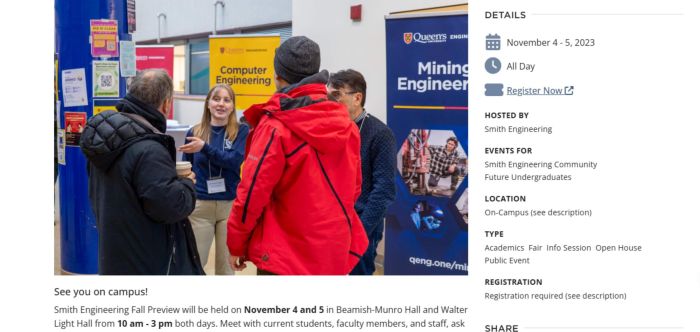
    Example: Queen’s University (Canada) demonstrated advanced planning by creating a dedicated “Fall Preview” Open House webpage months ahead. The page provided key details (date, schedule, location) and prominently featured a call-to-action for prospective students to register, ensuring maximum visibility and early sign-ups.
    HEM Image 2HEM Image 2

    Source: Queen’s University

    Then, plan your outreach. Don’t wait until the last minute. Get your date on the calendar months in advance, and begin promoting it strategically across various online channels:

    • A dedicated landing page on your school’s website (with RSVP).
    • A short email series to build awareness and excitement.
    • Countdown posts, teaser videos, and stories on social media.
    • Text reminders or personal phone calls to those most likely to attend.

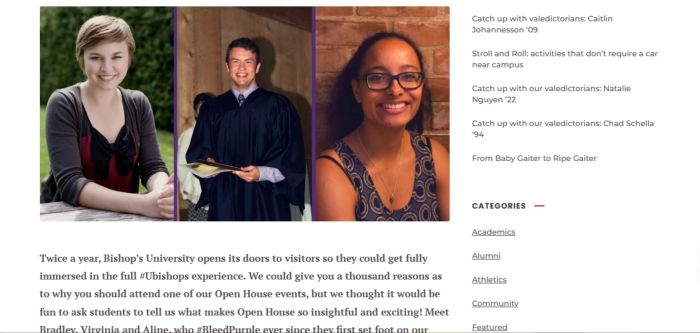
    Example: Bishop’s University (Canada) boosted promotion by publishing a blog post prior to their Open House that walked readers through what to expect at the event. This preview-style post generated excitement and informed prospective students and parents about the Open House experience in detail.
    HEM Image 3HEM Image 3

    Source: Bishop’s University

    Still want more attendees? Consider offering a virtual option. Whether it’s a livestream, a digital campus tour, or a short webinar, giving families more than one way to experience your school expands your reach.

    2. Make Arrival Smooth and the Welcome Unforgettable

    Let’s face it, no one enjoys showing up somewhere and feeling lost.

    That’s why the moment guests arrive at your open house, the experience should feel seamless and friendly.

    Start with signage. Make sure every guest knows exactly where to park and where to go. Have greeters ready: staff, student leaders, or enthusiastic parent volunteers. A welcome table with a map, a friendly smile, and a short overview of what’s ahead can work wonders.

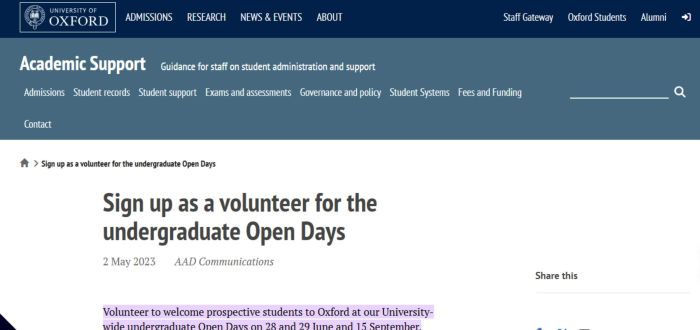
    Example: University of Oxford (UK): For its 2023 undergraduate Open Days, Oxford enlisted staff volunteers as greeters and guides. These volunteers welcomed visitors, helped with directions around campus, and served as friendly points of contact at entrances and info tables, ensuring guests felt comfortable and never lost.
    HEM Image 4HEM Image 4

    Source: University of Oxford

    Don’t stop there. Decorate with banners, student art, or a slideshow of school activities. Create a warm and exciting vibe the moment families step inside. You’re not just showing them the campus, you’re showing them the community they could be a part of.

    Example: UC Santa Cruz (USA): At its “Banana Slug Day” admitted-students open house in 2025, UC Santa Cruz set up check-in tables at key parking areas and deployed student guides (the “S.L.U.G.” ambassadors) throughout campus. Visitors were greeted at these welcome points and guided by the student ambassadors, making navigation easy and the arrival experience warm and organized.

    HEM Image 5HEM Image 5

    Source: UC Santa Cruz

    3. Spotlight the People Who Make Your School Special

    The facilities are nice. Programs are great. But what really wins hearts?

    Your people.

    That’s why teachers, support staff, coaches, and counselors need to be front and center during the open house. Make sure they’re not just present but prepared. Equip them with key talking points and FAQs so they feel confident answering questions and reinforcing your school’s values.

    What should teachers do for open house? Teachers should prepare a welcoming classroom with student work on display, provide a brief overview of their curriculum, and have handouts with contact information and expectations. During the event, they should greet families warmly, answer general questions, and encourage follow-up meetings for individual concerns.

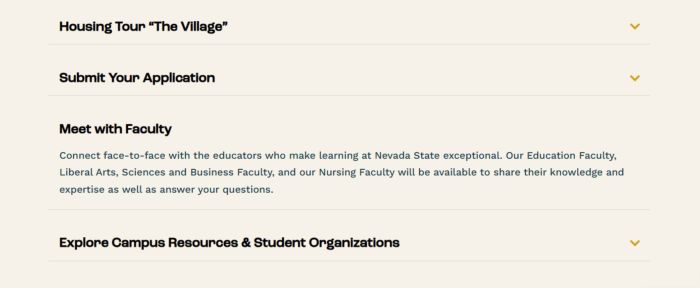
    Example: During Nevada State’s Open House, faculty participation was a centerpiece. The event agenda included “Meet with Faculty” sessions where professors from various departments (Education, Liberal Arts & Sciences, Nursing, etc.) were on hand to chat and answer questions. This gave visitors a chance to connect face-to-face with the educators and get a feel for the academic community.
    HEM Image 6HEM Image 6

    Source: Nevada State University

    Encourage classroom displays that show what day-to-day learning looks like. And while teachers should be warm and approachable, remind them this isn’t the time for parent-teacher conferences. Keep it general, upbeat, and informative.

    Want to go the extra mile? Kick off the event with a welcome from your school leader, followed by a quick intro to the key staff attendees. Let families know who’s who, and who they can talk to about specific interests like arts, athletics, or academics.

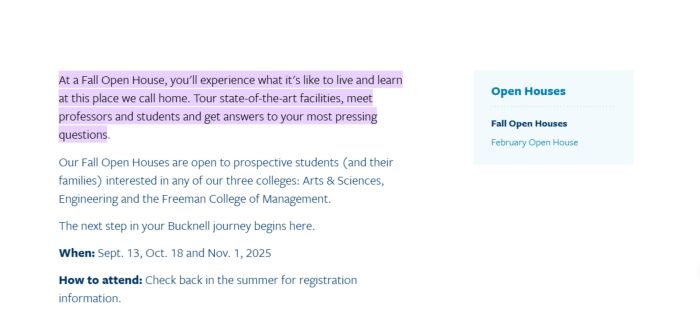
    Example: Bucknell’s Fall Open House actively involved faculty and staff in mingling with prospects. Visitors could tour facilities and meet professors and current students to ask questions about programs and campus life, rather than only hearing formal presentations. This personal professor-student engagement at Open House helped put a human face on the university’s academics.
    HEM Image 7HEM Image 7

    Source: Bucknell University

    4. Let Students and Parents Do the Talking

    Your current students and parents are your school’s best spokespeople. Hearing about the school’s strengths from an administrator or teacher is valuable, but hearing it from a peer can be even more persuasive. In marketing terms, it’s social proof, and it carries a lot of weight. In fact, one study found that 93% of people trust recommendations from friends and family, while only 38% trust advertising.

    Applying this to an open house, a prospective student is likely to trust the words of a current student, and parents will trust the perspectives of other parents, more than any brochure or formal presentation.

    That’s why student ambassadors and parent advocates are some of your most valuable open house lead generation assets.

    Hand-pick current students who represent the best of your school; friendly, positive, and articulate. Let them lead tours, greet visitors, or share their experience during a short panel. Their enthusiasm is contagious.  As one education marketing expert put it, hearing directly from current students and parents can be one of the most powerful ways to engage prospective families.

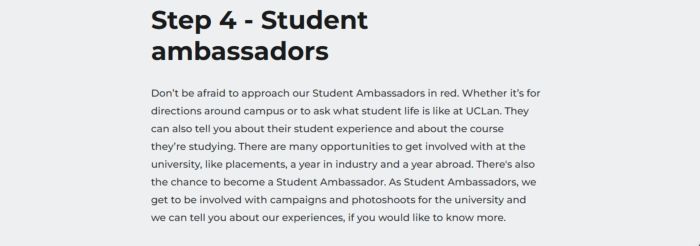
    Example: University of Central Lancashire (UK) : At UCLan’s Open Days, current students act as official ambassadors (identifiable in special red attire). These student ambassadors welcome visitors at entrances, give campus directions, and share honest insights about student life and their courses. Attendees are encouraged to approach them with any questions, making the experience peer-guided and relatable.
    HEM Image 8HEM Image 8

    Source: University of Central Lancaster

    Similarly, invite a few involved parents to chat with prospective families. Their personal stories, why they chose the school, how their child has grown, carry a weight that even the best marketing can’t match.

    You’re not just saying, “We’re great.” You’re showing it.

    5. Make the Event Fun, Interactive, and Memorable

    Let’s be honest: No one wants to sit through a two-hour lecture.

    So here’s your mission: Turn your open house into an experience. 

    How do you make an open house at school fun? Incorporate interactive elements like hands-on activities, themed scavenger hunts, live demonstrations, or student performances. Offer refreshments, set up a photo booth, and keep presentations short and engaging. The goal is to create an energetic, memorable experience that showcases school spirit.

    Instead of a long presentation, create a rotating itinerary. Let families move through classrooms, labs, and activity spaces at their own pace. Throw in a scavenger hunt or “passport” that gets stamped at each stop. Offer a prize at the end for completing the journey.

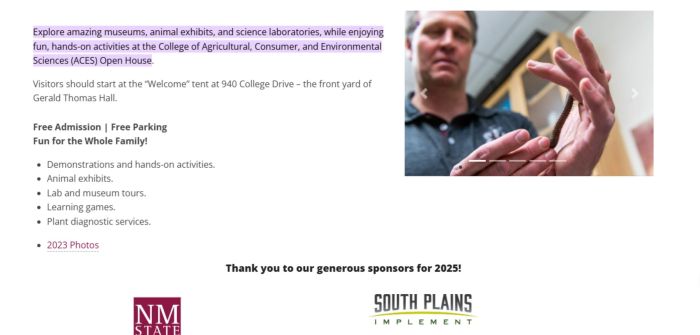
    Example: New Mexico State (USA): The College of ACES Open House 2025 at NMSU was designed as a family-friendly, interactive event. Visitors could roam through animal exhibits, science labs and museums with hands-on demonstrations and learning games at each stop. From petting zoo stations to chemistry experiments, attendees of all ages were invited to actively engage, making the Open House both educational and fun.
    HEM Image 9HEM Image 9

    Source: New Mexico State University

    What else works? Hands-on demos. Let students try a science experiment, play with robots, sample the art room, or participate in a music warm-up. The more your visitors can do, not just see, the more they’ll remember.

    Don’t forget the snacks. Coffee, cookies, or treats from the culinary class add comfort and create natural mingling moments. Bonus points if they’re decorated with school colors or logos.

    And yes, music, performances, or even a visit from your mascot can energize the space and give families that “wow” moment.

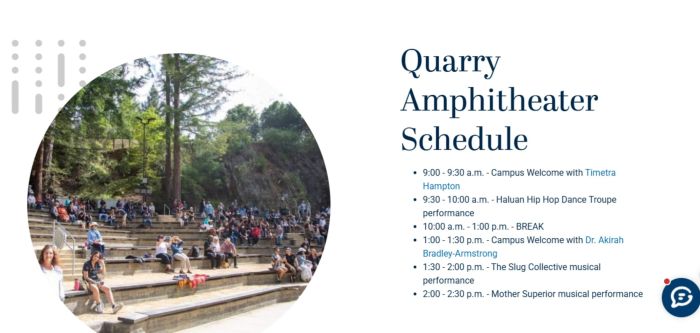
    Example: UC Santa Cruz (USA): The Banana Slug Day Open House combined campus exploration with fun activities. Prospective students and families joined student-led tours, watched student performances, visited a resource fair, and even sat in on mock mini-lectures by faculty. These interactive elements (plus chances to snag some UC Santa Cruz swag at the bookstore) turned the day into an immersive campus experience rather than a passive info session.
    HEM Image 10HEM Image 10

    Source: UC Santa Cruz

    6. Keep Presentations Short and Sweet

    You’ve got a lot to say, but that doesn’t mean you should say it all at once.

    Keep any formal presentations concise and dynamic. Ten to fifteen minutes max is ideal. Focus on the core message: What makes your school stand out? What are the values driving your mission?

    Break up speeches with visuals; videos, photos, and student voices make everything more relatable. If you can, include a current student or alum to co-present. Their stories add authenticity and emotion.

    Whatever you do, rehearse in advance. A confident, polished delivery makes all the difference.

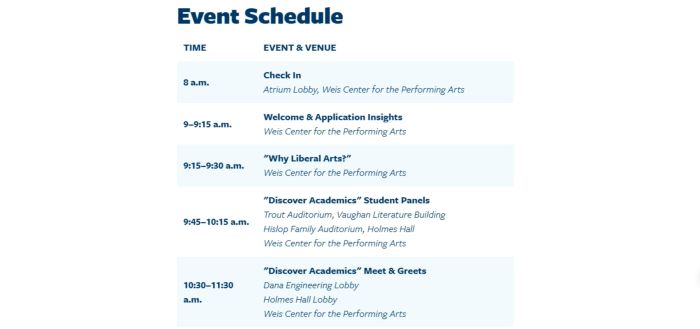
    Example: Bucknell keeps Open House presentations brief and purposeful. Its Fall Open House schedule is broken into short sessions: for example, a 15-minute welcome and admissions overview followed by a 15-minute “Why Liberal Arts?” talk. Instead of long lectures, Bucknell offers multiple bite-sized talks and student panels, which keep visitors engaged and allow them to sample various topics without fatigue.
    HEM Image 11HEM Image 11

    Source: Bucknell University

    7. Personalize the Experience

    Here’s where you go from good to unforgettable.

    Before the event, ask registrants about their interests: academics, sports, arts, etc. Use this intel to tailor their visit. Match them with the right teacher, program head, or club coordinator. Let them know you were expecting them.

    Even on the fly, personalization is powerful. Train ambassadors and staff to ask questions and respond accordingly: “You’re interested in robotics? You’ve got to meet Mr. Jackson. Let me introduce you.”

    Name tags, interest-specific packets, or a simple, “Hi Sarah, we’re so glad you’re here,” can go a long way in helping families feel seen.

    And yes, be mindful of accessibility needs, language support, and dietary restrictions. Every thoughtful detail adds up.

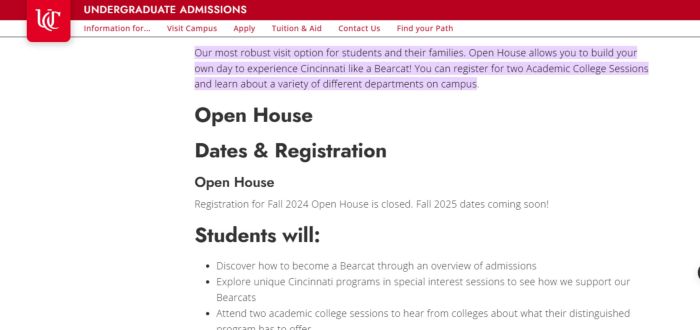
    Example: University of Cincinnati (USA): Cincinnati’s Open House model allows each guest to “build your own day.” Attendees register for the specific academic sessions and special topics that interest them most. For example, a student could choose two different college info sessions (say, Engineering and Business) and several niche interest workshops. The itinerary is flexible – with options like honors program talks, campus tours, residence hall tours, etc. – so each visitor crafts a personalized schedule aligned with their goals.
    HEM Image 12HEM Image 12

    Source: University of Cincinnati

    8. Send Families Home with Something to Remember

    You’ve done the work. Now end strong.

    Before families leave, hand them something to take home, whether that’s a branded folder with your materials, a printed photo from a photo booth, or even just a small keepsake like a sticker or magnet.

    More importantly, give them the info they need to take the next step. Include your admissions contact, an FAQ sheet, key dates, and a personalized thank-you letter from the principal.

    A friendly goodbye, a handshake, and a “We hope to see you again soon” can seal the deal emotionally. People remember how you made them feel. Make it good.

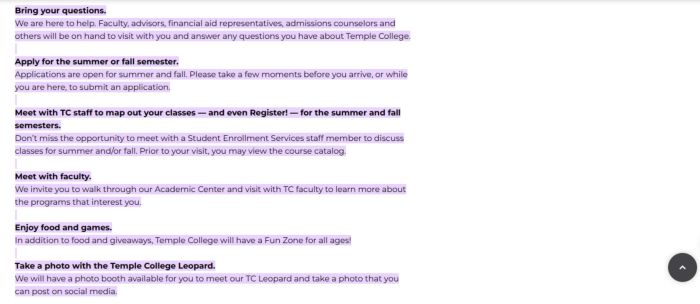
    Example: Temple College (USA): This community college makes sure guests leave with smiles (and photos). At its Open House, Temple College set up a fun photo booth with their mascot, “TC Leopard.” Students and families could snap pictures with the mascot – a keepsake to post on social media – and even win prizes. This lighthearted closing activity gave attendees a lasting memory and positive vibe to associate with the school.
    HEM Image 13HEM Image 13

    Source: Temple College

    9. Follow Up While You’re Still Top of Mind

    The event may be over, but your job isn’t.

    Send a thank-you email the next day. Personalize it if you can. Include links to the application page, upcoming deadlines, and photos from the event. Invite further questions and make it easy to get in touch.

    If a family asks about something specific, say, learning support or scholarship details, make sure someone follows up with a personalized message.

    Want to keep the momentum going? Enroll attendees in a short email series spotlighting your programs, alumni, or events. Nurturing that relationship can turn a visitor into an applicant.

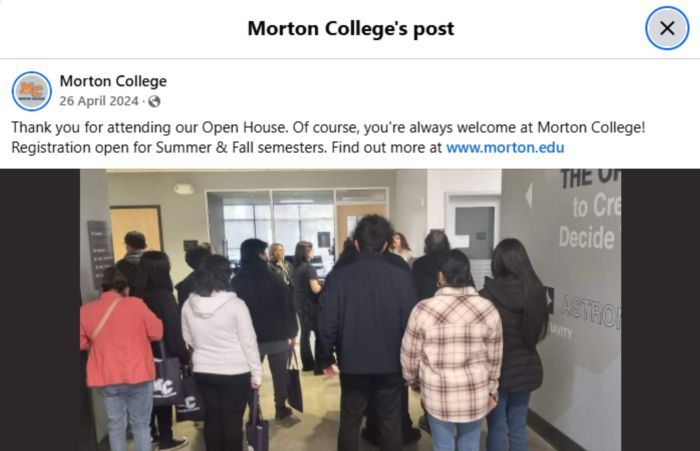
    Example: Morton College (USA): After the Open House, Morton College immediately followed up with attendees and the broader community on social media. They posted a thank-you message to everyone who came, reinforcing that visitors are always welcome on campus. Importantly, the message included a next-step call-to-action, a reminder that registration was open for upcoming semesters, nudging interested students to take the next practical step toward enrollment.
    HEM Image 14HEM Image 14

    Source: Facebook

    10. Debrief, Reflect, and Get Ready to Do It Even Better Next Time

    One last tip, and it’s a game changer.

    After the event, take time to evaluate. Meet with your team and ask: What worked? What didn’t? What feedback did families share?

    Review your numbers: RSVPs, attendance, applications started. Be sure to look for patterns. Did most families come from a certain neighborhood? Were particular sessions packed while others lagged?

    Use this insight to adjust your strategy for next time. Update your checklists. Refine your flow. Keep evolving.

    Oh, and don’t forget to celebrate your wins. Share event highlights in a post or newsletter. Thank your team. Show appreciation.

    Final Thoughts

    An open house is more than just an event, it’s an invitation.It’s your chance to say, “Here’s who we are. Here’s why we care. Here’s how your family fits in.”

    When you plan with intention, create moments of connection, and follow through with heart, your open house becomes more than a tour. It becomes a story families want to be part of.

    So get planning, and get ready to make your next open house your best one yet.

    Would you like to receive tailored open house school ideas for your institution?

    Contact Higher Education Marketing for more information.

    Struggling to stand out in a crowded market?

    Boost enrollment with tailored open house strategies!

    Frequently Asked Questions

    Question: How do you prepare for an open house at school?

    Answer: Start by setting clear goals and selecting a date that works for your audience. Plan the schedule, secure staff and student volunteers, and prepare promotional materials. Promote the event across multiple channels (website, email, social media), tidy up the campus, and organize signage, welcome tables, and printed resources to ensure a smooth, welcoming experience.

    Question: What should teachers do for open house?

    Answer: Teachers should prepare a welcoming classroom with student work on display, provide a brief overview of their curriculum, and have handouts with contact information and expectations. During the event, they should greet families warmly, answer general questions, and encourage follow-up meetings for individual concerns.

    Question: How do you make an open house at school fun?

    Answer: Incorporate interactive elements like hands-on activities, themed scavenger hunts, live demonstrations, or student performances. Offer refreshments, set up a photo booth, and keep presentations short and engaging. The goal is to create an energetic, memorable experience that showcases school spirit.


    Source link

  • Top Tips: Be naive

    Top Tips: Be naive

    Young people are often accused of naivety. But in journalism, naivety can be powerful.

    Being naive means sounding innocent or unsophisticated about something. You often get accused of naivety when you question why things are the way they are. Many people hate being accused of that, so they accept generally accepted standards — a fancy term I like is “prevailing paradigms.” 

    Often these are notions that some problems are so rooted that they can’t be fixed so you just have to accept them: polluted rivers or entrenched corruption or homelessness or discriminatory policies. 

    When you question these notions you might be accused of being naive. I say wear that like a badge. Why? Because if we accept problems without seeking solutions we won’t ever improve a community or society or nation. And that means that you must reject the idea that some problems can’t be solved. 

    It means we have to go back to the idea that everyone deserves clean air and water, healthy food, a basic education, shelter and safety. Nowadays you might add internet access, heat and electricity to that list and maybe a decent transportation system. The more I add, the more naive I sound. 

    Question prevailing paradigms.

    Good journalism comes from asking why people don’t have these things, not from accepting that they don’t have them. 

    So I suggest this: Draw an imaginary line. It represents a perfect world. In a perfect world everyone would have those things I listed: clean air and water, healthy food, etc. Then draw a line next to it that represents the current situation, and make the space between them wider the more off we are from that perfect world. Therein lies your story. 

    How far off is your community from having clean water or clean air? How bad are diets or how bad is the food shortage? 

    Then ask why. Why are people drinking or fishing out of contaminated water streams? Why are people going hungry? Why are people homeless? These are basic questions that come from the naive perspective that these problems shouldn’t exist in a perfect world. 

    Only when you ask these questions can you get to the heart of causes. Here is the hard part. The accusation of naivety comes not because these problems can’t be solved. It comes because the solutions are complicated. Sometimes they are really complicated. So the naivety comes in the idea that no one — including you or me — is willing to take the time and effort and brain power to unravel all those complications to get to solutions. 

    Prove them wrong.

    This all gets to the two traits that make someone a great journalist: Persistence and patience. It is the persistence to not just walk away when someone tells you that you are being naive or that a problem is too complicated, and the patience to work through the complicated elements. 

    All the complications people will throw at you are like protective layers around a problem. They are like the levels you need to surmount in a video game. 

    Once you peel them away, you get to causes that are pretty basic: Not enough money because people with money aren’t willing to spend it; a lack of power because people with power aren’t willing to cede it; and basic human failings like racism, homophobia, sexism or greed.

    If you can call out people or communities or government representatives on their racism or homophobia or sexism or greed, maybe you can get them to work on solutions. Only by finding solutions to problems can we get a little closer to that perfect world.

    Isn’t a perfect world the one you want to work towards? Or am I being naive?


    Questions to consider:

    1. What does the author mean by “prevailing paradigms”?

    2. Why can naivety be powerful in journalism?

    3. What are some problems in your community that people seem to accept without question?


    Source link

  • Balancing Passion & Practicality: Mia Aston’s College Success Tips

    Balancing Passion & Practicality: Mia Aston’s College Success Tips

    Photo courtesy of Mia Aston

    Mia Aston, whose popular YouTube channel details her daily life as an NYU film student, shares her best advice for college preparedness, career development, and financial literacy.


    What advice do you have for students trying to find the right balance between passion and practicality in their college and career choices?

    Finding a balance between passion and practicality is actually something that I still struggle with today. Amidst the competitive job hunt with graduation approaching this May, I am often questioning why I have led myself more with my heart rather than my head. Many college students choose a major strictly based on how much money they will make or what their working hours will look like. That feels practical. As a film student, I was so in love with storytelling that I dove straight into New York University, blinded by passion. I think any art student has to be somewhat delusional in that sense, but at the end of the day, it comes down to your priorities in life. I would try and figure out what you need to both sustain yourself and be happy. Is a corporate job with a steady income more important to you than an exciting job that initially might not pay the bills? Are you willing to work multiple jobs? Do you have the financial support to even start your career on a lower-paying salary? Can you pursue a more practical career path and still nurture your passions as hobbies? 

    The best advice I can give is to be honest with yourself. You will always have to make sacrifices. Personally, I cannot imagine doing a job that I am not passionate about. I probably will struggle immediately after graduation, but I would be miserable if I did not let myself work in a creative field. This is the unsettling sacrifice, or rather gamble, that I am making. 

    How can students make the most of their college experience — both inside and outside the classroom — to set themselves up for success?

    The best way to make the most of your college experience is to be proactive in learning and pursuing new opportunities. I always feel the most enriched when I am allowing myself to try new things and remain curious about my major. Attend school events, open lectures, galleries, film screenings, office hours, resume clinics, and more. The community around you can be inspiring and informative as well. There is such an endless array of resources available to you as a student. Take advantage of everything. 

    Networking is obviously also essential for your professional success. However, I have found that networking is the most enriching when you don’t approach it as a tool to meet an employer, but as an opportunity to learn from someone who has made it to a position that you hope to be in one day. Utilizing college as a learning experience outside of just the classroom can only help you. 

    What’s one piece of advice you wish you had received when you were preparing for college?

    In the same way that I followed my heart into a film degree, I often let my enthusiasm lead me astray. When I started college, I wanted to be a part of so many different school clubs and work opportunities that I ended up spreading myself too thin. I wish someone had told me to commit to one or two clubs or jobs and let the rest go. I ultimately realized it’s better to give your best efforts to one thing rather than do a half job at seven different things. 

    What are the biggest challenges you faced when navigating both academic and creative fields, and how can you overcome them?

    The biggest challenge I faced when navigating academic and creative fields was time management. The workflow and obligations of my academic and film classes can be extremely different. Managing your time in college is tricky regardless of your major, but when you have to write, shoot, and direct a short film on the same day that you have a research paper due for another course, it can be a little overwhelming. I overcame this by being diligent about my due dates and learning from trial and error. At the end of the day, my work will get done because it has to and because I will not let myself turn it in late. Additionally, managing my time between the two realms of academia and art becomes easier after every project I complete. As you learn more about your creative process and how long you need for each stage of production, you can begin to map out your workload schedule ahead of time. Sometimes I will start writing a paper over a month in advance because I already know that production for a film will be intense and demanding by the time that the paper’s due date rolls around. I am basically always trying to predict the future.

    What role do financial literacy and budgeting play in college preparedness, and what resources would you recommend for students?

    Financial literacy and budgeting play a huge role in college preparedness, but it looks different for everybody. There are so many factors to consider, and it is important to understand what your financial situation requires. NYU’s tuition is very expensive. In regard to my financial standing, I got lucky during my admissions process and was offered a full-ride scholarship from Tisch based on the portfolio I submitted. Therefore, I am able to cover my additional financial responsibilities through YouTube and freelance film jobs. When browsing through potential schools, I would research scholarships and apply to any offered by the college and external organizations. If you need to make money while you are a student, see if you can get an on-campus job. These jobs are great because they should be more flexible with your class schedule and coursework demands. Some of my friends are resident assistants at dorms. They are compensated through university housing and meal plans. I have other friends who work one or two service jobs to pay their bills. There are a variety of ways that you can navigate financial literacy as a student, depending on what you need. One piece of advice I would recommend is understanding what those budgetary restrictions look like for you and honoring them, even though students around you may have different spending habits. Be honest with yourself about the best way to responsibly manage your own money. 

    Source link

  • 3 Tips to Improve Student Mental Health

    3 Tips to Improve Student Mental Health

    Reading Time: 3 minutes

    This post is a modified version of an article that originally appeared on the Cengage EMEA “Unstoppable Minds Blog.”

    As Mental Health Awareness Month comes to a close, we’re highlighting insights from someone who’s been in students’ shoes. While studying psychology at Queen Mary University of London and serving as a Cengage EMEA Student Ambassador, Roya Mohamed shared three simple but powerful tips to help students take care of their mental health.

    I remember my first year at university. All of the new friends I made, the exciting modules I took, the societies I joined, my first time living away from home, learning how to cook and how to save money. It was such an exciting time full of adventure and new beginnings. I learned so much about myself and the world of adulthood. However, I also remember the all-nighters, the breakdowns, the tears, the times I almost gave up, the sacrifices I made and the feelings of loneliness and exhaustion I had. Being a student is not easy I would know — and the increasing academic and societal pressures cause a strain on our precious mental health. Being thrown into the deep end during my first year caused my mental health to plummet and I fell into a deep depression where I had to go to therapy. It was a bleak time in my life and for a while I didn’t know how to get out of the negative cycle I was in. But I did — hooray! There were a couple of changes I made to my daily routine that notably improved my wellbeing and stopped me from ever going back to that period of darkness. Follow these steps to start taking control of your mental health and wellbeing:

    1. Scheduling

    Not having a daily schedule can leave students feeling overwhelmed and unprepared. This can cause feelings of stress which can contribute to poor mental health. Planning time for revision, relaxation, hobbies, friends, family and sleep really helped to create a routine in my life and to avoid the anxiety I used to have about completing everything on my to-do listHowever, it will take time to adapt and follow a routine. But having a structure to your life will make you feel less worried and we all know that worrying does us no good.

    1. Positive self-talk

    This is a psychological strategy that you can use to increase your self-esteem, confidence, self-love and positivity. How do you do it? The clue is in the name! This technique involves talking positively to yourself, praising your achievements no matter how big or small they are and motivating yourself with words of affirmation. Being kind to oneself is a crucial step to maintaining good mental health. For example, when I received a grade that I wasn’t happy with, I would say to myself, “Roya, that was a very difficult exam and you still scored above the class average, you should be really proud of yourself!” At first it felt weird doing this, but you begin to internalize the thoughts and quickly realize how good it makes you feel!

    1. Sleep

    We all know that students have a tricky relationship with sleep. It is recommended that university students sleep for 7-9 hours a night. This can prevent you from feeling fatigued, sleepy, having low concentration levels and becoming irritable. However, we commonly see students pulling “all-nighters” where they sleep very little — or not at all — in order to complete an academic task. I don’t recommend this at all. When it comes to revising, all-nighters are practically useless. This is because our sleep cycle at night consists of four cycles, each lasting 90 minutes. In each stage of the cycle, our body and brain rejuvenate in different ways. One area that is affected is our memory of that day. If you don’t go through the four cycles, then the hours of revision won’t be “consolidated” into your memory — moved from short term to long term memory. This causes stress and regularly losing sleep can contribute to poor mental well-being. Once I began to sleep enough, I really saw how it improved my life.

    These are just some of the changes I began to make which took my mental health out of the darkness I was in and back to the bright old me!


    Roya Mohamed was a former Cengage Student Ambassador studying psychology at Queen Mary University of London.

    Roya shared three meaningful student mental health tips that can help improve overall well-being. If you think these tips might be impactful for your students, share this article and also check out “5 Ways I’m Building Connections With My College Peers” by Pranav Harwadekar, a junior at Texas A&M University.

    Source link

  • Student Minds Blog : Dealing with homesickness and loneliness: tips for year-abroad students

    Student Minds Blog : Dealing with homesickness and loneliness: tips for year-abroad students

    Before you go on a year abroad, you’re told plenty of advice: try to take it all in, say ‘yes’ to everything, and speak as much of the local language as possible. The list goes on.   

    Much of this advice before I moved to Lyon in France for my year abroad faded into irrelevance as I was consumed by nerves and worries about the move. What was my accommodation going to be like? Would it be easy to make friends? Was I going to be able to cope with university academics in another language?  

    Although many of these questions have fortunately been replaced by positive experiences, there are two things I didn’t quite expect to encounter: homesickness and loneliness. When I was not in Lyon, I studied at The University of Manchester, a city I grew to love and appreciate. Embarking on a year abroad is particularly challenging when you’ve become accustomed to one place, only to uproot everything and move. Adjusting to living away from home in a new location is hard enough, but having to do it again and re-adjust next September adds another layer of difficulty. One of the most important things is to acknowledge that you are completely within your right to feel homesick and unsettled. I’ve found it really helpful to avoid comparing my current experience to my life in Manchester. This has limited feelings of homesickness and instead allows me to appreciate that the two experiences will be inherently different.   

    I have grown to learn that I instead cannot simply ‘replicate’ my life in Manchester in Lyon. Keeping similar routines and activities has allowed me to be more settled, even just having the same decorations as my last two rooms at university.    

    Surrounding yourself with people from all walks of life can also be beneficial in helping with homesickness – being open with how you’re finding it can spark conversations and ultimately build stronger friendships too. Having friends who also come from your home country can help too – it’s surprising that not hearing your own language whilst out and about can be isolating. I will never take for granted the experience of being a home student in the UK again.  

    I’ve become much better at using FaceTime, as keeping up with friends from home, university, and my year abroad can be challenging. It’s comforting to know that even though I don’t see them as often as I used to, many of my friends are still there for me. Scheduling calls can help you stay in touch with those who matter a lot to you.  

    Another challenge I’ve found with doing a year abroad is overcoming loneliness and feelings of isolation. Fortunately, there is a group of students who’ve also come from Manchester, as well as friends from all over the world, who have made the experience a lot easier. The temporary nature of a year abroad (or even just a semester for some) is undoubtedly a double-edged sword. While you want to make the most of everything, it’s impossible to do it all. Spending an evening in my flat instead of going out with friends, or dedicating a weekend day to relaxing and catching up on work – though necessary – sometimes leaves me feeling like I’m not fully maximising the experience I could be having. The reality is, we’re only human. Going out every night, constantly staying busy, and completely neglecting university work would ultimately have negative consequences in the long run. It can be hard not to compare yourself to others who are on a year abroad, whether they’re in different cities, countries, or even the same place as you. 

    While social media allows us to stay updated on the experiences of lots of people, it often serves as a highlights reel—especially for something like a year abroad. I frequently remind friends who respond to my Instagram stories about day trips, scenic viewpoints, or fun activities that it’s not all sunshine and rainbows. Many people who’ve done a year abroad focus on sharing the positive moments, often leaving out the less glamorous side of the experience. My grades from the university here don’t directly transfer to my final transcript; instead, all I need to do is pass. 

    This has been incredibly helpful in reducing the pressure to excel academically, allowing me to focus on making the most of the experience. However, the free time this arrangement inevitably gives me has been a challenge as someone who thrives on staying busy. That said, it’s been a valuable learning experience. My second year in Manchester was intense—I was constantly juggling my course, societies, and socialising with friends. Being abroad, though, has forced me to slow down, providing a much-needed break. It’s been a steep learning curve but one I can say has been incredibly beneficial for my personal development.  

    Remember that your home university is there for you throughout your year abroad and the reason you pay a percentage of fees that year is for continued access to services (including mental health support). The Foreign and Commonwealth Office’s Travel Aware Campaign has specific advice on mental wellbeing and living abroad too.

    I’m a third-year History and French student at The University of Manchester but am currently studying in Lyon in France as part of my year abroad. I’m passionate about making sure more students are aware of the support they have access to and destigmatising the challenges mental health can pose whilst in education.  

    Source link

  • Solutions for Students Skipping Classes: Tips to Boost Performance

    Solutions for Students Skipping Classes: Tips to Boost Performance

    High education institutions and colleges are trying hard to suppress student skipping rates to boost performance and improve education standards. Management is trying hard to tackle truancy by imposing strict penalties on students skipping classes. Suspensions can only count as time missed from classroom instructions. Parents also face a blitz on attendance, and they are trying to keep students in higher education.


    No more students skipping classes – try these out!

    With nearly 25% of students admitting to skipping classes, we have churned out 10 sure-fire ways to tackle the issue behind students skipping classes. Easy to adopt, try these out for a result in a split-second.


    Techniques to tackle students skipping classes


    Monitor Attendance

    This is practically the first and foremost way when trying to clock in to stop students from skipping classes. Monitoring attendance at high education is not new. Forget the days when faculty used to pass a piece of paper around the classroom to check attendance. It was ideally to support students who silently disengage. But trust us, of the hundreds of students attending lectures, 10-20% can even be missing without the lecturer realizing. Do not think of suspensions – for even they count as time missed from classroom instructions. Having an attendance policy in place works better! With electronic registrations, there can be a more structured attendance pattern. RFID-based attendance management system tracks unauthorized absence or lateness of higher education students in real-time. This will reduce the scenario of students skipping classes keep up-to-date records for all courses and improve student outcomes.

    Track Discipline

    When it comes to tackling the problem of chronic absenteeism, students who already have a track record of skipping class can be a particularly tough crowd to sway. So infectious they could be! The overall strategy for tackling such high education absenteeism should be to prioritize discipline. Getting into a friendly discussion helps. Figure out ways to help such students. Pool in mentors! Take complete ownership. Alternatively, manage and track behavior incidents of students using discipline software and generate automated reports for quicker decision-making.

    Parent Communication

    Get parents involved! This can be a way to reduce tardiness amidst such irregular students. Increased communication with parents will curb the notion of students skipping classes. Today, there are many parents connect software that provides real-time access to student’s academic information.

    Manage Assessments

    Another reason for students to skip classes could be their exam anxiety. If these classic signs of test uneasiness fill your classroom, attendance muddles will be there. Make assessments tension-free by creating online tests and assignments and sharing results with students and parents often. This will reduce the rising numbers of withdrawals from assessments and remove fears and inhibitions from students and parents.

    Review of Curriculum

    Hard to believe, but yes attendance truancy could be a result of the ill-fitting curriculum too. Teachers can review the curriculum and align the portfolio of courses to deliver quality learning for the institution. The curriculum management system provides student access to all the relevant course and curriculum data.

    Smart Classrooms

    Students feel aloof when teachers do not spend little or quality time with them. With smart classrooms paperwork gets eliminated, enabling teachers to spend quality time to improve teaching and learning.

    Teacher Evaluations

    Never neglect students who are chronically absent themselves – be all ears and resolve it at the earliest. This strategy works better! Analyze the teacher’s effectiveness in classrooms with a strong evaluation system and set performance goals to improve their skills. An ineffective faculty is but a drabby asset to the class. After all, it is they who matter the most in the classroom.

    Role-based Security

    The high education management system provides role-based authorization which facilitates discipline and eliminates privacy concerns of students. This information is protected and will be visible only to the targeted students or groups. Parents will be able to access and see the information about his or her children.

    Event Management

    Turn mundane days into gripping ones by scheduling events and announcements! With many departments and units, scheduling an event might seem like a task. Using an online calendar can be a lifesaver here. With such a calendar in place, make instant academic information available to students, teachers, parents, and alumni for specific purposes.

    Automated Notifications

    Don’t wait for the students to turn up the next day to notify them. Sending mass notifications with pre-built templates helps! Dish it out to students, teachers, staff, and parents via email, SMS alerts, and push notifications.


    How Creatrix Campus Cloud Can Transform Your Institution and Simplify Student Life

    Here’s a tip: Cloud and mobile technology can tackle regular and chronic absenteeism and benefit in many ways. They drastically result in increased attendance rate, improved student performance, reduced staff workload, and improved efficiencies of the institution.

    Creatrix Campus offers the most advanced cloud and mobile-based cloud suite of solutions designed for higher education institutes. Adaptable, it easily integrates with other modules and provides secure access to track all your information in a single unified system.

    Source link

  • When in Dublin… | Abbey Road Programs

    When in Dublin… | Abbey Road Programs

    Dublin is a unique, quirky city which is very walkable and full of interesting buildings and architecture. Here are my top five things to do in Dublin (although there are a lot more!).


    Dublin Castle

    Located in the heart of Dublin, the Castle is believed to have originally been an early Gaelic Ring Fort. Although the Castle is now used for State functions and presidential inaugurations, visitors can explore much of the Castle, including parts of the original 13th-century fortress. The rich history of the Castle gives a lot of insight into Dublin, and the grounds are absolutely gorgeous.


    Cliffs of Moher

    Lying outside Dublin’s walls, The Cliffs of Moher are a must-see and were a major highlight of my semester aboard. The Cliffs span for five miles, and the views are incredible. This natural attraction is a popular tourist destination but is one that should not be missed. I recommend using a tour guide company to visit the Cliffs (like “Paddywagon Tours”), as the prices are very reasonable and you get to see some cool stops along the way. The wind can be a bit chilling so make sure to bring a jacket and, of course, a camera to take pictures of the breathtaking landscape.


    St. Patrick’s Cathedral  

    St. Patrick’s Cathedral has a rich history that dates back over 800 years. One of the few buildings remaining from medieval Dublin, the Cathedral has a gorgeous interior and the many burial sites including that of Jonathan Swift, author of “Gulliver’s Travels”. After visiting the Cathedral, make your way to St. Stephens Green and take a stroll through the public park, which houses the Yeats Memorial Garden as well as many festivals throughout the year.


    Trinity College

    Visiting Trinity College while in Dublin is a must! Walk on the cobblestone paths through the grounds, buildings and dining areas to see what a selective college looks like abroad. Afterward, make sure to drop by the Book of Kells Exhibit to walk through the Old Library and other works from the 18th century, including the Book of Kells.


    ABOUT THE AUTHOR: Jolie Blair is a rising senior at Emory University from Sun Valley, Idaho. She is double majoring in Theater Studies and Public Health and has a passion for the arts, writing, and traveling. She studied abroad for the 2016 fall semester in Rome, Italy and had an experience of a lifetime, which she loves to share with those who want to listen (and even those who don’t like her 140lb Great Dane!).

    Check the current list of our programs here.

    Visit our website.

    Source link

  • Tips for the Student Journey- Archer Education

    Tips for the Student Journey- Archer Education

    5 Tips for Keeping Students Engaged Throughout the Admissions Process

    In higher education, the enrollment funnel can feel like a battleground for institutions vying to convert interest into commitment. 

    Traditionally, the enrollment funnel has been viewed simply: attract, engage, and enroll. But the modern student’s journey is anything but straightforward — it’s a complex, winding path influenced by numerous digital touchpoints and personalized interactions.

    The health of the enrollment funnel extends beyond mere numbers; it represents the institution’s ability to connect with prospective students through every phase of their decision-making process. With technology reshaping expectations and behaviors, colleges and universities must not only catch the eye of prospective students but also keep them engaged through multiple channels and strategies. 

    This article unpacks key elements of the enrollment and admissions funnel, offering actionable insights and innovative tips to capture and retain students’ attention from their first inquiry through their enrollment stages. As we explore these strategies, you’ll discover the vital role that continuous, tailored engagement plays in transforming interest into activity, setting the stage for a successful educational journey.

    The Modern Student Journey

    Today’s students embark on their educational journeys equipped with a wealth of information and digital tools at their fingertips, making their paths to enrollment more complex and multifaceted than ever before. 

    Complexities and Challenges

    The student journey is far from linear. It involves numerous interactions across various platforms and touchpoints. Each student’s path is unique and influenced by personal, financial, and academic factors. 

    For instance, a modern student, such as a working professional returning to education or a parent seeking to balance family responsibilities with schooling, may have different priorities and use different resources compared to a younger, first-time college student.

    Technology has diversified the ways students gather information, and also how they engage with institutions. Prospective students might start their journey by conducting a simple Google search, but they will also often visit social media platforms, participate in virtual campus tours, and attend online webinars before starting their application. During this time, they are continuously evaluating their options and being influenced by each interaction they have with a school’s digital presence.

    Impact of Technology

    The proliferation of digital platforms has dramatically altered the student journey, both for students and institutions, in ways such as the following: 

    Given these technological influences, it is essential for educational institutions to adapt their enrollment strategies to meet the changing behaviors and preferences of modern students. Integrating data analytics, enhancing digital communication channels, and providing personalized experiences are all critical to effectively engaging with prospective students throughout their decision-making journey.

    Understanding the Enrollment Funnel 

    The enrollment and admissions funnel is a foundational concept in higher education marketing that illustrates the progressive stages a student navigates, from awareness through enrollment. The funnel is not just a theoretical model but a practical guide for shaping effective engagement strategies. 

    6 Stages of the Enrollment Funnel

    The enrollment funnel can be divided into several key stages, each requiring specific strategies to move prospective students to the next step:

    A deep understanding and effective management of the enrollment and admissions funnel is crucial for any educational institution aiming to increase its student body. Let’s see how it’s done. 

    How to Keep Students’ Attention Through the Enrollment Funnel

    Maintaining the attention of prospective students throughout their educational journey is crucial for successful enrollment. Here are key strategies to keep students engaged from initial inquiry through enrollment:

    1. Consistent Engagement Across Channels

    Leverage multiple channels to engage with students to ensure your institution remains top of mind. Implement a mix of digital and traditional marketing strategies to reach students where they are most active, such as the following:

    2. Personalization and Differentiation

    Tailor your communications to meet the specific needs and interests of each prospective student, and utilize data from their interactions with your digital content to personalize messages. Strategies to achieve these goals include the following:

    3. Incentives and Urgency

    Create a sense of urgency and motivation by offering incentives that encourage prospective students to take the next step:

    4. Building Relationships

    Foster a sense of community and belonging from the first interaction through forums such as the following:

    5. Continuous Improvement

    Regularly assess and refine your engagement strategies based on feedback and analytics tools and processes:

    It’s Time to Build Out Your Enrollment Funnel 

    The landscape of higher education is competitive, but the enrollment funnel could be your institution’s edge. By engaging prospective students at every stage of their journey with tailored strategies and personalized communications, institutions can significantly enhance their enrollment rates. If you’re ready to elevate your enrollment marketing strategies, Archer Education is here to take you to the next level. Reach out to us, and let us help you create a robust enrollment funnel that not only attracts but also converts prospective students into committed learners.


    John Van Fleet

    John Van Fleet is the Chief Marketing Officer at Archer Education. With more than 20 years of experience in higher ed marketing, John has a continuous track record of successfully supporting institutional growth.

    Source link

  • 10 Top Hat Tips for a More Engaging Semester

    10 Top Hat Tips for a More Engaging Semester

    What does the future of higher education look like? At Top Hat, we believe engagement, affordability and equity are at the heart of a great classroom experience. That’s why we’re excited to highlight a number of features in our platform and content solutions to empower students and faculty alike. Take a look at these unique capabilities in Top Hat and get ready to level up your lectures, assessments and grading strategy.

    → Free Toolkit: Get strategies, templates and videos for a successful new term

    1. Add AI-generated questions to every lecture

    Top Hat Ace, our AI-powered assistant, is the latest milestone in our mission to make education more effective, inclusive and accessible. Instructors can use Ace’s Lecture Enhancer to instantly generate assessment questions based on their lecture content. Doing so will spark engagement in class and help educators assess comprehension in the moment. Faculty can even edit generated questions as they see fit, maintaining control over the questions generated. Learn more about our AI-powered Lecture Enhancer here. In addition, educators can save time designing assignments and readings in Top Hat Pages by adding questions automatically generated by Ace.

    2. Assign homework to specific students

    Shore up learning gaps sooner rather than later. With personalized data delivered to your inbox every week, identify which students didn’t answer discussion or poll questions in your lecture and re-assign your PowerPoint slides to this group as homework. This will give students a chance to refresh themselves on your material, which may prove especially beneficial for those who weren’t able to join your class live. Learn more about assigning homework to specific students here. You can also watch the video below as we explore the difference between homework and review mode.

    3. Make your discussion and poll questions media-rich

    Give students an interactive assessment experience. You may know how to add videos or simulations to your Pages, but you can also directly embed media into your quiz questions. Not only will students get a more dynamic, immersive learning experience, they’ll get an opportunity to consume your course material in a different medium. Plus, using videos in your quiz questions makes for a more engaging alternative to the static Scantron or multiple-choice test. Learn more about using videos in questions or discussions here.

    4. Offer line-by-line feedback on document submissions

    Enjoy feedback functionality that will be familiar to those who regularly use Google Docs. Using our file submission question, students are able to upload PDFs, lab templates or spreadsheets to Top Hat. Take your feedback to another level by offering annotated comments at various points in PDF or image submissions. This level of detailed commentary allows students to fully understand their own learning gaps, while giving you an opportunity to flag specific areas for improvement in advance of a high-stakes assessment. Learn more about how to leave detailed feedback in PDF file submissions here.

    5. Measure comprehension of the same concept over time

    If you’re preparing students for an exam and want to check their understanding of tricky concepts multiple times, this feature is for you. Compare student comprehension over a period of your choosing by keeping a record of responses to the same question asked more than once. After enabling this feature, you’ll be able to compare responses submitted on date X with date Y, seeing what percentage of students answered a particular way and letting you adapt your instruction accordingly. Explore how to create multiple question report sessions for your next quiz here. You can also watch our video below to see how to segment question results over time.

    6. Annotate your slideshow with whiteboard sketches

    Sometimes, visually explaining a new concept can be easier than describing it in words. Top Hat’s Whiteboard Sketch tool allows you to insert blank slides into your slideshow, which you can then draw on in real time. For instance, complement a presentation on mitosis by drawing out the various stages live, answering student questions along the way. This tool doesn’t just allow for richer, more detailed discussions, it ensures students get a visual depiction of challenging concepts before moving on to your next topic. Learn how to embed interactive elements into your slides here.

    7. Embed iFrames to create a truly interactive learning experience

    Tailor your learning materials to the needs of Generation Z. When creating assessments, homework or customizing chapter readings in Pages, use iFrames to link to media such as podcasts, websites, simulations and GIFs. Open the interactive toolbar in your page, select the iFrame option and paste your desired link in the field. Learn how to embed iFrames in your course content here. You can also watch our video below for guidance on creating course materials using Pages.

    8. Use Presenter View to view personal notes and real-time responses

    In a single view, get all the information you need to deliver a high-quality presentation. Use Presenter View to get a second screen that’s only accessible to you. View lecture notes that you added into your slide deck and get a live report of students’ responses as they answer questions live. Plus, preview which slide is next—and shift your conversation with students accordingly. Explore the power of Presenter View in helping you deliver an impactful slideshow here.

    9. Keep your course textbook fresh and relevant with in-app content updates

    Give students a learning experience that mirrors the world around them. Incorporate the latest content updates without losing any customizations in your interactive Top Hat textbook. You’ll be alerted whenever new author-created content is available for your text and will be given a chance to review all updates before accepting or rejecting them. This functionality ensures that educators have access to the latest content when it becomes available, on their own terms. In-app content updates are currently available in beta format for select Top Hat textbooks. Discover how our content enhancements make it easy to keep any textbook up-to-date here.

    10. Provide AI-powered study support 

    Make sure every student has in-the-moment study support. Students can use our AI-powered study assistant to clarify challenging concepts, generate examples of specific topics and quiz themselves in advance of a test. Ace delivers relevant responses built from the context of your uploaded materials, making it easy for students to review lectures and study notes in one place. Read more about our personalized study assistance here. You can also watch the video below for a closer look at our AI-powered study tools.

    → Free Toolkit: Get the Most Out of Top Hat

    Source link

  • Dr. James Lang’s 4 Tips for a Great First Day of Class

    Dr. James Lang’s 4 Tips for a Great First Day of Class

    What goes into a great first lecture? Ask any educator and they’ll highlight three resounding themes: prioritize community, foster connection and build excitement. The good news is that designing a high-impact first lecture doesn’t involve a complete rewrite of your existing lesson plan. Rather, it’s about making simple adjustments to help students form a great first impression.

    Dr. James Lang, acclaimed author of Small Teaching and featured speaker at Top Hat Summer Camp 2024, shares actionable strategies to deepen engagement during week one of your course. We’ve rounded up his ideas below.

    → Student Engagement Toolkit: Enjoy FREE teaching tips, templates and more!

    1. Focus on community building

    Set the table for long-term success by getting to know students and in turn, help them get to know you. Consider sharing what made you want to teach your specific subject and the most rewarding part of teaching. Dr. Lang also suggests intentionally forging personal ties with students. Simple practices could involve showing up to class early and greeting students as they file in. You might also use your first lecture to stream a relevant TED talk, podcast snippet or music video that relates to your course material. Helping students see that there’s more to the first day than reviewing the syllabus will surely leave them feeling inspired and primed to learn. What better feeling could there be as an educator?

    2. Ensure activities model your course structure

    The early stages of your course represent an important opportunity to instill the right behaviors. Dr. Lang’s advice? Begin as you intend to continue by modeling the kind of learning environment you seek. For instance, if your course revolves around peer-to-peer discussions, consider including a collaborative exercise during your opening session. If active learning is important, give students a problem to solve or have them respond to a series of polling questions. Dr. Lang shares other discipline-specific examples of how to break the ice between students.

    History English Math
    Take a page out of Dr. Cate Denial’s book. The Bright Distinguished Professor of American History at Knox College, who teaches a problem-based course, randomly places students in small groups. She then provides each group with a document package about a specific event. Students then work together to develop stories about what occurred during the event. Finally, they share their stories with the wider group. The purpose of the exercise is to demonstrate that in the pursuit of truth there are often numerous ways historical events can be interpreted.  Any English instructor can vouch for the importance of discussion and critical analysis. Consider holding a prior knowledge brainstorm to spark conversation among students. For example, if your course covers 21st Century British literature and culture, you might ask students to respond to the following prompts: a) what do we mean by the word ‘British?,’ b) what are your impressions of British culture and c) are you familiar with any British writers? This is a great way to surface prior knowledge, clarify common misconceptions, and get students thinking about the journey ahead.  You might also use your opening class to get students reflecting on their past experiences in your subject. Dr. Robert Talbert, Professor in the Department of Mathematics at Grand Valley State University, uses open-ended questions to encourage students to reflect on their learning. He shares the following prompts: a) what is something that you are good at doing? And b) how did you get good at the thing you are good at doing? Math is a challenging subject. This exercise gets students thinking about their approach to learning while sending a subtle message that you are invested in their success. 

    3. Pose ‘big’ questions to students (and yourself)

    Framing your course as a BIG question to explore over the term is a powerful way to pique curiosity, build excitement, and communicate the value of what students will learn. Starting your course with a BIG question is also a great opportunity to engage students right away in a meaningful discussion. Here’s an example from a course on science fiction:

    “Can you be confident that the person sitting next to you on the bus is really a human rather than some remarkable replica conjured up by a mad scientist or, perhaps, an alien from another planet? What evidence is needed to conclude that the person casually looking at her mobile device is human? How have we constructed the conceptual boundary between what we qualify as human and what we categorize as robotic, animal, android, or alien? What, in the end, makes the human “human”?”

    If you’re struggling to craft a big question for your course, Dr. Lang suggests thinking through the following prompts:

    • What deep questions drove the development of my discipline?
    • What questions drove the creation of my course?
    • What intriguing questions have arisen over time?
    • What questions remain unanswered in my field?

    To drive a first day discussion around your big question, you might ask your students to pair up and answer the following: What do you know about this subject? How might this relate to other things you’ve studied? How would you answer this question? What other questions does this bring to mind?  Once students have had an opportunity to discuss, regroup as a class and ask a handful of pairs to share their insights.

    4. Try out the Annotated Syllabus method

    Your course syllabus serves as the roadmap for the term. While important to review, Dr. Lang advises it shouldn’t be your first priority and counsels against simply reciting each section. Instead, he suggests using the Annotated Syllabus methodology. Conceptualized by Dr. Remi Kalir, Assistant Professor of Learning Design and Technology at the University of Colorado Denver, the Annotated Syllabus is a tool to generate a broader conversation about your course.

    Prior to the next class, ask students to work through the following prompts: What do students feel needs further clarification? What are their sentiments around your course policies? What are their opinions about readings and assignments? What advice do you have in order to be successful in the course? The goal is to strive for commentary that is “inquisitive and constructive.” Above all, an Annotated Syllabus invites feedback that may otherwise go unheard. Students are made active participants from the get-go and are more accountable for reading the document before coming to class.

    Source link