
Tag: today

  • AI Teaching Learners Today: Pick Your Pedagogy

    AI Teaching Learners Today: Pick Your Pedagogy

    University budgets across the country are broken. Overall revenue and accumulated financial support appear to be declining for a wide variety of reasons.

    New funding policies, administrative reorganizations such as those at the Department of Education, lean fiscal times for states, diminished regard for higher learning, fewer requirements for degrees among employers hiring for entry-level positions and the impact of artificial intelligence all come together to reduce the pool of new students, tuition revenues and grants. As a result, new initiatives are stifled unless they show promise to immediately reduce costs and generate new revenue.

    The cost of developing, designing and teaching classes is often largely determined by the faculty and staff costs. Long-running lower-division classes at some universities may be taught by supervised teaching assistants or adjunct faculty whose salaries are lower than tenure-track faculty’s. However, we are now confronted with highly capable technologies that require little to no additional investment and can bring immediate revenue positive opportunities. Each university very soon will have to determine to what extent AI will be permitted to design and deliver classes, and under what oversight and supervision.

    However, few of us in higher ed seem to realize that such technologies are freely available today. The tsunami of new and improving AI technologies has inundated us over the past three years so quickly that many in academe have not been able to keep up.

    Case in point is the rapidly expanded and enhanced AI app. We know them by the names Gemini, ChatGPT, Claude and a few others that we tried out in 2023 or 2024. Early on, they were deficient in many ways, including hallucinations and a strictly limited number of words you could put into a prompt. That has largely changed, though hallucinations can still happen—which is why it is good practice to compare prompts submitted at multiple sites, as has been suggested previously in this column.

    AI is now capable of teaching higher learners in a highly sophisticated way. Given a thoughtful, detailed prompt, it is able to implement most of the proven pedagogical approaches, many of which are unknown to our teaching faculty. It is able to dig more deeply into a topic with more recent data than many of the faculty members are using. It can interpolate, extrapolate and pursue conjectures to their statistical conclusions, revealing unexpected outcomes. It can be friendly, supportive, patient and also challenging at the appropriate times.

    My point is that the prompt today can be a most powerful teaching tool that can consistently create a robust, engaging learning environment. It can even offer material through a variety of pedagogies. A well-written, detailed prompt can be the equal of many of our teaching assistants, adjunct faculty and, yes, full-time faculty members who have not been deeply trained in effective pedagogy and current practice.

    Let’s test out one of these technologies right now!

    This one below, shared by the “There’s an AI for That” newsletter, provides an online tutor to teach students using an assortment of time-tested technologies and pedagogies. The first step begins with merely a prompt, albeit not a short one. The Interactive Learning Tutor is a virtual instructor that runs on the leading frontier AI app models (Gemini, ChatGPT and Claude). Most interesting is not only the vast range of topics it is prepared to deliver, but the range of pedagogies it will enable at the request of the learner. So, the learner can pick their pedagogy rather than being subject to the designer’s and instructor’s choice of teaching and learning methods.

    This prompt turns AI into a dual-role system that first helps learners choose the most effective study techniques for their subject, then switches into live teaching using those chosen methods. In Navigator Mode, the system gathers details about what the user wants to learn and how they prefer to learn it, then presents a curated set of three to five evidence-based methods from its catalog. Each method is explained in depth, with strengths, limitations, step-by-step applications and concrete examples tied to the user’s subject. It also suggests learning archetypes, outlines pitfalls and fixes, creates an integrated action plan, and provides tools like reflection prompts, comparison tables, and pathways matrices to help learners see their options clearly.”

    This is a highly qualified virtual teaching assistant, eager and well prepared to take on the task of teaching an individual in an online tutorial or class. Imagine 30 students, with a week or so initial orientation, running this app to achieve specified learning outcomes in an engaging, interactive way. The materials provided in the individual tutorial could be augmented through a syllabus of supplementary readings, reference materials and periodic assessments leading up to a final project or paper to be submitted individually or by groups in the class. The prompt and app take over the most important role of engaging and guiding the student in ways proven to be successful.

    So, let’s give this a road test! Step one is to copy the 1,112-word prompt that begins with and ends with . Paste this into the input box of your chosen AI app and press enter. After a brief moment for processing, the app will reply with an invitation to share the topic about which you would like to learn. This would be defined by the instructor of the course along with the learning outcomes for the class. As an enthusiastic learner who is going to attend an outdoors bluegrass music festival today, I typed in, “I want to learn about bluegrass music, including how it evolved, its popularity, the geographic range of its performance, the instruments used and cultural impact.” Including such learning outcomes will streamline the process for later assessments.

    Gemini replied, “That’s a fantastic topic! Bluegrass music has a rich history and a vibrant culture. We can definitely break down its evolution, instruments, and cultural impact.” Gemini went on to write,

    Now, to help me suggest the best learning methods for you, could you tell me a bit about how you prefer to learn? For example, when you’re trying to understand something new, do you find it helps to:

    • Discuss it and ask lots of questions?
    • Organize information visually, maybe with timelines or diagrams?
    • Listen to examples (like different songs) and connect them back to the concepts?
    • Try to explain it to someone else to make sure you’ve grasped it?

    Gemini also offered a personalized action plan to set the schedule.

    Integrated Action Plan

    • Immediate Actions (First 1-2 Hours): Use the Socratic method to generate a list of foundational questions about bluegrass. Use dual coding to create a simple timeline of major events (e.g., Bill Monroe forms the Blue Grass Boys, Earl Scruggs joins, the Newport Folk Festival).
    • Medium-Term Actions (First Week): Use the Storytelling method to weave those timeline events into a narrative about the birth of the genre. Pick one specific concept (e.g., “the high lonesome sound”) and use the Feynman technique to explain it in your own words.
    • Long-Term Actions (Ongoing): Continue to build out your visual library (dual coding) with instrument diagrams and regional maps. As you learn more, continuously refine your core story (Storytelling) and test your understanding of complex subtopics (Feynman technique).

    Further details were shared by Gemini in table format to ensure that the learner understood the different approaches. Then it gave me, the learner, the chance to affirm that I wanted to blend those modes. And then we were off and running.

    This format seems ideal to prototype just-in-time certificate programs, over-demand programs where insufficient numbers of faculty are readily available and other instances where time or finances may not permit full design and teaching staffing. Carefully monitor each student by asking them to share their exchanges with the app. Be vigilant to protect the learner’s FERPA rights. Use secure methods for quizzing and other assessments. Compare the outcomes to other such classes and gather feedback from the participating learners. Modify the original prompt to meet your needs and refine the results for the next offering.

    Source link

  • Student Loan Thriller “The Payback” On Sale Today

    Student Loan Thriller “The Payback” On Sale Today

    STELLAR
    EARLY PRAISE FOR THE PAYBACK

    “An
    exciting and hilarious heist novel that centers down-on-their-luck older
    millennials who are riddled with debt and decide to take matters into their own
    hands to dismantle the system. Timely and witty, Cauley’s plotting, prose, and
    character development will keep you hooked from start to finish.”
    —Morgan
    Jerkins, New York Times bestselling author of This Will Be Undoing

    “In
    an Afrofuturist world of barbaric debt police and an absurd heist to bring it
    all down, The Payback is a delightfully dark comedy of three
    coworkers-turned-conspirators hell-bent on revenge. This trio of Robin Hoods
    taking matters into their own hands out of grief and desperation will have you
    alternating between raucous laughs and fear for their safety. California strip
    malls, 80s fashion, punk and hacker culture, all combine in a tenacious
    cocktail of sweet justice shared by all.”
    —Xochitl
    Gonzalez, New York Times bestselling author of Olga Dies Dreaming
    and Anita de Monte Laughs Last

    “Like Ocean’s Eleven but no one’s
    famous. The Payback is a love letter to the American mall, the revenge
    of the break room, and a laugh-cry of the gods of retail. The result is
    obsessive truth-telling fun, with zingers, dishy thrills, bodysuits, and a few
    wigs that have seen better days but are hoping to have the best one yet.”
    Alexander Chee, author of How to Write an
    Autobiographical Novel

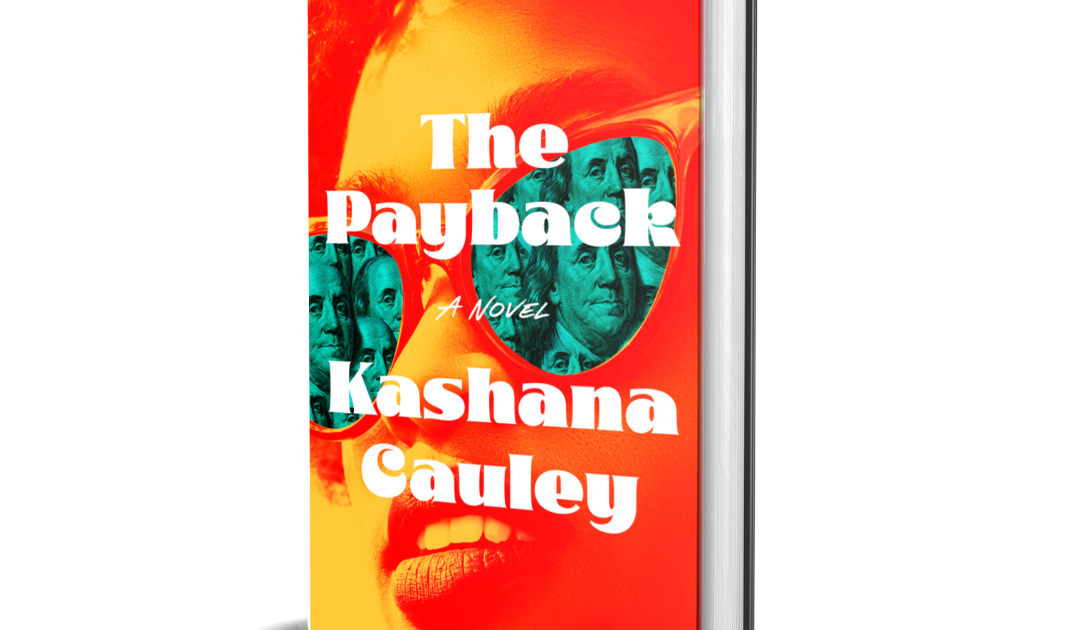
    The Payback

    A Novel

    Kashana Cauley

    ON SALE JULY 15, 2025 FROM ATRIA BOOKS

    _______________________________________________

    In
    the second novel from television writer and author of the “lethally witty” (The
    New York Times Book Review
    ) The Survivalists, a retail worker is
    relentlessly pursued by the Debt Police and forced to take down her student
    loan company with the help of two mall coworkers.
    The
    Payback
    is a razor-sharp and hilarious dissection of
    race and capitalism from one of the most original and exciting writers at work
    today.


    Jada
    Williams is good at judging people by their looks. From across the mall, she
    can tell not only someone’s inseam and pants size, but exactly what style they
    need to transform their life. Too bad she’s no longer using this superpower as
    a wardrobe designer to Hollywood stars, but for minimum wage plus commission at
    the Glendale mall.


    When Jada is fired yet again, she is forced to outrun the newly instated Debt
    Police who are out for blood. But Jada, like any great antihero, is not going
    to wait for the cops to come kick her around. With the help of two other
    debt-burdened mall coworkers, she hatches a plan for revenge. Together the
    three women plan a heist to erase their student loans forever and get back at
    the system that promised them everything and then tried to take it back.

    About
    Kashana Cauley

    Kashana
    Cauley is the author of The Payback and The
    Survivalists
    , which was named a best book of 2023 by the BBC, TodayVogue,
    and more. Cauley is also a television writer, having worked on The
    Great North
    Pod Save America on HBO, and The
    Daily Show with Trevor Noah
    . Her writing has also appeared in The
    New York Times
    The AtlanticEsquireRolling
    Stone
    The New Yorker, and more. Find out more at
    KashanaCauley.com. 


    MORE
    PRAISE FOR THE PAYBACK

    “A
    stylish, blazingly original take on the heist novel, The Payback is both
    a whip-smart critique of contemporary capitalism and a moving character study
    of the workers most often caught in its clutches.”
    —Grace
    D. Li, New York Times bestselling author of Portrait of a Thief

    “A
    novel of great fun and unforgettable fury, The Payback sharply questions
    the punitive systems we live within, the contradiction between social wellbeing
    and individual wellness,
    and what it means to work toward a decent life.”
    —Megha
    Majumdar, bestselling author of A Burning

    “Smart,
    socio-politically astute, and sidesplitting hilarious, The Payback‘s
    inventive wit solidifies Kashana Cauley’s place among our most entertaining
    social critics and novelists.”
    Camille
    Perri, author of The Assistants and When Katie Met Cassidy


    About the Book


    The Payback
    A Novel
    by Kashana Cauley
    on-sale: July 15, 2025
    Atria Books
    ISBN 9781668075531
    Price: $27.99
    eISBN 9781668075555
    Price: $14.99

    Source link

  • ‘Betraying an entire generation of students’? What do Trump University and Matt Goodwin’s excoriating new book tell us about universities today?

    ‘Betraying an entire generation of students’? What do Trump University and Matt Goodwin’s excoriating new book tell us about universities today?

    Browsing in a good bookshop sure beats scouring the internet for things to read. And when I was recently in my local independent bookshop (the Book House in Thame since you ask), I stumbled across a new biography of Donald Trump focusing on his pre-politics business career. Seeing that the book, Lucky Loser: How Donald Trump squandered his father’s fortune and created the illusion of success by Russ Buettner and Susanne Craig, included a section on Trump University, I snapped it up.

    Every leader’s weaknesses are clear before they rise to power if you look in the right places. We knew Gordon Brown’s seriousness could merge into tantrums long before the revelations about throwing phones at staff came to light, and we knew Boris Johnson’s joie de vivre hampered an eye for detail long before he caught the ball ‘from the back of the scrum’ and entered Number 10. If Nigel Farage ever makes it to the top job, as ever more people seem to be predicting, no one will be able to claim his destructive approach to politics was previously hidden.

    Similarly, this new biography of Trump written by two New York Times journalists proves the US President’s weaknesses were evident beneath the bluster throughout his long business career in hotels, casinos and golf courses. If the authors are right, Trump has long been prone to taking big risks on a hunch, to acting litigiously and to seeking credit for things that aren’t his doing. The title suggests he was a Lucky Loser, though perhaps that is just an uncharitable way of saying he was a big winner against the odds.

    As a businessman, the book shows how Trump began lucky, with ‘the equivalent of half a billion dollars from his father’, and ended lucky, with ‘another half billion as a reality television star’. These allowed him to take on huge debts, aided by paying as little tax as possible and reclaiming what tax he had paid whenever he could (as during Obama’s Great Recession recovery programme).

    Trump’s dollars from the TV show ‘The Apprentice’ came not so much from appearance fees as from his right to half the profits from any sponsorship deals and from lending his name to all sorts of businesses attracted by his TV success, from health supplements to early video phones. These enabled him to keep afloat. But there were many lows to Trump’s business career and a number of his big projects declared bankruptcy in the 1990s and 2000s, leading the two authors to conclude, ‘He would have been better off betting on the stock market than on himself.’

    If there’s one person responsible for Trump’s rise to the top, it is Mark Burnett, a British Falklands veteran who is now the United States Special Envoy to the UK. Burnett invented the TV programme ‘Survivor’ before creating an urban equivalent in The Apprentice (and later also creating ‘The Voice’). And if there’s one thing responsible for Trump’s rise it seems to be vanilla-and-mint Crest toothpaste as Proctor & Gamble were the first mass consumer company to do serious sponsorship of The Apprentice. They paid $1.1 million to get the contestants to come up with a new toothpaste, thereby drawing attention to the actual new vanilla-and-mint product sitting on shop shelves.

    Ostensibly, this all has little to do with higher education. But Trump University (also known as Trump U) is one of the most notable of all the current US President’s past projects and one of the ventures undertaken just before he stood for the Presidency for the first time. Trump not only lent his name to the project, he also invested millions of dollars in return for 93% of the business –like Victor Kiam, he liked it so much he bought the company. But the authors of this book conclude the whole thing was a disaster from start to finish.

    Beginning as a way to sell recorded lectures to small and medium-sized businesses, Trump University quickly moved into get-rich-quick in-person seminars. The Trump Elite Gold programme had a fee of $34,995 (about the same as the entire cost of a three-year degree in England or Wales). Prospective learners were told, ‘There are three groups of people … People who make things happen; people who wait for things to happen; and people who wonder, “What happened?”’ If you wanted to be in the first group, you were encouraged to open your wallet or else borrow the necessary fee.

    One failed applicant for The Apprentice, Stephen Gilpin, found himself tapped up to work for Trump U but later wrote an exposé that claimed, ‘the focus for Trump University was purely on separating suckers from their money.’ At the time, Trump said he hand-picked the instructors, but he did no such thing. The whole venture ended up in three major lawsuits, which were settled just as Trump became President for the first time.

    In the end, the story of Trump University confirms a truism: it is vital to protect the use of the term ‘University’ and to police it actively and in real time. The book serves as a reminder that – as Jo Johnson has argued persuasively on the HEPI blog – pausing new awards for University Title means the Office for Students is giving less attention to this area than it should.

    It is ironic that the global leader of right-wing populism should not only have sought to establish his own ‘University’ but that, having done so, it should embody in such exaggerated form all the negatives that populists tend to ascribe to traditional universities: poor value for money; an unoriginal curriculum taught by ill-trained staff; and insufficient personal attention to students. However, if a new book being published today attacking UK and US universities, Bad Education: Why our universities are broken and how we can fix them by Matt Goodwin, is any guide to populism more generally, then the failure of Trump U has not deterred the attacks on places that actually do have the legal right to call themselves a ‘University’.

    Goodwin starts with a chapter called ‘Why I decided to speak out’ though it could just have easily been called ‘The grass is always greener’ or ‘Looking back with rose-tinted spectacles’. The book’s core argument is that:

    the rapid expansion of the university bureaucracy, the sharp shift to the left among university academics and the politicization of the wider system of higher education have left universities in a perilous state.

    As a result, Goodwin argues, ‘our universities are not just letting down but betraying an entire generation of students.’

    He notes that, as the number of EDI (Equality, Diversity, and Inclusion) champions has gone up, some types of diversity, such as diversity in academic thought, have gone down. But Goodwin is a political scientist rather than a historian and the problems he identifies are not as new as he makes out. Far-left students used to disrupt Enoch Powell, Keith Joseph and Leon Brittan when they spoke on campus; now they try and block Helen Joyce, Kathleen Stock and Jo Phoenix. The issue of whether such individuals should be allowed to speak even if some people on campus will be ‘offended’ are the same. The recourse to legislation in response is the same too: the rows of the 1980s led to the Education (No. 2) Act (1986) and the rows of today led to the Higher Education (Freedom of Speech) Act (2023).

    Notably, Goodwin’s views seem to have changed even more over time than the institutions he criticises. Two decades ago, Goodwin was a progressive studying for a PhD under Professor Roger Eatwell, an expert in fascism and populism at the University of Bath, after which he moved to Manchester and Nottingham, where he worked with political scientists like Rob Ford and Philip Cowley, and thereafter to Kent. These days, Goodwin has not only given up his professorship but is found speaking at Reform UK meetings while accepting a job as a GB News presenter.

    And while Goodwin says his book has been 20 years in the making, it reads like it was 20 weeks in the writing. That is not meant to be rude for the piece is pacey, personal and polemical – and all the more readable for that. But while it is based in part on others’ research – including pieces of HEPI output – it generally draws from just one well: the place inhabited by Eric Kaufman, Jonathan Haidt and Niall Ferguson. The dust jacket includes endorsements from Douglas Murray, Claire Fox and Nigel Biggar among others.

    Goodwin’s pamphleteer-style of writing ensures his text has little in common with the meticulous research on recent university history by Mike Shattock or Roger Brown and Helen Carasso or Steve Jones (who will be writing his own review of the book for HEPI in due course). Nonetheless, whisper it quietly but – whether you like his general approach or not, whether you like his new acquaintances or not and whether you like his writing style or not – Matt Goodwin may have something of a point.

    Universities do not always welcome or reflect the full diversity of viewpoints in the way that perhaps they should, given their business is generating and imparting knowledge. It has been said many times before by others, so it is far from original, yet that doesn’t make it false. Goodwin quotes the US economist Thomas Sowell: ‘when you hear university academics talk about diversity, ask them how many conservatives are in their sociology department.’ It seems a fair question.

    But grappling with that is not easy. The best answer, Goodwin argues, is a muscular response. Rather than leaving it to the sector to resolve its own issues, he wants to see hard-nosed interventions from policymakers and regulators:

    only government action and new legislation, or pressure from outside universities, can change the incentive structures on campus. This means adopting a proactive rather than a passive strategy, making it clear that the individual freedom of scholars and students is, ultimately, more important than the freedom or autonomy of the university.

    At the very end, Goodwin even argues someone should ensure ‘all universities be regularly audited for academic freedom and free speech violations’, with fines for any that transgress. Yet that begs more questions than it answers: we don’t know who would do the audit or what the rules for it would be.

    So there is a paradox at the heart of Goodwin’s critique. He ascribes the problems he sees to flaws in the ‘system’ whereby the number of university administrators, institutions’ central bureaucracy and the pay of vice-chancellors have all increased rapidly. But such changes have often reflected:

    1. external influences, such as the increase in the regulation of education (in response to scandals of the Trump U variety);
    2. the need to have flattering statistics (such as to present to the Treasury in the battle for public resources); and
    3. recognition that the old ways of working are not going to root out inappropriate behaviours (for example, sexual harassment).

    Perhaps making universities more accountable to regulators and policymakers will make them bastions of free speech in the way Goodwin hopes, but might it not just clog up the lives of academics even more?

    Reprinted with permission of ANDREWS MCMEEL SYNDICATION. All rights reserved.

    Source link

  • “How Are You Doing Today?” A Survey for Starting Each Class – Faculty Focus

    “How Are You Doing Today?” A Survey for Starting Each Class – Faculty Focus

    Source link

  • High schoolers: Become a voice for tomorrow, today!

    High schoolers: Become a voice for tomorrow, today!

    Free speech is more than just a constitutional right — it’s the cornerstone of democracy and social progress. In today’s divided political climate, defending this right has never been more important. That’s why FIRE’s Free Speech Forum is bringing together passionate young leaders who are ready to become tomorrow’s defenders of free speech.

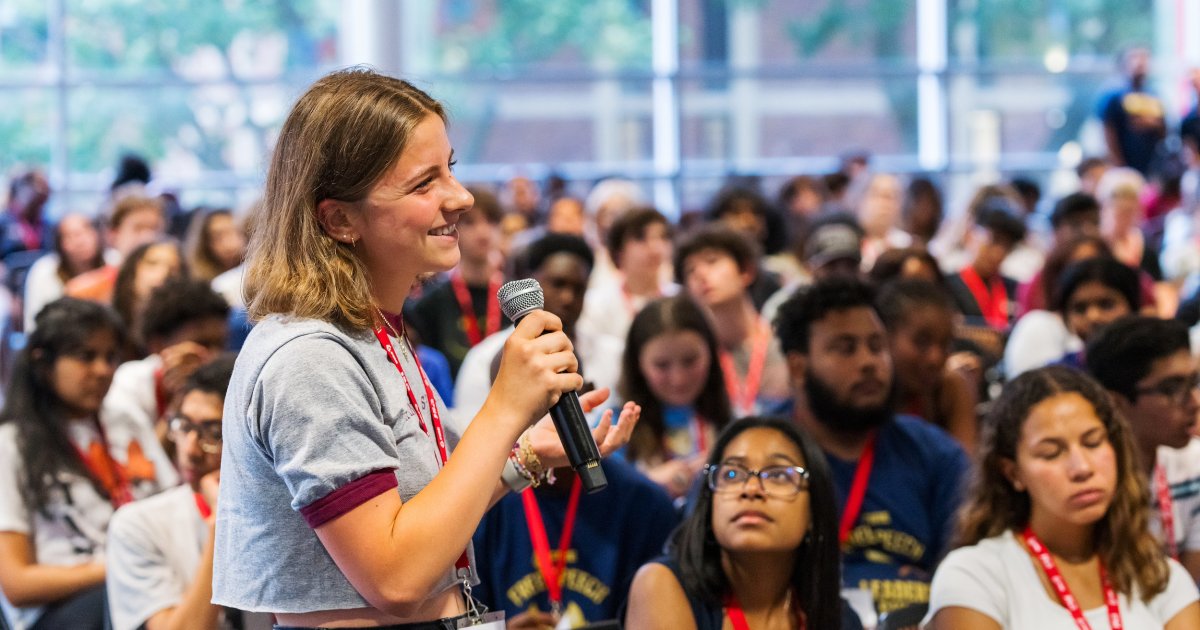
    The Free Speech Forum isn’t just another high school summer camp. It’s an immersive, week-long experience designed for rising 10th through 12th graders who are passionate about free speech and learning about the First Amendment. Held at American University in Washington, D.C. from June 22-28, this unique forum is a launchpad for students eager to learn from experts, connect with like-minded peers, and build the skills needed to advocate for these vital democratic values — on campus and beyond.

    Free Speech Forum

    Page

    FIRE is bringing together the next generation of free speech leaders at American University in Washington D.C. from June 22 to 28.


    Read More

    What to expect:

    • Interactive workshops led by free speech experts
    • Field trips to key sites in Washington, D.C.
    • Skill-building activities to help you better advocate for free speech in your community
    • Networking opportunities with advocates, policymakers, and fellow students

    This is a chance to join 200 student leaders for an unforgettable week of learning and career development, all right in the heart of one of America’s greatest cities.

    Who should apply? The forum is open to college-bound students who:

    • Have a passion for free speech and advocacy
    • Rising 10th to 12th graders at the time of application
    • Are able to attend the entire program

    What does it cost? It’s completely free! FIRE covers registration, housing in the American University dormitories, and meals. Students are responsible for their own travel arrangements to and from Washington, D.C., but FIRE will provide free transportation between Ronald Reagan National Airport or Union Station and the university.

    What if I can’t afford the cost of travel? A limited number of need-based scholarships are available to help with travel expenses to and from Washington, D.C. Students will be notified about the scholarship application process after they are accepted into the program.

    How do I apply? Applications are now open! The application deadline is March 30, 2025. Due to the competitive nature of the program, we recommend applying early.

    This is your chance to dive deep into the First Amendment, explore the history of free speech, learn from the experts, and develop the skills you need to become an advocate for free expression.

    Questions? For more information, email [email protected].

    We can’t wait to see you in D.C. this summer!

    Apply Now

    Source link