The name of an ambition more than it is of a body of knowledge, the term “futurology” is attributed by one source on word origins to Aldous Huxley. The author of Brave New World is a plausible candidate, of course; he is credited with coining it in 1946. But a search of JSTOR turns up an article from three years earlier suggesting that Oswald Spengler’s The Decline of the West made him the pioneer of “what one may hope will sometime develop into a real science of ‘Futurology.’”
The author of that article was a political scientist and émigré from Nazi Germany named Ossip K. Flechtheim, then teaching at the historically Black Atlanta University; the article itself was published in a historically Black scholarly journal, Phylon. He soon decided that his idea’s time had come.
By 1945, writing in The Journal of Higher Education, Flechtheim advocated for futurology both as an emerging line of interdisciplinary scholarship and as a matter of urgent concern to “the present-day student, whose life-span may well stretch into the twenty-first century.” He was optimistic about futurology’s potential to advance knowledge: Maintaining that “a large number of scholars” concurred on “the major problems which humanity would face” in the coming decades, he announced that “predict[ing] the most probable trends is a task which we have the means to accomplish successfully today.”
But as Niels Bohr and/or Yogi Berra famously put it, “It is difficult to make predictions, especially about the future.” Flechtheim went on to publish landmark contributions to the incipient field of study, surely expecting that a proper social science of the future would be established by the turn of the millennium. But on this point, as in most cases, subsequent history only confirms the Bohr-Berra conundrum.
One rough metric of futurology’s public-intellectual salience over time is how often the word appears per year in publications stored in the Google Books database. The resulting graph shows barely any use of the term before about 1960. But with the new decade there is a sudden burst of activity: a period of steep acceleration lasting about two decades, then collapsing dramatically over the final years of the 20th century. The JSTOR search results show much the same pattern.
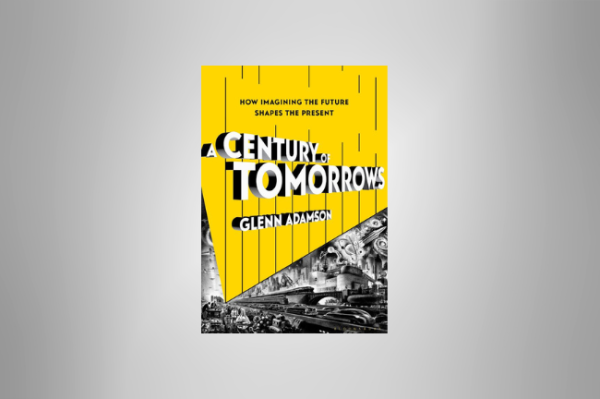
And so it is that Glenn Adamson’s A Century of Tomorrows: How Imagining the Future Shapes the Present (Bloomsbury Publishing) approaches the subject with not so much skepticism about futurology’s prospects as a certain irony about its very status as a distinct kind of knowledge. The author, a curator and a historian, attaches Flechtheim’s neologism as a label to a kaleidoscopic array of efforts to anticipate the shape of things to come, whether by analyzing statistical trends, through artistic creativity or in experimentation with new ways of life. The book concentrates on the United States and the 20th century, but inevitably the larger world and earlier history shape the book, which also reflects some 21st-century pressures as well.
Plenty of science fiction novels have done better at imagining life in subsequent decades than think tank projections made in the same era. But comparing prognostications for relative accuracy is not Adamson’s real concern. Whatever means it may employ, the futurological imperative is always to respond to current reality—to its perceived failings or potentials, to the opportunities and terrors looming over the world or lurking just out of sight. Adamson writes that “every story about the future is also a demand to intervene in the present.” The forms of intervention considered include political movements, religious revivals, market research, scenarios for thermonuclear war, hippie communes, the insurance industry and time capsules assembled for future generations to ponder (to give an abbreviated list).
The future’s uncertainty provides a blank screen for projecting contemporary issues in reimagined form and the opportunity to imagine alternatives. (Or to imagine inevitabilities, whether of the encouraging or despairing kind.)
The author takes futurology to have emerged in the 19th century as a response to concerns previously the domain of religious traditions. Utopia and dystopia provide fairly obvious secular analogues to heaven and hell. But there is more to it than that. “For those who no longer saw the future as a matter of revealed truth,” Adamson writes, “new forms of authority stepped in to fill the gap. This is where the futurologists would come in. They would not only make claims about what lies ahead but also somehow persuade others of their ability to see it.”
The grounds for claiming such authority proliferated, as did the visions themselves, in ways resistant to linear narrative. Instead, the author pulls seemingly unconnected developments together into thematic clusters, rather like museum exhibits displayed in partly chronological and partly thematic order.
For example, the futurological cluster he calls the Machine includes the organization Technocracy, Inc., which in the early 1930s won a hearing for its plan to put the entire economy under the control of engineers who would end the waste, bottlenecks and underperformance that had, they purported, caused the Depression.
Enthusiasm for the Technocracy’s social blueprints was short-lived, but it expressed a wider trend. Futurologists of this ilk “set about creating self-correcting, self-regulating systems; conceptually speaking, they became machine builders.” Under this heading Adamson includes enthusiasts for “the Soviet experiment” (as non-Communist admirers liked to call it), but also the market-minded professionals involved in industrial design, especially for automobiles: “The advance planning of annual model changes was a way to humanize technology, while also setting the horizon of consumer expectation.”
Whereas the Machine-oriented visionaries of the early 20th century had specific goals for the future (and confidence about being able to meet them), a different attitude prevailed after World War II among those Adamson calls the Lab futurologists. The future was for them “something to be studied under laboratory conditions, with multiple scenarios measured and compared against one another.” Some of them had access to the enormous computers of the day, and the attention of people making decisions of the highest consequence.
“Prediction was becoming a much subtler art,” the author continues, “with one defining exception: the prediction of nuclear annihilation, a zero multiplier for all human hopes.”
Those who thought life in a Machine world sounded oppressive offered visions of the future as Garden, where a healthier balance between urban and rural life could prevail. A corresponding horror at Lab scenarios spawned what Adamson calls Party futurology. This started in Haight-Ashbury, fought back at the Stonewall and generated the radical feminist movement that still haunts some people’s nightmares.
Missing from my thumbnail sketch here is all the historical texture of the book (including a diverse group of figures, leading and otherwise) as well as its working out of connections among seemingly unrelated developments.
As mentioned, the book is centered on 20th-century America. Even so, “Flood,” the final chapter (not counting the conclusion), takes up forces that have continued to accumulate in the early millennium. Flood-era futurology is not defined either by climate change or digital hypersaturation of attention. The main element I’ll point out here is Adamson’s sense that futurology’s own future has been compromised by an excess of noise and meretricious pseudo-insight.
The floods of dubious information (from too many sources to evaluate) make it harder to establish reality in the present, much less to extrapolate from it. Filling the void is a churn of simulated thought the author calls Big Ideas. “By this,” he writes, “I mean a general prediction about culture at large that initially feels like an important insight, but is actually either so general as to be beyond dispute, or so vague as to be immune to disproof.” Much better, on the whole, is to study the record of futurology itself, with its history as a warning against secular fortune-telling.
Scott McLemee is Inside Higher Ed’s “Intellectual Affairs” columnist. He was a contributing editor at Lingua Franca magazine and a senior writer at The Chronicle of Higher Education before joining Inside Higher Ed in 2005.