Barbara Trent’s 1992 documentary The Panama Deception remains an essential work for comprehending the nature and impact of U.S. military interventions in Latin America. Winner of the Academy Award for Best Documentary Feature, the film offers a critical examination of the December 1989 U.S. invasion of Panama—Operation Just Cause—and challenges official narratives about that intervention.
Reframing the Official Narrative
The Panama Deception scrutinizes the publicly stated justifications for the 1989 invasion, including protecting U.S. citizens, defending democracy, and combating drug trafficking. In doing so, it highlights stark discrepancies between government claims and on‑the‑ground realities, arguing that the invasion served broader strategic interests rather than solely humanitarian or legal objectives.
The film foregrounds how the U.S. government and mainstream media shaped public perceptions, often downplaying civilian casualties and simplifying complex political dynamics to justify military action. By exposing this media bias, the documentary encourages viewers to question official accounts and consider how information is framed in service of policy goals.
Human Cost and Civilian Impact
A central contribution of the documentary is its focus on the human toll of the invasion. Using firsthand testimonies, footage of destruction, and accounts of displacement, the film documents the suffering of Panamanian civilians—particularly in impoverished neighborhoods such as El Chorrillo—which received limited attention in U.S. media coverage.
These portrayals deepen our understanding of how military interventions affect everyday lives beyond abstract geopolitical objectives. For students and scholars of international relations, human rights, and media studies, this emphasis provides a critical counterpoint to sanitized official histories.
Historical and Geopolitical Context
The Panama Deception situates the Panama invasion within a longer history of U.S. influence in the region. It suggests that long‑standing strategic interests—including control over the Panama Canal and hemispheric dominance—shaped U.S. policy long before the invasion’s official rationales were publicly articulated.
While the Torrijos‑Carter Treaties mandated transfer of canal control to Panama by 1999, the film and many independent observers argue that U.S. policymakers were intent on maintaining influence and minimizing threats to American strategic goals.
Media Critique and Public Perception
One of the documentary’s most enduring contributions lies in its examination of media complicity. The Panama Deception demonstrates how mainstream outlets often uncritically echoed government talking points, marginalizing dissenting voices from Panamanian civilians, independent journalists, and human rights advocates.
This critique remains relevant for students exploring how propaganda, framing, and selective reporting can influence public support for foreign policy decisions. The film thus serves as a case study for media literacy alongside political critique.
Conclusion: Educational and Analytical Value
The Panama Deception offers a multifaceted analysis of U.S. interventionism that transcends a single historical event. By combining archival evidence, eyewitness accounts, and critical commentary, it provides learners with a structured means to examine the intersections of power, narrative, and human consequence. For educators and researchers in Latin American studies, political science, and media studies, the film underscores the importance of questioning official narratives and exploring the lived effects of foreign policy decisions.
Selected Sources
The Panama Deception (1992 documentary overview and details).
Analysis of the film’s critique of U.S. media and government narratives.
Historical context on media bias and human impact.
Wider context on the invasion and implications related to Panama Canal treaty issues.
Students can complete faculty-made case study prompts with a generative AI model called STRATPATH.
Nicole Coomber has taught consulting and experiential learning courses at the University of Maryland’s Smith School of Business for years, assigning graduate students take-home case studies that mimic consulting interviews.
But, like many professors in the ChatGPT era, Coomber has found that the assignments no longer challenge her classes, because students simply enter questions into large language models and submit whatever the generative AI model spits out.
“I was discovering that students could pretty much take my assignment, plug it into AI and get a perfect answer without having to go through some of the struggle that we know is part of learning,” she said.
Case studies are a critical part of the interview process for many business students, so ensuring they engage with the exercises and don’t circumvent critical thinking is important to Coomber. But rather than create a new low-tech assignment, Coomber partnered with a group of master’s-level students to make an AI tool to act as a case interviewer.
The result is STRATPATH, a generative AI tool that delivers faculty-created case studies to assess and provide real-time feedback to business students. The tool both connects students’ learning to real-world scenarios and provides career-readiness skills, prepping students for interviews after graduation.
How it works: STRATPATH was developed by six recent UMD business school graduates: Deep Dalsaniya, Anna Huertazuela, Aditya Kamath, Aromal Nair, Krishang Parakh and Venkatesh Shirbhate. The team first assembled to participate in a case competition for M.B.A. students in 2024 and then returned to the university after graduation to launch STRATPATH, using funds allocated by the dean.
“It was a bit of, ‘Hey, these are really talented students, the job market is really hard, they could use a soft landing to keep up with their job search,’” Coomber said. “It’s turned into something much more; we’ve built something that’s really incredible.”
Students can chat with STRATPATH or respond with audio to the faculty-developed case study.
To set up the tool, professors provide the case-study story they want the student to answer, a rubric or feedback form, and some examples of ideal answers, Dalsaniya said. Based on the input, STRATPATH facilitates prompts via audio or text, engaging the student in a conversation.
“Students are getting prepared for thinking spontaneously and building their critical thinking abilities over all,” Dalsaniya said.
STRATPATH relies on a large language model with additional boundaries set by developers to reduce the odds that the AI hallucinates, accepts incorrect information or provides overly complimentary feedback. It also investigates student responses to ensure that they aren’t cheating using outside sources.
“It doesn’t say, ‘Deep, you’re so smart, that’s right!’” Coomber explained. “It’s like, ‘How did you get there?’ So even if the students are typing into ChatGPT, then putting that answer into our platform, our platform will go, ‘How did you get there?’”
The platform also doesn’t allow for copying and pasting responses, so if a student is sidebarring with ChatGPT while responding to STRATPATH, they have to at least transcribe responses (and at a reasonably human words-per-minute rate), which will hopefully produce learning in some capacity, Dalsaniya said.
“Our main focus is whether their critical thinking abilities are increasing or not, and it does even if they are cheating,” he said.
The impact: STRATPATH provides instant grading and real-time personalized feedback, saving faculty time and helping students adjust faster.
It used to take Coomber hours to go over student assignments, which could hinder learning due to the long lag time between assignment and feedback. Now she can spend more time conducting face-to-face learning or holding office hours.
Anecdotal feedback from students so far indicates they feel better prepared to tackle interviews, and they’ve appreciated the assessments from the tool, which identifies both where they’re excelling and areas where they could improve.
What’s next: Coomber and her team are looking to identify other campus stakeholders who might have a use case for STRATPATH. One option is to work alongside the career center to deliver behavioral interview prompts. Many interviewers require applicants to use the STAR method—situation, task, action and result—to respond to questions and use it to assess talent, and STRATPATH could be one forum for students to practice these questions.
Dalsaniya and the development team are also investigating ways to feed STRATPATH additional resources from faculty to provide a richer evaluation of student responses to case studies.
“Case-based learning has no right answer—all answers can be right,” Dalsaniya said. “What we are trying to focus on is how we can integrate all the class materials of the professor, including their slides, their video lectures, within the feedback so that the student can see the feedback and reference those slide numbers or chapters or video transcripts.”
The team is also looking for additional funding sources to scale and possibly license the tool for outside groups.
Educators tap two tech firms to create NYC Childcare Navigator, a free platform that cuts through the chaos.
A one-stop shop
Frustrated by the maze of agencies, websites, and applications families face to find childcare and possible financial support, New York City teachers said, “Enough!”
The United Federation of Teachers, the union that represents more than 200,000 educators and professionals in New York City, teamed up with two tech firms to build a better approach: NYC Childcare Navigator.
Navigator is a platform that connects New York City families to upwards of 12,000 childcare options across the five boroughs. It offers instant eligibility checks for money-saving programs, step-by-step application support, and the most comprehensive directory of childcare providers in the city — all in one free, easy-to-use website.
The union created the tool as a benefit for its own members, but it was so successful that the union opened it up to all New York City residents in October.
“We couldn’t gatekeep something that we knew so many New York City families needed,” said Michael Mulgrew, president of the United Federation of Teachers.
Centralizing tailored childcare
The union partnered with Mirza, a city-based tech firm that builds platforms to connect low-wage workers with local, state, and federal benefits, including for childcare.
“We wanted to get meaningful benefits to parents, but there wasn’t a single place that would allow a parent to see all the options available. That felt like a big missing piece. But it also pointed toward a solution,” said Siran Cao, CEO and Co-Founder of Mirza, who said she was inspired by how her own mother navigated a new country and the impact that a few well-timed bits of financial support had on her own family.
The union then introduced Upfront, a software company that consolidates multiple sources of childcare providers into a single, centralized database. The result: parents using the NYC Childcare Navigator can see every licensed program in NYC (center, home, and school-based), searchable by zip code, child’s age, availability, languages spoken, special needs, and many other filters. For the first time, childcare providers can claim a dedicated page to share current information about their specific childcare services.
“It’s everything in a single location instead of having to make dozens of calls and scour multiple, incomplete websites,” said Levin-Robinson, who said she was motivated by how challenging it was to find care for her own children.
By now, it’s obvious that the Trump administration’s efforts to expand Immigration and Customs Enforcement activities go far beyond enforcing federal immigration policy. The near-daily stories of inhumane detainment conditions, open violence against citizens and noncitizens alike, wanton civil rights violations, and purposeful shielding of these abuses from any form of public accountability lay bare that President Trump is now using ICE as a key component for advancing his administration’s hateful agenda.
This context is essential to evaluate why the administration has sung such a different tune with the advertised $60,000 student loan forgiveness offers to new ICE recruits, compared to the normal song and dance about how higher education is evil incarnate. Trump and his political allies didn’t suddenly discover the societal benefits of affordable education, as evidenced by his simultaneous efforts to strip loan forgiveness pathways from those who are deemed obstructors to Trump’s political goals. What’s clear is that federal student loan forgiveness is now a poverty draft, coercing increased ICE and military enlistment from among those experiencing economic desperation.
Weaponizing educational debt to fuel armed forces conscription from lower-income individuals is essentially socioeconomic hostage taking. It deprives people of their agency in choosing whether conscription is truly the career and life pathway they desire by forcing the decision as a survival tactic, especially when nearly half the country is approaching an economic recession deliberately caused by Trump’s policies.
A History of Weaponizing College Affordability
The easiest way for an authoritarian regime to maintain a highly militarized state is to make enlistment the only means of socioeconomic survival for the masses. This is exactly why the Trump administration is promoting student loan forgiveness for ICE recruits while curtailing eligibility for Public Service Loan Forgiveness. By passing the reconciliation bill that nearly tripled ICE’s budget while restricting Pell Grant eligibility for some students and cutting back basic needs programs like food stamps and Medicaid, congressional leaders have identified themselves as active participants in this strategy.
Though Trump’s tactics are an unprecedentedly naked attempt to weaponize student loan relief in the service of authoritarianism, this is a foundational concept in federal higher education policy that he’s taking the opportunity to exploit. The Servicemen’s Readjustment Act of 1944, the first federal educational assistance program for veterans, and most follow-up educational assistance programs were more focused on rewarding military service in already-declared conflicts than using benefits as a recruitment draw.
That shift came with the larger 1960s push to align higher education with the Cold War. California’s Master Plan of 1960 provided an opening for later attacks on college affordability, because it codified into public policy the idea that some types of institutions were worth attending more than others, mainly by segregating various types of educational experiences offered by different institutions. Later in the decade, then–California governor Ronald Reagan slashed public university budgets, in this way punishing students for antiwar protests. Reagan’s camouflaging of draconian education funding cuts as a necessary tool to combat the “filthy speech movement” became the groundwork for today’s deep inequality across all levels of the educational system.
Over the next several decades, federal and state policymakers abandoned their responsibilities to fund public higher education, which has strengthened the ties between college (un)affordability and militarization. In 2022, 20 Republican House members—14 of whom are still in office—wrote a joint letter to then-president Biden expressing concern that his efforts to provide widespread student loan forgiveness would harm the ability of the military to use higher educational benefits as a recruitment tool.
Last fall, 48 percent of 16- to 21-year-olds surveyed by the Department of Defense identified “to pay for future education” as a main reason they would consider joining the armed forces. This was the second-most common reason expressed in the survey, behind only “pay/money.”
Student Loan Forgiveness Is Not Siloed Public Policy
Public policy is rarely siloed into neat categories, and we are now experiencing the widespread consequences of allowing an inequitable and unaffordable higher education system to exist for so long in the United States. Trump isn’t the only federal policymaker endorsing this strategy, but he is the primary beneficiary. The more people willing to join ICE’s march toward martial law or forced to join ICE due to socioeconomic necessity, the easier it is for Trump to fully embrace authoritarianism and stay in power past January 2029.
This is the framing that should be used in every policy conversation about student loan forgiveness moving forward, not just for the offers given to new ICE recruits. These actions are not distinct or separate from the administration’s federalizing of the National Guard, ICE’s vast increase in weapons spending or Trump’s public consideration of invoking the Insurrection Act to deploy more troops to U.S. cities; they’re a vital complement. Ransoming access to an affordable higher education, along with its associated socioeconomic benefits, based on how willing someone is to inflict terror on immigrant communities or any other population that the administration deems undesirable, is a deliberate tactic to build an authoritarian military state.
Ideally, the current scenario facing higher education will end the usual hemming and hawing from policymakers about universal student loan forgiveness or tuition-free higher education being too expensive. Are the cost savings from not offering widespread forgiveness truly worth militarizing the country against the estimated 51.9 million immigrants living in the U.S., including more than 1.9 million immigrant and undocumented higher education students? Is appeasing Trump’s desire to play dictator dress-up so vital that policymakers feel compelled to willingly eradicate recent progress in national college affordability, discourage or outright bar international students from coming to learn in the United States, and shrink the economies of every state and congressional district due to the loss of international students?
State Legislatures Are the Last Line of Defense
The Trump administration is desperate to expand domestic militarization through ICE, as evidenced by advertisements on popular media streaming services and during nationally televised football games, public commitments to keep paying ICE agents as roughly 1.4 million federal workers go without pay during the government shutdown and the elimination or loosening of recruitment and training requirements for new ICE agents in relation to their age, physical fitness and ability to speak Spanish. As the Trump administration through ICE utilizes every available tool to further its authoritarian agenda, policymakers and institutions must use every available tool to combat said authoritarianism.
State legislatures wield vast amounts of legal authority over education policy in comparison to the federal government. However, that authority is useless if states capitulate or are otherwise unwilling to use that authority to protect their education systems and their larger communities.
Efforts like Connecticut’s new statewide student debt forgiveness program, California’s prohibition on campus police departments providing personal student information for immigration enforcement purposes and Colorado’s adoption of a new state law requiring public campuses to limit federal agents’ access to campus buildings are all welcome ways that state policymakers can fight back against ICE.
These efforts must be expanded to more states as ICE continues to ramp up its domestic terrorism and congressional leadership remains content to abandon its constitutional responsibilities to hold the executive branch in check. For institutions, advocates and concerned community members, resources available through the Presidents’ Alliance on Higher Education and Immigration and its Higher Ed Immigration Portal, and from the Immigrant Legal Resource Center, provide essential guidance on how to act in protecting immigrants and their families.
Student loan forgiveness, and the larger concept of an affordable and equitable higher education, could now be a matter of life and death for millions of people. The traditional willingness of policymakers to resist supporting higher education during times of economic surplus, while eagerly cutting educational funding at the first sign of economic distress, has now imperiled American democracy. Every image of ICE committing authoritarian violence is a stark call for policymakers to ask themselves what they value more: the fiscal savings of making no meaningful effort to address the more than $1.6 trillion owed in student debt, or American democracy itself.
Christian Collins is a policy analyst with the education, labor and worker justice team at the Center for Law and Social Policy, a nonprofit organization focused on reducing poverty and advancing racial equity.
Landscape, a College Board tool for providing colleges with information about the educational environment of an applicant’s high school and neighborhood based on publicly available information, has been discontinued, the organization announced this week.
“As federal and state policy continues to evolve around how institutions use demographic and geographic information in admissions, we are making a change to ensure our work continues to effectively serve students and institutions,” College Board wrote in the short announcement.
Geographic recruitment has come under fire from the Trump administration. Attorney General Pamela Bondi, in a memo declaring various diversity, equity and inclusion initiatives unconstitutional, said that recruiting from specific areas or neighborhoods could be unlawful when it’s being done as a proxy for race. Experts have said that doing so is not a standard practice for universities.
Jon Boeckenstedt, a longtime enrollment manager, criticized the decision to discontinue Landscape in a post on LinkedIn.
“I’m no fan of College Board of course … but I thought Landscape was a good and thoughtful product,” he wrote. “Now, it’s going away. You don’t have to be Wile E. Coyote to figure out why. Someone in DC has suggested it’s too close to ‘race based admissions’ (a thing that does not exist) and ‘it’d be a shame if something happened to your company.’ Or their lawyers rolled over voluntarily.”
Edward Blum, the founder of Students for Fair Admissions, the group that successfully challenged affirmative action at the Supreme Court, lauded the decision.
“Since the 2023 Supreme Court opinion in our Harvard and UNC cases, Students for Fair Admissions raised has concerns that Landscape was little more than a disguised proxy for race in the admissions process. We are gratified that this problematic tool will no longer be used to influence who is and who is not admitted to America’s colleges and universities,” he wrote in a statement. “This decision represents another important step toward ensuring that all students are treated as individuals, not as representatives of a racial or ethnic group.”
Phillip Levine, an economics professor at Wellesley College, has been studying college financial aid and students’ higher ed spending habits for more than a decade. When his children first started applying to college about 15 years ago, he was amazed by how difficult it was to get a clear answer on how much it was really going to cost them—and he was a trained economist.
Imagine, he thought, how the average family felt reading through interminable webpages and offer letters explaining the detailed price breakdowns, differences in tuition and fees, added expected costs, and loans versus grants. Then he tried to imagine how parents who’d never gone to college might feel.
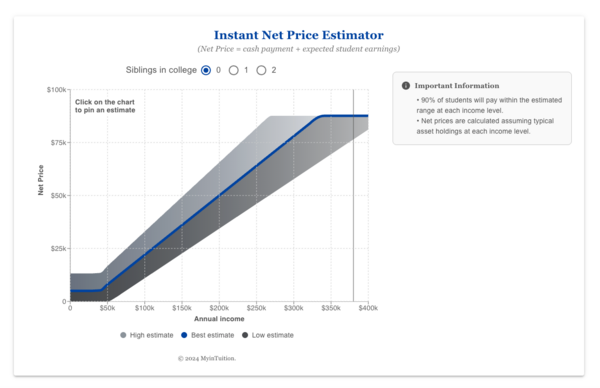
Since then, Levine has worked on a number of college cost transparency initiatives. His most recent project is the Instant Net Price Estimator, a streamlined digital tool that he hopes will make it easier for colleges to break through the noise and deliver a clear estimate to families.
As public skepticism about the value of a postsecondary degree grows and $100,000 sticker prices make front-page news, colleges are in the market for a simple way to let families know that their degrees can be affordable. Washington University in St. Louis became the first institution to adopt the tool and served as a kind of pilot program this application cycle. Interest from colleges has grown swiftly: This fall, an additional 19 institutions will introduce Levine’s calculator on their websites, and he anticipates that number will triple next academic year.
Levine spoke with Inside Higher Ed about his new tool, how low-income students get stuck in the financial aid “funnel” and how colleges can be better communicators in a time of widespread public distrust of higher ed. The conversation has been edited for length and clarity.
Q: Walk me through the genesis of this idea. What were you hoping to achieve?
A: I don’t think it’s a state secret that college pricing is complicated. If you go to any college website and look at the financial aid webpage, there’s tons of stuff there trying to explain how much they charge, but they overshoot it in terms of what people are looking for. You’re taking a high school kid and their family and giving them a Ph.D.-level course in financial aid. Not surprisingly, they don’t usually get it.
I think about the admissions process like a funnel: You give me a little information, I’ll give you a basic answer that’s pretty imprecise. You give me more information, I’ll give you a better answer that’s a little more precise. You can keep going down the process until eventually, you know, ultimately you fill out the FAFSA or the CSS Profile.
To maximize access, that funnel needs to have a very wide mouth at the top; in financial aid language, what that means is you need to communicate extremely quickly to as wide an audience as possible that college is not $100,000. It doesn’t even matter exactly what it is. But if you can’t get people off of the ledge at the $100,000 number—the mainstream media puts out stories all the time that college costs a million dollars a year, so their perception is that it’s extremely expensive. All you want them to do at the beginning stages is to be like, “Hey, maybe this is something I can afford.” Then you need to lead them through the rest of the funnel.
Phillip Levine
Ultimately, the financial aid process really is complicated because we have this concept of what a family can afford to pay, and there’s no right answer to that question, but we have all these complicated formulas that are trying to find it anyway. Over time, colleges have been trying to do a better job of getting past that point, just not very successfully. What I’ve been working on for the last 10 or 15 years is to make an easier entry point, and this tool is even higher up the funnel than what I’ve been working on in the past.
It takes three seconds to get a sense of what college is going to cost you, and in particular to get you over that hurdle that it’s probably not $100,000. My goal is within a matter of literally a few seconds to give people a sense that college is very unlikely to be as expensive as they fear. And then you can start having a more substantive conversation. Otherwise, you close the door on the poor kids, way before they’re into the process.
Q: Colleges have been trying to do this kind of thing on their own for a while. What makes your tool an improvement on institutional efforts?
A: Colleges understand that this is a problem. But to be quite honest, the only people who actually understand the way the financial aid system works are the people in the financial aid office, and they don’t speak English, so to speak. It’s an unbelievably complicated process, very complex, and now they have to explain it to a regular person, and they can’t do that. It’s not their fault; they try, they’re just not successful. There’s a handful of people in the admissions office who understand it, too, but not many. And once you get past those two audiences, nobody else at the college understands it, including the public affairs people.
I got started on this because when my kids were looking at colleges, I just wanted to know whether I was eligible for any financial aid, yeah. And I realized how unbelievably hard it was to figure it out. Back then [around 2010] it was actually impossible to figure out. Things have evolved a lot since then.
Q: Like you said, there are other tools out there now. What makes this one different?
A: I’m just trying to push it to the next stage of development. I’m an economist; I can speak geek as well as anyone. But as I started doing this, I’m learning more and more about how you sell a product, which is basically what you’re doing with college cost. I’m realizing how little time you have to communicate a message.
I’m in a weird position, because I’m doing the research on the pricing issues, and I’m developing the tools. It was in one of the Brookings [Institution] papers I wrote when these ideas were just kind of coming together and we were thinking about how you do the graphics. And it just kind of came together that we can visually display this information in a simulator, what I really refer to as a simple game. So I thought, if I can do it for a Brookings paper, why can’t I do this for a school or a family? And about that time, Washington University [in St. Louis] came to me looking for assistance on some other issues, and I pitched this to them, and they bought into it. So they paid for the development, and it’s been up and running there since December. If you go to most schools’ webpages, including my own, there’s stuff there, but you gotta read forever. And you know as well as I do that nobody reads that much anymore.
That’s what I’m trying to accomplish with this: just get the ball rolling with something that speaks to where students are.
A demo version of Levine’s Instant Net Price Estimator, which can be customized to fit colleges’ specific needs and profiles.
Screenshot from myintuition.org
Q: I assume the calculator doesn’t factor in things like merit aid?
A: You want it as simple as possible. So you just slide your input and it essentially just tells you what the average cost is going to be for you based on income, and tells you the range, which may be very broad. At Washington University, they don’t give a lot of merit aid, so, like, it would not be a big deal there, but at schools that do a lot of merit aid, that range could also include merit. They can factor that into the calculator.
But mainly, you just want the light bulb to go off of, “Oh, maybe I can afford this.” And then maybe they’re willing to go spend some time reading instead of getting scared off right from the start. Their initial instinct is, there’s no way I can afford to go to Washington University. And it’s the school’s job in terms of marketing to communicate to people. The problem, in my mind, is that the door is closed so early for so many people that you need to be able to just let them get through that first door in the process. There’s still a lot of hurdles you have to get through after that, yeah, but if you don’t make it through the first one, you don’t even approach any of the others.
Q: There’s been legislation introduced at the federal level and passed in many states to mandate that colleges take certain steps toward cost transparency. Do you think there’s a good understanding of what that takes among policymakers?
A: Clearly, policymakers have figured out that transparency is an issue, and they’re right. But their intentions are often better than their proposals. The net price calculator law [a federal law mandating institutions include a price calculator on their websites by 2011], for instance, was very well intended. But it’s easy to see the big picture problem; to then come up with a solution that actually works, you have to have a little bit more inside baseball. The net price calculator law is a perfect example. It was so well intended, they completely had the right idea, and they blew it. I obviously don’t know all of the details of all the different state laws, but I’ve seen proposals, and generally I look at them and go, right idea, wrong solution.
Q: Have there been any good policy solutions?
A:The College Cost Transparency Initiative. It’s much better if the schools can fix this problem on their own, because they know what they’re doing. It’s a tiny step, and you have to already apply and get accepted before you get your letter. And then it tells you, in a more clear way than it used to. It’s lower on the funnel, really at the bottom. But it’s a good step.
[Levine later clarified that he sat on the technical advisory committee for the CCTI.]
Q: Has there been a lot of interest in your instant price calculator from other colleges? And what kinds of colleges seem to be most invested in these transparency efforts?
A: Nineteen more colleges will roll it out in the fall. It’s a small range right now, from relatively wealthy to very wealthy. I think at the very high end of higher ed, the Ivies and such, where they have a lot of money to spend on financial aid, they’re trying to increase access in a very direct way. It is good for them to enroll more lower-income students from a public relations perspective. And I think every school wants to do the right thing. But as you stray from the very top of the spectrum, there’s also an interest in simply increasing enrollment, where they don’t want to be turning away students because they think they can’t afford it when they can. They’re just looking for more students, especially because there’s fewer kids. So the ability to open the door to as many kids as possible at this moment has appeal.
Unibuddy, a higher education peer-to-peer engagement platform, has officially launched Assistant – an AI tool designed to support large-scale, authentic student-led conversations.
Following a successful beta phase, the tool is now fully live with 30 institutions worldwide and delivering impressive results: tripling student engagement, cutting staff workload significantly, and maintaining over 95% accuracy.
As universities face increasing pressure from tighter budgets and rising student expectations, Unibuddy said its Assistant tool offers a powerful solution to scale meaningful engagement efficiently, combining the speed of AI with the authenticity of real student voices.
65,000 unique students have used Assistant
100,000+ student questions answered automatically without requiring manual intervention
125% increase in students having conversations
60% increase in lead capture
five hours saved per day for university staff
“Today’s students demand instant, authentic and trustworthy communication,” said Diego Fanara, CEO at Unibuddy. “Unibuddy Assistant is the first and only solution that fuses the speed of AI with the credibility of peer-to-peer guidance – giving institutions a scalable way to meet expectations without sacrificing quality or trust.”
Unibuddy has partnered with more than 600 institutions globally and has supported over 3,000,000 prospective students through the platform. As part of this extensive network, it regularly conducts surveys to uncover fresh insights. Although chatbots are now common in higher education, survey findings highlight key limitations in their effectiveness:
84%of students said that university responses were too slow (Unibuddy Survey, 2025)
79%of students said it was important that universities balance AI automation (for speed) and human interaction (for depth) while supporting them as they navigate the decision-making process (Unibuddy Survey, 2025)
51%ofstudents say they wouldn’t trust a chatbot to answer questions about the student experience (Unibuddy Survey, 2024)
78% say talking to a current student is helpful — making them 3.5x more likely to trust a peer than a bot (Unibuddy Survey, 2025)
Only 14% of students felt engaged by the universities they applied to (Unibuddy Survey, 2025)
Unibuddy says these finding have shaped its offering: using AI to handle routine questions and highlight valuable information, while smoothly handing off to peer or staff conversations when a personal, human connection is needed.
Buckinghamshire New Universityused Unibuddy Assistant to transform early-stage engagement – generating 800,000 impressions, 30,000 clickthroughs, and 10,000+ student conversationsin just six months. The university saved over 2,000 staff hoursand saw 3,000 referrals to students or staff.
Today’s students demand instant, authentic and trustworthy communication Diego Fanara, Unibuddy
Meanwhile the University of South Florida Muma College of Business reported over 30 staff hours saved per month, with a 59% click-to-conversation rate and over a third of chats in Assistant resulting in referrals to student ambassador conversations.
And the University of East Anglia deployed Assistant across more than 100 web pages, as part of the full Unibuddy product suites deployment of peer-to-peer chat, with student-led content contributing to a 62% offer-to-student conversion rate compared with 34% of those who didn’t engage with Unibuddy.
Gathering and assessing the quality of information is one of the most effective ways to develop media literacy, critical thinking and effective communication skills. But without guidance, too many young people fail to question the reliability of visual images and overly rely on the first results they find on Google.
That’s why News Decoder has been working with the Swedish nonprofit, Voice4You, on a project called ProMS to create a self-guided digital tool that guides students in writing news stories.
The tool, called Mobile Stories, is now available across Europe. It takes students step-by-step through the journalistic process. Along the way, they gain critical thinking skills and a deeper understanding about the information they find, consume and share.
It empowers students to develop multimedia stories that incorporate original reporting for school, community or global audiences, with minimal input from educators. It comes with open-access learning resources developed by News Decoder.
After a decade of success in Sweden, Voice4You partnered with News Decoder to help make the tool available across Europe and the globe. Throughout the ProMS project, new English language content suitable for high schoolers was developed and piloted in 21 schools in Romania, Ireland and Finland. The Mobile Stories platform has demonstrated remarkable potential in building student confidence and media and information literacy by providing a platform and an opportunity to produce quality journalism.
From story pitch to publication
Using the new international version of Mobile Stories, students have already published 136 articles on mobilestories.com, with another 700 currently in production. Their topics range from book reviews and reporting from local cultural events to in-depth feature articles on the decline in young people’s mental health and child labor in the fast fashion industry.
“The tool looks like a blogging platform and on every step along the way of creating an article, students can access learning materials including video tutorials by professional journalists from around the world, articles and worksheets,” said News Decoder’s ProMS Project Manager Sabīne Bērziņa.
Some of these resources, such as videos and worksheets are open access, available to all.
The Education Reporting Collaborative, a coalition of eight newsrooms, is investigating the unintended consequences of AI-powered surveillance at schools. Members of the Collaborative are AL.com, The Associated Press, The Christian Science Monitor, The Dallas Morning News, The Hechinger Report, Idaho Education News, The Post and Courier in South Carolina, and The Seattle Times.
RIGBY, Idaho — Four years ago, a sixth grader in Rigby, Idaho, shot and injured two peers and a custodian at a middle school. The tragedy prompted school officials to reimagine what threat prevention looks like in the approximately 6,500-student district.
Now, student-run Hope Squads in Rigby schools uplift peers with homemade cards and assemblies. Volunteer fathers patrol hallways as part of Dads on Duty. A team of district staff, counselors, social workers and probation officers gathers to discuss and support struggling students. Thanks to a new cellphone ban, students are off screens and talking to each other. The positive results of these combined efforts have been measurable.
“We’ve helped change … lives,”said Brianna Vasquez, a senior at Rigby Highand member of her school’s Hope Squad. “I’ve had friends who have been pulled out of the hole of depression and suicidal thoughts because of [the Hope Squad].”
School shootings like Rigby’s have driven America’s educatorstotry to prevent similar harm. Many districts in the U.S. have turned to technology — especially digital surveillance — as the antidote. Not everyone is sold on that approach, as there can be issues, including with privacy and security.Without broad agreement on which strategies do work best, some districts are trying a braided approach — using a combination of technology, on-the-ground threat assessment teams, and other mental health supports.
“If you’re sitting in the shoes of a district leader, taking a multi-pronged approach is probably very sensible,” said Jennifer DePaoli, a senior researcher at the Learning Policy Institute, who has studied school safety.
In Rigby, educators lean toward human interaction. Artificial intelligence and digital surveillance systems are perhapsless likely to identify who is eating alone at lunch or withdrawing from friends.
“It’s all about culture,” said Chad Martin, the superintendent of Jefferson County School District in Rigby. “It starts with that — just having a friend, having a group of friends, having a connection somewhere.”
Rigby school leaders use technology to detect threats, including an app, STOPit, which allows students to anonymously report safety concerns, and surveillance software that monitors students’ keystrokes and looks out for troubling terms. Martin said those are helpful, but must be used in concert with human-led initiatives.
The district’s version of a threat assessment team, which meets monthly, has been one of the most useful tools, Martin said. In those group conversations, school staff may realize that a student who’s been missing class has a parent who was recently arrested, for example.
“Everybody has a little piece of information,” Martin said. “So the goal is to put those people in the same room and be able to paint a picture that can help us support kids.”
Chad Martin, superintendent of Jefferson County School District, said student relationships remain the most powerful tool in keeping school safe. Credit: John Roark
A leading model,used by thousands of school districts, is the Comprehensive School Threat Assessment Guidelines (CSTAG). These were developed by forensic clinical psychologist Dewey Cornell after he spent years studying homicides committed by children or teens, including school shootings. He said digital surveillance technology can offer school districts “an illusion of safety and security.”
With CSTAG, school-based teams use a five-step process when threats emerge. The team includes a school administrator, a counselor or psychologist, a social worker, a staff member focused on special education, and a school resource officer. In serious situations, the group might suspend or move a student elsewhere while conducting mental health screenings,a law enforcement investigation, and development of a safety plan. Ultimately, that plan would be put into effect.
If implemented correctly, Cornell says, this type of approach is less punitive and more rooted in intervention. Instead of relying only on technology, Cornell and his threat assessment guidelines recommend adding humans who can make decisions with schools as situations emerge. He points to a recent study in Florida, one of the states where threat assessment teams are mandatory. Threats investigated by those teams “resulted in low rates of school removal and very low rates of law enforcement actions,” according to the report authored by Cornell and fellow University of Virginia researchers.
“If you’re a school counselor and you can work with a troubled kid and help get them on the right track, you’re not just preventing a school shooting, but you’re more likely to be preventing a shooting that would occur somewhere else and maybe years in the future,” he said.
Threat assessment teams — whether using the CSTAG model or another form — haven’t been immune from scrutiny. Complaints have emerged about them operating without student or parent knowledge, or without staff members to represent children with special needs. Criticism has also included concern about discrimination against Black and Hispanic students.
DePaoli, from the Learning Policy Institute, says more research is needed to determine whether they successfully identify threats and provide students with appropriate support. She suspects it boils down to implementation.
“If you are being required to do these, you need to be doing them with so much training and so much support,” she said.
The Jordan School District in Utah uses the CSTAG model. Travis Hamblin, director of student services, credits the “human connection” with strengthening the district’s approach to handling threats and, as a result, boosting student safety and well-being.
Earlier this school year, the district received an alert through Bark, a digital monitoring tool that scans students’ school-issued Google suite accounts. It flagged a middle schooler’s account, which contained a hand drawn picture of a gun that had been uploaded.
The notification mobilized the school’s threat assessment team. By using the CSTAG decision-making process, the team determined the student did not intend any harm, Hamblin says.
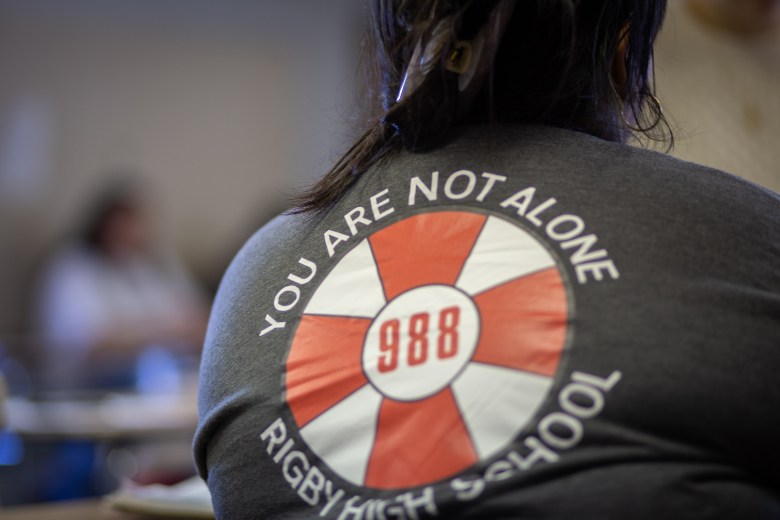
Rigby High’s Hope Squad — and those like it nationwide — aim to foster connection and reduce the risk of suicide. Credit: John Roark
The school leaders didn’t unnecessarily escalate the situation, he says. After their assessment, they chalked it up to middle school immaturity and asked the student to avoid such drawings in the future.
“When you say, ‘Why did you do that?’ And they say, ‘I don’t know.’ That’s the truth, right? That’s the gospel truth,” Hamblin said.
He shares this example to illustrate how the district marries technology-related monitoring with human-led threat assessment. The district employs someone — a former school administrator and counselor — to field the Bark alerts and communicate with school staff. And administrators from every school in the district have undergone threat assessment training, along with select members of their staff.
“A digital tool for us is a tool. It’s not the solution,” Hamblin said. “We believe that people are the solution.”
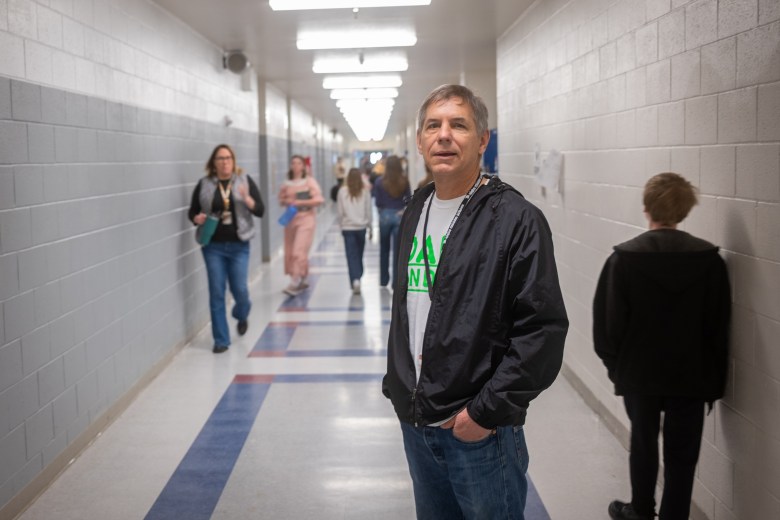
In Rigby, one of those solution people is Ernie Chavez, whose height makes him stick out in a hallway streaming with middle schoolers. He’s part of Dads on Duty, a program that brings in parents to help monitor and interact with students during passing periods and lunch.
Throughout the school, students reach out to Chavez for high-fives. On one February afternoon, he was greeted with applause and cheers. “I don’t know what that was about,” he said with a smile.
Similarly, the district’s Hope Squads, in place since 2021, have become an active presence inside the school.
The student-led coalitions aim to foster connection and reduce the risk of suicide. Thousands of schools across the United States and in Canada have implemented Hope Squads, but in Rigby, the mission of violence prevention has become personal.
Ernie Chavez monitors the hallways at Rigby Middle School on Feb. 5 for the Dads on Duty program. Credit: John Roark
“We refer … students every year to counselors, and those students go from some of the worst moments in their life (to getting help),” Vasquez said. “We build the connection between adults and faculty to the student.”
Members of the Hope Squad notice peers who seem down or isolated and reach out with a greeting, or sometimes a handmade card.
“We just reach out and let them know that people in the community are there for them, just to show them that we care and they’re not alone,” said Dallas Waldron, a Rigby High senior and Hope Squad member.
The groups also plan assemblies and special events, including, for example, a week of activities themed around mental health awareness.
Emilie Raymond, a sophomore at Rigby High, said the shooting made it clear “that people need to feel included and they need to find that hope.”
Another change at Rigby schools is a cell phone ban that was put in place this school year.
Before the ban,students were “sitting in the corners, isolated, staring at a screen,” said Ryan Erikson, Principal at Rigby Middle School. Now, “they’re playing games, they’re goofing off … they’re actually conversing.”
While Jefferson County School District’s approach to stemming violence is robust, “it’s not perfect,” Martin, the superintendent, said. “It’s still life. That’s just the reality of it, we’re still going to have things come up that we haven’t prepared for or weren’t on our radar. But we address them and just try to do whatever we can to support kids.”
Carly Flandro is a reporter with Idaho Education News. Jackie Valley is a reporter with The Christian Science Monitor.
Contact Hechinger managing editor Caroline Preston at 212-870-8965, on Signal at CarolineP.83 or via email at [email protected].
This story about school threat assessments was produced by the Education Reporting Collaborative, a coalition of eight newsrooms that includes AL.com, The Associated Press, The Christian Science Monitor, The Dallas Morning News, The Hechinger Report, Idaho Education News, The Post and Courier in South Carolina, and The Seattle Times.
The Hechinger Report provides in-depth, fact-based, unbiased reporting on education that is free to all readers. But that doesn’t mean it’s free to produce. Our work keeps educators and the public informed about pressing issues at schools and on campuses throughout the country. We tell the whole story, even when the details are inconvenient. Help us keep doing that.